Atlanta: Secure E-Waste Recycling for Businesses

When your Atlanta business upgrades its technology, you’re left with a pile of old equipment that has to go somewhere. Here’s a hard truth: tossing old servers, workstations, or medical devices into a standard recycling bin isn't just a logistical mistake—it’s a massive compliance risk and a potential data security nightmare.
For any organization that handles sensitive information, specialized IT Asset Disposition (ITAD) isn't just a good idea. It's non-negotiable.
Why Your Business Needs a Specialized Electronics Recycling Partner
For many Atlanta companies, "recycling" probably brings to mind the blue bins used for paper and plastic. While those city programs are great for residential waste, they are completely unequipped to handle the complex demands of commercial e-waste.
Business electronics aren’t just bulky; they're packed with sensitive data and contain hazardous materials that require careful, certified handling. A single disposal error can have devastating consequences.
Imagine a healthcare system retiring 500 workstations. Each one likely holds protected health information (PHI). One wrong move in that disposal chain could trigger severe HIPAA violations, leading to fines that can cripple an organization and permanently damage its reputation. This is where the line between general recycling and specialized ITAD becomes crystal clear.
Commercial E-Waste Needs Versus Municipal Recycling
City services are designed for households, not for the high-stakes world of corporate IT and data security. The gap between what they offer and what a business truly needs is significant.
| Feature | Municipal Recycling (Atlanta) | Specialized ITAD Service (ACR) |
|---|---|---|
| Data Security | No data destruction services offered. | Certified data wiping and physical shredding. |
| Compliance | No documentation provided for auditors. | Certificates of Data Destruction and Recycling. |
| Logistics | Curbside pickup for residential items only. | On-site de-installation and secure pickup. |
| Accepted Items | Limited to household goods (cans, paper). | All IT assets, including servers, PCs, and medical tech. |
| Chain of Custody | None. Assets are co-mingled immediately. | Secure, documented chain of custody from A to Z. |
Simply put, relying on municipal services for business electronics is a recipe for a compliance disaster.
The Limits of Municipal Recycling for Commercial Needs
Atlanta's city-wide recycling efforts are making a real difference for household waste. The program collected nearly 20,000 tons of recyclables and doubled its diversion rate to 23%, which is fantastic for residents. But its focus is squarely on materials like cardboard, glass, and plastic.
Meanwhile, IT managers at hospitals, schools, and data centers are dealing with a completely different challenge. Their e-waste requires HIPAA-compliant data destruction—a highly specialized service far outside the scope of any city collection program. The core issue is that municipal services aren’t built for the security, compliance, or logistical needs of a business. They offer zero guarantees for data destruction, provide no chain of custody paperwork, and can't handle the sheer volume of enterprise-grade IT equipment.
What a Specialized ITAD Partner Provides
This is where a true ITAD partner comes in. We focus exclusively on the entire lifecycle of your business technology, moving way beyond simple disposal. The process is built around three pillars: data security, environmental compliance, and value recovery.
When you're looking to atlanta recycle electronics, a dedicated partner provides a process built around your specific operational and legal needs.
Here’s what you get with a professional that standard recycling will never offer:
- Certified Data Destruction: We provide documented processes like DoD 5220.22-M 3-pass wiping and physical shredding to ensure all sensitive data is permanently eradicated.
- Compliance Documentation: You receive official Certificates of Data Destruction and Recycling. This is your legal proof of due diligence for any audit under regulations like HIPAA, FACTA, or SOX.
- Environmental Responsibility: A certified partner ensures hazardous materials like lead and mercury are managed safely. We also recover valuable commodities, supporting a circular economy.
- Logistical Management: From on-site de-installation and secure transportation to detailed inventory tracking, every step is handled by professionals with minimal disruption to your team.
Choosing a specialized ITAD provider isn't an expense; it's an investment in risk mitigation. It protects your company’s data, reputation, and bottom line from the severe penalties associated with improper e-waste handling.
Ultimately, working with a professional electronic waste recycling company transforms a complex compliance headache into a secure, managed, and defensible process. It ensures that when your technology reaches its end, your business remains completely protected.
Preparing Your IT Assets for Secure Disposal
Before any equipment ever leaves your facility, the real work begins. Proper preparation of your assets for recycling is the most important step in the entire process. This is where you take control, mitigate risk, and set the stage for a smooth, secure, and compliant project.
Think of it this way: good preparation is the difference between a potential data breach and a defensible, documented disposal process. For any Atlanta business, this is your chance to build a clear chain of custody before the truck even arrives.
Start with a Detailed IT Asset Inventory
First, you need to know exactly what you have. A detailed inventory isn't just busywork; it's the master document for tracking every single device from your server room to its final destruction or recycling. A simple count of PCs and monitors won't suffice for regulatory compliance.
For real accountability, your inventory needs to capture the essentials for each asset:
- Asset Type: Is it a laptop, desktop, server, switch, or firewall? Be specific.
- Manufacturer and Model: Think "Dell Latitude 7490" or "HPE ProLiant DL380 Gen10."
- Serial Number: This is the non-negotiable part. It's the only way to track an individual asset.
- Data Status: Make a note if the device holds sensitive data that needs certified destruction.
An accurate, serialized inventory is your primary tool for establishing a chain of custody. Without it, you have no way to prove that the specific hard drive from your CFO's old laptop was the one that was properly destroyed. It’s your proof.
Selecting the Right Data Destruction Method
Once you know which devices are holding sensitive information, the next big decision is how you're going to destroy it permanently. The method you choose depends entirely on your company's security needs, compliance rules (like HIPAA or PCI), and what kind of hardware you're dealing with.
A law firm in Buckhead managing a move has a much different risk profile than a small creative agency in Midtown. For the law firm, documented, physical proof of destruction for every single drive is an absolute must.
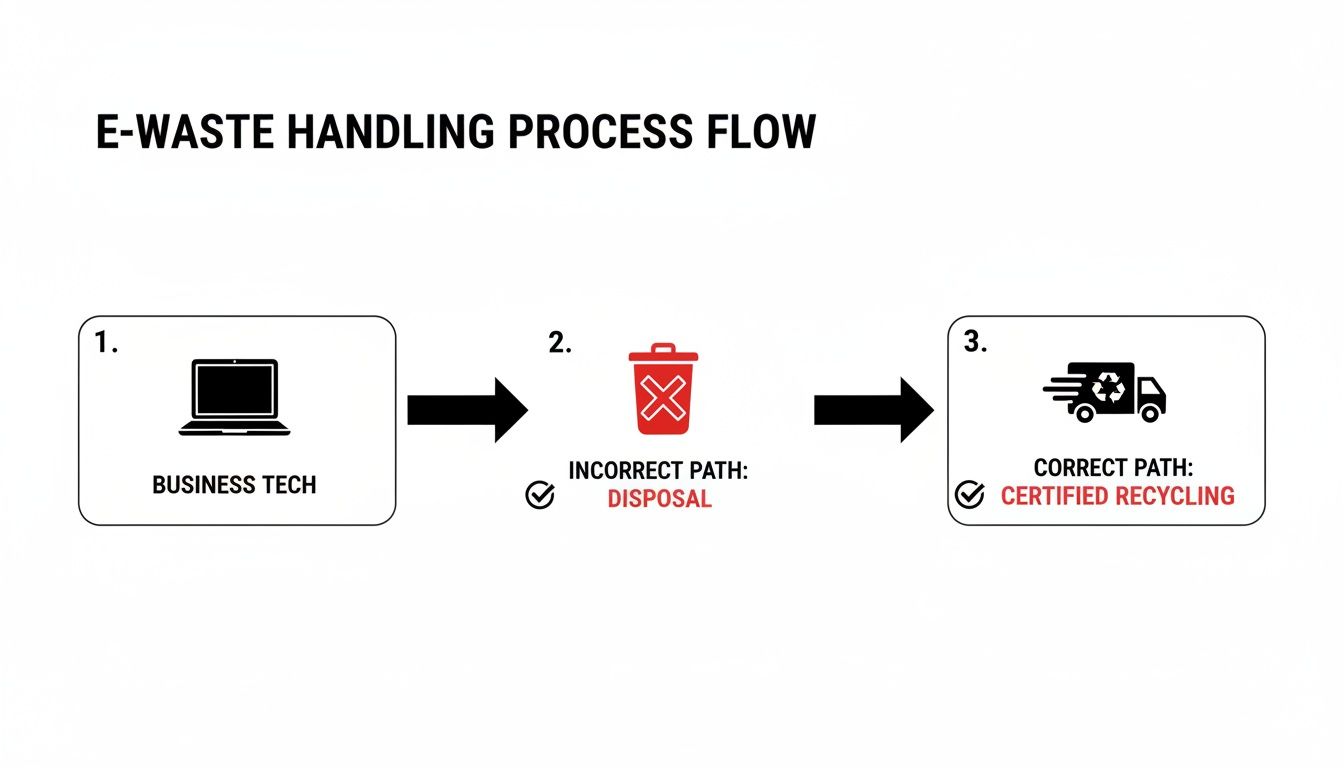
This is the critical decision point for any business getting rid of old tech. Tossing it out is a dead end that leads to massive risk. Partnering with a certified recycler is the only path to a secure and compliant outcome.
Software Wiping vs. Physical Destruction
When it comes to data, you have two main routes: wiping it with software or physically destroying the drive.
Software-based wiping uses specialized programs to overwrite every sector of a hard drive with random data, making the original information unrecoverable. The industry benchmark is the DoD 5220.22-M 3-pass wipe, a process that overwrites the data three separate times. This is a great option for newer, working hard drives that still have value and can be refurbished. We cover this in more detail in our guide on how to erase hard drives.
Physical destruction means exactly what it sounds like—rendering the storage media completely unusable. The two common methods are:
- Degaussing: Using incredibly powerful magnets to instantly scramble the magnetic fields on a hard drive, wiping out all data in a second.
- Shredding: This is the gold standard. Industrial shredders physically grind hard drives, SSDs, and backup tapes into tiny, mangled pieces.
Physical shredding offers the ultimate peace of mind and is often required for devices that held highly sensitive or classified data. It's also the only choice for damaged or dead drives that can't be powered on for a software wipe.
To make the decision clearer, here’s a quick breakdown of your options.
Choosing Your Data Destruction Method
| Method | How It Works | Security Level | Best For |
|---|---|---|---|
| DoD 3-Pass Wipe | Software overwrites the drive with random data three times. | High | Functional, newer HDDs and SSDs that can be reused or resold. |
| Degaussing | An intense magnetic field instantly erases all data on a magnetic drive. | Very High | HDDs and magnetic tapes that need quick, secure destruction. Not for SSDs. |
| Shredding | The physical grinding of drives into small, unrecognizable fragments. | Maximum | End-of-life drives, damaged media, SSDs, and highly sensitive data. |
Ultimately, choosing the right method comes down to balancing your security requirements, budget, and sustainability goals.
Don't Overlook Asset Recovery Opportunities
As you're sorting through everything, keep an eye out for equipment that might still have some value. While data security is always the top priority, asset recovery can help offset the cost of your recycling project. Functional laptops, servers, or networking gear might be perfect for refurbishment and resale.
You might also have other valuable supplies sitting around. For example, many businesses find they have a surplus of printer supplies and can explore options for selling unused toner cartridges through dedicated platforms. Taking a moment to sort these items out can put real money back into your budget.
Proper preparation means accounting for every asset, securing every byte of data, and making smart financial decisions along the way.
Managing On-Site Logistics from Pickup to De-Installation
You’ve inventoried your assets and planned the data destruction. Now for the logistics: getting all that old equipment out of your building. This is where most IT asset disposal projects hit a snag. The physical act of removing outdated gear can quickly turn into an operational nightmare if it’s not handled by professionals.
When you partner with a service that knows how to atlanta recycle electronics, that entire headache disappears. We handle the on-site process for you, minimizing disruption and maintaining a secure chain of custody from your server room all the way to our truck.
It all starts with clear communication. We’ll coordinate with your facilities manager or IT team to nail down every detail. We’ll determine a pickup time that avoids your busiest hours and understand any building access rules, like loading dock availability or freight elevator restrictions. The entire point is to make the removal process seamless and efficient.
From Simple Pickups to Complex De-Installations
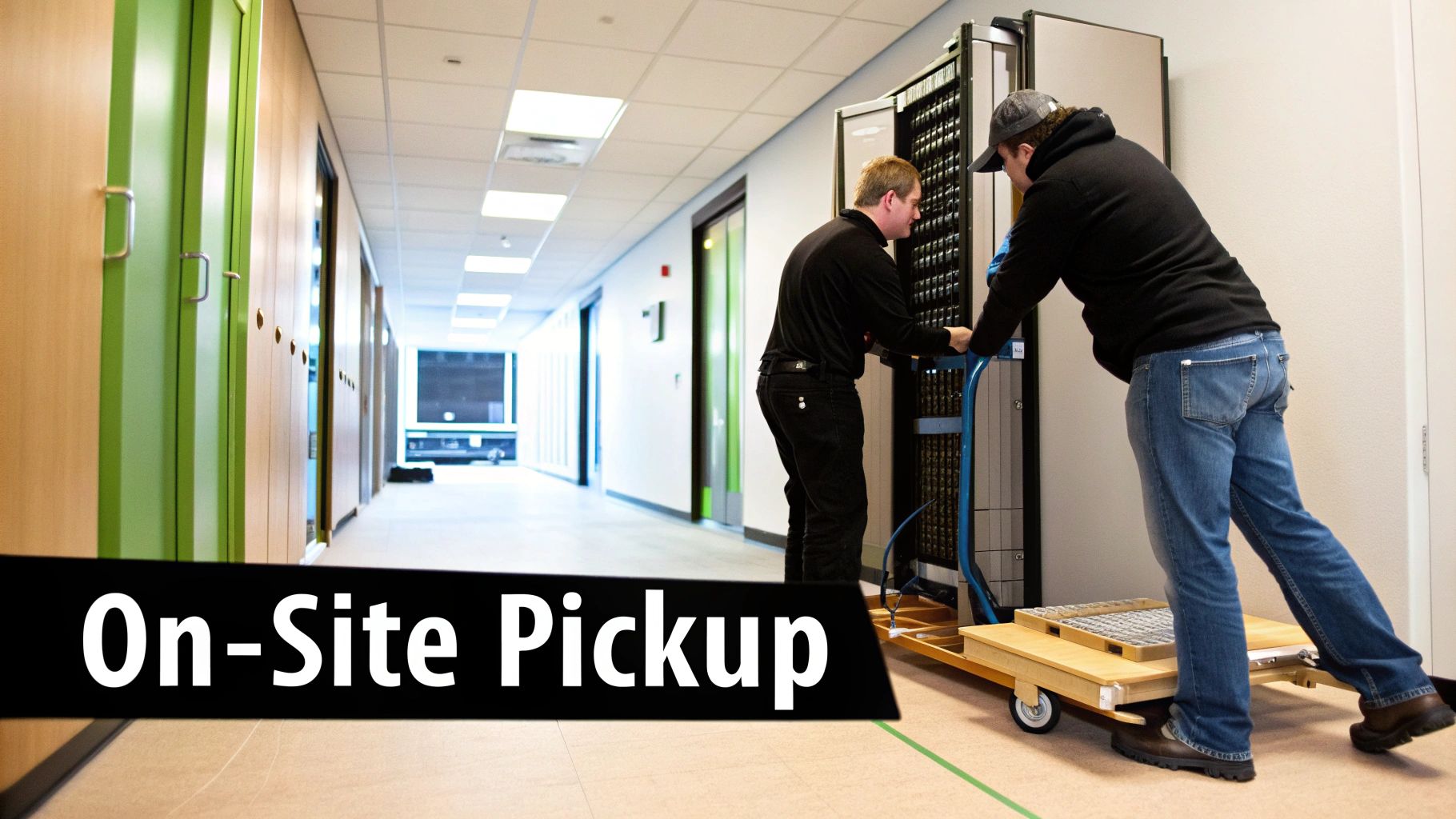
No two projects are the same. A capable partner must adapt to your facility's specific needs. Sometimes, it’s as simple as rolling out a few pallets of desktops you’ve already staged. Other times, it’s a full-blown operation involving the careful de-installation of hundreds of pieces of equipment spread across multiple floors.
Let’s look at a real-world scenario we see all the time. An Atlanta company in a downtown high-rise needs to decommission 300 workstations on three different floors. The building has a single freight elevator with a strict two-hour usage window in the afternoon.
Here’s how a professional team tackles that challenge:
- We arrive with the right-sized crew and all the equipment—dollies, carts, and pallet jacks.
- Our technicians methodically and safely disconnect everything at each workstation: monitors, PCs, and peripherals.
- We consolidate and shrink-wrap the assets onto pallets right there in your office space to keep everything secure for transport.
- The loaded pallets are staged efficiently to make the most of that limited elevator time, ensuring we’re out before your company incurs building overtime fees.
This level of coordination means your IT staff isn't pulled away from their core duties to haul heavy equipment. What could have been a disruptive, multi-day internal project becomes a quiet, professional removal that’s over in just a few hours. For many Atlanta businesses, simply scheduling an electronic recycling free pick up is the most efficient first step.
The mark of a great logistics partner isn't just showing up on time. It's the ability to operate quietly and efficiently inside your active work environment, making the entire removal process almost invisible to your employees.
Handling Specialized Projects Like Data Center Decommissioning
Then there are the projects that demand a much higher level of technical skill and precision—especially data center decommissioning. This is miles beyond removing old office PCs. It’s a delicate operation involving disconnecting live environments, managing extremely heavy and sensitive equipment, and ensuring every single asset is accounted for.
On a typical data center job, our specialized team manages the entire workflow on-site. This includes:
- Systematic Disconnection: We expertly power down and unplug servers, switches, and storage arrays from both network and power sources.
- De-Racking: Individual servers and other hardware are carefully removed from their rack enclosures.
- Secure Palletizing: The de-racked equipment is packed onto pallets, often with anti-static materials, and securely shrink-wrapped for transport.
- Inventory Verification: Before a single item leaves your building, we cross-reference the serial numbers of the removed equipment against your master inventory list.
This detailed, hands-on approach guarantees that your most valuable and data-sensitive equipment is handled with the care it requires. It gives you confidence that your critical assets are managed securely and professionally from the moment they're powered down. Whether it’s a single server rack or an entire data hall, the right partner brings the technical expertise to get the job done right.
Understanding Your Compliance and Documentation Trail
Once your IT assets are packed up and on their way, the process moves into what is arguably the most critical phase for your business's legal and financial protection: the documentation.
For any organization handling sensitive information, the physical removal of old equipment is just the beginning. The paperwork you get back is the only tangible proof you have that you fulfilled your due diligence and protected your client, patient, or company data. This documentation trail isn't just a receipt—it's your official record that will stand up to the toughest audit scrutiny.
Why Certificates Are Non-Negotiable
In the world of IT asset disposition (ITAD), a couple of key documents form the backbone of your compliance strategy. They might sound similar, but they serve very different—and equally vital—purposes.
-
Certificate of Recycling: This confirms your electronics were processed in an environmentally responsible way, following all local and federal regulations. It breaks down the types and weights of materials diverted from landfills.
-
Certificate of Data Destruction: This is the most important document for data security. It certifies that every data-bearing device was either sanitized or physically destroyed according to specific, verifiable standards. It’s your ironclad proof that sensitive information is gone for good.
For a hospital system here in Atlanta, this paperwork is absolutely essential for proving HIPAA compliance. For a financial firm, it’s what satisfies regulators for FACTA and SOX. It’s the final, crucial step that closes the loop on your asset management lifecycle.
What to Look for on Your Certificate of Destruction
Here’s a hard truth: not all certificates are created equal. A legitimate, audit-proof Certificate of Data Destruction needs to have specific, granular details that create an unbroken chain of custody right back to your original inventory list.
When you get this document, you need to check for a few key things:
- Unique Serial Numbers: The certificate must list the individual serial numbers of every single hard drive or data-bearing device destroyed. This is the only way to tie the certificate back to a specific piece of equipment from your office.
- Method of Destruction: It needs to clearly state how the data was destroyed. Was it a DoD 5220.22-M 3-pass wipe? Was it physical shredding? This detail is non-negotiable for auditors.
- Date and Location of Destruction: The document must specify exactly when and where the destruction happened, locking in the timeline.
- Signature of an Authorized Representative: A formal sign-off from your recycling partner makes the document official.
A vague certificate that just says "100 hard drives destroyed" is a massive red flag. Real compliance requires serialized, detailed, and verifiable proof. Your documentation should be a mirror image of the inventory you created before the pickup.
To navigate the complexities of environmental and data protection laws, it's crucial to partner with providers holding relevant industry certifications. This ensures they follow established best practices for both recycling and data security. You can explore a detailed breakdown of what goes into a compliant document by reading more about the Certificate of Destruction and its role in protecting your business.
Ultimately, this paper trail is your shield. It protects your business from liability, reinforces your commitment to corporate social responsibility, and gives you the peace of mind that comes from knowing your retired assets were handled correctly from start to finish.
The Journey of Your Recycled Electronics After Pickup
Once our truck pulls away from your facility loaded with your company's old IT assets, you might be wondering, "So, what happens now?" The journey from your office to its final destination is a lot more involved than a simple trip to a processing plant. For a certified partner managing commercial electronics recycling in Atlanta, this next phase is a precise, multi-stage process designed to protect your data, maximize value, and ensure every single component is handled responsibly.
The moment your equipment arrives at our secure facility, it’s checked in against the detailed inventory list created during the pickup. This critical step maintains a strict chain of custody, ensuring every asset—from a single server to an entire pallet of laptops—is accounted for. Nothing gets lost in the shuffle.
From there, the sorting process begins. This isn't just about separating monitors from keyboards. Our trained technicians triage the equipment based on its age, condition, and potential for a second life.
The Hierarchy of Reuse, Recover, and Recycle
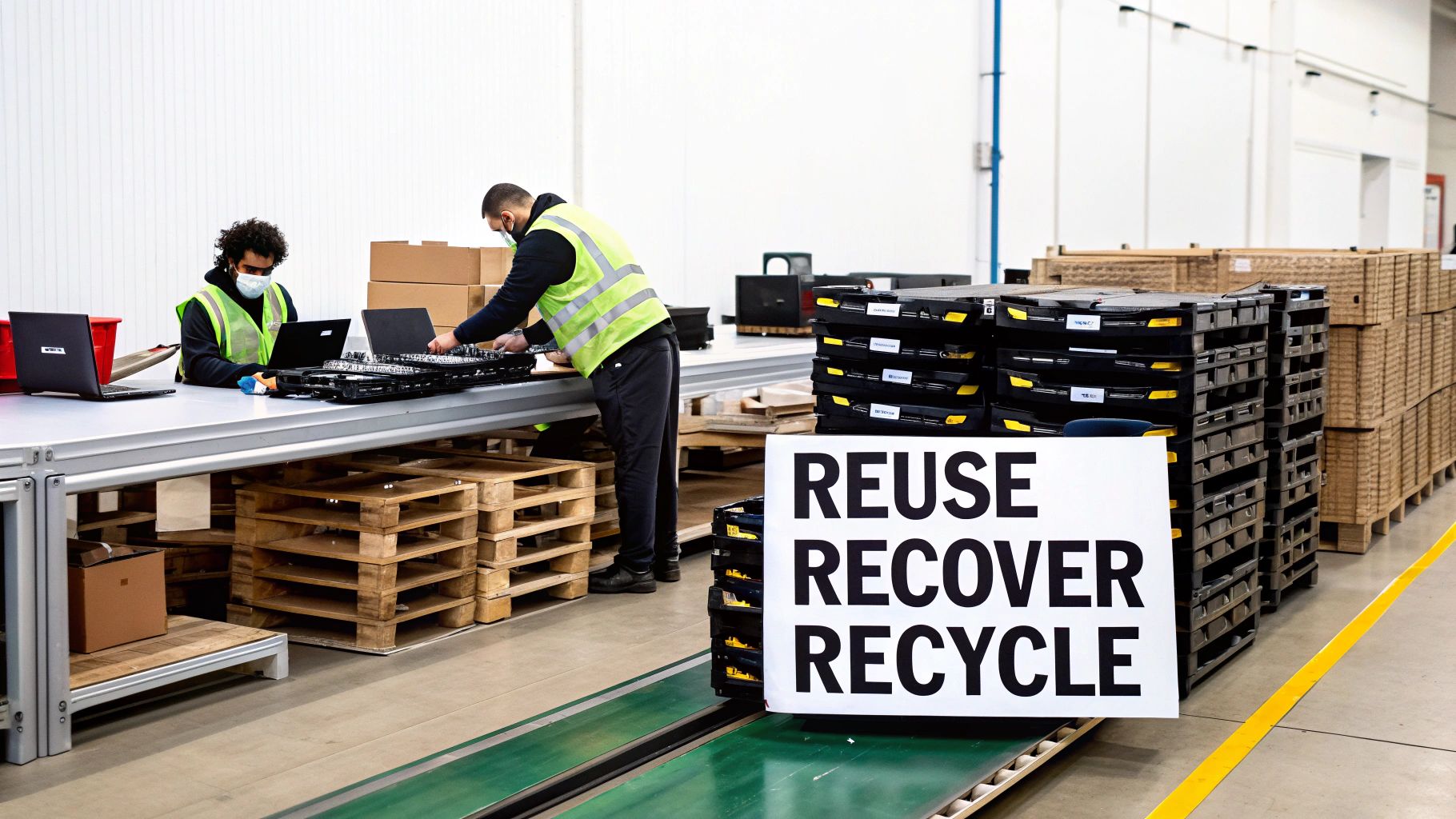
The guiding principle of responsible IT asset disposition (ITAD) is a clear hierarchy: reuse first, then recover valuable materials, and finally, recycle what’s left. This approach pulls the most value from your old equipment while dramatically minimizing its environmental footprint.
- Reuse and Refurbishment: Functional devices that still have life in them are flagged for refurbishment. A batch of corporate laptops, for instance, might undergo testing, secure data wiping, and minor repairs to be remarketed for secondary use. This extends the asset's lifecycle, which is by far the most sustainable outcome.
- Material Recovery: For equipment that's too old or damaged for reuse, the focus shifts to recovering valuable components. This involves carefully dismantling devices to harvest parts like RAM, CPUs, and power supplies that can be tested and resold.
- Commodity Recycling: Anything that can't be reused or harvested for parts is broken down into its base materials. This is where the true recycling happens, turning old circuit boards and metal casings back into raw commodities that can be used to make new products.
The goal is always to keep electronics in their most valuable form for as long as possible. A working laptop is far more valuable and environmentally friendly than the handful of plastic and metal it would become if immediately shredded.
From E-Waste to Raw Materials
For non-functional electronics, the de-manufacturing process is a highly controlled operation. Technicians manually dismantle devices to separate the different material streams. Plastics go one way, steel chassis go another, and circuit boards are set aside for specialized processing.
Circuit boards are particularly valuable, containing trace amounts of precious metals like gold, silver, copper, and palladium. These are sent to certified smelters who use advanced, environmentally sound methods to extract and refine these metals, allowing them to re-enter the global supply chain. This directly reduces the need for new mining—an incredibly energy-intensive and damaging practice. You can dive deeper into what happens to recycled electronics in our detailed guide.
Managing Hazardous Materials Safely
A critical, non-negotiable part of the process is the safe management of hazardous materials. Older CRT monitors, for example, contain significant amounts of lead, while circuit boards and batteries can contain mercury and cadmium. A certified recycler is equipped to handle these substances according to strict EPA guidelines.
- Lead-lined Glass (CRTs): Sent to specialized facilities that can safely separate the lead from the glass.
- Mercury-containing Components: Items like the fluorescent backlights in old LCD screens are carefully removed and sent to certified mercury recyclers.
- Batteries: All types of batteries, especially lithium-ion, are separated and processed by partners who specialize in battery chemistry recycling.
This careful handling ensures these toxins never leach into our soil or groundwater, protecting Georgia's environment. Globally, electronic waste is projected to exceed 74 million metric tons by 2025, yet only about 22.3% is formally recycled. For businesses in states like Georgia without mandatory e-waste laws, partnering with a certified recycler is the only way to prevent your old equipment from ending up in a landfill or being illegally exported.
Got Questions? We've Got Answers.
Even the most buttoned-up IT asset retirement plan sparks a few questions. That's completely normal. Below, we've tackled some of the most common ones we hear from businesses across the Atlanta area.
What Does Business Electronics Recycling Cost?
This is usually the first question on everyone's mind, and the answer really comes down to your inventory. For most of our corporate clients getting rid of modern equipment—think laptops, servers, and networking gear less than five years old—the service is often completely free.
How? The value we recover from refurbishing and reselling those assets is enough to cover all the logistics, labor, and data destruction costs.
On the other hand, charges might come into play for older, bulkier items that have no resale value and are costly to process. We’re talking about things like:
- CRT Monitors: That old, heavy glass contains lead and needs special handling.
- Large batches of printers or copiers: These are mostly plastic and low-grade metals, making them labor-intensive to break down.
- Piles of miscellaneous peripherals: Your keyboards, mice, and tangled cables have very little commodity value.
No matter what, we provide a clear, transparent quote right from the start. You'll know exactly what to expect with no surprises.
As a quick rule of thumb: if your equipment can be given a second life, the recycling process will likely be free or very low-cost. A true ITAD partner's first goal should always be to maximize asset value.
Can My Employees Bring in Their Home Electronics?
While our services are exclusively designed for business-to-business projects, we encourage responsible recycling for everyone. We don't offer residential pickup services directly, but we can point individuals toward our trusted local partners who run public e-waste drop-off events.
These community drives are a fantastic way for residents to safely get rid of their old devices. For example, organizations like Zoo Atlanta often team up with certified recyclers for community-wide events.
How Can I Be Sure My Data is Actually Gone?
This is the most critical question, and it's one we take very seriously. We provide absolute proof through a documented, multi-step process. First, we offer certified data wiping that meets the DoD 5220.22-M 3-pass standard, which overwrites every sector of a drive, making the data completely unrecoverable.
For drives that are too old, non-functional, or held top-secret information, physical shredding is the answer. Either way, you get a serialized Certificate of Data Destruction. This isn't just a generic piece of paper—it's an official, auditable document that lists every single hard drive by its unique serial number and confirms the destruction method used. It's your proof of compliance.
Ready to clear out your old IT assets with a partner you can trust? The team at Atlanta Computer Recycling is here to manage the entire process, from on-site pickup to certified data destruction. Contact us today for a free project assessment.