The Business Guide to Hard Drive Shredding


When it comes to decommissioning IT assets, one data destruction method provides absolute certainty: physical shredding. It is the only way to guarantee your organization's sensitive data is 100% irrecoverable. This isn't just disposal; it's the final, non-negotiable step in your data security protocol—transforming a potential liability into inert, recycled commodities.
Why Shredding Is Your Last Line of Defense
Every business eventually upgrades its technology. Old servers, laptops, and workstations are decommissioned and often relegated to a storage closet or sent to a recycler. However, each of these devices contains a hard drive—a potential goldmine for data thieves. Simply deleting files or reformatting a drive is insufficient; it's akin to erasing a whiteboard but leaving the faint impressions behind.
With readily available software, a determined actor can recover "deleted" files, exposing your entire organization to significant risk. This can lead to the exposure of mission-critical data, including:
- Confidential Client Information: Customer lists, financial records, and contracts.
- Internal Employee Data: Social Security numbers, payroll details, and performance reviews.
- Proprietary Business Secrets: Trade secrets, financial reports, and strategic plans.
The Myth of "Wiping" a Drive Clean
Many businesses assume data wiping is a sufficient end-of-life solution. While wiping has its place for assets intended for reuse, it is not a foolproof method for hardware being retired. It is impossible to reliably wipe a drive that is failing or physically damaged. Even on functional hardware, a failed or incomplete wipe can leave data fragments behind, creating an unacceptable security gap.
Physical destruction is the only method that eliminates this risk entirely.
Hard drive shredding isn’t just an operational task; it’s a strategic risk management function. It protects your business from the catastrophic financial fallout and reputational damage of a data breach.
A Growing Need for Total Destruction
Businesses are increasingly recognizing this reality, and the market reflects it. The global hard drive destruction service market was valued at USD 1.65 billion and is on track to hit an incredible USD 5.05 billion by 2035. This growth is driven by rising cyber threats and stricter data privacy regulations, making it impossible for companies to afford any gambles with end-of-life data.
Shredding completely eliminates the source of the risk. It takes a potential liability and turns it into harmless, recyclable raw materials. This single act protects your brand, keeps you compliant, and gives your organization complete peace of mind.
To see how we make this happen, explore Atlanta Computer Recycling's professional hard drive destruction services.
Choosing Between Shredding and Wiping
When an IT asset reaches the end of its lifecycle, your organization faces a critical decision balancing security, value recovery, and compliance. The two primary paths are physical destruction through hard drive shredding or digital sanitization via data wiping. These methods are not interchangeable; the right choice depends on the asset's condition and your business objectives.
Consider the analogy of retiring sensitive corporate documents. If the paper is reusable but the information is confidential, you might redact it for internal reuse. But if the document contains trade secrets or is damaged, you shred it to eliminate all risk. The same logic applies to your data-bearing hardware.
When to Choose Data Wiping
Data wiping, or data erasure, uses specialized software to overwrite a hard drive's entire contents with random data, rendering the original information unrecoverable. This method is the ideal choice when the hard drive is functional and holds residual value.
Wiping is your best strategy for:
- IT Asset Reuse: When redeploying a computer to another employee, wiping creates a clean, secure slate for a fresh start.
- Resale or Donation: For functional equipment you intend to sell or donate, wiping preserves the hardware's value while sanitizing it of corporate data.
- Lease Returns: Leased equipment often contractually requires certified proof that all sensitive data has been thoroughly erased before return.
This process is highly effective for any viable hardware. For a closer look at the technical side of things, you can learn more about how to erase hard drives and the standards we follow.
When Hard Drive Shredding Is Non-Negotiable
While wiping is excellent for value recovery, shredding provides the ultimate guarantee of data security, especially when a drive's condition is compromised. Hard drive shredding becomes mandatory for any asset that is non-functional or poses a security risk that software cannot mitigate.
This flowchart helps visualize why simply deleting files is never enough and why permanent destruction is so often required.
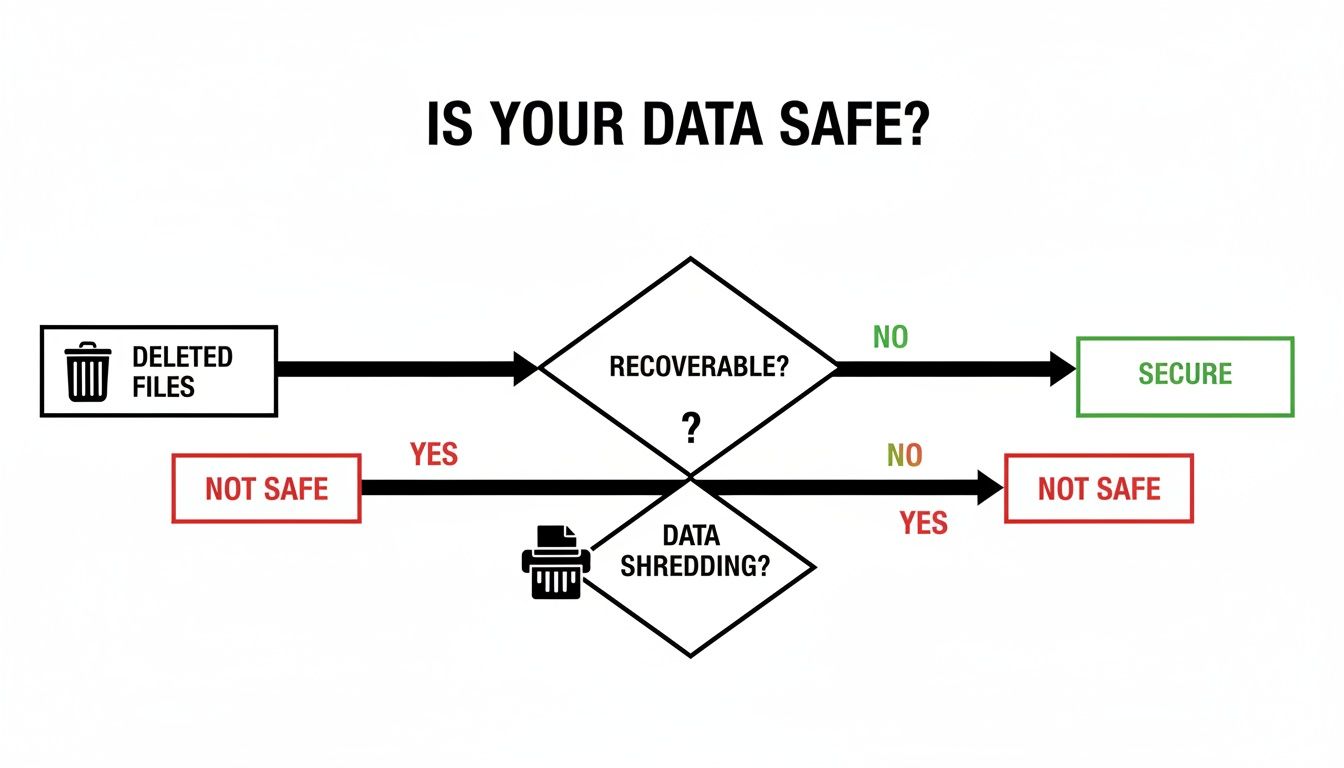
As you can see, deleted files are still recoverable and remain a potential liability. Only physical destruction through shredding guarantees they become secure and unreadable forever.
Shredding is the required course of action for:
- Failed or Damaged Drives: A drive that won't power on or has suffered physical damage can't be wiped. Shredding is the only way to destroy the data stored on its platters.
- Obsolete Technology: Old drives with no resale value that are too slow for reuse should be shredded to securely remove them from your inventory once and for all.
- Maximum Security Requirements: For drives containing highly sensitive intellectual property, patient records (HIPAA), or critical financial data, many organizations mandate physical destruction as a final, foolproof security measure.
Choosing to shred is an explicit business decision to prioritize total data security over any residual hardware value. It is the definitive final step that leaves no room for error or future liability.
To help your business decide, here’s a quick comparison of the two methods.
Hard Drive Shredding vs Data Wiping At a Glance
| Attribute | Hard Drive Shredding | Data Wiping (e.g., DoD 5220.22-M) |
|---|---|---|
| Data Security | 100% Irreversible. Physical destruction guarantees data cannot be recovered. | Extremely High. Overwrites data multiple times, making recovery nearly impossible. |
| Best For | Failed, damaged, or obsolete drives; assets with maximum security data. | Functional drives intended for reuse, resale, donation, or lease return. |
| Asset Value | Destroys the drive, eliminating all hardware value. | Preserves the hardware, allowing for value recovery through remarketing. |
| Verification | Certificate of Destruction, visual confirmation of shredded particles. | Software-generated, auditable reports proving successful data erasure. |
| Compliance | Meets all major standards (HIPAA, DoD, NAID) for data destruction. | Meets all major standards (HIPAA, DoD, NAID) for data sanitization. |
Ultimately, a robust IT Asset Disposition (ITAD) program strategically utilizes both methods. Wiping recovers value from working assets, while shredding provides an ironclad security guarantee for all retired media. For a deeper dive into evaluating different approaches, you can learn about common data destruction and disposal methods from other industry experts.
Meeting Data Destruction Compliance Standards
For any modern business, secure data destruction isn't just a best practice—it's a legal obligation. Failure to comply can result in crippling fines, severe reputational damage, and a complete loss of customer trust. While the regulatory landscape can seem complex, all rules point to a single mandate: if you collect sensitive data, you are legally responsible for its permanent and verifiable destruction at the end of its life.
This is not an optional guideline. These regulations are the non-negotiable rules of the road for data security. Ignoring them is equivalent to ignoring safety protocols—eventually, a catastrophic failure is inevitable.
Navigating Key Data Protection Regulations
Several major regulations dictate how organizations must handle data at its end of life. While each has a different focus, they all demand that sensitive information is rendered completely unrecoverable. This is where professional hard drive shredding becomes non-negotiable, as it provides the physical proof of destruction that auditors and regulators demand.
Key regulations include:
- HIPAA (Health Insurance Portability and Accountability Act): Essential for any organization in the healthcare ecosystem, including providers, insurers, and their business associates. It requires the secure disposal of any device that held Protected Health Information (PHI).
- FACTA (Fair and Accurate Credit Transactions Act): Aimed at financial institutions and any business handling consumer credit information, FACTA mandates the proper destruction of that data to prevent identity theft.
- GDPR (General Data Protection Regulation): This EU regulation impacts any company worldwide that handles data from EU citizens. It enforces the "right to be forgotten," requiring the permanent erasure of personal data upon request.
The consequences of non-compliance are severe. Morgan Stanley faced a $35 million SEC fine for improperly decommissioning thousands of hard drives containing the personal information of 15 million customers. This case serves as a stark reminder that a simple oversight in asset disposal can escalate into a multi-million-dollar disaster.
The Importance of Certification and Documentation
How do you prove to auditors and stakeholders that your organization has met its due diligence? The answer lies in ironclad documentation from a certified partner. Two elements are essential for a defensible data destruction program.
First, your vendor must hold a NAID AAA Certification. This is the gold standard in the data destruction industry, signifying that the provider adheres to the most stringent protocols for security, hiring, training, and operational procedures. Partnering with a NAID-certified vendor is the clearest way to demonstrate your commitment to compliance.
A documented, compliant destruction process transforms hard drive shredding from a simple disposal task into a powerful risk management strategy. It provides the concrete evidence needed to demonstrate due diligence and protect your organization from legal challenges.
Second is a bulletproof chain of custody. This is the detailed audit trail that documents every step of your hard drives' journey, from the moment they leave your facility to the second they are destroyed. This meticulous tracking ensures there are no gaps where an asset could be lost or compromised.
This entire process culminates in the single most important document you will receive: the Certificate of Destruction. This is your legally binding proof that your assets were destroyed in full compliance with all relevant laws. For any business that needs to understand the weight this document carries, learning more about the role of a Certificate of Destruction is a critical step.
The intense focus on these processes is why the market is growing. North America currently leads the global hard drive shredding market, a direct result of our strict data protection laws and the unfortunate frequency of breaches. The U.S. alone saw over 3,200 data breach incidents exposing 540 million records, which is a key driver behind the market’s expected annual growth of 9.8%. For a deeper dive into how to build a systematic approach to regulatory adherence, you might find value in understanding compliance risk management.
On-Site vs Off-Site Shredding: What Fits Your Business?
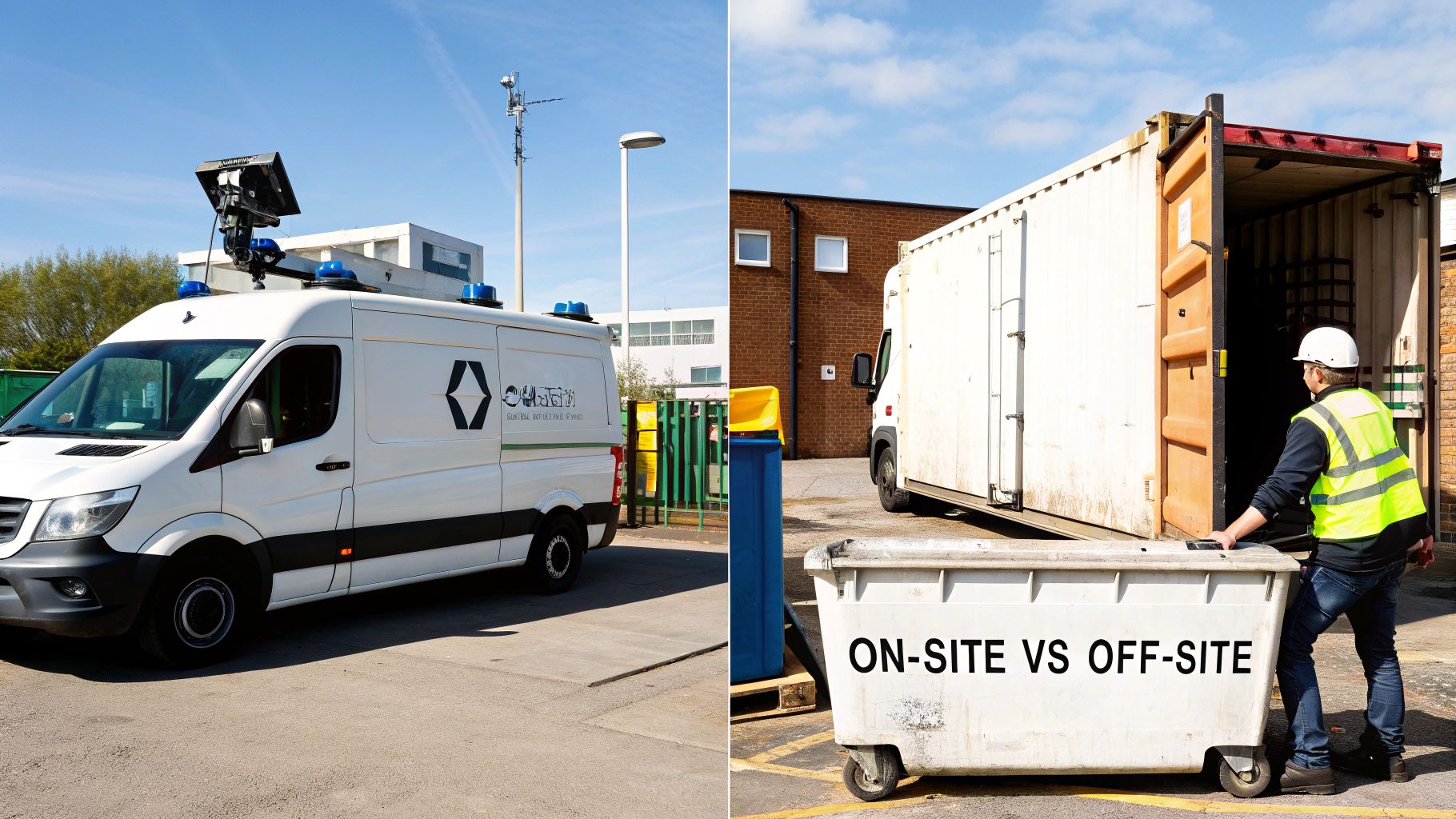
Once your organization determines that physical destruction is the required method for retiring data-bearing assets, the next decision is logistical: should the shredding occur at your facility or be performed at a secure, off-site plant?
This decision impacts your organization's security posture, compliance verification, and operational workflow. The choice between on-site and off-site hard drive shredding depends on your specific risk tolerance and business needs. One offers direct oversight, while the other provides industrial-scale efficiency. Both, when executed by a certified professional, achieve the same secure outcome.
The Case for On-Site Shredding
For businesses that require an unbroken chain of custody with direct visual verification, on-site shredding is the definitive solution. Also known as mobile shredding, this service brings an industrial-grade shredder directly to your location via a specialized vehicle. Your team can witness every drive being scanned, documented, and physically destroyed on your premises.
This hands-on approach is the preferred choice for organizations in highly regulated sectors like healthcare, finance, and government contracting, where witnessed destruction is often a mandatory compliance requirement.
Key benefits of on-site shredding include:
- Total Transparency: Your team witnesses the entire destruction process, leaving no ambiguity.
- Instant Verification: The process is completed on-site, and a Certificate of Destruction is often issued immediately.
- Elimination of In-Transit Risk: Because drives are destroyed before leaving your property, the risk of loss or theft during transport is completely nullified.
If your organization handles sensitive patient data under HIPAA or manages personal financial information, the ability to verify destruction firsthand is invaluable. Searching for on-site shredding near me is the first step toward achieving this level of certainty.
The Power of Off-Site Shredding
Off-site shredding, or plant-based shredding, delivers security through rigorous, audited, and certified processes. In this model, your hard drives are collected in locked containers and transported by a secure, GPS-tracked vehicle to a specialized destruction facility. These plants are built like fortresses, with 24/7 surveillance, strict access controls, and high-capacity shredders capable of processing thousands of drives per hour.
This method is ideal for large-scale projects, such as data center decommissioning or enterprise-wide IT refreshes, and for businesses seeking a more cost-effective, streamlined solution. It minimizes disruption at your facility, as the entire destruction process occurs elsewhere.
While on-site shredding gives you visual proof, off-site shredding provides process-based proof. A vendor with NAID AAA Certification ensures every step—from pickup to final destruction—is airtight, documented, and fully compliant.
The entire journey is tracked from start to finish. You receive a complete chain-of-custody report showing your assets' movement, and a final Certificate of Destruction is issued once the job is done. This makes off-site shredding a highly efficient and defensible choice for routine IT asset retirement and bulk disposals.
Choosing Your Shredding Service: On-Site vs Off-Site
So, which service aligns with your business requirements? This table breaks down the key differences to help guide your decision.
| Factor | On-Site Shredding | Off-Site Shredding |
|---|---|---|
| Security Focus | Maximum transparency and witnessed destruction. | Audited process and plant-based security. |
| Best For | High-compliance industries (healthcare, finance), small to medium volumes. | Large-scale projects, data center cleanouts, cost-sensitive operations. |
| Chain of Custody | Unbroken visual confirmation at your location. | Secure, GPS-tracked transport and documented facility intake. |
| Cost | Typically higher due to specialized equipment and on-site labor. | Generally more cost-effective, especially for larger quantities. |
| Convenience | Requires some coordination of space and personnel at your facility. | Minimal disruption; vendor handles all logistics after pickup. |
Ultimately, the best choice depends on what you value most: the absolute certainty of watching the process yourself, or the operational efficiency of a secure, documented, off-site system. Both methods, when performed by a certified vendor, lead to the same result: your data is gone for good.
Understanding the Costs of Hard Drive Shredding
Budgeting for professional hard drive shredding is a straightforward process driven by a few key variables. It's crucial for decision-makers to view this not as a disposal fee but as an investment in data security. The nominal cost of shredding pales in comparison to the catastrophic financial and reputational damage of a data breach. It is an affordable insurance policy against a multi-million-dollar liability.
Key Factors That Influence Pricing
Several core elements determine the final quote for a hard drive shredding project. Understanding these factors enables effective budgeting and service selection.
Here’s what drives the cost:
- Quantity of Drives: Volume is the primary cost driver. Most vendors offer tiered pricing, meaning the cost-per-drive decreases as the quantity increases. A project with 50 drives will have a higher per-unit cost than a data center decommissioning involving 500 drives.
- Type of Media: Standard hard disk drives (HDDs) form the pricing baseline. Shredding solid-state drives (SSDs), backup tapes, or other magnetic media may alter the price, as these materials can require different shredding equipment or handling protocols.
- On-Site vs. Off-Site Service: As previously discussed, on-site mobile shredding typically carries a premium. This covers the operational costs of bringing a specialized shredding vehicle and crew to your location. Off-site shredding is almost always the more cost-effective option due to centralized operational efficiencies.
- Logistical Support: Additional services will affect the total price. If your project requires technicians to remove drives from servers and desktops, this is an add-on service. Similarly, detailed asset tracking with serial number scanning and reporting provides an enhanced layer of documentation and will be factored into the final cost.
Per-Drive vs. Bulk Rates
Hard drive shredding is typically priced using one of two models. For smaller quantities, a per-drive or per-pound rate is common, offering a simple and transparent pricing structure.
For large-scale projects, such as an enterprise-wide hardware refresh or data center closure, a bulk rate or flat-fee quote is standard, as counting individual units becomes impractical. Always request a detailed quote that itemizes all potential charges to ensure there are no surprises. For a clear estimate on your project, the best move is to talk directly with providers of professional hard drive destruction services.
It's crucial to view hard drive shredding as a preventative security investment. The relatively small cost of physical destruction is a drop in the bucket compared to the average cost of a data breach, which can easily climb into the millions.
This corporate mindset is becoming standard practice. In fact, the commercial and industrial sectors are the main drivers behind the global hard disk destruction market, which is already valued at around USD 450 million. Experts project this market will grow by 7-9% every year as more businesses wake up to the reality that ignoring end-of-life data is an incredibly expensive mistake.
Your Step-By-Step Data Destruction Checklist
A successful hard drive shredding project requires more than a simple phone call. A structured, documented plan is essential to ensure every device is accounted for, all compliance requirements are met, and your data remains secure throughout the entire process.
This checklist breaks the project down into clear, manageable phases, establishing a defensible and secure workflow for your organization's IT asset disposition.
Phase 1: Inventory and Segregation
Effective management begins with a comprehensive understanding of your assets. You cannot protect what you do not track.
-
Inventory All Data-Bearing Assets: Create a detailed inventory of all devices slated for retirement. This includes servers, desktops, laptops, external hard drives, and network equipment with internal storage. Log serial numbers, asset tags, and the physical location of each item.
-
Segregate Drives by Disposition: Not all drives require shredding. Sort your inventory into two distinct categories: functional drives with remarketing potential (candidates for data wiping), and drives that are failed, obsolete, or contain highly sensitive data (these are non-negotiable for shredding).
This initial sort is crucial for cost management, ensuring you only pay for hard drive shredding when it is the necessary and appropriate solution.
Phase 2: Vendor Vetting and Logistics
With a complete inventory, the next step is to select a qualified partner and prepare for service. A vendor’s credentials directly reflect the level of security your organization will receive.
-
Vet Vendors and Request Quotes: Focus exclusively on NAID AAA Certified vendors. This certification is the industry's highest standard and guarantees adherence to strict security protocols. Obtain detailed quotes that transparently itemize costs per drive, transport fees, and any supplemental charges for services like drive removal or serial number logging.
-
Prepare Assets for Service: Designate a secure, access-controlled area to consolidate all devices. If your team is removing drives, place them immediately into locked containers. For on-site shredding, ensure a clear and safe access path is available for the mobile shredding truck.
A vendor's process is just as important as the shredder itself. Dig into their chain of custody procedures, ask about employee background checks, and understand their facility security. Make sure it all aligns with your company's risk tolerance.
Phase 3: Execution and Verification
This is the final stage, focused on witnessing the destruction and obtaining the critical documentation that proves compliance.
-
Verify the Chain of Custody: On the day of service, assign a member of your team to oversee the process. For off-site service, this means witnessing the drives being scanned and sealed in locked bins. For on-site shredding, it means watching the drives being fed directly into the shredder.
-
Receive and File Your Certificate of Destruction: This is your most critical deliverable. The Certificate of Destruction is your legal proof that the assets were properly destroyed in a compliant manner. It should clearly list the destruction date, method, and a list of serialized assets. File this document securely with your IT asset records for future security audits.
Following this checklist ensures a secure, auditable, and defensible process for your company's end-of-life data.
Common Questions About Hard Drive Shredding
As IT managers and business leaders implement data destruction policies, several key questions consistently arise. Clear answers are fundamental to building a trustworthy IT asset disposition program.
Can You Shred SSDs and HDDs the Same Way?
Yes, but only with the correct industrial-grade equipment. Traditional hard disk drives (HDDs), with their spinning magnetic platters, are relatively simple to destroy. Solid-state drives (SSDs) present a greater challenge, as they store data on multiple small memory chips soldered to a circuit board.
To properly destroy an SSD, a shredder must reduce it to a much smaller particle size than an HDD, ensuring every memory chip is obliterated. A professional, NAID AAA Certified vendor utilizes shredders specifically engineered to handle both media types, guaranteeing complete data destruction regardless of the technology.
What Happens to the Shredded Materials?
The shredded material is not e-waste; it is the first step in a secure and environmentally responsible recycling chain. The resulting fragments—a commodity mix of aluminum, steel, plastics, and circuit boards—are securely transported to a certified downstream recycling partner.
At the recycling facility, these materials are sorted and refined. Metals are melted down for reuse in new manufacturing, and plastics are processed into new products. This closed-loop process fulfills both data security mandates and corporate environmental responsibility goals, preventing hazardous e-waste from entering landfills.
The Certificate of Destruction is more than a receipt; it's a legally defensible document that proves your organization followed a compliant, secure, and documented process. It's your official record for any future audits.
How Is Data Protected During Transit?
This is a critical concern for any business using off-site shredding. A certified vendor protects data through an unbroken and documented chain of custody.
- Secure Collection: Drives are placed into locked, tamper-evident containers at your facility before transport.
- GPS-Tracked Transport: The containers are transported in a secure, GPS-tracked vehicle operated by screened, uniformed professionals.
- Secure Facility: The vehicle proceeds directly to a monitored, access-controlled destruction plant, where the drives are received and shredded under continuous video surveillance.
This rigorous protocol ensures that from the moment an asset leaves your control to the second it is destroyed, it is tracked, secured, and accounted for. There are no gaps in the security chain. Your Certificate of Destruction provides the final, auditable proof that this secure process was completed successfully.
Ready to implement a secure, compliant, and environmentally responsible plan for your end-of-life IT assets? Atlanta Computer Recycling provides certified hard drive shredding services to protect your business's most sensitive data. Visit us at https://atlantacomputerrecycling.com to get a quote and schedule your secure pickup today.