A Business Leader’s Guide to Certificates of Destruction

Think of a Certificate of Destruction as the final, legally-binding handshake in your company's data lifecycle. It is the official document proving that sensitive business information—whether on a hard drive or in a file cabinet—has been permanently and verifiably eliminated.
This is not just a receipt; it is your formal proof of due diligence, ensuring that retired company assets and confidential data don't become future liabilities.
What a Certificate of Destruction Actually Guarantees for Your Business

A Certificate of Destruction (CoD) is much more than a piece of paper. It's a critical risk management tool for your enterprise. In a business environment where a single data breach can lead to crippling fines, litigation, and a shattered brand reputation, the CoD is your first line of defense.
This document serves as concrete evidence that your company acted responsibly—legally and ethically—to protect confidential information. For any business handling sensitive data such as client lists, financial records, intellectual property, or employee files, this proof of compliance is non-negotiable.
The Core Purpose of a CoD
At its heart, a certificate of destruction provides an auditable, legally sound record proving that sensitive materials were disposed of according to industry regulations and best practices. This becomes critical during compliance audits or, in a worst-case scenario, a legal dispute.
It demonstrates your commitment to data security, building trust with clients, partners, and regulators. Essentially, it confirms that your old assets won't become tomorrow's liabilities. For businesses looking to integrate this process even further, exploring options like certificate automation for digital security can add another layer of operational efficiency.
Verifying Irretrievable Destruction
A properly issued CoD is a serious legal and compliance document that verifies data and equipment have been destroyed beyond any possibility of recovery. For it to be valid, it must include specific details, including the exact destruction method used—whether physical shredding or a secure data wipe.
You can learn more about the technical side of this in our guide on how to wipe a computer's hard drive. A legitimate certificate will always list asset serial numbers and include authorized signatures, providing a clear chain of custody that meets stringent compliance standards like HIPAA or GDPR.
Decoding Your Certificate of Destruction

When you receive a Certificate of Destruction, you're holding a legally defensible record of your data's final disposition. Think of it as your official alibi in the event of a compliance audit. But if it lacks key details, it offers zero protection, leaving your business exposed.
Knowing what to look for allows you to instantly differentiate a legitimate certificate from a worthless one. This ensures the documentation you receive from your ITAD partner is a genuine shield for your business.
Tracing the Journey with a Unique Serial Number
Every compliant CoD begins with a unique serial number or transaction ID. This number is the anchor for the entire destruction event, linking every asset and action back to one specific job.
Attempting to verify a destruction event without this ID is like trying to track a shipment without a tracking number—it's impossible. This serial number provides crucial traceability for your assets, proving that your destruction event was logged, is verifiable, and can be retrieved for any future audits. This unique ID is the first sign your vendor operates a professional, accountable service.
A Certificate of Destruction is your official proof that establishes an unbroken and secure chain of custody. It transforms the disposal of assets from a simple operational task into a documented, compliant, and legally defensible action.
The Unbreakable Chain of Custody
The chain of custody is the chronological paper trail detailing every individual who handled your sensitive materials, from the moment they left your facility to their final destruction. A valid CoD must map this journey with precision.
This includes details like the date and time of transfer, the names of authorized personnel involved, and the secure location where the destruction occurred. Any gap in this chain is a massive security red flag, indicating your assets were unaccounted for and potentially exposed to theft or a data breach.
Verifying What Was Destroyed and How
Vague descriptions are unacceptable. A certificate that merely states "one pallet of electronics" will not hold up under scrutiny. A compliant CoD must provide a detailed inventory of every asset that was destroyed.
To ensure your certificate is airtight, it needs to contain several key elements. We've broken them down here for your review.
Key Elements of a Valid Certificate of Destruction
A summary of the critical information that must be included in a compliant CoD to ensure it serves as legally defensible proof of destruction.
| Component | Description | Why It's Important for Your Business |
|---|---|---|
| Asset Descriptions | A clear list of what was destroyed (e.g., Dell Latitude Laptops, Seagate Hard Drives). | Provides specific evidence of the items included in the disposal, leaving no room for ambiguity. |
| Asset Serial Numbers | The individual serial numbers for each device destroyed. | Offers undeniable, granular proof that your specific assets were part of the destruction event. |
| Destruction Method | The exact technique used (e.g., physical shredding, degaussing, secure wiping). | Confirms that the method used met compliance standards for the type of data you were destroying. |
| Date and Location | The precise date and physical address of the destruction facility. | Establishes a verifiable timeline and location, which is critical for audit trails and legal verification. |
Each of these details builds a rock-solid case for your company’s due diligence. Understanding the correct disposition for different media types is essential, which is why partnering with experts in professional hard drive destruction services is a strategic decision for any business that prioritizes data security.
When you ensure these elements are all present, you can be confident your certificate will withstand any regulatory scrutiny.
How a CoD Protects Your Business From Costly Fines
Failing to properly dispose of sensitive data isn’t just a security risk—it's a massive financial liability. In today's regulatory landscape, a Certificate of Destruction (CoD) is your number one shield against devastating penalties. This document transforms your destruction process from an internal operational task into a legally defensible action.
Imagine facing a multi-million dollar fine from a data breach or an audit that reveals improper disposal protocols. In that moment, your collection of CoDs becomes irrefutable proof of due diligence. It’s the official record that demonstrates you took data privacy seriously, protecting your bottom line in a world where compliance is absolutely non-negotiable.
Navigating the Regulatory Minefield
Several major regulations don’t just recommend, but mandate the secure destruction of sensitive information. Non-compliance isn't a minor infraction; it can lead to fines that cripple a business. Take the Health Insurance Portability and Accountability Act (HIPAA)—violations can result in penalties as high as $1.5 million per year, for each violation.
It doesn't stop there. The General Data Protection Regulation (GDPR) can impose fines of up to 4% of a company's entire annual global turnover. These laws don't just ask for secure disposal—they demand proof.
A CoD delivers exactly that proof by documenting:
- What was destroyed (e.g., patient records, financial data).
- When it was destroyed (establishing a crystal-clear timeline).
- How it was destroyed (verifying the method meets tough regulatory standards).
Without this documentation, you have no evidence to present to auditors, leaving your business completely exposed. The first step is always to establish effective document retention policies, which define exactly when and how data must be permanently eliminated.
The CoD as Your Legal Standing
Think of a Certificate of Destruction as your star witness in a legal challenge. It provides a clean, auditable trail that proves your company acted responsibly and in accordance with the law. This is absolutely critical under regulations like the Fair and Accurate Credit Transactions Act (FACTA), which requires businesses to destroy consumer information to prevent identity theft.
In the event of a regulatory audit or data breach investigation, the burden of proof is on your business. A complete and accurate Certificate of Destruction flips that script, providing tangible evidence that you fulfilled your legal obligations to protect sensitive information.
This proactive documentation is a cornerstone of any sound data governance strategy. The entire IT asset lifecycle, from identifying retired hardware to its final disposition, is a mission-critical function. For businesses managing large inventories of equipment, understanding what IT asset disposition entails is the foundation for building a compliant and secure program. A CoD is the final, essential piece of that puzzle, confirming that every single step was handled correctly and securely.
Choosing the Right Destruction Method for Your Assets
Not all destruction methods are created equal, and the technique used for your specific assets must be accurately reflected on your Certificate of Destruction. Selecting the appropriate method isn't just a technical detail; it’s a critical compliance decision that directly impacts the validity of your CoD and your company's risk exposure.
You wouldn't use a hammer to turn a screw. Similarly, the method for destroying paper documents is entirely different from what's required to permanently eliminate data from a solid-state drive (SSD).
This decision tree clearly shows the simple path to avoiding hefty fines—it all hinges on using certified destruction for sensitive data.
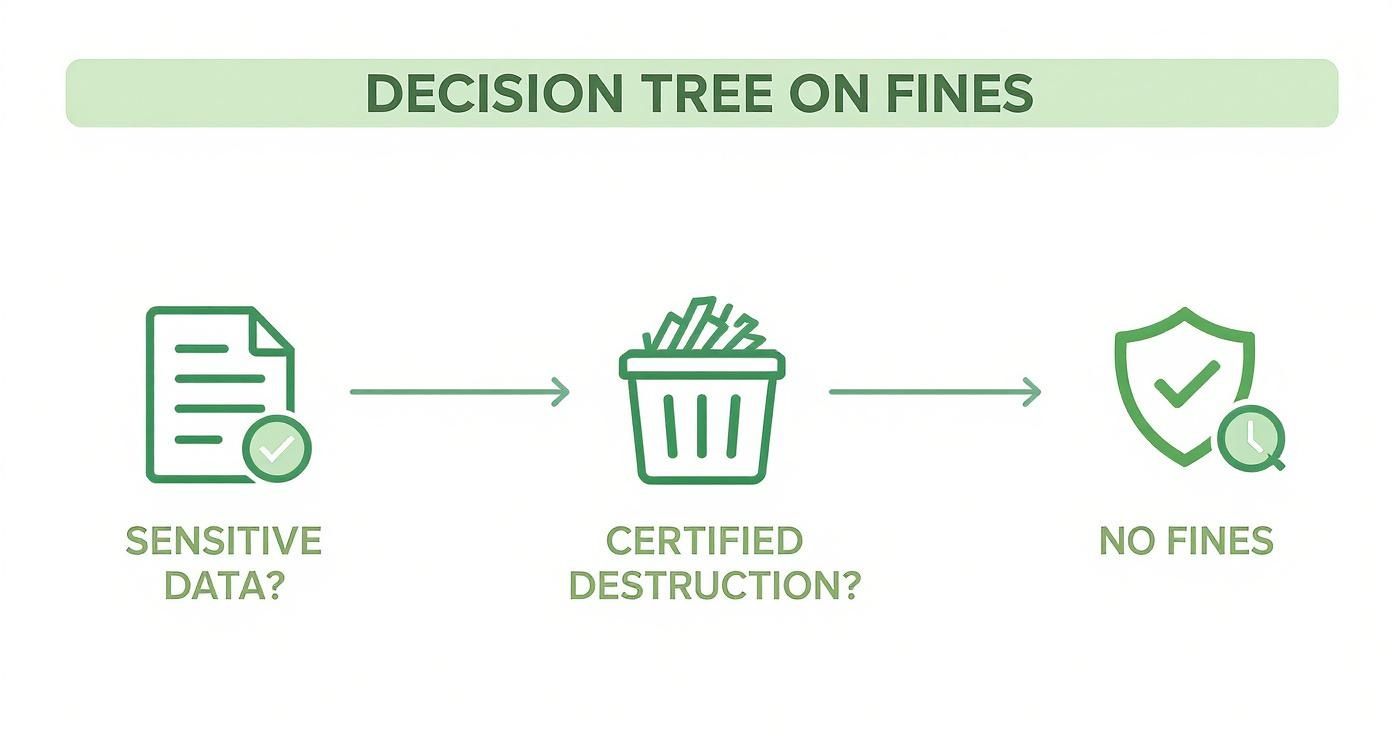
As the visual points out, certified destruction is the key step that separates responsible data handling from the kind of non-compliance that leads to serious penalties.
Comparing Common Destruction Techniques
The method your vendor employs must align with the media type and data sensitivity. As a business leader, understanding these options is key to having an intelligent conversation with a destruction partner and ensuring you receive the service you require. The technique listed on your certificate must be the right one for the job.
Here are the primary methods your business will encounter:
- Physical Shredding: This is the gold standard—the most secure and visually verifiable method for hard drives, SSDs, backup tapes, and other electronic media. The device is physically pulverized into small, unsalvageable fragments, making data recovery impossible.
- Degaussing: This process utilizes powerful magnets to erase the magnetic field on traditional hard drives and tapes. While effective for older magnetic media, it is completely useless on SSDs, which store data on flash memory chips.
- Secure Data Wiping: Software-based wiping overwrites the entire drive with random data, often multiple times, to sanitize it according to standards like NIST 800-88. This is an excellent choice for assets you plan to reuse or resell, as it preserves the hardware's integrity.
Matching the Method to Your Needs
For end-of-life assets containing highly sensitive information, physical shredding is almost always the preferred choice because it provides absolute, undeniable proof of destruction. The numbers back this up. The global hard drive destruction service market, valued at $1.65 billion recently, is projected to explode to $5.05 billion over the next decade.
This growth is driven by strict regulations that demand verifiable, permanent data elimination to prevent data breaches and intellectual property theft.
Ultimately, your choice should be guided by compliance requirements and your organization's risk tolerance. When dealing with a mix of assets, it is vital to partner with a vendor who can provide the right service for each device. For businesses, finding a service to shred hard drives near you that provides a clear, accurate Certificate of Destruction is the most direct path to compliance.
When the method listed on your CoD perfectly matches the service performed, you create an airtight, defensible record that protects your business from liability.
Finding a Destruction Partner You Can Trust

When it comes to data destruction, your Certificate of Destruction is only as credible as the company that issues it. This isn't just about hiring a vendor; it's about selecting a partner who will protect your business from serious liability with legally sound documentation.
Choosing the wrong provider can have disastrous consequences. An unreliable company may issue a non-compliant or worthless certificate, leaving your organization exposed to regulatory fines and legal challenges.
Vetting Your Vendor Checklist
To ensure you’re working with a professional, due diligence is required. A trustworthy partner will be transparent and prepared to answer tough questions. Here's what to ask:
- Industry Certifications: Are they NAID AAA Certified? This is the gold standard for secure data destruction, signifying they have passed rigorous, unannounced third-party audits.
- Chain of Custody: Can they demonstrate a detailed, unbroken chain of custody log? You should be able to track your assets from your facility to their final disposition.
- Security Protocols: What physical and digital security measures do they employ? Look for GPS-tracked vehicles, locked containers, and 24/7 video surveillance at their facility.
- Employee Screening: Are all employees background-checked and regularly trained in security protocols? The personnel handling your sensitive data must be thoroughly vetted.
The demand for these secure services is growing rapidly. The global market is already valued at approximately $15 billion and is projected to grow at a compound annual rate of 12%. This surge underscores how vital secure data destruction has become for cybersecurity and corporate compliance. You can read more about these secure data destruction market trends to understand why this is a growing concern for all businesses.
Choosing a certified vendor isn't an expense—it's an investment in risk management. Their credentials, processes, and transparency are direct reflections of the level of protection your business will receive.
When you find the right provider, you're not just hiring a service to haul away old equipment. You are engaging an expert who understands the complexities of data security and regulatory compliance. Finding reputable electronic waste recycling companies that can provide a valid Certificate of Destruction is the single most important step in protecting your business.
Common Questions About Certificates of Destruction
Even when you understand the importance of a Certificate of Destruction, practical questions often arise. Getting the details right is crucial for keeping your business protected and ensuring your compliance efforts are effective.
Here are a few of the most common questions we hear from IT managers and business owners managing their CoDs.
How Long Should My Business Keep a Certificate of Destruction?
While no single federal law dictates a universal period, retaining CoDs for seven years is a widely accepted best practice. However, your specific industry regulations or internal data policies may require longer retention.
For instance, healthcare organizations subject to HIPAA may need to keep records for an extended period. A sound strategy is to align the CoD's retention period with the lifecycle of the data that was destroyed. When in doubt, always consult with legal counsel to establish a policy that fits your company’s unique compliance obligations.
Is a Digital Certificate of Destruction as Valid as a Paper Copy?
Absolutely. A digital CoD is just as legally sound as a paper one, provided it contains all the crucial compliance elements—such as a unique serial number, a clear chain of custody, and verifiable signatures.
In fact, most businesses now prefer digital certificates. They are far easier to store, search for during an audit, and integrate into your permanent corporate records. Reputable destruction vendors will provide access to a secure online portal where you can manage your CoDs, creating a clean, auditable trail for every destruction job.
What Should I Do If My Vendor Does Not Provide a Certificate?
If a potential ITAD partner cannot—or will not—provide a compliant CoD, it is a non-starter. You should immediately end the discussion and find a certified, reputable vendor who understands the critical nature of this document.
This is a major red flag. A Certificate of Destruction is a standard, non-negotiable proof of service in the secure destruction industry. Without it, you have no legal evidence that the service was performed correctly, leaving your business exposed to significant risk.
An unwillingness to provide this essential proof indicates a lack of professional standards and an inability to adequately protect your business from liability. Do not take that risk.
At Atlanta Computer Recycling, we provide a detailed Certificate of Destruction for every job, giving you the legally defensible proof you need to ensure compliance and protect your business. Learn more about our secure ITAD services.