Disposal of Computers Near Me: A Guide for Businesses


Searching for "disposal of computers near me" is a critical task for any business managing an IT refresh. This isn't just about clearing out storage space; it's a crucial component of your company's risk management strategy. Mishandling the disposal of end-of-life IT assets can lead to severe consequences, including seven-figure regulatory fines and significant brand damage if sensitive corporate or client data is compromised.
Why Secure Computer Disposal Is a Business Imperative

For modern businesses, retiring IT equipment has evolved from a logistical chore into a strategic necessity. Every decommissioned device—from laptops and servers to mobile phones—is a potential liability. A single workstation improperly discarded could contain proprietary financial data, confidential client information, or sensitive employee records, creating a massive security risk.
Consider a financial services firm decommissioning old servers without certified data destruction. If client financial records are recovered from those drives, the firm faces not only crippling regulatory penalties but also a catastrophic loss of client trust. This isn't a hypothetical scenario; it's a real-world risk that underscores why a documented, secure chain of custody is non-negotiable for corporate IT asset disposition.
The Growing Challenge of Corporate E-Waste
The scale of electronic waste is a global issue with direct implications for corporate social responsibility. As technology refresh cycles accelerate, the volume of e-waste continues to grow. By 2025, the world is projected to generate over 60 million metric tons of e-waste annually, containing both hazardous materials like lead and mercury and valuable, recoverable resources. For businesses, responsible recycling is a key pillar of their environmental, social, and governance (ESG) commitments.
Moving Beyond a Simple Disposal Checklist
A robust IT Asset Disposition (ITAD) process is an integral part of your organization's data security framework. It extends far beyond arranging a pickup from a local recycler. A proper ITAD strategy ensures every stage—from initial asset inventory to final, certified data destruction—is meticulously documented, auditable, and secure.
For any business, treating computer disposal as an operational afterthought is a costly mistake. Your data's security doesn't end when a device is unplugged; it ends when that data is verifiably destroyed by a certified professional.
To mitigate risk effectively, businesses must integrate comprehensive IT Asset Management best practices into their operational lifecycle. This proactive approach ensures that from procurement to disposal, every IT asset is managed securely and in full compliance with relevant regulations.
You can gain a deeper understanding of this structured approach in our guide on what is IT asset disposition. Implementing a formal ITAD program transforms a potential liability into a secure, well-managed business function.
Finding and Vetting Certified ITAD Providers
Once your organization acknowledges the risks of improper hardware disposal, the next step is to select a qualified ITAD partner. A search for "disposal of computers near me" will yield numerous options, but it's crucial to differentiate a certified ITAD professional from a basic scrap hauler who lacks the credentials to protect your business interests.
The key is to look for specific industry certifications. These are not mere marketing badges; they represent rigorous, third-party audits that validate a vendor's adherence to the highest standards for data security, environmental compliance, and operational transparency. Think of them as the SOC 2 compliance of the ITAD world—they verify a provider's processes are sound.
Demystifying Key ITAD Certifications
Navigating the landscape of ITAD certifications can seem complex, but a few key credentials stand out. Each one addresses a critical aspect of secure and responsible electronics recycling, providing assurance that your assets are handled correctly from the moment they leave your facility.
Here are the primary certifications to look for in a potential partner:
- R2v3 (Responsible Recycling): This is the globally recognized standard for the electronics recycling industry. It mandates a strict focus on environmental protection, worker health and safety, and robust data security protocols. An R2v3-certified company is proven to follow a "reuse, recover, dispose" hierarchy to minimize landfill waste.
- e-Stewards: Often considered the most stringent environmental standard, e-Stewards certification provides an absolute guarantee that no hazardous e-waste is exported to developing countries. It also includes rigorous data security requirements.
- NAID AAA: This certification is exclusively focused on data destruction. A NAID AAA-certified vendor has undergone intensive, unannounced audits of their security procedures, employee screening, and destruction processes. For businesses in regulated sectors like healthcare (HIPAA) or finance (GLBA), this certification is essential.
When evaluating a potential ITAD provider, always verify their certifications directly on the governing body's website. This due diligence step confirms their credentials are valid and active, protecting your organization from compliance risks.
From a General Search to a Targeted Query
Armed with this knowledge, you can refine your search for greater efficiency. Instead of generic queries, use more specific terms like "NAID certified ITAD provider in Atlanta" or "R2v3 computer recycling for businesses." This targeted approach helps filter out unqualified vendors and connects you with partners capable of meeting your organization's security and compliance requirements.
When engaging with potential electronic waste recycling companies, request copies of their certifications and ask for a detailed overview of their chain-of-custody process.
A reputable ITAD partner will readily provide documentation on how they track assets, secure logistics, and document every step of the destruction process. This transparency is the hallmark of a professional firm you can entrust with your company's retired assets and the sensitive data they contain.
Preparing Your IT Assets for Secure Handover
Before your ITAD partner arrives, the preparation conducted by your internal team is crucial for a secure and efficient project. A well-organized handover process not only accelerates the project timeline but also reinforces security and accountability from the outset.
The first step is to create a detailed inventory of all assets slated for disposition. This is not a simple device count but a comprehensive manifest that establishes an auditable paper trail under your control.
A robust inventory should include these key data points for each asset:
- Asset Tag Number: Your company's internal tracking identifier.
- Serial Number: The manufacturer's unique identifier.
- Device Type: e.g., laptop, desktop, server, network switch.
- Physical Location: The office, floor, or data center where the asset is located.
This inventory log serves as the foundation for the project's chain of custody. Upon the vendor's arrival, your internal list can be reconciled against theirs, ensuring no asset is overlooked.
The First Layer of Data Defense
Although a certified ITAD partner will provide guaranteed data destruction, performing a preliminary data wipe in-house is a recommended best practice. This initial sanitization acts as your first line of defense, significantly reducing the risk of data exposure before the assets physically leave your premises.
This is an important step in demonstrating corporate due diligence.
While various software tools are available, the objective is to overwrite data, rendering it unrecoverable through standard methods. For teams seeking guidance, our resource on how to wipe a computer's hard drive provides practical, step-by-step instructions. Remember, this internal procedure complements—but never replaces—the certified destruction performed by your ITAD vendor.
Segregate Assets to Maximize Value and Security
Not all retired IT assets are the same. A four-year-old high-performance server has a different end-of-life trajectory than a ten-year-old desktop with a failed hard drive. By strategically segregating assets before pickup, your business can maximize financial returns while ensuring the highest level of security for devices containing sensitive data.
Smart asset segregation isn't just about sorting old from new. It's about making a strategic decision for each device: can it generate a return through remarketing, or does its data risk demand immediate physical destruction?
For example, a pallet of recent-model laptops may be ideal for refurbishment and resale, generating revenue that can offset your IT budget. Conversely, legacy servers that once processed corporate financials should be designated for immediate, on-site shredding. This simple sorting process ensures you aren't destroying potential value or taking unnecessary risks with high-stakes data.
To facilitate this, we use a clear framework to help businesses categorize their retired IT assets, clarifying whether a device has resale potential or is a candidate for secure destruction.
IT Asset Categorization for Disposal
| Asset Category | Typical Devices | Recommended Action | Key Consideration |
|---|---|---|---|
| High-Value Remarketing | Laptops, desktops, and servers (less than 4 years old), newer networking gear, mobile devices. | Audit, data wipe, and professional refurbishment for resale. | Potential for significant financial return to offset disposal costs. |
| Low-Value Resale | Older but functional desktops, monitors, printers, and basic networking switches. | Bulk data wipe and sale to wholesale buyers. | The goal here is cost recovery, not high profit. |
| Data-Sensitive/Scrap | Failed hard drives, damaged servers with sensitive data, proprietary hardware. | On-site or off-site physical shredding. | Data security is the top priority; value recovery is secondary. |
| Standard E-Waste | Keyboards, mice, cables, broken peripherals, very old or obsolete equipment. | Responsible recycling for raw material recovery. | Focus is on environmental compliance and avoiding landfill. |
This proactive categorization streamlines the entire ITAD process, making it more efficient, secure, and financially advantageous.
This preparation is more important than ever. The world is grappling with a massive e-waste problem, with a yearly increase of approximately 2.6 million tons. That figure is projected to hit a staggering 82 million tons by 2030. Properly sorting your equipment is a key part of responsible IT management and contributes to a far more sustainable outcome. You can discover more insights about e-waste trends to understand the scale of this global challenge.
Understanding Data Destruction and Compliance
Once your assets are inventoried and sorted, the most critical phase begins: ensuring the complete and permanent eradication of all data. Simply deleting files or reformatting a hard drive is insufficient and leaves your organization vulnerable.
True data destruction is a certified, verifiable process that shields your business from liability and ensures compliance with data protection regulations. When you search for "disposal of computers near me," this service is what distinguishes a professional ITAD partner from a common scrap hauler.
The appropriate destruction method depends on two factors: the storage media type and your company's internal security policies and regulatory obligations. Proactive measures like implementing full-disk encryption with BitLocker provide a strong layer of data protection throughout the asset's lifecycle. A good primer on understanding BitLocker encryption can be a valuable resource for IT teams looking to enhance their data security posture.
This decision tree offers a quick visual guide for categorizing retired IT assets—balancing the potential for value recovery against the need for immediate, maximum-security destruction.
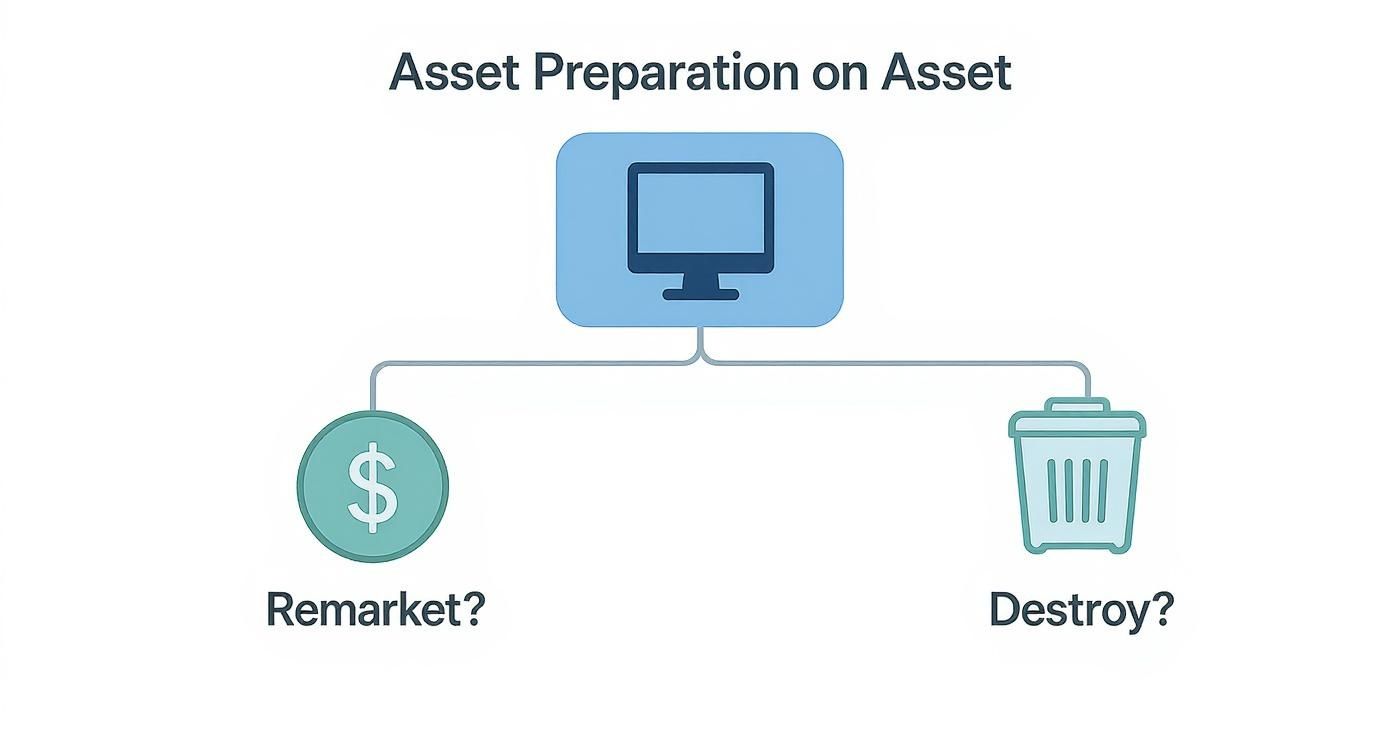
This chart helps break down the choice between getting some money back on newer equipment and prioritizing the total destruction of devices holding sensitive information.
Choosing the Right Data Destruction Method
There are three primary methods for certified data destruction. Understanding their applications is key to aligning your ITAD process with compliance standards like HIPAA, GDPR, or NIST 800-88.
-
Software-Based Wiping: This method uses specialized software to overwrite all data on a storage device with random characters, typically adhering to standards like the DoD 5220.22-M 3-pass protocol. It is the ideal solution for functional hard disk drives (HDDs) and solid-state drives (SSDs) destined for remarketing.
-
Magnetic Degaussing: This process uses a powerful magnet to completely neutralize the magnetic field on traditional platter-based hard drives, rendering them permanently unreadable and inoperable. It is a highly effective method for HDDs but is not effective on SSDs.
-
Physical Shredding: This is the most secure and definitive method of data destruction. The storage device is fed into an industrial shredder that reduces it to small, irrecoverable fragments. Shredding is the required method for failed drives, end-of-life media, or any device that contained highly sensitive data.
The greatest risk in computer disposal is not the hardware itself, but the residual data left behind. The only way to mitigate the risk of a future data breach is to select the appropriate destruction method and obtain documentation to prove it.
The Importance of a Certificate of Destruction
Regardless of the method chosen, the process must conclude with the issuance of a Certificate of Destruction. This document is not merely a receipt; it is your legal proof of compliance and due diligence.
The certificate provides an auditable record confirming your data was destroyed in accordance with industry standards. As detailed in our guide on what to expect from a Certificate of Destruction for hard drives, it must, at a minimum, list the serial numbers of the destroyed devices, the date of destruction, and the method used.
This documented, verifiable process is a fundamental component of responsible corporate governance. In 2022, the world generated an astounding 62 million metric tons of e-waste, yet only 22.3% was properly documented as collected and recycled. Certified, documented disposal is not just a best practice—it is a business necessity.
Managing the Logistics of a Disposal Project
A professional ITAD engagement is a meticulously coordinated logistical operation designed to be secure, efficient, and fully documented. From the moment a pickup is scheduled, every step is structured around maintaining an unbreakable secure chain of custody, safeguarding your assets and the data they contain.
The process begins with serialized asset tracking. Upon arrival at your facility, our technicians create a detailed inventory, capturing the unique serial number of every computer, server, and hard drive. This manifest serves as the foundation for the entire project, enabling one-to-one reconciliation at each stage.
Pickup is conducted by badged, background-checked technicians using secure, GPS-tracked vehicles. This is not a simple collection but a formal, documented transfer of custody, protecting your organization from liability the moment assets leave your premises.
On-Site vs. Off-Site Data Destruction
A critical logistical decision is whether to have data destroyed on-site at your facility or off-site at a secure ITAD plant. The best choice depends on your organization's security policies and compliance mandates.
-
On-Site Destruction: A mobile shred truck comes directly to your location, allowing your team to witness the physical destruction of hard drives, SSDs, and other media. For organizations in highly regulated industries such as healthcare or finance, this method provides the highest level of assurance and verifiable proof of destruction.
-
Off-Site Destruction: For large-scale projects, securely transporting assets to a certified facility for destruction is often more efficient. This process is equally secure, provided the vendor maintains a strict, documented chain of custody from your loading dock to their shredder.
Many businesses find a hybrid approach is the most effective solution. You might opt for on-site shredding of servers containing critical financial data while allowing employee laptops to be securely transported for off-site processing. A flexible ITAD partner should be able to accommodate both options.
Minimizing Disruption to Your Business
An IT asset disposition project should never disrupt your core business operations. We understand that operational continuity is paramount. That's why we schedule services to align with your business needs, offering pickups during off-peak hours, on weekends, or in scheduled phases to minimize impact.
Our technicians can manage the entire on-site de-installation and palletizing process, freeing up your internal IT staff to focus on mission-critical tasks. We arrive with all necessary equipment—pallets, secure bins, and tools—to consolidate assets efficiently and without disrupting your workflow. This turnkey service ensures the process is not just secure, but virtually seamless.
Even with a solid plan, a large-scale computer disposal project can generate questions for IT managers and business leaders regarding cost, security, and logistics. Here are answers to the most common questions we receive from our commercial clients.
Clarifying these details upfront enables you to make informed decisions, ensuring your ITAD project is compliant, efficient, and cost-effective.
Do We Have to Pay for Computer Disposal Services?
The answer is: it depends on the resale value of the assets being retired.
-
Projects with Value Recovery: If your organization is disposing of a significant quantity of recent-model equipment (typically less than 4-5 years old), such as laptops, servers, or networking gear, these assets often have a strong secondary market value. In these scenarios, the revenue generated from remarketing can partially or fully offset the costs of logistics and data destruction. In some cases, your business may even receive a net payment.
-
Projects with No Resale Value: If the equipment is obsolete, damaged, or consists mainly of low-value peripherals, a service fee will likely apply. This fee covers the secure transportation, labor, certified data destruction, and environmentally responsible recycling of all materials.
A reputable ITAD partner will always provide a transparent, itemized quote upfront. They should be able to provide a fair market value assessment for your assets and clearly outline any service costs before you commit to the project.
How Can We Be Sure Our Data Is Actually Destroyed?
This is the most critical question an organization can ask. Absolute, auditable proof of data destruction is non-negotiable. A certified ITAD provider delivers multiple layers of verification.
Your company must receive a Certificate of Data Destruction. This legal document serves as your official record of compliance and due diligence, confirming that the process was executed according to industry standards.
The certificate must list the serial numbers of the destroyed drives, the destruction method used (e.g., wipe, degauss, shred), and the date of service. For organizations requiring the highest level of assurance, on-site shredding allows your team to witness the physical destruction firsthand. You can learn more about best practices in our guide on how to dispose of old computers safely and securely.
What Types of Equipment Do You Accept?
A professional ITAD company is equipped to manage the full spectrum of business technology assets. While a local drop-off center may only accept consumer electronics, a commercial service is prepared to handle an entire office or data center decommissioning.
We accept virtually all standard corporate and data center equipment, including:
- Desktops, Laptops, and Servers
- Networking Gear (Switches, Routers, Firewalls)
- Monitors (LCD, LED)
- Hard Drives (HDD) and Solid-State Drives (SSD)
- Printers, Scanners, and Copiers
- Telephones and VoIP Systems
- Cables, Keyboards, and Mice
If your business has specialized or proprietary equipment, it is always best to confirm with your provider in advance. A brief consultation ensures a smooth and efficient pickup process.
When your Atlanta-area business needs a partner for the secure disposal of computers near me, Atlanta Computer Recycling provides the certified, documented, and professional service you require. We ensure your data is destroyed and your old equipment is handled responsibly.