E Recycle Near Me: Atlanta Business E-Waste Guide

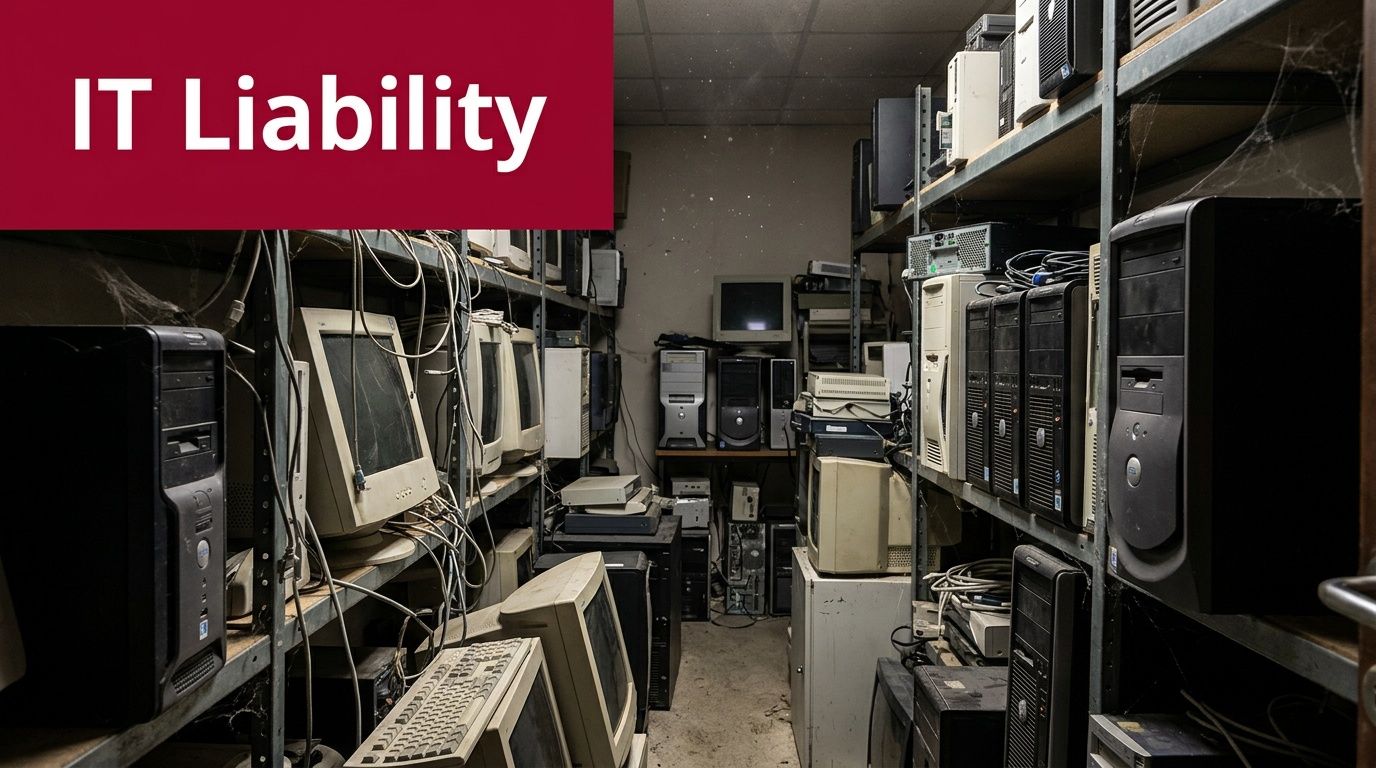
Your storage closet probably tells the full story of your IT lifecycle.
Not the CMDB. Not the budget spreadsheet. The closet.
That’s where retired laptops pile up after a refresh stalls. It’s where old switches stay on a shelf because nobody wants to deal with them before audit season. It’s where failed drives sit in a cardboard box with labels still attached. For an Atlanta IT manager or CIO, that isn’t just clutter. It’s unmanaged risk.
Searches for e recycle near me rarely solve that problem. Most results are built for residents dropping off a printer or a dead tablet. They don’t address bulk pickup, chain of custody, data destruction evidence, or the operational reality of clearing equipment from a hospital, school district, office floor, or data center. The gap is real. Existing “e recycle near me” content is heavily residential, while U.S. businesses generated 2.8 million tons of e-waste in 2022 and only 19% was properly recycled according to the source cited in this guide’s underlying verified data from the Westland Recycle Center reference.
A business process has different stakes. If you manage regulated data, every retired device has to be treated like a security event waiting to happen. If you manage multiple sites, pickup logistics matter as much as downstream recycling. If your leadership team cares about sustainability, vague assurances don’t help. You need documentation.
Teams that already have strong data security best practices usually discover the same thing at end of life. Controls break down when old hardware leaves production but doesn’t enter a governed disposition process.
This is also where many Atlanta organizations start sorting out what belongs in resale, recycling, or IT scrap streams instead of treating everything as the same pile.
Introduction The Hidden Risks in Your IT Storage Closet
An IT refresh often starts cleanly and ends messily.
Procurement places the new order. Deployment gets scheduled. Old assets come off desks and out of racks. Then the retired equipment sits because nobody has time to reconcile inventory, arrange pickup, verify serials, and confirm how data will be destroyed. A month later, the “temporary holding area” becomes permanent.
Why this is a business problem
Every stored device creates at least one of these problems:
- Data exposure risk. A powered-down laptop still holds data. So does a failed server drive.
- Compliance uncertainty. If no one can prove disposition, you can’t show a clean process later.
- Space and operations drag. Storage rooms become overflow for unresolved projects.
- Budget leakage. Reusable assets lose value while they sit untouched.
Residential recycling guidance doesn’t help much here. It’s designed around public drop-offs, event days, and small-volume household electronics. Business environments need a process that starts with inventory and ends with auditable reporting.
Practical rule: If a device once touched regulated, financial, HR, legal, student, or patient data, treat its disposal path as part of your security program, not your facilities cleanup.
What usually goes wrong
The failures are predictable.
Someone assumes the recycler “handles data.” Nobody asks how. Pickup happens without a detailed manifest. Equipment from multiple departments gets mixed together. Drives that should be shredded get shipped with general hardware. Weeks later, accounting asks for documentation and IT has partial emails instead of a defensible record.
That’s why the right answer to e recycle near me isn’t the nearest option. It’s the nearest provider that can operate like an ITAD partner.
For Atlanta businesses, that means looking for four things early:
- Clear intake controls
- Documented data destruction methods
- Secure transport and chain of custody
- Final reporting that matches your internal records
Without those, you’re not recycling responsibly. You’re outsourcing uncertainty.
Beyond the Bin Why Atlanta Businesses Need a Strategic ITAD Partner
A business doesn’t need “someone to haul old electronics away.” It needs a partner that can reduce legal, security, and operational exposure.
That distinction matters most in Atlanta organizations with regulated workflows. Healthcare groups have patient data concerns. Schools have student records. Financial and professional services firms have client files, credentials, and internal documents embedded across endpoints and storage media. Once those assets leave your control, casual disposal stops being a harmless admin task.
Disposal is part of risk management
A proper ITAD program does three jobs at once.
It protects data, it documents compliance, and it keeps retired equipment out of the wrong downstream channels. If your recycler can’t explain all three clearly, they’re functioning like a junk hauler with better branding.
State-run recycling models show what disciplined programs can accomplish at scale. Wisconsin’s E-Cycle Wisconsin program has diverted more than 370 million pounds of electronics from landfills and reduced carbon dioxide emissions by about 150,000 metric tons, comparable to using 17 million fewer gallons of gasoline, according to the Wisconsin DNR. For an IT leader, the lesson isn’t “copy Wisconsin.” It’s that structured collection, documented handling, and accountability produce measurable outcomes.
What a strategic partner does differently
A serious commercial provider should be able to support these business needs:
- Secure chain of custody from pickup through processing
- Data destruction choices based on asset condition and sensitivity
- Asset reporting with serial-level detail where needed
- Operational planning for office clears, relocations, and decommissions
- Downstream transparency so your equipment isn’t dumped into unknown channels
That’s very different from a public drop-off model.
Treat end-of-life hardware the same way you treat backup media, privileged access, and offboarding. The risk sits at the handoff point.
Why “good enough” usually isn’t
Plenty of vendors will say they recycle responsibly. That phrase doesn’t tell you whether they preserve resale value when reuse makes sense, whether they segregate damaged lithium devices safely, or whether they can issue a certificate tied to the assets you released.
The practical trade-off is simple.
A low-friction, low-questions pickup may feel efficient in the moment. It often creates extra work later when legal, compliance, procurement, or leadership asks what happened to the equipment and how the data was rendered unrecoverable.
A strategic ITAD partner gives you evidence, not reassurance. That’s the difference between an environmental service and a business control.
Vetting Your E-Recycling Vendor A 5-Point Inspection
Most vendor failures aren’t dramatic. They’re hidden in vague answers.
A provider says they “sanitize drives.” You ask for the process and get marketing language. They claim secure logistics, but their pickup paperwork doesn’t identify assets clearly. They promise certificates, but the document arrives as a generic one-line summary. Those are the warning signs that matter.
The reason to inspect closely is straightforward. Verified background data for this article notes that 30% of e-waste recyclers fail independent verification, and data breaches cost an average of $4.88 million, making proof of compliance an essential requirement according to the cited Ewaste1 reference.
1. Certifications should mean something operational
Ask which certifications the vendor maintains and how those standards affect actual workflow.
A credible answer ties certification to process. You should hear about intake controls, downstream vendor management, employee handling procedures, environmental safeguards, and data-bearing device treatment. If the answer stays abstract, keep pressing.
What works is specificity. What doesn’t is a logo on a website with no explanation behind it.
2. Data security needs a method, not a promise
Ask how the vendor handles functional drives, failed drives, loose media, and mobile devices separately.
You’re not looking for a sales script. You’re looking for a decision tree. A good provider can explain when media is wiped, when it is shredded, how results are verified, and what evidence you receive afterward.
Red flags include:
- Unclear terminology such as “erased,” “destroyed,” or “processed” with no method attached
- No distinction between reusable and non-functional media
- No audit trail connecting the destruction result to your asset list
Some Atlanta organizations also ask for policy alignment against internal security standards before releasing any device. That’s a smart move.
3. On-site capability matters more than many teams expect
A vendor that can manage a few palletized desktops may not be ready for an active office floor, clinic, or data center.
Ask practical questions:
- Can they de-install equipment from racks and workstations?
- Can they pack and label on-site without slowing your staff?
- Can they separate assets by department, location, or sensitivity level?
- Can they support phased pickups during a refresh?
If your project includes mixed assets or a larger retirement cycle, compare providers against commercial-focused options such as electronics waste disposal companies serving Atlanta organizations.
If the vendor can’t explain how pickup day will work hour by hour, they probably haven’t done enough enterprise projects.
4. Documentation is part of the service
Documentation should arrive without you chasing for it.
At minimum, expect intake records, transport documentation, and final destruction or recycling records that support your internal review. Better vendors can map reports to asset tags, serial numbers, department groupings, or site locations.
A useful test is to ask for sample paperwork before signing anything. You’ll learn a lot from that request alone.
5. Downstream policy tells you where your risk really ends
Your liability doesn’t magically disappear after pickup.
Ask what happens after triage. Which assets are resold, harvested for parts, or sent to downstream processors? How are non-usable components handled? What controls prevent export into opaque channels?
Weak vendors often get uncomfortable at this point. Strong ones answer directly and can explain the path in plain language.
Here’s the five-point inspection in compact form:
| Inspection point | What to ask | What a strong answer sounds like |
|---|---|---|
| Certifications | Which standards do you maintain and how do they affect process? | Clear connection between certification and day-to-day controls |
| Data security | How do you handle working vs failed media? | Specific wipe and shred workflows with evidence |
| On-site logistics | Can you support our environment and schedule? | Detailed pickup, packing, labeling, and de-install plan |
| Reporting | What records do we receive and when? | Sample certificates, manifests, and asset-level reporting |
| Downstream handling | Where do assets go after pickup? | Transparent reuse, recycling, and vendor oversight path |
The Final Line of Defense DoD Wiping vs Physical Shredding
Data destruction should be a decision, not a default.
Some devices should be wiped because they’re still functional and suitable for reuse. Others should be physically destroyed because they’re damaged, obsolete, or too sensitive to keep intact. The problem is that many buyers hear both terms and treat them as interchangeable. They aren’t.
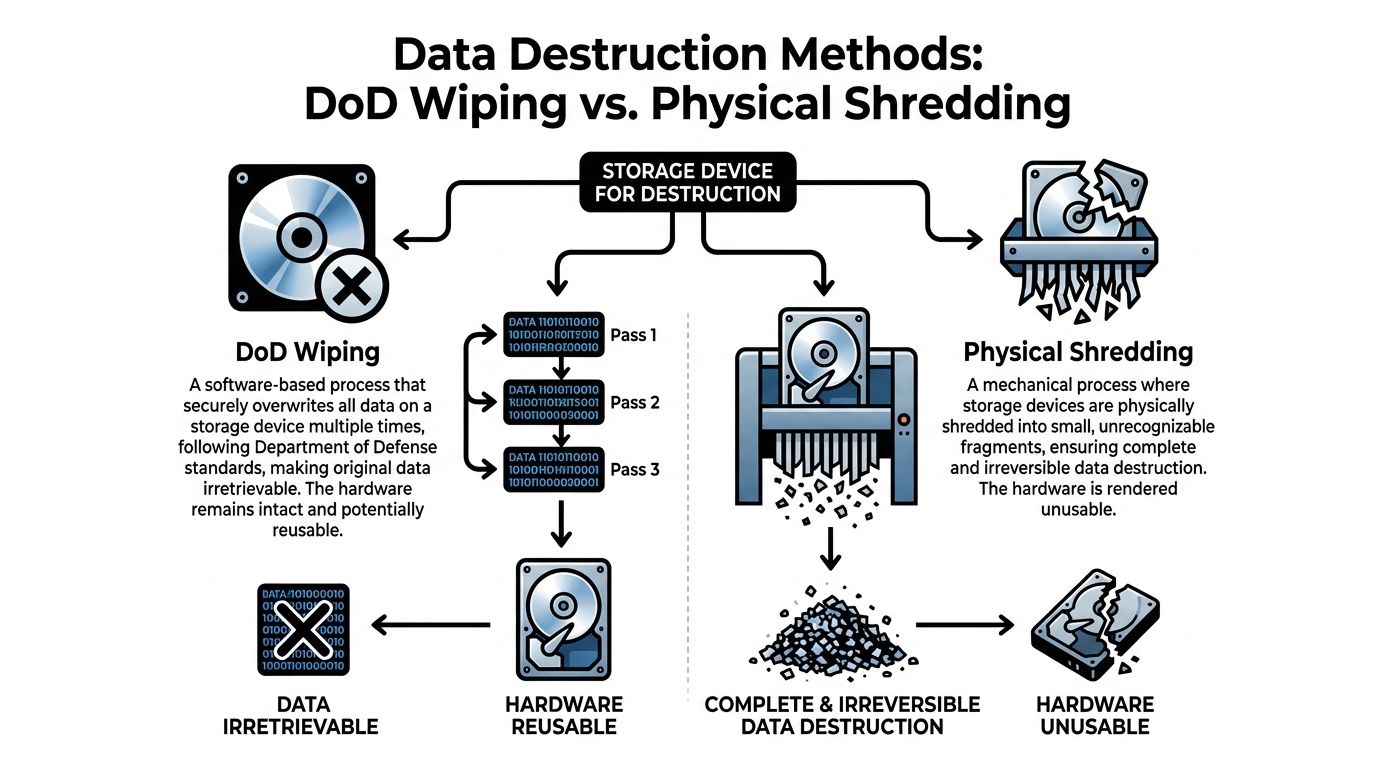
Verified background for this article states that certified ITAD operations use DoD 5220.22-M 3-pass wiping for functional drives and physical shredding for non-functional media, with shredding reducing particles to <2mm to ensure zero recoverability. The same verified data notes that uncertified facilities have a 15% incident rate of hazardous events like battery explosions, underscoring why process control matters, as cited from the EPA electronics management reference.
When wiping is the right call
DoD-style wiping fits assets that still work and may be remarketed, reused internally, or redeployed in less sensitive roles.
The advantage is obvious. You remove data while preserving the hardware. That supports sustainability goals and can improve asset recovery value. It also makes sense when your finance team wants a cleaner path for reusable laptops and desktops rather than turning every retirement event into scrap.
Good vendors should explain the wipe workflow clearly, then verify it. If your team needs a baseline explainer before speaking with a recycler, this guide on data deletion is useful context for understanding what secure erasure should involve.
A sound wiping process includes:
- Device validation before wipe begins
- Standardized overwrite method applied consistently
- Verification step to confirm completion
- Reporting tied back to the specific asset
For organizations comparing methods internally, it also helps to review a practical overview of how to wipe a computer hard drive before deciding which devices can remain intact.
When shredding is the better answer
Physical shredding is the right choice when the device is non-functional, the media can’t be reliably wiped, or your internal policy demands irreversible destruction.
That usually includes failed hard drives, damaged SSDs, loose media from unknown systems, and assets tied to highly sensitive workloads. In those cases, preserving the hardware isn’t worth the residual doubt.
Security judgment: If you can’t reliably validate the drive’s condition and complete a verified wipe, physical destruction is the safer path.
Shredding also has an operational advantage. It simplifies decision-making for mixed lots that contain unknown or failed media. Instead of spending staff time testing edge cases, the vendor can segregate those devices into a destruction stream with stronger finality.
Side-by-side decision logic
| Method | Best for | Main benefit | Main trade-off | Evidence you should get |
|---|---|---|---|---|
| DoD wiping | Functional drives and reusable assets | Keeps hardware intact for reuse or remarketing | Requires the device to be accessible and processable | Asset-linked wipe confirmation or destruction documentation |
| Physical shredding | Failed, obsolete, or highly sensitive media | Irreversible destruction | Hardware cannot be reused | Certificate of destruction tied to released assets |
The wrong approach is using one method for everything because it’s simpler for the vendor.
The better approach is matching the method to the asset, the condition, and the policy risk. That’s what a mature ITAD process looks like in practice.
From Server Room to Smelter Planning Onsite Logistics
The quality of an ITAD project is often decided before the truck arrives.
If your team has ever done a rushed office clear or a server retirement with no staging plan, you already know where friction shows up. Missing asset lists. Confused department ownership. Equipment that’s still mounted when the pickup crew arrives. Staff standing around waiting for a decision on what stays and what goes.

For data center decommissioning, verified background data used for this article states that best practices include RFID asset tagging for 99% traceability, specialized equipment that can keep on-site de-installation downtime to less than 4 hours per rack, and certified facilities achieving 85-90% material reuse rates versus 20% in the informal sector, according to the cited MCR recyclers article.
What a smooth pickup day looks like
In a well-run engagement, the first step is scoping.
The vendor confirms locations, access restrictions, asset types, loading conditions, and whether de-installation is part of the job. If it’s a data center or MDF/IDF environment, they should also ask about rack layouts, cable management, elevator access, dock scheduling, and whether work has to occur after hours.
Then comes inventory discipline. Some organizations provide an internal asset list. Others rely on the vendor to tag and reconcile on-site. Either way, the goal is the same: nothing moves without being accounted for.
A typical sequence looks like this:
- Pre-pickup review with site contact, scope, and handling instructions
- On-site identification of assets by room, rack, department, or category
- Segregation of wipe candidates, shred-only media, resale-eligible systems, and scrap
- Packing and loading using methods suited to the equipment type
- Manifest confirmation before the vehicle departs
Where operational issues usually appear
The most common delays are boring and avoidable.
- Access problems when security, facilities, and IT aren’t aligned
- Scope drift when extra pallets appear on pickup day
- Poor labeling that forces decisions in real time
- Mixed streams where storage media gets bundled with general hardware
For larger environments, this is why many teams use a vendor that can support a more formal data center decommissioning process in Atlanta rather than a basic collection service.
A strong logistics plan protects security because it reduces improvisation. Most chain-of-custody mistakes happen when crews have to make up the process on-site.
What you should prepare internally
Your side of the project matters too.
Before pickup, identify who owns final approval for the release of equipment. Separate anything still under legal hold or pending internal review. Flag devices that require destruction rather than reuse. If you have multiple departments involved, appoint one operational lead.
That prevents the classic pickup-day failure where five people have opinions and nobody has authority.
Decoding the Deal Costs Timelines and Accepted Assets
Most confusion around e recycle near me comes from assuming every provider prices and scopes work the same way. They don’t.
For commercial jobs, the deal usually depends on a mix of labor, logistics, asset type, and whether equipment still has reuse value. Working laptops and late-model systems are different from broken printers, loose cables, or obsolete rack hardware. A realistic quote separates those categories instead of blending everything into one vague line item.
What affects pricing and timing
A vendor typically looks at:
- Asset mix. Reusable IT assets are handled differently from low-value scrap.
- Labor intensity. Packed pallets are simpler than rack de-installation or room-by-room collection.
- Site conditions. Loading dock access, stairs, security procedures, and scheduling windows all matter.
- Data handling requirements. Wiping, shredding, and reporting change the workflow.
Some projects can offset cost when equipment still has remarketing value. Others are strictly a paid removal and destruction exercise. If your inventory includes older but still serviceable machines, it’s worth reviewing how old electronics may still hold value before assuming everything belongs in a pure disposal budget.
Accepted assets and common exclusions
Most commercial ITAD providers accept business electronics such as desktops, laptops, servers, networking gear, storage arrays, and related peripherals.
Exclusions or special-handling items often include appliances, non-IT bulk waste, and certain legacy or hazardous equipment. CRTs, damaged batteries, and mixed non-electronics can also require separate handling depending on the provider’s downstream setup.
The practical move is simple. Send photos, counts, and a rough category list before pickup is scheduled. That reduces change orders, pricing surprises, and day-of confusion.
Your Ready-to-Use Vendor Questionnaire
A vendor interview should feel closer to a security review than a junk removal call.
The goal isn’t to hear polished language. It’s to test whether the provider can answer basic operational, compliance, and downstream questions without evasion. If they can’t, remove them from consideration early.
Use this checklist in calls, RFPs, and procurement review. Ask for documents where the answer should be document-backed.
| Category | Question to Ask | Look for This Answer |
|---|---|---|
| Certifications | Which certifications do you currently maintain? | A direct answer with documentation and an explanation of how the standards affect handling |
| Data destruction | How do you decide between wiping and shredding? | A policy-based answer tied to media condition, sensitivity, and verification |
| Chain of custody | What happens from pickup to final processing? | A clear handoff path with manifests, transport controls, and intake tracking |
| Reporting | What records will we receive after the job? | Certificates, asset lists, and summary reporting that support audit needs |
| On-site work | Can you de-install, pack, and segregate by department or location? | A practical description of labor capability and site workflow |
| Media handling | How do you process failed drives and loose storage media? | Separate handling rules, not a generic “we destroy everything” statement |
| Downstream controls | What happens to reusable assets and scrap materials? | Transparent explanation of reuse, recycling, and downstream processor oversight |
| Insurance and liability | What coverage do you carry and what responsibilities stay with us? | Clear contract language and no ambiguity about scope |
| Scheduling | How far in advance do you need to plan a project like ours? | A specific process for scoping, scheduling, and changes |
| Exceptions | What items do you not accept or require special handling for? | A candid exclusions list with no guesswork |
A few practical rules make this checklist more effective:
- Ask for sample documents before you sign.
- Use the same questions with every vendor so comparisons stay clean.
- Pay attention to hesitation. Evasive answers are useful information.
- Involve security or compliance early if the assets touched regulated data.
If you’re vetting providers in the Atlanta market, Atlanta Computer Recycling is one commercial option for organizations that need business-focused electronics recycling, pickup, data wiping, shredding, and decommissioning support. The key point is broader than any single vendor. Choose the company that can prove its process, document its controls, and operate cleanly inside your environment.
If your team is sitting on retired laptops, boxed-up drives, old network gear, or a pending server shutdown, start the conversation before those assets become an audit problem. Atlanta Computer Recycling works with businesses, schools, healthcare organizations, and public sector teams across metro Atlanta on secure electronics recycling and ITAD projects.