Where Do You Recycle Old Phones In Atlanta For Business

When your company's old mobile phones reach the end of their lifecycle, you have a critical decision to make. For any business, the only responsible choice for recycling them is a certified e-waste recycler or an IT Asset Disposition (ITAD) partner.
While retail drop-off bins and manufacturer mail-in programs exist, they are designed for consumers. For a business, only a specialized commercial service can provide the guaranteed data destruction, compliant documentation, and secure logistics required to protect your organization from significant financial and legal risks.
Why Your Phone Recycling Choice Matters
When an old company phone is ready for retirement, it isn’t just a piece of plastic and glass—it’s a vault holding sensitive corporate and client information. That’s why deciding where to recycle old phones is a critical security decision, not just an operational task. The choice you make directly impacts your company’s data security, regulatory compliance, and environmental reputation.
For an individual, dropping a personal phone in a collection bin is a simple, responsible act. But for a business managing dozens, or even hundreds, of devices, that same approach introduces unacceptable risk. Every one of those devices could still hold fragments of data, from employee PII and customer lists to confidential financial records and network credentials.
Key Factors For Businesses To Consider
When evaluating recycling options, you must think beyond simply removing old hardware from your facility. The right partner provides a secure, unbroken chain of custody from the moment those devices leave your possession.
Here’s what should be on your vetting checklist:
- Data Security: Is the data destruction process certified and guaranteed? A simple factory reset is insufficient and will not stop a determined actor from recovering sensitive business data.
- Compliance: Can the recycler provide official documentation, such as a Certificate of Destruction? This is your proof of compliance with data privacy regulations like HIPAA, GLBA, or GDPR.
- Logistics: Can they handle a bulk pickup for a large number of devices, or does the logistical burden fall on your team?
- Environmental Standards: Is the partner certified to R2 or e-Stewards standards? This certification ensures that all materials are handled responsibly and in compliance with federal and state laws.
Choosing a certified partner transforms phone recycling from a potential liability into a secure, documented component of your IT asset management strategy. It ensures your company's data is irretrievably destroyed and all environmental regulations are met.
Getting these details right is the first step in building a robust IT asset disposal plan. To dive deeper into building a complete strategy, you can learn more about secure IT disposal in our detailed guide.
The Hidden Risks In Your Old Company Phones
Every old company phone stored in an office closet is more than just obsolete hardware—it's a potential liability. For IT and operations managers, these retired devices create a silent but significant business risk. It’s easy to view them as a simple disposal task, but they are concentrated packages of sensitive corporate data awaiting a potential breach.
Consider that storage closet a "digital landfill." It’s an unmanaged, insecure repository of devices that still contain fragments of their operational past—from client contact information and internal emails to network credentials and financial records. Improper disposal turns a manageable asset into a ticking time bomb.
The Scale Of The E-Waste Problem
The challenge of managing end-of-life electronics is growing at an alarming rate, and the global smartphone recycling crisis is now one of the fastest-growing waste management issues facing organizations.
In 2022 alone, an estimated 5.3 billion mobile phones became e-waste, joining billions of other devices already discarded. For businesses, this trend highlights a critical need for a secure and compliant disposal strategy. You can explore more about this issue in this detailed report on smartphone recycling trends.
This sheer volume transforms a minor logistical headache into a major security threat. When you're deciding where to recycle old phones, the stakes are much higher than for an individual. One improperly handled device can expose your entire organization to significant harm.
More Than Just Data Breaches
While the threat of a data breach is the most obvious risk, the dangers lurking in your digital landfill extend much further. Failing to manage e-waste responsibly opens the door to a range of severe consequences.
- Hefty Environmental Fines: Regulations like the Resource Conservation and Recovery Act (RCRA) impose strict penalties for improper e-waste disposal. A single violation can lead to fines costing tens of thousands of dollars per day.
- Severe Brand Damage: A data breach or an environmental scandal linked to your company’s discarded phones can destroy customer trust and tarnish your brand's reputation for years.
- Compliance Violations: For industries like healthcare or finance, failing to properly destroy data on old devices can violate regulations like HIPAA, leading to crippling fines and legal action.
The core issue isn't just about getting rid of old hardware. It's about a complete chain of custody that guarantees the permanent and verifiable elimination of data. Anything less leaves your company exposed.
This is why certified recycling isn't just an eco-friendly choice; it's a fundamental component of modern risk mitigation. For a deeper look into eliminating these risks, check out our guide on professional IT asset destruction.
Why a Factory Reset Isn't Enough for Business Data
When determining where to recycle old phones, it's a common misconception that a factory reset is sufficient to protect corporate data. For a personal phone, that may be an acceptable risk. For business phones, that assumption can lead to a disastrous data breach.
A factory reset primarily removes pointers to data, not the data itself. To the average user, the device appears empty. However, the actual data—client records, emails, financial reports, employee information—often remains on the memory chips, recoverable with specialized software.
The Ghost in the Machine
Think of a phone's storage as a library. A factory reset doesn't destroy the books; it just removes the card catalog. The information remains on the shelves, accessible to anyone who knows how to find it without a guide.
With powerful data recovery software widely available, a motivated actor can easily reconstruct "deleted" information. This residual data can be a goldmine of saved passwords, network credentials, confidential documents, and customer PII. For any business, leaving that information exposed is an unacceptable risk.
The fallout from a data breach on a single, improperly wiped phone can be devastating. It could lead to massive fines under regulations like HIPAA or CCPA, trigger expensive lawsuits, and cause permanent damage to your company's reputation.
True Data Destruction for Businesses
To completely erase data and meet compliance standards, you need a process that either overwrites the storage media or physically destroys it. This is the equivalent of shredding every page of every book in that library. Anything less is a gamble.
Certified data destruction follows strict, verifiable methods to ensure information is permanently irrecoverable. For mobile devices, it comes down to two main approaches:
- Secure Data Wiping: We use specialized software to overwrite the phone's entire memory with random data, multiple times. A process like the DoD 5220.22-M 3-pass wipe overwrites the original data so thoroughly it can never be recovered.
- Physical Destruction: When a device is damaged, non-functional, or cannot be reliably wiped, the only guaranteed solution is to physically shred it. The phone is fed into an industrial shredder that pulverizes its internal components—including memory chips—into tiny, useless fragments.
Both methods provide a definitive end to the data's lifecycle, which is an absolute requirement for any organization handling sensitive information. While the tools differ from those used on traditional hard drives, the principle of total data elimination is the same. You can learn more about professional hard drive wiping methods to see the kind of technical standards involved.
Choosing The Right Commercial Recycling Partner
For a business, deciding where to recycle old phones isn't about convenience—it's about due diligence. While mail-in programs and carrier buy-backs are suitable for consumers, they lack the robust security and compliance guarantees that corporations require. Selecting the right partner means scrutinizing their processes for data destruction, chain of custody, and environmental accountability.
Consider it analogous to choosing a financial institution. You wouldn't entrust your company's funds to an unvetted entity; you would demand proof of security, insurance, and a solid track record. The same logic applies to your retired electronics, which are packed with sensitive data. A certified IT Asset Disposition (ITAD) partner functions as a secure vault for your retired assets, providing essential safeguards that generic programs cannot.
This flowchart highlights a critical decision point for any IT manager grappling with how to handle old devices.
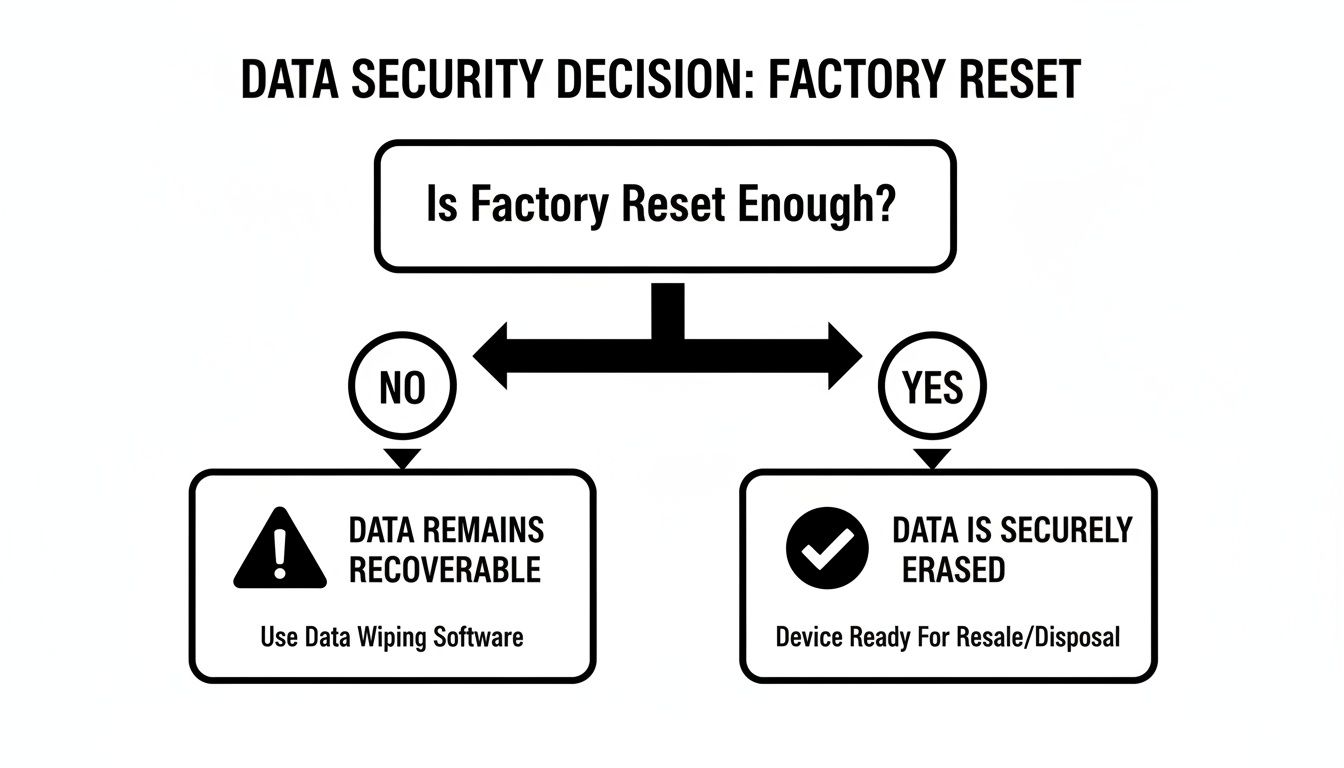
As you can see, relying on a simple factory reset is a significant gamble for corporate data. True security demands professional intervention.
Evaluating Your B2B Recycling Options
When vetting a potential partner, look beyond the price. The true cost of a poor choice isn't the service fee—it's the fallout from a data breach, non-compliance fines, or a damaged reputation. A specialized commercial recycler provides a multi-layered defense against these risks.
Here are the absolute must-haves when evaluating a partner:
- Data Security Certifications: Look for a commitment to standards like NIST 800-88 for media sanitization. They must offer certified data destruction methods, including DoD 5220.22-M 3-pass wipes and physical shredding.
- Verifiable Chain of Custody: Your partner must provide meticulous documentation that tracks every device from your facility to its final disposition. This includes serialized inventory lists and a final Certificate of Destruction.
- Logistics for Bulk Pickups: The partner must be equipped to handle bulk pickups of hundreds of devices. A professional ITAD service will manage secure packing, locked transport, and efficient logistics.
- Environmental Compliance: Certifications like R2 (Responsible Recycling) or e-Stewards are non-negotiable. These credentials guarantee that your e-waste is managed ethically and will not be illegally exported or sent to a landfill.
Why Certified ITAD Vendors Are Superior
Manufacturer and carrier programs are designed for low-volume consumer returns. They may offer store credit and perform a basic factory reset, but they almost never provide the detailed, auditable proof of data destruction that businesses need to comply with regulations like HIPAA or GDPR.
A certified ITAD partner’s entire business is built on providing auditable security and mitigating risk for companies. They assume the liability for your data from the moment of collection, offering a level of assurance that retail-focused programs cannot match.
Their B2B focus means they understand the operational realities of managing a corporate device lifecycle. This includes handling large-scale pickups and providing the necessary documentation to satisfy internal audits and external regulators. For any organization that takes data security and environmental responsibility seriously, partnering with a dedicated electronic waste recycling company is the only logical and secure path forward.
How Certified Recycling Protects Your Bottom Line
Strategic phone recycling is not an operational expense—it's a financial decision that actively protects your company’s bottom line. It's time to view certified recycling as a powerful risk management tool rather than a simple disposal cost.
The fee for a certified recycling service is a comprehensive insurance policy. While some value may be recovered from materials, the real financial benefit comes from preventing catastrophic costs down the road.
The Real Cost of Doing Nothing
When old company phones are disposed of without a proper plan, the financial fallout can be devastating. The consequences extend far beyond the asset's residual value, creating long-term liabilities. The "cost of inaction" is a real and measurable threat.
The potential financial impacts can be staggering:
- Regulatory Fines: Non-compliance with environmental laws like RCRA or data privacy regulations like HIPAA can lead to fines costing tens of thousands of dollars per violation, per day.
- Legal Fees: A data breach traced back to an improperly wiped phone can trigger expensive lawsuits from customers or employees, resulting in prolonged and costly litigation.
- Reputation Damage: A public data breach or environmental scandal can shatter customer trust. The resulting loss of business and decline in market value can far exceed any initial fine.
Partnering with a certified recycler is a proactive investment in your company's financial health. The documented proof of secure data destruction is your best defense against compliance violations and legal claims.
The mobile phone recycling market has seen explosive growth, indicating that businesses now grasp the economic importance of e-waste management. In 2023, the global market was valued at USD 3.5 billion and is projected to reach USD 9.8 billion by 2032. This surge is driven by regulated industries like healthcare, finance, and government that require compliant solutions to mitigate risk. You can find more insights on mobile phone scrap trends from Accio.
To truly protect your business, it’s critical to understand how certified recycling fits into your broader data privacy compliance strategy. A formal, documented process ensures you’re meeting your legal obligations. This is why a formal Certificate of Destruction is not just a value-add—it's a non-negotiable component of any secure IT asset disposal program.
Your Step-By-Step Corporate Phone Recycling Plan
Implementing a repeatable, secure process for disposing of old company phones is essential for protecting your organization. A casual, disorganized approach invites data breaches and compliance violations. This framework provides a structured approach for managing retired mobile devices securely from start to finish.
Treat this process with the same rigor as decommissioning any other sensitive IT asset. You wouldn't unplug a server and leave it unsecured, and company phones demand the same documented and secure workflow. Following these steps ensures every device is accounted for and its data is handled properly.
Internal Preparation Checklist
Before engaging a recycling partner, internal preparation is critical. This phase focuses on securing the devices and preparing them for a smooth, auditable handover. A disciplined internal process mitigates risk and strengthens security from the outset.
- Create a Detailed Inventory: Log every phone by its serial number, company asset tag, and last assigned user. This list is the foundation of your chain of custody.
- Consolidate and Secure Devices: Gather all phones into a single, locked, access-controlled location. This prevents asset loss or unauthorized access.
- Remove SIM and SD Cards: Physically remove and destroy all SIM and memory cards. These components can retain sensitive contacts and other data fragments.
External Vetting and Logistics
Once your assets are prepared and secured internally, it’s time to engage a certified partner for final disposition. This stage is about due diligence to ensure the chosen partner meets your stringent security and compliance requirements.
Selecting your external partner is the most critical decision in this process. Their certifications, security protocols, and documentation become a direct extension of your own risk management strategy.
Finalize the plan with these steps:
- Vet a Certified Recycler: Confirm they hold an active R2 or e-Stewards certification. Request proof of serialized reporting and their ability to provide official Certificates of Data Destruction.
- Schedule a Secure Pickup: Arrange for pickup using locked transport and verify their chain-of-custody procedures from the moment of collection.
- Receive and File Documentation: After processing is complete, obtain your Certificate of Destruction. File it with your original inventory records to formally close the loop on the assets' lifecycle.
Your Business Phone Recycling Questions, Answered
When planning the disposal of old company phones, IT managers and business owners often have several key questions. Here are answers to common concerns to help you build a secure and compliant disposal strategy.
Is A Factory Reset Good Enough To Wipe Our Data?
Absolutely not. A factory reset is a preliminary step and is insufficient for any business device that has handled sensitive data. Data recovery tools can often restore information from a "wiped" phone, exposing your company to liability.
To be secure and compliant with regulations like HIPAA, professional data destruction is required. This involves methods like a DoD 5220.22-M 3-pass wipe or physical shredding—services that a certified ITAD partner provides to render data completely unrecoverable.
Think of a factory reset as locking a filing cabinet but leaving the key on top. It appears secure, but it is not. True data security ensures that information is permanently destroyed.
What Actually Happens To The Phones After You Pick Them Up?
Once the phones are securely transported to our facility, they undergo a triage process. Each device is evaluated.
Phones with reuse potential are professionally data-wiped according to NIST 800-88 standards, fully tested, and refurbished for resale. Devices that are broken, obsolete, or fail sanitization are de-manufactured. All components containing data are physically destroyed to guarantee security. We then recover valuable materials like precious metals, plastics, and glass, which are sent to certified downstream processors to be used in new products. This process ensures hazardous e-waste is kept out of landfills.
How Much Does It Cost To Recycle Business Phones?
The cost depends on the volume and type of devices, as well as the specific services required. However, for most businesses, the service is surprisingly affordable and can sometimes be free, depending on the residual value of the assets.
At Atlanta Computer Recycling, services like secure data wiping are often included as part of a comprehensive ITAD solution. The real value is not in the service cost but in avoiding the significant financial and reputational damage of a data breach or compliance fine. We provide a custom quote based on your inventory and needs to ensure the process is transparent and efficient.
Protect your business with a partner who understands certified, compliant, and secure electronics recycling. Atlanta Computer Recycling offers ITAD solutions designed for organizations across the Atlanta metro area.