Navigating the Weather Forecast Roswell GA: A Guide for Commercial Operations

For businesses managing critical infrastructure and sensitive hardware, the weather forecast roswell ga is more than a weather report—it's a vital component of operational risk management. When dealing with high-value IT assets, a sudden heatwave or unexpected thunderstorm isn't just an inconvenience; it's a direct threat to your assets, project timelines, and financial bottom line.
How Roswell GA Weather Impacts Corporate Logistics and Security
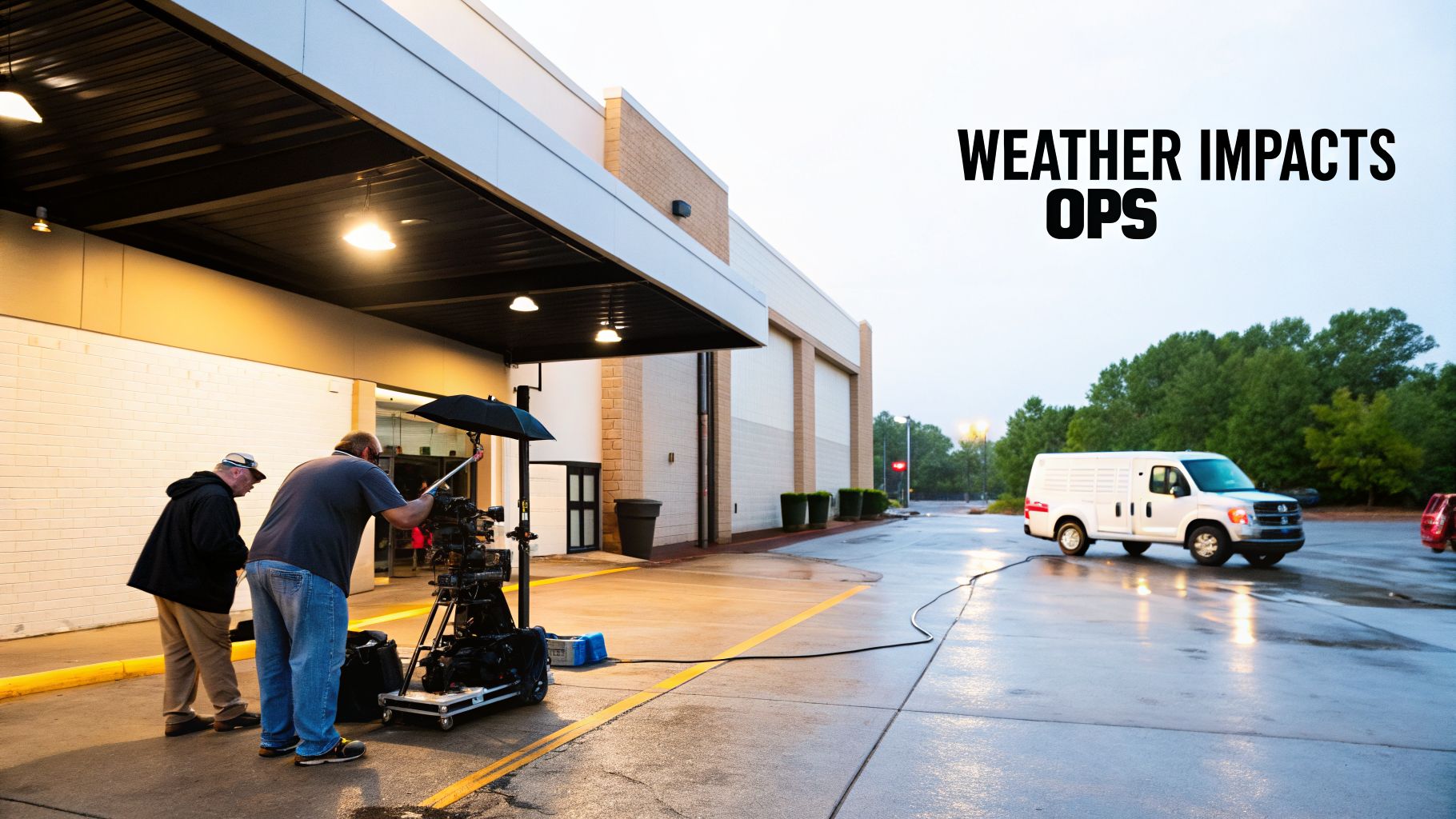
The weather in Roswell has a direct and immediate impact on the security of corporate IT asset pickups. Imagine our logistics team is on-site to decommission a server farm, and a severe thunderstorm materializes. If the loading dock is exposed, your valuable data-bearing assets are now vulnerable.
Minimal exposure to moisture can cause catastrophic failure in sensitive electronics, leading to data loss and rendering valuable hardware worthless. Furthermore, wet and slippery conditions introduce significant safety hazards for our personnel managing heavy and expensive equipment. A single misstep can result in damaged assets, project delays, or personnel injury, all of which introduce liability.
The True Financial Cost of Unpredictable Weather
For our commercial and enterprise clients, the stakes are exceptionally high. A delayed or compromised IT Asset Disposition (ITAD) project can disrupt data center migrations, office relocations, and critical compliance timelines. This is precisely why the local Roswell forecast is integrated into our core logistics and project management framework.
We don't just anticipate clear skies; we engineer our process for every contingency. By actively monitoring weather patterns, we safeguard your assets from the moment we arrive on your property until final processing.
Our entire operational workflow is designed with weather-awareness to mitigate specific business risks:
- Asset Protection: We deploy weather-resistant coverings and utilize enclosed, climate-controlled transport to shield your equipment from rain, humidity, and extreme temperatures.
- Personnel Safety: Our team adheres to stringent OSHA-compliant safety protocols for operating in adverse conditions, ensuring every pickup is executed safely and professionally.
- Schedule Integrity: We maintain transparent communication. If adverse weather is forecasted, we collaborate with you to adjust the schedule, preventing last-minute disruptions and maintaining project momentum.
For immediate operational planning, here is a snapshot of the upcoming forecast.
Roswell GA Weather Conditions: A Strategic Overview
| Timeframe | Temperature (°F) | Conditions | Precipitation Chance |
|---|---|---|---|
| Now – 12 hours | 72-78° | Partly Cloudy | 10% |
| 12 – 24 hours | 65-75° | Scattered Showers | 40% |
| 24 – 48 hours | 68-80° | Thunderstorms Likely | 70% |
| 48 – 72 hours | 70-82° | Sunny | 5% |
This proactive, data-driven planning ensures your ITAD project is executed flawlessly, regardless of the atmospheric conditions.
Understanding these logistical variables underscores why monitoring the local forecast is our first step in secure asset management. To learn more about how local conditions can affect commercial operations, explore our detailed guide on weather in Roswell, GA.
Why Weather Poses a Material Risk for IT Asset Disposition
Transporting sensitive IT equipment is not a standard moving service. It is a high-stakes logistical operation where minimal precipitation can have significant financial and compliance-related consequences. Consider a wet loading dock: it represents more than a slip hazard—it is a direct threat to your data security if a server containing proprietary information is dropped and physically breached.
This is precisely why the daily weather forecast roswell ga is a critical data point in our operational planning. High winds can make handling large server racks hazardous, while a sudden downpour can compromise the integrity of both your equipment and its anti-static protective packaging.
From Temperature Fluctuations to Logistical Failures
Extreme temperatures present another significant risk factor. The humid subtropical climate in Georgia creates a unique set of challenges for electronics logistics. Roswell, for example, has an annual average temperature of 61.3°F, a clear indicator of Southern weather patterns that demand meticulous planning. You can review the complete historical context by exploring Roswell's historic climate data.
Leaving sensitive electronics on a hot loading bay or within a non-climate-controlled vehicle during a Georgia summer can cause irreversible thermal damage to micro-circuitry. Conversely, winter cold can make components brittle and susceptible to fracture during transit.
A professional ITAD provider's function is to anticipate and neutralize these threats. We don't react to storms; our process is architected on a foundation of proactive risk management to protect your capital assets and sensitive data at every stage.
This diligent, proactive methodology is the hallmark of secure ITAD. It provides IT managers, compliance officers, and data center operators with the assurance that their assets are protected by a proven system, not exposed to environmental chance. You can see how this methodology is applied in our complete guide to IT asset disposition in Atlanta.
In some cases, severe weather necessitates temporary asset staging. In these scenarios, access to secure, flexible storage units for business allows us to maintain the chain of custody and project continuity. This commitment to preparedness is what distinguishes a true logistics partner.
Strategic Planning for E-Waste Logistics Around Roswell's Climate
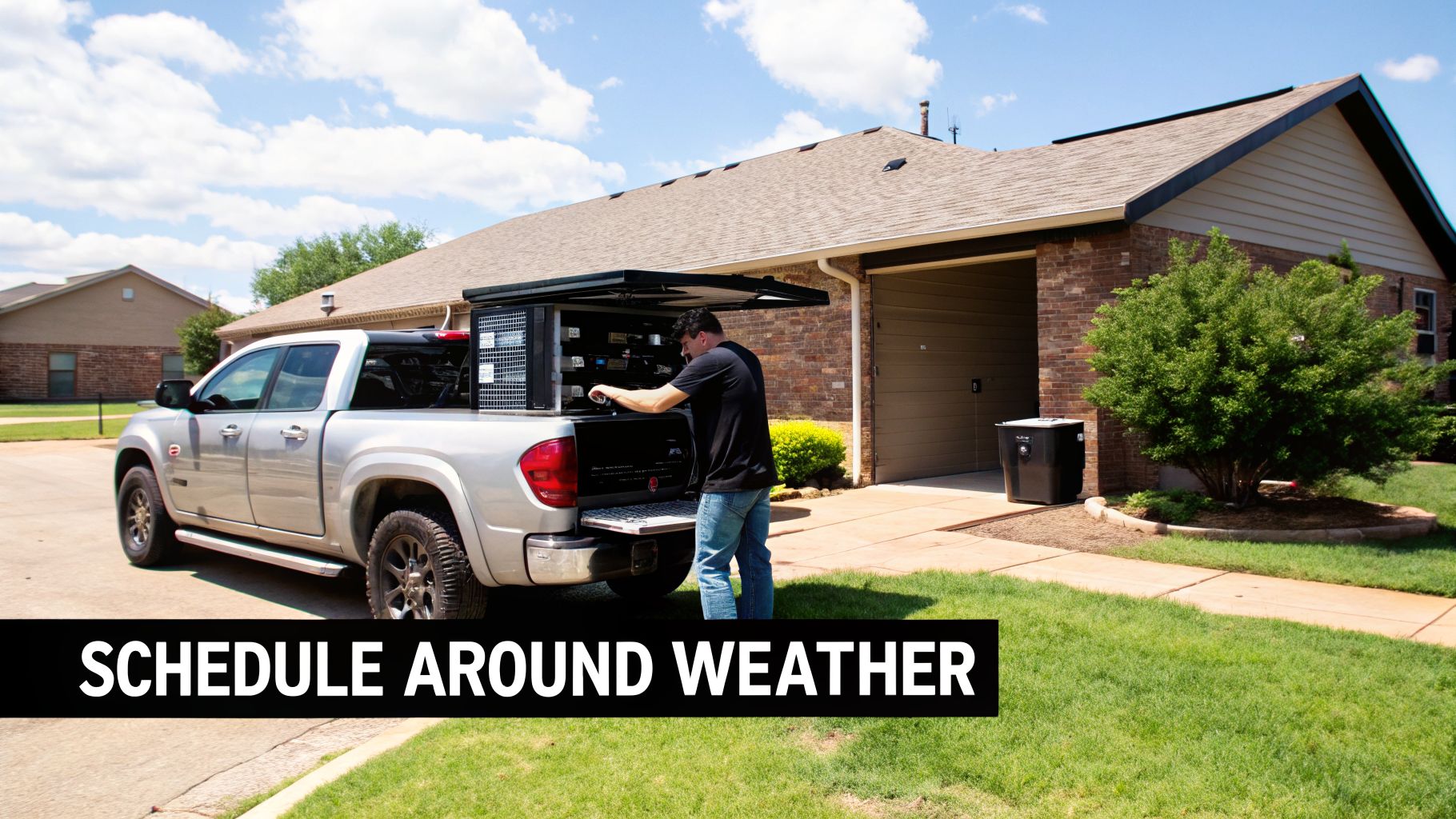
This is where our localized expertise provides a tangible advantage for your business. We don't simply react to adverse weather; we architect our service schedules around the local weather forecast roswell ga to guarantee secure and efficient logistics for every project. This is a critical component of our reliable service delivery model.
Consider a typical Georgia afternoon with a high probability of severe thunderstorms. If your business has an outdoor data center equipment pickup scheduled, our logistics team is already monitoring the situation. We will proactively contact your project lead to discuss mitigation options, such as shifting the pickup to a safer time window. This simple, preemptive action protects your high-value assets from water damage and ensures the safety of all on-site personnel.
Our attention to environmental detail extends far beyond precipitation.
Adapting to Any Forecast for Business Continuity
During a summer heatwave, for example, we ensure our vehicles are pre-cooled to a specified temperature long before arriving at your facility. This may seem like a minor detail, but this step is crucial for protecting sensitive electronics from thermal shock and damage during transit. It is one of many ways we mitigate risks you may not have considered.
For our clients with stringent regulatory and compliance requirements, such as those in healthcare and finance, this level of detailed, proactive planning offers essential peace of mind. Your ITAD projects are executed with meticulous care, irrespective of the forecast.
This proactive communication and scheduling flexibility form the foundation of our client partnerships. We manage the logistical complexities so you can remain focused on core business objectives. Our weather-aware procedures are designed to ensure a seamless, secure process from start to finish. Learn more about how we integrate the local climate into our operations with our complete guide to Roswell, GA weather.
By preparing for every environmental contingency, we reinforce our commitment to protecting your assets and data from the moment we arrive. This foresight is what elevates our logistics from a service to a strategic advantage.
Navigating Atlanta's Seasonal Weather for Large-Scale Projects
When orchestrating a large-scale IT asset decommissioning, a daily forecast is insufficient. Strategic planning requires a seasonal perspective. Understanding the broader patterns of Atlanta's climate allows us to schedule complex, multi-phase operations months in advance, effectively engineering out predictable weather-related disruptions.
Consider the summer thunderstorm season. From June through August, we recognize that sudden, intense downpours are a high-probability risk. This represents a high-risk window for transferring sensitive electronics from a facility to our transport vehicles. To mitigate this, we strategically schedule the most exposed logistical phases of a project for morning hours, when convective storm development is far less likely.
Winter and Year-Round Logistical Challenges
Conversely, North Georgia winters can introduce disruptive ice events. While significant snowfall is uncommon, a thin glaze of ice on roadways and loading docks can bring logistics to a complete halt. For this reason, we build contingency days into all winter project timelines, ensuring a minor meteorological delay does not derail your entire project schedule.
High humidity is another persistent factor we contend with year-round. Even on days without rain, ambient moisture can be a silent threat to electronic components. This is precisely why our climate-controlled transport and secure handling procedures are non-negotiable, regardless of the season. We leverage historical weather data for this type of long-range planning. For more on regional conditions, our guide on Alpharetta, Georgia weather offers valuable context.
The dramatic seasonal shifts in Roswell, GA are a critical planning variable for IT professionals managing data center migrations. September, for example, often sees average temperatures near 69°F, but daily highs can still reach 84°F amidst frequent thundershowers, creating a complex mix of heat and moisture risks.
This macro-level view of the weather forecast roswell ga patterns allows us to function as a strategic partner, not merely a pickup service. You can explore these trends in greater detail by reviewing Roswell's yearly weather history. This level of foresight is especially crucial for the large corporations and government agencies we serve, who require absolute operational reliability.
Our Severe Weather Protocol for Secure Commercial Logistics
When managing sensitive IT assets for enterprise clients, surprises are unacceptable. That’s why we monitor the weather forecast roswell ga with the same diligence as your own risk management team. If there is any indication of disruptive weather—from flash flood warnings to high wind advisories—our team immediately activates our communication protocol.
We believe in collaborative decision-making. Before a storm system becomes a threat, your dedicated project manager will contact you to discuss the potential for a schedule adjustment. Our primary objective is always the security of your equipment and the safety of all personnel; we will not proceed until we have an agreed-upon plan that meets your operational needs.
This decision tree illustrates our high-level approach to seasonal risk mitigation.

As shown, we have developed specific strategies to manage Georgia’s summer heat, potential winter ice, and year-round precipitation risks, ensuring business continuity.
Securing Assets and Ensuring Project Continuity
Should adverse weather develop unexpectedly during an on-site project, our field team is trained for rapid response. They will immediately secure all equipment from the elements by moving assets to a secure indoor location or protecting them within our sealed, enclosed vehicles.
For our clients in the healthcare, financial, and government sectors, there is zero tolerance for error. Our severe weather protocols are designed to ensure data protection and chain of custody remain the top priority, regardless of the forecast.
These protocols are not theoretical. Roswell’s climate is highly variable—long-term data indicates overcast conditions 40% of the time, and while March temperatures average 59.03°F, they are prone to wide swings. This inherent unpredictability is precisely why our contingency planning is so robust.
Of course, asset protection begins before our arrival. Knowing how to pack electronics for moving is a critical first step for your internal teams. This type of detailed preparation is a key part of our https://atlantacomputerrecycling.com/business-continuity-planning-checklist/ and ensures your assets are protected at every project stage.
Weather, Logistics, and Your ITAD Project: Managing Expectations
When you are overseeing a corporate IT asset disposition project, an unforeseen weather event is a costly variable. We frequently field questions about how the weather forecast roswell ga could impact a scheduled service, so we have outlined our standard operating procedures to provide clear answers.
How Is Our Equipment Protected During Rain or Snow?
Your assets are never exposed to the elements. This is a non-negotiable aspect of our service. Before any equipment leaves your facility, it is securely packed into weather-resistant containers. From there, it is moved directly into our fully enclosed, climate-controlled trucks.
We have a strong operational preference for covered loading docks. If your facility lacks one, we deploy our own temporary shelters to create a protected, dry channel from your building entrance directly to our vehicle. This is a simple but highly effective system that guarantees a secure transfer.
What Is the Communication Plan for Weather-Related Delays?
We maintain constant surveillance of local and regional forecasts. If adverse weather appears probable, your account manager will contact you a minimum of 24 hours prior to your scheduled service to discuss and align on a course of action.
If a storm materializes unexpectedly while we are on-site, our team lead maintains continuous communication with your designated point of contact. Decisions are made collaboratively and in real-time, always prioritizing the safety of personnel and the security of your equipment.
We never impose a fee for rescheduling a pickup due to legitimate weather-related safety concerns. A safe, controlled delay is always preferable to a high-risk operation. This is a core part of our risk management philosophy and our commitment to being a true business partner.
Weather Event Impact Matrix on ITAD Services
To provide a clear understanding of our response framework, we have developed this quick-reference matrix. It details how specific weather conditions can impact logistics for your electronics recycling pickup and the mitigation strategies we employ to maintain project integrity.
| Weather Condition | Potential Impact on Service | ACR's Mitigation Strategy |
|---|---|---|
| Heavy Rain/Thunderstorms | Slick surfaces increase handling risks; potential for water damage during loading. | We pause all outdoor transport, utilize protective coverings, and will reschedule if conditions are deemed unsafe for personnel or assets. |
| Extreme Heat (>90°F) | Risk of thermal damage to sensitive electronics during transit. | Our vehicles are pre-cooled to regulated temperatures, and we minimize asset exposure time on open loading docks. |
| Ice/Freezing Rain | Hazardous road conditions for our fleet and unsafe loading dock environments creating liability. | We will postpone service until roadways and on-site conditions are confirmed to be safe for our team, vehicles, and your assets. |
Ultimately, our strategic objective is to complete your ITAD project securely and on schedule, regardless of the forecast.
For a partner who proactively manages every logistical detail, including the weather, trust Atlanta Computer Recycling. Get a free quote for your ITAD needs today.