Palmetto GA County: A Strategic Guide for Commercial Operations


For businesses operating in Palmetto, Georgia, a seemingly simple question can have complex operational consequences: what county are you in? The city of Palmetto uniquely straddles two distinct county lines—Fulton and Coweta.
This is not a mere geographical footnote. For any facilities manager, IT director, or business owner, confirming which side of the county line your commercial property resides on is a critical first step for compliance. Your physical address dictates tax liabilities, permitting processes, and local environmental regulations.
Navigating Palmetto's Dual-County Jurisdiction for Businesses

The county line running through Palmetto means your business operations are governed by either Fulton County or Coweta County regulations. This dual jurisdiction directly impacts your corporate tax obligations, building permits, and—most importantly for IT and operations—your legal responsibilities for e-waste disposal and secure data destruction.
Consider this scenario: two companies on the same industrial park road could be subject to entirely different regulatory frameworks. One might need to adhere to Fulton County's specific e-waste programs, while the other must comply with Coweta County's distinct mandates.
To clarify, here is a breakdown of Palmetto’s administrative structure.
Palmetto GA County Jurisdiction for Commercial Entities
| Geographic Area of Palmetto | Governing County | Primary Administrative Body |
|---|---|---|
| Northern & Eastern portions | Fulton County | Fulton County Board of Commissioners |
| Southern & Western portions | Coweta County | Coweta County Board of Commissioners |
This distinction is essential when planning any IT asset retirement, office consolidation, or data center decommissioning project.
For example, a business near the Palmetto Library at 9111 Cascade Palmetto Hwy falls under the Fulton County system. However, a warehouse just down the road could easily be governed by Coweta County.
Before initiating the disposal of a single server or workstation, you must confirm which county’s rules apply to your facility. If your business is in the Coweta portion of the city, our guide on Coweta County recycling centers provides further details on its specific programs. Verifying your jurisdiction is the foundational step for a compliant and secure IT disposal strategy.
How Palmetto's Dual-County Status Impacts Your Business
You've established that Palmetto sits in two counties. How does this translate into tangible business impacts? This is more than a local factoid—your physical address dictates everything from property tax rates and zoning laws to which emergency services respond to your facility.
For IT and operations managers, this split jurisdiction is especially critical for managing electronic waste and data security mandates. The compliance requirements in Fulton County can differ significantly from those in Coweta County. This creates a complex regulatory landscape where an accepted practice on one side of Palmetto could be a costly violation on the other.
Practical Consequences for Local Businesses
As Palmetto continues its strategic growth, pressure mounts on local businesses to implement compliant processes for end-of-life electronics. With a population projected to reach 5,382 in 2025, reflecting a steady 3.2% annual growth rate, the city is an increasingly vital commercial hub in the metro area. You can find more data on the city's expansion on the Palmetto demographics page.
This growth fuels business expansion, technology upgrades, and, consequently, a greater volume of e-waste. Knowing which county’s rules apply to your specific location is no longer just good practice; it is essential for maintaining compliant and sustainable operations.
For businesses navigating Palmetto's unique dual-county environment, understanding how to effectively rank higher on Google Maps can significantly enhance local visibility and customer reach. This ensures that customers in both Fulton and Coweta counties can find you.
This county-specific framework affects numerous aspects of your operations, a challenge seen in other split-jurisdiction cities. For example, companies with multiple facilities across the metro Atlanta area will find that regulations change from one city to the next. We cover this in more detail when discussing other areas, like Milton, GA, and its county.
Your exact location within Palmetto dictates:
- Tax Liabilities: Both property and sales tax rates are determined at the county level.
- Permitting Processes: Obtaining business licenses or construction permits involves different agencies and procedures.
- Compliance Mandates: E-waste disposal and data security regulations are often enforced by county authorities.
Successfully operating a business within the Palmetto, GA county structure requires careful attention to these local regulatory details.
Navigating E-Waste and Data Security Rules
Once you determine which side of the Palmetto, GA county line your business occupies, the next step is to master the regulations for electronics disposal and data security. This is where compliance becomes most critical. Fulton and Coweta counties each have their own protocols for managing e-waste, including different rules on what materials are banned from landfills.
For any organization, disposing of old computers or servers in a dumpster is not only environmentally irresponsible—it is often illegal and creates a severe security risk. Federal laws like HIPAA and FACTA, which govern data privacy, apply universally regardless of county. If you are an IT manager at a Palmetto-based financial institution, for example, improperly disposing of a single workstation with client data could result in catastrophic fines and reputational damage.
Comparing County and Federal Standards
The regulatory landscape can seem complex. Fulton County may have specific programs for managing hazardous materials in electronics, while Coweta County might focus on achieving landfill diversion targets. Both counties aim to prevent environmental harm, but their methodologies and enforcement can vary significantly.
This is why your physical location is paramount, as it determines which local ordinances apply.
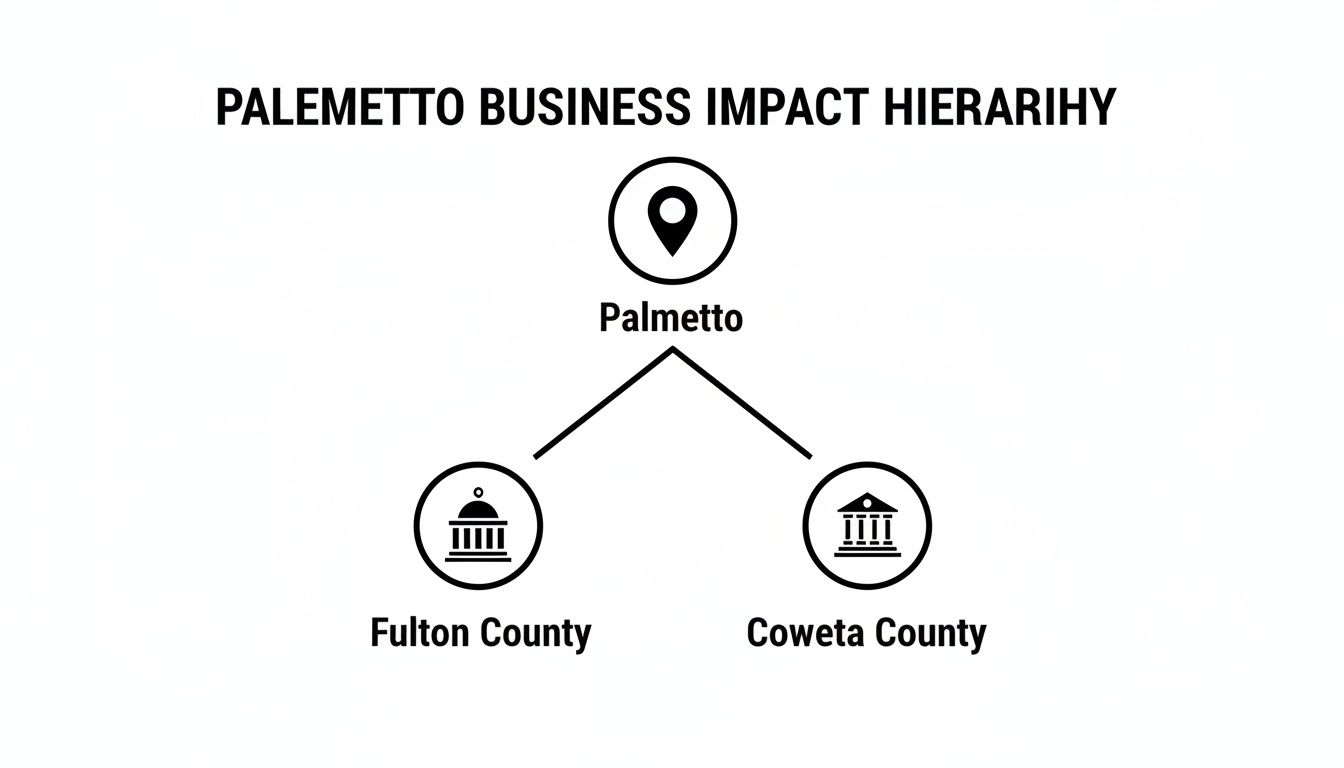
This diagram illustrates how your business's location dictates whether you report to Fulton or Coweta County for local compliance matters.
However, regardless of your county, federal laws establish a non-negotiable baseline for data protection. To ensure compliance, businesses should be proactive with their data security and compliance pentests.
The most significant error a business can make is assuming county e-waste guidelines fulfill their data security obligations. While counties regulate physical waste, protecting the data on those devices is 100% your responsibility under federal and state laws.
This is why a documented data destruction process is non-negotiable for any commercial entity. Learn more in our guide to secure data destruction services in the Atlanta area. A certified process provides a clear audit trail to prove you have met your legal obligations, shielding your business from liability.
Your Partner for Compliant IT Asset Disposition
Navigating the county-specific rules for electronics disposal in Palmetto can be a complex and time-consuming task. Atlanta Computer Recycling (ACR) eliminates this complexity. We serve commercial clients across the entire city, whether your facility is in Fulton or Coweta County, providing a single, reliable partner for all your IT asset disposition (ITAD) needs.
Our services are engineered for businesses managing technology refreshes, office moves, or data center decommissioning. We offer professional on-site de-installation, where our team handles the entire process of disconnecting and removing legacy equipment. From there, we manage secure packing and logistics, ensuring every asset is tracked and transported safely from your facility with minimal disruption to your operations.
Peace of Mind Through Certified Processes
For any business, data security is non-negotiable. That’s why every hard drive we collect undergoes a free, documented data wipe using the DoD 5220.22-M 3-pass standard. This thorough process guarantees that all your sensitive corporate and client information is permanently erased, protecting you from the risk of a data breach.
Imagine a financial firm in Palmetto retiring its old servers. Partnering with ACR means they get more than just simple equipment removal.
After the servers are securely processed, the firm is issued a Certificate of Destruction. This official document becomes a critical part of their audit trail, proving they met all legal and regulatory requirements for data disposal—a vital step for any business handling confidential information.
This certified process delivers the confidence that comes from working with a proven expert. You can see how we support businesses with our full ITAD services in Atlanta. When you partner with ACR, you can be sure your IT retirement project is handled correctly, securely, and in full compliance from start to finish.
How to Schedule Your E-Waste Pickup in Palmetto

When you're ready to decommission outdated technology assets, arranging for compliant e-waste removal is simpler than you might expect. We build our entire process around your business operations. Whether you’re a government office, a school district, or a corporation in Palmetto, our team is equipped to handle bulk pickups with professional efficiency.
The first step is to provide a general scope of the assets you need removed. This doesn’t require a detailed, serial-number-level inventory—a high-level overview of the equipment is sufficient for us to plan the logistics for a smooth pickup.
Information to Have Ready
To expedite the process, having a few key details on hand when you contact us is extremely helpful. This allows our logistics team to coordinate everything from the truck size to the number of technicians needed for the job.
Before you call or email, try to have this information prepared:
- A rough estimate of equipment: For example, "approximately 50 desktops, 15 servers, and a pallet of miscellaneous cables."
- Your facility's location: Your address and any specific logistical details, such as loading dock access or if there are stairs.
- Your preferred timeline: We collaborate with you to schedule pickups at a time that minimizes disruption to your business.
Our experience spans projects of all scales, from decommissioning a single server rack to clearing out an entire data center. We understand the specific challenges businesses in the Palmetto, GA county area face and provide a solution tailored to your operational needs.
Once we have these details, our professional crew will coordinate the entire project—including on-site de-installation, careful packing, and complete removal. We make responsible IT asset disposal seamless so you can remain focused on your core business, confident in your compliance.
To initiate the process, you can schedule a pickup for your business directly on our site. It's the first step toward a clean, secure, and compliant technology refresh.
Your Palmetto E-Waste Questions, Answered
We field many practical questions from businesses in Palmetto navigating the complexities of electronics recycling. Here are answers to the most common inquiries, helping you make informed decisions for your end-of-life IT assets.
How Do I Know Which County Rules Apply to My Business?
The determining factor is your physical address. If your facility is located in the northern or eastern parts of the city, you are in Fulton County. If you are in the southern or western sections, your business falls under Coweta County.
For definitive confirmation, consult your official business registration or property tax records. These documents will state which county’s regulations you are required to follow.
What if My Business Is in the Fulton Part of Palmetto?
This is where we streamline compliance. Atlanta Computer Recycling serves businesses across the entirety of Palmetto, regardless of which side of the county line your facility is on.
Our data destruction and recycling standards are designed to meet or exceed all federal, state, and local requirements for both Fulton and Coweta counties. This unified approach ensures your business is fully protected and compliant, without exception.
The critical takeaway is that while the Palmetto, GA county designation affects local ordinances, federal data protection laws like HIPAA and FACTA apply universally. Our certified process ensures you meet these higher standards regardless of your physical address.
What Is the Process for a Commercial Pickup?
Our process is engineered for efficiency and simplicity, allowing you to return to your core operations with minimal disruption. It consists of three straightforward steps.
- Get in Touch: Contact us with a general inventory of the IT assets you need to decommission.
- Schedule Pickup: Our logistics team will work with you to arrange a pickup time that aligns with your operational schedule.
- On-Site Service: Our professional crew arrives on-site to manage all de-installation, heavy lifting, packing, and secure transport from your facility.
This turnkey approach enables you to clear out old equipment and reclaim valuable space without diverting your internal resources.
Ready to manage your IT asset disposal with confidence? Atlanta Computer Recycling offers secure, compliant, and professional electronics recycling services for businesses across Palmetto and the entire Atlanta metro area. Get a quote and schedule your pickup by visiting us at https://atlantacomputerrecycling.com.