Hartsfield jackson atlanta international airport location: H


You are staring at a pickup window that cannot move.
The server room has been cleared, the pallets are wrapped, chain-of-custody paperwork is waiting for signatures, and someone on your side has already told leadership the load will move today. Then the hard part starts. Not the de-install. Not the wipe verification. Getting equipment through the Hartsfield-Jackson airport area without losing an hour to the wrong entrance, the wrong lane, or the wrong assumption about Atlanta traffic.
Most writeups about hartsfield jackson atlanta international airport location are built for passengers. That is not the problem commercial teams are solving. If you manage IT asset disposition, facilities moves, secure e-waste pickups, or time-sensitive freight, you need to think about ATL as a logistics zone with strict access patterns, recurring choke points, and very different rules for passenger vehicles and commercial fleets.
Why ATL's Location Matters for Your Business Logistics
A common scenario looks like this. An IT manager schedules a same-day handoff for retired laptops, switches, and storage from a metro Atlanta office. The recycler is ready, the receiving side is ready, and the plan looks simple on paper because the airport is "right there."
It often does not feel simple on the road.
ATL handled 108.1 million passengers and 796,224 aircraft operations in 2024, which reinforces how large the operating environment is for any business trying to coordinate ground movement near the airport (Wikipedia on Hartsfield-Jackson Atlanta International Airport). For commercial teams, that scale creates two competing realities at once. You get access to a world-class air hub. You also inherit the congestion, staging pressure, and routing mistakes that come with that hub.
The upside is obvious for time-sensitive disposal and reverse logistics work. If your project involves redeployable hardware, export-bound equipment, or fast interstate movement, proximity to ATL can shorten the handoff between truck and air network. If your project involves local secure recycling, the airport corridor still matters because so many regional routes cross it. Teams planning metro Atlanta e-waste services run into this constantly.
Practical takeaway: The airport’s value is not just flights. It is the density of roads, warehouses, freight activity, and service vendors around it. That helps when your routing is right and punishes you when it is not.
What does not work is treating ATL like a single point on a map. It is a large operating area with multiple access patterns, different county jurisdictions around it, and road behavior that changes sharply by time of day.
Pinpointing the Official Airport Location and Boundaries
ATL sits in southwest Atlanta, primarily in Clayton County, with edges in Fulton and DeKalb counties. For business routing, that matters more than most guides admit. Different approach roads feel very different depending on whether your truck is coming from the south metro, the west side, or an in-town site.

What the location means in practice
The most important strategic fact is not the mailing address. It is reach. ATL’s location puts it within a two-hour flight range of 80% of the American population, which is a major advantage for companies that need efficient logistics for IT asset disposition and other time-sensitive shipments (Invest Clayton on Atlanta International Airport).
That reach changes how businesses should think about the airport area:
- Regional projects benefit first. A decommission in Atlanta can feed a national redistribution plan without adding unnecessary handoffs.
- Cross-functional teams save time. Facilities, IT, compliance, and freight teams can work off one hub instead of building separate shipping paths.
- Sensitive loads need cleaner planning. Hospitals, schools, and government offices cannot afford loose routing when secure equipment is leaving a site.
Boundaries matter more than the pin drop
When operations teams say "near ATL," they mean very different places. One may mean the domestic terminal side. Another may mean the cargo side. Another may mean a nearby warehouse district that is operationally easier than entering the terminal complex at all.
That is why aerial and site-layout thinking helps. Teams that use geospatial planning tools for facility work understand this faster. A useful outside reference is Drone Lidar Mapping for Precise Surveys, not because you need LiDAR for a routine pickup, but because it shows how professionals reduce routing mistakes by understanding terrain, access, and site constraints before wheels move.
Use this rule: Route to the function, not the airport name. Passenger terminal, cargo building, warehouse partner, and nearby staging point are four different destinations.
A Realistic Guide to Driving and Transit Near ATL
Most planning errors happen before a driver reaches airport property.
The standard assumption is that downtown-to-airport access is quick. Official language frames ATL as a short drive from central Atlanta. That may be fine for a passenger with one carry-on. It is weak guidance for a box truck, cargo van, or secure pickup team that has a fixed appointment window.
Theoretical versus Practical Routes
A lot of operators still repeat the familiar line that ATL is roughly a 20-minute drive from Downtown Atlanta. In actual conditions, commutes to the airport can stretch to 45 to 90 minutes during peak hours, which is the variable that breaks otherwise sound logistics plans (traffic discussion and reporting on airport access delays).
For business moves, the lesson is simple. Route planning near ATL is not about distance. It is about timing, approach side, and what kind of vehicle you are sending.
What usually works
The main interstate framework is straightforward enough. Most commercial trips are shaped by I-75, I-85, and I-285. The mistake is assuming that any of them will remain predictable once you are within the airport orbit.
Use a planning pattern like this:
- Set an arrival band, not a single ETA. Give dispatch a working window that accounts for slowdown near the final approach roads.
- Confirm the exact handoff point. "Airport area" is not a valid destination for a commercial team.
- Build a fallback staging spot off-property. If the contact goes silent or the dock is not ready, the driver needs somewhere legal to wait.
- Call the site contact before the last approach. Problems are easier to fix before the truck is committed to terminal traffic.
If your route passes the Camp Creek side of the market, nearby business landmarks can be useful for staging and re-orienting before the final push. This local reference point around Camp Creek Marketplace in East Point is the kind of area many drivers recognize, which helps when dispatch is trying to simplify verbal directions.
What usually fails
Two habits create avoidable delays:
- Dispatching by passenger navigation logic. Passenger entrances and commercial access do not serve the same purpose.
- Scheduling airport-area pickups during obvious congestion windows without a buffer. If the appointment absolutely cannot slip, the truck should arrive early and wait off-property rather than gamble on perfect timing.
Tip: If the load involves secure media or regulated equipment, protect the schedule first. Waiting at a controlled off-site location is better than rushing into a bad route decision near the terminal loop.
Commercial and Cargo Access for Logistics Fleets
Commercial crews need a different mental map from travelers.
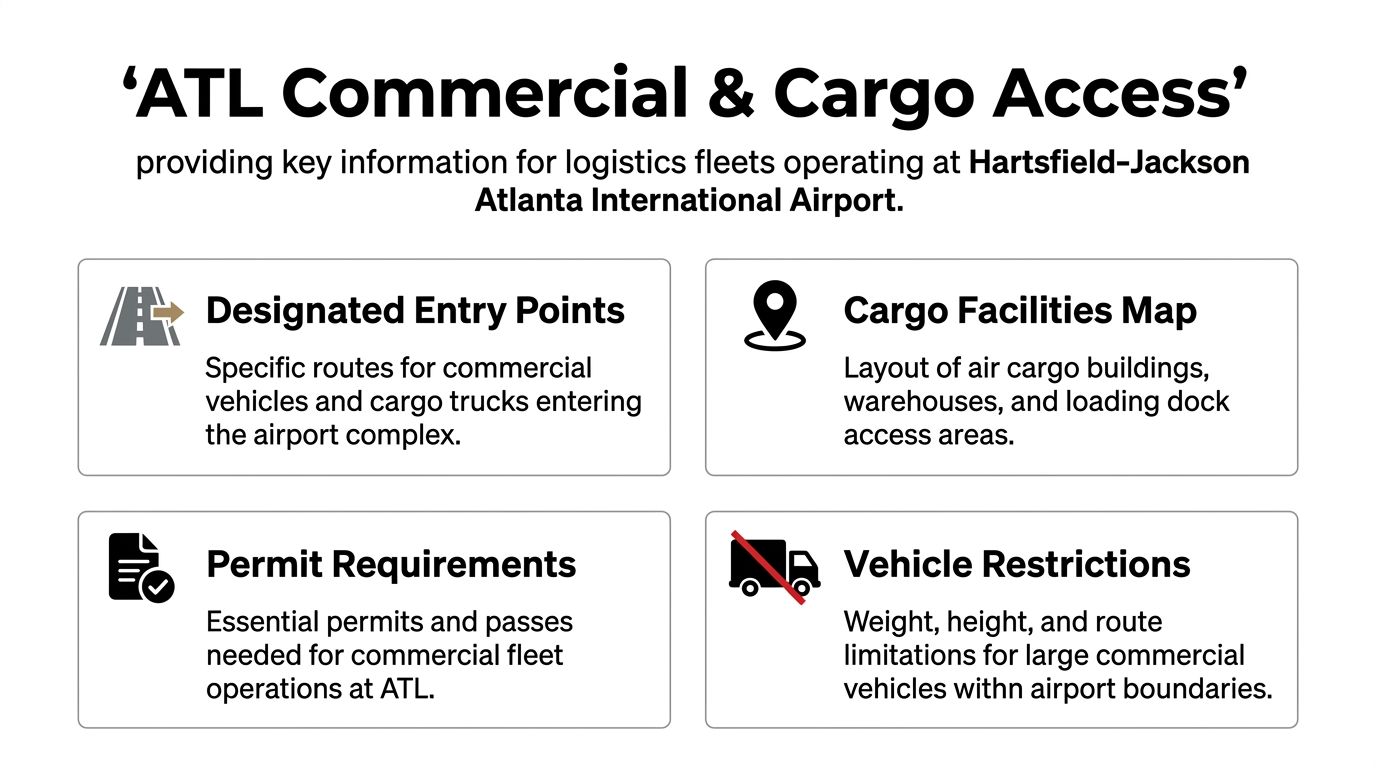
Passenger traffic pulls toward terminal roads. Freight traffic needs to stay focused on cargo-specific access, service roads, and the exact facility handling the load. If you send a truck to the wrong side of ATL, recovery is not quick. The driver may need to loop, re-clear, or work through dense traffic before getting back on the correct path.
Why cargo operations stay more predictable than many expect
ATL’s airfield design helps freight planning even when the surrounding roads are messy. The airport’s five parallel runways enable over 90 landings and 100 departures per hour, which reduces airside bottlenecks and supports reliable cargo availability for time-sensitive shipments (Georgia Encyclopedia on Hartsfield-Jackson Atlanta International Airport).
For ground teams, that does not erase roadway risk. It does mean the air side is not the weak link. The weak link is the handoff from city roads to the correct cargo entrance.
A simple playbook for drivers
Use this sequence when dispatching a commercial load into the ATL area:
- Start with the facility name. Do not route by airline assumption or terminal label.
- Confirm the approved vehicle type. A cargo van, straight truck, and larger commercial vehicle may face different instructions.
- Verify paperwork before the truck moves. Driver ID, pickup reference, bill of lading details, and contact names should be ready before arrival.
- Keep the driver off passenger approaches. Terminal traffic burns time and creates unnecessary confusion.
- Use nearby staging if the dock is not open. Do not idle in circulation areas waiting for someone to answer a phone.
The airport road network changes over time, so dispatch should verify current instructions directly with the receiving or releasing party. On complex sites, even details like gate width and dock clearances can affect whether a given truck should enter. For teams dealing with specialized aviation-adjacent facilities, reading about systems like aircraft hangar doors is a reminder that building access is an operational variable, not an afterthought.
ATL Commercial Access Points
| Facility | Primary Access Route | Best For |
|---|---|---|
| Domestic terminal side | Terminal-directed approach roads | Passenger-adjacent vendor activity, small non-freight appointments |
| International terminal side | Terminal-directed approach roads on the international side | International passenger support activity and pre-cleared small service visits |
| North cargo area | Cargo-specific routing confirmed by facility | Air freight handoff, warehouse delivery, commercial pickups |
| South cargo area | Cargo-specific routing confirmed by facility | Freight transfer, export/import support, larger commercial activity |
| Off-airport staging locations near the airport corridor | Nearby commercial roads and business parks | Early arrival holding, paperwork checks, driver coordination |
Not every project should enter airport property at all. For some secure IT removals, it is cleaner to stage the equipment at a nearby business location and hand off from there. That is easier on drivers coming up from the south side through areas such as Fairburn Family Travel Center in Fairburn, where fleet operators understand the stop, refuel, and regroup pattern before approaching the airport corridor.
Key point: Dispatch should treat ATL as a set of separate commercial zones. One wrong entrance can cost more time than the drive across town.
Practical On-Site Logistics for Commercial Pickups
Once your vehicle is in the airport area, the job shifts from routing to execution. Otherwise capable teams lose time here. They arrive on schedule but without a staging plan, a named contact, or a clean chain-of-custody packet. Near ATL, those gaps matter because there is limited room for indecision. Security is tighter, circulation space is constrained, and waiting in the wrong place can trigger a fast correction.

The on-site habits that save time
The airport’s sustainability materials discuss waste diversion, but they do not give much practical guidance for e-waste hauling fleets navigating airport-area chokepoints, which leaves IT managers to solve the routing and compliance side themselves (ATL sustainability information).
That gap shows up in daily operations. For secure pickups, good execution comes down to a short checklist:
- Paperwork ready before arrival. Driver name, vehicle description, pickup authorization, and contact numbers should be finalized before entering the area.
- Load sequence decided in advance. If the team is moving monitors, towers, networking gear, and loose drives, the order should already be set.
- Staging rules confirmed. Ask where the truck can wait legally if the dock or contact is not immediately available.
- Chain of custody protected. Asset tags, serialized media, and sign-off points should be matched before the vehicle leaves.
What works for ITAD and secure recycling jobs
For airport-area commercial pickups tied to office closures, school refreshes, or healthcare retirements, the smoothest jobs share one trait. The pickup team and the client agree on one traffic-safe handoff point and one decision-maker.
That is where a service such as commercial computer pickup fits operationally. For example, Atlanta Computer Recycling handles business pickups, on-site packing, and secure equipment movement for organizations that need an ITAD process rather than a general junk haul. In the ATL corridor, that matters because the pickup itself has to stay organized under time pressure.
Tip: Do not let drivers sort equipment on-site unless the job was scoped that way. Sorting in a tight commercial area adds dwell time and increases chain-of-custody risk.
A final detail that local teams learn quickly: employee shift changes and general airport circulation peaks can snarl nearby roads even when your destination is not a terminal. If your pickup has to hit a hard deadline, earlier coordination beats a heroic last-minute dispatch every time.
Nearby Business Services and Hotels for Logistics Teams
Out-of-town operations managers ask the wrong question. They ask which hotel is closest to the airport. The better question is which location reduces tomorrow morning’s friction for the crew.
The ATL area gives logistics teams plenty of support options, but they are not all equal. College Park, Hapeville, East Point, and the broader airport corridor each serve different needs depending on whether your team is handling overnight equipment control, early dock appointments, or a multi-stop commercial run.
What to look for in nearby support services
Prioritize function over brand. For commercial teams, the useful nearby services are:
- Truck-friendly fuel and service access. Your driver does not need a stylish lobby. The driver needs easy ingress, room to turn, and fast recovery if a vehicle issue appears.
- Print, scan, and business-center basics. Bills of lading, manifests, and client sign-off documents still fail at the worst times.
- Freight-adjacent warehousing and courier support. Some jobs run smoother when the team stages off-airport and finishes the final leg after confirmation.
- Food that does not require losing parking. Crews on a schedule should not fight terminal-adjacent traffic just to take a break.
How to choose a hotel for a working crew
A practical hotel for a logistics team has four traits:
- Predictable airport-corridor access
- Parking that can handle larger work vehicles or multiple vans
- Late check-in without drama
- A location near business services, not tourist traffic
If the team will be working on the north side of the airport area one day and the south side the next, central convenience can be overrated. In many cases, it is better to place the crew where morning egress is cleaner, even if the property is not the closest possible pin to ATL.
Hapeville is useful for that reason. It stays close to the airport ecosystem without forcing every crew move through the densest terminal approach logic. This local overview of the City of Hapeville, GA is relevant because many airport-adjacent commercial teams end up using Hapeville as a practical support zone rather than a destination in its own right.
A simple decision filter
If you are booking for a working team, ask these questions before confirming a property or support vendor:
- Can a commercial van enter and exit cleanly?
- Is there a quiet place to review manifests and site instructions?
- Can the crew reach the airport corridor without crossing unnecessary choke points?
- If tomorrow’s schedule changes, can the team pivot without reworking the entire route?
Luxury does not help much here. Reliability does.
If your team is planning a secure IT pickup, office cleanout, or data center equipment removal anywhere in the ATL corridor, Atlanta Computer Recycling provides business-focused electronics recycling and ITAD support across metro Atlanta, including on-site packing, pickup logistics, data-bearing media handling, and compliant disposition workflows for offices, schools, healthcare organizations, and public sector sites.