Free E-waste Pickup in Atlanta for Commercial IT Asset Disposal

For Atlanta-based organizations, a free e-waste pickup is a strategic solution for managing IT asset disposition. This commercial service is designed to eliminate the logistical challenges and compliance risks associated with recycling outdated computers, servers, and networking hardware, streamlining a complex operational task into a secure, documented process.
Why Professional IT Asset Disposition is Non-Negotiable for Atlanta Businesses
When retiring IT assets, every Atlanta enterprise faces a critical decision point. Disposing of legacy servers, laptops, and networking components improperly is not just an environmental issue—it's a significant security and compliance liability. That storage closet filled with obsolete electronics represents a repository of sensitive corporate and customer data, posing a tangible risk to your organization.
Landfill disposal is not a viable option. For any business focused on mitigating risk and protecting its interests, professional e-waste recycling is the only responsible course of action.
The Financial Consequences of Improper Disposal
The risks associated with inadequate IT asset disposal protocols extend far beyond environmental impact, carrying severe financial and reputational consequences.
- Data Breach Liabilities: A single discarded hard drive can contain trade secrets, financial records, or customer PII. A data breach can result in millions in remediation costs, regulatory fines, and irreparable brand damage.
- Regulatory Penalties: Compliance frameworks like HIPAA for healthcare or FACTA for financial services mandate strict data protection protocols. Failure to securely sanitize data from retired devices can lead to crippling financial penalties.
- Environmental Non-Compliance: Georgia has specific regulations governing electronics disposal. Corporations found illegally dumping e-waste face legal action and significant public relations crises.
Proper disposal begins with a clear understanding of regulatory requirements. For insights on managing hazardous material information, a guide on Mastering Safety Data Sheet compliance can provide a valuable framework.
A Strategic Approach to IT Asset Retirement
Instead of viewing retired equipment as waste, consider it an asset requiring structured management. When handled correctly, these devices can be processed in a manner that protects your organization's financial health and reinforces corporate responsibility.
In 2022, the world generated a staggering 62 million metric tonnes of e-waste. This explosive growth, rising by 2.6 million tonnes annually, outpaces recycling efforts fivefold, with only 22.3% documented as properly collected and recycled that year.
These statistics underscore the importance of a formal disposition strategy. A professional partner in the Atlanta metro area can transform this operational challenge into a secure and efficient process. By engaging a certified e-waste recycler, your organization gains assurance that sensitive data is verifiably destroyed and all materials are managed in an environmentally compliant manner. This is not merely about clearing space; it's a critical component of corporate risk management.
Does Your Business Qualify for a Free E-waste Pickup?
The primary question for IT and facilities managers is straightforward: is this e-waste pickup service truly free for our company? The answer is frequently yes, contingent upon the quantity and quality of the IT assets slated for disposition.
The service operates on a value recovery model. Business-class equipment such as servers, networking gear, or large quantities of recent-model laptops retain residual value. This value is recovered through refurbishment and resale, offsetting the costs of logistics, labor, and certified data destruction. This creates a mutually beneficial outcome: your organization disposes of retired technology with no budgetary impact, while we ensure its responsible and secure processing.
The Threshold for Complimentary Service
What constitutes a qualifying pickup? While each project is unique, certain scenarios consistently fall into the complimentary service category. If your inventory aligns with these common examples, your business is likely eligible.
- Mid-Sized Office Tech Refresh: A law firm upgrading 50 workstations or a marketing agency replacing 40 laptops and monitors.
- Data Center or IT Department Decommissioning: A growing startup retiring its first server rack or a larger enterprise clearing out multiple racks of legacy servers, switches, and firewalls.
- Specialized Facility Bulk Disposals: Hospitals retiring a wing's worth of medical PCs or university labs clearing out dozens of computers and testing equipment.
As a general guideline, if your equipment volume is sufficient to fill a significant portion of a cargo van or small truck, you are likely on track for a free pickup. Minor, one-off disposals, such as a single desktop or a few printers, do not meet this threshold. For these smaller needs, local drop-off points are the most effective solution. Our guide on where you can recycle electronics in Atlanta can provide further direction.
Equipment That Drives Value
The type of equipment is as crucial as the quantity. High-value, reusable IT assets are the cornerstone of a free pickup service, as they possess the greatest potential for refurbishment and resale, which underwrites the cost of the entire operation.
Items that consistently qualify for a complimentary pickup include:
- Servers and Storage Arrays: Enterprise-grade servers from Dell, HP, and Cisco, even older models, often retain significant value.
- Networking Gear: Business-class switches, routers, and firewalls are consistently in demand.
- Laptops and Desktops: Bulk quantities (typically 20 or more) of computers that are less than 7-8 years old.
- Telecom Systems: Modern VoIP phone systems and related communication hardware also contribute to the overall value.
Conversely, older consumer-grade electronics like CRT monitors, outdated printers, and miscellaneous cables hold minimal to no recoverable value. These items can incur a net cost for proper recycling, which may necessitate a small fee if they constitute the bulk of the pickup.
Key Takeaway: A free pickup is most probable when your inventory consists primarily of business-class IT assets. The service is predicated on our ability to recover value from your equipment to cover the operational costs of secure, compliant recycling.
Real-World Qualification Scenarios
Let's examine how this model applies to typical Atlanta businesses.
Scenario A: The Tech Firm
A software company in Buckhead is relocating and needs to dispose of two racks of Dell PowerEdge servers, a dozen Cisco switches, and approximately 30 employee laptops (MacBooks and Lenovo ThinkPads). This is an ideal candidate for a free pickup. The high concentration of valuable, reusable enterprise hardware easily covers all operational costs.
Scenario B: The School District
A suburban school district is retiring 300 older classroom desktops and 150 CRT monitors. While the quantity is substantial, the asset value is low. The desktops are obsolete, and CRT monitors incur a cost for safe recycling. This project might involve a nominal fee to cover the labor and specialized recycling required for the monitors. Any such costs would be quoted transparently and upfront.
Understanding these parameters enables your organization to accurately assess eligibility and plan your IT asset disposition with confidence, ensuring a sound financial and environmental decision.
Your Game Plan for a Smooth E-waste Pickup
Once you have confirmed that your inventory of retired IT assets likely qualifies for a free pickup, a bit of preparation can transform a potential logistical challenge into a seamless operation. A well-executed plan ensures our team can operate efficiently, minimizing disruption to your daily business activities.
This flowchart outlines the process, from initial inventory assessment to scheduling the pickup.
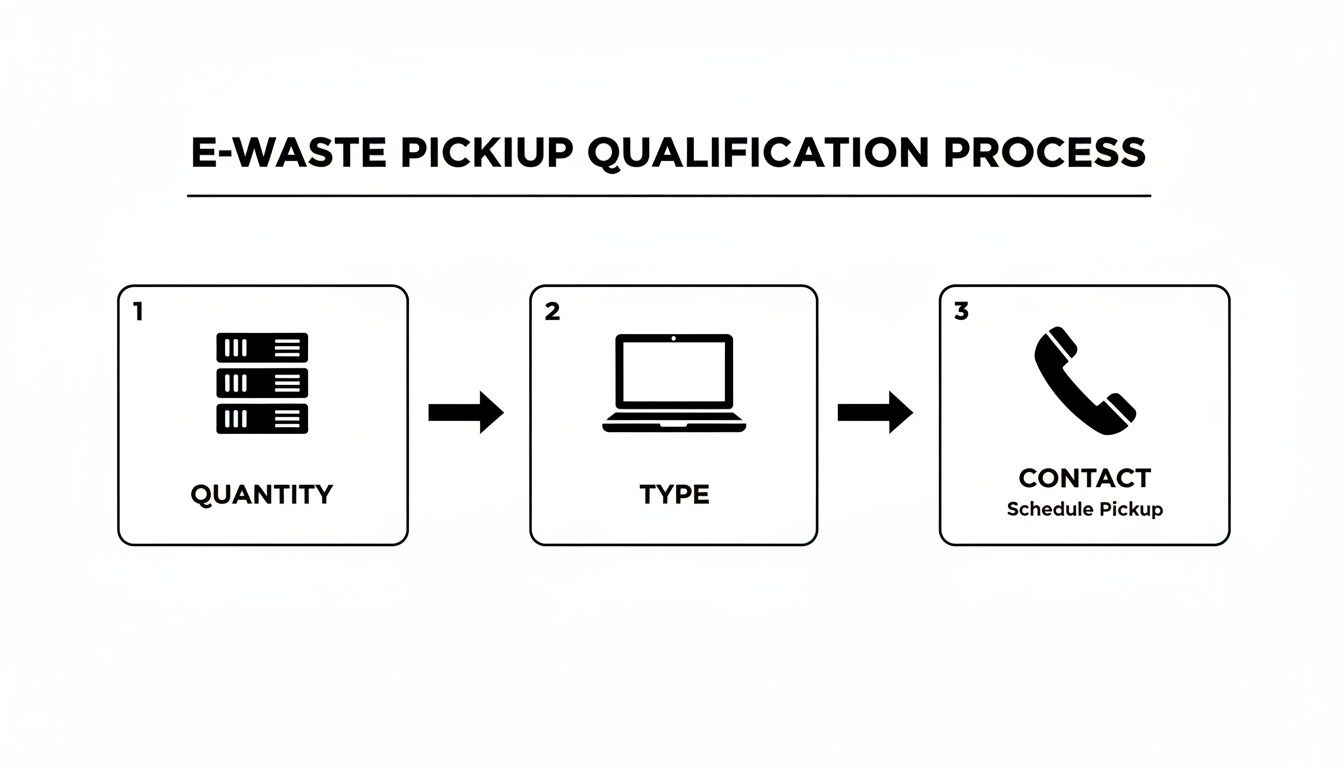
As illustrated, a successful pickup begins with a clear understanding of your asset inventory before scheduling the service.
Create a Quick Asset Inventory
A detailed, serial-number-level audit is not necessary for the initial call. A solid estimate is sufficient. Conduct a walkthrough of your storage area and compile a high-level list of the equipment ready for disposal.
A simple tally is usually all that is required to initiate the process. For example, your inventory list might look like this:
- Servers: Approx. 15 Dell PowerEdge servers (mixed models)
- Laptops: Approx. 60 mixed units (primarily Dell Latitudes, some MacBooks)
- Desktops: Approx. 40 HP EliteDesk towers
- Networking: Half a pallet of assorted Cisco switches and routers
- Monitors: Approx. 100 flat-screen displays
This level of detail allows us to determine the appropriate vehicle size and crew for the job and confirm your eligibility for a free e-waste pickup in Atlanta without ambiguity.
Segregate and Stage the Equipment
Consolidating all e-waste into a single, easily accessible location is one of the most effective preparatory steps you can take. A first-floor storage room, a loading dock, or an unused conference room are ideal staging areas.
Consider the logistics of the pickup route. Is the path clear of obstructions? Are there security desks or locked doors that will require an escort? Staging equipment near an exit or loading bay can reduce our on-site time significantly, minimizing disruption to your operations.
Pro Tip: For devices containing highly sensitive data, such as servers from the finance department or C-suite laptops, physically segregating them from the main collection is a recommended practice. While we securely sanitize all data-bearing devices, this extra step provides an additional layer of internal control and peace of mind.
Additionally, boxing loose peripherals like keyboards, mice, and cables helps maintain an organized and safe work area, accelerating the loading process.
Key Details to Have Ready for the Call
When you contact us to schedule the pickup, having a few key details prepared will ensure a quick and productive conversation. This is your opportunity to communicate any unique logistical challenges at your facility.
Before calling, please have the following information available:
- Your Estimated Inventory: The list you've compiled.
- Building Access Details: Specify if you have a loading dock, a freight elevator, or a designated entrance for service providers. Mention any security protocols, such as check-in requirements or the need for an escort.
- On-Site Contact Person: The name and mobile number of the individual who will meet our crew.
- Parking Information: Is there designated parking for a large van or truck? Providing this information in advance helps prevent delays.
Having these details ready allows us to schedule an accurate arrival window and ensures our team is fully prepared for your specific site requirements, paving the way for a completely hassle-free experience.
To learn more about how we manage logistics for Atlanta businesses, explore our commercial computer pickup services. Proper preparation on your end enables us to execute a complex task with simplicity and efficiency.
Locking Down Your Data During Disposal
For most Atlanta businesses, the primary concern with IT asset disposition is not the physical hardware, but the vast amount of sensitive data it contains. Transferring custody of servers or laptops without a robust data security protocol is a significant operational risk. Data lockdown is not merely a best practice; it is an essential step in protecting your company, your clients, and your brand reputation.
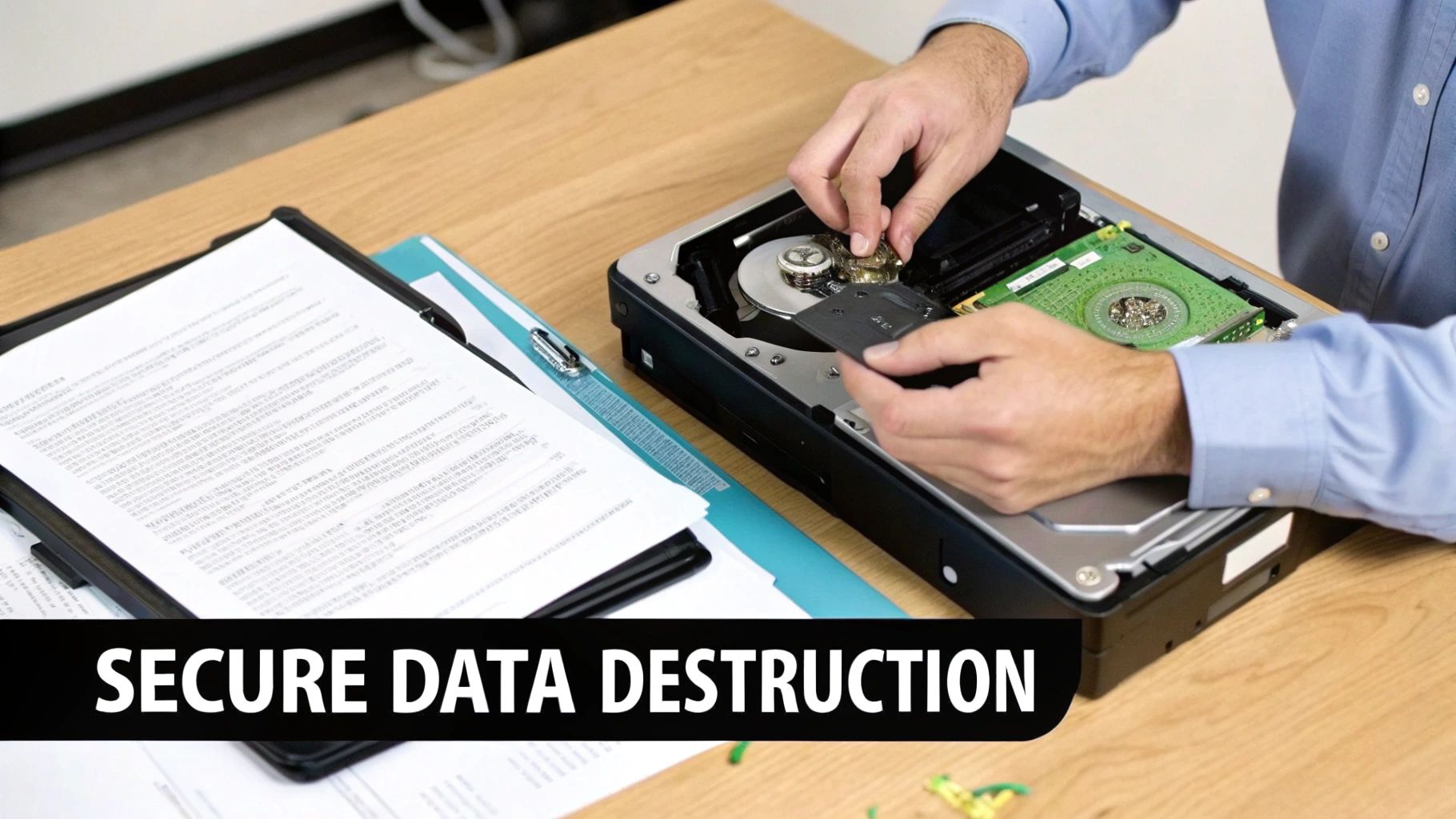
This process extends far beyond simple file deletion. True data destruction employs proven methodologies to render information permanently and completely irretrievable.
The Gold Standard: DoD 5220.22-M Data Wipe
Securely wiping a hard drive involves a software-based data sanitization method. The industry benchmark for this process is the DoD 5220.22-M 3-pass wipe. Developed by the U.S. Department of Defense, this method overwrites every sector of a hard drive with new data in three distinct passes.
This multi-layered approach ensures that even the most advanced data recovery tools cannot reconstruct the original information. It is the ideal solution for functional hard drives that may be refurbished and reused, achieving a balance between maximum security and environmental sustainability.
Of course, professional wiping complements your existing security infrastructure. It is beneficial to have an understanding of encryption solutions like BitLocker that protect data during an asset's active lifecycle.
When Physical Shredding Is the Only Answer
In some cases, a software-based wipe is not feasible. For hard drives that are damaged, non-functional, or contain exceptionally sensitive data, physical destruction is the only method to guarantee complete data elimination.
This is accomplished through industrial-grade shredding. The process involves feeding hard drives, SSDs, and other storage media into a powerful shredder that grinds them into small, unrecognizable metal fragments, making data recovery physically impossible.
When to Choose Shredding: Physical shredding is often the mandated method for healthcare organizations complying with HIPAA, as well as for financial institutions and government agencies. It is the definitive choice for any company requiring indisputable proof that its data has been physically obliterated.
This table provides a quick comparison to help you determine the best method for your commercial e-waste.
Data Destruction Methods for Commercial E-waste
| Feature | DoD 5220.22-M Wipe | Physical Shredding |
|---|---|---|
| Best For | Functional drives, reusable assets, standard data security | Damaged/failed drives, highly sensitive data, strict compliance |
| Process | Software overwrites data in multiple passes | Mechanical shredder grinds media into small fragments |
| Data Recovery | Considered impossible with current technology | Absolutely impossible |
| Asset Outcome | Drive can be safely reused or remarketed | Drive is destroyed and recycled for raw materials |
| Proof | Certificate of Data Sanitization with drive serial numbers | Certificate of Destruction with serial numbers |
The choice of method depends on your organization's specific security policies and regulatory requirements. Both are highly effective, but shredding provides the ultimate physical assurance.
Your Proof of Compliance and Security
Secure data destruction is incomplete without proper documentation to support your compliance and risk management efforts. A reputable e-waste partner provides two critical documents. For a full overview, see our guide to secure IT disposal for Atlanta businesses.
First is the chain-of-custody record. This document logs your assets from the moment they leave your premises until final processing, creating an unbroken audit trail that eliminates security gaps.
Second, and most critically, is the Certificate of Destruction. This official document serves as your legal proof of data sanitization. It details:
- The date of destruction.
- The method used (DoD wipe or shredding).
- A serialized list of the destroyed hard drives.
- A statement of compliance with relevant regulations.
This certificate is your definitive safeguard. In the event of an audit or legal inquiry, this document proves that you executed your due diligence in protecting sensitive information, providing your organization with complete liability protection.
What We Take and How We Handle It
A common question from IT managers facing a large-scale equipment clear-out is, "Can you take everything?" The answer is almost always a confident yes.
While our free pickup service is often utilized for standard office computers, our capabilities extend to the full spectrum of commercial IT hardware found in a modern Atlanta business, from data centers to telecom closets. Our objective is to be your single-source solution, eliminating the need to coordinate with multiple vendors.
From Data Center Racks to Telecom Closets
Our focus is on business-grade IT assets—equipment with the highest potential for secure refurbishment, component harvesting, or responsible recycling.
Items we regularly accept for our free e-waste pickup in Atlanta include:
- Servers and Storage: All makes of rack-mounted and tower servers, SANs, NAS arrays, and blade server chassis.
- Networking Gear: Enterprise-grade switches, firewalls, routers, and load balancers from brands like Cisco, Juniper, and Arista.
- Computers and Laptops: Bulk quantities of desktops, laptops, thin clients, and high-performance workstations.
- Telecom Systems: VoIP phone systems, PBX hardware, and associated communication equipment.
- Peripherals and Components: LCD monitors, keyboards, mice, docking stations, and loose components such as RAM and CPUs.
For a comprehensive list, please review our detailed list of accepted items for recycling. This can serve as a useful tool for building your inventory sheet prior to contacting us.
Navigating Specialty Items and Exceptions
While we handle nearly all electronics, certain items fall outside the scope of IT asset recycling due to hazardous materials that require specialized disposal processes.
We typically cannot accept items such as:
- Household appliances (microwaves, refrigerators)
- Smoke detectors (contain small radioactive components)
- Loose batteries or light bulbs (we do accept laptop and UPS batteries)
- Old CRT monitors may require a fee due to the leaded glass, which incurs a recycling cost.
Our Promise: No Surprises. Transparency is a core principle of our service. If your inventory includes items that require special handling or may incur a fee, such as CRT monitors, we will discuss this with you upfront. You will never encounter hidden charges on an invoice from us.
Tailored Logistics: On-Site De-Installation vs. Dock Pickup
Every Atlanta facility has unique logistical requirements. We adapt our process to your operational reality, offering services ranging from a simple dock pickup to a complex, white-glove de-installation.
Scenario 1: Simple Dock Pickup
A distribution center in South Fulton has 10 pallets of old computers and monitors, staged and shrink-wrapped. Our truck arrives, our team loads the pallets from the dock, and the job is completed in under an hour with minimal involvement from your staff.
Scenario 2: Full-Service On-Site De-installation
A downtown law firm needs to decommission a server room on the 20th floor. Our technicians arrive with the necessary tools to safely power down and disconnect servers, remove equipment from racks, and transport everything via the freight elevator for secure loading. This is our "white-glove" service, designed for complex projects requiring end-to-end management.
Common Questions About Atlanta E-waste Pickup
Here are answers to some of the most frequent questions we receive from Atlanta-area organizations.
HIPAA Compliance for Healthcare Facilities
Our hospital needs to dispose of old computers and medical monitors. Is the data destruction process HIPAA compliant?
Yes. For our healthcare clients, data security is paramount. Our services are specifically designed to meet and exceed the stringent data sanitization requirements of HIPAA.
We utilize two primary methods to ensure compliance. For functional hard drives, we perform a DoD 5220.22-M 3-pass data wipe, a military-grade process that renders data irretrievable. For non-functional drives or older media, we employ physical shredding.
Upon completion, we issue a formal Certificate of Destruction. This document serves as your official audit trail, listing the serial numbers of every destroyed drive and providing a guarantee that all protected health information (PHI) has been permanently and verifiably eliminated.
Logistics for Multi-Location Projects
We are a school district with 500 old desktops spread across three schools. Can you handle a multi-location pickup?
Yes, we specialize in coordinating complex, multi-location logistics for school districts, large corporations, and government agencies.
Our team will work with your IT staff to develop a phased pickup schedule that minimizes disruption at each location. We can provide on-site packing services and ensure efficient loading. For large-scale projects, meticulous planning is key, and our goal is to provide a seamless experience for your organization.
Expert Insight: Effective communication is critical for a successful multi-location pickup. We assign a single point of contact to coordinate with your leads at each site, ensuring alignment on schedules, access requirements, and on-site procedures.
Scheduling Timelines and Expectations
What's the typical turnaround time from when I call you to the actual pickup?
For most standard commercial pickups within the Atlanta metro area, we can typically schedule service within 3 to 7 business days.
This timeline can be influenced by several factors:
- Volume of Equipment: A few servers can be scheduled more quickly than a full truckload of assets.
- Location Accessibility: Factors like loading dock availability or security protocols can affect timing.
- Special Requirements: On-site de-installation or other specialized labor may require additional lead time.
For larger projects, such as a data center decommission, we recommend contacting us 2-4 weeks in advance to allow for thorough planning. However, we maintain flexibility and can often accommodate more urgent requests.
Understanding the "Free" Service Costs
Are there any hidden costs associated with the 'free' pickup service?
We are committed to transparent pricing. Our free e-waste pickup for qualifying commercial clients is made possible when the recoverable value of the IT assets covers our costs for logistics, labor, and certified data destruction. This is typically the case for bulk quantities of recent-model computers, servers, and networking gear.
Costs may apply in specific situations, such as for items with no recoverable value (e.g., CRT monitors), projects requiring extensive de-installation labor, or for pickups that do not meet our minimum volume threshold.
We are 100% transparent regarding any potential costs. If your project warrants a fee, we will provide a clear, itemized quote for your approval before any work begins. A core component of our service is providing the documentation your business requires, including a detailed Certificate of Destruction to verify proper data handling.
Ready to manage your retired IT assets securely and efficiently? At Atlanta Computer Recycling, we simplify the process for businesses across the metro area. Contact us today to schedule your free consultation and discover a superior approach to e-waste management. https://atlantacomputerrecycling.com