How to Choose an Electronic Waste Recycling Company for Your Business

Choosing the right electronic waste recycling company is a critical business function that protects your corporate data, ensures regulatory compliance, and ultimately safeguards your brand’s reputation.
Get it right, and these operational risks are managed seamlessly. Get it wrong, and your organization could be exposed to significant data breach fines, legal liabilities, and a public relations crisis you never saw coming.
Why Your E-Waste Partner Is a Critical Business Decision

For too many IT and procurement departments, disposing of old electronics feels like a routine, check-the-box task. That's a dangerous blind spot. Every single server, laptop, and hard drive leaving your facility is a vault containing sensitive corporate data, client information, and valuable intellectual property.
Handing that equipment over to an unqualified vendor is like giving them the keys to your digital kingdom without a second thought. If that hardware is mishandled, illegally exported, or improperly sanitized, the consequences fall squarely on your organization. This is a common mistake for businesses that only look at the initial cost of disposal instead of the total cost of risk.
Beyond Disposal: The Strategic Importance of ITAD
Thinking of this as just "disposal" is an outdated mindset. Today, smart businesses approach it as IT Asset Disposition (ITAD)—a strategic process built around security, compliance, and value recovery. A truly capable e-waste recycling partner doesn't just haul away your old tech; they deliver a secure, documented, and responsible end-of-life process. This decision is a core part of comprehensive IT Asset Management (ITAM) best practices.
This shift in perspective is crucial for several key business reasons:
- Data Security: It’s your best defense against catastrophic data breaches from lost or stolen hard drives. A single incident can cost millions in fines and destroy customer trust.
- Regulatory Compliance: This ensures you're adhering to environmental laws (like EPA regulations) and industry-specific data mandates (like HIPAA for healthcare or SOX for finance).
- Brand Reputation: It's a clear demonstration of corporate social responsibility. In a world where clients and partners value sustainability, this matters.
A poorly chosen vendor can turn a simple equipment refresh into a public relations disaster. Downstream liability means your responsibility doesn't end when the truck leaves your loading dock; your business is accountable for where its assets ultimately end up.
The Financial and Reputational Stakes
These are not just hypotheticals. We’ve seen companies hit with staggering fines for improper disposal and data breaches traced back to discarded hardware.
Imagine a healthcare system facing millions in HIPAA violation penalties because patient data was recovered from a hard drive found in a landfill. Or a financial firm suffering irreparable brand damage because client account information was compromised. These are preventable business disasters.
A professional partner eliminates these risks by providing certified data destruction, transparent chain-of-custody reporting, and environmentally sound recycling. You can learn more by exploring our overview of secure IT equipment recycling services.
This guide will walk you through the essential steps to vet and select a partner that truly protects your business from these very real threats.
Verifying Certifications and Ensuring Full Compliance
When selecting an e-waste recycler, taking their word for it is a massive gamble for your business. The certifications a vendor holds aren't just logos for their website—they are your only verifiable proof of their commitment to environmental safety, data security, and legal compliance.
Without this proof, your organization is exposed to downstream liability. This means you can be held legally and financially responsible if your e-waste is mismanaged, even long after it’s left your facility. This isn’t a theoretical risk. Businesses have faced huge fines and PR nightmares when their old equipment was traced to an illegal dump site or when sensitive data was pulled from hard drives that were supposedly wiped clean.
Partnering with a non-certified recycler isn't just a compliance oversight; it's a bet where you're staking your company’s reputation and finances.
Decoding the Most Important E-Waste Certifications
Getting familiar with key industry certifications is the first step toward making a smart choice. These aren't just participation trophies; they're rigorous standards maintained by third-party auditors who scrutinize everything from a recycler's facility to their data destruction methods. They’re what separate the legitimate, professional operators from unqualified outfits.
Here are the certifications that truly matter for commercial clients:
-
R2v3 (Responsible Recycling): This is the gold standard in the electronics recycling industry. To become R2v3 certified, a company is audited in over 50 different areas, including worker health and safety, data security, and maintaining a complete chain of custody for every single asset they process. It's a comprehensive framework that leaves no room for operational error.
-
e-Stewards: Developed by the Basel Action Network, the e-Stewards standard is often seen as the strictest. It has a zero-tolerance policy against exporting hazardous e-waste to developing nations and strictly forbids the use of prison labor. Its main focus is on preventing illegal trade and environmental injustice.
-
NAID AAA: This certification is all about data security. Issued by the International Secure Information Governance & Management Association (i-SIGMA), NAID AAA certification is your guarantee that a vendor’s data destruction processes—whether physical shredding or digital wiping—meet the absolute highest security protocols. For any business handling confidential information, this is non-negotiable.
When a vendor holds multiple certifications, like being both R2v3 and NAID AAA certified, it demonstrates a deep, multi-layered commitment to best practices. That combination is what we consider best-in-class for any corporate IT asset disposal program.
How to Verify a Recycler's Credentials
Never just accept a PDF of a certificate as proof. It's not unheard of for shady operators to display expired or even fraudulent credentials. A little due diligence here goes a long way in protecting your business.
The good news is that the verification process is simple and should be a mandatory part of your vendor vetting checklist. All legitimate certification bodies maintain public, searchable online directories.
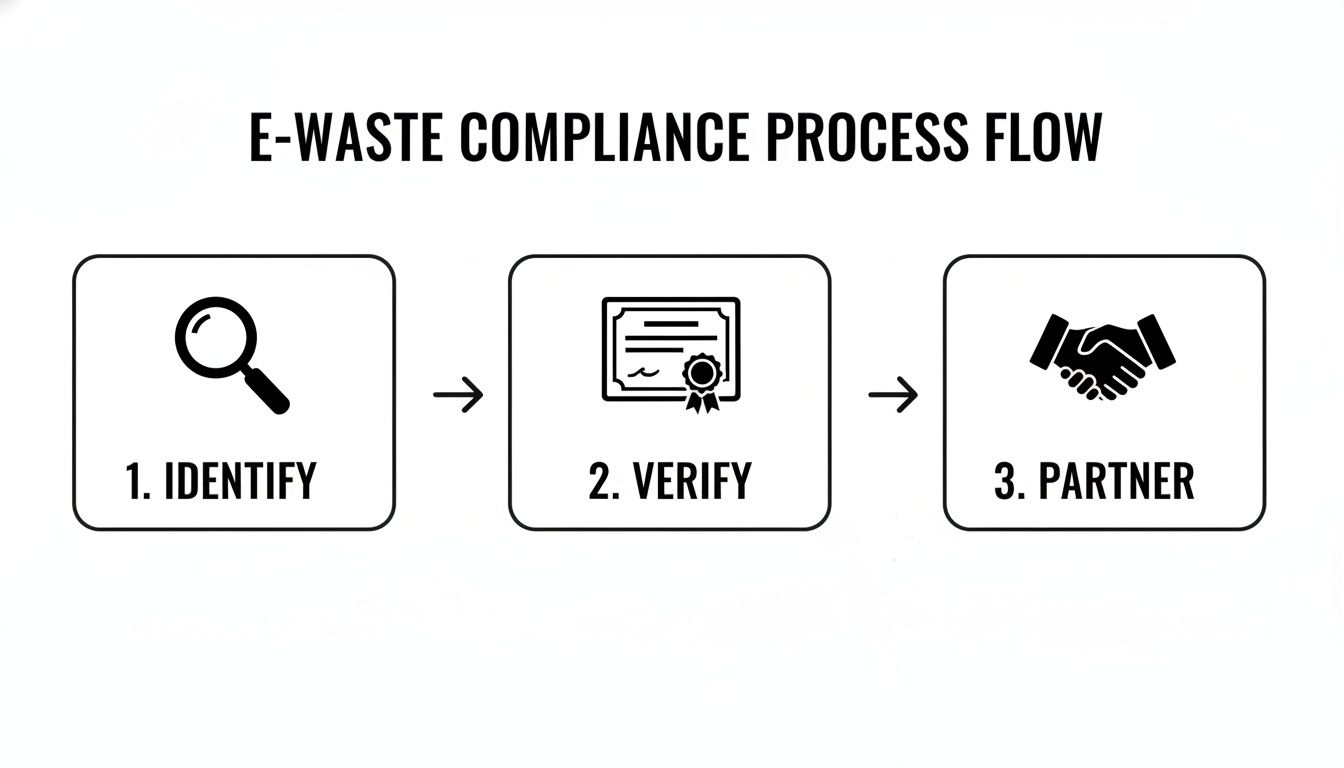
- Request the Certificate: Have the potential vendor send you a copy of their current certificates for R2, e-Stewards, or NAID AAA.
- Go to the Source: Head directly to the official websites for each standard—Sustainable Electronics Recycling International for R2, e-Stewards, or i-SIGMA for NAID.
- Search the Directory: Use their search tool to look up the company by name and location. Confirm their certification is active, not expired. Critically, ensure the physical address on the certificate matches the actual facility where your assets will be processed.
This quick, five-minute check provides complete certainty that you're working with a compliant and responsible partner. It also creates a solid, defensible record of your due diligence should your process ever be audited.
Once you've confirmed they can handle the hardware correctly, the next step is understanding the documentation they provide after the job is complete. A certificate of destruction is a critical step in your compliance strategy. This document is your official record that closes the loop on your liability, proving all your data-bearing devices were sanitized or destroyed to industry standards.
Mastering Data Security And Chain Of Custody
When your business retires hardware, you’re not just dealing with old equipment—it’s a vault full of sensitive corporate information. The true risk in electronic waste recycling isn’t just environmental; it’s a data breach waiting to happen.
Your recycling partner must be a security ally first and a recycler second. For IT managers, the mandate is simple: achieve a zero-risk state on every retired asset. Deleting files or reformatting drives is insufficient and leaves your company vulnerable.
In the following sections, you’ll find a practical blueprint to insist on a data destruction process that leaves no room for data leakage.
Choosing The Right Data Destruction Method
Vendors should offer at least two proven routes for data destruction—pick the one that aligns with your corporate security posture.
-
Software-Based Data Sanitization (Wiping):
Overwrites every sector with random characters—often following the NIST 800-88 standard. This process provides verifiable logs and renders data completely unrecoverable. It is ideal when you want to refurbish and resell assets, recouping some of their value. -
Physical Destruction (Shredding):
Obliterates drives in industrial-grade shredders until they’re small, destroyed particles. There is no chance of data escape, making it the go-to for failed, outdated, or ultra-sensitive media.
In practice, always ask candidates to walk you through both workflows. And don’t stop there—scrutinize their data retention and disposal policies to confirm they match your company's security standards.
For an added layer of assurance, explore certified hard drive destruction services that include tamper-evident seals and detailed destruction certificates.
The Unbreakable Chain Of Custody
Data destruction is only half the battle. What happens to each asset from your dock door to the shredder determines your true risk profile.
A single missing drive in transit equals a security gap as big as an unshredded server. Your chain of custody must be ironclad—transparent, auditable, and foolproof from start to finish.
“Your liability doesn’t end when the truck pulls away. A robust chain of custody is your legal and operational shield, proving you took every necessary step to protect sensitive information throughout the disposition process.”
Key Elements Of A Secure Chain Of Custody
• Serialized Asset Tracking: Every server, laptop, and drive must be tagged with a unique ID before pickup. That manifest becomes your single source of truth.
• Secure, GPS-Monitored Logistics: Demand company-owned, locked vehicles with real-time tracking to eliminate unauthorized stops or route deviations.
• Controlled-Access Facilities: Look for 24/7 video surveillance, biometric or badge-only entry, and background-checked staff.
• Final Reconciliation And Reporting: Require a certificate of data destruction that ties back to each serial number on the original manifest. No loose ends—ever.
Assessing Logistics and On-Site Service Capabilities
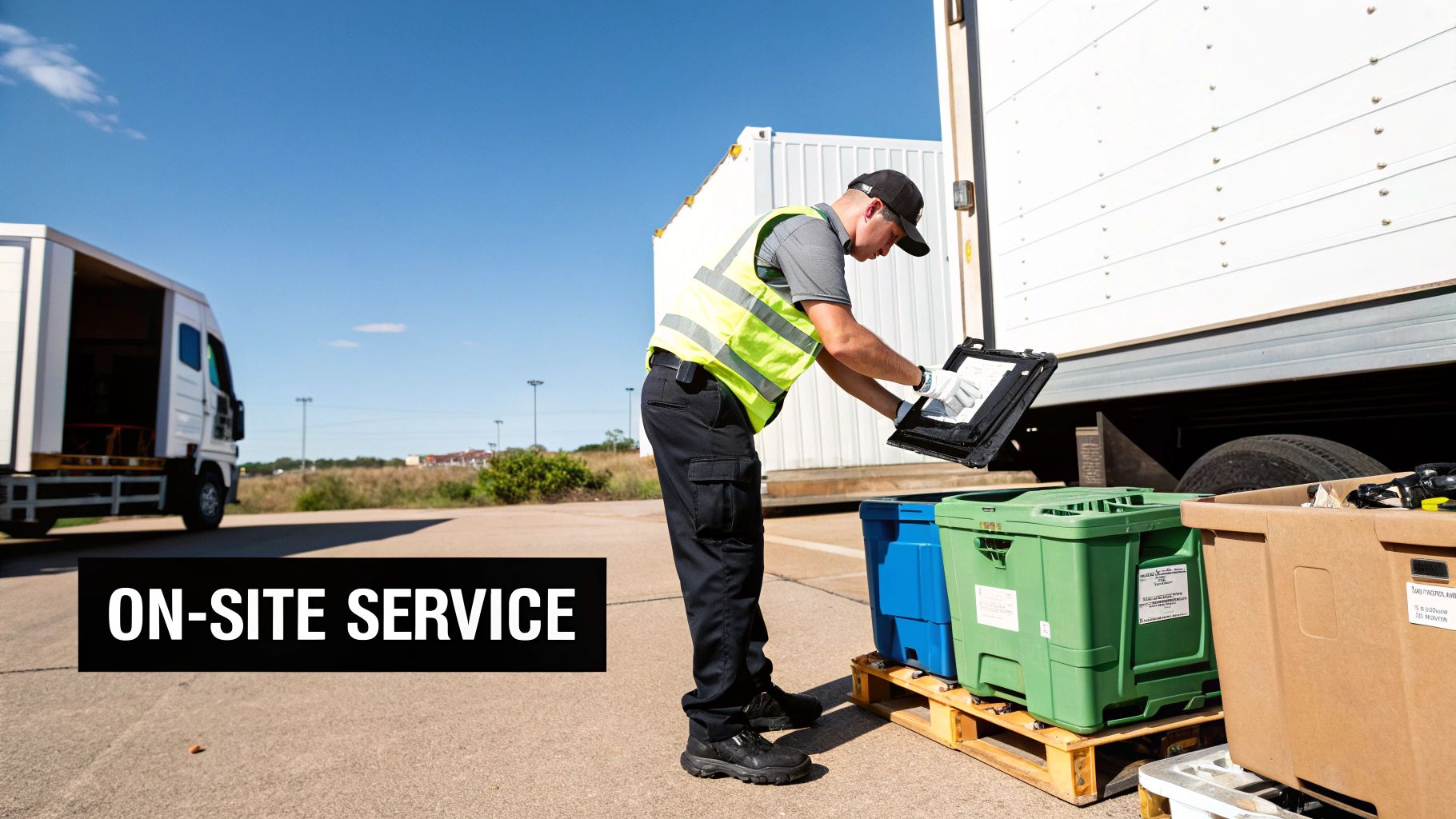
A top-tier e-waste recycler is more than just a destination for your old gear; they must be a rock-solid logistics partner. The journey from your server room to their facility is when your assets are most vulnerable. This is where equipment can get lost, damaged, or mishandled—creating security holes your business cannot afford.
Don't just ask, "Do you offer pickups?" You need to dig into their actual operational capabilities. How a vendor physically removes and transports your assets reveals their professionalism and whether they truly grasp the risks involved.
The entire process should cause minimal disruption to your daily operations. A professional partner arrives with a clear plan, the right equipment, and a trained crew that works quickly and securely, respecting your workspace from the moment they arrive.
On-Site Services That Minimize Your Risk
The best vendors bring their most critical services right to your doorstep. This tightens the chain of custody and gives you direct oversight where it matters most—especially when it comes to data destruction.
When vetting a potential partner, be sure to ask about these key on-site offerings:
- Secure Asset De-installation: Crucial for complex projects like a full data center decommission. Do they have technicians who can safely disconnect and remove servers, racks, and switches without disrupting your existing infrastructure?
- On-Site Hard Drive Shredding: This is the gold standard for data security. A mobile shredding truck comes to your location and pulverizes your hard drives while you watch. You witness the destruction and receive immediate verification.
- Asset Tagging and Inventory: Before any equipment leaves your building, their team should perform a detailed inventory. They should apply serialized tags to each asset and create a manifest that you both sign off on. This establishes accountability from the very start.
By bringing services like data shredding directly to your facility, a vendor dramatically shortens the chain of custody. It’s the single most effective way to eliminate the risk of a data breach during transit and prove your due diligence.
Evaluating Transportation and Fleet Security
Once everything is inventoried and ready for transport, the focus shifts to security. This isn't a job for a standard moving company. The vendor's logistics process must be built from the ground up to protect high-value, data-bearing assets at every stage.
You can get a better sense of how a professional partner handles mobile destruction by looking into options for on-site shredding in the Atlanta area. Offering this specialized service is a clear indicator that a company is serious about maximum security.
To properly gauge their transportation protocols, you need to ask direct questions:
- Who are the drivers? Are they direct employees who've passed background checks and security training, or are they third-party contractors? You always want direct employees handling your corporate assets.
- What kind of vehicles do you use? You're looking for company-owned, GPS-tracked trucks with secure, locking cargo areas. Unmarked vehicles are also a plus, adding a layer of discretion.
- Do you have documented security procedures for transit? This should include rules for secure loading, how pallets or containers are sealed, and protocols for unexpected stops or incidents.
- How is the project managed? A professional e-waste recycling company will assign a dedicated project manager. This person is your single point of contact—they coordinate the schedule, manage the on-site crew, and ensure the entire project runs smoothly, freeing up your IT team to focus on core business functions.
Understanding Costs and Maximizing Your Asset Value
Selecting an electronic waste recycling company based solely on the lowest price is one of the biggest—and most expensive—mistakes a business can make. That lowball quote rarely reflects the total cost of ownership.
When a price seems too good to be true, it’s usually hiding cut corners. You might be looking at sloppy data security, non-compliant disposal practices, or downstream liability that comes back to haunt your P&L. A true partner isn't just focused on a low per-pound rate; they’re focused on delivering total value. Think of it less as a disposal fee and more as an investment in risk mitigation and potential revenue recovery.
Decoding Common Pricing Models
As you start getting quotes, you'll encounter a few different ways vendors structure their pricing. There’s no single "best" model—it all depends on the type, age, and volume of your equipment.
Here are the main pricing structures you'll likely see in a commercial context:
- Per-Pound or Per-Item Fees: This is a straightforward model where you pay a set price based on weight or item count. It's common for older, broken equipment with no resale value, where the cost simply covers labor, transport, and recycling of raw materials.
- Flat Project Fees: For large-scale jobs, like a full office cleanout or a data center decommissioning, a vendor may quote a single all-inclusive price. This provides cost certainty by bundling everything—from on-site packing and removal to logistics and final reporting—into one fee.
- Revenue Sharing Agreements: This is where a top-tier partner really demonstrates their worth. If you have newer assets—think recent-model laptops, servers, or networking gear—that still have market value, the vendor will test, refurbish, and resell them. In return, your business gets a percentage of the profits, turning a liability into a revenue stream.
The best partners often use a hybrid model. They might charge a fee to process worthless scrap but share the profits from anything they can remarket. You will receive a detailed, itemized report showing every cost and credit, so you know exactly where you stand.
A breakdown of common cost structures to help you select the most financially sound model for your business needs.
Comparing E-Waste Recycling Pricing Models
| Pricing Model | Best For | Pros | Cons and Hidden Costs |
|---|---|---|---|
| Per-Pound / Per-Item | Older, low-value, or non-functional bulk equipment. | Simple and predictable for basic recycling needs. | Can become expensive for heavier items. Does not account for any asset resale value. |
| Flat Project Fee | Large, complex projects like data center decommissions or office moves. | All-inclusive pricing provides budget certainty. | May overpay if the scope is smaller than anticipated. Requires a very clear Statement of Work (SOW). |
| Revenue Sharing | Newer, functional, and remarketable IT assets (e.g., laptops, servers, networking gear). | Turns retired equipment into a revenue source. Aligns vendor's goals with yours. | Payout depends on market demand. Requires a trustworthy partner with strong resale channels. |
| Hybrid Model | A mixed inventory of old and new equipment. | The most balanced approach, combining cost-effective disposal with value recovery. | Requires a detailed settlement report to track both costs and credits accurately. |
This table helps illustrate why a one-size-fits-all approach to pricing doesn't work. The right model directly reflects the actual value—or lack thereof—in your retired assets.
Uncovering Hidden Fees and Ensuring Transparency
That initial low quote can balloon quickly if it’s not all-inclusive. A professional e-waste recycler will be completely transparent about their charges. It’s on you to ask the right questions upfront to avoid any surprises on the final invoice.
Use this checklist to probe for potential hidden costs:
- Data Destruction: Is there an extra charge for data wiping or physical shredding? Are Certificates of Destruction included, or is that a separate line item?
- Reporting and Auditing: Does the standard service include serialized asset tracking and a final settlement report, or is that a premium feature?
- Logistics: Are there fees for pallets, packing supplies, or fuel surcharges? What about extra labor for complex removals involving stairs or specialized equipment?
- Environmental Fees: Are state-mandated recycling fees or other compliance charges clearly broken out on the invoice?
A vendor who welcomes these questions is a good sign. If they get defensive or provide vague answers, consider that a major red flag in your procurement process.
Turning Retired Tech into a Revenue Stream
The biggest financial opportunity in this process comes from IT Asset Disposition (ITAD). This isn't just recycling; it's a strategic plan to maximize the value of your retired electronics through refurbishment and resale.
A partner with a strong ITAD program doesn't see a pile of old computers. They see an inventory of valuable components and systems that can be put back into the secondary market. This is where your choice of vendor directly impacts your bottom line. An ITAD expert knows how to test and grade equipment properly, price it for the current market, and has the sales channels to move it quickly.
To fully grasp this concept, it helps to understand what IT Asset Disposition (ITAD) is and see how it’s fundamentally different from simple disposal. This approach flips the script, turning your IT retirement from a cost center into a value-recovery engine that can help fund your next technology upgrade.
Answering Your Top E-Waste Recycling Questions
When navigating the world of IT asset disposition, many questions arise. As an IT manager or business leader, you need straightforward answers to feel confident in the e-waste partner you select. We frequently hear these concerns from Atlanta organizations, so let's provide the practical insights your business needs.
What Happens If My Company’s E-Waste Is Illegally Dumped?
The answer is simple: if your vendor takes a shortcut and illegally dumps your old equipment, your company is still on the hook, legally and financially. It’s a concept called "downstream liability," and it means your responsibility doesn't end just because the assets left your premises.
This is precisely why partnering with a certified recycler isn't just a good practice—it's an essential risk management strategy.
- Your Legal Shield: Choosing a partner with a certification like R2v3 or e-Stewards is your best defense.
- Audited and Vetted: These recyclers undergo intense third-party audits. They have to prove they are following responsible practices and properly managing all their own downstream vendors.
Having that certified partner provides the documented due diligence to show you did everything right, shielding your company from hefty fines and a public relations nightmare.
Should I Be Wary of a Recycler Who Offers to Pay for My E-Waste?
You should be cautious, but don't dismiss them immediately. Getting paid for old equipment—value recovery—is a legitimate part of a comprehensive ITAD program. The danger comes from unethical operators who promise high returns, cherry-pick a few valuable items, and then illegally dispose of the rest, leaving you exposed to all the risks mentioned.
A trustworthy partner will be completely transparent. They won't just issue a check; they'll provide a detailed, itemized report that clearly breaks down:
- Which assets were sold and the revenue they generated.
- Which assets had no resale value and were properly recycled.
- Any costs associated with labor, logistics, or data destruction.
The final settlement statement should balance the revenue against the costs, giving you the net financial outcome. That open-book approach is the sign of an electronic waste recycling company you can trust.
What Is the Difference Between Data Wiping and Physical Destruction?
Both methods render data unrecoverable, but they work differently and are used for different business cases.
-
Data Wiping (Sanitization): This is a software-based method. Specialized tools are used to overwrite every sector of a hard drive with random data, typically following the NIST 800-88 standard. The primary advantage is that the hard drive is preserved and remains functional, meaning it can be refurbished and resold to generate revenue.
-
Physical Destruction (Shredding): This is exactly what it sounds like. Industrial shredders are used to physically demolish the drive into tiny, mangled pieces. It makes data recovery physically impossible but also destroys any potential resale value of the drive.
Which one is right for your business? It depends on your company's security policies and whether you want to recoup value from your assets. For maximum security, especially with highly sensitive data, shredding is the definitive answer. For newer, functional drives, wiping allows you to recover some of your initial investment.
The e-waste problem is growing fast. In 2022, the world generated a staggering 62 million tonnes of it—an 82% jump since 2010. What's worse, only about 22.3% of it was properly recycled. This means an estimated $62 billion in valuable metals is thrown away annually. Meanwhile, the professional IT asset disposition (ITAD) market is set to hit $36.4 billion by 2034 as more businesses demand secure solutions. You can learn more about these e-waste and ITAD trends and see why professional management is so critical.
Ready to implement a secure, compliant, and financially smart e-waste program for your Atlanta-based business? At Atlanta Computer Recycling, we provide end-to-end ITAD services that protect your data and maximize your asset value. Contact us today to schedule a pickup or discuss your needs.