A Business Guide to Electronic Circuit Board Recycling

At its core, electronic circuit board recycling is the process of breaking down the Printed Circuit Boards (PCBs) inside old technology to safely recover the valuable materials they contain. For any business, this isn't just about "going green"—it's a critical practice that protects sensitive data, ensures you're meeting environmental laws, and unlocks the commodity value hidden inside your retired IT gear.
Unlocking the Hidden Value in Your E-Waste
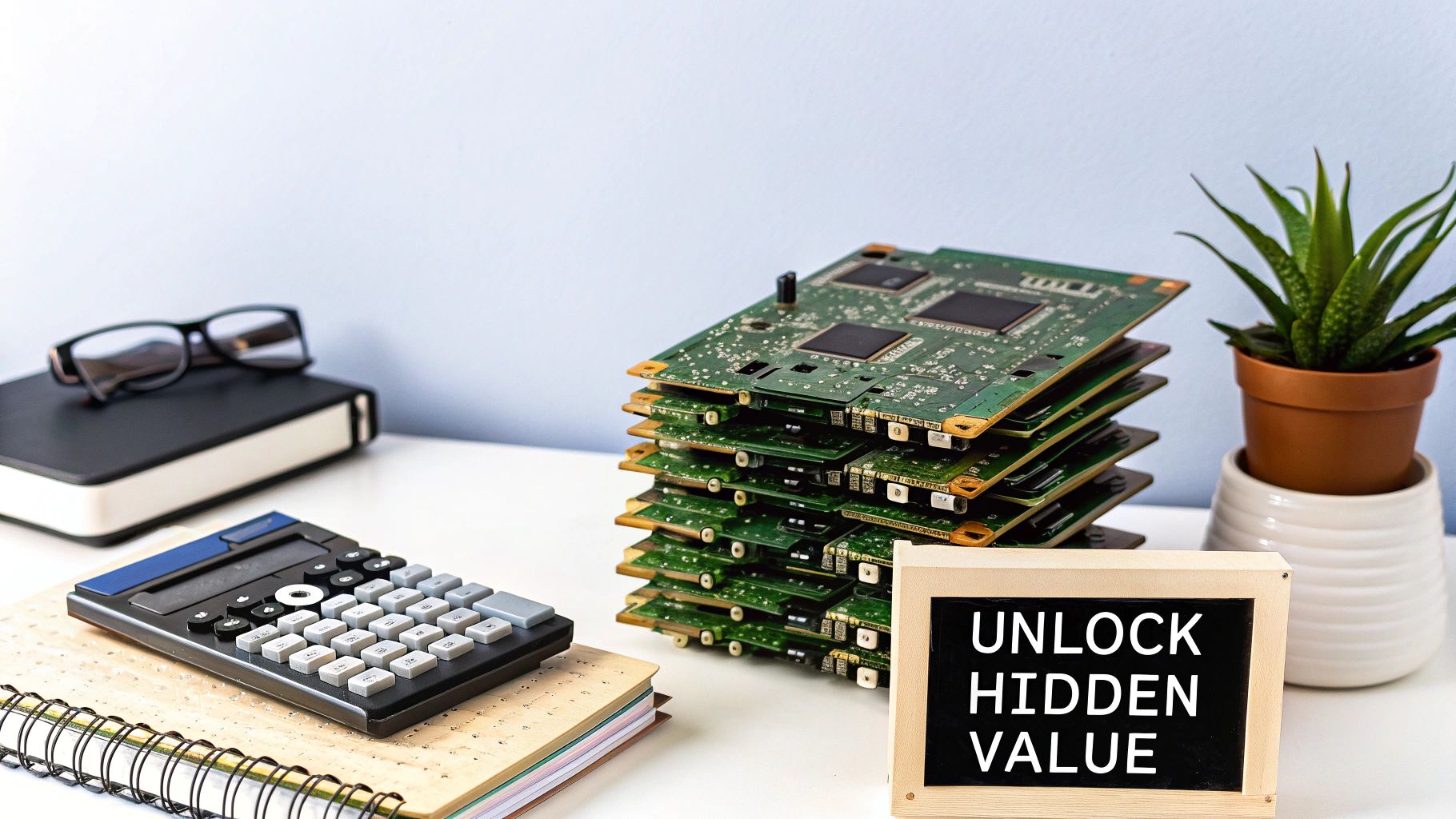
Consider the storage closet filled with old servers, laptops, and networking equipment. Each device represents a choice for your business. One path leads to significant operational risks, while the other presents a strategic opportunity. The heart of this choice lies in the Printed Circuit Boards (PCBs)—the intricate green and gold nerve centers that drive your company's technology.
What many businesses overlook is that these circuit boards are packed with valuable resources. We're talking precious metals like gold, silver, copper, and palladium, all of which can be extracted and returned to the manufacturing supply chain. This process, often called "urban mining," effectively turns what appears to be obsolete junk into a tangible asset.
From Compliance Headache to Strategic Advantage
Conversely, those same devices can create serious problems if improperly discarded. Circuit boards and their associated hard drives often hold sensitive company data, customer details, or proprietary information. Improper disposal is a direct invitation for a data breach.
Furthermore, PCBs contain hazardous materials like lead, mercury, and cadmium. If they end up in a landfill, these toxins can contaminate the environment and subject your company to hefty regulatory fines. This is where professional electronic circuit board recycling provides a solution.
A certified recycling partner transforms this entire process from a compliance headache into a strategic business advantage. It offers a secure chain of custody that protects your data, ensures you meet environmental regulations, and can even generate a return on your obsolete assets.
A Secure and Responsible Solution
Partnering with a professional recycler delivers a complete, end-to-end solution for managing your company's retired technology. This service is a key component of a broader strategy, and you can learn more about how it fits into a full IT asset disposition plan.
The right partner simplifies the entire operation, from secure collection and certified data destruction to the final recovery of materials. To fully leverage your e-waste, it's essential to understand the correct process. For a deeper look at the subject, exploring the benefits and process of e-waste recycling offers valuable context for any business aiming to operate more responsibly.
This guide will walk you through exactly what electronic circuit board recycling involves for a business like yours, giving you the clarity you need to make smart, secure, and even profitable decisions.
What Exactly Are Electronic Circuit Boards?
At the core of every computer, server, or smartphone lies an electronic circuit board, more commonly known as a Printed Circuit Board (PCB). Think of it as the central nervous system for any electronic device. It's a complex, miniature city grid where conductive copper pathways connect essential components like microchips, capacitors, and resistors.
This intricate network directs every function, from booting up a laptop to processing a critical financial transaction. For any business, understanding the composition of these boards is the first step toward recognizing why professional electronic circuit board recycling isn't just a good practice—it's a corporate necessity.
The Duality of Value and Risk
The materials inside a PCB make it a fascinating mix of opportunity and danger. On one hand, these boards are surprisingly rich in valuable and rare materials. On the other, they contain a cocktail of toxic substances that pose serious environmental and health risks if they’re just thrown away.
This duality is precisely what makes professional recycling so critical. It’s a highly specialized process designed to safely separate the valuable from the hazardous, ensuring that valuable resources are recovered while toxic elements are completely neutralized.
PCBs are a classic double-edged sword in the world of technology. They contain precious metals that power our digital world, but also hazardous materials that can cause lasting harm if they end up in a landfill.
Urban Mining: Pulling Precious Metals from E-Waste
The concept of "urban mining" is key to understanding the tangible value hidden in old circuit boards. Instead of extracting new materials from the earth, this process reclaims them from electronics we've already used. PCBs are heavily concentrated with valuable metals that can be recovered and put back into circulation.
- Gold (Au): Used for its superior conductivity and resistance to corrosion, gold is found in connectors, pins, and relays.
- Silver (Ag): Another highly conductive metal used in various components and solder.
- Copper (Cu): This forms the conductive pathways or "traces" that make up the board's infrastructure. A significant portion of a PCB's weight is pure copper.
- Palladium (Pd): Used in certain capacitors and connectors due to its durability and unique catalytic properties.
Remarkably, the concentration of these metals in PCBs is often far higher than in natural ore. Industry reports consistently show that one tonne of old circuit boards can contain hundreds of grams of gold and kilograms of copper, making their recovery economically advantageous. The global market for PCB recycling was already valued in the hundreds of millions of dollars in 2024, with strong growth projected. You can explore the data further by reviewing the economic significance of PCB recycling.
Addressing the Hazardous Side of the Equation
While the value is clear, the risk is just as real. Disposing of circuit boards in a dumpster releases a toxic mix of substances into the environment.
A lesser-known fact of the electronics industry is that these boards are packed with materials you do not want seeping into the ground. Below is a quick breakdown of the primary concerns.
Materials Recovered From Circuit Boards
| Material | Category | Primary Use in PCBs | Environmental/Health Risk if Landfilled |
|---|---|---|---|
| Lead (Pb) | Hazardous Metal | Solder, component connections | A powerful neurotoxin that can contaminate groundwater and soil. |
| Mercury (Hg) | Hazardous Metal | Lighting elements, switches | Potent neurotoxin known to bioaccumulate in wildlife. |
| Cadmium (Cd) | Hazardous Metal | Rechargeable batteries, resistors | Carcinogenic and causes serious harm to kidneys and bones. |
| Brominated Flame Retardants | Hazardous Chemical | Plastic casings and board material | Persistent organic pollutants that disrupt endocrine systems. |
These materials are why landfilling circuit boards is not only an environmental problem but also a serious legal liability for your business. Professional electronic circuit board recycling is the only responsible way to ensure these toxins are managed safely, keeping them out of local ecosystems and protecting your company from expensive non-compliance penalties.
Why Data Security Is Non-Negotiable in E-Waste
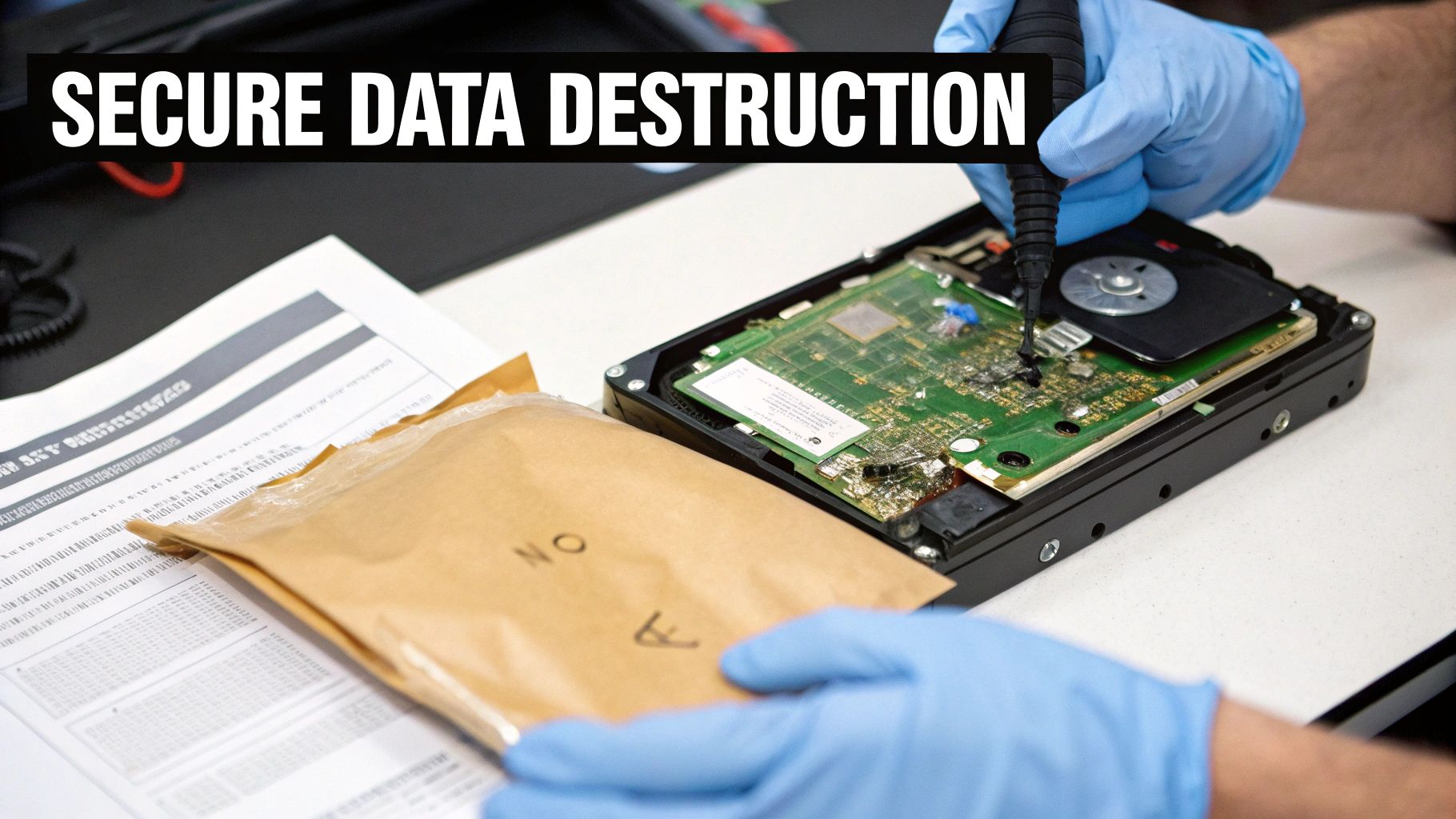
When an old server or company laptop leaves your building, where does its data go? The physical components are one concern, but the information left behind is a far greater liability. Any serious conversation about electronic circuit board recycling must begin with data security.
Allowing old electronics to leave your control without a certified destruction plan is a massive threat to your business. Every hard drive, server, and network switch holds a digital history of your operations. One improperly discarded device could easily become the source of a catastrophic data breach.
More Than Just Deleting Files
It is a common—and dangerous—misconception that hitting "delete" or reformatting a drive is sufficient. This is equivalent to tossing a sensitive file into a public recycling bin without shredding it. The information remains and is surprisingly easy to recover with basic software tools.
True security comes from certified data destruction, a process that completely and permanently eradicates all information from a device. This is the digital equivalent of turning a paper document into dust. There is no possibility of reassembly.
Protecting your data isn't just an IT task—it's a fundamental business imperative. A breach can lead to devastating financial penalties, legal action, and irreparable damage to your company's reputation and customer trust.
A professional recycler understands this and establishes a secure, documented chain of custody from the moment your equipment is picked up.
Ensuring Compliance and Protecting Your Reputation
Data privacy laws are strict. Regulations like HIPAA for healthcare, FACTA for consumer information, and GDPR for data related to EU citizens all mandate secure data handling through a device's final disposal.
- HIPAA Compliance: For healthcare providers, failing to properly destroy patient data on old equipment can lead to multi-million dollar fines.
- FACTA Rules: This law requires businesses to destroy consumer information before it's discarded to protect individuals from identity theft.
- Protecting Intellectual Property: Beyond regulatory fines, your old hard drives hold trade secrets, financial records, and strategic plans. That information is invaluable to a competitor.
Working with a professional recycler ensures you meet these requirements using industry-standard methods. Obtaining expert advice on preventing data breaches is crucial for any business decommissioning old electronics.
The Power of a Certificate of Destruction
How can you be certain the data is truly gone? You require official documentation. Reputable e-waste recyclers provide a Certificate of Destruction for every data-bearing device they handle. This legal document is your proof that you fulfilled your due diligence to protect sensitive information.
Consider this certificate your shield in an audit. It details precisely what was destroyed, when, and how, creating a clear and defensible record. To better understand its role, you can learn more about why a Certificate of Destruction is so important for your risk management.
Ultimately, there's no substitute for partnering with a certified expert. It's the only way to guarantee your company’s digital footprint is completely erased—protecting your assets, your customers, and your bottom line.
Navigating E-Waste Compliance and Regulations
For any business, claiming ignorance of e-waste laws is not a viable defense. When disposing of old technology, you must navigate a complex web of local, state, federal, and even international standards. Tossing old circuit boards in a dumpster isn't just irresponsible—it’s a direct path to serious financial and legal trouble.
This maze of regulations exists for a critical reason. As previously discussed, circuit boards contain both valuable materials for recovery and a cocktail of hazardous substances like lead and mercury. These regulations are designed to keep those toxins out of our soil and water while encouraging the reclamation of valuable commodities. Understanding these rules is the first step to protecting your business.
The penalties for non-compliance are severe. Fines can quickly escalate into the tens or even hundreds of thousands of dollars, depending on the nature and volume of the discarded materials. Beyond the financial impact, a public violation can do lasting damage to your company’s reputation, shattering the trust you’ve built with customers and stakeholders.
Key Federal and State Regulations
At the federal level, the primary regulation to know is the Resource Conservation and Recovery Act (RCRA). This law grants the EPA authority to manage hazardous waste from "cradle-to-grave." Because many components on a circuit board are classified as hazardous, RCRA dictates exactly how they must be handled, transported, and ultimately processed.
Mismanaging e-waste under RCRA can lead to steep civil and criminal penalties. The law puts the responsibility squarely on the generator of the waste—your business—to ensure it’s handled correctly throughout its entire lifecycle.
While no single federal law mandates that all businesses recycle all electronics, many states have established their own rules. Here in Georgia, specific regulations target certain types of e-waste, and all businesses are expected to adhere to best practices for responsible disposal. Partnering with a certified recycler is the most effective way to ensure you meet every state and local requirement.
The Growing Influence of Global Standards
It's also important to recognize that compliance is being shaped by global trends. In major international markets, regulatory pressure and "design-for-recycling" rules are setting new expectations for corporate responsibility. For instance, European frameworks are pushing for material-level recycling rates on certain components that can exceed 85% and requiring better tracking to prove it. With more than 80 countries now having e-waste legislation, these global standards have a ripple effect, influencing how multinational corporations—and their U.S. partners—manage their electronics. You can find more details on how international rules are shaping the future of PCB recycling.
This worldwide push makes one thing clear: responsible electronic circuit board recycling is no longer optional—it's becoming the universal standard for good corporate citizenship.
Partnering for Guaranteed Compliance
Attempting to navigate these regulations independently is a significant undertaking. The most reliable way to keep your business protected and compliant is to partner with a certified e-waste recycler. Think of a professional partner as your compliance expert, managing the entire process according to every legal requirement.
Here’s what a certified partnership provides:
- Proper Handling of Hazardous Materials: Experts know how to safely isolate and manage toxic substances like lead and mercury, preventing environmental contamination.
- Secure Chain of Custody: You receive complete documentation that tracks your assets from the moment they leave your facility to their final disposition.
- Certified Destruction: Certificates of Recycling and Data Destruction provide the official, auditable proof required for your records.
When you entrust your retired IT assets to a specialist, you also transfer the burden of compliance. This not only shields you from fines but also frees up your team to focus on core business operations. If you're looking for a reliable partner, our guide to choosing among Atlanta's e-waste recycling companies can help you make an informed decision.
The Professional E-Waste Recycling Process Step-By-Step
Have you ever wondered what actually happens to your company's old electronics after they leave your facility? For many businesses, the process seems like a black box. A truly professional electronic circuit board recycling journey, however, is built on trust, security, and transparent communication at every stage.
From the moment you decide to partner with a certified recycler, a predictable and secure process is set in motion. This is not simply about hauling away old equipment. It’s a meticulously managed operation designed to protect your data, guarantee compliance, and responsibly recover valuable resources.
Let's walk through the entire journey from a business perspective.
Step 1: Initial Assessment and Logistics Planning
The process begins with a simple consultation. A professional recycler will work with you to understand the scope of your needs—the type of equipment you have, its volume, and its location. This initial assessment is key to planning a smooth, non-disruptive pickup.
Based on this information, a detailed logistics plan is developed. We will schedule a pickup time that suits your business operations, determine the appropriate vehicles and equipment for the job, and map out any special requirements for handling bulky or sensitive items like data center servers.
Step 2: Secure On-Site Collection and Transport
On the scheduled day, a trained and insured team arrives at your facility. They will professionally handle the de-installation, packing, and removal of all designated assets. Everything is carefully inventoried before being loaded into a secure, GPS-tracked vehicle.
This step is about more than just physical labor; it's about maintaining a strict security protocol from the outset. The moment your electronics are in our possession, they are officially under a secure chain of custody.
The infographic below outlines the core principles of managing e-waste compliance—moving from identifying risks to taking decisive action and, ultimately, achieving the reward of security and peace of mind.
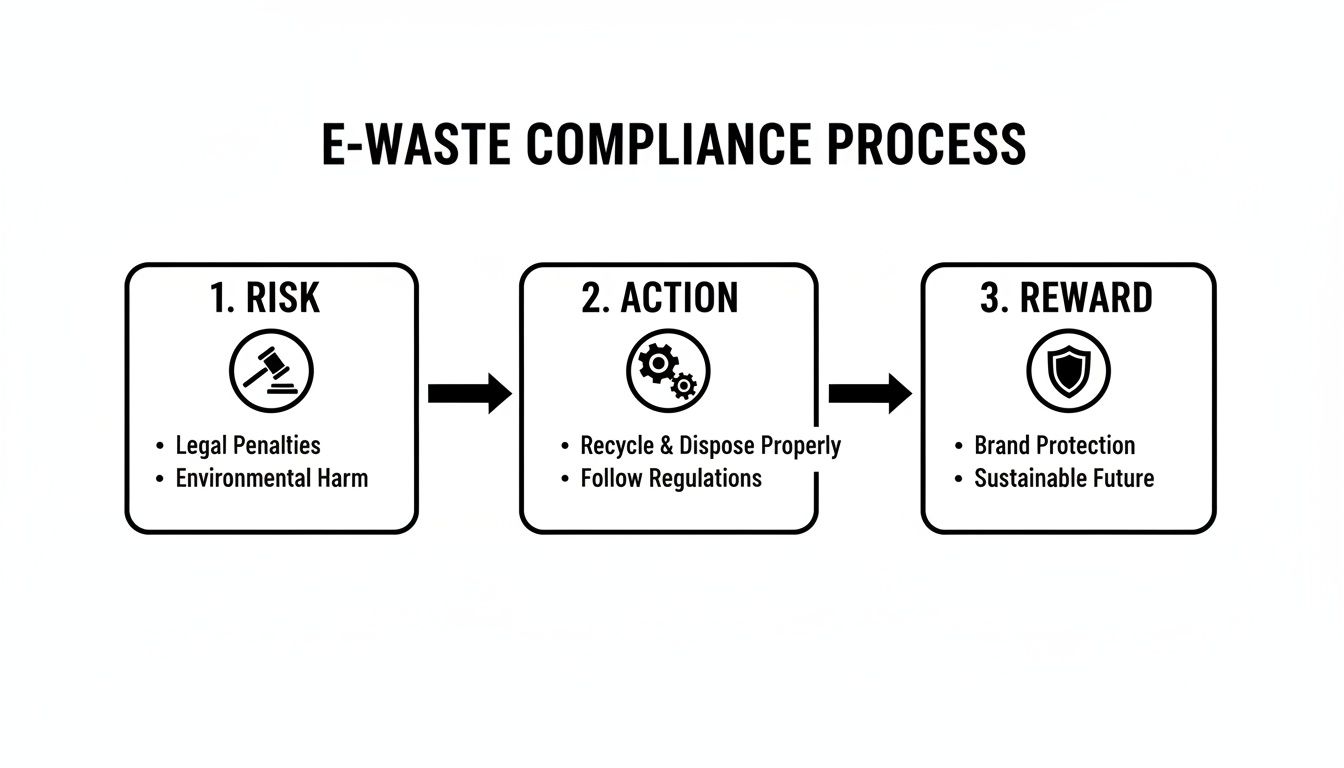
This workflow emphasizes how a structured process is key to converting a potential liability into a protected asset for your business.
Step 3: Certified Data Destruction
Once your equipment arrives at the secure recycling facility, the most critical phase begins: data destruction. Every data-bearing device—hard drives, SSDs, servers, and phones—is identified and segregated for secure processing.
Your data is destroyed using methods that meet or exceed Department of Defense (DoD) standards. This may involve multi-pass data-wiping software that overwrites every sector of a drive, or physical shredding that reduces the media to tiny, completely irrecoverable fragments.
Upon completion, you receive a Certificate of Destruction. This is a crucial legal document that provides an auditable record proving your company’s sensitive information was permanently eliminated, serving as your proof of due diligence.
Step 4: Sorting and Commodity Recovery
After all data has been destroyed, the equipment is manually disassembled. Our technicians sort the components into different material streams: circuit boards, steel casings, aluminum, plastics, and copper wiring. This careful separation is vital for maximizing the value of the raw commodities.
The electronic circuit boards themselves are then sent through a mechanical process that shreds and granulates them. We use advanced separation technologies, like magnets and eddy currents, to isolate precious metals from non-metallic materials like fiberglass and resin. This "urban mining" is what transforms e-waste back into a valuable resource, feeding materials like copper and gold back into the manufacturing supply chain. You can see the entire breakdown in our guide on what happens to recycled electronics.
Finally, you will receive a Certificate of Recycling that documents the responsible disposition of all your materials. This closes the loop on the chain of custody, confirming that your e-waste was managed in an environmentally sound and legally compliant way, from start to finish.
Comparing Professional Recycling and Improper Disposal
When it's time to retire old electronics, the choice your business makes has consequences that ripple far beyond your storage closet. One path leads to sustainable resource management and a stronger brand, while the other creates serious environmental and financial liabilities. Drawing a clear distinction between certified electronic circuit board recycling and high-risk methods like landfilling is crucial for any modern business.
Professional recycling is a cornerstone of the circular economy—a system designed to put valuable materials back to work instead of discarding them. When a circuit board is responsibly processed, precious metals like gold, silver, and copper are meticulously extracted. These recovered materials re-enter the supply chain, dramatically reducing the environmental toll of mining for new resources.
This approach transforms your e-waste from a liability into a valuable asset that supports a more resilient and sustainable industrial ecosystem.
The High Cost of Improper Disposal
Conversely, improper disposal methods like landfilling represent a dead end for valuable resources and a direct threat to the environment. When circuit boards are dumped in a landfill, they become a latent environmental hazard.
The hazardous materials they contain—lead, mercury, and cadmium—do not remain inert. Over time, these toxins can leach into the soil and seep into groundwater, contaminating local ecosystems for generations. This not only causes severe environmental damage but also wastes the finite precious metals locked inside. Disposing of old electronics is like burying treasure mixed with poison. The potential fallout is a huge part of the total environmental impact of electronic waste.
Choosing professional recycling isn't just about checking a compliance box; it's a fundamental part of modern Corporate Social Responsibility (CSR). This decision actively strengthens your brand by demonstrating a tangible commitment to sustainability and ethical business practices.
A Growing Global Challenge
The scale of this problem is staggering. Global e-waste generation surged from about 34 million metric tonnes in 2010 to roughly 62 million metric tonnes in 2022. It's projected to hit 82 million metric tonnes by 2030.
Unfortunately, recycling efforts are not keeping pace. Documented collection and recycling only covered about 22.3% of e-waste in 2022, a figure expected to decline without intervention. This gap means vast quantities of recoverable metals are being lost to landfills or processed in unsafe conditions, as highlighted in the UN's findings on e-waste rising faster than recycling.
This global challenge makes the choices made at the local level—by every single business—even more critical.
From Risk Management to Brand Enhancement
Framing this decision correctly is key. Responsible electronic circuit board recycling is a clear path to both managing risks and building a stronger corporate identity. Here’s how the two choices compare:
| Aspect | Professional Recycling (The Responsible Choice) | Improper Disposal (The High-Risk Path) |
|---|---|---|
| Resource Management | Feeds the circular economy by recovering valuable metals. | Permanently loses finite resources to landfills. |
| Environmental Impact | Prevents toxic materials from contaminating soil and water. | Creates long-term pollution and environmental hazards. |
| Legal Compliance | Ensures adherence to RCRA and state regulations, avoiding fines. | Exposes the business to severe penalties and legal action. |
| Data Security | Guarantees certified destruction of all sensitive information. | Leaves sensitive company and customer data vulnerable to theft. |
| Brand Reputation | Strengthens CSR credentials and builds customer trust. | Damages public perception and can lead to negative press. |
Ultimately, how your business handles its retired technology sends a powerful message. Opting for professional recycling demonstrates foresight, responsibility, and a commitment to being a positive force in the community. It’s a strategic decision that protects your bottom line, your reputation, and our shared environment.
Your Top E-Waste Recycling Questions, Answered
When it comes to business e-waste, we hear a lot of the same questions from IT managers and business owners. Clarifying the specifics around electronic circuit board recycling typically addresses these concerns and demonstrates the value of partnering with a certified professional. Let's cover the most common inquiries we receive.
Is My Business Too Small for This Service?
Absolutely not. A reputable recycler offers flexible solutions for businesses of all sizes, whether you are a small office with a few old PCs or a large corporation decommissioning a data center.
The need for ironclad data security and environmental compliance is universal. A good partner will develop a straightforward, cost-effective plan tailored to your specific inventory and needs.
What Kind of Documentation Will We Receive?
You should always receive official documentation that proves you have followed proper procedures. This is not just for your records; it's your liability shield. Typically, you'll get:
- A Certificate of Destruction for any device that held data, confirming every byte of sensitive information was permanently eliminated according to strict industry standards.
- A Certificate of Recycling for all hardware, detailing how your assets were responsibly managed.
These documents are crucial for internal audits and for demonstrating compliance with all regulatory requirements.
Choosing a certified recycler gives you a fully auditable, legally defensible paper trail. It's your guarantee that every single piece of equipment was managed securely and responsibly from the moment it left your hands.
Can We Get a Financial Return on Our Old Electronics?
Yes, this is often a possibility. The potential for a financial return depends on the type, age, and volume of your equipment. Enterprise-grade servers, high-end networking gear, and specific types of circuit boards contain higher concentrations of valuable precious metals.
A professional recycler can assess your assets and frequently offer a return based on the current market value of the recovered commodities. This can help offset service costs and, in some cases, even generate revenue for your IT budget.
What Happens to the Hazardous Materials?
This is where a certified recycler truly proves their value. They adhere to strict, established protocols for managing hazardous substances like lead, mercury, and cadmium found in older electronics.
These hazardous materials are carefully isolated during the disassembly process and then sent to specialized downstream partners who are permitted and equipped to handle them safely. This ensures they are never released into the environment.
Ready to manage your company's e-waste the right way? Atlanta Computer Recycling offers secure, compliant, and efficient electronic recycling solutions built for Atlanta-area businesses. Contact us today to schedule your pickup.