County of Fulton E-Waste: Secure Disposal & ITAD

Old laptops are stacked in a locked closet. A server refresh is done, but the retired drives are still sitting on a shelf. Facilities wants the room back. Legal wants documentation. Security wants chain of custody. Procurement wants to know whether anything has resale value. That is a normal week for an IT manager in the county of fulton.
The problem is not volume alone. It is context. Fulton County was established in 1853, and its unusual shape stretches roughly 70 miles north to south because it absorbed Milton and Campbell counties during the Great Depression, according to the history of Fulton County. This means that retired IT assets do not move through one simple local system.
For commercial teams, e-waste in Fulton County is a risk management issue first. Devices often contain protected health information, student records, internal financial data, customer files, credentials, and archived email. Once equipment leaves your control without a disciplined process, the project stops being “recycling” and becomes a data security exposure.
That is why a generic cleanup approach usually fails. A one-day office purge might remove clutter, but it does not create defensible records, secure transport, or verifiable data destruction. If you are planning a move, closure, hardware refresh, M&A integration, or data center shutdown, the county of fulton requires a more deliberate operating model. Teams handling broad metro Atlanta pickups often start with a regional view of commercial e-waste needs across metro Atlanta, then narrow that into site-specific controls for each facility.
Your E-Waste Challenge in a Thriving Fulton County
Monday starts with a routine refresh. By Thursday, the project has stalled because a department closet in Sandy Springs still holds undeployed laptops, a clinic in South Fulton has two failed drives with no destruction decision, and Facilities needs the old equipment gone before a move-out inspection. That is a common Fulton County ITAD problem. The risk is not the volume alone. The risk is scattered custody, mixed asset types, and too little time to document what happened.
In Fulton County, disposal projects break down at the handoff points. Assets leave desks, pass through local storage, and wait for pickup while different teams assume someone else handled data sanitization, approvals, and records. For an IT manager, that gap creates significant exposure. A recycling job can quickly become a HIPAA issue, a contract issue, or a failed audit trail.
Fulton County creates more of these failure points because the county combines dense commercial corridors, healthcare facilities, schools, public entities, and multi-site businesses across a long metro footprint. A one-office cleanout is manageable. A county-wide refresh with clinics, branch offices, and leased administrative space requires chain-of-custody discipline from the start. Teams planning pickups across multiple facilities begin with a broader view of commercial e-waste services across metro Atlanta, then narrow the project into site-by-site controls.
What makes county of fulton different
The local issue is not just disposal. It is disposal under uneven rules, strict data obligations, and real logistical friction. Fulton County does not give IT managers one simple county ordinance that answers every question, so internal policy and sector-specific requirements carry more weight. Healthcare groups, legal offices, schools, and government contractors all face different records, privacy, and destruction expectations. That puts ITAD closer to general regulatory compliance than to standard junk removal.
Site conditions add pressure. Equipment may be spread across high-rise offices in Atlanta, municipal buildings, medical campuses, warehouse offices near logistics routes, and satellite locations with limited loading access. Pickup windows are short. Building rules vary. If your vendor cannot maintain documented custody across those conditions, your process is weak before the truck is loaded.
What works in practice
The teams that keep these projects under control do a few things early and do them consistently.
- Classify assets by data risk first: Laptops, servers, phones, removable media, and failed drives need a data decision before a recycling decision.
- Build the inventory before the pickup date: A basic serial-level list, location, and custodian record gives you something defensible if questions come later.
- Set one release process across all sites: The same authorization, packing, labeling, and sign-off standard should apply whether the asset came from Buckhead, downtown Atlanta, or a South Fulton facility.
- Choose disposition by asset condition and compliance need: Reuse, resale, shredding, and recycling each fit different equipment. Treating everything the same wastes value or weakens documentation.
Poor results tend to come from three predictable mistakes. Teams use office cleanout vendors that can move pallets but cannot prove secure handling. They treat business equipment like consumer drop-off material. Or they wait until lease-end week, when records get thin and disposal decisions get rushed.
If a device stored business data, the sanitization method, custody record, and final disposition should be decided before pickup is scheduled.
Understanding the Fulton County Regulatory Environment
Businesses often look for one county ordinance that explains exactly how to dispose of IT assets in Fulton County. In practice, that single rulebook does not exist.

The local challenge is a patchwork. Federal obligations apply to the data on the device. State environmental rules affect handling and disposal. Internal corporate policy governs who can release assets, who signs off, and what records must be retained. County services may exist for general waste streams, but those are not a substitute for a business ITAD program.
Fulton County also has a policy gap. The county has significant gaps in e-waste management regulations for its concentration of businesses and underserved populations. The same assessment notes that 10.1% of residents are uninsured, and it highlights environmental health risks from improper ITAD that are not addressed by specific county ordinances, increasing the burden on organizations to find qualified partners, according to the Grady community health needs assessment.
What that means for your team
If there is no single county-level business e-waste ordinance telling you exactly what to do, responsibility shifts back to your organization. You have to define a defensible workflow.
That workflow should answer basic operational questions:
- Who owns the asset release decision
- How is data destruction verified
- How is chain of custody documented
- What happens to damaged or non-working media
- What proof do you keep after the project closes
A useful frame is to think in terms of broader general regulatory compliance. For IT managers, compliance is not one statute. It is the discipline of aligning operational steps, records, controls, and vendor oversight.
Where companies get exposed
Organizations in the county of fulton get exposed in one of three places:
- Policy mismatch: Internal policy requires auditable destruction, but operations use a convenience-based disposal method.
- Vendor mismatch: The provider can haul equipment but cannot support secure data handling, serialized reporting, or regulated project needs.
- Documentation gaps: The project is completed physically, but nobody can prove what happened to each storage-bearing asset.
For local organizations, the safer approach is to treat county-specific ambiguity as a reason to tighten process, not loosen it. Teams looking at location-specific service expectations start with a Fulton-focused commercial ITAD view such as https://atlantacomputerrecycling.com/fulton-county/ and then layer in legal, security, and records requirements from their own environment.
Tip: If your disposal process depends on trust instead of documentation, it is too weak for healthcare, education, government, and most mid-market enterprises.
The High Stakes of Non-Compliance for Local Industries
The main risk is not the scrap value of a device. The main risk is the information on it.
In Fulton County, that risk lands differently depending on the industry. A medical office may be dealing with protected health information. A school district may be dealing with student records. A law firm may hold litigation files. A finance team may have archived reporting data or employee tax records on retired endpoints. The hardware changes. The exposure does not.
Healthcare and HIPAA pressure
For healthcare organizations, office closures, department consolidations, and equipment refreshes create dangerous moments. A workstation that looks obsolete to facilities may still contain cached records, scanned documents, or credentials. A copier hard drive may hold sensitive images. A server slated for disposal may contain old backups that nobody remembered.
The county-level policy gap makes this harder. Fulton County’s public health planning highlights an underserved intersection between e-waste and health equity, with no clear county policies on ITAD for office closures. That creates a practical challenge for organizations trying to uphold HIPAA standards while avoiding community harm from poorly handled decommissioning projects, according to the Fulton County Board of Health community assessment.
That point matters operationally. If your disposal process leaks drives, loose media, or mixed loads into weak downstream handling, the problem is not only internal non-compliance. It can also become a broader environmental and social responsibility issue.
Education and FERPA realities
Schools and higher education institutions face a different version of the same problem. Devices move constantly. Labs are refreshed in batches. Departments store equipment long after retirement because nobody wants to release something that may still contain data.
FERPA risk is less visible than HIPAA risk because the devices look ordinary. A student affairs laptop, an admissions desktop, or a registrar’s printer fleet may not look sensitive during a move. From a records standpoint, they are.
What works in education is centralized control. What fails is leaving each department to improvise disposal on its own timeline.
The local ESG dimension
In the county of fulton, non-compliance also has a community-facing dimension. Improper handling of retired electronics can affect vulnerable populations when assets are abandoned, mixed into unmanaged waste streams, or released without proper controls. For many organizations, that puts ESG, legal, and information security into the same conversation.
That is why responsible organizations do not treat ITAD as a janitorial line item. They treat it as part of governance.
The weak spots that cause damage
The highest-risk errors are basic:
- Untracked hard drives: Drives removed from systems but not logged individually.
- Uncontrolled staging areas: Retired equipment left in unlocked rooms or loading areas.
- Mixed project scopes: Data-bearing assets and non-data scrap packed together without review.
- No destruction evidence: The organization cannot show what was wiped, what was shredded, and when.
- Department-level side deals: Staff giving away or moving old devices outside approved process.
A strong control point is dedicated secure data destruction in Atlanta tied to written release procedures, serialized asset handling, and final reporting. Without that, organizations are often relying on memory, not evidence.
Key takeaway: In regulated environments, the primary failure is not “we recycled incorrectly.” It is “we cannot prove data was secured before the asset left control.”
A Compliant ITAD Workflow for Fulton County Businesses
A compliant workflow should be simple enough to repeat and strict enough to survive an audit, an internal review, or a leadership challenge after an incident. In the county of fulton, logistics planning also matters because multi-site pickups and long-distance scheduling can introduce delays and custody gaps.

Start with inventory and asset triage
Do not begin with trucks. Begin with visibility.
Create an asset list that separates equipment into practical groups:
- Data-bearing assets: laptops, desktops, servers, hard drives, SSDs, copiers, appliances
- Non-data electronics: monitors, docks, cables, phones without local storage where applicable
- Hazard or special handling items: batteries, damaged media, legacy display equipment
- Potential reuse candidates: newer devices that may still have remarketing or redeployment value
The point is not perfection. The point is to stop mixed handling before it starts.
For each asset, capture enough detail to support release and reporting. Serial number if available. Department or room location. Functional status. Whether the device needs wiping or physical destruction.
Decide on sanitization method early
Not every asset should be wiped. Not every asset needs shredding. The decision depends on media condition, reuse goals, policy requirements, and risk tolerance.
Use a practical rule set:
- Wipe functioning media when the organization intends reuse, remarketing, or internal redeployment and the media can be processed reliably.
- Physically destroy failed or obsolete media when it cannot be sanitized with confidence.
- Escalate exceptions such as damaged drives, encrypted systems with uncertain key control, and specialty equipment with embedded storage.
If your team needs a baseline overview of process terminology, https://atlantacomputerrecycling.com/what-is-it-asset-disposition/ is a useful starting point. The critical work, however, happens in the release controls and evidence trail.
Control the pickup and route plan
Transport is part of compliance. Once assets leave the building, your exposure depends on custody discipline.
Fulton County’s GIS mapping system offers parcel-level data for route planning and site verification, with sub-meter accuracy that can help IT managers verify coordinates, assess access, and plan pickups. The same source notes that this can reduce transport delays by up to 30% and support a secure chain of custody for HIPAA-sensitive disposals through better logistics planning, according to the Fulton County GIS maps resource.
That matters more than many teams realize. For large campuses, medical buildings, schools, and multi-tenant offices, route confusion creates idle equipment, late pickups, and unnecessary handoffs.
Require chain-of-custody checkpoints
Every transfer should have a checkpoint. That includes:
- At release from the department: confirm asset list against staged equipment
- At loading: verify counts or serialized units before the truck departs
- At processing intake: reconcile what was received with what was expected
- At final disposition: tie wiping, shredding, recycling, or remarketing outcomes back to the original inventory
A short chain with clear signatures beats a long chain with assumptions.
Tip: If your team cannot identify the last verified custodian for a batch of drives, pause the project and fix the process before the next pickup.
Close with reporting, not assumptions
The project is not done when the room is empty. It is done when records are complete.
Final reporting should answer four questions:
| Required record | Why it matters |
|---|---|
| Asset summary | Shows scope and what entered disposition |
| Data destruction record | Proves how storage media was sanitized or destroyed |
| Chain-of-custody documentation | Shows who controlled assets during transfer |
| Recycling and disposition summary | Confirms downstream handling and closes internal review |
Good workflow design removes improvisation. That is the point. A compliant ITAD process should feel boring, repeatable, and hard to break.
Accepted Items and Secure Disposal Options
Most business projects in the county of fulton involve mixed equipment. The mistake is treating that mixed load as if every item carries the same risk.
A monitor without storage is not handled the same way as a laptop with a drive. A failed SSD is not handled the same way as a working desktop intended for reuse. A network switch is usually lower data risk than a multifunction printer with internal storage. The disposal path should match the asset.
Business disposal is not the same as public drop-off
Public or residential e-waste options can be appropriate for household items. They are usually a poor fit for commercial assets containing regulated or confidential data. A business needs controlled pickup, chain of custody, and records that hold up after the fact.
That is especially true during relocations, office closures, school refreshes, and healthcare equipment turnover. Convenience-based drop-off is attractive when teams are under pressure. It is rarely the safest path for organizations.
Fulton County Business IT Asset Disposal Cheat Sheet
| IT Asset | Contains Data? | Recommended Action | Compliance Note |
|---|---|---|---|
| Laptops | Usually yes | Inventory, sanitize if functional, destroy media if failed | Treat as sensitive until wiped or shredded |
| Desktop computers | Usually yes | Same as laptops | Include loose drives removed during upgrades |
| Servers | Yes | Serialized tracking, controlled de-install, sanitize or destroy media | Higher oversight due to concentration of business data |
| Hard drives and SSDs | Yes | Dedicated data destruction workflow | Do not place in mixed electronics bins |
| Copiers and multifunction printers | Often yes | Review internal storage, then sanitize or destroy media | Frequently overlooked in office moves |
| Network switches and routers | Sometimes | Evaluate configuration and storage, then recycle through business ITAD process | Do not assume no data without review |
| Monitors | No direct user data in most cases | Recycle through approved electronics channel | Handle separately from storage devices |
| Keyboards, mice, cables | No | Bulk electronics recycling | Low data risk, but keep separate for efficiency |
| UPS units and batteries | No user data, but special handling may apply | Process through qualified electronics and battery handling stream | Do not mix with general office cleanout loads |
| Mobile phones and tablets | Yes | Secure wipe or physical destruction based on condition | Include SIM and removable media controls |
A quick sorting rule
If the item can store data, route it into secure ITAD first.
If it cannot store data, route it into electronics recycling after verification.
If you are not sure, treat it as data-bearing until someone qualified confirms otherwise.
That conservative approach prevents the most common disposal errors. It also gives procurement, security, and facilities a shared language for deciding what leaves the building and how.
Aligning with ACR for End-to-End Fulton County Compliance
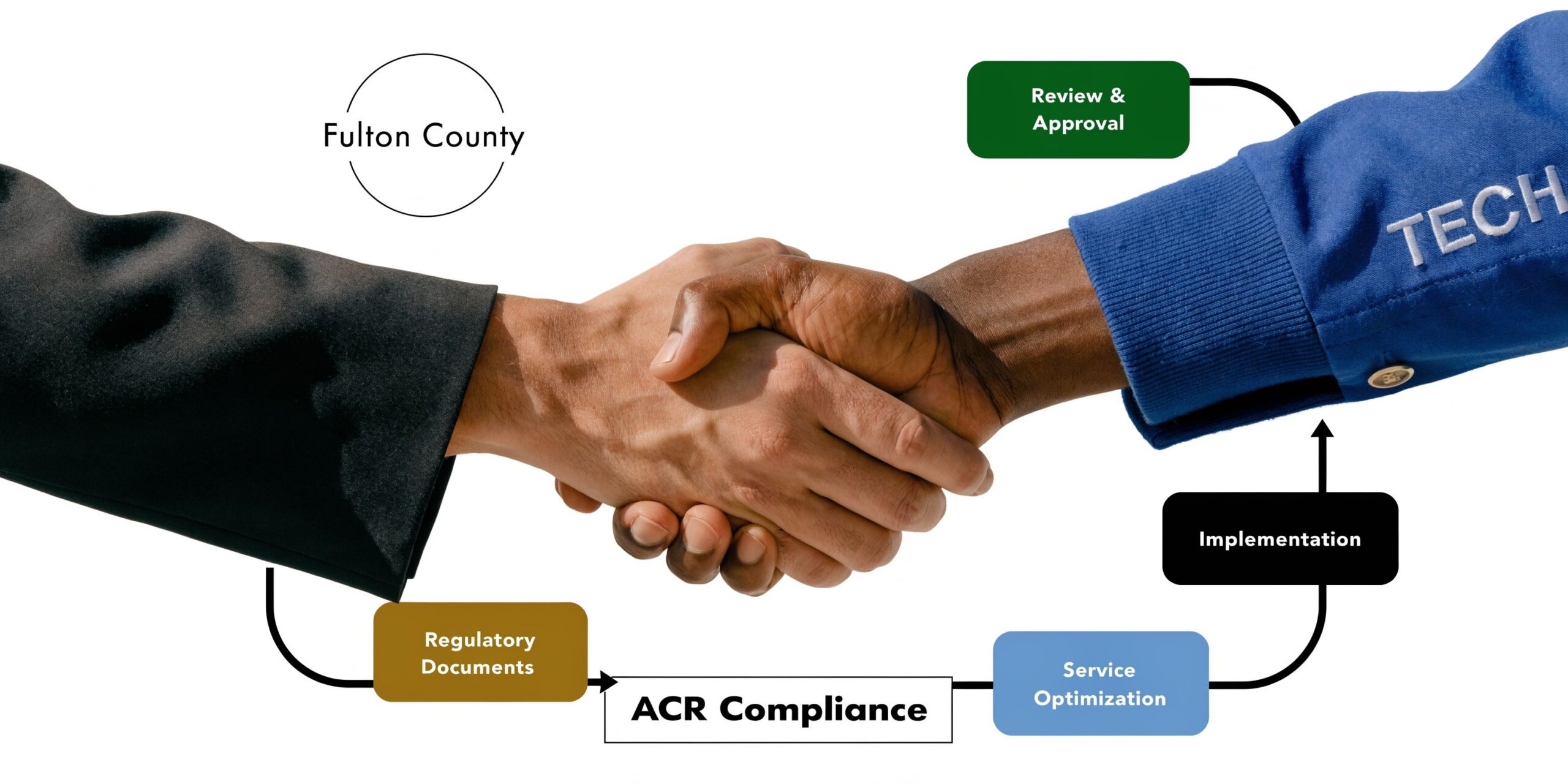
A Fulton County ITAD project breaks down in one of four places. Pickup is delayed. Data handling is inconsistent. Documentation arrives incomplete. Or the vendor can manage small office loads but not a larger commercial decommission.
That is where Atlanta Computer Recycling fits best. The company is built around business-to-business electronics recycling and IT asset disposition across metro Atlanta, with services that map directly to the control points commercial clients care about.
How ACR addresses key problems
For organizations managing regulated data, the first question is always what happens to the storage media. ACR offers DoD 5220.22-M 3-pass wiping for eligible drives and physical shredding for obsolete or non-functional media. That gives IT managers two clear paths. Preserve reuse value when media can be sanitized reliably, or destroy it when policy or hardware condition demands certainty.
The second issue is logistics. Fulton County projects often involve office towers, medical campuses, schools, and government buildings where the hard part is not just disposal. It is controlled removal. ACR handles on-site de-installation, packing, pickup, and logistics, which matters when retired equipment is spread across floors, closets, racks, and secured spaces.
Why this matters in commercial environments
A generic recycler may be able to take equipment away. That is not enough for healthcare, education, or public sector teams. They need a provider that understands why a copier hard drive, a batch of failed SSDs, and a rack of retired servers cannot all be treated as the same commodity load.
ACR also prioritizes reuse and certified recycling to divert e-waste from landfills. That matters for organizations trying to pair information security with environmental stewardship instead of treating them as separate initiatives.
The practical fit for Fulton County teams
ACR is useful when your project includes one or more of these conditions:
- A multi-site pickup plan: offices, clinics, schools, or field locations across metro Atlanta
- A department move or closure: where speed matters but documentation cannot slip
- A bulk server retirement: with storage media that needs verified disposition
- A lease-end cleanout: where facilities timelines create pressure on the IT team
- A compliance-sensitive environment: where HIPAA-oriented handling and clear records are required
The strongest reason to align with a partner like ACR is simple. It turns a disposal event into a controlled business process. You get operational help at the point where internal teams are usually stretched thin, and you reduce the chance that old assets leave the building without a clean evidence trail.
Advanced Scenario Decommissioning a Fulton County Data Center
A data center decommission is not just a larger version of office e-waste pickup. It is a different class of project.
In the county of fulton, these jobs often happen under deadline pressure. A lease expires. A cloud migration reaches cutover. A merger consolidates infrastructure. Leadership wants the space cleared, but security still needs control over every server, drive, appliance, and rack component.

The project risks are layered
A data center shutdown combines several disciplines at once:
- Asset accountability: You need to know what is still in production, what is approved for removal, and what media must be isolated.
- Physical de-installation: Racks, rails, PDUs, switches, storage arrays, and servers have to come out safely and in sequence.
- Data destruction: Every storage-bearing component needs a defined sanitization path.
- Logistics: Equipment must move from the room without creating chain-of-custody blind spots.
- Final site closure: The client needs a clean sweep, supporting records, and no leftover surprises in cabinets or cages.
What fails here is ad hoc labor. Teams get into trouble when they mix facilities removal, scrap hauling, and data disposition under separate vendors with no single control point.
What a disciplined decommission looks like
A proper project starts with scope control. Identify production dependencies. Freeze release lists. Separate infrastructure that must remain in place from hardware that is cleared for removal.
Then move in order. De-install. Stage. verify. Sanitize or destroy media. Load under documentation. Reconcile the intake. Close the loop with reporting.
For larger projects, that is why organizations use specialized partners for data center decommissioning in Atlanta. The issue is not just capacity. It is coordination across security, facilities, operations, and downstream disposition.
Practical takeaway: If your decommission plan starts with “we’ll sort it on the truck,” the plan is already weak.
The best data center projects feel tightly choreographed. Everyone knows what is approved, who is touching it, where it is going, and what documentation closes the job.
Frequently Asked Questions for IT Managers
Is data wiping enough, or should we shred drives
It depends on the media condition and your reuse goals. If a drive is functional and your policy allows sanitized reuse, wiping can be appropriate. If the drive is failed, obsolete, or too risky to trust, physical destruction is the stronger option. Many organizations use both methods in the same project.
Do we need certificates and final reports
Yes. Without documentation, you are relying on verbal assurance. In commercial ITAD, that is weak. You need records that show what assets were handled, how storage media was processed, and when the disposition occurred.
Can facilities or office services manage this for us
They can support logistics inside the building, but they should not own secure ITAD unless they are operating under a clear IT and compliance workflow. Facilities teams are not usually responsible for data governance decisions.
Are printers and copiers part of the risk
Yes. They are often missed because they do not look like traditional computers. Many organizations forget that multifunction devices can store sensitive information and should be reviewed before disposal.
What if our asset records are incomplete
That is common. Start by creating a controlled staging process and documenting what you can verify at pickup. The bigger mistake is delaying the project until the inventory is perfect. Build a defensible list, flag unknowns, and route uncertain assets through the stricter handling path.
Should we let departments dispose of small batches on their own
No, not if those devices may contain business data. Decentralized disposal creates policy drift. One team wipes. Another team stores devices for months. A third hands equipment to an unapproved party. Central oversight is safer.
How fast can a project move
Small office pickups can move quickly if the inventory is clear and the release decision is already approved. Complex projects take longer because they involve de-installation, media segregation, and reporting. Speed matters, but clean custody matters more.
What is the simplest way to reduce risk right now
Use a short internal rule:
- Any data-bearing asset requires approved ITAD handling
- Any failed media goes to physical destruction unless policy says otherwise
- No asset leaves the building without documentation
- No department runs its own disposal channel
That rule alone prevents many of the avoidable mistakes seen in office closures, hardware refreshes, and server retirement work across the county of fulton.
If your team needs a commercial ITAD partner that can handle secure pickup, data destruction, de-installation, and documented electronics recycling across Fulton County, Atlanta Computer Recycling offers a practical end-to-end option for businesses, hospitals, schools, agencies, and data center operators.