A Strategic Business Guide to Corporate IT Recycling in Atlanta, GA

For any IT manager or business leader in Atlanta, managing end-of-life technology is far more than a logistical task—it's a critical component of your corporate security, compliance, and risk management strategy. This is where professional corporate IT recycling Atlanta GA services, formally known as IT Asset Disposition (ITAD), provide a secure, auditable process designed to protect your organization from data breaches, regulatory fines, and environmental liability.
Why Professional IT Recycling Is a Business Imperative in Atlanta
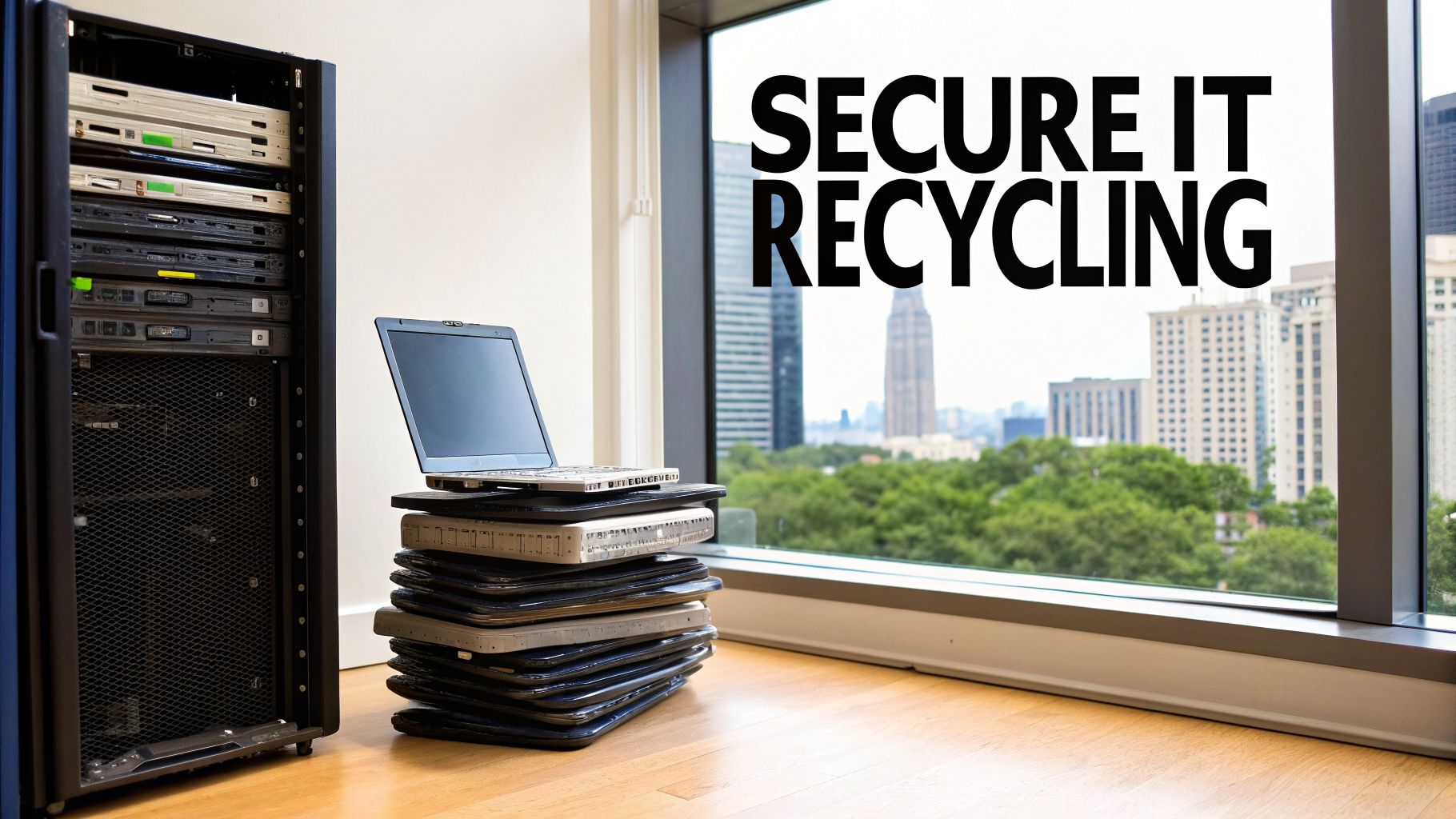
To a modern business, retired technology isn’t junk. It's a vault holding sensitive corporate data. Consider the old server in a storage closet, the stack of laptops from a recent employee refresh, or a box of decommissioned hard drives. Each asset contains a history of your operations, client data, and proprietary information. In a competitive business hub like Atlanta, a single misstep in disposal can expose your entire enterprise to significant risk.
This is not a theoretical problem. Failure to properly manage your end-of-life IT assets can have severe real-world consequences, from the financial devastation of a data breach traced back to a discarded device to the brand damage of non-compliance with environmental regulations.
Beyond the Dumpster: A Strategic Necessity
The scale of this challenge is growing. Driven by constant hardware upgrade cycles in corporate offices, tech firms, and data centers, the global computer recycling market is projected to expand from $13.63 billion in 2025 to an estimated $22.98 billion by 2033. This trend is particularly relevant for Atlanta’s diverse business landscape, where organizations require a secure, scalable solution for bulk IT asset disposition. You can find more market analysis on sites like MarketResearch.com.
Engaging a dedicated ITAD partner transforms this complex operational duty into a streamlined, secure process. The objective is to provide a comprehensive service that goes far beyond simple equipment removal.
A professional ITAD service is your company's last line of defense against data exposure from retired assets. It’s the process that ensures your digital history doesn't become a public headline.
Effective corporate e-waste recycling isn't just about disposing of old equipment. It’s about implementing a secure and compliant framework that addresses several key business objectives simultaneously:
- Data Security: Ensuring every bit of corporate and customer data is verifiably destroyed to shield your business from breaches.
- Regulatory Compliance: Adhering to standards like HIPAA for healthcare data or FACTA for financial records, helping you avoid costly penalties.
- Environmental Responsibility: Keeping hazardous e-waste out of landfills and supporting corporate sustainability goals.
- Operational Efficiency: Reclaiming valuable office or data center space and allowing your IT team to focus on core business functions, not disposal logistics.
By treating IT recycling as a strategic priority, Atlanta businesses can convert a significant operational liability into a streamlined process that protects their brand, their bottom line, and their most valuable information.
Understanding Secure Data Destruction Methods
What really happens to the data on your company's retired hard drives and servers? Simply deleting files or reformatting a drive is the business equivalent of leaving a company ledger on the curb—the information remains and is surprisingly easy for a determined actor to recover. For any Atlanta business, true data security requires a more definitive, irreversible approach.
When you partner with a professional for corporate IT recycling Atlanta GA, you are not just discarding old hardware. You are gaining access to certified methods that permanently eliminate sensitive information. Proper data destruction isn't merely a best practice; it's a critical component of preventing data loss and protecting your business from liability and reputational harm.
Data Wiping: The Digital Overwrite Standard
One of the most common methods for data sanitization is software-based wiping. This process is akin to trying to erase a sentence written in permanent marker. You cannot simply wipe it clean—you must overwrite it repeatedly until the original message is completely indecipherable.
The gold standard for this process is the DoD 5220.22-M 3-pass wipe. This U.S. Department of Defense specification employs a precise, three-step protocol:
- Pass 1: Writes a character, such as a zero, across the entire drive.
- Pass 2: Writes the complementary character, such as a one, over the entire drive.
- Pass 3: Writes random characters and then verifies the overwrite was successful.
This triple-overwrite process renders the original data unrecoverable via any known software-based forensic tools. For an Atlanta-based healthcare provider, this is essential for destroying patient records on old computers in compliance with HIPAA.
Physical Shredding: The Ultimate Failsafe
What about drives that are too old to run software, are physically damaged, or contain your company’s most sensitive intellectual property? In these scenarios, physical destruction is the only acceptable solution. This is not a crude process of taking a hammer to a hard drive; it is a precise, industrial-grade procedure.
Physical shredding is the digital equivalent of feeding a highly confidential document into an industrial wood chipper. There is no possibility of reassembly or data recovery—it guarantees absolute destruction.
This method is the ideal solution for:
- Non-functional or obsolete hard drives and solid-state drives (SSDs).
- Backup tapes, flash drives, and other magnetic media.
- Organizations with a zero-risk tolerance for data exposure, such as law firms, financial institutions, and R&D departments.
The process reduces drives to small, unrecognizable fragments of metal and plastic, making data retrieval physically impossible. This method can be used in conjunction with other technologies, and you can learn more about related options like degaussing in our detailed article.
The Certificate of Data Destruction: Your Proof of Compliance
Regardless of the method used, the process is not complete until you have a Certificate of Data Destruction. This document is your official, auditable record verifying that your company’s digital assets have been securely and permanently sanitized.
This certificate is a non-negotiable deliverable. It lists the serial numbers of every device that was wiped or shredded, creating a clear chain of custody that is indispensable for any compliance audit. For IT and compliance managers across Atlanta, this document provides the final assurance that closes the loop on asset disposition and proves due diligence was performed correctly.
Navigating Data Compliance and Georgia Regulations
For any Atlanta business, data compliance is not merely a best practice—it's a legal minefield. When retiring old IT equipment, mishandling the data contained within can trigger crippling fines and inflict permanent damage on your company’s reputation. This is precisely why professional corporate IT recycling Atlanta GA has become an essential service for modern risk management.
Every time a retired computer, server, or hard drive leaves your premises, you are also parting with the sensitive data it holds. This could range from protected health information (PHI) and customer financial data to internal trade secrets. Regulations like HIPAA (for healthcare), SOX (for public companies), and FACTA (for consumer credit) have stringent rules for protecting this data, even at its end of life.
The Unbroken Chain of Custody
Consider your sensitive data a high-value armored car shipment. You would never allow it to leave your facility without knowing exactly who has it, where it is going, and obtaining signatures at every handoff. This is the core principle behind chain of custody in IT asset disposition.
A documented chain of custody creates a complete, auditable trail for your IT assets, from the moment they leave your control to their final, verified destruction. Every step is logged, providing you with a clear record.
- On-site Inventory: We begin by creating a detailed manifest of every asset, including serial numbers, before anything is moved.
- Secure Transport: Your assets are transported in a secured, GPS-tracked vehicle directly to the recycling facility.
- Facility Check-in: Upon arrival, the inventory is reconciled to confirm that every item that left your site has arrived securely.
- Final Documentation: You receive a formal Certificate of Data Destruction, giving you concrete proof that the process was executed securely.
This unbroken chain is your legal shield. It provides the evidence auditors require and the documentation that protects your business from liability in the event of a potential data breach from retired assets.
Why Compliance Hinges on Your Recycling Partner
Let’s be direct: selecting a certified, professional recycler is the single most important action you can take to meet your compliance obligations. An expert partner understands the nuances of regulations like HIPAA and builds their entire process around meeting those legal standards. They don't just haul away old equipment; they assume the responsibility of safeguarding your data.
A data breach from improperly disposed hardware is one of the most preventable—yet most damaging—security incidents a company can face. Your choice of an ITAD vendor is your first and best defense.
The growing demand for these secure services is reflected in market trends. In 2023, the global IT asset recycling market was valued at a staggering $10 billion, with projections showing it will climb to $15 billion by 2028. This growth is driven by businesses in major tech hubs like Atlanta prioritizing secure and compliant disposal. You can find more details on this trend in a report from marketreportanalytics.com.
When you partner with a professional for your Atlanta-based business, you aren't just disposing of e-waste. You are proactively protecting your organization from the immense financial and reputational fallout of a data breach. It's a strategic move that protects your customers, your employees, and your bottom line. To ensure you’re choosing wisely, review our guide on what to look for in an Atlanta GA recycling partner.
What to Expect During an On-Site IT Recycling Project
Understanding the workflow of a professional IT recycling project demystifies the process for Atlanta businesses. Whether you are refreshing dozens of workstations or decommissioning an entire data center, a well-defined process is crucial for maintaining security, compliance, and efficiency from start to finish.
The engagement begins with a simple consultation to define the project scope. From there, a trained and insured team arrives at your location, prepared to manage the entire physical process with minimal disruption to your operations. This is more than a pickup service; it is a full-service operation where technicians handle all the heavy lifting.
They will execute the tasks your IT team lacks the time for—such as de-installing servers from racks, carefully inventorying every asset by serial number, and securely packing everything for transport. That cluttered server room or storage closet is quickly converted back into usable space, all without consuming your internal resources for days or weeks.
From Your Office to Our Secure Facility
Once your assets are loaded onto a secure, GPS-tracked vehicle, the chain of custody officially begins. This documented transfer is a critical step, ensuring every item is accounted for as it moves from your site to our processing facility.
Upon arrival, every piece of equipment is triaged. This sorting process determines the appropriate disposition path for each asset based on its type, condition, and data-bearing status.
- Data-Bearing Devices: The top priority. Anything containing data—such as hard drives (HDDs), solid-state drives (SSDs), and servers—is immediately segregated and queued for secure data destruction.
- Reusable Equipment: Newer or still-functional devices, like monitors, networking gear, and peripherals, are tested. If viable, they are refurbished for resale, which supports a circular economy and can help offset project costs.
- End-of-Life Electronics: Older or non-functional equipment is slated for responsible de-manufacturing. We recover valuable commodities like steel, aluminum, copper, and plastic for recycling.
For equipment demanding the absolute highest level of security, you can learn more about our process for on-site hard drive shredding in Atlanta GA, which ensures your data is destroyed before it ever leaves your property.
The Final Steps: Destruction and Documentation
Following triage, the data destruction process commences. Drives are either wiped to DoD 5220.22-M standards or physically shredded into tiny, unrecoverable fragments. Every action is meticulously logged against the inventory created at your office.
This simple flow chart illustrates how a complex project is broken down into clear, manageable phases.
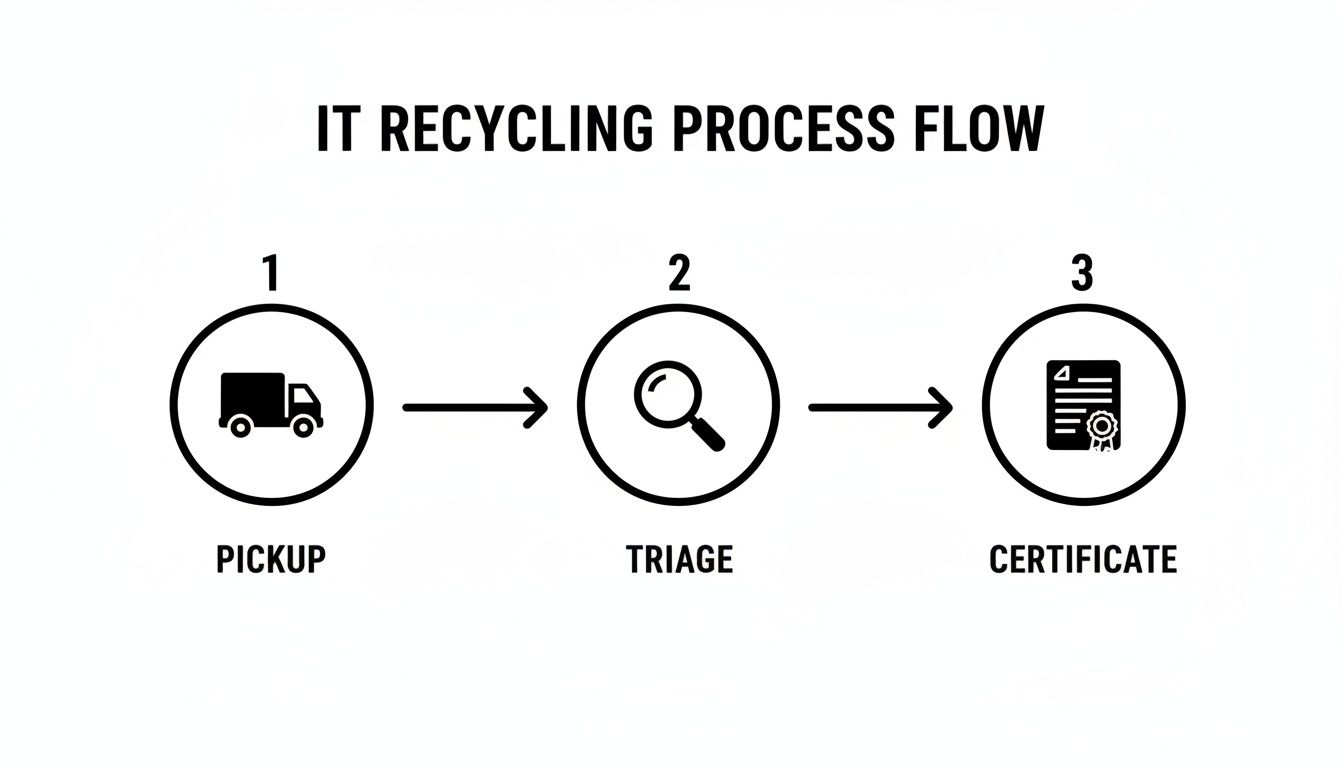
As you can see, the process boils down to three key stages: a secure on-site pickup, a detailed triage at our facility, and the final certified reporting that closes the loop on compliance.
To provide a clearer picture, here is a step-by-step breakdown of a typical engagement.
IT Asset Recycling Project Workflow
| Phase | Key Activities | Your IT Team's Role |
|---|---|---|
| 1. Scoping & Scheduling | Initial consultation to discuss asset types, volume, and location. Provide a preliminary quote and schedule a pickup date. | Provide a rough inventory count and identify the location of the assets. |
| 2. On-Site Pickup | Our team arrives to de-install, palletize, and inventory all equipment by serial number. Assets are securely loaded for transport. | Point our team to the equipment and provide access to necessary areas. |
| 3. Secure Transit | Equipment is transported in a secure, GPS-tracked vehicle from your site to our processing facility. | Relax. Your equipment is now in our secure chain of custody. |
| 4. Receiving & Triage | Assets are received, weighed, and triaged. Data-bearing devices are segregated for destruction; other items are sorted for reuse or recycling. | None. This phase is handled entirely by our team. |
| 5. Data Destruction | Hard drives and other media are wiped or physically shredded according to compliance standards and your project requirements. | None. This is a core part of our secure service. |
| 6. Reporting & Certification | We generate a Certificate of Data Destruction and a final report, itemizing every asset by serial number and its final disposition. | Review and file the certificate for your compliance and audit records. |
This structured process ensures that from the moment we arrive until you receive your final documentation, every step is secure, transparent, and fully documented for your records.
The final piece of the puzzle is the Certificate of Data Destruction. This is not just a receipt; it is an itemized, serial-number-level record of every drive that was destroyed or sanitized. It provides the auditable proof your organization needs for total compliance and peace of mind.
How to Choose the Right IT Recycling Partner in Atlanta
Selecting a vendor for your corporate IT recycling Atlanta GA project is a critical security decision for your company. This is not about finding a hauler for old equipment. It is about entrusting a vendor with your company's sensitive data, its brand reputation, and its compliance standing. A single misstep can lead to a devastating data breach, significant fines, and irreparable brand damage.
This is nothing like hiring a typical service provider. The right partner becomes an extension of your security team. The wrong one can become your single greatest liability. Your objective is to find a company that treats your data with the same level of seriousness that you do.
Start with Certifications and Core Services
The first step in vetting a potential partner is to verify their certifications. These are not just logos for a website; they are hard-earned proof that the company meets stringent, third-party audited standards for data security, environmental safety, and employee protection.
The two certifications that matter most in the industry are:
- R2v3 (Responsible Recycling): This is the premier global standard for electronics recycling. It covers everything from data sanitization protocols to environmental impact and worker health. An R2v3-certified recycler has proven their processes are both secure and responsible.
- e-Stewards: This is another highly respected certification, known for its extremely strict standards. It specifically prohibits the export of hazardous e-waste to developing nations, addressing a major ethical concern.
If a vendor lacks at least one of these certifications, it should be considered a serious red flag. They serve as the baseline for professional competence and ethical operations in the ITAD industry.
Key Questions to Ask Any Potential Vendor
Once you have confirmed their certifications, it is time to dig deeper with pointed questions. A trustworthy partner will provide clear, direct answers. Vague replies or an unwillingness to share details are causes for concern.
- Can you walk me through your chain-of-custody process? They must be able to detail every step, from on-site inventory and secure transport to their facility check-in procedures and final destruction.
- Do you offer both data wiping and physical shredding? A reputable partner provides both DoD 5220.22-M wiping for reusable drives and industrial shredding for obsolete media, giving you flexibility based on your security policies.
- Are data security services included or an extra fee? Core data destruction should be an integral part of their standard service, not a costly add-on. Charging extra for basic security suggests it is not fundamental to their process.
- Will I receive a Certificate of Data Destruction? This is absolutely non-negotiable. They must provide an official certificate listing every drive by serial number, giving you an auditable paper trail for compliance.
A provider’s inability to produce clear process documentation or a sample Certificate of Data Destruction is a clear signal to walk away. Transparency is the bedrock of trust in this business.
By asking these questions, you can quickly differentiate professional ITAD experts from simple scrap haulers. If you want to dive deeper, you can learn more about how to evaluate an electronic waste recycling company in our related guide. Making the right choice empowers you to protect your Atlanta organization from risk while ensuring reliable, compliant service.
The Hidden ROI of Responsible E-Waste Disposal
Too many Atlanta businesses view IT asset disposal as a simple line-item expense—a chore to clear out old hardware. This perspective overlooks the significant strategic value. A professional corporate IT recycling in Atlanta GA program is not just a cost; it's an investment that mitigates risk, enhances your brand, and streamlines operations.
When calculating the return on investment (ROI), you must look beyond the pickup fee. The most powerful return often comes from the disasters you avoid. A single data breach originating from an old, improperly disposed hard drive can trigger millions in regulatory fines, legal battles, and lost customer trust. Certified data destruction is your insurance policy against that catastrophe.
Beyond Security: The Financial and Brand Benefits
The financial upside extends beyond data protection. Consider that storage closet filled with old servers, monitors, and tangled cables. That's not just clutter—it's valuable commercial real estate sitting unproductive. Reclaiming that space provides room for growth, whether for new team members, a needed conference room, or even an opportunity to downsize your office footprint. It’s a direct way to convert dead space into productive value.
Properly managing e-waste is no longer just an environmental issue; it’s a core component of your Corporate Social Responsibility (CSR) profile. It shows customers, investors, and employees that your company operates ethically and sustainably.
This commitment to responsible practices builds genuine brand equity. Today’s consumers and B2B partners increasingly prefer to work with companies that take their environmental responsibilities seriously. By ensuring hazardous materials like lead and mercury from your retired electronics do not contaminate Georgia’s environment, you strengthen your public image. You also participate in the "circular economy," helping to recover valuable materials for reuse in new products.
The Global Push for Responsible Recycling
The need for these professional services is becoming more urgent. Globally, e-waste generation reached a new record in 2022, yet a staggering 22.3% was the only portion properly collected and recycled. Worse, experts project that recycling rates will decline to 20% by 2030. For small IT equipment like the laptops and servers your business uses, only 22% is handled correctly, highlighting the critical need for secure recycling in business hubs like Atlanta.
This global challenge makes certified processes like R2v3 so vital, as they guarantee your old equipment will not be irresponsibly exported or landfilled. You can get a clearer picture of this challenge from the UN's global e-waste report.
Ultimately, this reframes IT recycling from a simple task to a strategic business decision. It's a move that protects your bottom line, elevates your brand, and makes your entire operation more efficient. By partnering with a certified expert, you transform a potential liability into a clear business advantage.
Atlanta Corporate IT Recycling FAQs
When it comes to IT asset disposition, we understand Atlanta businesses have a great deal on the line. Obtaining clear answers is the first step toward building a secure, compliant disposal strategy. Here are some of the most common questions we hear from local organizations.
What Specific Types of Business Equipment Do You Handle?
Our services are designed exclusively for commercial projects, not residential drop-offs. We are equipped to manage the full spectrum of electronics that power your business, from a small office refresh to an entire data center decommissioning.
This includes equipment such as:
- Servers and all data center infrastructure
- Laptops and desktop computers
- Networking gear, including switches, firewalls, and routers
- Monitors and standard office peripherals
How Do We Know Our Company Data Is Actually Destroyed?
Your absolute proof is the Certificate of Data Destruction you receive upon project completion. This is not a simple receipt—it’s a legal document that provides a fully auditable record for your internal security policies and any external compliance requirements.
This certificate certifies the exact serial numbers of the drives we processed, confirming they were either wiped to government standards or physically shredded into fragments. It is the final, undeniable proof that your data is gone forever.
This documentation is your key to proving due diligence during an audit and provides your leadership team with complete peace of mind. Without it, you are leaving your company exposed to significant risk.
What Are the Costs for Corporate IT Recycling in Atlanta?
Project costs can vary based on the volume and type of equipment, as well as any special logistical needs like on-site de-installation. However, for most qualifying bulk business pickups, we provide the service at no cost.
This no-cost service includes secure data destruction and certified, responsible recycling. When you compare that to the enormous financial and reputational cost of a data breach, professional corporate IT recycling in Atlanta GA represents one of the most cost-effective decisions you can make to protect your business.
Do You Work with Small Businesses or Only Large Corporations?
Our process is designed to be scalable for any Atlanta-area business. We handle everything from a small office cleanout involving a dozen computers to a complete data center decommissioning with hundreds of servers and networking racks.
Every client, regardless of size, receives the same high-level security, certified processes, and meticulous compliance documentation. Our mission is to make professional-grade ITAD accessible and straightforward for every organization.
For a secure, compliant, and cost-effective solution to your IT asset disposal needs, partner with Atlanta Computer Recycling. We provide end-to-end services tailored for businesses across the metro area. Contact us today to schedule your pickup at https://atlantacomputerrecycling.com.