A Business Guide to Commercial Circuit Boards Recycling


Implementing a professional circuit boards recycling program is more than an environmental responsibility—it’s a critical business strategy that protects your data, ensures regulatory compliance, and recovers financial value. A certified partner can transform your outdated technology from a logistical liability into a secure and managed asset.
Why Strategic Circuit Boards Recycling is a Business Imperative
For many organizations, retired IT equipment is a storage problem waiting to be solved. This perspective overlooks the significant risks and opportunities locked inside those assets.
Every server, laptop, and network switch contains a circuit board holding two critical elements: sensitive corporate data and valuable, recoverable precious metals. Improper disposal exposes your organization to catastrophic data breaches and significant fines for environmental non-compliance.
This is where a strategic approach to circuit boards recycling provides a distinct competitive advantage. It's not about discarding old equipment; it's about executing a secure IT Asset Disposition (ITAD) plan that safeguards your interests.
Mitigate Risk and Ensure Compliance
Data security is paramount. A single data breach can result in millions of dollars in fines, legal fees, and reputational damage. Partnering with a certified recycler guarantees that all data-bearing devices are sanitized or physically destroyed according to industry best practices. You receive a Certificate of Destruction, providing legal proof of your due diligence.
Furthermore, environmental regulations governing e-waste are increasingly strict. Improper disposal can lead to violations of federal and state laws, including the Resource Conservation and Recovery Act (RCRA).
A professional recycling program shifts the liability for data destruction and environmental compliance from your organization to a certified expert, providing the documentation needed to prove you met all legal and ethical obligations.
Uncover Hidden Financial Value
Your retired electronics are not worthless. The metal content in a waste circuit board can be as high as 40%, far exceeding the 3-5% found in high-grade mineral ores.
To put this in perspective, recycling one ton of Printed Circuit Boards (PCBs) can yield up to 300 times more gold than mining the same quantity of ore. This is a key driver of a global industry projected to reach $50 billion by 2025.
For businesses committed to corporate social responsibility, formalizing these efforts through certifications like ISO 14001 can further enhance brand reputation. Learn about the benefits of an ISO 14001 certification for your business to see how it aligns with a robust recycling program.
Preparing Your IT Assets For Secure Recycling
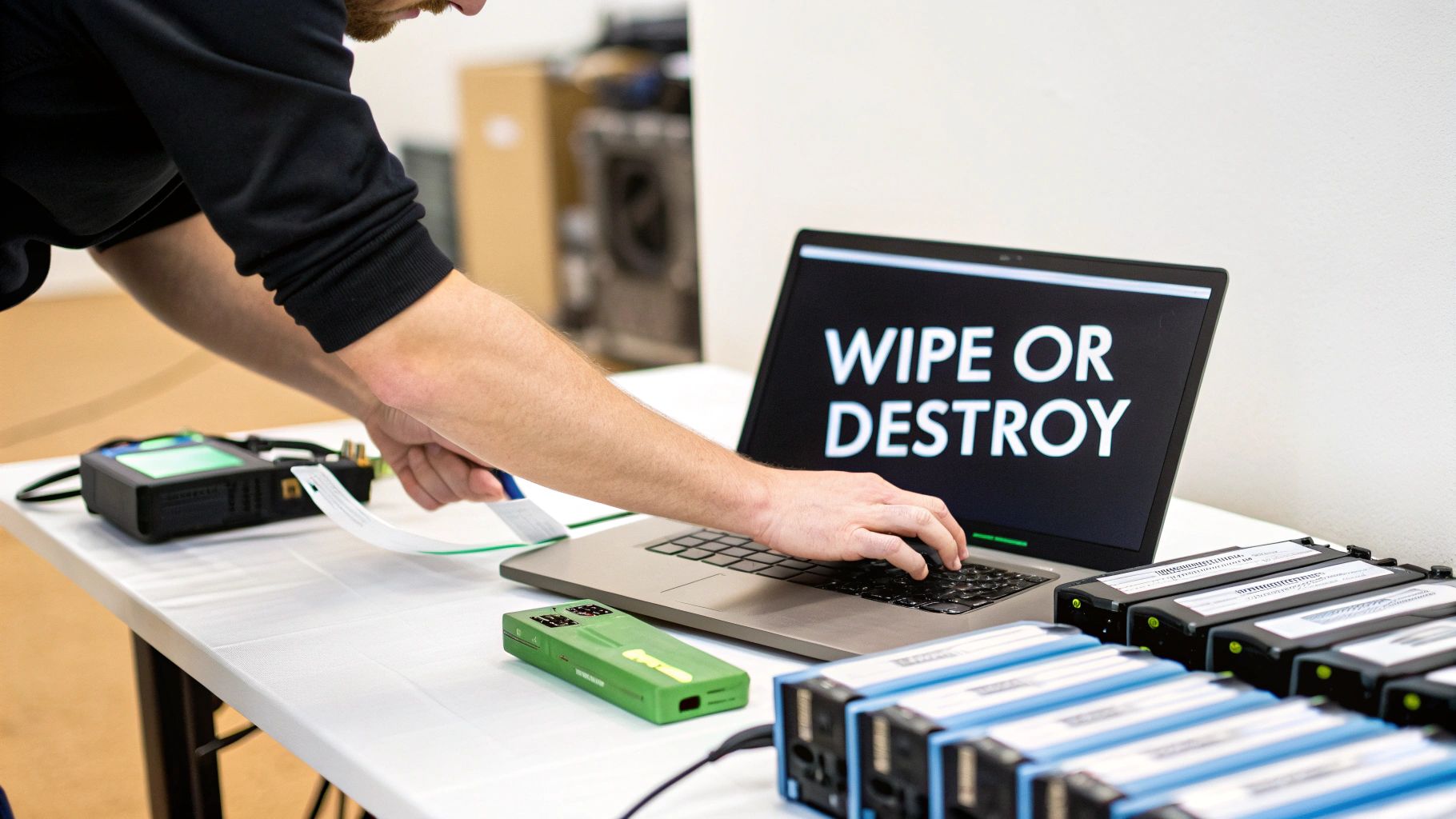
Before any equipment leaves your facility, critical preparation is required to protect your organization from data security and compliance risks. The first step is to create a detailed inventory of all assets slated for disposition.
Your inventory must include every device containing a circuit board that could store data—not just servers and laptops, but also network switches, office phones, and specialized machinery. Documenting the make, model, and serial number of each asset establishes a clear chain-of-custody record.
This initial audit is your best defense against a future data breach. It forces the identification of every data-bearing device that requires professional sanitization, preventing a forgotten hard drive in a retired server from becoming a future liability.
Lock Down Your Sensitive Data
With a complete inventory, the next step is data destruction. Your organization's sensitive information—from financial records and HR files to proprietary intellectual property—resides on the hard drives and solid-state drives within your equipment. Simply deleting files is insufficient; the data remains easily recoverable.
There are two industry-accepted methods for proper data sanitization.
Software-Based Wiping utilizes specialized programs to overwrite a drive with random data, rendering the original information irretrievable. This is an ideal option for newer, functional drives that can be refurbished and resold, maximizing asset value recovery.
Physical Destruction is the definitive solution for older, non-functional, or highly sensitive media. The process involves shredding the drive into small fragments, providing absolute certainty that the data is permanently destroyed. For technical details, our guide explains how to wipe a hard drive to professional standards.
The decision between wiping and shredding is a risk management strategy. A certified recycler will provide a Certificate of Data Destruction, a legal document that proves due diligence and transfers liability away from your organization.
Segregate and Stage for Efficient Pickup
With data secured, the final preparatory step is logistics. Properly sorting your e-waste streamlines the pickup process, making it safer and more efficient for your recycling partner.
Group similar items to facilitate collection and processing. A simple organization strategy includes:
- Data Center Equipment: Consolidate servers, storage arrays, and networking gear. These are often high-value items requiring specialized handling.
- End-User Devices: Palletize desktops, laptops, and monitors for easy assessment and loading.
- Peripherals and Cables: Use gaylord boxes or other large containers for keyboards, mice, power cords, and other accessories.
This organization allows your recycling partner to work quickly and safely, minimizing disruption to your operations and ensuring different material streams are managed correctly from the outset.
Managing The Logistics Of E-Waste Pickup And Removal
You've inventoried assets and secured your data. The next challenge is the physical removal of equipment from your facility. The key is to partner with a recycler who can accommodate your operational schedule, not the other way around.
A professional e-waste pickup should be seamless. For complex projects like a data center decommissioning, where downtime is not an option, the service must be available after hours or on weekends.
On-Site De-Installation And Secure Transport
A professional removal crew does more than move boxes. They provide on-site de-installation, carefully disconnecting servers, dismantling network infrastructure, and preparing all items for safe transport. This specialized skill prevents facility damage and ensures heavy equipment is handled correctly.
As each asset is removed, it is meticulously logged to initiate the chain-of-custody—a critical audit trail that tracks your equipment from the moment it leaves your control. This documentation is a non-negotiable component of risk management.
The moment your electronics leave your premises, they become a liability in transit. Insured transport and a documented chain-of-custody are essential safeguards that transfer that liability to your recycling partner, giving you complete peace of mind.
The environmental impact is significant. E-waste constitutes only 5% of municipal solid waste but contributes disproportionately to toxicity. In 2022, the world generated 62 million tons of e-waste, with an alarming 77.7% managed improperly. Professional circuit board recycling prevents hazardous materials from entering the environment and can reduce CO2 emissions by up to 85% compared to virgin material mining. You can discover more insights on the importance of recycling circuit boards on samrinc.com to understand the broader benefits.
What To Expect From The Pickup Process
A well-executed removal is the hallmark of an experienced recycling partner. The team will arrive with the necessary equipment—dollies, pallet jacks, and appropriate vehicles—and be trained to operate efficiently in a professional environment. The objective is to remove all designated assets with minimal disruption.
Use this checklist to prepare your facility for a smooth on-site service.
On-Site Service Planning Checklist For Businesses
| Preparation Step | Key Consideration | Why It Matters |
|---|---|---|
| Clear Access Path | Ensure the route from equipment to the exit is clear. | Prevents delays, property damage, and safety hazards. |
| Designated Contact Person | Appoint a single point of contact for the removal crew. | Facilitates quick decisions and clear on-site communication. |
| Parking & Loading Dock Access | Reserve a parking space and ensure the dock is clear. | A blocked dock or no parking can halt the entire process. |
| Confirm Scope of Work | Ensure all parties agree on the items being removed. | Prevents misunderstandings and ensures no equipment is left behind. |
| Final Walkthrough | Have the contact person available for sign-off upon completion. | Confirms all inventoried items were collected before departure. |
Proactive planning is crucial, and a reliable partner will assist in coordinating these details. For businesses in the Atlanta metro area, explore options for a free and convenient electronics recycling pickup tailored to your schedule. This service transforms a logistical challenge into a simple, documented, and secure final step in your IT asset's lifecycle.
What Happens To Your Circuit Boards After Pickup
Once your IT assets leave your facility, they begin a journey through a sophisticated materials recovery process. A certified circuit boards recycling partner does more than transport; they use advanced technology to extract maximum value while ensuring total environmental compliance.
The first destination is the sorting and dismantling station. Technicians manually separate components like batteries, plastics, and metal casings from the circuit boards. This critical step prevents contamination of material streams and prepares the boards for mechanical processing.
This infographic illustrates the secure logistics that move your e-waste from your door to our processing facility.
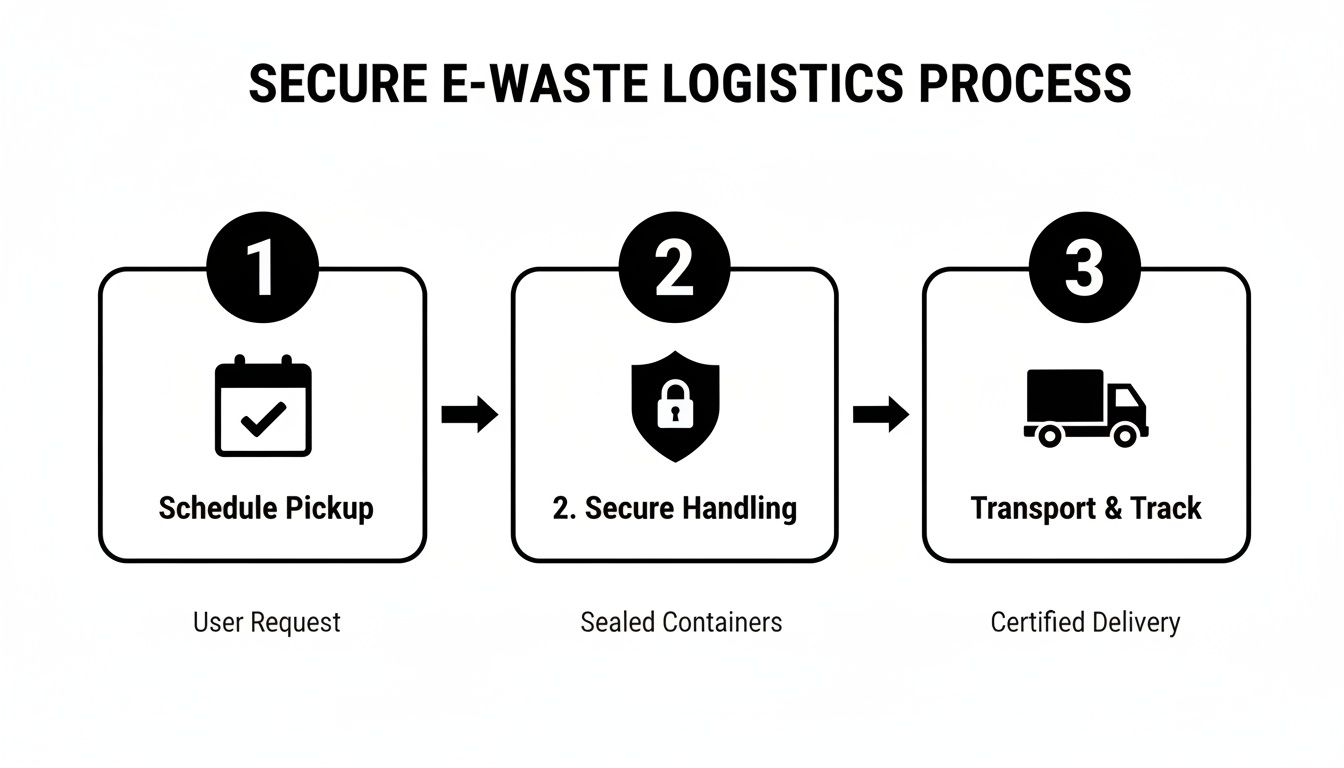
A documented and secure chain-of-custody is the foundation of our process, creating a transparent, auditable trail for every asset we manage for your business.
Mechanical Processing and Materials Separation
Following manual disassembly, the circuit boards are fed into industrial shredders and granulators. These machines reduce the boards to a uniform mixture of fine particles, liberating the valuable metals from the non-metallic fiberglass and resin substrates.
The granulated mix then undergoes a series of advanced separation processes that function like a high-tech mining operation.
- Magnetic Separators: Powerful magnets extract ferrous metals, such as iron and steel from casings and frames.
- Eddy Currents: An opposing magnetic field repels non-ferrous metals like aluminum and copper into separate collection streams.
- Electrostatic Separation: Electrical charges are used to separate the remaining conductive metal fragments from the non-conductive plastic and fiberglass.
This multi-stage system achieves over 95% efficiency in precious metal recovery and 99% in copper recovery. This process can yield up to 300g of gold per ton of boards—a concentration far richer than that found in traditional mining ore.
By the end of this process, a pallet of obsolete IT equipment is transformed into purified raw commodities—copper, aluminum, gold, silver, and palladium—ready for smelting and reintroduction into the global manufacturing supply chain.
The entire system is built on transparency to provide you with complete peace of mind. For a more detailed look at the end-of-life journey for different materials, see our guide on what happens to recycled electronics. We ensure your e-waste is managed ethically and efficiently, turning a potential liability into a valuable resource for the circular economy.
How To Choose The Right E-Waste Recycling Partner
Selecting a partner for your circuit boards recycling and IT asset disposition is a critical business decision. The right vendor acts as a safeguard against data breaches, compliance penalties, and environmental liability. The wrong one can expose your organization to catastrophic risk. The selection process comes down to thorough due diligence.
Begin your evaluation by verifying certifications. These are the non-negotiable proof of a recycler’s competence and ethical standards. Vetting a potential partner without confirming their credentials is an unacceptable business risk.
Prioritize Certified and Audited Recyclers
In the electronics recycling industry, two certifications are paramount: R2v3 (Responsible Recycling) and e-Stewards. These are not mere marketing logos; they represent rigorous, third-party audited standards covering data security, environmental safety, and worker protection.
A certified recycler is required to maintain a complete, unbroken chain-of-custody for every asset, providing you with a transparent and defensible audit trail. This documentation is your ultimate proof of compliance. To aid your vetting process, a comprehensive guide to vendor due diligence can be a valuable resource.
A recycler’s certifications are your first and best line of defense. They confirm that an independent body has audited their processes, validating their claims of security, environmental responsibility, and legal compliance. Always request a copy of the certificate.
Verify Security Protocols and Insurance
Beyond certifications, scrutinize a vendor’s specific security protocols. How do they guarantee data destruction?
Confirm they offer software-based wiping that meets NIST 800-88 standards and physical shredding for complete data elimination. A top-tier partner will provide a formal Certificate of Data Destruction, a legal document that transfers data liability away from your organization.
Equally important is their insurance coverage. A reputable partner must carry robust liability insurance, including policies that specifically cover data breaches and environmental contamination. Request their certificate of insurance to verify adequate coverage for a worst-case scenario.
Finally, assess their reputation and experience. Do they have a proven track record with businesses in regulated industries like healthcare or finance? Look for case studies and references that validate their reliability. Finding the right electronic waste recycling company means choosing a specialist who understands your unique operational needs and can execute your asset disposition flawlessly.
Common Questions About Commercial Circuit Boards Recycling
When establishing a commercial e-waste program, business leaders typically have questions regarding cost, data security, and documentation. Addressing these key areas provides the clarity needed to move forward confidently.
The conversation often begins with the financial aspect, as many businesses assume professional recycling is cost-prohibitive.
What Costs Are Involved In Recycling?
Pricing for commercial services is not a flat fee; it is based on the scope of the project. We assess the volume and type of your equipment, logistical requirements such as on-site de-installation, and the current market value of the recoverable commodities.
For instance, a large volume of high-value assets like enterprise servers and networking equipment can often be processed at a low cost, and may even result in a rebate to your company. Conversely, a mixed load of older, lower-value electronics will likely incur a service fee to cover labor and processing costs.
Always request a detailed, itemized quote. A reputable recycler will provide a transparent financial breakdown, outlining all costs and any potential value recovery from your IT assets.
How Can We Guarantee Our Data Is Destroyed?
Verbal assurances of data destruction are insufficient. True security is achieved through a certified, documented process that provides legal proof of compliance.
A certified recycler provides data destruction services compliant with NIST 800-88 standards. Upon completion, you must receive a formal Certificate of Data Destruction. This legal document confirms that every data-bearing device was either sanitized via multi-pass wiping or physically shredded. It serves as your auditable proof of due diligence, releasing your organization from liability.
What Documentation Is Essential?
Proper documentation is your primary defense against future compliance issues. An unbroken audit trail is required from the moment equipment leaves your facility.
You should expect to receive three key documents from your recycling partner:
- Chain-of-Custody Record: Tracks your assets from pickup to final disposition, ensuring complete accountability.
- Serialized Asset Reports: Provides an itemized list of every asset by serial number, confirming what was received and processed.
- Certificate of Recycling and Data Destruction: The final document certifying that your e-waste was managed in an environmentally compliant manner and that all data was destroyed according to industry standards.
This documentation demonstrates compliance with data privacy laws like HIPAA and GDPR, as well as environmental regulations such as RCRA.
Do You Recycle More Than Loose Circuit Boards?
Yes. While the keyword is "circuit boards," a true commercial partner provides comprehensive IT Asset Disposition (ITAD) services for your entire IT inventory.
We manage everything from servers, desktops, and laptops to networking gear, phone systems, and specialized industrial or medical electronics. Our objective is to offer a single, integrated solution for your business, ensuring every piece of retired technology is managed securely and responsibly.
Ready to implement a secure and compliant electronics recycling program for your business? Atlanta Computer Recycling offers expert IT asset disposition services tailored to the needs of Atlanta-area organizations. We provide documented data destruction, on-site logistics, and certified recycling to protect your business and the environment. Contact Atlanta Computer Recycling today for a transparent quote and a smarter approach to e-waste.