How to Choose the Right Circuit board Recyclers for Your Business

Choosing a certified circuit board recycler isn’t just about disposing of obsolete hardware. It's a critical business decision that directly impacts your company's data security, environmental compliance, and bottom line.
For any organization managing IT assets, a certified recycler is not a waste vendor; they are a specialized risk management partner. Their primary function is to protect your most valuable assets: your proprietary data and your corporate reputation.
Why Choosing a Certified Recycler Is a Critical Business Decision
Every time your business upgrades servers, refreshes employee laptops, or decommissions networking equipment, it generates a stream of electronic waste, or e-waste. At the core of each device is a printed circuit board (PCB)—a complex assembly of valuable precious metals and regulated hazardous materials.
How your company manages these end-of-life assets is a strategic operational decision with significant financial and legal ramifications.
An uncertified vendor might offer an attractively low-cost pickup, but this service almost invariably comes with unacceptable hidden risks. Without a documented chain of custody, your company's electronics could be illegally landfilled, improperly exported, or—in a worst-case scenario—fall into the hands of data thieves. The resulting financial and reputational fallout can be catastrophic.
The True Cost of Improper Disposal
Partnering with an unqualified vendor exposes your company to a cascade of preventable liabilities. These are not hypothetical scenarios; they are real-world consequences for businesses that neglect their due diligence in e-waste management.
- Data Breach Lawsuits: A single improperly discarded hard drive containing customer, employee, or proprietary data can trigger a devastating breach. This can lead to class-action lawsuits, crippling regulatory fines, and brand damage that is nearly impossible to repair.
- Environmental Non-Compliance Fines: Federal and state regulations, such as the Resource Conservation and Recovery Act (RCRA), carry strict mandates. They impose costly penalties for the improper disposal of hazardous electronic waste, holding the generating company liable.
- Reputational Damage: Negative press travels instantly, particularly when it concerns a data breach or an environmental scandal. The erosion of customer trust and public goodwill can impact revenue and market position for years.
By partnering with a certified recycler, you invest in a robust layer of protection against these exact outcomes. The comprehensive documentation, certificates of destruction, and secure, auditable processes they provide serve as your proof of compliance and due diligence, shielding your organization from legal and financial threats.
A Partnership Focused on Protection
When you evaluate circuit board recycling through a risk management lens, the value proposition becomes clear. A professional, certified recycler delivers far more than simple disposal. They provide a secure, fully auditable process that protects your business at every stage.
This guide will outline the essential criteria every business leader must understand, from data security protocols to downstream accountability. Recognizing what differentiates reputable electronic waste recycling companies is the first step toward transforming retired IT assets from a liability into a secure, compliant, and potentially value-additive component of your operations. You will learn how to confidently select a partner that eliminates liability while maximizing any recoverable asset value.
What Really Happens to Your Electronics After They Leave Your Office
Once a pallet of retired servers, laptops, and networking gear is loaded onto a truck, the job may seem complete. For your business, however, this is the most critical juncture—the point where your assets and data transition from your control to your recycling partner. A certified process is not a black box; it is a transparent, documented journey designed to protect your organization at every step.
This is fundamentally about more than disposal. Professional circuit board recyclers operate as asset recovery and security specialists, not waste haulers. They have two primary objectives: to securely and verifiably destroy all data and to responsibly recover the maximum value from the remaining materials, all while maintaining an unbroken chain of custody.
The Initial Steps: Intake and Triage
The process begins the moment your assets arrive at a secure, access-controlled facility. The first stage is intake and auditing, where every piece of equipment is inventoried and reconciled against the pickup manifest. This establishes a documented trail confirming the safe arrival of all assets and creates clear accountability.
Next, technicians perform sorting and testing. Each device is evaluated to determine its optimal disposition. Can a server be refurbished for resale? Can components from a laptop be harvested for reuse? This triage phase is crucial for maximizing your return on investment, as functional equipment holds significantly more value than its raw material content.
A key differentiator for professional circuit board recyclers is their commitment to "reuse"—the highest principle in the sustainability hierarchy. By identifying and refurbishing viable assets, they not only generate a better financial return for your business but also extend the useful life of electronics, achieving the most environmentally responsible outcome.
The flowchart below illustrates the core decision-making process a certified partner employs, consistently balancing risk mitigation with value creation.
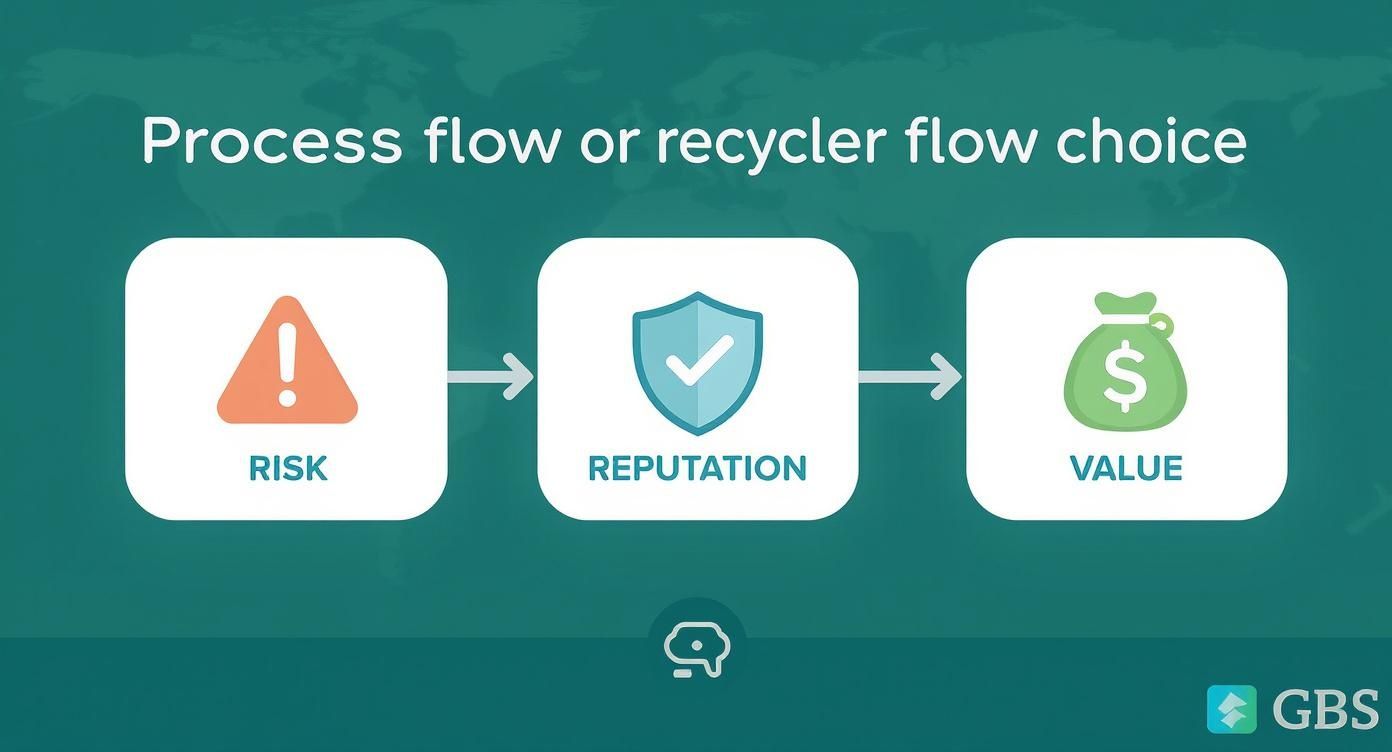
As this process shows, every step is built on a foundation of managing risk and protecting your reputation, which in turn allows for the maximum value recovery from your retired IT assets.
The Critical Phase: Secure Data Destruction
For any device containing a hard drive, solid-state drive, or other data storage media, data destruction is the most critical step. This is a non-negotiable process that ensures your sensitive corporate, customer, or patient information is permanently and verifiably destroyed. Two industry-standard methods are employed:
- Data Wiping: For functional drives suitable for reuse, technicians use specialized software to overwrite the entire drive with random data, often in multiple passes. This process adheres to standards like DoD 5220.22-M, which renders the original information forensically unrecoverable.
- Physical Shredding: For non-functional, obsolete, or highly sensitive drives, physical destruction is the only acceptable method. Industrial shredders grind the storage media into small, confetti-like fragments, making data reconstruction physically impossible.
Upon completion, you receive a Certificate of Destruction. This legal document serves as your official, auditable proof that all data-bearing devices were securely and permanently sanitized, protecting your business from future liability. You can explore more on what happens to recycled electronics to understand why this documentation is vital for corporate compliance.
The Final Stage: Material Recovery
After all reusable components are salvaged and all data is destroyed, the remaining electronics are demanufactured. Skilled technicians manually dismantle the devices, segregating them into core material streams—plastics, steel, aluminum, and the printed circuit boards (PCBs).
These sorted materials are then transported to specialized, audited downstream partners for smelting and refining. Here, advanced metallurgical processes extract valuable precious metals like gold, silver, copper, and palladium from the circuit boards. These recovered commodities re-enter the global manufacturing supply chain, reducing the environmental impact of new mining operations. For context, recycling circuit boards can yield up to 20% copper from scrap, a significant increase compared to the less than 1% yield from raw ore.
Understanding E-Waste Certifications and Compliance
For any business, compliance is not just a procedural formality—it is a core operational responsibility. When evaluating circuit board recyclers, the most reliable indicator of professionalism and security is a set of industry-standard certifications. These are not mere logos on a website; they are your guarantee that a partner is equipped to protect your organization, not expose it to liability.
Think of certifications as your insurance policy against the enormous risks of improper e-waste disposal. They establish a verifiable, third-party audited framework that a recycler must adhere to. This framework governs everything from data destruction protocols to hazardous materials management, ensuring every step is documented and compliant.
The Gold Standards R2 and e-Stewards
In the electronics recycling industry, two certifications stand out as the gold standard for responsible and secure processing. While they have different origins, both provide businesses with total confidence that their retired assets are being managed to the highest ethical and legal standards.
- R2 (Responsible Recycling): Developed through a multi-stakeholder process convened by the U.S. Environmental Protection Agency (EPA), the R2 standard covers the entire lifecycle of electronics. It sets rigorous requirements for environmental protection, worker health and safety, data security, and the tracking of all materials through the downstream recycling chain.
- e-Stewards: Created by the Basel Action Network (BAN), a non-profit environmental watchdog, the e-Stewards standard is renowned for its stringent controls. It enforces a zero-tolerance policy against the export of hazardous e-waste to developing countries and mandates that all downstream partners are also certified.
Selecting a recycler with either R2 or e-Stewards certification means they have undergone independent audits and demonstrated adherence to the highest industry benchmarks. This is your most critical defense against regulatory penalties and brand damage.
Navigating Key Federal and State Regulations
Beyond voluntary certifications, your business must navigate a complex web of government regulations. A professional recycler acts as your compliance partner, helping you meet these legal obligations and providing the documentation to prove it.
These regulations are strict because many circuit boards contain hazardous materials like lead and mercury. Improper disposal can lead to violations of laws like the Resource Conservation and Recovery Act (RCRA), which governs all solid and hazardous waste.
For most companies, however, data privacy laws present an even greater concern. These regulations carry significant penalties:
- HIPAA (Health Insurance Portability and Accountability Act): Healthcare organizations are legally responsible for protecting patient data (ePHI). Any recycler handling medical equipment must provide secure, documented data destruction to ensure HIPAA compliance.
- FACTA (Fair and Accurate Credit Transactions Act): This law requires businesses to properly destroy consumer information, whether on paper records or digital media. Non-compliance can result in substantial fines.
A certified partner understands these regulations intimately. They provide the essential documentation, like a formal Certificate of Destruction, that serves as your auditable proof of compliance. This documentation is your defense when auditors or regulators inquire. You can learn more about its importance by reviewing our guide on the certificate of destruction.
The scale of the global e-waste challenge is immense. An estimated 1.2 million metric tons of PCB waste are generated globally each year, yet only about 34% is processed in environmentally sound facilities. In response, regulations are tightening, such as the European Union’s WEEE Directive, which requires an 85% recycling rate for circuit boards by 2025. You can discover more insights about these global recycling trends.
Certified Vs Uncertified Recyclers A Business Risk Comparison
The choice between a certified recycler and an uncertified vendor is a decision between security and significant risk. The table below outlines the critical differences, making it clear why comprehensive due diligence is essential for any business.
| Feature | Certified Recycler (R2/e-Stewards) | Uncertified Vendor |
|---|---|---|
| Data Security | Guarantees data destruction that meets or exceeds federal standards, backed by a Certificate of Destruction. | Offers no verifiable process, leaving your business exposed to data breaches and regulatory fines. |
| Downstream Accountability | Vets and audits all downstream partners, ensuring your materials are never illegally exported or landfilled. | Provides no transparent downstream chain, meaning your e-waste could end up anywhere, creating legal liabilities for your company. |
| Environmental Compliance | Operates under strict environmental controls, preventing pollution and ensuring proper handling of hazardous materials. | May cut corners by dumping toxic materials, placing your company at risk of significant non-compliance fines. |
| Legal Protection | Provides a complete, auditable paper trail (chain of custody) that serves as your legal proof of due diligence. | Leaves you with no documentation, making it impossible to defend your company in a lawsuit or audit. |
| Reputation Management | Protects your brand by associating it with responsible, ethical, and sustainable practices. | Puts your brand at risk of being linked to an environmental or data security scandal. |
Ultimately, engaging a certified recycler is not an expense; it is an investment in risk management. The potential costs of a data breach, an EPA fine, or a damaged corporate reputation far exceed the price of ensuring proper IT asset disposition from the outset.
A Practical Checklist for Vetting Recycling Partners
Certifications like R2 and e-Stewards are an excellent starting point for creating a shortlist of potential circuit board recyclers, but your due diligence should not end there. It is crucial to investigate a partner’s operational procedures, security protocols, and transparency. Treat this process like hiring any key risk management vendor—you must verify their capabilities to ensure they align with your company's security and compliance standards.
This checklist is designed to equip your team with the essential questions to ask. It will help you look beyond the certification and assess the reality of how your assets will be managed. The responses you receive will quickly distinguish a basic vendor from a true security partner.
Verifying Downstream Accountability and Reporting
A critical legal principle to understand is that your company’s responsibility for its e-waste does not end when the truck leaves your facility. It extends throughout the entire recycling chain to the final disposition of the materials, a concept known as downstream accountability. An elite recycler will not only be certified themselves but will also provide proof that every partner in their downstream chain—smelters, refiners, and processors—is also certified and regularly audited.
Before signing a service agreement, ask these critical questions:
- Downstream Vendor Proof: Can you provide documentation verifying that your downstream partners are R2 or e-Stewards certified? This is non-negotiable and is your only guarantee that your materials will not be illegally exported or landfilled.
- Reporting and Documentation: What types of reports will our company receive? Request samples of all documentation—Certificates of Destruction, chain of custody logs, and asset tracking reports—to understand what your audit trail will include.
- Asset Tracking: How are our specific assets tracked from pickup to final disposition? A top-tier partner should offer serialized tracking for all data-bearing and high-value assets, providing complete visibility.
Clear, direct answers are a positive sign. If a potential partner is vague or unwilling to share this information, consider it a major red flag.
Assessing On-Site Security and Insurance Coverage
A recycler’s physical security is as important as their process. Your retired equipment contains sensitive data and holds commodity value, making it a target for theft. A secure facility ensures your assets are protected from the moment they arrive.
A recycler's insurance coverage, particularly for data breaches, acts as your financial backstop. It demonstrates that they have a contingency plan for worst-case scenarios and are prepared to assume financial responsibility, protecting your business from the consequences of an incident.
In addition to physical security, you must confirm they carry adequate insurance to cover potential liabilities. Ask directly about these specifics:
- On-Site Security Measures: What security protocols are in place at your facility? Look for controlled access points, 24/7 video surveillance, and secure, segregated storage areas for data-bearing devices.
- Data Breach Insurance: Do you carry Errors and Omissions (E&O) insurance that specifically covers data breaches? Do not just take their word for it—request a copy of their insurance certificate to verify coverage limits.
- Employee Vetting: What is your process for background-checking employees who handle sensitive equipment? A secure partner will have stringent hiring and training protocols.
Understanding Pricing Models
Finally, you need a clear understanding of the financial model. Pricing structures among circuit board recyclers vary, and the optimal model depends on the volume, type, and condition of your equipment. For a more detailed look, you can learn how different electronic waste disposal companies structure their commercial services.
The two most common models are:
- Fee-for-Service: In this model, your company pays a set fee for logistics, data destruction, and processing services. This is common for smaller volumes of equipment or for assets with minimal resale or commodity value. The primary benefit is predictable, upfront costs.
- Value-Sharing: If your business is retiring large volumes of high-value equipment like servers, networking switches, or enterprise-grade hardware, this model is an excellent option. The recycler processes the assets and, after deducting service fees, shares a percentage of the revenue generated from recovered precious metals or refurbished components. This can transform your IT asset disposition from a cost center into a revenue-generating activity.
By asking these targeted questions, you can move beyond a sales pitch and confidently select a recycler that delivers on security, transparency, and financial value.
Where the Rubber Meets the Road: Recycling in Data Centers and Hospitals
The principles of secure, certified electronics recycling are clear in theory, but its true value is demonstrated in high-stakes operational environments. For industries built on managing sensitive data, choosing the right circuit board recyclers is not merely a compliance task—it is a core component of their cybersecurity and risk management strategy.
Let's examine two distinct business scenarios. Each presents unique challenges and highlights the critical importance of an expert recycling partner.
Case Study A: The Data Center Overhaul
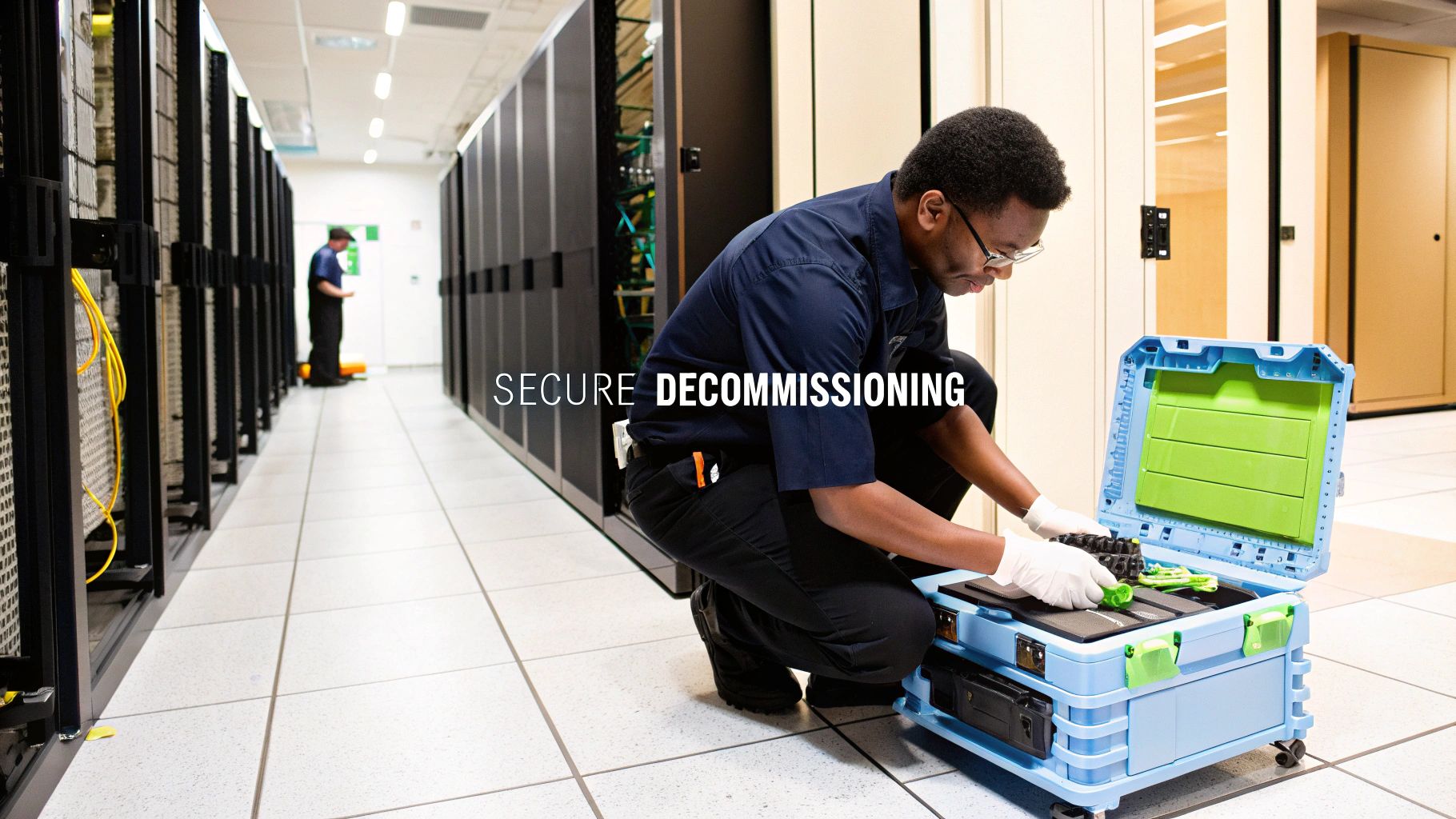
Consider a large enterprise data center executing a major hardware refresh, decommissioning hundreds of servers, storage arrays, and network switches. Each device is laden with proprietary business plans, sensitive customer data, and valuable intellectual property. The logistical and security challenges are immense.
The primary risk is a data breach during the disposition process. A single mishandled server or lost drive in transit could trigger a catastrophic security incident, leading to lawsuits, severe regulatory fines, and irreparable brand damage. Simply wiping drives on-site is insufficient; the company requires irrefutable proof of data destruction.
This is precisely where a certified recycler provides an end-to-end, secure solution.
- Secure On-Site Services: Professional, insured technicians arrive at the facility to manage de-installation, palletizing, and secure transport, minimizing disruption to internal IT teams.
- Auditable Asset Tracking: Each server and data-bearing device is tagged and inventoried, creating an unbroken chain of custody from the data center floor to final disposition.
- Guaranteed Data Destruction: The recycler physically shreds all hard drives and storage media, either on-site with a mobile shredder or at their secure facility, rendering data 100% irrecoverable.
Upon completion, the recycler issues a serialized Certificate of Destruction. This document lists every hard drive by its unique serial number, serving as the company’s ironclad legal proof that it fulfilled its data security obligations. This closes the loop on liability. For any business retiring servers at scale, understanding the specifics of data center equipment recycling is essential for effective risk management.
Case Study B: The Healthcare Facility Upgrade
Now, consider a hospital system upgrading thousands of medical devices, from patient monitors to diagnostic imaging machines. Every device contains electronic Protected Health Information (ePHI), placing HIPAA compliance at the forefront of the project.
A breach of ePHI can trigger devastating penalties under HIPAA, with fines potentially reaching millions of dollars. The hospital's legal duty to protect patient data extends through the entire disposal process. They cannot afford to partner with a vendor that does not specialize in these stringent regulations.
A specialized recycling partner addresses these unique healthcare challenges directly:
- HIPAA-Compliant Protocols: The recycler’s entire process is designed around HIPAA's security rules, ensuring every device containing ePHI is handled with the utmost security.
- Verified Destruction Methods: They utilize data destruction methods that meet or exceed NIST 800-88 guidelines, the gold standard for HIPAA-compliant data sanitization.
- Business Associate Agreements (BAA): A professional recycler will always sign a BAA. This legally binding contract makes them directly accountable for protecting any ePHI they handle on behalf of the hospital.
In this scenario, the recycler functions as a true compliance partner. They provide the hospital with all necessary documentation to demonstrate due diligence in the event of an audit, giving the healthcare facility the confidence to adopt new technology while ensuring patient data remains secure from creation to destruction.
Common Questions About Circuit Board Recycling
Even after conducting thorough due diligence on processes and certifications, several key questions often arise when selecting a circuit board recycler. Obtaining clear, straightforward answers is the final step in protecting your business and making an informed decision. Here are the most common inquiries from commercial clients.
Which Circuit Boards Have the Most Value?
This is an excellent question for any business looking to maximize returns. While all circuit boards require responsible processing, their recoverable commodity value varies significantly. High-grade boards found in servers, enterprise networking gear, and telecommunications equipment contain higher concentrations of precious metals like gold, palladium, and silver. Consequently, these boards offer the most significant value for commodity recovery.
Conversely, lower-grade boards from consumer electronics like printers and monitors contain far fewer precious metals, resulting in lower scrap value. However—and this is critical for compliance—they still contain hazardous materials and must be processed correctly to protect your business from environmental liability.
How Can We Guarantee Our Data Is Destroyed?
This is the most critical question for any business, and the answer must be absolute. We guarantee complete data destruction through methods that meet or exceed rigorous standards like NIST 800-88 and Department of Defense protocols. Our primary method is physical destruction. We use industrial shredders to pulverize hard drives and other storage media into small, irrecoverable fragments, making data recovery physically impossible.
For every project, we issue a formal Certificate of Destruction. This is not simply a receipt; it is a legal, serialized document that serves as your auditable proof of data sanitization. It closes the liability loop and protects your organization from future claims.
What Is a Chain of Custody and Why Is It Essential?
A chain of custody is the documented, chronological paper trail that tracks your IT assets from the moment they leave your control to their final disposition. It is absolutely essential for managing your company’s risk.
Think of it as your legal evidence. This documentation proves that you acted with due diligence by transferring your e-waste to a certified recycler and that every asset was tracked at each stage of the process. In the event of an audit or a legal challenge regarding a data breach or improper disposal, this paperwork is your primary defense. Without a documented chain of custody, you have no verifiable proof that you acted responsibly.
Ready to partner with a certified recycler that prioritizes your security, compliance, and bottom line? Atlanta Computer Recycling provides secure, transparent, and reliable electronics recycling and IT asset disposition services for businesses throughout the Atlanta metro area. Get a quote for your commercial needs at https://atlantacomputerrecycling.com.