Atlanta ITAD & Electronics Recycling Guide 2026


For businesses across Atlanta, managing outdated technology is more than just another item on a checklist—it’s a critical security and financial decision. The process of properly retiring IT assets, known as IT Asset Disposition (ITAD), is your strategy for protecting sensitive data and recovering value from old equipment.
Your Guide to IT Asset Disposition in Atlanta
Managing the lifecycle of your company’s technology infrastructure shouldn't be a logistical nightmare. It's a strategic advantage. This guide is built to demystify ITAD, providing a clear roadmap for IT Directors, CFOs, and compliance officers across the metro Atlanta area.
As a major hub for business, medicine, and education, Atlanta sees a constant flow of retiring technology. That volume presents a challenge, but also a significant opportunity for smart electronics recycling and corporate data management.
From Logistical Burden to Strategic Advantage
It helps to think of ITAD as a 'reverse supply chain' for your organization's most sensitive information. You put careful processes in place for new assets coming in; a professional ITAD plan ensures those same assets are handled with equal security and accountability when they go out. In a competitive market like Atlanta, that’s not just smart—it’s essential.
A solid ITAD strategy helps your organization:
- Prevent Data Breaches: Securely wiping or physically destroying hard drives is the only way to guarantee confidential company, customer, or patient data doesn't walk out the door.
- Ensure Regulatory Compliance: Industries like healthcare (HIPAA) and finance have strict data privacy rules. Proper ITAD delivers the documentation you need to prove compliance and avoid massive fines.
- Maximize Financial Return: Not all old equipment is junk. A good partner can pinpoint assets with resale value, turning a potential cost into a new source of revenue.
- Support Environmental Responsibility: Certified recycling keeps hazardous e-waste out of landfills, directly supporting your company's sustainability and ESG goals.
This guide is your expert playbook for handling technology retirement in Atlanta—securely, compliantly, and responsibly. It’s the framework you need to choose a vendor who can protect your business and maximize your asset value.
Navigating this process requires a partner who knows the local business landscape. From on-site de-installation in a downtown high-rise to a bulk pickup from a suburban corporate campus, the right partner truly makes all the difference. For a primer on the fundamentals, you can learn more about what is IT asset disposition and why it’s a cornerstone of modern IT management.
The High Stakes of ITAD for Atlanta Companies
Ignoring how you get rid of old tech isn’t just a small mistake—it’s a huge business risk. For any organization in Atlanta, from a healthcare provider in the Perimeter to a financial firm downtown, the consequences of improper electronics disposal are far more serious than just clearing out a storage room.
The most immediate threat? A devastating data breach. Think about it: a single forgotten laptop or server hard drive can hold a goldmine of sensitive data. We're talking customer lists, financial records, or protected health information (PHI). If that information gets out, the damage to your finances and reputation can be immense.
Two Paths for Atlanta Businesses
Let's imagine how this plays out for two local companies.
One is a marketing firm in Midtown that hires an uncertified scrapper to haul away old computers. A few months later, a laptop with its hard drive still intact shows up on a resale site. The resulting leak exposes confidential client strategies, leading to a public relations nightmare and lost business.
The other is a logistics company near Hartsfield-Jackson with a documented ITAD plan. Every retired device is inventoried, and its hard drive is either wiped clean or physically shredded by a certified partner. They get a Certificate of Destruction, proving they did everything right, protecting their brand, and even getting some money back from newer parts.
The difference is night and day. One company is in crisis mode, the other has actually improved its security and its bottom line. It’s a clear demonstration that professional data destruction services in Atlanta aren't just another expense—they're an investment in keeping your business running smoothly.
From a Single Drive to a Full Data Center
The risk grows right along with your IT footprint. A misplaced hard drive is bad enough, but an entire data center decommissioning project handled poorly? That's a catastrophe waiting to happen. For Atlanta's key industries, the legal mandates are not suggestions.
For any company that isn't prepared, a data breach is no longer a question of "if" but "when." Old, improperly handled IT assets are like leaving the front door wide open for attackers.
Healthcare organizations, for instance, are legally bound by HIPAA; a violation can result in fines that could cripple an entire hospital system. Financial institutions must follow regulations like FACTA, which demand the secure disposal of customer data. For these sectors, a documented, provable ITAD process is absolutely non-negotiable.
IT Asset Risk Matrix for Atlanta Organizations
Different businesses face different threats. This table breaks down some of the specific risks tied to common IT assets across Atlanta's major industries.
| Asset Type | Potential Risk | Affected Sector | Compliance Concern |
|---|---|---|---|
| Laptops & Desktops | Unwiped drives leak employee or customer data | All Businesses | GDPR, CCPA |
| Servers | Exposure of entire databases, intellectual property | Data Centers, Tech | SOX, PCI DSS |
| Medical Devices | Leak of Protected Health Information (PHI) | Healthcare | HIPAA, HITECH |
| Point-of-Sale Systems | Theft of credit card and transaction data | Retail, Finance | PCI DSS, FACTA |
| Network Gear | Exposure of network configurations, security gaps | Government, Enterprise | FISMA, NIST |
As you can see, the type of data and the compliance rules vary, but the fundamental need for secure disposal is universal. A solid ITAD plan is your best defense.
Atlanta’s own history is built on managing massive, complex projects. After being almost completely destroyed in 1864, the city's rapid recovery and reinvention as a logistics hub required incredible coordination. That same spirit of resilience mirrors the challenge modern businesses face when retiring old infrastructure. It shows that tackling complex logistics—including secure IT asset management—is part of Atlanta's DNA. You can learn more about the city’s impressive growth at the New Georgia Encyclopedia.
A Step-by-Step Guide to the ITAD Process
Getting rid of old company technology can feel like a huge, complicated headache. But it doesn't have to be. By breaking the process down into clear, manageable stages, any IT manager in Atlanta can turn this daunting task into a smooth, secure, and routine operation.
Think of it this way: the real work begins long before a truck ever shows up at your facility. Solid planning and documentation are what make or break a successful ITAD project.
Stage 1: Inventory and Valuation
First things first: you need to know exactly what you have. A detailed inventory isn't just a simple list; it's your first line of defense for security and the key to getting money back for your old gear.
For every single asset you're retiring—from servers and laptops to network switches—you need to log its make, model, serial number, and current condition. Following essential asset tracking best practices from the start is what creates a secure chain of custody, ensuring nothing gets lost in the shuffle.
Once you have your list, it's time to figure out what it's worth. A professional ITAD partner can assess which items still have resale value and which are headed for recycling. This step is crucial because it helps offset the costs of data destruction and logistics, often making the entire process surprisingly affordable.
Stage 2: Data Destruction
This is where the stakes are highest. Every device with a hard drive or storage chip is a potential data breach waiting to happen if you don't handle it correctly. One forgotten laptop can quickly spiral into a major compliance failure, complete with hefty fines.
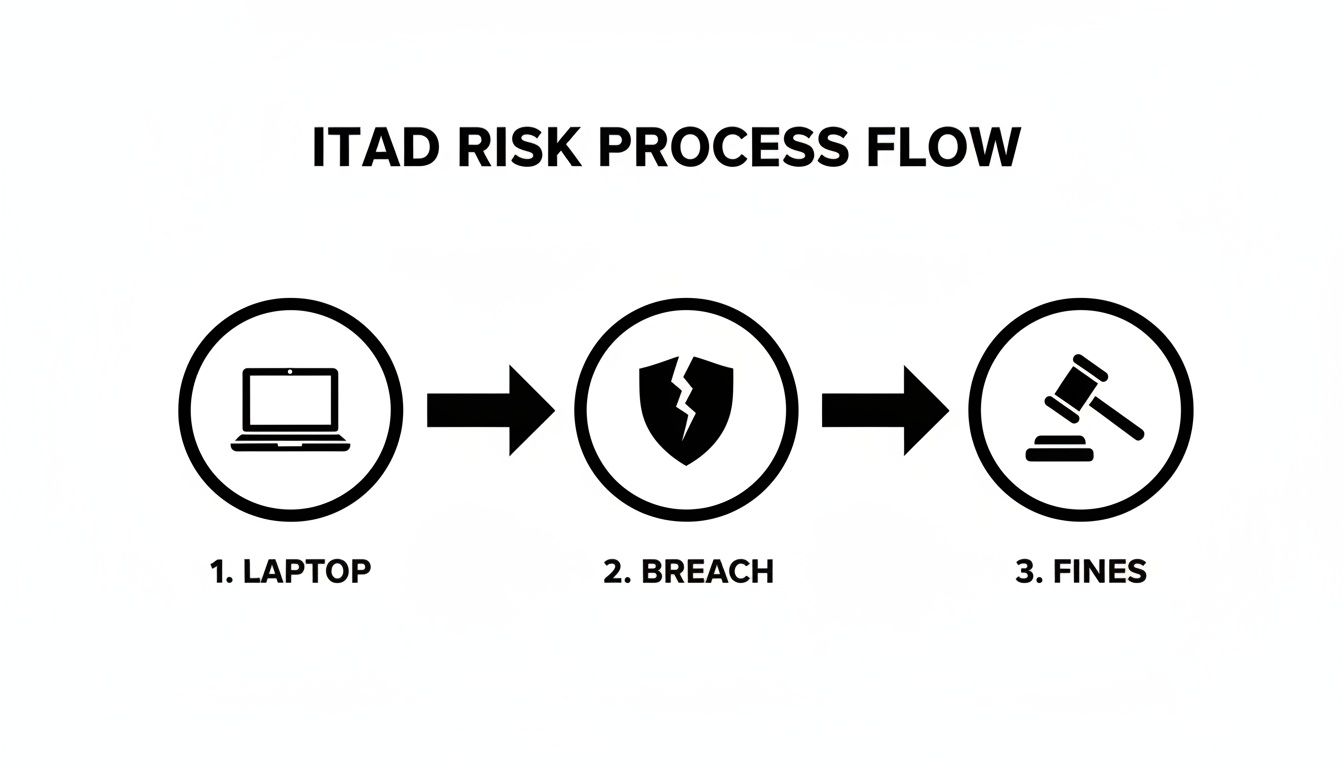
The image above shows the direct line from a simple piece of hardware to serious legal and financial trouble. Thankfully, you have two proven methods to make sure that data is gone for good.
Data Wiping (Sanitization)
- What it is: Using specialized software to overwrite all the data on a hard drive, making the original information impossible to recover.
- Best for: Newer, working hard drives that can be refurbished and resold. The DoD 5220.22-M 3-pass wipe is a widely trusted and effective standard.
- The benefit: It keeps the hardware intact, preserving its value and maximizing the financial return on your assets.
Physical Destruction (Shredding)
- What it is: The most straightforward method—physically shredding hard drives, SSDs, and other media into tiny, confetti-like pieces.
- Best for: Broken drives, older media, or when your company policy requires the absolute highest level of security. On-site shredding lets you watch the destruction happen.
- The benefit: It provides undeniable, physical proof that the data has been destroyed, a must-have for highly sensitive industries like healthcare and government.
Stage 3: Secure Logistics and Final Reporting
Once your assets are wiped clean or prepped for destruction, they need to be moved securely. A certified ITAD vendor provides a documented chain of custody from the moment the equipment leaves your facility, giving you a transparent, trackable process.
Proper logistics planning is all about minimizing disruption to your Atlanta business. Your partner should handle all the packing, palletizing, and transport, whether you're in a downtown high-rise or a large data center campus. For a closer look at what goes into a large-scale project, our guide on the data center decommissioning process breaks it down further.
The final, crucial step is getting your paperwork. This package should include:
- A serialized inventory report that lists every single asset processed.
- A Certificate of Destruction to confirm all data was wiped or shredded according to industry standards.
- A Certificate of Recycling to verify that all non-reusable materials were handled in an environmentally sound way.
These documents are far more than just receipts. They are your auditable proof of compliance. They close the loop on your ITAD project, protecting your business from future liability and proving your commitment to corporate responsibility.
How to Choose the Right ITAD Partner in Atlanta
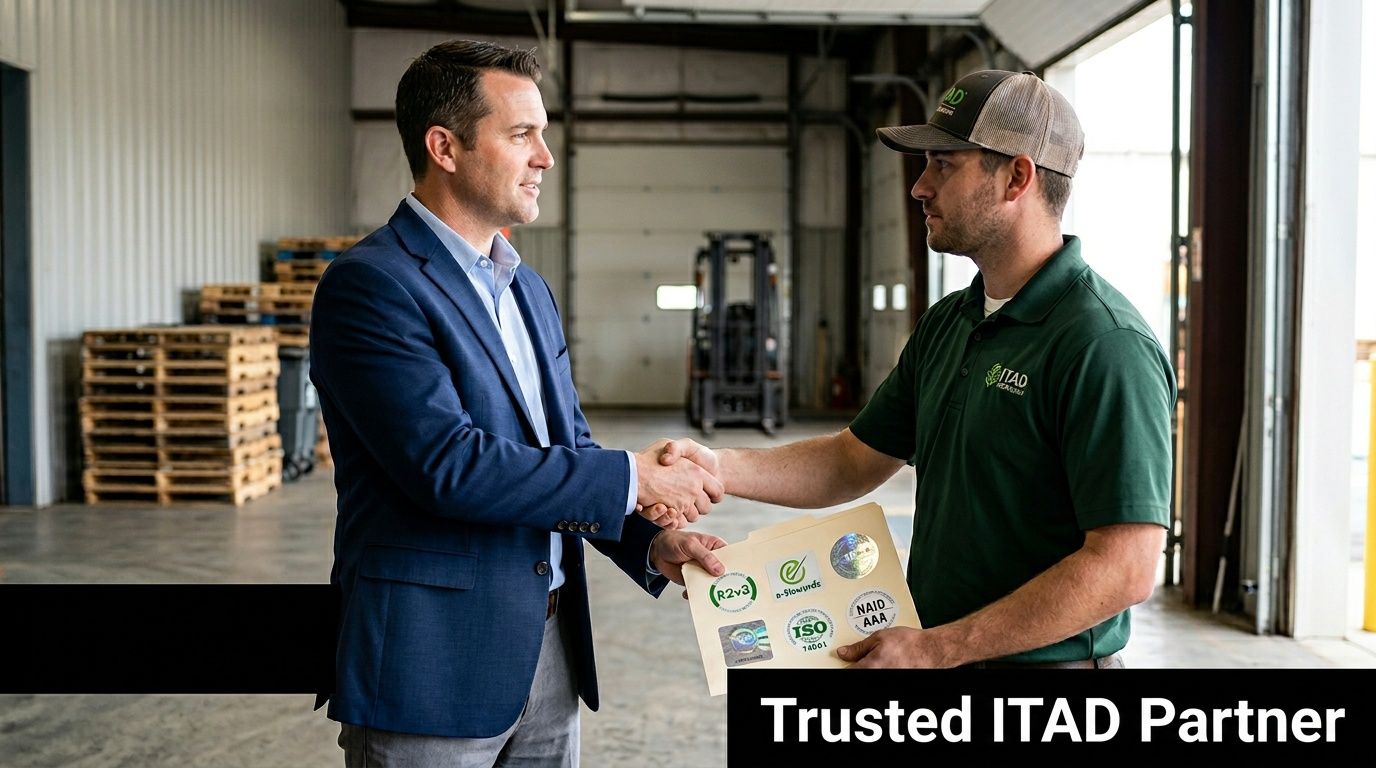
Choosing an ITAD vendor in Atlanta is a serious decision that goes far beyond just finding the lowest quote. You’re entrusting a partner with your most sensitive data and your company's reputation. The right partner acts as an extension of your security team, protecting you from crippling fines and data breaches.
When you begin evaluating vendors, your focus should be squarely on security, compliance, and verifiable processes. A lowball offer can quickly turn into a massive expense if it results in a compliance failure. A qualified partner will be completely transparent about their operations and provide concrete proof of their credentials.
Verifying Essential Certifications
Before even talking price, your first question should be about certifications. These aren't just logos for a website; they are hard-earned proof that a company’s processes have been rigorously audited and approved by a recognized third party.
Make sure any potential partner holds these non-negotiable industry standards:
- R2v3 (Responsible Recycling): This is the gold standard for electronics recycling. It ensures a vendor follows strict best practices for environmental safety, data security, and worker health.
- e-Stewards: Like R2, the e-Stewards certification is highly respected and focuses on preventing the illegal export of hazardous e-waste to developing nations.
A vendor without these credentials can’t guarantee your retired assets won't end up in a landfill or shipped overseas, putting your business at enormous financial and legal risk. To see what a fully certified provider looks like, learn more about our professional electronic waste recycling company.
Scrutinizing Data Destruction and Logistics
With certifications confirmed, your next step is to dig into their data destruction and logistical security. You need absolute, documented confidence that every bit of your data is gone for good.
A handshake and a promise aren’t enough. Demand a documented, auditable trail proving every single drive was handled according to industry standards. This is your only real defense in a compliance audit.
Ask direct questions about their process:
- Do they offer on-site shredding so you can witness the destruction yourself?
- What data wiping standards do they follow (e.g., DoD 5220.22-M)?
- Will you receive a serialized Certificate of Destruction for every asset?
- How do they maintain a secure chain of custody from your facility to theirs?
Atlanta’s infrastructure gives local vendors a distinct edge here. The city’s history, founded as a railroad hub back in 1837, created a legacy of logistical excellence. This deep-rooted expertise allows Atlanta-based ITAD partners to provide secure, efficient transport and chain of custody across the entire metro area.
When selecting a partner, you should also consider their ability to provide comprehensive IT services. A vendor with broader expertise can better understand how asset disposition fits into your company’s overall technology lifecycle, ensuring a more integrated and secure approach.
ITAD Success Stories from Atlanta Industries
Reading about compliance is one thing, but seeing how a tailored ITAD strategy works in the real world makes all the difference. Across the Atlanta metro, every industry faces its own unique challenges when retiring old technology. A hospital's security and compliance needs are worlds apart from a school district's, and a data center operates on a completely different scale.
Here’s a look at how we’ve helped organizations in key Atlanta sectors solve their specific IT retirement problems, protecting their data, their budgets, and their reputations.
Healthcare: A Northside Hospital’s HIPAA-Compliant Refresh
A major hospital system in Northside Atlanta needed to decommission 500 patient-facing devices, including tablets, workstations-on-wheels, and diagnostic PCs. Their number one priority was absolute, ironclad compliance with HIPAA, since every single device could have held Protected Health Information (PHI).
The challenge was twofold: they needed a 100% guaranteed way to destroy all data, and the entire process had to happen without disrupting patient care in a busy, 24/7 clinical environment.
The Solution: We implemented a phased, on-site project after hours. Our team de-installed devices floor by floor from patient rooms and nursing stations, ensuring zero impact on hospital operations. For maximum security, we brought a mobile shredding truck directly to the hospital’s parking lot, allowing administrators to witness the physical destruction of every hard drive firsthand.
The hospital received a serialized Certificate of Destruction that documented each asset, creating a clear, auditable trail for their HIPAA compliance records. All remaining materials were then sent for certified recycling, helping the hospital meet its sustainability goals.
Education: A Gwinnett County School District’s Chromebook Decommissioning
When a large Gwinnett County school district had to retire 2,000 end-of-life Chromebooks, they were juggling tight budgets and limited IT staff. Their goals were to handle the project cost-effectively, ensure all student data was securely erased, and hopefully recover some value to put toward new technology.
Just collecting and managing that many devices from multiple schools was a huge logistical puzzle. They needed a partner who could take the entire process off their plate.
The Solution: Our team coordinated pickups from ten different school locations across the district. We inventoried every Chromebook and securely wiped its data using a DoD 3-pass sanitization process. Because the devices were still functional, we tested and graded them for resale on the secondary market.
The project was a big win for the district. They received a check for the remarketed Chromebooks, which turned a disposal expense into a source of revenue. They also got detailed environmental reports to share with the community, highlighting their commitment to responsible recycling. For organizations with valuable equipment, exploring Atlanta IT asset liquidation can unlock significant financial returns.
Data Centers: An Alpharetta Corporate Data Center Shutdown
A Fortune 500 company consolidating its national footprint needed to completely shut down a corporate data center in Alpharetta. The project scope included hundreds of servers, storage arrays, and networking switches. The mission was clear: bulletproof data security, maximum value recovery, and hitting a non-negotiable project deadline.
This level of complexity demands expertise in both data center hardware and large-scale logistics. As a historic logistics hub, Atlanta is uniquely suited for these kinds of massive projects. The city’s incredible post-Civil War boom, where Fulton County's population shot up 131% in a decade, was built on its ability to coordinate complex railroad and industrial undertakings. This legacy is a perfect parallel for the precision required in modern data center decommissioning. You can learn more about this historical context by reviewing the History of Atlanta on Wikipedia.
The Solution: We deployed a specialized team for on-site de-installation, asset tagging, and inventorying. To meet the company's strict security policy, all server hard drives were shredded on-site. The remaining server components, networking gear, and racks were then carefully assessed for their resale value.
The project finished ahead of schedule with zero issues. The company recovered a substantial six-figure sum from the sale of its remarketable hardware, which more than offset the project's cost. Most importantly, they received a complete set of audit-ready documentation, including certificates of destruction and recycling, that satisfied their internal compliance teams.
Frequently Asked Questions About Atlanta ITAD
Even with a solid plan, practical questions always come up when it's time to retire old technology. Here are a few straightforward answers to the most common questions we get from businesses across the Atlanta area.
What Business Equipment Do You Recycle in Atlanta?
We exclusively handle commercial IT and electronic assets for business, government, and institutional clients. Our entire process is built to manage the unique security, compliance, and logistical challenges that companies face.
We focus on the hardware that forms your IT backbone and stores your sensitive data. This includes things like:
- Data Center Equipment: Servers, SANs, and enterprise-grade networking hardware.
- Office Technology: Laptops, desktops, monitors, and VoIP phone systems.
- Specialized Hardware: Medical devices, lab equipment, and point-of-sale (POS) systems.
By concentrating only on business equipment, we can provide a much higher level of security and service than a general-purpose recycler. For a more detailed breakdown, you can learn more about where to recycle various types of electronics.
What Is the Cost for Business E-Recycling Services?
There’s no one-size-fits-all price for ITAD. The final cost really depends on your specific project, and we’ve found that many business pickups end up being low-cost or even no-cost.
Your quote is shaped by a few key variables:
- Asset Value: Newer equipment that still has market value can be refurbished and resold. This return can often offset or even cover the entire cost of the service.
- Logistics: The scope of the project, including the volume of equipment and any on-site work like de-installing servers, will influence the price.
- Data Destruction: Your chosen method—whether it’s software-based wiping or bringing our mobile shredder to you for physical destruction—is also a factor.
We'll work with you to build a plan that hits your security goals without breaking your budget.
How Do You Ensure Our Data Is Securely Destroyed?
Data security is the most critical part of what we do. We use strict, documented protocols to make sure your company's sensitive information is destroyed completely and permanently, protecting your Atlanta business from a costly data breach.
Our process is built around a documented, unbroken chain of custody. From the moment we take possession of your assets until the final destruction report, every step is tracked to ensure total accountability and security.
We offer two primary, industry-standard methods for destroying data:
- DoD 5220.22-M Data Wiping: This is a software-based process that overwrites your data multiple times, making it impossible to recover. It also keeps the hard drive intact, preserving its value for resale.
- On-Site Physical Shredding: For ultimate peace of mind, we can bring a mobile shredding truck directly to your location to physically pulverize hard drives, SSDs, and backup tapes while you watch.
Once the job is done, we provide a serialized Certificate of Destruction. This is your official, auditable proof that every data-bearing device was properly sanitized or destroyed according to the highest industry and government standards.