A Business Guide to Atlanta Hard Drive Shredding

In a world full of sophisticated data recovery tools, simply hitting 'delete' or wiping a hard drive is insufficient for protecting your Atlanta business. For a surefire way to protect your organization from breaches, regulatory fines, and a damaged reputation, professional Atlanta hard drive shredding is the only definitive solution. It’s not about erasing data—it's about physically annihilating the media it's stored on.
Why Physical Destruction is Non-Negotiable for Atlanta Businesses
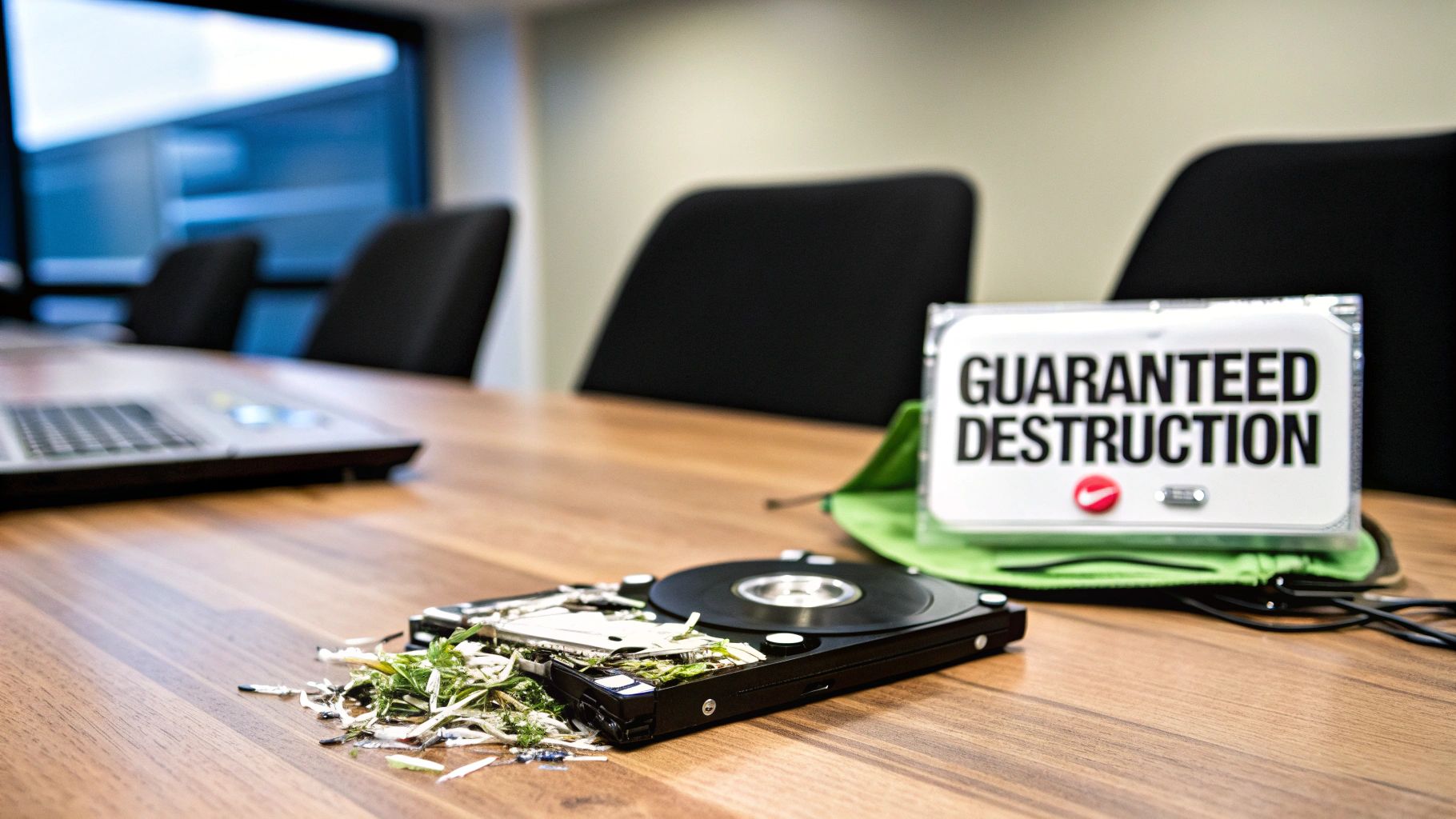
When a server, laptop, or desktop computer reaches its end-of-life, the data on its hard drive remains. Even after formatting or wiping, a determined actor with the right software can often piece together fragments of sensitive information. This includes customer lists, financial records, employee PII, and proprietary corporate data.
That lingering data represents a significant liability.
Improperly discarded hardware is a primary target for data thieves. A single drive recovered from a dumpster can trigger a catastrophic data breach, leading to devastating financial and legal consequences. For any business operating in Atlanta, this is not a hypothetical scenario—it’s a real threat to your operational stability and the trust you've built with your clients.
Staying Compliant in Atlanta's Regulatory Maze
Atlanta is a major hub for industries governed by strict data protection regulations. If your firm operates in healthcare, finance, or legal services, the stakes are exceptionally high. Failing to permanently destroy protected information is not an option; it's a direct path to severe penalties.
Here are key regulations we help our commercial clients navigate:
- HIPAA: The standard for healthcare, it mandates secure methods for disposing of electronic protected health information (ePHI). Physical destruction is the gold standard for ensuring ePHI on retired drives is irretrievable.
- GLBA (Gramm-Leach-Bliley Act): Financial institutions are required to protect consumer financial information, and that includes its secure disposal when no longer needed.
- SOX (Sarbanes-Oxley Act): While focused on financial reporting, its integrity requirements extend to the secure handling and destruction of corporate financial records on obsolete hardware.
These are not suggestions; they are mandates. A Certificate of Destruction from a professional shredding service provides the auditable proof required to demonstrate due diligence.
For any organization handling sensitive data, physical destruction isn't just another IT expense—it's a fundamental component of your risk management strategy. It’s the final, absolute step that guarantees data is permanently eliminated and your business is protected.
Beyond Compliance: Protecting Your Reputation and Bottom Line
The direct costs of a data breach—fines and legal fees—are substantial. However, the indirect costs often cripple a business. A public breach can shatter customer trust that took years to build, leading to client attrition and a tarnished brand that can persist for years.
Consider the business impact of a single compromised hard drive:
- Your valuable intellectual property could be acquired by a competitor.
- Sensitive client or patient information could be publicly exposed.
- Your brand’s reputation in the competitive Atlanta market could be irreparably damaged.
Physical hard drive destruction eliminates these risks. By pulverizing drives into tiny, unreconstructible pieces, you ensure data can never be recovered. It’s a proactive measure that protects your business's future. To further solidify your process, including a strong clause of confidentiality in your vendor agreements adds a critical layer of legal protection. A professional overview of hard drive destruction services can show you exactly how to build a plan that's both compliant and completely secure.
Building Your Hard Drive Disposition Plan
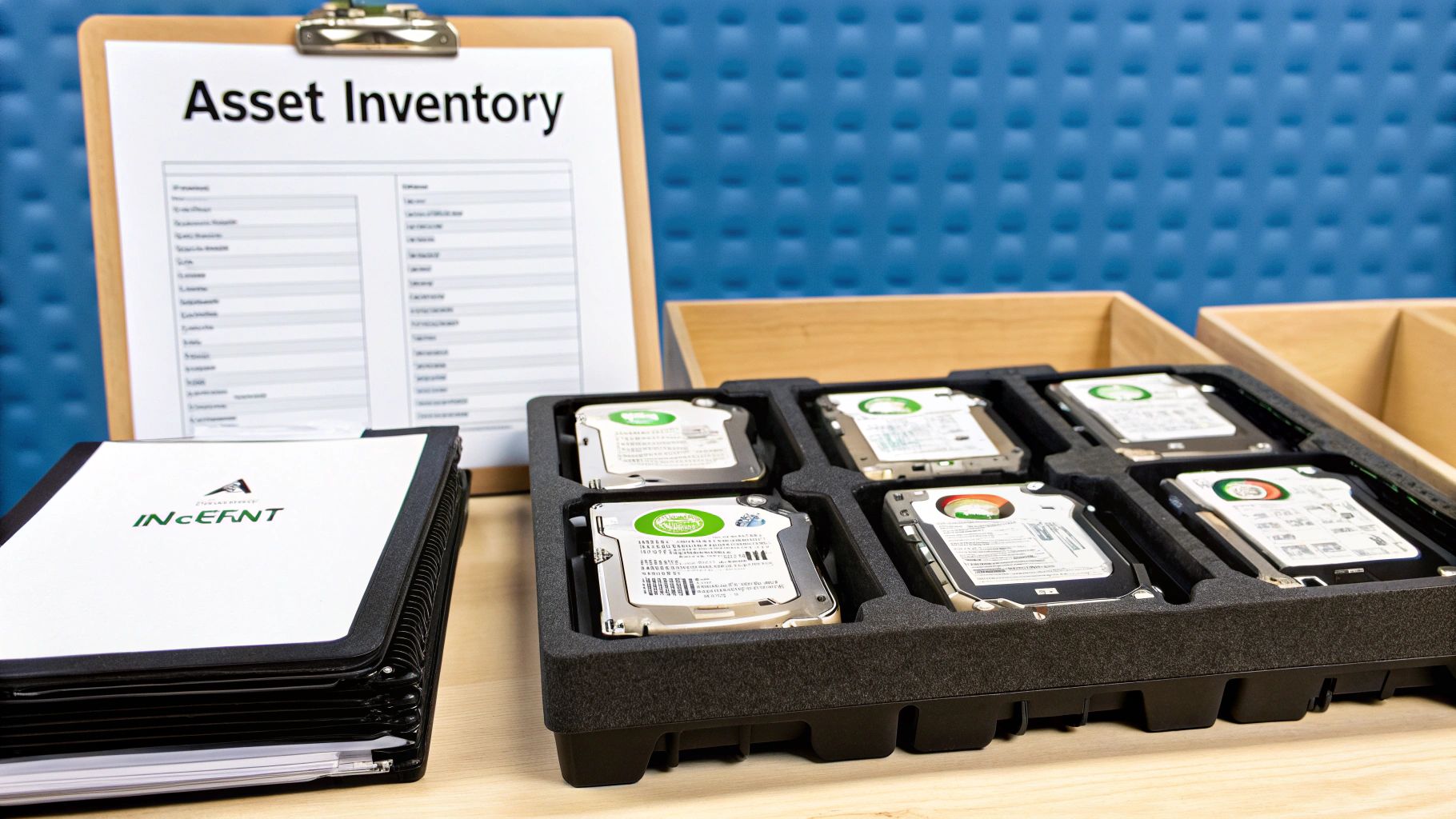
A smooth and secure Atlanta hard drive shredding project begins long before our truck arrives at your facility. The real work starts with a rock-solid disposition plan that accounts for every device being decommissioned. Without this groundwork, you risk logistical headaches, security gaps, and unnecessary operational disruptions.
Think of this plan as the blueprint for your data’s final journey. Proper organization upfront ensures that the destruction process is efficient, auditable, and secure from start to finish. This preparatory work is the most critical internal step your team will undertake.
Creating a Comprehensive Asset Inventory
First, you must know exactly what you have. This means building a detailed inventory of every data-bearing device. While servers and old laptops are obvious, our experience shows the list is almost always longer than IT managers initially expect.
Ensure your inventory includes these common assets:
- Desktop Computers and Laptops: Standard endpoints, typically loaded with a mix of employee files, internal communications, and proprietary information.
- Servers and Network Attached Storage (NAS): The core of your operations, holding vast volumes of critical business and customer data.
- Multifunction Printers and Copiers: Modern office machines have internal hard drives that cache copies of every document scanned, printed, or faxed.
- External Hard Drives and USB Flash Drives: These small, portable devices are easily misplaced and can hold anything from project backups to sensitive personal information.
For each asset, your inventory log must capture the serial number, asset tag, physical location, and its last assigned user. This detailed record is the foundation for your entire chain of custody.
Segregating Drives and Defining a Chain of Custody
Not all data is created equal, and your disposition plan must reflect that. Once you have a complete inventory, the next step is to classify devices based on the sensitivity of the data they contain. This allows you to prioritize assets that require immediate, certified destruction.
For example, a server that held years of customer financial records demands a much stricter handling protocol than a marketing laptop with public-facing presentations. A simple system using color-coded labels—such as red for highly sensitive and yellow for standard corporate data—can provide clear visual cues for your team.
An internal chain-of-custody log is your non-negotiable record of accountability. This document tracks every time an asset is moved, who handled it, and where it went, creating an unbroken audit trail from an employee’s desk to the secure destruction bin.
This internal paper trail is vital. It serves as proof that you maintained complete control over your assets before transferring them to a certified vendor. It demonstrates to auditors and stakeholders that you took every necessary precaution to prevent a device from being lost or stolen.
Finally, establish a secure, centralized location to store all retired assets awaiting destruction. This must be a locked room or a caged area with strictly limited access. Allowing old equipment to accumulate in an unsecured office or closet creates an unnecessary security risk.
A clear and robust disposition plan is a core component of a larger strategy. You can explore how all the pieces fit together by reading up on secure IT asset disposal. This planning phase minimizes your risk and makes the final shredding process completely seamless.
Choosing Your Shredding Method: On-Site vs. Off-Site
Once you've mapped out your IT disposition strategy, the next major decision is where the hard drive shredding will take place. This is not just a logistical choice; it's a critical decision that directly impacts security, compliance, and your budget. The optimal solution for your Atlanta business depends on your internal security policies and specific regulatory requirements.
The two primary options are on-site and off-site shredding. While both deliver secure, certified destruction, they are designed for different operational needs and risk tolerances. Let's break down how each one works so you can make an informed business decision.
On-Site Shredding: The Ultimate in Transparency
On-site shredding is exactly what it sounds like—we bring a mobile, industrial-grade shredding truck directly to your Atlanta office or data center. Often called "witnessed shredding," it offers a level of transparency that cannot be matched. Your team can personally observe the entire destruction process.
The workflow is straightforward and exceptionally secure:
- Asset Verification: Our vetted technicians arrive at your location and scan the serial number of every hard drive, matching them against your inventory list.
- Witnessed Destruction: The drives are immediately fed into the shredder inside the truck, right in your parking lot or at your loading dock.
- Immediate Certification: You receive a Certificate of Destruction on the spot, confirming exactly what was destroyed and when.
This approach completely eliminates chain-of-custody risks during transport. For organizations in healthcare governed by HIPAA or financial firms managing GLBA compliance, witnessing the destruction firsthand is often a non-negotiable requirement.
Key Takeaway: On-site shredding is the premium choice for any business that requires absolute, verifiable proof of destruction at its own facility. If your risk management policy demands zero gaps in your internal chain of custody, this is the definitive solution.
Off-Site Shredding: Secure and Cost-Effective Logistics
Off-site shredding delivers the same certified result but with a different workflow. This option is often more budget-friendly, particularly for larger projects or companies with regular pickup needs, as it allows us to optimize routes and processing schedules.
Here’s how our secure off-site process works:
- We collect your hard drives and place them into locked, tamper-evident containers at your facility.
- These secure containers are then transported in a GPS-tracked vehicle to our certified destruction plant.
- At our facility, the drives are destroyed under constant video surveillance, and we issue a Certificate of Destruction with a complete audit trail.
For many businesses, these robust security protocols—locked bins, vetted staff, and secure transport—provide all the assurance needed. It's a convenient, hands-off process that minimizes disruption at your office, allowing your team to remain focused on core business functions while we handle the logistics.
The Atlanta hard drive shredding market is part of an industry projected to surge from around $1.65 billion in the mid-2020s to as much as $5.05 billion by 2035. This growth is driven by commercial users with strict compliance needs, pushing local providers to invest in the best shredding technology and most secure workflows.
To help you decide, let's put the two methods side-by-side.
Comparing On-Site vs Off-Site Hard Drive Shredding
Here’s a quick feature-by-feature breakdown to help you determine which shredding method best fits your company's security, budget, and operational needs.
| Feature | On-Site Shredding | Off-Site Shredding |
|---|---|---|
| Security | Maximum. Witnessed destruction eliminates all chain-of-custody risk. | High. Secure, locked transport and facility surveillance. |
| Verification | Immediate. Your team can physically watch the drives being destroyed. | Certified. Video surveillance and a detailed audit trail provide proof. |
| Certification | Provided on the spot before our truck leaves your property. | Issued after destruction at our secure facility, typically within 24-48 hours. |
| Convenience | Requires some staff time for verification and witnessing. | Minimal disruption. Our team handles all logistics after pickup. |
| Cost | Generally higher due to dedicated truck and personnel time at your location. | More cost-effective, especially for bulk disposals and scheduled services. |
| Best For | Regulated industries (healthcare, finance), high-security needs, total peace of mind. | Businesses with large volumes, budget constraints, or flexible scheduling needs. |
Ultimately, the right choice depends on your organization's specific priorities. Both paths lead to the same result: securely destroyed data and full compliance.
If you're leaning toward the absolute assurance of witnessed destruction, you can learn more about our on-site shredding service near you. It’s a great resource for understanding the practical benefits of having a shred truck come right to your door.
What to Expect During the "Atlanta Hard Drive Shredding" Process
Understanding how professional Atlanta hard drive shredding works demystifies the process and provides the transparency businesses require. From the moment you schedule a service to when you receive the final paperwork, every step is designed for maximum security with minimal disruption to your operations. It’s a tightly managed process, whether we come to you or you come to us.
Let's walk through the lifecycle of your data-bearing drives. It all begins with proper organization at your facility to ensure every single drive is accounted for.
Preparing Your Drives for Secure Pickup
A secure shredding project starts with good preparation. Before our team arrives, your primary responsibility is to gather all hard drives designated for destruction and have them ready in a secure, easily accessible location. This is where your internal inventory lists are absolutely essential.
When our vetted technicians arrive for the pickup, they will perform an on-site audit. We scan the serial number of each drive and check it against the inventory list you prepared. This dual verification is a non-negotiable step that confirms every asset slated for destruction is present and accounted for, creating a solid audit trail from the very beginning.
The On-Site and Off-Site Workflow Experience
Once the drives are verified, the process diverges depending on your chosen method. The only significant difference is the location of the physical destruction; the security protocols are ironclad for both options.
For IT managers in metro Atlanta—where healthcare, finance, and government facilities operate under stringent regulations—physical shredding has become the standard for drives leaving a secure environment. It is no longer an afterthought. Organizations now treat on-site or tightly controlled off-site shredding as a mandatory final step in their IT asset disposition (ITAD) plans for any system that held sensitive data.
The flowchart below breaks down the distinct steps for both on-site and off-site services.
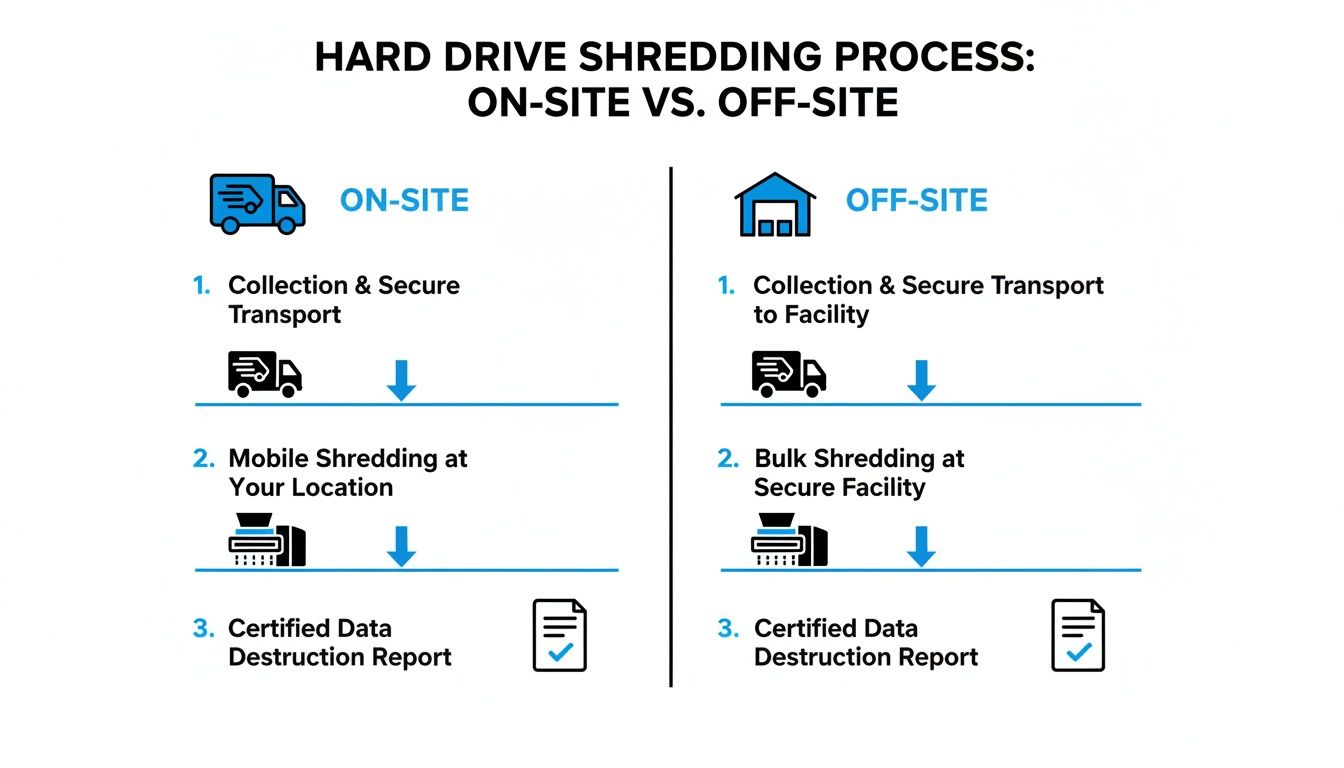
As you can see, both paths lead to certified destruction. The key difference is simply the location of the shredding event itself.
Our Commitment to Security: Every member of our team undergoes rigorous background checks. Whether they are operating a mobile shredder in your parking lot or managing the intake process at our facility, you can be confident that your assets are handled by trusted, trained professionals.
Layers of Security at Every Stage
True data security is about more than just the shredder. It’s about the layers of protection we build around the entire process to seal off any potential vulnerabilities.
- Secure Transport: For off-site shredding, drives are immediately placed in locked, tamper-evident containers before leaving your building. Our GPS-tracked vehicles transport them directly to our secure facility.
- Facility Surveillance: Our destruction facility is monitored by 24/7 video surveillance, covering every access point and all processing areas. This provides a complete visual record of your assets from arrival to final destruction.
- Controlled Access: Only authorized, vetted personnel are permitted inside the secure destruction area of our facility.
This multi-layered approach ensures that from the moment your hard drives leave your possession, they are protected by an unbroken chain of security. We make the integrity of your sensitive data our highest priority, giving you the peace of mind that comes with a verifiably secure process.
Verifying Destruction with a Certificate and Chain of Custody

The Atlanta hard drive shredding service is not finished when the shredder stops running. For your business, the process isn't truly complete until you have legally defensible proof in hand. Without it, you are left with a significant compliance gap, exposing your organization during an audit or a legal challenge.
This final step is centered on accountability. The documentation you receive is far more than a receipt—it's the official record that closes the loop on your IT asset’s lifecycle. It proves your due diligence to your executive team, board of directors, and regulatory auditors.
What Is a Certificate of Destruction?
A Certificate of Destruction (CoD) is the formal document that serves as your official, auditable proof that your hard drives were permanently destroyed. This is not an invoice. It is a detailed legal instrument designed to withstand scrutiny, confirming you took every necessary step to protect sensitive information.
Think of it as the final, critical piece of your data security and compliance framework. For any Atlanta business bound by regulations like HIPAA, SOX, or GLBA, this certificate is a non-negotiable requirement for proving compliance.
A legitimate CoD must contain specific, verifiable details to be valid. Vague or incomplete paperwork is insufficient for audit purposes.
Your Certificate of Destruction is the ultimate proof that you fulfilled your data protection obligations. It’s the document that transfers liability from your organization to your certified destruction partner, providing you with verifiable peace of mind.
The Anatomy of an Audit-Proof Certificate
When you receive your final paperwork, it's critical to know what to look for. A thorough, compliant Certificate of Destruction must always include several key pieces of information. Do not simply file it away without review.
An audit-proof certificate should clearly state:
- A Unique Serial Number for the Certificate: This enables easy tracking and referencing in your records.
- Your Company's Information: It must accurately list your business name and the service address.
- The Destruction Vendor’s Information: The name, address, and contact details of the certified company that performed the service.
- Date and Location of Destruction: This pinpoints exactly when and where the drives were physically destroyed.
- A Detailed List of Serialized Assets: This is crucial. The CoD should list the individual serial number of every hard drive destroyed, matching the inventory you created.
- Method of Destruction: The document must specify that the method was physical shredding, confirming data irretrievability.
- An Authorized Signature: A signature from a representative of the destruction company legally attests to the accuracy of the certificate's contents.
This level of detail is what separates a simple receipt from a powerful compliance tool. For a deeper look, check out our detailed guide on the importance of a Certificate of Destruction for hard drives.
Demystifying the Chain of Custody
Equally important as the CoD is the chain of custody. This is the documented, chronological trail detailing the handling of your assets from the moment they leave your control to their final destruction. An unbroken chain of custody is your proof that no device went missing or was tampered with along the way.
It’s a continuous log of accountability. The process begins with your internal inventory and continues with your vendor’s documentation at every stage: pickup, secure transport, and final processing.
This documented trail ensures there are no blind spots where a drive could be misplaced or accessed. For any Atlanta business focused on risk management, a strong chain of custody is essential. It provides the comprehensive story that supports the finality of the Certificate of Destruction.
Your Atlanta Hard Drive Shredding Questions Answered
Even with a solid plan, practical questions often arise before committing to an Atlanta hard drive shredding project. Getting clear answers is key to moving forward with confidence. We frequently address these questions from IT managers and business owners across the metro area.
Our goal is to provide direct, no-nonsense information to help you finalize your data destruction strategy.
Is It Necessary to Wipe a Hard Drive Before Shredding?
This is one of the most common questions we receive. While wiping a drive before shredding can add a layer of security, it is generally not required if the drive is destined for physical destruction. The shredding process itself is absolute—it pulverizes the drive platters, making data recovery impossible.
However, some organizations, particularly in government or finance, maintain strict internal security policies that mandate wiping for all retired media, regardless of the final disposition method. For most businesses, physical shredding alone is more than sufficient to meet compliance and security requirements.
Can SSDs Be Shredded Like Traditional Hard Drives?
Yes, absolutely. In fact, physical destruction is the only guaranteed method to destroy data on Solid-State Drives (SSDs). Because SSDs use flash memory chips instead of magnetic platters, traditional wiping and degaussing methods can be unreliable or completely ineffective.
An industrial-grade shredder built for e-waste is media-agnostic. It will tear through servers, SSDs, and other media with equal force, reducing them to tiny, useless fragments. This physical annihilation is the only way to be certain the data on those memory chips is gone forever.
What Happens to the Shredded Material?
After your drives are reduced to a pile of mangled metal and plastic, they are not sent to a landfill. Responsible shredding is the first step in a certified electronics recycling workflow.
The shredded pieces are securely transported to a downstream recycling partner for further processing. The process includes:
- Sorting and recovering valuable materials like aluminum, steel, and other metals.
- Sending these raw commodities to smelters to be melted down and repurposed into new products.
This closes the loop, ensuring your data security project also supports the circular economy and aligns with your company's environmental, social, and governance (ESG) goals.
How Can I Verify the Destruction Actually Happened?
Verification is critical for compliance audits and internal peace of mind. The primary tool for this is the Certificate of Destruction issued by your vendor. This legal document serves as your official, audit-proof record of destruction.
If your security policy requires absolute, direct proof, nothing beats on-site shredding. Your team can physically witness the drives being fed into the shredder at your own facility. For off-site services, any reputable provider will have 24/7 video surveillance and strict access controls at their secure facility to provide an auditable trail.
For a full breakdown of the different methods and security protocols, you can learn more about our comprehensive Atlanta data destruction services. It will provide all the details you need to make a secure and compliant decision for your business.
Ready to secure your company's data and ensure compliance? Atlanta Computer Recycling provides certified, reliable hard drive shredding services tailored for Atlanta businesses. Protect your sensitive information and gain the peace of mind that comes with verifiable destruction. Contact us today to schedule your secure pickup.