HIPAA compliant electronics recycling Atlanta GA: A Guide for Businesses

For any Atlanta-based organization handling sensitive data, especially in healthcare, retired technology isn't just clutter—it's a direct financial and legal liability. Ensuring HIPAA compliant electronics recycling in Atlanta GA is far more than simple disposal. It demands a secure, documented process to shield your organization from devastating data breaches and severe legal penalties. This isn't just an IT task; it's a critical boardroom responsibility.
Why E-Waste Disposal Is a Boardroom Issue for Atlanta Businesses

When an Atlanta hospital, clinic, or any business bound by HIPAA decommissions a server, laptop, or medical device, it’s not just an operational footnote. That single piece of equipment represents a massive liability. The conversation around end-of-life electronics has shifted dramatically from an IT checklist item to a recurring topic in the corporate boardroom, and for good reason.
Every retired IT asset is a potential source of a catastrophic electronic protected health information (ePHI) breach. A forgotten hard drive from a diagnostic cart or an improperly wiped server can contain thousands of patient or client records. If that device ends up in the wrong hands, the consequences for your business are immediate and severe.
The High Stakes of Non-Compliance
Imagine a mid-sized specialty clinic in the Atlanta suburbs facing a surprise audit by the Office for Civil Rights (OCR). The auditor asks for proof of secure disposal for 50 laptops retired during a recent tech refresh. Without a certified Certificate of Destruction for each device, the clinic has no way to prove it met its legal obligations.
This isn't a hypothetical. It’s a reality that business leaders face every day. The financial and reputational damage from such a compliance failure can be crippling for any commercial enterprise.
In the eyes of a HIPAA auditor, if an action isn't documented with a clear audit trail, it effectively never happened. This makes certified, verifiable destruction an organization's primary defense against non-compliance allegations.
The Health Information Technology for Economic and Clinical Health (HITECH) Act dramatically increased the penalties for HIPAA violations. Fines can reach millions, and the reputational damage from a publicly disclosed breach can erode customer trust for years. This legislation also extended liability directly to "business associates"—including the recycling vendors you partner with.
Legal Safeguards and Business Associate Risks
The HIPAA Security Rule is clear: covered entities must implement and document policies for destroying ePHI, keeping those records for at least six years. Thanks to the HITECH Act, this requirement now applies just as strictly to any business associate handling that data.
This makes your choice of an electronics recycling partner in Atlanta a decision with direct legal consequences. A non-compliant vendor becomes your liability. If they fail to destroy data properly, your organization is the one held responsible.
That’s why a robust, documented disposal process is a non-negotiable legal safeguard. It involves much more than a handshake agreement; it requires:
- A formal Business Associate Agreement (BAA) that clearly outlines the vendor's responsibilities.
- A serialized inventory of every asset being disposed of.
- A final Certificate of Destruction that serves as your legal proof of compliance.
These documents form an essential audit trail, proving your due diligence. By understanding these requirements, you can better navigate your responsibilities. For a deeper dive, check out our guide on HIPAA compliance IT requirements. The bottom line is clear: managing e-waste is no longer just about recycling. It's about risk management at the highest level.
How to Vet Your Atlanta Electronics Recycling Partner
Choosing an electronics recycler isn't like picking any other vendor. This decision is a direct reflection of your company's commitment to data security, legal compliance, and its public reputation. For any business in Atlanta handling sensitive data—especially those bound by HIPAA—this partnership is a critical extension of your own security framework.
A flashy website or a rock-bottom price means nothing when sensitive data is on the line. You absolutely need a partner who can provide verifiable proof of their security protocols, compliance measures, and destruction processes. Think of this vetting process as your first and most important defense against a data breach originating from a retired hard drive.
Don't Just Take Their Word for It: Verify Certifications
When you're looking for HIPAA compliant electronics recycling in Atlanta GA, you'll see a lot of certifications thrown around. The two that matter most are NAID AAA and R2v3 (Responsible Recycling). You need to know what they actually guarantee for your business.
NAID AAA Certification: This is the gold standard for data destruction. It means the vendor is subject to surprise, unannounced third-party audits that inspect everything from their security protocols and employee screening to the destruction process itself. For HIPAA compliance, this is non-negotiable.
R2v3 Certification: This certification covers environmental responsibility and worker safety. It ensures your old electronics don't get illegally dumped or shipped overseas, which protects your organization from serious environmental liability and negative press.
A vendor having these on their website is a good start, but it's not the end of the story. Always ask to see a copy of their current certificates to confirm they are active and in good standing.
A vendor’s certifications are a starting point, not a conclusion. True due diligence involves questioning what those certifications cover and verifying that their practices align with the promises made on paper.
Scrutinize the Business Associate Agreement
Under HIPAA law, any vendor who touches your electronic protected health information (ePHI) is considered a Business Associate. That means you are legally required to have a formal Business Associate Agreement (BAA) in place. Be careful here—not all BAAs offer the same level of protection, and signing a generic template can leave your organization exposed.
When you review a recycler's BAA, look for specific, ironclad language that covers:
- Permitted Uses of ePHI: The agreement must state that the vendor will only handle ePHI for the sole purpose of destroying it.
- Data Breach Notification: The BAA needs to spell out the exact timeline and method for notifying you if a breach ever occurs.
- Subcontractor Liability: It must hold the vendor responsible for making sure any of their own subcontractors are also HIPAA compliant, extending protection all the way down the supply chain.
A weak or vague BAA is a massive red flag. A trustworthy partner will have a robust, attorney-vetted agreement ready and will be happy to walk you through its terms to ensure you're fully protected.
Essential Vendor Vetting Checklist
Use this checklist to evaluate and compare HIPAA-compliant electronics recycling vendors in the Atlanta area.
| Vetting Criteria | What to Look For | Red Flags to Avoid |
|---|---|---|
| Certifications | Active NAID AAA and R2v3 certificates. Ask for copies. | Expired certs, vague claims of being "compliant," no certifications. |
| Business Associate Agreement (BAA) | A robust, detailed agreement reviewed by an attorney. | Generic templates, refusal to discuss terms, no BAA offered. |
| Insurance | At least a $1 million cyber liability policy. Ask for the certificate. | No data breach insurance, low coverage limits, unwillingness to provide proof. |
| Employee Screening | Mandatory background checks and drug screening for all staff. | No formal screening process, vague answers about employee protocols. |
| Facility Security | 24/7 video surveillance, controlled access, and alarms. | Unsecured facilities, no clear access control policies. |
| Documentation | Sample Certificate of Destruction with serialized inventory. | Incomplete or generic sample documents, missing key details. |
A trustworthy partner will have no problem providing clear, documented answers for every item on this list.
Ask the Tough Questions About Security and Insurance
Beyond the paperwork, you need to dig into the recycler's day-to-day operational security. How they answer will tell you everything you need to know about their real-world commitment to protecting your data. When vetting potential partners, a thorough understanding of their compliance posture is essential; consulting a comprehensive and up-to-date guide like this HIPAA Compliance Checklist can help ensure all necessary security measures are in place.
Here are a few non-negotiable questions to ask:
- Employee Protocols: Are all employees who handle our assets subjected to background checks and drug screening?
- Facility Security: Can you describe the physical security at your processing facility? I'm talking about surveillance, access control, and alarms.
- Cyber Liability Insurance: Do you carry insurance that specifically covers data breaches? Can I see a certificate of insurance?
The quality of their answers gives you a clear window into their risk management practices. Any hesitation or inability to provide documented proof is a sign to walk away. If you're looking for more context, it's worth understanding what truly makes a top electronic waste recycling company.
Confirm the Legitimacy of Your Documentation
At the end of the day, your audit trail is only as strong as the paper it's printed on. A legitimate, professional recycler will provide you with clear, detailed, and legally sound documentation for every single device they process for you.
Before you sign anything, ask to see a sample Certificate of Destruction. A proper certificate must include:
- Your company’s name and address.
- The date the destruction was completed.
- A serialized inventory of the hard drives or devices destroyed.
- The method of destruction used (e.g., shredding, wiping to NIST 800-88 standards).
- An authorized signature from the recycling vendor.
This document is your ultimate proof of compliance. If a vendor’s sample looks flimsy or is missing any of these elements, they simply can't provide the audit-proof records you need to satisfy HIPAA requirements.
Executing Secure Data Destruction and Chain of Custody
You’ve vetted and chosen a certified recycling partner. Now the real work begins. For any Atlanta-based organization handling electronic protected health information (ePHI), your responsibility doesn't end when a device leaves your office. It follows that asset every step of the way.
This documented journey is called the chain of custody, and it’s your single most important defense in a HIPAA audit. It's the irrefutable proof that every server, laptop, and hard drive was handled securely from your facility all the way to its final destruction. The process starts with meticulous inventory tracking at your site, continues with secure transport, and concludes with a formal certificate of destruction. Every single handover needs to be documented to create a transparent, defensible record.
Choosing the Right Data Destruction Method
HIPAA is clear: ePHI must be rendered permanently unrecoverable. But how you achieve that depends on the device type, its age, and your own internal risk policies. Your two main options are software-based wiping and complete physical destruction.
This visual guide breaks down the essential pillars of a compliant process, from verifying certifications to securing a final destruction certificate.
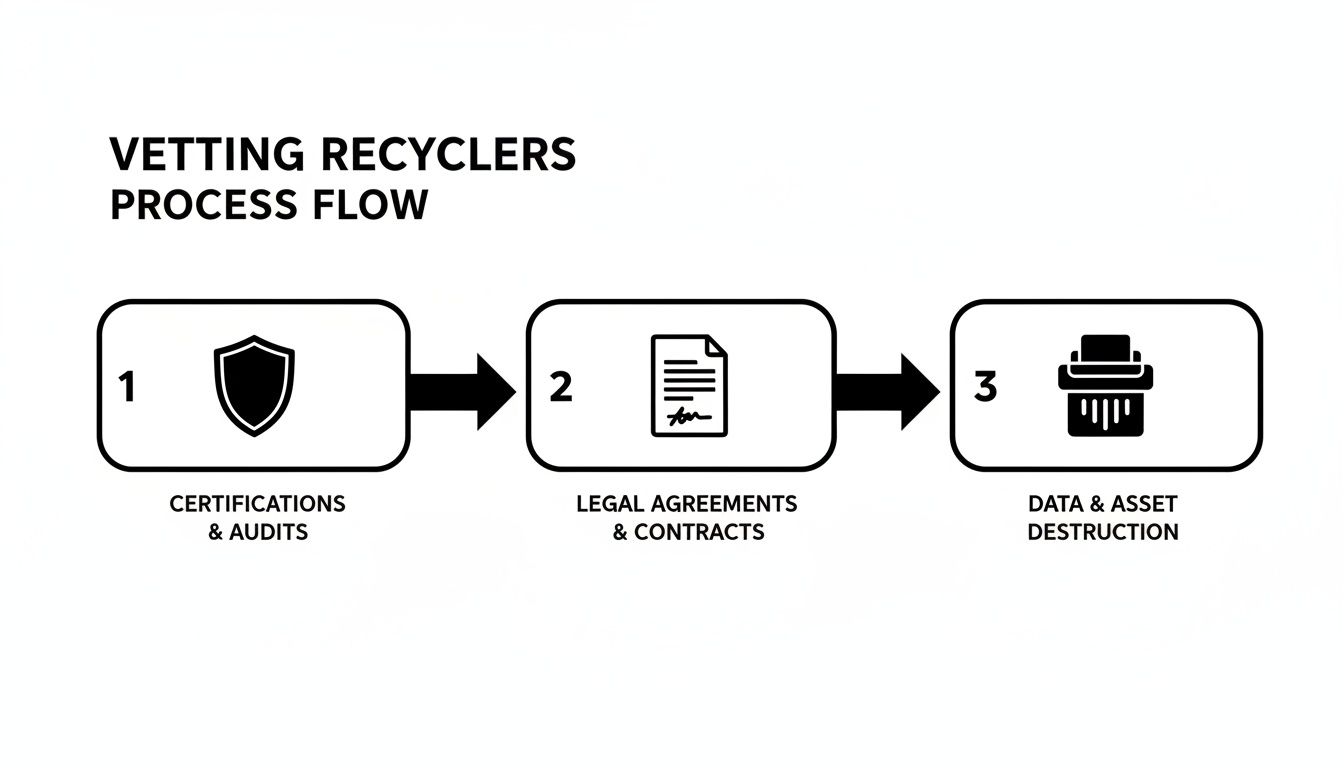
As you can see, compliance isn’t a single action. It’s a multi-stage process where each step—from certifications to legal agreements to the final destruction—builds on the last to create a secure, auditable system.
Software Wiping Standards: NIST vs. DoD
Software wiping, also known as data sanitization, uses specialized programs to overwrite every sector of a storage device, making the original data inaccessible. For years, the go-to standard was DoD 5220.22-M, a 3-pass overwrite method that’s still effective for older magnetic hard disk drives (HDDs).
However, the current gold standard is NIST 800-88, Guidelines for Media Sanitization. This modern framework is critical because it specifically addresses newer technologies like Solid-State Drives (SSDs) and flash media, which the old DoD standard was never designed to handle.
NIST 800-88 outlines three distinct levels of sanitization:
- Clear: A basic overwrite, similar to a "factory reset." Good for low-risk scenarios, but not for ePHI.
- Purge: Uses advanced techniques to ensure data is infeasible to recover, even with lab equipment. This is the minimum standard for most media containing ePHI.
- Destroy: The media is physically obliterated through shredding, melting, or incineration. Recovery is impossible.
For most Atlanta businesses, wiping to the NIST 800-88 Purge standard is the right choice for devices that still have value and can be remarketed. It securely erases all data while preserving the hardware.
When Physical Destruction Is the Only Answer
Sometimes, wiping isn't enough. For devices that are non-functional, contain extremely sensitive ePHI, or use media that can’t be reliably sanitized (like damaged drives or old backup tapes), physical destruction is the only guaranteed path to compliance.
Physical destruction is not just a security measure; it is an absolute guarantee. When a hard drive is reduced to coin-sized fragments, there is no ambiguity about whether the data is recoverable. It provides the ultimate peace of mind and the strongest possible legal defense.
This process involves feeding hard drives, backup tapes, and other media directly into an industrial shredder. The shredded fragments are then responsibly recycled as raw material. Many providers offering HIPAA compliant electronics recycling in Atlanta GA can even bring a mobile shred truck to your facility for you to witness the destruction firsthand. Want to see how it works? You can learn more about the security benefits of on-site hard drive shredding in Atlanta.
The Importance of Secure Logistics
Your chain of custody is only as strong as its weakest link, and that weak link is often transportation. A reputable partner will never just send a standard courier to pick up a pallet of sensitive IT assets.
Proper secure logistics must include:
- Secure Transport: Assets should only be moved in locked, unmarked vehicles equipped with GPS tracking to monitor their journey from your door to the secure facility.
- Professional Crew: The drivers and technicians handling your equipment must be background-checked, insured, and thoroughly trained in secure asset management protocols.
- Documented Handover: At the time of pickup, a detailed inventory or bill of lading is signed by both your representative and the recycler’s team. This is the moment custody officially transfers.
This meticulous approach ensures that from the moment your retired electronics leave your Atlanta office, they are protected within a secure, controlled, and fully documented process until their final destruction.
Managing On-Site Logistics and Decommissioning Projects
Getting outdated technology out of your facility is a massive undertaking, especially during a full tech refresh or data center move. It’s far more than just calling a hauler. A smooth project needs a solid game plan to manage the complex logistics without disrupting your daily operations.
For IT managers and facilities directors in the Atlanta metro area, this means working hand-in-hand to schedule pickups that don’t interfere with business hours and preparing all equipment for secure transport. The real goal is to make the entire process seamless, fully documented, and secure from start to finish.
A Real-World Decommissioning Scenario
Let's walk through a common situation. An Atlanta-based business is consolidating offices and closing a satellite location in Sandy Springs. That office has hundreds of devices—desktops, monitors, printers, networking gear, and even a few racks of servers holding years of sensitive company and client data. The IT manager in charge has one critical task: ensure every single asset is removed and its data is handled securely under HIPAA.
A professional HIPAA compliant electronics recycling service in Atlanta GA approaches this kind of project methodically, starting with a coordinated plan built alongside the company's IT and facilities teams.
It all begins with a pre-project consultation to:
- Map out the full scope of work, including a preliminary count of all assets.
- Pinpoint any special needs, like de-racking servers or moving fragile equipment.
- Lock in a timeline that works for the business, often scheduling pickups after hours or on weekends to avoid any disruption.
Coordinating On-Site Execution
On the scheduled day, a trained and background-checked logistics crew arrives on-site ready to execute the plan with precision. Their job isn’t just moving boxes. It’s a systematic process of de-installing equipment, carefully taking servers out of racks, and disconnecting workstations.
A key part of successful on-site logistics is taking the burden off your internal staff. A professional recycling partner brings the team, the tools, and the project management needed to handle everything. This frees up your IT and facilities teams to supervise, not do the heavy lifting.
As assets are readied for transport, they are meticulously inventoried against the pre-approved list. Every device is serialized, creating the first link in the chain of custody documentation. This is a critical step that guarantees every asset leaving your facility is accounted for. From there, the equipment is professionally packed, palletized, and secured with shrink-wrap for safe transport in a locked, GPS-tracked vehicle.
De-Installation and Asset Preparation
Prepping equipment correctly is vital for both security and efficiency. An experienced crew knows exactly how to handle different types of technology to prevent damage and ensure a smooth, quick loading process.
Key Preparation Steps:
- Systematic De-Racking: Servers and network switches are carefully removed from their racks in an organized way. This isn't just pulling plugs; it's a methodical process essential in complex data center environments.
- Cable Management: All associated power cords and cables are bundled with their devices. This is crucial if any equipment is slated for remarketing or internal redeployment.
- Secure Packing: Devices are packed securely onto pallets. This protects the equipment and makes loading the transport vehicle faster and safer for everyone involved.
This level of professional coordination turns a potentially chaotic cleanout into a well-managed, compliant project. For any business, it ensures that even during a major move, your focus can stay on core operations, not logistical headaches. If you're facing a similar challenge, it helps to know all the steps involved in decommissioning a server securely and efficiently. By working with experts, Atlanta businesses can ensure their decommissioning projects are completed on time, on budget, and in full compliance.
Creating an Audit-Proof Documentation Trail

When it comes to HIPAA compliance, there's one rule that trumps all others: if you can't prove it, it never happened. This is especially true when disposing of electronics that once held ePHI. After your assets are securely transported and the data is destroyed, the final, most critical step is gathering the paperwork that proves you did everything right.
An auditor from the Office for Civil Rights (OCR) won't just take your word for it. They need to see a clear, unbroken paper trail detailing every action your organization took to protect sensitive data. This documentation is your ultimate line of defense, turning a potential compliance nightmare into a simple verification.
The Three Pillars of Your Audit-Proof File
When you work with a professional for HIPAA compliant electronics recycling in Atlanta GA, your documentation package must contain three key documents. Together, they tell the complete story of secure, compliant asset retirement.
- Fully Executed Business Associate Agreement (BAA): As we've covered, this is the foundational legal contract. It must be signed and dated before a single device changes hands.
- Serialized Inventory Reports: This report connects every single device to its final outcome. It lists each asset by make, model, and serial number, confirming exactly what was picked up and what was processed.
- Certificate of Destruction (CoD): This is the final and most important piece of evidence. It's the official declaration that the data on your inventoried devices has been permanently and irreversibly destroyed.
These aren't just "nice-to-haves"—they are mandatory. HIPAA requires you to keep these records for a minimum of six years from the date of destruction.
What a Robust Certificate of Destruction Includes
A legitimate Certificate of Destruction is much more than a simple receipt; it’s a detailed legal document that needs specific information to hold up in an audit. A generic or incomplete CoD is a massive red flag that can undermine your entire compliance effort.
A detailed Certificate of Destruction is the cornerstone of your audit trail. It’s the official record that proves you fulfilled your legal duty to destroy ePHI, turning a potential liability into a documented, compliant action.
Make sure your recycler’s CoD contains all of the following:
- A Unique Certificate Number for tracking.
- Your organization's full name and address.
- The recycler's (Business Associate's) name, address, and contact info.
- A clear reference to the Serialized Inventory Report, linking the certificate to specific devices.
- The exact Destruction Method used (e.g., "Physical Shredding" or "Data Erasure compliant with NIST 800-88 Purge standards").
- The specific Date of Destruction.
- An Authorized Signature from a representative of the recycling company.
If you want to see what a properly structured document looks like, you can review this example Certificate of Destruction form to better understand the necessary fields.
This level of detail is the mark of a true professional partner. The global e-waste recycling market is on track to hit $48.9 billion by 2026, driven largely by stricter data privacy regulations across all sectors. This growth shows just how critical certified partners have become for businesses.
Finally, remember that strong HIPAA compliant document management practices are what hold this whole process together. We always advise clients to organize these documents in a secure, clearly labeled digital folder. Naming files like "CoD_Pickup_04-15-2024" ensures you can pull them up instantly for an auditor. That simple step can make all the difference during a high-pressure review.
Common Questions About HIPAA E-Waste Recycling in Atlanta
Even with a solid plan, navigating the rules for HIPAA compliant electronics recycling in Atlanta GA can bring up some tricky questions. We hear them all the time from business administrators and IT managers, so let's clear up a few of the most common concerns.
Is My Business Too Small for a Professional Service?
It’s easy to think that professional IT asset disposition (ITAD) is only for large hospital systems decommissioning entire data centers. The reality is that HIPAA’s rules apply to every single covered entity, no matter how small. A single retired laptop from a solo dental practice carries the same legal weight—and risk—as a server rack from a major medical center.
Professional recyclers are equipped to provide commercial services to businesses of all sizes, from a single-physician office to a sprawling enterprise. The core services you need—secure pickup, certified data destruction, and audit-ready documentation—are completely scalable. The financial and reputational damage from one data breach is just as devastating for a small business, which makes professional services a necessity, not a luxury.
What if We Already Wiped Our Hard Drives?
It's great practice for an internal IT team to wipe drives before they leave the office. But when it comes to HIPAA, that internal wipe isn't enough to prove compliance. An audit requires independent, third-party verification that the data is gone for good. Without a formal Certificate of Destruction from a certified vendor, you simply have no official proof that ePHI was destroyed according to NIST standards.
Think of it this way: your internal wipe is a good operational step, but the recycler's Certificate of Destruction is your legal evidence. It's the document that proves to an auditor that you met your obligations through a verified, independent process.
Partnering with a certified recycler provides exactly that. They will either re-wipe the drives to the NIST 800-88 standard or physically shred them, then issue the certificate that closes the loop on your audit trail.
Can We Just Drop Off Our Old Equipment?
While dropping off a personal computer at a recycling center is fine, it's a risky move for any business handling ePHI. The HIPAA Security Rule is crystal clear about maintaining a documented chain of custody. If you transport sensitive assets yourself, you create a major gap in that chain and become fully liable for any data loss that happens on the way.
That’s why professional on-site pickup is the standard for our commercial clients. This service ensures:
- Secure Handling: Trained, background-checked personnel manage the equipment from the moment it leaves your office.
- Documented Transfer: A bill of lading or inventory sheet is signed at your location, officially transferring custody and liability to the recycler.
- Safe Transport: Your assets are moved in locked, secure vehicles, maintaining the integrity of the chain of custody from start to finish.
This approach removes the logistical headaches and security risks from your team, guaranteeing a compliant process from door to destruction.
Ready to implement a secure, compliant, and efficient electronics recycling program for your Atlanta-based business? Atlanta Computer Recycling offers end-to-end services, including on-site pickups, certified data destruction, and the audit-proof documentation your organization needs. Protect your data and simplify your IT asset disposition by partnering with the experts.
Secure your compliance today by visiting https://atlantacomputerrecycling.com.