A Business Guide to Warehouse Electronics Recycling Atlanta GA

For any growing Atlanta business, that back corner of the warehouse often tells a story. It’s a graveyard of old servers, desktops, and networking gear—the ghosts of tech upgrades past. But this isn't just about clutter. It’s a ticking clock of security risks and compliance headaches.
Properly retiring warehouse electronics is one of the most critical, and often overlooked, parts of IT management. It’s about much more than just making space. It's about protecting your data, your customers, and your company's reputation from the fallout of improper disposal.
The Mountain of E-Waste Facing Atlanta Companies
Rapid tech cycles are a non-negotiable part of staying competitive. The downside? Your warehouse is probably filling up with obsolete equipment faster than you can manage it. This isn't just a local problem; it's a massive global one.
In 2022, the world generated an incredible 62 million tonnes of e-waste, a staggering 82% jump from 2010. Worse yet, that number is expected to climb another 32% to 82 million tonnes by 2030, while only 22.3% of it was properly recycled. For IT and facilities managers here in Atlanta, that global crisis shows up as pallets of decommissioned gear taking up valuable real estate.
Why You Can't Afford to Ignore Strategic Recycling
Failing to manage your retired IT assets is a gamble you can’t win. A single old hard drive tossed in a dumpster without certified data destruction could easily become ground zero for a catastrophic data breach. At the same time, environmental regulations are tightening, and regulators want to know exactly where your old electronics end up.
The real liability isn't the old equipment itself—it's the sensitive data it still holds and the hazardous materials it contains. A professional warehouse electronics recycling Atlanta GA program solves both problems, turning a major risk into a secure, documented, and sustainable process.
Working with a certified recycling specialist like Atlanta Computer Recycling transforms this challenge from a liability into a documented strength. A professional partner delivers:
- Total Data Security: We use certified methods like data wiping and physical shredding to completely destroy information, protecting your business and your clients.
- Airtight Regulatory Compliance: We help you meet standards like HIPAA and provide the official documentation you need to prove it.
- True Environmental Responsibility: We guarantee that hazardous materials are managed safely and that valuable commodities are recovered and returned to the supply chain. You can learn more about the environmental impact of electronic waste and see why this is so critical.
By putting a formal ITAD strategy in place, your business doesn't just protect itself. It actively reinforces its commitment to corporate social responsibility and strengthens its environmental, social, and governance (ESG) credentials. This guide will walk you through exactly how to get it done.
How to Plan Your Warehouse E-Waste Project
A warehouse full of old electronics isn't just a storage problem; it's a security and compliance risk waiting to happen. The key to a successful cleanout isn't just calling for a pickup—it's starting with a smart, organized plan. A chaotic approach always leads to higher costs and bigger headaches, which is why a detailed inventory audit is where every successful project begins.
Before you do anything else, you need to know exactly what you have. This isn’t about a rough headcount. It’s about creating a detailed manifest that gives a recycling partner the full picture. When you're dealing with rows of pallets and forgotten equipment, managing the physical space is key, much like the logistics behind warehouse self storage. Your first move should be a walkthrough, documenting every piece of gear destined for disposal.
Creating Your Asset Inventory
An accurate quote and a compliant process both depend on a thorough inventory. Break down your equipment list with a few key details to get it right:
- Equipment Type: Get specific. List out servers, desktops, laptops, network switches, routers, old phone systems, and monitors.
- Condition: Is it working, broken, or just old? This detail helps determine if an asset has any resale value or if it’s purely scrap material.
- Age and Model: Jotting down the model number can flag equipment that’s still valuable, which could help offset your recycling costs.
- Data-Bearing Devices: This is non-negotiable. Pinpoint every single device that holds data. Think servers, PCs, and laptops, but don't forget about copiers, certain network gear, and anything with a hard drive or flash storage.
Getting this list together forces your IT, finance, and operations teams onto the same page. Finance can see the potential for asset recovery, and IT can ensure data security is baked into the plan from day one.
A detailed inventory isn't just for getting a quote. It becomes the backbone of your chain-of-custody, proving exactly which assets were handed off for secure disposal.
This process is critical. A misstep in the planning stage can expose your business to serious consequences, from data breaches to hefty fines.
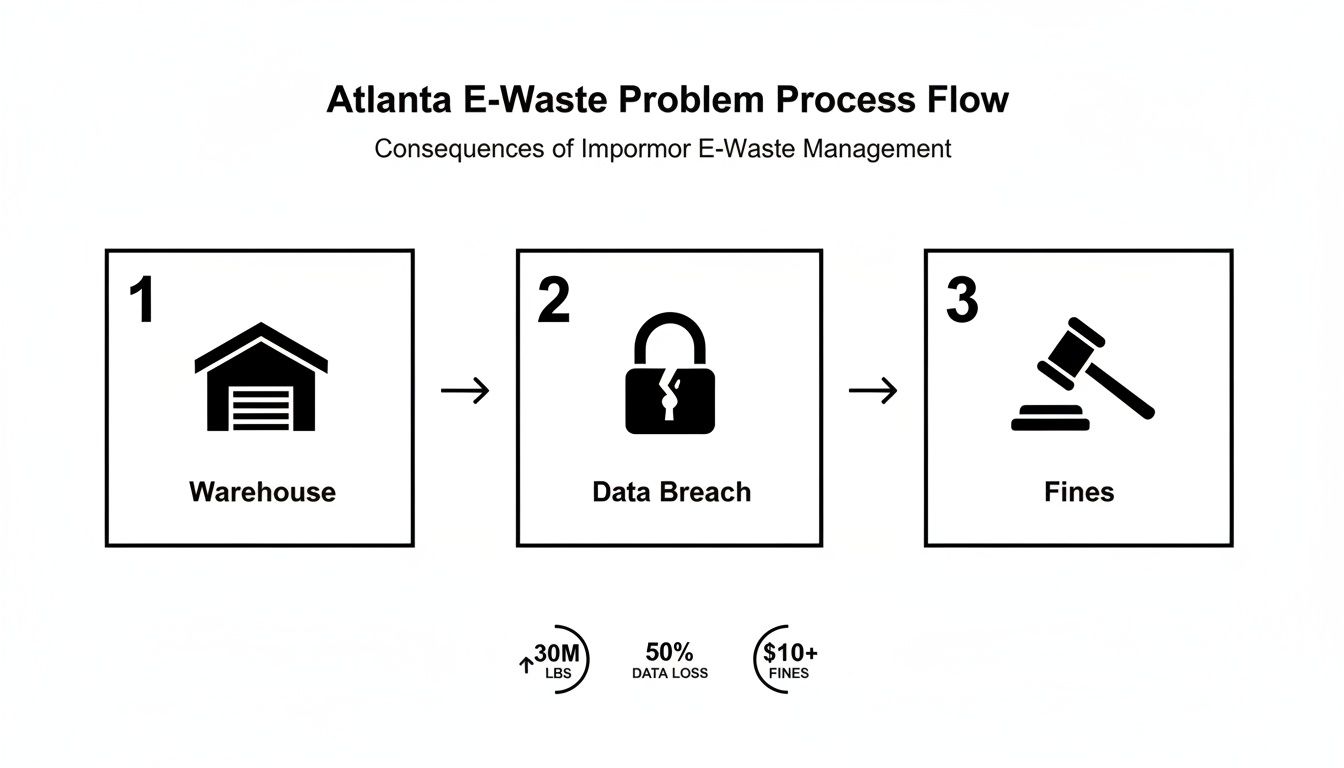
As you can see, the path from a disorganized warehouse to a data breach is shorter than you think. Proper planning is your first line of defense.
From Inventory to Actionable Plan
Once you have that complete asset list, you can start to see the real scope of the project. A data center teardown involving 50 servers, 10 network racks, and 200 hard drives is a completely different ballgame than clearing out 100 desktops from an old office space.
For bigger jobs, use your inventory to estimate the physical volume. How many pallets is the equipment currently on, or how many will it fill once staged for pickup? This is exactly the kind of information a warehouse electronics recycling Atlanta GA provider needs to schedule the right size truck and the right number of technicians.
A clear manifest leads to a solid quote and a project plan that works. You can learn more about the specifics in our guide to IT asset disposition in the Atlanta GA area. When you put in the work upfront, you eliminate surprises and ensure the entire process is smooth, secure, and fully compliant.
Ensuring Secure Data Destruction and Compliance
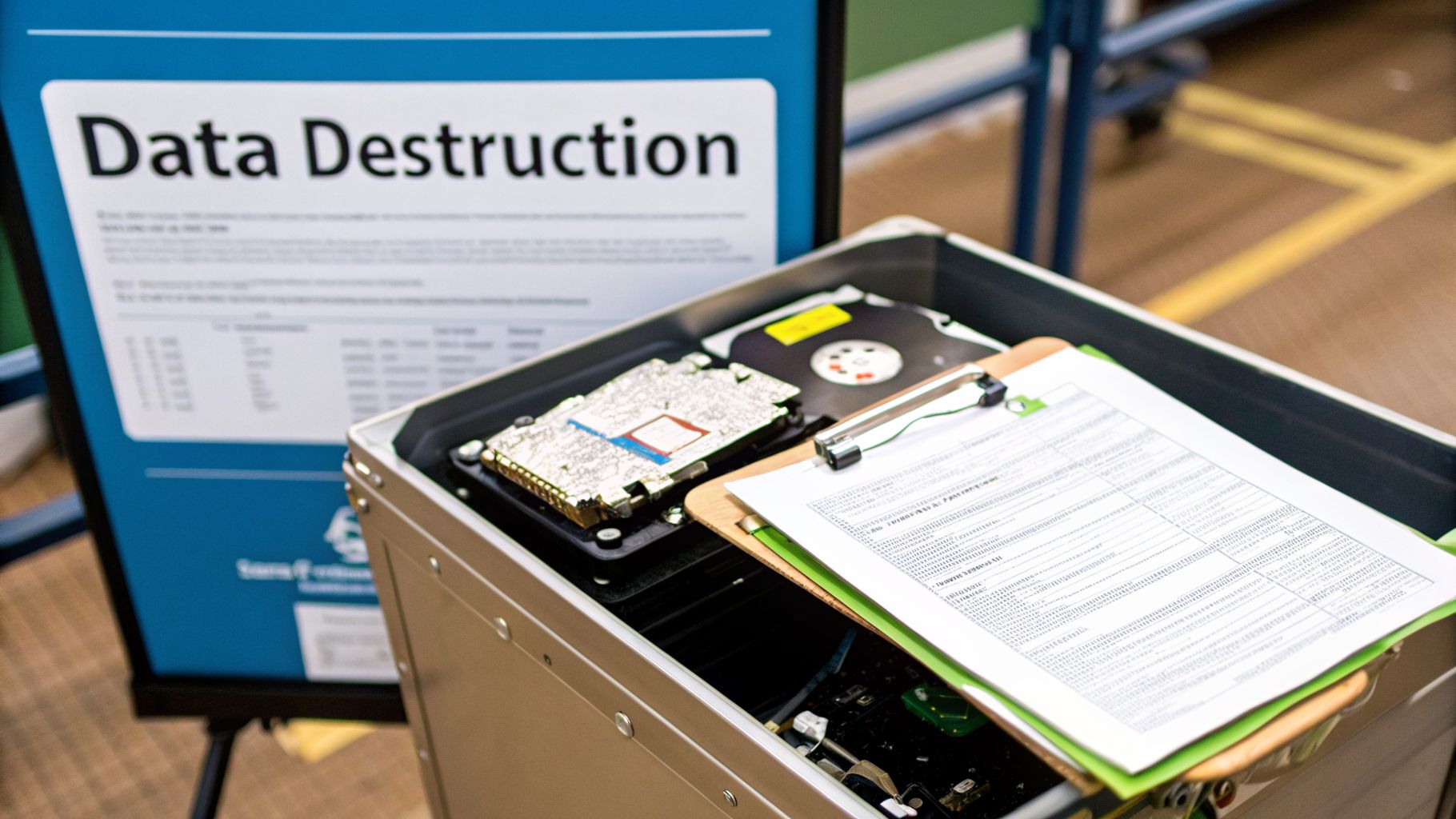
Once you've cataloged every device in your warehouse, the real work begins. This is the most critical phase: guaranteeing that every last bit of data is gone for good.
For any company, data security is non-negotiable. This is especially true if you're in healthcare, finance, or a government-contracted field. Simply hitting 'delete' or formatting a drive won't cut it—that data is still easily recoverable. Your reputation and your legal standing are on the line, which is why professional, certified data destruction is essential.
Wiping vs. Shredding: What’s Right for You?
You have two primary, industry-accepted methods for sanitizing your media: software wiping and physical destruction.
Software-based data wiping uses specialized programs to overwrite a hard drive's entire surface with random characters. Think of it like painting over a canvas multiple times until the original image is completely obscured. The process often follows strict standards, like the DoD 5220.22-M 3-pass protocol, which is more than enough to make data irretrievable.
The biggest plus here is that the physical hard drive remains intact. This makes wiping the perfect choice for newer or high-value assets like recent-model servers or laptops that can be refurbished and resold. This approach can even help offset your recycling costs by generating a return.
On the other end of the spectrum is physical destruction, or shredding. It’s exactly what it sounds like. We feed the hard drives into industrial shredders that pulverize them into tiny metal fragments, making data recovery physically impossible.
When an asset has no resale value, is non-functional, or your internal security policy demands the absolute highest level of security, shredding is the only answer. It leaves no room for doubt.
This is the standard for drives containing sensitive intellectual property, patient health information (PHI), or classified data.
Choosing Your Data Destruction Method
Deciding between wiping and shredding comes down to balancing security needs, asset value, and compliance requirements. Here’s a quick breakdown to help you choose the right path for different types of equipment.
| Method | Best For | Security Level | Asset Reuse Potential | Compliance Use Case |
|---|---|---|---|---|
| Data Wiping | Newer servers, laptops, desktops with resale value. | High (Exceeds NIST 800-88 Purge standards). | High. The device and drive can be remarketed. | Perfect for most corporate data and general IT assets. |
| Physical Shredding | Outdated or broken drives, SSDs, mobile devices, or media with highly sensitive data. | Absolute. Data is physically impossible to recover. | None. The asset is completely destroyed. | Essential for HIPAA, financial regulations, or top-secret data. |
Ultimately, a good ITAD partner can help you create a blended strategy, using wiping to recover value where possible and shredding to eliminate risk where necessary.
Meeting Compliance and Securing Your Proof
For businesses in regulated industries, proving you did things the right way is just as important as the act of destruction itself. This is particularly true for healthcare providers bound by HIPAA or financial firms with strict data privacy mandates.
A certified warehouse electronics recycling Atlanta GA provider must deliver ironclad documentation. This starts with a full chain-of-custody record, tracking your assets from the moment they leave your warehouse to their final disposition.
The process ends with a Certificate of Data Destruction. This isn't just a receipt; it's your official, auditable proof that your data was destroyed according to legal and industry standards. It will list the serial numbers of the sanitized media, the method used, and the date. This document is your shield in the event of an audit or legal challenge. To learn more about the specifics, you can check out our detailed guide on secure data destruction in Atlanta.
As regulations tighten, the demand for these secure services is skyrocketing. The electronics recycling industry is projected to hit $22,210 million globally by 2026. With North America holding a 30% market share, driven by innovation in data-heavy sectors, the need for ITAD providers who can meet the stringent demands of hospitals, data centers, and government agencies has never been greater.
Coordinating Logistics for Pickup and Transport
Once you’ve audited your inventory and have a solid data destruction plan, you’ve hit the next major hurdle: getting everything out. Moving what can often be tons of old electronics from your warehouse to a recycling facility requires real logistical planning. The goal is a seamless pickup that doesn't disrupt your daily operations and ensures every single asset is accounted for.
The first big question is how much of the heavy lifting your own team will do. You could have your staff handle all the de-installation, palletizing, and staging. This gives you hands-on control, but it also pulls your team away from their core responsibilities, costing you significant time and labor.
On-Site De-Installation vs. Self-Staging
The alternative is a full-service pickup, where a partner’s trained technicians come on-site and manage the entire process for you. They’ll de-rack servers, disconnect workstations, and professionally pack and wrap all the materials. For most large-scale warehouse electronics recycling Atlanta GA projects, especially complex data center cleanouts, this is the way to go. The efficiency and expertise are well worth it.
No matter which route you take, proper staging is the key to a safe and efficient pickup.
- Palletize Securely: Stack your equipment neatly on standard pallets. Heavier items like servers always go on the bottom, with lighter gear stacked on top.
- Shrink-Wrap Everything: Once a pallet is fully loaded, wrap it tight with industrial-grade shrink-wrap. This is crucial for preventing items from shifting or falling off during transport.
- Label Clearly: Every pallet needs a copy of your inventory manifest. This allows the pickup crew to quickly verify the contents against their records the moment they arrive.
This simple prep work doesn't just speed up the loading; it protects the equipment and establishes a clear chain of custody right from the start.
For huge warehouse cleanouts or office moves, we always recommend a phased pickup schedule. Trying to move hundreds of pallets in a single day can create a massive bottleneck at your loading docks. A staggered approach over several days keeps your own operations running smoothly.
When the pickup team arrives, they should come prepared with dollies, pallet jacks, and a truck that's actually the right size for your job. They’ll verify your inventory against the manifests and, most importantly, sign the chain-of-custody paperwork before a single item leaves your property. At that moment, they formally assume all liability for the assets. You can find more details about our professional IT equipment pickup in the Atlanta GA area.
This is where working with a truly local Atlanta provider makes a difference. We know the city’s traffic nightmares, the loading dock restrictions in downtown high-rises, and all the other little logistical hurdles unique to our metro area. That local knowledge helps prevent delays and ensures your pickup happens right on schedule, without any last-minute surprises.
From Your Warehouse to a Circular Economy
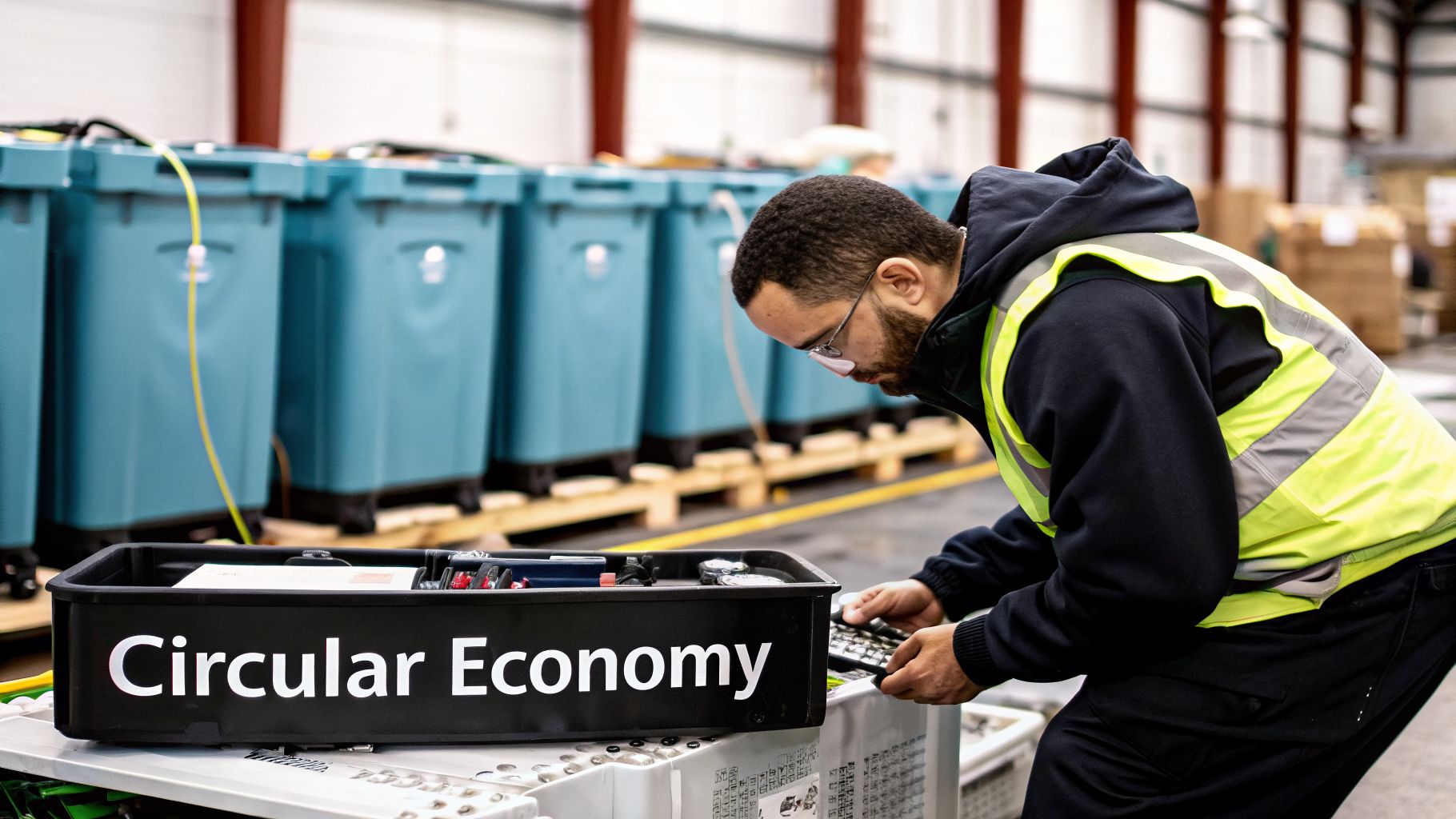
So, the truck has pulled away from your loading dock, loaded with pallets of retired IT equipment. What actually happens from here? The journey from your Atlanta warehouse to its final destination is a meticulous, fully documented process—turning what could have been e-waste into a tangible part of the circular economy.
Once our truck arrives at a certified recycling facility, the work starts immediately. The first step is to unload the equipment into a secure receiving area. Here, technicians check each pallet’s manifest against the chain-of-custody paperwork you received. It's a critical verification step to ensure every single asset is accounted for before any processing begins.
The Triage Process: Sorting for Value
Inside the facility, the first real stop is triage and testing. This isn't just about sorting laptops from servers. Our trained technicians evaluate each piece of equipment to determine its condition and potential for reuse, which is where the real value lies.
For instance, a technician might find that a pallet of decommissioned Dell servers is still perfectly functional after testing. Those assets are immediately tagged for refurbishment. In contrast, a cage of older desktops and monitors with cracked screens will be routed straight for de-manufacturing.
This careful evaluation is what makes a true IT Asset Disposition (ITAD) strategy so different from basic junk removal.
- Identified for Refurbishment: Devices with life left in them are cleaned, data-wiped, and prepped for resale. This is the most sustainable outcome, as it extends the product’s lifecycle and often generates a financial return for your company.
- Tagged for Parts Harvesting: Maybe a server won't power on, but its RAM, processors, and power supply are in great shape. We harvest these valuable components to repair other devices.
- Designated for Destruction: Any equipment that's truly end-of-life, broken beyond repair, or contains proprietary hardware is sent for secure de-manufacturing and commodity recovery.
De-Manufacturing and Commodity Recovery
For equipment that can’t be reused, the de-manufacturing process is far more complex than just shredding. Technicians carefully disassemble devices by hand, separating them into their core components: steel frames, plastic casings, aluminum heat sinks, power supplies, and circuit boards.
A single server circuit board contains hazardous materials like lead and mercury that require safe handling. But it also holds precious metals like gold, silver, and palladium. Certified recycling ensures these valuable resources are recovered and kept out of landfills.
Once separated, these raw commodities are bundled and sent to specialized smelters and refineries, where they are reintroduced into the manufacturing supply chain. The steel from your old server racks might become rebar for a new building, while the plastics from your office phones could be used in new consumer products.
This is the circular economy in action. The decision to responsibly recycle your warehouse assets directly reduces the demand for virgin materials. With the electronics recycling market valued at around $70 billion in 2026 and the ITAD sector alone projected to reach $36.4 billion by 2034, the need for these recovered commodities has never been higher.
By choosing professional warehouse electronics recycling Atlanta GA, you're not just clearing out space. You are actively turning retired assets back into valuable resources. To see a full breakdown of this journey, check out our guide on what really happens to recycled electronics.
Common Questions About Commercial E-Waste Recycling
Even with a solid plan, a few questions always pop up when you're looking at a large-scale electronics recycling project. As an IT or facilities manager, you need straight answers to move forward with confidence. Here are some of the most common things we get asked by Atlanta businesses.
What Does Warehouse Electronics Recycling in Atlanta Cost?
The cost really depends on what you have and the services you need. For many businesses with bulk loads of valuable gear—think newer servers, laptops, and networking hardware—we can often provide pickup and recycling services for free. The value we recover from those assets helps cover our labor and logistics.
On the other hand, fees usually apply for items with zero resale value and high recycling costs, like old CRT monitors or massive office copiers. Premium services, like bringing our shredder to your site for on-site hard drive destruction, also have a fee. The best approach is always to get a detailed quote based on that inventory list you put together.
How Long Does the Entire Process Take?
The timeline is all about the scale of your project. A standard warehouse cleanout of 20-30 pallets might be a one-day pickup. But a full data center decommissioning, where we're de-installing equipment on-site, could be a multi-day project designed to work around your schedule and avoid any disruption.
Once we pick everything up, the processing, data destruction, and sorting back at our facility typically takes about one to two weeks. You can expect to have your official Certificates of Destruction and Recycling in hand within 30 days of the pickup. That final paperwork is what completes the chain of custody and officially closes the loop on your project.
What Electronics Can My Business Recycle?
Most professional recyclers focus on IT, office, and data center equipment. This covers a huge range of assets, including:
- Servers and storage arrays
- Desktops, laptops, and docking stations
- Networking hardware like switches, routers, and firewalls
- Hard drives (both HDD and SSD) and other storage media
- Keyboards, mice, cables, and other peripherals
- LCD monitors and business phone systems
Things like consumer televisions, breakroom appliances, or loose batteries often fall outside the scope of a commercial ITAD provider or might require special handling. It’s always a good idea to confirm your recycler’s list of accepted materials before scheduling a pickup.
Is My Business Protected from Liability After Pickup?
Yes, but only if you work with a certified and insured ITAD provider. When a professional recycler takes possession of your assets, they must provide you with chain-of-custody paperwork. This document is what legally transfers liability from your company to theirs.
From that moment on, the recycler is responsible for making sure your data is destroyed securely and all materials are managed in an environmentally compliant manner. The final certificates you receive are your legal proof that you did your part, protecting your business from any future risk.
Ready to clear out your warehouse and handle your e-waste the right way? The team at Atlanta Computer Recycling provides secure, compliant, and efficient electronics recycling services for businesses across the metro area. Contact us today for a free project assessment and quote at https://atlantacomputerrecycling.com.