ITAD Planning and Weather in Sandy Springs Georgia: A Commercial Guide


For businesses in Sandy Springs, the weather is more than a topic for small talk—it's a critical operational factor that can impact the bottom line of an IT Asset Disposition (ITAD) project. From blistering summer heat and humidity to unexpected winter ice storms, the local climate presents tangible risks to your sensitive electronics, facility safety, and project timelines.
How Weather Impacts Your Commercial IT Asset Disposition Strategy
For any facilities or IT manager, the weather in Sandy Springs, Georgia, isn't just a forecast; it's a major variable in your logistics and risk management plan. A large-scale ITAD project, such as a data center decommissioning or an office-wide hardware refresh, is a complex operation where weather is a key stakeholder. A sudden downpour or a spike in temperature can disrupt schedules, compromise asset value, and create safety hazards.
Imagine a meticulously planned on-site de-installation derailed by a sudden thunderstorm that makes loading impossible. A slick, icy loading dock isn't just an inconvenience—it's a serious safety hazard and a liability that can lead to damaged equipment, employee injuries, and costly delays.
Proactively managing weather-related risks is what separates a smooth, successful ITAD project from one fraught with logistical headaches, unforeseen costs, and operational disruptions.
Protecting Corporate Assets in Transit
A robust ITAD strategy must account for every risk, including the transit and storage phases. A crucial component of this is understanding bailee coverage, which is the insurance that protects your corporate assets once they are in the custody of a third-party vendor like Atlanta Computer Recycling.
This guide serves as a practical playbook for navigating the unique climate challenges facing businesses in the Atlanta metro area. We will detail how partnering with a local logistics expert who understands these variables can safeguard your equipment, protect your investment, and prevent expensive operational disruptions.
To further bolster your operational resilience, consult our guide on creating a business continuity planning checklist. By anticipating how weather can affect your project, you ensure your e-waste pickups and data destruction services are executed seamlessly, regardless of the season.
Understanding The Annual Climate Cycle For Business Operations in Sandy Springs
To make strategic decisions for your IT asset pickups, it is essential to understand the predictable rhythm of the weather in Sandy Springs, Georgia. The area’s humid subtropical climate creates a distinct annual cycle of temperature and precipitation that directly impacts logistics planning. Viewing this cycle through a business lens helps you preemptively address challenges before they disrupt your operations.
This isn't about short-term forecasting. It’s about recognizing that scheduling a large server de-installation in July requires a fundamentally different set of precautions than a pickup on a crisp October day. Understanding these seasonal shifts is the key to proactively scheduling your e-waste projects and minimizing risks to your valuable corporate assets.
This timeline illustrates how seasonal weather creates specific risks for your ITAD projects throughout the year.
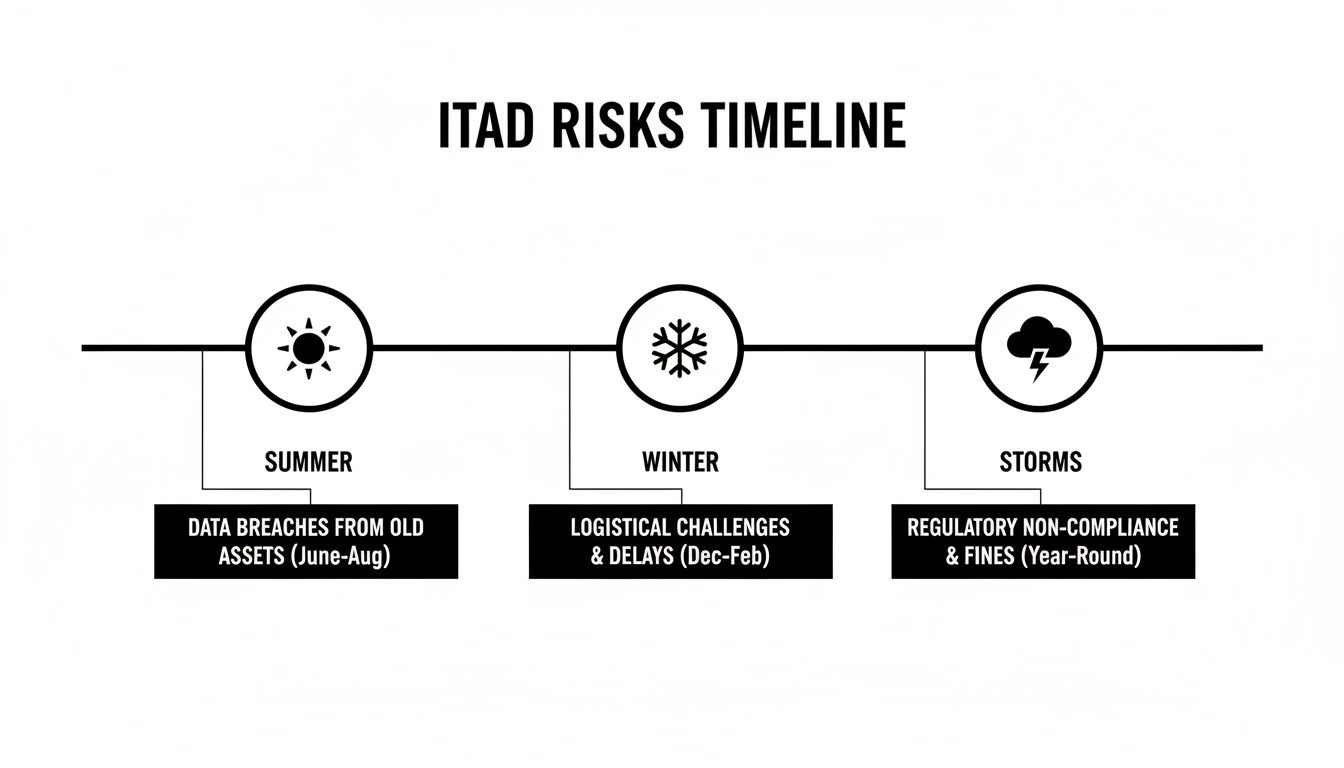
As shown, summer humidity, winter freezes, and sudden storms each present unique threats that must be managed with a well-defined logistics and risk mitigation strategy.
The Ebb And Flow Of Georgia Weather
Sandy Springs' climate creates a wide operational window your business must plan for. Annually, temperatures can swing from a low of 35°F in winter to a sweltering 89°F during peak summer.
For businesses coordinating on-site server pickups, this range is a significant logistical factor. Summer humidity often exceeds 70%, creating a corrosive environment that can accelerate degradation on exposed electronics during transport. Precipitation is a constant, with approximately 50 inches of rain annually, peaking in July. You can explore the complete climate data for Sandy Springs on WeatherSpark.com to analyze these trends.
This data is operational intelligence. High humidity means unprotected circuit boards and metal components are at a higher risk of degradation. Even a brief transit from a climate-controlled office to a transport truck can introduce enough moisture to cause latent damage, potentially erasing the resale value of your assets.
By translating historical climate data into actionable business decisions, you can schedule projects to minimize risk and maximize efficiency, avoiding common seasonal pitfalls.
The objective is to shift from reactive weather responses to strategic planning. Knowing that July brings both intense heat and heavy rain allows you to build in buffer time for secure loading or confirm your logistics partner utilizes covered, climate-controlled vehicles.
Likewise, anticipating the potential for freezing temperatures in January means verifying that loading docks and access routes will be clear and safe for crews and equipment. This foresight is the foundation of a resilient and cost-effective ITAD strategy.
Sandy Springs Seasonal Weather At A Glance For Business Planning
This table breaks down the average seasonal conditions in Sandy Springs and what they mean for your IT asset disposal logistics. Use it as a quick reference to align your projects with the most favorable weather windows.
| Season | Average Temp Range | Key Weather Concern | Business Planning Implication |
|---|---|---|---|
| Spring (Mar-May) | 45°F – 78°F | Unpredictable thunderstorms, heavy rain, pollen | Schedule pickups for mid-morning to avoid afternoon storms. Ensure loading docks are covered and secure. |
| Summer (Jun-Aug) | 68°F – 89°F | High heat, extreme humidity (>70%), frequent rain | Mandate climate-controlled transport. Plan for early morning pickups to avoid peak heat and ensure employee safety. |
| Fall (Sep-Nov) | 48°F – 82°F | Mild and dry, occasional tropical storm remnants | Optimal season for large-scale projects and on-site de-installations with minimal weather-related risk. |
| Winter (Dec-Feb) | 35°F – 55°F | Freezing rain, ice, occasional light snow | Confirm access routes are clear and treated. Protect equipment from thermal shock between indoor and outdoor temps. |
Ultimately, planning around the seasons helps protect your equipment's value and ensures your project runs smoothly, safely, and on schedule.
Managing Summer Heat Risks for Sensitive Commercial Electronics
The oppressive summer weather in Sandy Springs, Georgia, is more than an inconvenience for your staff—it's a direct threat to your sensitive IT assets during decommissioning. Extreme heat and humidity can quietly corrode electronics, slashing their resale or recycling value before they even leave your property. Protecting these assets from environmental factors is a critical step in preserving your company's investment.
Humid summer air acts as a corrosive agent. When servers or networking gear are moved from a cool, dry data center to a sweltering loading dock, condensation immediately forms on internal components. This moisture, combined with high temperatures, accelerates the breakdown of delicate circuit boards and connections, often causing hidden damage that can render a valuable asset worthless.
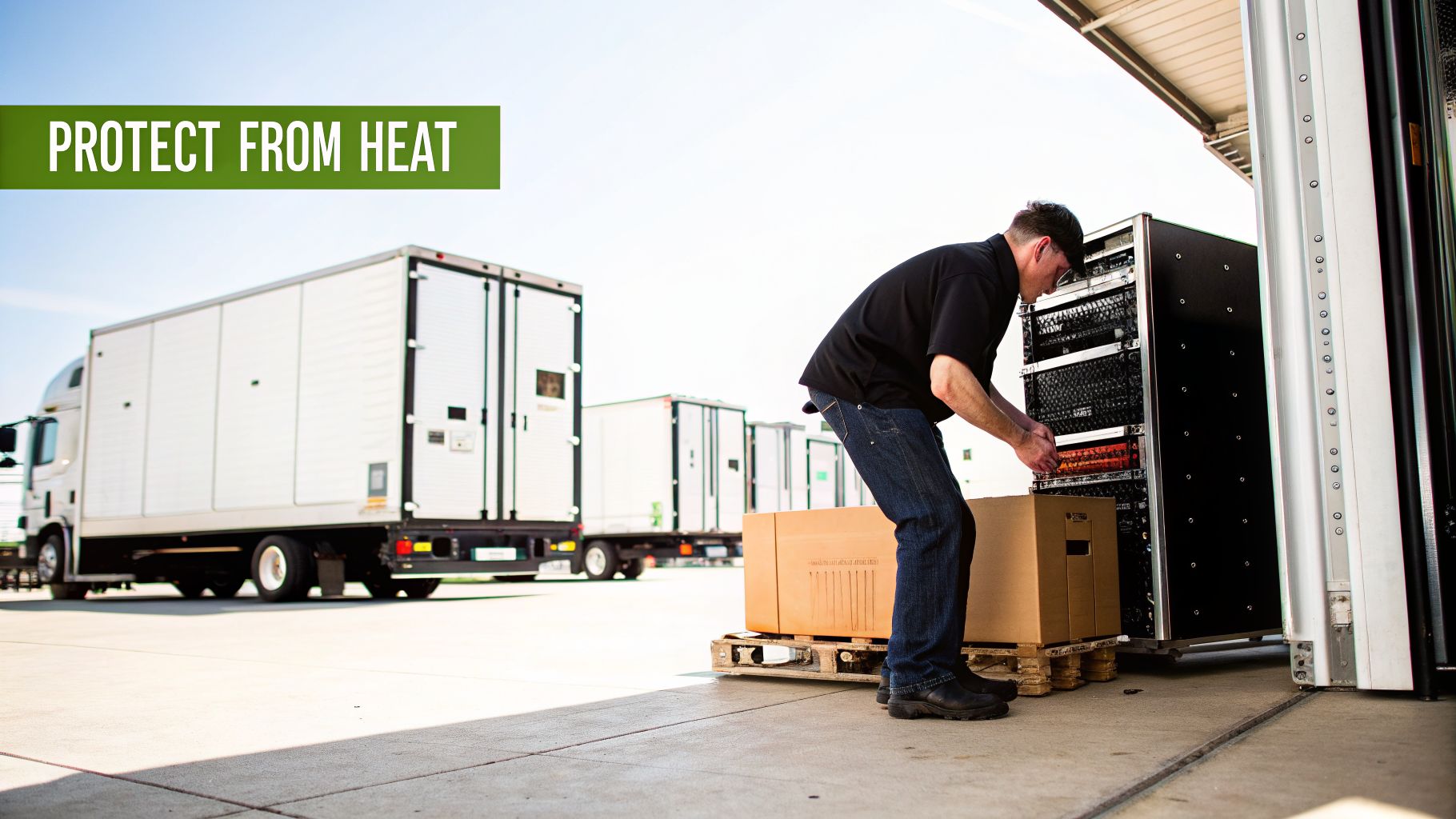
This is precisely why professional packing and climate-controlled transport are non-negotiable for summer ITAD projects. This protocol creates a stable, secure environment from your facility door to our processing center, protecting your hardware from thermal shock and moisture damage.
Pre-Pickup Best Practices For Hot Weather
Implementing a few smart procedures before equipment pickup can make a significant difference during Georgia's hottest months. These steps are designed to minimize your assets' exposure to harsh conditions.
- Stage Equipment in a Climate-Controlled Zone: Do not leave assets on a hot loading dock. Keep all equipment in an air-conditioned staging area until the moment our pickup team arrives for transfer.
- Coordinate Shutdown Cycles: Power down servers and other heat-generating equipment well in advance of the scheduled pickup. This allows them to dissipate residual heat, dramatically reducing thermal stress during the move.
- Schedule Early Morning Pickups: The coolest, driest part of a Georgia summer day is in the morning. By scheduling your pickup between 7 a.m. and 10 a.m., you can avoid the worst of the afternoon heat, which regularly exceeds 85°F.
The operational goal is to create the shortest possible path between your climate-controlled facility and our climate-controlled vehicle. Every minute your assets sit on a hot, humid loading dock increases the risk of financial loss due to damage.
Proper execution requires smart coordination and a practical understanding of how the environment impacts hardware. For businesses managing large facilities, these factors tie directly into operational efficiency and asset value recovery. Explore more strategies in our articles on data center cooling and infrastructure management. By taking these proactive steps, you ensure your equipment's value is preserved throughout the ITAD process.
Navigating Winter Logistics for Commercial E-Waste Pickups
While Sandy Springs winters are generally mild, they can be deceptive from a commercial logistics standpoint. The primary challenge isn’t heavy snow—it’s the sudden cold snaps and freezing rain that can turn a routine e-waste pickup into a logistical and safety nightmare.
A loading dock can become a sheet of ice in minutes, creating a significant liability. This isn't just a safety hazard for crews; it's a project delay that can disrupt your entire operational schedule. A seasoned logistics partner knows that Georgia winters demand proactive planning, not reactive problem-solving.
An icy loading dock or frozen access road can prevent trucks from safely reaching your facility. A single winter storm in the Atlanta area is sufficient to cause widespread road closures, particularly on secondary roads or major interchanges like I-285 and GA-400. This is why we don't wait for a negative weather report to become a logistical failure.

Our team actively monitors forecasts 72 hours in advance of any scheduled pickup. If the weather in Sandy Springs, Georgia, indicates a high probability of freezing rain or significant ice, we will contact you immediately to coordinate a safer, more viable service window.
Your Winter Pickup Preparation Checklist
A smooth pickup in adverse weather is a collaborative effort. By taking a few preparatory steps at your facility, you can help us ensure the process is safe, efficient, and compliant with safety standards.
- Pre-Treat Walkways and Loading Docks: Please apply salt or de-icer to all access paths, ramps, and loading zones before our truck arrives. This is the single most critical step to prevent slip-and-fall incidents and ensure a safe work environment.
- Protect Staged Equipment: If assets must be staged near an exit, ensure they are covered with protective wrap. This prevents sleet or freezing rain from infiltrating electronics and causing moisture damage.
- Confirm Clear Access Routes: Verify that the route from your building to the street is clear of ice and snow. We often encounter delays due to unexpected icy patches on private access roads or in large commercial parking lots.
The primary objective in winter is to eliminate environmental obstacles. A logistics partner who understands local weather collaborates with your facilities team to create a safe operational window, rather than attempting a high-risk pickup.
By planning for these winter challenges, you can keep your ITAD projects on schedule and avoid costly disruptions. This is achieved by selecting a provider who integrates weather planning into their standard operating procedures.
For more details on our logistics management, review our electronic recycling pickup services and see how we adapt to any conditions.
Building Contingency Plans for Severe Weather Events
The weather in Sandy Springs, Georgia, can be highly unpredictable. A clear forecast can quickly give way to a severe thunderstorm with high winds, lightning, and potential flash floods. For a scheduled ITAD project, this is more than an inconvenience—it's a direct threat to your assets, personnel safety, and business continuity.
Ignoring a severe weather warning is a high-stakes gamble. Imagine pallets of decommissioned servers on a loading dock awaiting pickup. A sudden squall soaks the equipment. The financial loss from water damage, coupled with project delays and potential data security risks, can be substantial. This is precisely why proactive communication and flexible scheduling are your most effective risk mitigation tools.
Creating A Storm-Ready Service Plan
When a storm is forecast for your service day, a clear action plan distinguishes a managed event from a crisis. The goal is simple: ensure personnel safety and hardware security with minimal disruption to your business operations.
A reliable ITAD partner will not simply arrive and hope for the best. We actively monitor forecasts and will communicate with you to make a joint, informed decision. This collaboration is the core of effective contingency planning.
Your storm plan should define these key actions:
- Confirm Emergency Contacts: We require a designated point person on your team—and provide one on ours—empowered to authorize schedule changes.
- Assess and Secure Loading Zones: Is your loading dock safe for operation? High winds can turn equipment into projectiles, and heavy rain creates significant slip-and-fall risks for all personnel.
- Protect Staged Assets: If equipment has been staged for pickup, it must be moved to a secure indoor location, away from doors, windows, and areas at risk of water intrusion.
A professionally managed ITAD process includes built-in risk mitigation. It is not a simple transaction but a managed service designed to protect your assets even in worst-case scenarios.
As you develop these plans, it is also prudent to consider the broader financial impact of a major storm in Georgia, which can have consequences far beyond immediate logistics. You can learn more about building this resilience by exploring various supply chain risk management strategies. By preparing for severe weather, you ensure your project remains on track and your valuable assets stay protected.
Optimizing Your ITAD Schedule with a Local Expert
Attempting to internally manage IT asset pickups around the weather in Sandy Springs, Georgia, can be an inefficient use of resources. As local businesses know, summer humidity can corrode sensitive components, winter ice makes loading docks treacherous, and a sudden storm can halt logistics completely. Forcing your own IT or facilities team to juggle these variables adds an unnecessary operational burden.
This is where partnering with a true local expert provides significant value. Instead of your staff spending valuable time tracking forecasts or managing the risks of an equipment transfer, you can delegate that entire responsibility to us. A partner with deep roots in the Atlanta metro area doesn't just react to a bad weather report—we build weather-readiness into our service model.
By partnering with Atlanta Computer Recycling, you are not just scheduling a pickup. You are implementing a weather-proof logistics strategy designed to protect your assets and free your team to focus on core business functions.
Our firsthand knowledge of regional climate patterns ensures your e-waste pickups are secure, timely, and efficient, no matter the forecast.
Building a Weather-Proof ITAD Plan
We maintain a straightforward process. Our deep understanding of the local climate informs every step, from on-site de-installation to secure transport, mitigating weather-related risks from the outset. This local expertise is the key to protecting your assets and maximizing value recovery year-round.
Here’s how we deliver this service:
- Proactive Scheduling: We collaborate with you to schedule major ITAD projects during the most reliable weather windows and build robust contingency plans for services during more unpredictable seasons.
- Expert Risk Management: Our teams manage all weather monitoring, logistical adjustments, and on-site coordination, removing the burden from your internal teams.
- Secure, All-Weather Transport: We utilize the appropriate vehicles and secure packing methods to shield your sensitive electronics from damaging heat, humidity, and moisture during transit.
This approach transforms your ITAD process from a reactive task into a proactive, professionally managed service.
Ready to build a resilient ITAD strategy that accounts for Sandy Springs weather? Learn more about our specialized e-waste and IT asset disposition services in Sandy Springs. Contact us today to request a consultation and create a plan that protects your business assets all year long.
Frequently Asked Questions About Weather and ITAD Logistics
When coordinating a major ITAD project, the last thing your business needs is an unforeseen complication from the weather. We receive many questions from IT and facilities managers about how Sandy Springs, Georgia's unpredictable weather can impact logistics. Here are the answers.
What Is The Best Time Of Year To Schedule A Large E-Waste Pickup?
For maximum logistical stability, the fall (September-November) and spring (March-May) are optimal. The weather is generally more mild and predictable, which minimizes the risk of extreme heat or ice impacting a large-scale project like a data center decommission.
However, a professional ITAD partner is equipped to operate year-round. With proper planning, climate-controlled transport, and an experienced team, we can execute a secure pickup in any season. It comes down to partnering with a vendor who understands and plans for Georgia's seasonal challenges.
How Do You Handle Last-Minute Weather Delays?
We maintain a proactive approach to weather, actively monitoring forecasts 72 hours prior to every scheduled service. If a significant event like an ice storm or severe thunderstorm is likely, our logistics team will contact your designated representative immediately to review our options.
Our policy is unequivocal: safety comes first. We will never compromise the safety of our team or your assets by attempting a pickup in hazardous conditions.
This transparent communication allows us to quickly adjust the pickup time or reschedule for the next clear window, ensuring personnel safety and protecting your equipment from damage.
Is My Equipment Insured Against Weather-Related Damage During Transport?
Yes. Our service includes comprehensive insurance that covers your assets from the moment they are in our custody until they are fully processed. This policy is designed to cover unforeseen events, including any weather-related damage that could occur during transit.
Beyond insurance, we utilize climate-controlled vehicles for transporting sensitive electronics. This is our primary defense against the biggest threats from the weather in Sandy Springs, Georgia—extreme summer heat and humidity. Your hardware remains protected from temperature fluctuations and moisture throughout the entire process.
What Do We Need To Do To Prepare Our Loading Dock For Bad Weather?
To ensure the pickup is safe and efficient, we ask that you ensure your loading dock and all walkways are clear and safe for our team's arrival.
- In Winter: This involves applying salt or another de-icing agent to any ramps, docks, or paths our crew will use. This is a critical safety measure.
- During Rain: Keeping the loading area as dry as possible is extremely helpful. It prevents slips and protects the equipment during the transfer to our vehicle.
Our team will always communicate with your on-site contact to confirm conditions before we arrive, ensuring a smooth and safe operation.
Are you ready to eliminate weather-related risks from your next ITAD project? Atlanta Computer Recycling offers expert, weather-aware logistics to protect your commercial assets year-round. Get a free consultation and build your resilient ITAD plan by visiting us at https://atlantacomputerrecycling.com.