A Business Guide to Office Electronics Recycling Atlanta GA

When your Atlanta business is ready for a technology refresh, what do you do with the old equipment? It’s a bigger question than most IT managers and operations directors think. This isn't just about clearing out a storage room—it’s a critical business challenge involving data security, regulatory compliance, and environmental stewardship.
A professional office electronics recycling plan turns this logistical headache into a structured IT Asset Disposition (ITAD) strategy. This approach is no longer optional; it’s a core business function for any modern company looking to protect its assets and reputation.
Why Smart E-Waste Management Is a Business Imperative in Atlanta
For IT managers and business leaders across Atlanta, dealing with outdated electronics is a serious responsibility. Every old server, laptop, and company phone represents a potential data security risk. Without a formal disposition plan, your company is exposed to data breaches, non-compliance penalties, and significant reputational damage.
That’s why forward-thinking Atlanta businesses are shifting their perspective. Instead of seeing a pile of old computers as junk, they see it as a risk to be managed and a process to be optimized. This is the essence of a strong IT Asset Disposition (ITAD) strategy.
A proper ITAD strategy isn't just about "going green." It's a fundamental part of your company's security posture, protecting your bottom line from the massive financial and reputational fallout of a data breach or compliance failure.
The most effective way to manage this is by partnering with a specialist in office electronics recycling in Atlanta, GA. A dedicated partner handles the entire lifecycle of your retired assets, from secure data destruction to final recycling, giving you complete, documented peace of mind.
The Growing E-Waste Challenge for Businesses
The amount of electronic waste being generated is staggering. The global e-waste market, valued at USD 62.96 billion in 2026, is projected to hit USD 85.9 billion by 2030. Yet, the documented recycling rate is expected to fall from 22.3% to just 20% in that same period.
Consider this: small IT equipment like laptops and phones alone generates 4.6 million tonnes of waste annually, but only 22% is properly recycled. For an Atlanta business, every un-recycled device is a liability. It could hold sensitive client data, financial records, or proprietary information.
This flowchart shows the basic stages of a professional IT asset disposition process from initial inventory to final reporting.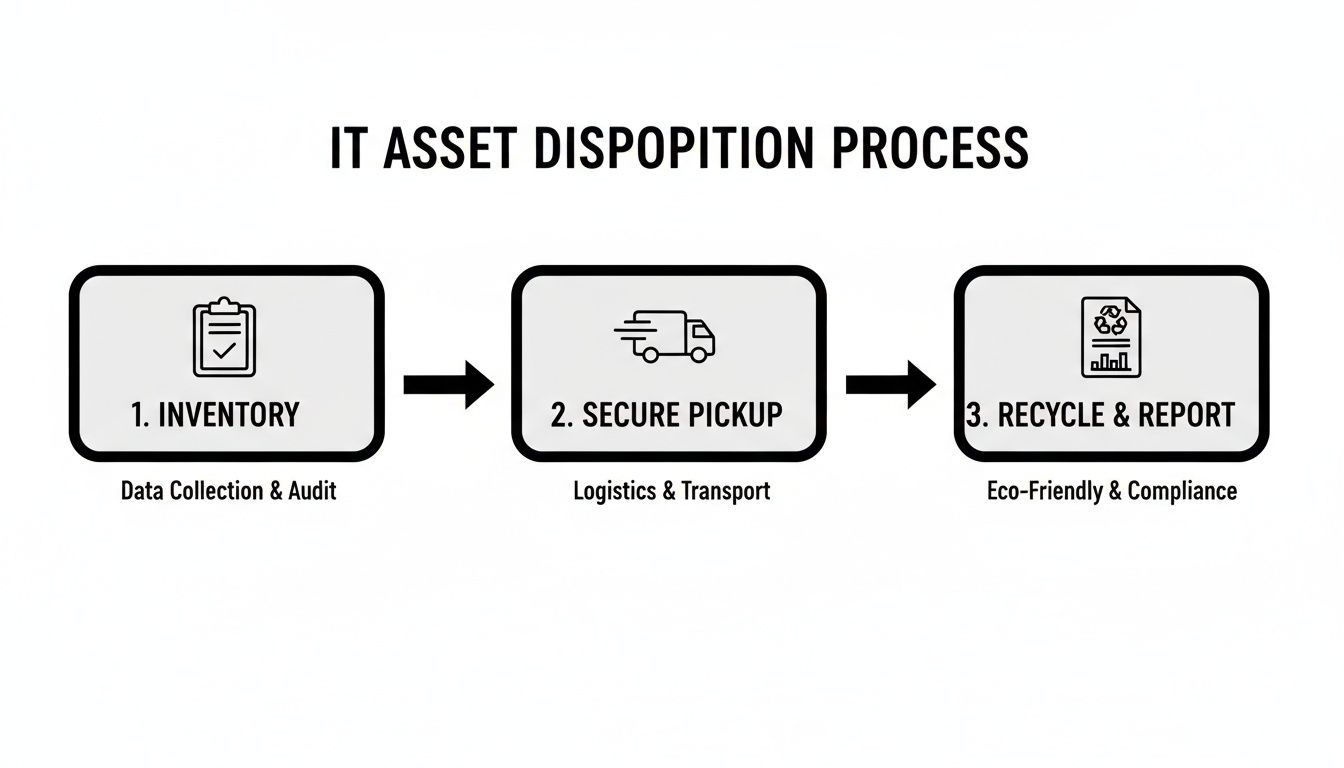
As you can see, responsible e-waste management is a systematic process designed to ensure security and accountability at every turn.
To give your business a clearer picture, here’s a breakdown of the core phases involved in a typical commercial project.
Key Stages of a Commercial E-Waste Recycling Project
| Phase | Key Objective | Primary Consideration for Your Business |
|---|---|---|
| 1. Scoping & Inventory | Define the scope of assets to be recycled. | Creating a detailed list of all equipment, including types, quantities, and locations to ensure an accurate quote. |
| 2. Data Security | Ensure 100% destruction of all sensitive data. | Choosing between DoD-standard wiping, physical shredding, or both to meet compliance requirements. |
| 3. Logistics & Pickup | Securely remove all assets from your facility. | Coordinating de-installation, packing, and secure transport with minimal business disruption. |
| 4. Processing & Reporting | Recycle materials and provide auditable documentation. | Receiving Certificates of Data Destruction and Recycling for compliance and audit trails. |
Each stage is essential for transforming a potential liability into a well-managed part of your IT lifecycle.
From Liability to Strategic Asset Management
Adopting a formal ITAD program delivers real, tangible business value that goes far beyond just being environmentally conscious. It directly addresses key operational risks and frees up valuable internal resources.
Here’s what a specialized e-waste partner brings to your business:
- Ironclad Data Security: We use methods like DoD 5220.22-M standard data wiping and physical hard drive shredding to guarantee that sensitive information is impossible to recover.
- Compliance and Auditing: You get a complete chain of custody, including Certificates of Data Destruction and Recycling. This documentation is your proof of compliance for regulations like HIPAA, SOX, and GLBA.
- Operational Efficiency: Our team handles all the heavy lifting—de-installation, packing, and secure transport. This frees up your IT staff to focus on strategic initiatives that drive your business forward.
By professionalizing your office electronics recycling process, you protect your company and demonstrate a commitment to corporate responsibility. To better understand the stakes, you can learn more about the environmental impact of electronic waste and how proper disposal protects our communities.
Scoping Your IT Asset Disposition Project
Moving from a general idea to a solid plan for office electronics recycling in Atlanta, GA, all starts with one crucial task: inventory. Before you can get an accurate quote or nail down logistics, your business has to know exactly what it’s dealing with. The success of any IT asset disposition (ITAD) project hinges on how well this initial scoping phase is handled.
Without a clear inventory, the entire process is just guesswork. You won't be able to budget accurately, plan the right data security measures, or give a recycling partner the details they need for a seamless pickup. Putting in the effort upfront saves a world of headaches and surprise costs later on.
Start with a Comprehensive Asset Inventory
The first thing to do is build a detailed list of every single electronic asset you plan to dispose of. This doesn't need to be an overly complex spreadsheet, but it does need to be organized and complete. Think of it as a final roll call for your retired tech.
Your inventory needs to go beyond a simple head count. For total clarity and an accurate quote, document these details for each group of items:
- Asset Category: What is it? A desktop PC, a server, a laptop, a networking switch, or a peripheral like a monitor or printer?
- Total Quantity: How many of each do you have? For instance, 85 laptops, 12 servers, 2 network racks.
- Physical Location: Are all assets in one storage closet, or are they spread across different floors or even separate buildings? This is a huge factor for planning labor and logistics.
- Data-Bearing Status: This is the most critical piece. Flag every device that contains a hard drive or solid-state drive—anything that stores sensitive company or client information.
This inventory list becomes the roadmap you'll share with us. A detailed list allows us to provide a precise quote and map out a logistical plan that fits your exact operational needs.
Pro-Tip for IT Managers: Don't forget the small stuff. It’s easy to focus on computers and servers, but remember to include VoIP phones, old company cell phones, docking stations, and those boxes of miscellaneous cables. These items add up quickly and need to be part of a complete office electronics recycling project.
Differentiating Between Data-Sensitive and Non-Sensitive Assets
Once your inventory is built, the next move is to sort assets by their data security risk. This is where you connect the physical hardware to your company’s risk management policies. Not every piece of electronics needs the same level of data destruction, and knowing the difference is key to a cost-effective and compliant project.
Consider a mid-sized Atlanta law firm decommissioning 150 workstations. They’ll likely have different security requirements for different roles.
- High-Security Assets: Laptops used by partners that hold privileged client data should be flagged for on-site physical shredding. This offers maximum security with an unbroken chain of custody.
- Standard-Security Assets: The desktop PCs used by administrative staff for everyday tasks might only need DoD 5220.22-M standard data wiping—a completely secure and auditable process that’s less intensive than shredding.
- Non-Sensitive Assets: Peripherals like monitors, keyboards, and printers have no stored data. These can be designated for straightforward recycling without any data destruction services needed.
By sorting your assets this way, your business avoids paying for high-security services on devices that simply don't need them. It helps you communicate your needs precisely, ensuring you get the right service for the right asset. Getting these details right is a core part of a successful IT asset disposal strategy, as it aligns your security protocols directly with the specific risks of each device.
This careful planning guarantees a smooth, predictable, and secure disposal process. It’s the professional approach that protects your Atlanta business from liability and ensures every piece of equipment is handled correctly.
Ensuring Ironclad Data Security and Compliance
When your business retires old technology, you’re not just clearing out hardware—you're managing the sensitive data stored inside. For any Atlanta business, data security is non-negotiable. Hitting "delete" or performing a factory reset is insufficient; that data can often be recovered with off-the-shelf software.
A single data breach from an improperly discarded device can lead to crippling financial penalties, legal action, and a hit to your company's reputation that's hard to recover from.
This is why a certified data destruction process is at the heart of professional office electronics recycling in Atlanta, GA. It's not just about wiping data. It's about creating an auditable, legally defensible paper trail that proves your company took all necessary steps to protect its information. This verifiable proof is what gives IT managers and compliance officers true peace of mind.
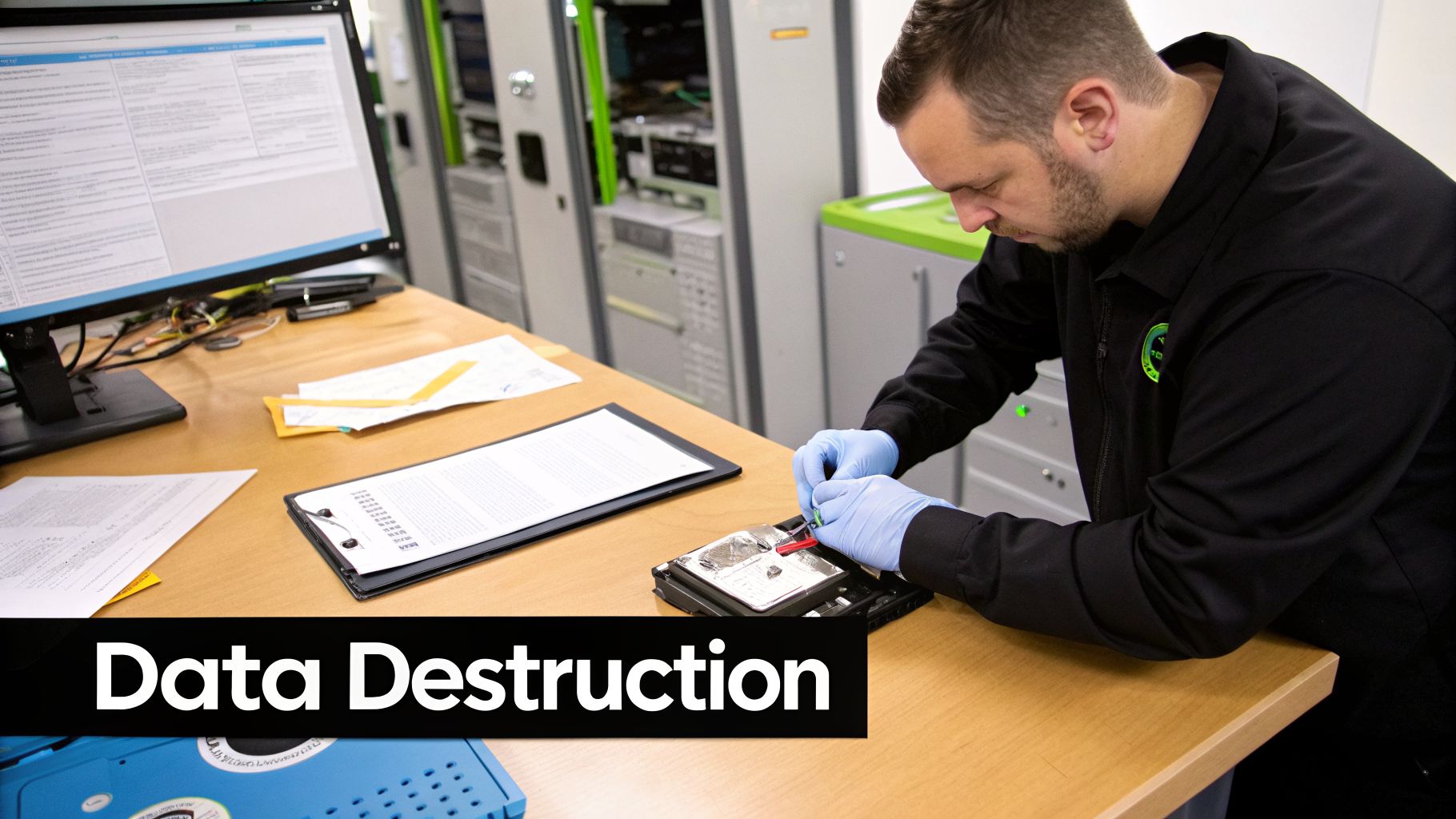
Software Wiping vs. Physical Destruction
When it comes to data sanitization, there are two industry-standard methods. The right choice depends on your company's security policies, the sensitivity of the data, and your specific compliance requirements.
1. Software-Based Data Wiping
This process uses specialized software to overwrite a hard drive multiple times with random data, making the original files completely unrecoverable. The gold standard is the DoD 5220.22-M specification, which uses a 3-pass overwrite. It's a rock-solid method for most business needs and is ideal for drives that are functional and may have remarketing value, aligning with sustainability goals.
2. Physical Hard Drive Shredding
For the absolute highest level of security—or for drives that are non-functional or obsolete—physical destruction is the definitive solution. We use industrial shredders to grind hard drives, SSDs, and other media into tiny metal fragments. This is an irreversible process that makes data recovery completely impossible. To see how this works, you can learn more about our secure data destruction services in Atlanta.
For businesses in highly regulated fields like healthcare or finance, physical shredding isn't just a best practice—it's often a strict compliance requirement. It provides indisputable proof that sensitive data has been permanently destroyed.
Tailoring Destruction to Your Compliance Needs
Different industries are governed by different regulations, so a one-size-fits-all approach to data destruction is inadequate.
Consider an Atlanta-based healthcare clinic decommissioning old patient check-in kiosks. Those machines almost certainly held Protected Health Information (PHI), which means HIPAA compliance is paramount. In this case, simply wiping the drives isn't enough to eliminate risk. The best and safest route is on-site physical shredding, where your team can witness the destruction and the chain of custody remains unbroken.
Here’s how different regulations can shape your disposal strategy:
- HIPAA (Health Information): Demands extremely tight controls over PHI. Physical shredding is the go-to method for any device that has ever stored or processed patient data.
- SOX (Financial Records): Requires secure handling of corporate financial data. Certified wiping or shredding is necessary to prevent fraud and satisfy audit requirements.
- GLBA (Financial Institutions): Puts the responsibility on banks and financial firms to protect consumer financial data. A documented destruction process is essential for compliance.
By working with an experienced electronics recycler, you ensure the right destruction method is used for every asset. We help you align your disposal project with your specific legal and regulatory duties, turning a compliance headache into a straightforward, risk-free process.
Navigating On-Site Logistics and Pickup

Once your inventory is set and data security is planned, the next piece of the puzzle is the physical removal of the equipment. Getting hardware out of your office without disrupting business operations is where a professional partner really proves their value. Our approach to office electronics recycling in Atlanta, GA is all about a seamless, managed process.
This is a full-service operation. We handle everything—from de-installing servers in a cramped IT closet to palletizing hundreds of desktops for secure transit. We work on your schedule to minimize disruption to your business.
Handling Complex On-Site Challenges
Not every office is a straightforward pickup. We’ve seen it all, especially in Atlanta’s mix of historic and modern commercial buildings. Downtown and Midtown high-rises often come with logistical hurdles that can quickly derail a poorly planned project.
Here’s a common scenario we manage: a marketing firm in a tower near Centennial Olympic Park needs to recycle 80 workstations plus a full server rack. Their building has a time-restricted loading dock, a small freight elevator, and no internal staff available to assist.
An amateur might just show up with a truck. A professional plans ahead. This is what our team does:
- Coordinate with Building Management: We proactively secure a time slot for the loading dock and freight elevator, eliminating last-minute access issues.
- Provide On-Site Labor: Our team arrives with the right tools—dollies, pallet jacks, and expertise to safely de-install servers and move every asset from the tenth floor to our truck.
- Flexible Scheduling: We can arrange the pickup after hours or on a weekend to avoid disrupting your employees or client-facing operations.
This is how we turn a logistical headache into a smooth, predictable process. Your office electronics recycling project gets done right, no matter your building's challenges.
The success of a pickup isn't just about having a truck; it's about having a plan. An expert partner anticipates challenges like limited dock access or stair-only routes and brings the right team and equipment to handle them without issue.
The Pickup Day Checklist for IT Managers
On pickup day, a little organization goes a long way toward ensuring a fast, accountable handover. Your IT or facilities manager should have a quick checklist ready to confirm every asset is accounted for. For a complete rundown of our process, check out our guide to IT equipment pickup services in Atlanta, GA.
Before our team arrives, run through these simple steps:
- Final Asset Count: Do one last walkthrough to ensure the equipment being removed matches your inventory list. This prevents any downstream discrepancies.
- Segregate Data-Bearing Devices: If possible, group the devices flagged for on-site shredding separately from those designated for wiping or standard recycling. This helps our team work more efficiently.
- Clear Access Paths: Ensure the path from where the equipment is located to the building exit is clear. A clear path is a safe and efficient path.
- Confirm Documentation Handover: Designate someone to sign the initial paperwork (bill of lading), which officially transfers asset custody to us and starts the chain of custody.
- Take Final Photos: A quick picture of the pallets before they're loaded can be a great final step for your own internal records.
Following this checklist creates a seamless transition. It gives you a clear record of the handover and prepares the way for receiving your final certificates of destruction and recycling.
Understanding Your Chain of Custody and Final Documentation
Once your old electronics leave your building, the job isn’t over. For your company's legal protection and compliance records, the most important part is just beginning. A simple receipt is insufficient; your business needs a fully documented, unbroken trail that proves every single device was handled securely and recycled responsibly.
This is what we call the chain of custody.
This final reporting stage is what separates professional office electronics recycling in Atlanta GA from a risky, informal pickup. The paperwork you receive isn't just for your files—it’s your legal shield, a critical corporate asset that proves due diligence and protects you from massive liability down the road.
The Power of an Unbroken Chain of Custody
From the moment our team signs for your equipment at your office to its final recycling and destruction, every step is tracked. A solid chain of custody provides a transparent, auditable history of your assets. It’s the documented proof that your sensitive data never had a chance to fall into the wrong hands and that your company’s hardware was managed in full compliance with environmental laws.
Without it, you're operating on trust. And trust offers zero protection during a compliance audit or legal dispute. For Atlanta businesses handling regulated data—like financial records under SOX or patient information under HIPAA—this documentation is completely non-negotiable.
The Three Pillars of E-Waste Recycling Documentation
When you work with a certified recycler, you should expect to receive a portfolio of documents that officially closes out your project. These certificates are your proof of compliance.
Here are the essential documents you must have for your records:
- Serialized Asset List: This document itemizes every device we picked up. For high-value or data-bearing assets like servers and laptops, we include serial numbers. It’s your confirmation that what you intended to recycle was what we actually received.
- Certificate of Recycling: This certifies that your electronic assets were processed in an environmentally compliant, zero-landfill manner. This is your proof of good corporate citizenship and environmental responsibility.
- Certificate of Data Destruction: This is arguably the most important document you’ll receive. It confirms that all data on your hard drives, SSDs, and other storage media was permanently and irreversibly destroyed. It specifies the destruction method—like DoD 5220.22-M wiping or physical shredding—and lists the serial numbers of the destroyed drives.
For any business, the Certificate of Data Destruction is the ultimate shield against liability. It is the official, verifiable record that you took every necessary step to protect sensitive company and customer information. To understand what this crucial document entails, you can view a sample Certificate of Destruction form here.
The Immense Risks of Informal Disposal in Atlanta
Choosing an uncertified recycler or a "scrap guy" to save a few dollars is a huge business gamble. These routes offer no chain of custody and zero certified documentation, leaving your business completely exposed. The risks aren't theoretical; they can lead to severe financial and legal consequences.
It’s tempting to cut corners, but it's important to see the bigger picture of recycling in our city. While Atlanta's general recycling program collected nearly 20,000 tons of materials in 2023, a staggering 20% of it was contaminated. Atlanta's overall recycling rate of 23% also lags behind the national average of 32%. These numbers show why specialized e-waste handlers are so crucial—general recycling just isn't equipped for the complex needs of business electronics. You can read more about Atlanta's recycling improvement efforts and see why expert partners are a necessity.
When you choose a certified process, you get accountability. With an informal process, you get a potential data breach, a compliance violation, or an environmental fine just waiting to happen. For any responsible Atlanta business, the choice is clear.
Common Questions About Atlanta Business E-Waste Recycling
Even with a detailed ITAD plan, questions always come up. IT managers and operations directors across Atlanta often ask us about the specifics of a project, from cost and logistics to handling particular types of equipment. We've compiled the most common questions we hear to give you clear, straightforward answers.
Think of this as your final checklist—the practical details you need to know before scheduling your pickup.
What Are the Main Cost Drivers for a Commercial Recycling Project?
Every project is unique, but the final cost comes down to a few key factors. While many pickups involving newer, high-value assets like recent-generation laptops and servers can often be done at no cost, certain services or equipment types can introduce a fee.
Knowing these drivers helps you budget accordingly:
- Logistics and Labor: The amount of on-site work is a major factor. A simple, dock-level pickup of pre-palletized gear is straightforward. A project that requires our team to de-install equipment, navigate multiple flights of stairs, or work around a tight freight elevator will involve more labor.
- Equipment Type: Some electronics cost more to recycle responsibly. Old CRT monitors, for instance, contain hazardous materials and carry a recycling fee. On the other hand, a pallet of modern laptops has enough recoverable value to easily offset logistical costs.
- Data Destruction Method: The level of data security you need plays a big role. Our standard, software-based wiping is an efficient process. However, if your compliance rules demand on-site physical hard drive shredding, there is a service fee for bringing our mobile shredding truck and certified technicians to your location.
- Total Volume and Value: It often comes down to a simple value assessment. A large volume of desirable equipment can make the entire project free of charge. We weigh the recoverable value of your assets against our logistical and processing costs to create a transparent, final quote.
Do You Handle Full Data Center Decommissioning?
Yes, absolutely. Full data center decommissioning is a core service we offer to enterprises throughout the Atlanta area. These are not simple pickups—they are meticulously managed projects built for complex, enterprise-grade infrastructure.
Our specialized team manages every phase of the shutdown, ensuring nothing is overlooked. This includes:
- De-racking all servers, switches, and storage arrays.
- Removing and bundling all network and power cabling.
- Securely palletizing all assets on-site for transport.
- Executing certified data destruction on all storage media.
- Providing a complete chain-of-custody report for every serialized asset.
We approach every data center project as a custom engagement, working hand-in-hand with your IT and facilities teams to hit tight deadlines and leave your space broom-clean.
A data center decommissioning requires more than just manpower; it demands a deep understanding of enterprise hardware and security protocols. The goal is to return your facility to a clean slate while ensuring 100% data security and environmental compliance.
How Does HIPAA Compliant Recycling Work?
For our healthcare clients across Atlanta, HIPAA compliance is paramount. The process for handling any equipment that may have stored Protected Health Information (PHI) is strict, secure, and designed to eliminate any possibility of a data breach.
It starts with a secure chain of custody the moment we arrive. Every data-bearing device is inventoried and tracked by serial number. For hard drives or storage media with potential PHI, physical shredding is the gold standard and our recommended method. This irreversible destruction is the only way to be 100% certain patient data is gone forever.
Finally, we issue a formal Certificate of Data Destruction. This document specifically lists the serial numbers of the destroyed drives, giving you a clear audit trail that satisfies HIPAA's stringent documentation requirements.
Can We Recycle Old Office Phones and Company Mobiles?
Of course. Business telecommunications equipment is a critical part of a complete office electronics recycling project, and we accept all of it. This covers everything from your old VoIP desk phones and conference room systems to every last company-issued smartphone and tablet.
These devices often hold more sensitive data than business owners realize—contact lists, call logs, cached emails, and credentials for company networks. As part of our standard process, we ensure every single device is professionally wiped or physically destroyed to completely eradicate all data before the components are responsibly recycled.
Ready to create a secure and efficient electronics recycling plan for your Atlanta business? Atlanta Computer Recycling is here to help. We provide a complete, end-to-end service, from on-site logistics to certified data destruction. Contact us today to get a transparent quote and schedule your pickup.