Mastering Georgia’s Universal Waste System

The closet near the server room usually starts as a temporary holding area. A few retired laptops go there after a refresh. Then old UPS batteries. Then a carton of spent fluorescent tubes from facilities. A damaged switch gets set aside because nobody wants to guess whether it contains mercury.
A few months later, that “temporary” space is a compliance problem.
For IT managers in Georgia, confusion often starts here. Some of those materials fit under the universal waste system. Some do not. Some can move through a simplified process. Others, especially electronics with data on them, need a more controlled path that accounts for both environmental rules and information security.
That distinction matters. In 2022, the world generated 2.56 billion tonnes of solid waste, with management costs exceeding US$250 billion annually according to this summary of World Bank data. E-waste is part of that pressure, and businesses feel it in the form of storage overflow, audit risk, and disposal decisions that get deferred too long.
Before anything leaves your building, document what is present there. A simple internal inventory, paired with structured risk assessment forms, helps separate “ordinary clutter” from items that create environmental or data-handling exposure. If your team is also trying to decide what equipment belongs in a recycling stream versus a scrap stream, this practical guide on IT scrap handling is a useful starting point.
Introduction The Hidden Liability in Your Storage Closet
Most businesses do not get in trouble because they intended to ignore waste rules. They get in trouble because several departments each handle one piece of the problem, and nobody owns the full chain.
IT retires the hardware. Facilities swaps lamps. Operations clears storage rooms. Security focuses on data. Accounting wants quick removal. The result is a pile of regulated items managed as if they were all the same.
Why this pile becomes risky
A box of dead keyboards is one thing. A pallet with mixed batteries, lamps, and legacy electronics is another.
The universal waste system exists because some commonly generated hazardous materials show up in ordinary business operations often enough that the full hazardous waste framework can become impractical for routine handling. The system gives organizations a more workable route, but only for the categories that qualify.
That is the first operational rule: do not assume all retired tech-related waste is universal waste.
What experienced teams do early
The teams that stay out of trouble usually act before the pile gets large enough to force a rushed decision.
They do three things early:
- Identify the waste by type: Batteries, lamps, mercury-containing devices, aerosol cans, and pesticides do not belong in one mixed container.
- Separate electronics from universal waste items: A retired server may sit next to spent UPS batteries, but it does not follow the same handling logic in Georgia.
- Assign one owner: One person should control the storage area, pickup timing, and disposition records.
A storage room becomes a liability when no one can answer three questions fast: what is in it, how long it has been there, and who approved the handling method.
What Is a Universal Waste System
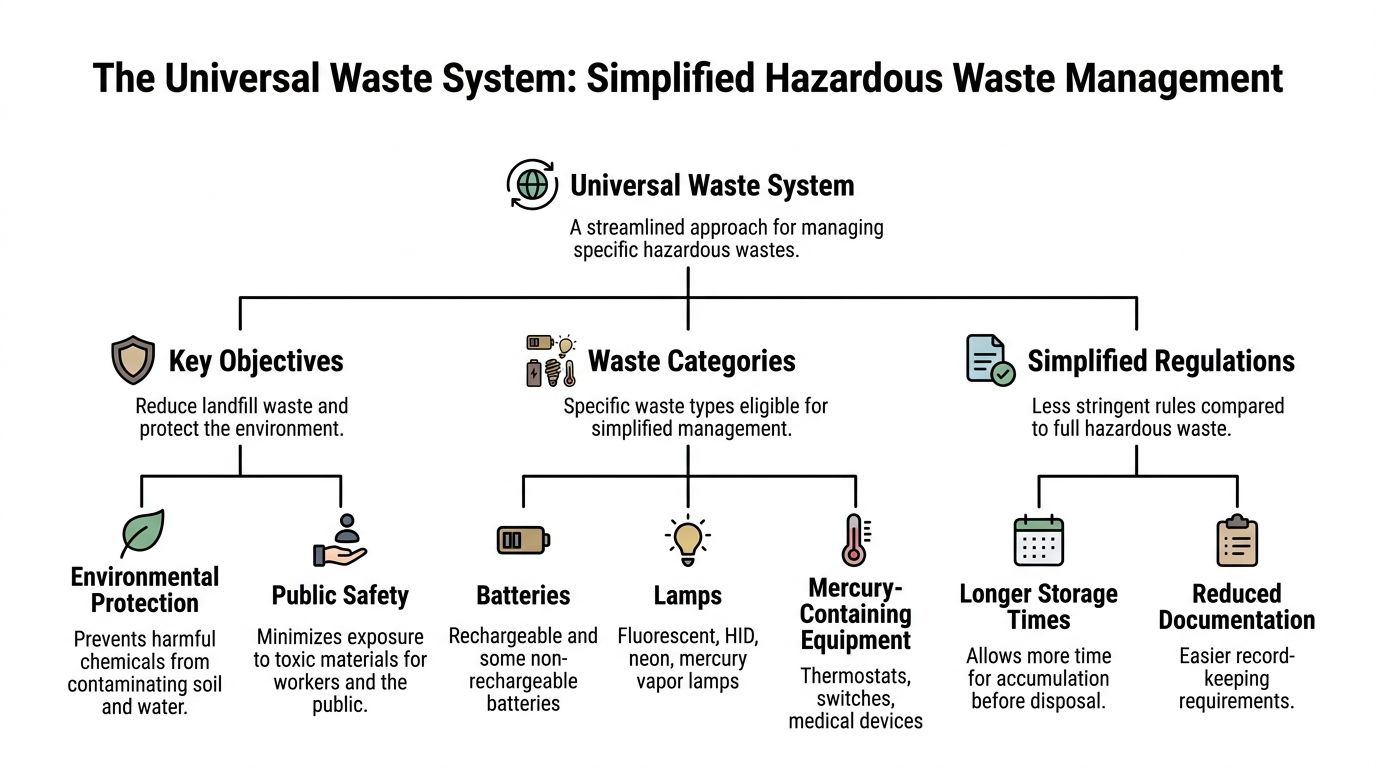
Think of the universal waste system as an express lane for a short list of widely generated hazardous wastes. It does not remove compliance duties. It simplifies them so businesses can collect and recycle common items without running every routine disposal event through the full hazardous waste process.
The federal framework sits under 40 CFR Part 273. Its purpose is straightforward: encourage recycling and proper disposal by reducing regulatory burden compared with standard hazardous waste rules, which helps keep toxic materials out of landfills.
The five federal categories
At the federal level, the program covers five categories. For an IT manager, each one connects to real equipment and facilities work.
Batteries
This is the category most technology teams recognize first. Think UPS batteries, rechargeable packs, and backup power components removed during maintenance or decommissioning.Pesticides
This usually matters more to facilities, grounds, and maintenance operations than IT. Still, large campuses often centralize disposal responsibilities, so it shows up in enterprise compliance planning.Mercury-containing equipment
This can include older switches, thermostats, gauges, relays, and other legacy devices. In mixed facility environments, mercury-containing components often surface during renovations, controls upgrades, and teardown work.Lamps
Fluorescent lamps are the classic example. Offices, warehouses, schools, hospitals, and data center support spaces all generate them.Aerosol cans
Maintenance teams often accumulate these. In practice, they get overlooked because they look harmless when compared with batteries or lamps.
Why the system exists
Without a simplified option, many businesses would face a choice between paying for more complex hazardous waste compliance every time these materials accumulate or delaying disposal until the problem becomes bigger.
Neither outcome works well operationally.
The universal waste system solves a practical bottleneck. It gives businesses a controlled method to collect qualifying wastes in designated containers, label them properly, hold them for a limited period, and move them to approved downstream handlers.
What it is not
It is not a free pass to toss regulated items in one gaylord and call it recycling.
It also does not automatically cover electronics. That is where many Georgia businesses make their biggest mistake. They hear “universal waste” and assume old desktops, switches, and servers fit under the same simplified path as batteries and lamps. In Georgia, that assumption can create compliance exposure fast.
A useful way to think about it
Use this mental test before you classify anything:
- Is the item in a federal universal waste category?
- Has the item been kept separate from other waste streams?
- Can your team label, store, and ship it under the applicable rules?
- Does state treatment match your assumption, especially for electronics?
If you cannot answer yes to all four, stop and verify before moving the material.
The universal waste system works best when businesses treat it as a controlled collection program, not a broad recycling label.
Navigating Federal and Georgia Specific Waste Rules
Federal rules give you the framework. Georgia-specific treatment determines whether your actual disposal plan holds up during an audit.
For most businesses, the first dividing line is quantity. Federal universal waste rules separate handlers by how much universal waste they accumulate at one time.
Universal Waste Handler Categories at a Glance
According to the EPA overview, Small Quantity Handlers of Universal Waste accumulate less than 5,000 kg, while Large Quantity Handlers of Universal Waste accumulate 5,000 kg or more. Large handlers must notify the EPA and maintain shipment records for three years. The same EPA reference notes that non-compliance can trigger fines of up to $70,376 per violation per day in the applicable context of enforcement under these rules, as outlined in the EPA universal waste guidance.
| Requirement | Small Quantity Handler (< 5,000 kg) | Large Quantity Handler (≥ 5,000 kg) |
|---|---|---|
| Accumulation threshold | Less than 5,000 kg | 5,000 kg or more |
| EPA notification | Generally not required at this level | Required |
| Shipment record retention | Minimal compared with large handlers | Maintain records for three years |
| Compliance burden | Lighter operational requirements | More formal oversight and documentation |
What that means in practice
A lot of Atlanta businesses sit comfortably below the threshold until a refresh, relocation, or data center cleanup changes the math.
That is why one-time events matter. A normal month of lamp and battery accumulation may be manageable. A one-week facility cleanup can push you into large-handler conditions if nobody is tracking incoming volume.
When clients ask what fails most often, it is rarely the law itself. It is poor internal visibility. Facilities has one count. IT has another. The recycler sees a third pile on pickup day.
Georgia is where electronics become the trap
Many IT managers miss this issue. Georgia follows the federal universal waste framework for items that clearly fit the covered categories, but electronics such as computers and servers are not automatically treated as universal waste in Georgia.
That changes the disposal decision in a major way.
A spent UPS battery may fit the universal waste path. A retired file server with drives inside does not become universal waste just because it is being recycled. It may require stricter handling, especially when data protection, chain of custody, and hazardous components are involved.
Why healthcare and education teams need to be extra careful
Hospitals, school districts, and universities often manage mixed streams in one project. A renovation or refresh may generate lamps, batteries, network hardware, desktops, monitors, and storage devices all at once.
Those environments also carry stronger data concerns. If your organization handles protected information, your disposal plan must account for more than waste classification. This is similar in spirit to how organizations approach tightly controlled handling under USP <800> requirements. The point is not that the rules are the same. The point is that regulated materials demand documented procedures, staff accountability, and no guessing.
If your team needs a Georgia-focused breakdown of the category rules before you schedule pickups, this overview of business universal waste handling is a useful reference.
In Georgia, the hardest part is not usually batteries or lamps. It is the mistaken belief that all obsolete electronics fall into the same simplified category.
The business takeaway
Use two tracks, not one.
Track one is your true universal waste stream. That includes qualifying items like batteries and lamps managed under the federal framework.
Track two is your electronics disposition stream. That requires a plan for asset identification, secure data destruction, downstream recycling, and records that stand up to customer, regulator, or internal audit review.
Core Compliance Actions Labeling Storage and Transport
Most universal waste problems start small. A box is unlabeled. A date never gets added. A damaged item gets left on a shelf because nobody wants to touch it. Good programs prevent those basic mistakes.
Label containers so anyone can understand them
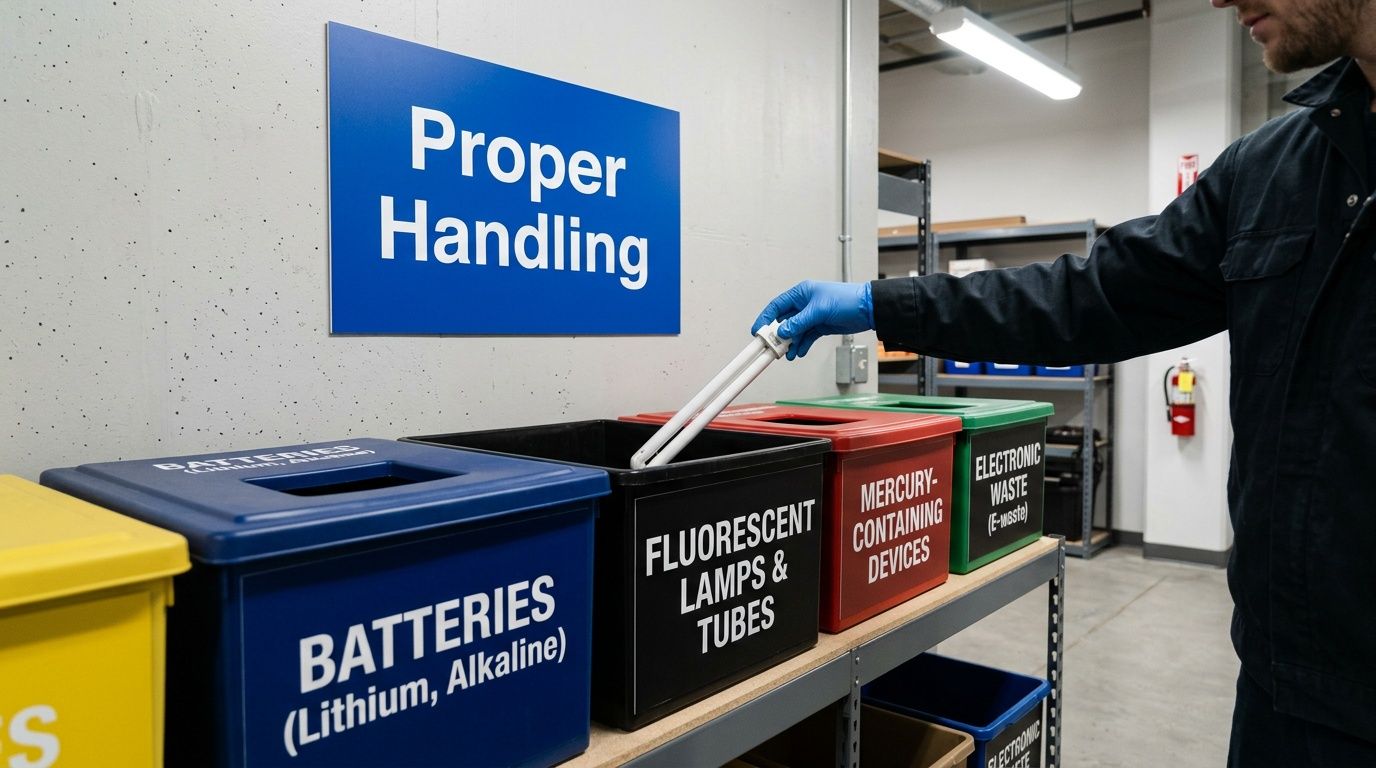
Your labels should be plain and specific.
Examples that work:
- Universal Waste – Batteries
- Universal Waste – Lamps
- Universal Waste – Mercury-Containing Equipment
Avoid internal shorthand that only one technician understands. “Spent UPS units” is useful for your team, but it does not replace a compliant waste identifier.
Add the accumulation start date to your internal process, even if the label format itself is not the only place you track it. The key is proving how long material has been on site.
Store waste like you expect an inspector to open the door
The storage area does not need to be complicated. It does need control.
Use a designated accumulation area with clear boundaries. Keep containers closed, structurally sound, and compatible with the contents. Separate batteries from lamps. Keep mercury-containing items protected from breakage.
For Mercury-Containing Equipment, the handling standard is strict. Damaged items must go into a closed, compatible container, and if an ampoule breaks it must be handled over a spill tray to capture the mercury and prevent vapor release, as described in this universal waste management procedure.
A practical floor-level checklist
- Use the right container: Fiber drums, sealed pails, lamp boxes, and battery tubs should match the waste type.
- Keep incompatibles apart: Do not combine unlike materials because it saves floor space.
- Control breakage risk: Put fragile lamps and mercury devices where carts, pallets, or forklifts will not hit them.
- Train for exceptions: Staff should know what to do when something is damaged, not only when everything goes as planned.
A well-run accumulation area is boring. That is the standard you want. If your storage corner looks improvised, your compliance process probably is too.
Transport is where undocumented assumptions cause trouble
Before anything leaves your building, confirm four points:
- The waste is correctly identified
- The containers are labeled
- The receiving vendor is appropriate for that waste stream
- Your shipment records match what left the site
This matters most on mixed pickups. Universal waste, scrap electronics, and data-bearing devices should not be treated as interchangeable just because the same truck is collecting them.
If your disposal workflow includes retired endpoints, servers, or networking gear, align the waste side with a documented IT disposition process such as this guide to disposal of IT equipment.
The one-year rule changes pickup planning
Universal waste cannot sit in storage indefinitely. The accumulation period is limited to one year under the federal framework. That means pickup timing is not a convenience issue. It is a compliance issue.
The easiest way to stay ahead of that clock is to schedule recurring reviews of what is in the room, what was added recently, and what should move next.
The High Cost of Non-Compliance Fines and Reputational Risk
The audit story usually starts with something small.
A facilities employee empties a maintenance area. A few spent lamps and batteries go into a container with obsolete electronics because the truck is already coming. Nobody updates the internal log. A month later, procurement asks for disposition paperwork tied to a site closure. The records do not line up.
Then the questions start.
Fines are only the visible part
The direct penalty gets attention first. That is fair. Regulatory fines can hurt quickly.
But the bigger operational damage often comes from the follow-on work:
- Internal investigations: Legal, compliance, IT, and facilities all get pulled in.
- Customer confidence issues: Clients may question how you handle equipment, records, and secure disposal.
- Procurement friction: Vendor reviews become slower and more demanding after a waste or data-handling failure.
- Executive escalation: Leadership gets involved once the issue reaches brand or legal risk.
Reputational damage travels faster than the waste issue itself
Improper disposal creates a story people understand immediately. Most customers will not know the difference between universal waste categories and hazardous waste classifications. They will understand “the company mishandled old equipment” or “regulated items were disposed of incorrectly.”
That is enough to damage trust.
For healthcare organizations, schools, and public agencies, the standard is even higher. Stakeholders expect visible control over anything tied to environmental compliance or retired systems. A sloppy waste room suggests sloppy governance, even when the root cause was only poor process design.
What commonly fails in organizations
The common failures are procedural:
- No one owns the accumulation area
- Labels are inconsistent
- Dates are missing
- Electronics and universal waste are mixed
- Pickup documentation is incomplete
- Data-bearing devices move before disposition approval
None of those problems require a major incident to become serious. They only require a bad day, an inspection, or a request for records you cannot produce.
Compliance protects more than the environment. It protects your ability to prove that your organization controls risk when someone asks hard questions.
Implementing Your Universal Waste Management Program
A workable program is not a binder on a shelf. It is a set of responsibilities that survive staff turnover, office moves, and refresh cycles.
The organizations that handle universal waste cleanly usually assign ownership by function, not by accident.
Assign clear roles
Start with named responsibility, not department-level vagueness.
A practical split looks like this:
- IT owner: Identifies retired electronics, flags data-bearing assets, and separates equipment that cannot go down the universal waste path in Georgia.
- Facilities owner: Manages lamps, maintenance-related waste, and physical accumulation areas.
- Compliance or operations owner: Maintains procedures, reviews records, and confirms pickups and downstream documentation.
- Approved vendor coordinator: Schedules removal and keeps the disposition packet together.
If one person holds multiple roles, that is fine. What does not work is “everyone handles a little of it.”
Build a short SOP that people will use
Many teams need a concise operating procedure, not a legal memo.
Include these elements:
Accepted waste categories on site
Spell out which items your team may place in universal waste containers.Exclusions
Be explicit that computers, servers, storage arrays, and other electronics require a separate decision path in Georgia.Labeling instructions
State the exact label format your team should use.Storage controls
Identify approved containers, approved areas, and what to do with damaged items.Pickup approval
Require signoff before material leaves the building.Record retention
Keep shipment and disposition documents in one place.
Train for the Georgia electronics gap
Many internal programs break down at this point. Staff learn the broad idea of universal waste and then over-apply it.
The key risk in Georgia is simple: batteries and lamps may fit the simplified universal waste route, but computers and servers can require stricter handling plus certified data destruction such as DoD 5220.22-M wiping for HIPAA-sensitive environments, as reflected in the EPA universal waste overview.
That point should appear in onboarding, annual refreshers, and any project kickoff involving relocations, cleanouts, or decommissions.
Document the chain from room to recycler
Your audit file should answer basic questions without reconstruction.
Keep:
- Container logs
- Pickup dates
- Vendor paperwork
- Internal approvals
- Asset lists for data-bearing devices
- Data destruction documentation where applicable
For organizations handling large device populations, a tracking layer reduces confusion. A dedicated inventory and workflow tool can make handoffs cleaner, especially when IT and facilities share responsibility. This overview of IT asset tracking software explains the operational benefit well.
If your team cannot show where an item was stored, when it left, and how it was processed, assume you do not have a complete program yet.
What works and what does not
What works is simple. Separate waste streams. Train the people who touch them. Review storage routinely. Use approved downstream partners. Keep records together.
What does not work is relying on memory, emailing spreadsheets back and forth, or assuming the same rule applies to every retired item with a power cord.
How ACR Solves Your IT Waste and Compliance Puzzle
Georgia businesses usually do not need more theory. They need a disposal partner that understands where the universal waste system ends and where controlled IT asset disposition begins.
That is the central compliance puzzle.
Universal waste rules can simplify handling for qualifying materials such as batteries and lamps. Retired electronics are different. They carry data risk, chain-of-custody risk, and classification issues that require tighter operational control. When a project includes both categories, the safest approach is to use a provider that can separate the streams correctly, document the process, and keep your internal team out of improvisation mode.
For commercial organizations in Atlanta, that means looking for a partner that can support on-site de-installation, packing, pickup logistics, secure media handling, and responsible downstream recycling without creating confusion between universal waste items and IT assets.
ACR fits that business need because the company focuses on end-to-end B2B electronics recycling and ITAD for organizations that cannot afford loose process. That includes hospitals, schools, government departments, offices, and data center operators. Secure wiping under the DoD 5220.22-M standard, physical shredding for obsolete media, and documented handling all matter because disposal is not just a sustainability issue. It is a governance issue.
If your team is planning a refresh, closure, decommission, or warehouse cleanup, the value is not only hauling material away. The value is reducing the number of compliance decisions your staff has to make under pressure.
A practical next step is to review the scope of ACR's business ITAD and recycling services and map them against your current waste room, refresh calendar, and data destruction requirements.
If your organization needs a defensible process for retired electronics, batteries, lamps, and mixed cleanout projects, Atlanta Computer Recycling can help you build a disposal workflow that aligns environmental compliance with secure IT asset disposition. Start with a site review, define which materials belong in the universal waste stream versus the ITAD stream, and put documented pickup, data destruction, and downstream recycling in place before your storage room becomes your next audit issue.