A Business Guide to Secure Hard Drive Recycling


When your business retires old storage devices, you can't just toss them out. Secure hard drive recycling is the essential process of permanently destroying every bit of corporate data on them before recycling the physical hardware. It’s a critical security function for any business, ensuring sensitive information is completely unrecoverable and stopping costly data breaches right in their tracks.
Why Secure Hard Drive Recycling Is a Critical Business Function
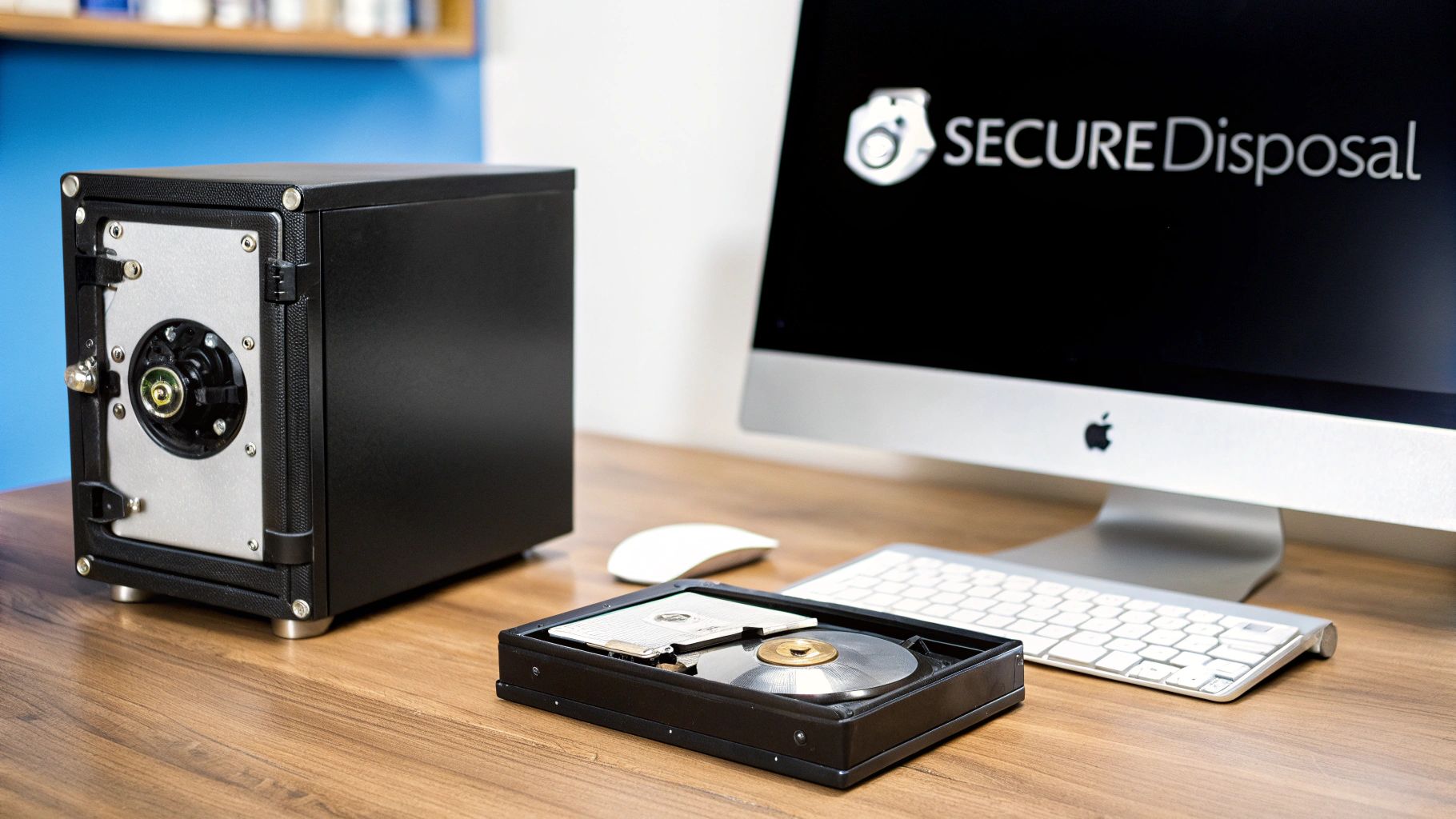
Those old hard drives piling up in a storage closet? They aren't just clutter—they're dormant security risks. Each one is a digital vault packed with years of sensitive company data, client information, employee records, and valuable intellectual property.
Simply deleting files or reformatting these drives creates a false sense of security. The truth is, that data often remains easily recoverable with basic, widely available software, exposing your organization to unacceptable risk.
Think of it like a retired bank vault. You wouldn't just abandon it with the door unlocked, leaving its contents exposed. In the same way, the digital vaults on your old computers, servers, and network gear must be permanently sealed before you let them go. Failing to do so is like leaving a trail of digital breadcrumbs for cybercriminals, competitors, or anyone else who might stumble upon the discarded hardware.
The Real-World Risks of Improper Disposal
The fallout from neglecting a formal disposal process can be severe. A single improperly discarded hard drive can trigger a cascade of negative consequences that reverberate through your entire organization. These aren't just hypothetical what-ifs; they are very real threats to your operational and financial stability.
- Steep Financial Penalties: Regulatory bodies like those enforcing HIPAA or FACTA impose massive fines for non-compliance. A data breach traced back to discarded hardware can cost millions.
- Irreparable Brand Damage: The moment a data breach goes public, customer trust evaporates. Rebuilding a tarnished reputation can take years, if it's even possible.
- Loss of Competitive Advantage: If your proprietary data or trade secrets fall into the wrong hands, it can directly undermine your market position and sabotage future growth.
This growing awareness is playing out in the market itself. The global hard drive destruction service market was valued at USD 1.65 billion in 2024 and is projected to surge to USD 5.05 billion by 2035. This rapid growth highlights just how urgent the need for professional data disposal has become for businesses worldwide.
Shifting from Liability to Proactive Security
Secure hard drive recycling isn’t just a cleanup task; it's a core part of your risk management strategy. It transforms a potential liability into a structured defense. The two primary methods for certified data destruction are software wiping and physical shredding, which you can read about in our complete guide to old hard drive disposal.
By treating every retired hard drive as a potential security threat, you shift from a reactive cleanup mindset to a proactive data defense strategy. This approach is essential for protecting your clients, your team, and your long-term business viability.
For modern businesses, partnering with a professional IT Asset Disposition (ITAD) provider is the only reliable way to navigate these challenges. It ensures your data is gone for good, your company stays compliant, and your brand remains protected.
Choosing Your Data Destruction Method
When your business decides to retire IT assets, the most important decision you'll make is how to permanently eliminate the sensitive data they contain. This isn't a one-size-fits-all choice. The right method depends on the drive's condition, your specific security requirements, and whether the hardware has any residual value.
At the heart of secure hard drive recycling are two industry-standard approaches: software-based wiping and physical destruction. Each one serves a distinct purpose, giving you a clear path to compliance and peace of mind when handled by a certified ITAD partner.
Software Wiping For Asset Reuse
Think of a hard drive's data like proprietary blueprints on a whiteboard. Simply hitting "delete" is like erasing the board with a dry cloth—the faint outlines are still visible to someone who knows how to look. Software wiping, on the other hand, is like methodically scribbling over the entire board with layers of permanent ink until the original plans are gone for good.
This process uses specialized software to overwrite every single sector of the drive multiple times, following strict protocols like the DoD 5220.22-M standard. This three-pass overwrite method ensures the original data is completely smothered and can’t be pieced back together.
Key Takeaway: Software wiping is the perfect choice for functional, newer hard drives that can be safely redeployed or sold. It preserves the hardware's value, turning a potential liability into a revenue opportunity that can help offset recycling costs.
This approach is ideal for situations like:
- Internal Redeployment: Securely preparing computers for use by different departments or new employees.
- Equipment Leasing: Wiping devices completely clean before sending them back to the leasing company.
- Asset Remarketing: Capturing the remaining value from retired but still-functional IT equipment.
By choosing certified wiping for your viable assets, you not only lock down data security but also contribute to a sustainable, circular economy. If you want to dive into the technical details, you can learn more about how to wipe a hard drive in our guide.
Physical Shredding For Absolute Destruction
Now, let's imagine that whiteboard holds extremely sensitive trade secrets, or maybe it's just old and cracked. In this case, you can't afford to risk even the slightest chance of the original image bleeding through. Physical shredding is the equivalent of feeding that whiteboard into an industrial woodchipper, turning it into nothing but indecipherable confetti.
This method provides the ultimate guarantee of data destruction. A powerful, industrial-grade shredder grabs the hard drive and pulverizes it into tiny, mangled pieces of metal and plastic. There are no platters left to recover, no electronics to analyze—just a pile of scrap from which data recovery is a physical impossibility.
Shredding is the definitive solution for:
- Failed or Obsolete Drives: Any hard drive that is no longer functional or has reached its end-of-life must be physically destroyed.
- High-Security Data: When compliance or internal policy demands the highest possible level of security.
- Assets with No Resale Value: For older hardware, shredding is often the most direct and secure path to disposal.
Physical shredding is non-negotiable for many organizations in healthcare, finance, and government, where the risk of a breach is simply too great to consider any other option.
Data Wiping vs Physical Shredding At a Glance
So, how do you decide which path to take? It really comes down to a clear-eyed assessment of your assets. For most businesses, a blended strategy is the most cost-effective and secure approach: wipe functional equipment to recover value and shred everything else for total peace of mind.
This table breaks down the key differences to help you choose.
| Attribute | DoD-Standard Software Wiping | Physical Shredding |
|---|---|---|
| Process | Overwrites all data sectors with random characters in multiple passes. | Mechanically pulverizes the entire hard drive into small metal fragments. |
| Best For | Functional drives intended for reuse, donation, or remarketing. | Failed, obsolete, or highly sensitive drives requiring total destruction. |
| Allows Reuse? | Yes, the hardware remains fully functional and ready for a new life. | No, the drive and all its components are permanently destroyed. |
| Security Level | High. Meets most compliance needs for data sanitization when certified. | Absolute. Data is physically impossible to recover from the fragments. |
No matter which method you choose, the process isn't truly complete until you receive a Certificate of Data Destruction. This legal document is your official, auditable proof that every drive was handled responsibly, protecting your business from liability and ensuring you meet all your compliance obligations.
Navigating Data Privacy and Compliance Laws
For any business in a regulated field like healthcare, finance, or law, secure hard drive recycling isn't just a smart move—it's a legal requirement. Hitting 'delete' or doing a quick format on a drive doesn't even come close to what the law demands. One misstep can lead to staggering fines, painful legal battles, and a hit to your company's reputation that's hard to recover from.
These regulations aren't suggestions; they're hard and fast rules dictating exactly how you must protect and ultimately destroy sensitive data. A single hard drive tossed in the wrong bin can trigger a full-blown compliance audit or, worse, a data breach that costs your business millions.
This is precisely why professional, certified ITAD services have become a non-negotiable part of corporate risk management. They give you a clear, defensible process for ticking every box.
Key Regulations Driving Data Destruction
A tangled web of federal and state laws dictates how data must be handled at the end of its life. While there are many, a few core regulations are absolutely critical for any IT manager overseeing asset retirement. For a deeper dive into building a unified strategy, it’s worth exploring how to master Governance, Risk, and Compliance (GRC).
- HIPAA (Health Insurance Portability and Accountability Act): This is the big one for healthcare. HIPAA demands that all electronic Protected Health Information (ePHI) be rendered completely unreadable and unusable before a device is retired. Certified physical shredding is the gold standard for meeting this requirement.
- FACTA (Fair and Accurate Credit Transactions Act): Designed to fight identity theft, FACTA requires any business that handles consumer reports or credit information to properly destroy that data before disposal. This makes professional shredding or wiping services essential.
- GLBA (Gramm-Leach-Bliley Act): Financial institutions live by GLBA, which mandates the protection of consumers' private financial information. The Safeguards Rule specifically calls for a formal security plan that includes the secure disposal of all customer data.
The need to comply with these rules has created a massive market for data destruction tools. In fact, the commercial sector's spending on hard disk destruction equipment is valued at over $450 million, making up more than two-thirds of the global market. This huge investment shows just how seriously businesses are taking breach prevention.
Your Essential Compliance Documentation Checklist
So, how do you prove you've done your due diligence? It all comes down to the paperwork provided by your ITAD vendor. Without a solid, auditable paper trail, you have no defense if an auditor or investigator comes knocking.
A verbal promise that a drive has been destroyed is worthless. Your business needs legally recognized documents that create an unbroken audit trail, proving you took every necessary step.
Your ITAD partner absolutely must provide these two documents to keep your business protected:
- A Detailed Chain-of-Custody Record: This document is like a passport for your assets. It tracks every hard drive from the moment it leaves your building, listing serial numbers and detailing who handled it, how it was transported, and when it arrived at the secure facility.
- A Formal Certificate of Destruction: This is your legal shield. It's the official, signed proof that the data on specific, serialized hard drives was permanently destroyed. The certificate must clearly state the method used, like physical shredding. Our Atlanta data destruction services are built to provide this critical proof for every single project.
By insisting on this level of documentation, you effectively transfer the liability to your certified partner. It closes the loop on your IT asset's lifecycle and ensures your business stays secure and compliant.
Mapping the Secure Chain of Custody Process
So, what actually happens to your old hard drives once they leave your office? It’s not just a simple pickup. The journey from your server room to final destruction is a carefully choreographed process designed to shut down risk at every single turn. This secure workflow is known as the chain of custody, and it turns the abstract idea of "recycling" into a tangible, auditable security service.
For any IT manager, getting a handle on this process is non-negotiable. It’s the only way to be certain your sensitive data is handled with lock-tight security from the moment it leaves your control until it’s verifiably destroyed. A professional ITAD partner doesn't leave anything to chance—they follow a strict, documented protocol that slams the door on potential errors.
The Initial On-Site Steps
The process kicks off right at your facility, long before a single drive is loaded onto a truck. This first phase is all about documentation and secure prep work.
- Asset Inventory: A technician will scan and log the serial number of every single hard drive or asset you're handing over. This creates the foundational record for the entire chain of custody.
- Secure Packing: Those inventoried drives are then carefully packed into locked, tamper-evident containers. This makes it impossible for any assets to be added or removed without breaking a seal and leaving a clear record.
This on-site diligence is the first, crucial link in an unbroken security chain. It establishes a crystal-clear record of exactly what is leaving your premises.
Secure Transit and Facility Intake
Once packed and sealed, your assets are moved into a locked, GPS-tracked vehicle for transport to a secure, access-controlled facility. This isn't your average shipping service; it's a dedicated security operation.
Upon arrival, the containers are opened, and the contents are checked against the initial on-site inventory log. This dual verification confirms that every asset that left your office has arrived safely at its destination, with no discrepancies.
This infographic shows just why a secure chain of custody is so critical under various compliance laws.
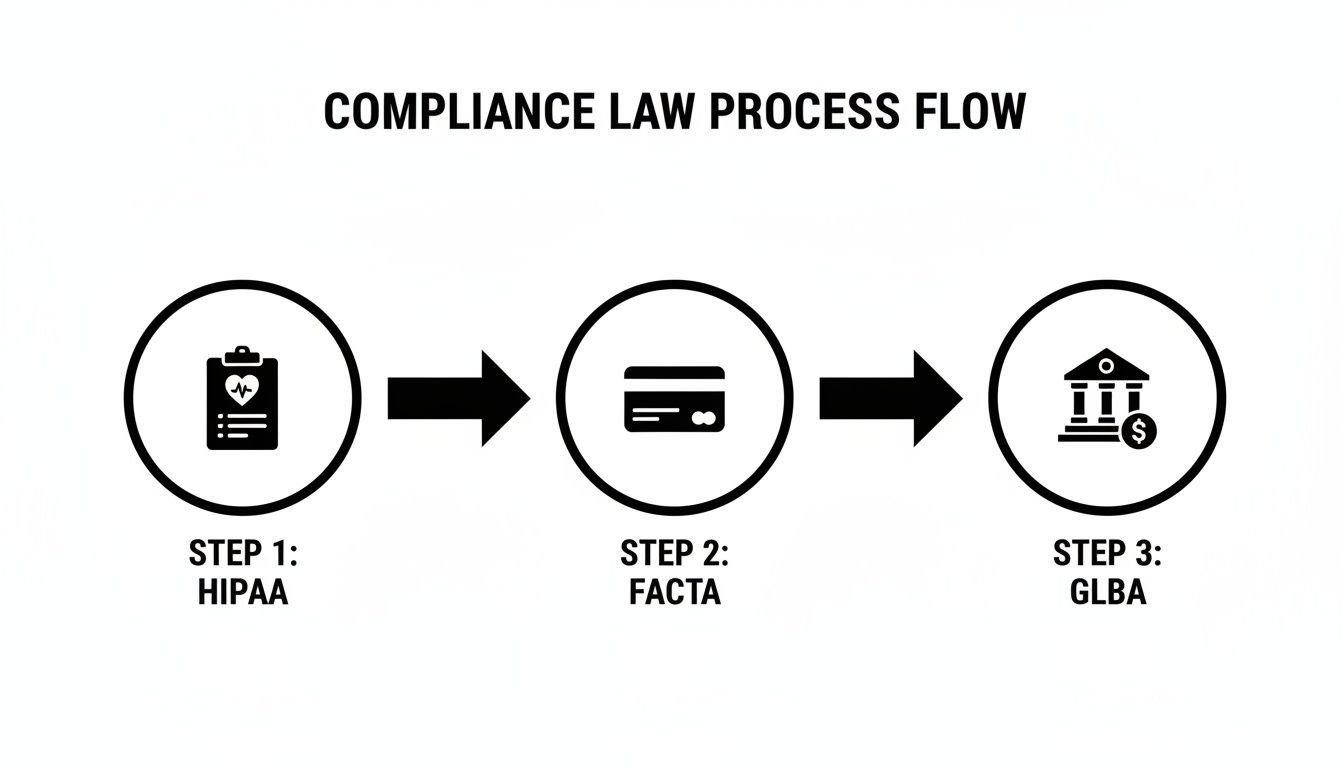
You can see how regulations like HIPAA, FACTA, and GLBA govern different types of sensitive data—and each one demands a verifiable, documented disposal process.
Final Destruction and Reporting
Inside the secure facility, the hard drives are queued up for their final end-of-life event, whether that’s software wiping or physical shredding. This is the moment the data is permanently eliminated. Every action is logged against each asset's serial number, keeping the audit trail perfectly intact.
The most critical part of this whole process is the final paperwork. Without it, you have no legal proof of proper data disposal. That leaves your business completely exposed during a compliance audit.
After the destruction is complete, your ITAD provider issues the final, all-important reports. This documentation is your definitive proof of compliance and due diligence. For any business, learning more about the role of a formal Certificate of Destruction is essential, as this document is your legal safeguard.
This final report officially closes the loop on your assets' lifecycle, giving you the peace of mind that your data, your clients, and your company are protected.
Finding the ROI in Secure IT Asset Disposition
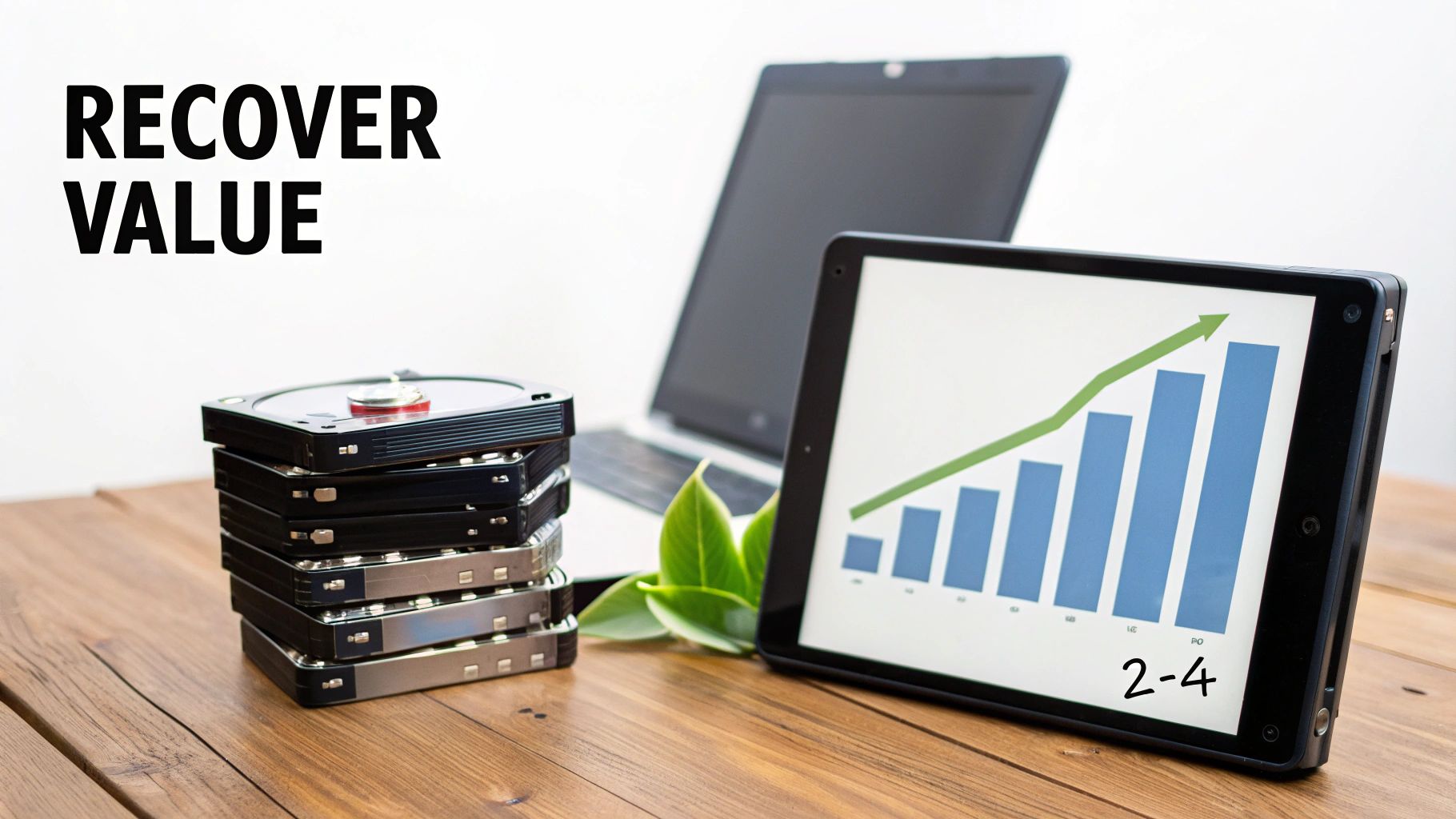
It’s easy to see secure hard drive recycling as just another line item on the IT budget—a necessary cost of doing business. But that’s a huge missed opportunity. A smart IT Asset Disposition (ITAD) strategy isn't a cost center. It’s a value-generating initiative that can deliver a real return on investment while bolstering your company's reputation.
The most obvious financial win comes from asset remarketing. When you work with a certified ITAD partner, your functional equipment—laptops, servers, storage arrays—is securely wiped using DoD-standard methods. That process keeps the hardware's value intact, making it ready to be sold on the secondary market.
This opens up a revenue stream most companies completely ignore. The money you make from selling that equipment can easily offset the costs of recycling and data destruction. In fact, for newer gear, it’s not uncommon for the return to be greater than the service fees, turning an operational requirement into a net positive for your IT budget.
Unlocking Value from Retired IT Assets
The secret to maximizing return is to stop thinking of retired hardware as e-waste. Instead, treat it like any other depreciating company asset. Before it sits in a storage closet losing value by the day, a proactive disposition plan captures what it's still worth.
Here’s how a structured plan turns an expense into revenue:
- Detailed Asset Auditing: Your ITAD partner takes a full inventory of every piece of equipment, flagging the items with the highest resale potential.
- Certified Data Sanitization: Secure data wiping gets the assets ready for sale while guaranteeing full compliance and wiping every last bit of sensitive information.
- Strategic Remarketing: The vendor uses their established sales channels to get the best possible market price for your refurbished equipment.
- Transparent Reporting: You get crystal-clear financial statements showing the value recovered from each asset, so you can track your ROI in plain sight.
A well-managed ITAD program turns a security requirement into a financial benefit. By recovering value from used electronics, you can fund future technology upgrades, reduce departmental overhead, and improve your overall budget efficiency.
Strengthening Your Corporate Social Responsibility
Beyond the bottom line, responsible e-waste management is a powerful way to enhance your brand. These days, customers, investors, and stakeholders are more likely to support companies that demonstrate a real commitment to environmental stewardship and corporate social responsibility (CSR).
Electronic waste is one of the world's fastest-growing—and most toxic—waste streams. In 2022 alone, the world generated an incredible 62 million tonnes of e-waste, and that number is projected to hit 181 billion pounds a year by 2030. What's worse is that only about 20-22% of it is properly collected and recycled. You can discover more insights about global e-waste statistics to see just how big this problem is.
When you partner with a certified e-waste recycler, you send a clear message about your commitment to sustainability. It shows your company is actively keeping hazardous materials out of landfills, conserving natural resources by recovering valuable materials, and shrinking your environmental footprint. This positions your business as both financially smart and environmentally conscious—a winning combination that builds brand loyalty and strengthens your reputation.
How to Choose the Right ITAD Partner
Picking the right IT Asset Disposition (ITAD) vendor is one of the most critical decisions you'll make for your company's security and compliance. This isn't just about hauling away old equipment; you're entrusting a partner with hard drives packed with sensitive corporate and customer data.
A great partner operates like a true extension of your IT and security teams. The wrong one can expose you to catastrophic data breaches, legal penalties, and a damaged reputation. This is why a simple price quote just doesn't cut it. You need a partner with verifiable credentials and a process you can trust, backed by proof.
Vet Your Vendor with This Checklist
To cut through the sales pitches and find a genuinely qualified partner for your secure hard drive recycling needs, use this checklist. A trustworthy vendor won't hesitate to provide documentation for every single point.
- Do they hold key industry certifications? Look for names like R2 (Responsible Recycling) or e-Stewards. These aren't just fancy logos—they represent a serious commitment. To earn them, a recycler has to pass intense, third-party audits covering data security, environmental safety, and even employee health.
- Can they provide comprehensive liability insurance? A professional ITAD partner will carry robust insurance that covers things like data breaches and pollution liability. This is your safety net, protecting your business if something goes wrong during transit or processing.
- Do they offer detailed, auditable reporting? Your partner absolutely must be able to track every single asset from your door to its final destination. This means you get a formal chain-of-custody document and, most importantly, a legally recognized Certificate of Data Destruction.
Asking the Right Questions
Once you have a shortlist of certified vendors, it's time to dig a little deeper into how they actually operate. Their answers will tell you everything you need to know about their professionalism and commitment to security.
Your goal is to find a partner whose security protocols are just as strict as your own. If you get vague answers about their process or they’re reluctant to detail their chain of custody, that's a massive red flag.
Here are a few essential questions to ask:
- What does your chain-of-custody process look like? Have them walk you through every step, from how they pack and secure assets at your facility to what happens when the locked truck arrives at their processing center.
- What on-site capabilities do you offer? If your internal policies require it, can they bring a shredder to your location for you to witness the destruction firsthand?
- How do you handle assets with potential resale value? A top-tier partner won't just destroy everything. They'll have a transparent process for testing, wiping, and remarketing functional equipment to maximize your return on investment.
Choosing the right ITAD partner turns a compliance chore into a strategic advantage. For more on finding the right fit, see our overview of what to look for in an electronic waste recycling company. Doing your homework now ensures your data is handled securely, responsibly, and in a way that fully protects your business from risk.
Common Questions About Secure Hard Drive Disposal
Even with a solid plan for retiring IT assets, a few specific questions always come up in the boardroom or the server room. IT managers and business leaders need straight answers to make smart, confident decisions that keep their organizations safe. Here are some of the most common questions we get asked by our commercial clients.
Can't We Just Drill Holes in Our Drives Instead of Paying for a Service?
Drilling a few holes through a hard drive seems like an easy, hands-on solution, but it's a security shortcut that doesn't hold up to scrutiny. This method often leaves large sections of the magnetic platters completely intact. For a determined data recovery expert, those untouched areas could still hold recoverable bits of sensitive information. It’s a gamble that's simply not worth the risk.
Even more importantly, this DIY approach leaves you with zero auditable proof of destruction. If your company ever faces a compliance audit for regulations like HIPAA or FACTA, you’ll have nothing to show that you handled that sensitive data properly. Professional shredding, on the other hand, pulverizes the entire drive and comes with a Certificate of Destruction—your official, legal proof of compliance.
What Is a Chain of Custody and Why Is It So Important?
A chain of custody is the formal, documented paper trail that tracks your IT assets from the moment they leave your sight. Think of it as a detailed travel log for your sensitive data, recording every single handoff and location change.
This log meticulously documents:
- Who picked up the assets and precisely when.
- How they were securely transported.
- When they arrived at the secure processing facility.
- The exact date and method of their final destruction.
Without a documented chain of custody, you can’t legally prove your data remained secure at every step of the disposal journey. This document is your first line of defense against claims of negligence and is a non-negotiable part of regulatory compliance.
What's the Typical Cost for Secure Hard Drive Recycling?
The cost for secure hard drive recycling depends on a few key factors—the total number of drives, the service you need (wiping vs. shredding), and any extra logistics like on-site de-installation. That said, most businesses are surprised to learn how affordable it actually is.
For example, many ITAD partners offer complimentary pickups for businesses that have enough qualifying equipment. Better yet, if your company is retiring newer, valuable assets that can be securely wiped and remarketed, the revenue from those sales can often cover the entire cost of the service. This can make your data destruction program budget-neutral or even profitable.
What Happens to the Materials After a Drive Is Shredded?
Once a hard drive is shredded into a pile of small, unrecognizable metal fragments, the process isn't over. That jumble of materials is then sent to a certified downstream refining partner, which is a crucial step in being a responsible environmental steward.
At the refinery, advanced sorting technology goes to work separating the valuable commodities. Materials like aluminum, steel, and trace amounts of precious metals are carefully recovered. These raw materials are then funneled back into the global supply chain, ready to be used in manufacturing new products. This circular process ensures your hard drive recycling program not only protects your data but also conserves natural resources and keeps hazardous e-waste out of landfills.
Ready to implement a secure, compliant, and cost-effective IT asset disposition strategy for your business? The experts at Atlanta Computer Recycling provide end-to-end services, from on-site pickup to certified data destruction, ensuring your company's data is protected every step of the way. https://atlantacomputerrecycling.com