Secure Computer Disposal in Atlanta GA: A Guide for Local Businesses


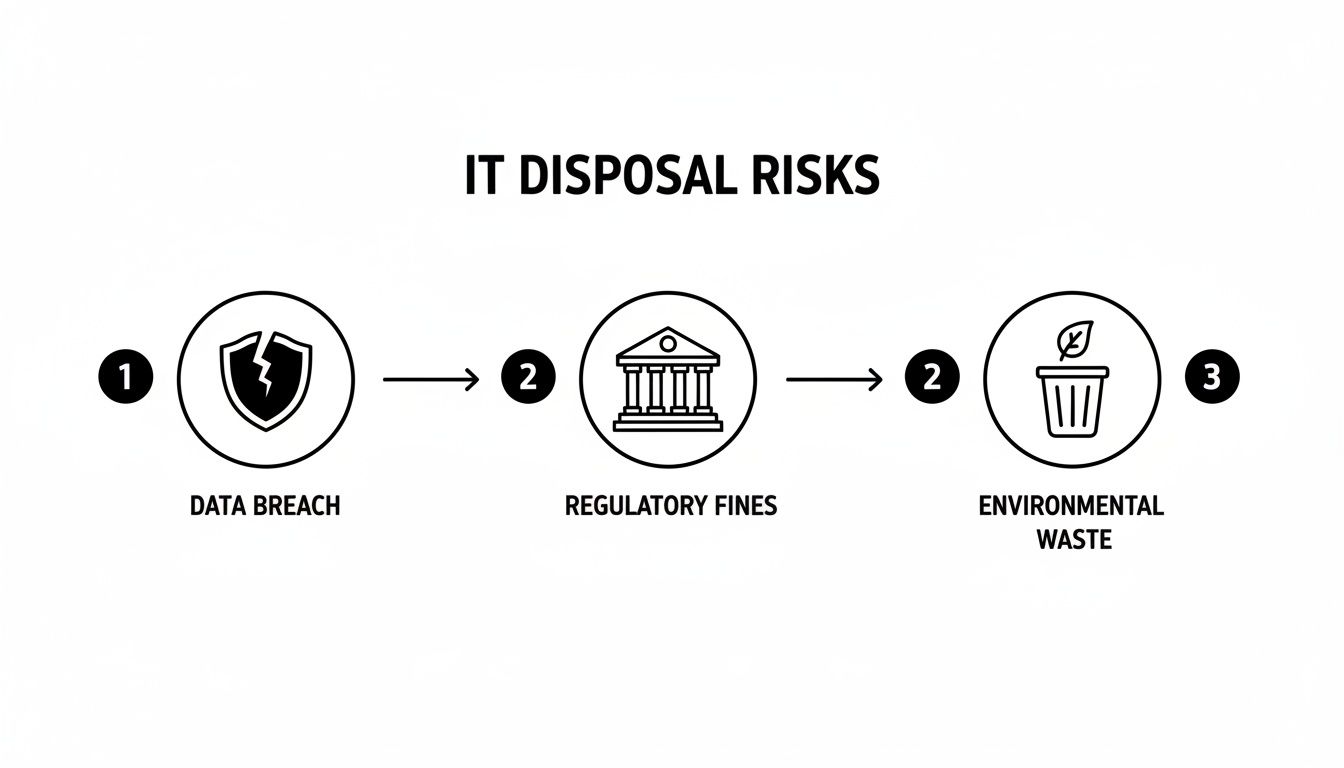
For any business in Atlanta, from Midtown's healthcare innovators to Buckhead's financial powerhouses, retiring old computer equipment isn't just a logistics task. It's a high-stakes process loaded with risk. Improper disposal can lead to catastrophic data breaches, crippling regulatory fines, and environmental non-compliance.
This guide provides a roadmap for Atlanta businesses to navigate IT asset disposal securely, compliantly, and efficiently.
The Real Risks of Improper IT Asset Disposal in Atlanta
When a company laptop or server reaches the end of its lifecycle, the real work for your IT department is just beginning. For IT managers across Atlanta, the challenge isn't just clearing out a storage closet—it's about neutralizing the sensitive data still residing on those devices. Simply discarding an old computer is a direct threat to your business's security, reputation, and bottom line.
Technology refresh cycles are faster than ever, which means your business has a constant stream of retired equipment. Every one of those devices could contain sensitive customer PII, financial records, employee files, or valuable trade secrets.
Data Breaches and Regulatory Fines
The most immediate and costly danger is a data breach. A single unsecured hard drive can expose your entire company to massive liability. For businesses in Atlanta's thriving healthcare and finance sectors, the consequences are especially severe.
- HIPAA Violations: Healthcare providers face astronomical fines for exposing Protected Health Information (PHI).
- Financial Regulations: Firms in the city’s financial district must adhere to strict data security laws like GLBA and SOX, which mandate secure data destruction.
Failing to properly manage end-of-life IT assets isn't just an IT problem—it's a major business continuity risk. A data breach from a discarded computer can cost millions in fines, legal fees, and reputational damage, completely dwarfing the cost of professional disposal services.
To truly grasp the gravity of these risks, it's helpful to understand the core principles of data security. For an in-depth look, the CompTIA Security+ Study Guide is an excellent resource. Proper disposal is a non-negotiable component of any serious corporate cybersecurity strategy.
Environmental Non-Compliance and E-Waste
Beyond data security, there's a serious environmental responsibility. In 2022, the world generated a shocking 62 million metric tons of electronic waste—an 82% jump from 2010. This growth is outpacing documented recycling efforts by a factor of five.
For Atlanta’s IT managers, this highlights the critical need for secure computer disposal Atlanta GA. Small IT equipment like laptops and servers alone accounted for 4.6 million tons of that e-waste, yet only 22% was properly recycled.
A professional ITAD (IT Asset Disposition) partner ensures your equipment never becomes a liability. They adhere to a zero-landfill policy, focusing on reuse and certified recycling to handle hazardous materials correctly. This turns a simple disposal task into an opportunity to strengthen your company's Environmental, Social, and Governance (ESG) profile.
To see how these methods work in practice, you can explore our detailed guide on professional data destruction in Atlanta.
A well-planned disposal project follows a clear, secure process from start to finish. Here’s a quick checklist outlining the key stages for Atlanta businesses.
Compliant Computer Disposal Checklist for Atlanta Businesses
| Stage | Key Action | Primary Goal |
|---|---|---|
| Preparation | Create a detailed inventory of all assets slated for disposal. | Establish a clear record of what needs to be processed. |
| Logistics | Schedule a secure pickup with a vetted ITAD vendor. | Ensure a documented and secure chain of custody from your site. |
| Data Destruction | Choose a certified destruction method (wiping or shredding). | Guarantee 100% data sanitization and prevent breaches. |
| Documentation | Obtain a Certificate of Destruction for all sanitized media. | Provide an auditable record of compliance for legal and regulatory needs. |
| Recycling | Ensure the vendor uses certified, eco-friendly recycling processes. | Meet environmental obligations and prevent e-waste from ending up in landfills. |
Following these steps with a trusted local partner is the surest way to protect your business, your data, and the environment.
How to Prepare Your IT Assets for Disposal
Before any retired equipment leaves your Atlanta office, proper preparation is the first—and most critical—step. This isn't just about logistics; it's about establishing firm control over every asset and its data from the very beginning.
Getting this right sets the stage for a verifiable chain of custody and a smooth, secure handover to your ITAD partner. An error at this stage can open the door to major risk.
Create a Detailed Asset Inventory
A detailed inventory is the foundation of a compliant disposal project. A simple spreadsheet is sufficient to capture the essential details for every piece of equipment being retired.
For a financial firm in Buckhead retiring a rack of servers or a law office decommissioning 50 laptops, this step is non-negotiable for audit and compliance purposes.
Your inventory list should track:
- Asset Tag Number: Your company's internal ID.
- Device Type: (e.g., Laptop, Desktop, Server, Switch).
- Brand & Model: (e.g., Dell Latitude 7420, Cisco Catalyst 9300).
- Serial Number: This is the single most important detail for tracking.
- Physical Location: Where the device is currently located (e.g., Office 314, Data Center Rack 12).
- Data Sensitivity Level: A simple High/Medium/Low rating to help prioritize destruction methods.
This master list will be used to verify against the Certificate of Destruction from your vendor. It’s your proof that every device was accounted for and properly processed.
Segregate Assets Based on Data Sensitivity
Not all electronics carry the same risk. A keyboard is one thing; a server that held proprietary R&D is another entirely. Grouping equipment by risk level helps streamline the process and ensures your most sensitive assets receive the highest level of security.
For example, a healthcare clinic in Midtown retiring diagnostic machines alongside administrative PCs would separate them. The machines with Protected Health Information (PHI) are high-risk and must be flagged for certified data destruction to meet HIPAA rules. The PCs, while still sensitive, might follow a standard data-wiping protocol.
Expert Tip: Use colored painter's tape to physically tag devices. Red for "High-Risk – Shred Drive," green for "Standard Wipe." These simple visual cues prevent mix-ups during pickup and ensure your ITAD partner executes your instructions perfectly.
By identifying your most sensitive assets upfront, you can direct your ITAD partner to apply the most rigorous data destruction methods where they count. You can learn more about the different options in our guide on how to wipe a computer hard drive.
Consolidate Equipment in a Secure Staging Area
Once everything is inventoried and sorted, move it all to one secure location. This could be a locked storage room, a corner of your warehouse, or an empty office that’s off-limits to general staff.
Centralizing the assets makes the pickup day far more efficient for your team and the vendor. It also dramatically reduces the chance of a device being lost or stolen.
This is especially critical for large-scale projects. For a university clearing out an entire computer lab, having 100+ machines palletized and ready on a loading dock saves hours, minimizes operational disruption, and tightens security.
As technology cycles speed up, the volume of retired hardware is exploding. The global e-waste management market hit USD 82.2 billion in 2025 and is projected to grow at a 12.5% CAGR. IT and telecom equipment alone make up a staggering 45.7% of that volume. For Atlanta businesses, this means finding a partner who can securely manage this growing stream of retired assets is more important than ever.
Choosing the Right Data Destruction Method
Once your IT assets are inventoried and staged, the next step is permanently destroying the sensitive data they hold. This is the core of any secure and compliant computer disposal project in Atlanta.
Making the right choice protects your company's brand, ensures regulatory compliance, and provides complete peace of mind. Your decision will come down to two main approaches: software-based wiping and physical destruction. The best fit depends on your data's sensitivity, hardware condition, and internal security policies.
Software Wiping: The Go-To for Most Business Data
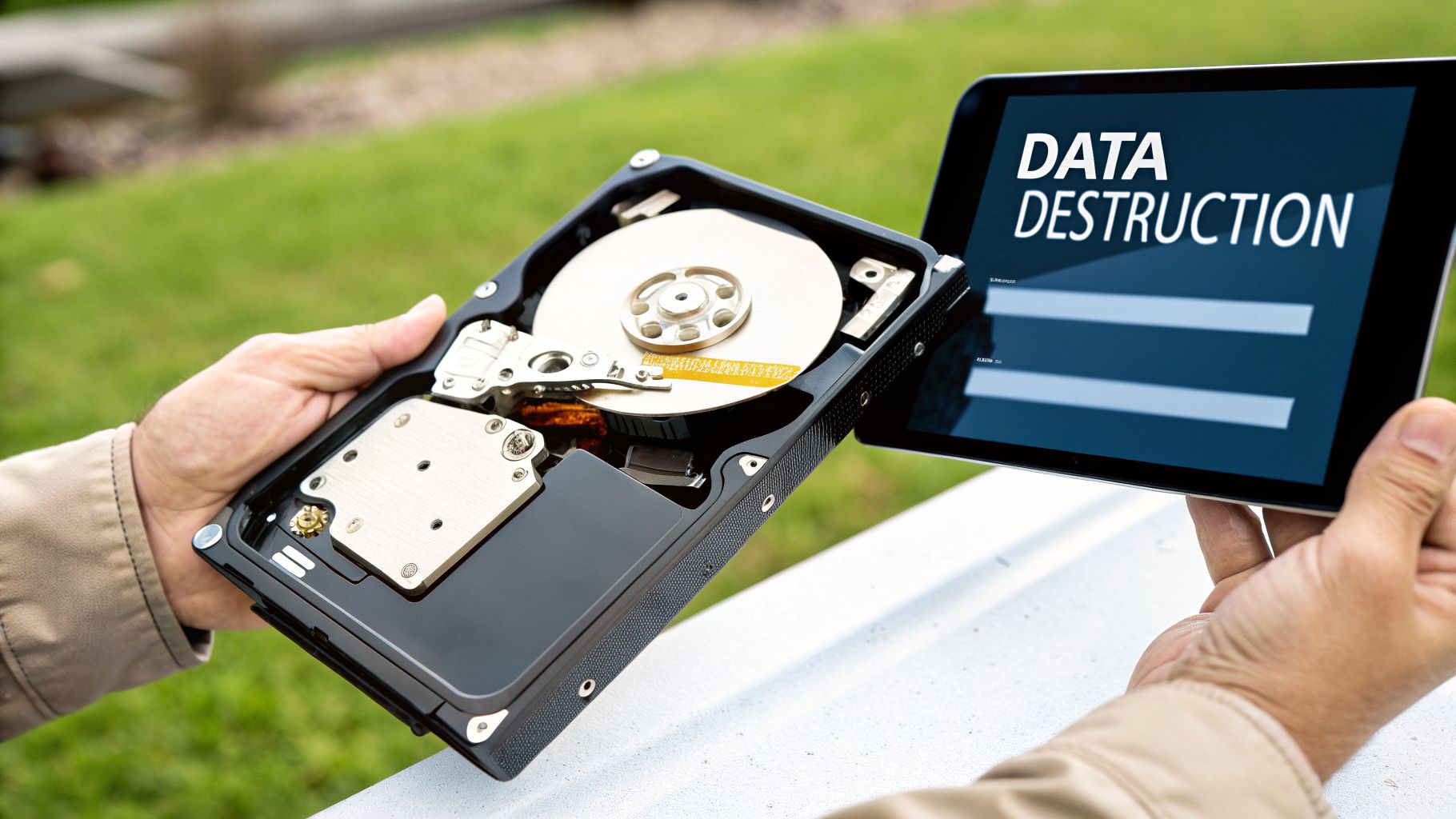
For the vast majority of commercial data, software-based wiping is the most practical and sustainable method. This process uses specialized software to overwrite every sector of a hard drive with random binary data, rendering the original information unrecoverable without damaging the drive itself.
The gold standard is the DoD 5220.22-M 3-pass wipe. This Department of Defense protocol writes over the data three separate times, providing a powerful level of security that satisfies most commercial and regulatory requirements.
Atlanta businesses often prefer this method for several key reasons:
- It's Cost-Effective. Reputable ITAD partners, including Atlanta Computer Recycling, typically include DoD-standard wiping for free with commercial pickup services.
- It Enables Reuse. Because the hard drive remains functional, the computer can be refurbished and find a second life, supporting circular economy goals. This is the most eco-friendly option.
- It's Fully Auditable. The wiping process generates a serialized report for each drive, providing a clear, documented paper trail that the data was sanitized.
This approach is ideal for functional desktops, laptops, and servers that contained standard business files, employee records, or internal financial documents.
When Physical Destruction is Non-Negotiable
Sometimes, wiping isn't an option—or simply isn't enough. For those cases, physical destruction is the only answer. This means shredding, crushing, or pulverizing the hard drive into small, mangled pieces of metal, offering an absolute guarantee that the data can never be accessed again.
Physical destruction is the required choice in a few specific scenarios. Your business should always opt for shredding if:
- You Handle Highly Sensitive Data. For Atlanta's healthcare providers bound by HIPAA, financial firms answering to the SEC, or law offices protecting client privilege, zero-risk data policies often mandate physical destruction.
- The Hard Drive Is Defective. Wiping software cannot run on a drive that is non-functional or fails to spin up. Shredding is the only way to destroy the data on a failed drive.
- Your Internal Policy Requires It. Many corporations and government agencies have strict internal security protocols that require physical destruction for all data-bearing devices, regardless of content.
The key takeaway is to match the destruction method to the risk. A one-size-fits-all approach doesn't work. By assessing your data's sensitivity and the hardware's condition, you can make a smart, defensible decision that aligns with your compliance needs and budget.
Another, less common method is degaussing, which uses powerful magnets to erase data. If you're interested in the nuances of this technology, you can find out more by reading our article on what a degausser is and how it fits into the data destruction landscape.
Ensuring HIPAA Compliance for Atlanta Healthcare
With Atlanta's massive and growing healthcare sector, secure computer disposal is directly linked to HIPAA compliance. A data breach involving Protected Health Information (PHI) can trigger devastating fines and reputational damage.
Both DoD-standard wiping and physical shredding can be part of a fully HIPAA-compliant disposal strategy, as long as the entire process is meticulously documented. The Certificate of Destruction you receive from your ITAD partner is your official proof that you took the required steps to protect patient data on retired assets.
Before you commit to a vendor, always confirm they will provide a serialized certificate that clearly lists the exact destruction method used for every single device.
How to Vet Your ITAD Partner in Atlanta
Choosing a partner for secure computer disposal in Atlanta is a critical business decision. The right IT Asset Disposition (ITAD) specialist is an extension of your risk management team. The wrong one is a simple scrap hauler who can become your biggest liability.
The difference often comes down to whether your sensitive data is professionally destroyed or ends up making headlines. Asking the right questions is crucial to separate a true expert from the crowd. This isn't about price—it's about verifying their process, credentials, and security from top to bottom.
Verify Key Industry Certifications
The fastest way to gauge a vendor's credibility is by checking their certifications. These aren't just logos for a website; they are hard-earned proof that the company has passed rigorous, third-party audits covering data security, environmental compliance, and safety.
When vetting any partner for computer disposal in Atlanta, GA, you should immediately look for two certifications:
- R2v3 (Responsible Recycling): This is the global standard for electronics recyclers. An R2v3-certified facility follows strict rules for sanitizing data, protecting the environment, and tracking every component downstream.
- e-Stewards: Another highly respected certification, e-Stewards puts a heavy emphasis on preventing the export of hazardous e-waste and maintaining the highest levels of data security.
If a potential vendor holds one or both, they have invested heavily in best practices. If they cannot provide a valid certificate, it's a major red flag for your due diligence process.
Scrutinize Their Data Destruction and Security Protocols
Certifications are the starting point. Next, you need to dig into their actual day-to-day security operations. Don't hesitate to ask for specifics on how they handle your data-bearing assets from the second they leave your facility.
A professional ITAD partner should provide clear, confident answers.
- Do they offer both DoD 5220.22-M wiping and physical shredding options?
- Can they bring a mobile shredder to your location for on-site destruction? This is the most secure option.
- What does their chain-of-custody documentation look like? Ask to see a real example.
- How secure are their facilities? Look for monitored alarms, controlled access, and 24/7 video surveillance.
Put them on the spot with a real-world scenario. Try asking: "If your team picks up 50 laptops from our office, walk me through the exact steps you take to guarantee every single hard drive is accounted for and destroyed." Their response will tell you everything you need to know about their professionalism.
You can learn more about how a professional electronic waste recycling company builds these critical security steps into their process.
Confirm Downstream Recycling and Insurance
A vendor's job isn't done after the data is destroyed. What happens to the physical scrap is just as important for your environmental compliance and long-term risk. This is where downstream liability becomes very real.
Ask for a list of their downstream recycling partners. A legitimate ITAD firm will only work with other certified processors and can prove they have a zero-landfill policy. This is more important than ever—globally, only 22.3% of e-waste was properly recycled in 2022. Even worse, 5.1 million tons of e-waste were shipped overseas, often to places without safe disposal methods. You can find more of these sobering global e-waste statistics on DTPGroup.co.uk. Choosing a certified local partner ensures your Atlanta business isn't part of that problem.
Finally, request their Certificate of Insurance. A professional ITAD provider will carry substantial liability coverage, including specific policies for data breaches and professional errors and omissions. This is your safety net. Verify they have adequate coverage to protect your business if the worst should happen.
Finalizing The Process From Pickup To Certification
You’ve vetted a partner and chosen the right data destruction method. Now comes the final, critical phase: turning that pile of old equipment into certified, documented proof of secure disposal. This is where a professional ITAD partner demonstrates their value, managing everything from on-site pickup at your Atlanta office to delivering the final compliance paperwork.
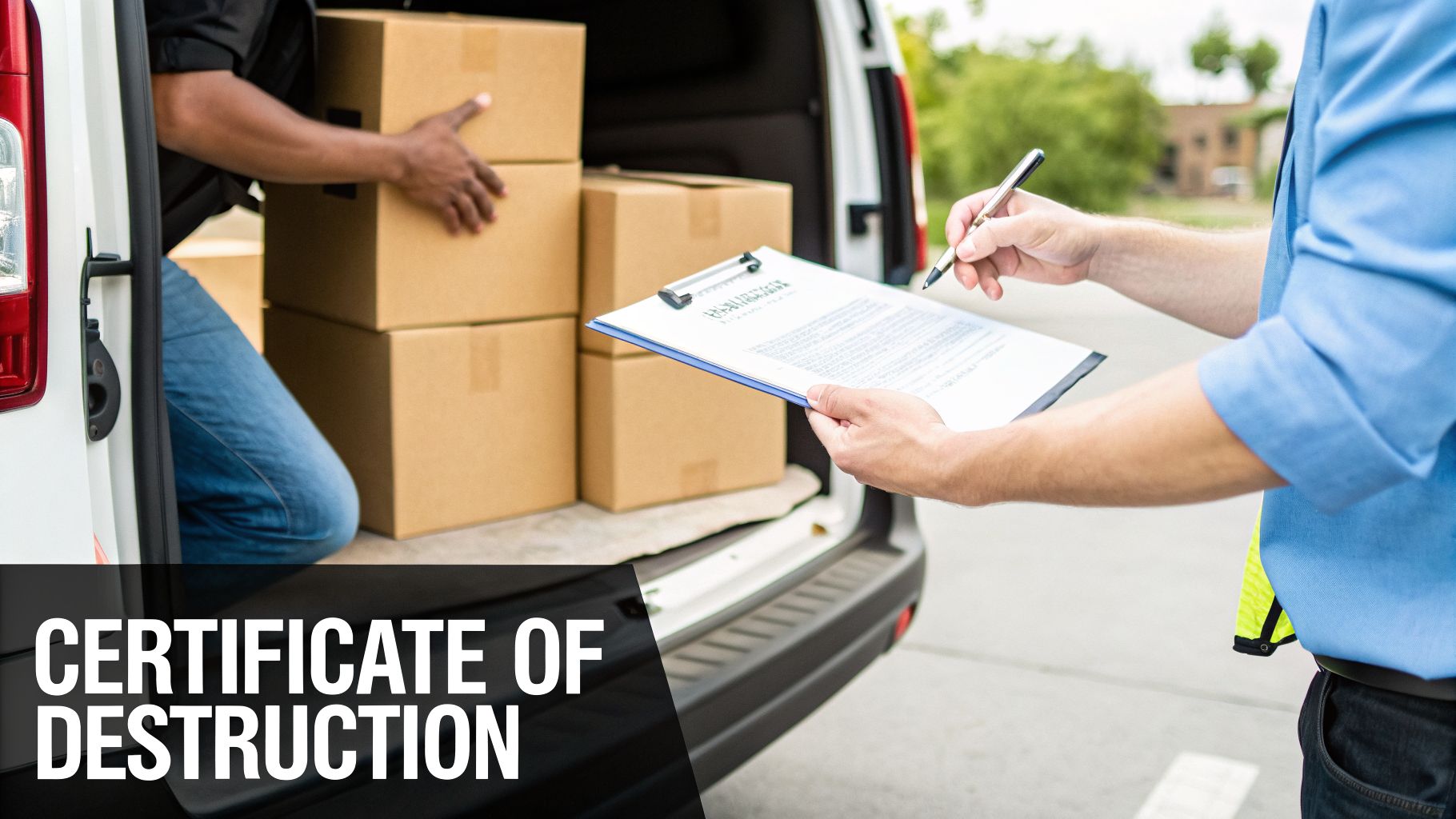
A well-managed pickup should be clean, efficient, and cause minimal disruption to your business operations. When done right, it's a careful, documented transfer of custody—not just a crew tossing boxes into a truck.
The On-Site Pickup Experience
When the disposal team arrives at your Atlanta office, whether it's in Buckhead or Alpharetta, they should be organized and ready to work. Expect a uniformed, insured crew prepared to handle any task, from de-installing servers in a data center to palletizing hundreds of old desktops.
Their first priority is to establish a secure chain of custody. They will verify the equipment against the asset list you prepared, making sure every device is accounted for before it leaves your building. For high-security projects, they should offer locked bins and sealed trucks.
The professionalism of the pickup crew is a direct reflection of the vendor's commitment to security. A team that is patient, organized, and works cleanly demonstrates that they respect your facility and the sensitive nature of their task. That's the standard you should expect for any secure computer disposal in Atlanta, GA.
Before the truck departs, you should receive an initial receipt confirming the transfer of custody. This document is the first piece of your official compliance record.
Understanding The Certificate Of Destruction
The most important document you will receive is the Certificate of Destruction (COD). This is more than a receipt; it's your legal proof that you fulfilled your obligation to protect the data on your retired IT assets. During any audit—whether for HIPAA, SOX, or internal governance—this certificate is your key piece of evidence.
A proper COD isn't a simple confirmation. It must contain specific, verifiable details that trace directly back to your original inventory.
Key elements of a valid COD include:
- Your Company's Information: Clearly identifying your organization.
- The ITAD Vendor's Information: Their name, address, and certification details.
- A Unique Certificate Number: For tracking and verification purposes.
- A Detailed List of Assets: This should list the make, model, and most importantly, the serial number of every single device and hard drive.
- The Destruction Method Used: Specifying whether each drive was wiped (e.g., DoD 5220.22-M) or physically shredded.
- The Date of Destruction: Pinpointing when the data was officially sanitized.
- An Authorized Signature: From a representative of the ITAD company, attesting to the certificate's accuracy.
For businesses interested in seeing how this documentation works, we offer examples and more information about our own Certificate of Destruction process. This document officially closes the loop on your liability.
From E-Waste To Green Initiative
A truly professional partner for secure computer disposal in Atlanta goes beyond data destruction to manage the physical hardware responsibly. This final step connects your IT project to your company's broader corporate social responsibility (CSR) and environmental, social, and governance (ESG) goals.
A certified vendor operates under a strict zero-landfill policy. After data destruction, functional equipment is tested and refurbished for reuse, extending its life and creating a source of affordable technology for other organizations. This is the most sustainable outcome.
Equipment that is broken or too old to be reused is carefully de-manufactured. Materials like steel, aluminum, plastic, and precious metals are separated and sent to certified downstream recycling partners. This process ensures hazardous materials are managed safely and valuable resources are recovered, turning your e-waste problem into a positive, demonstrable green initiative.
Answering Your Top Questions on Secure Computer Disposal
Even the best-laid plans for an IT cleanout run into real-world questions. As an Atlanta-based IT manager or business owner, you need straight answers on logistics, costs, and compliance. We get these questions all the time, so here are the practical insights you need to move forward with confidence.
What Is the Real Cost for an Atlanta Business?
For most businesses in the Atlanta metro area, professional computer disposal is surprisingly affordable. In fact, it can often be free, depending on the age and volume of the equipment being retired.
How does that work? Reputable ITAD vendors recover service costs by remarketing newer, functional assets like recent-model laptops and servers. This approach allows them to provide critical security services, like DoD-standard hard drive wiping, at little to no direct cost to your company.
The most important calculation isn't the service fee—it's the astronomical cost of a data breach. Always get a custom quote, but remember to prioritize a vendor's security credentials and compliance track record over the absolute lowest price.
How Do We Handle Laptops From Remote Employees?
Managing assets from a distributed workforce across the greater Atlanta area is a common challenge, but it's one we solve every day. A professional ITAD partner will work with you to create a clear, auditable process.
We typically see two effective strategies:
- Central Collection Day: Designate a day for remote employees to bring their old equipment to your main office for a scheduled bulk pickup.
- Mail-In Kits: Your disposal partner can provide secure, pre-labeled shipping boxes so employees can send their devices directly to the processing facility.
No matter which method you choose, the key is ensuring every single device is tracked from start to finish. Your partner absolutely must provide a serialized Certificate of Destruction that individually accounts for every remote asset. This gives you a complete, auditable trail that closes the loop on your liability.
This documentation is your proof that you maintained control over company assets, even those that were never physically inside your office.
Are You HIPAA Compliant and What Proof Do You Provide?
Yes. Any true ITAD specialist serving the healthcare industry must provide services that directly support your HIPAA compliance efforts. This isn't just a marketing claim; it's a commitment backed by strict, documented procedures.
A compliant process always includes these critical steps:
- Secure Chain of Custody: Documenting the transfer of assets right from your facility.
- Auditable Data Destruction: Using either NIST 800-88 or DoD-standard wiping, or physical shredding for total data elimination.
- Formal Documentation: Issuing a legally defensible Certificate of Destruction.
This certificate is your official record proving you fulfilled your duty to protect Patient Health Information (PHI) on end-of-life media. When vetting any partner for secure computer disposal in Atlanta GA, you should always ask to see a sample certificate and confirm their willingness to sign a Business Associate Agreement (BAA). For any HIPAA-covered entity, a BAA is non-negotiable.
What Actually Happens to Our Computers After Pickup?
Once your old equipment arrives at a secure processing facility, our team immediately triages each asset. The goal is always to maximize sustainability while guaranteeing 100% data security.
First, we identify functional devices with remaining market value—things like newer laptops, servers, and networking gear. After the data on these devices is securely wiped clean, they are refurbished and sold. This reuse model is the most sustainable option, and it's what helps keep your disposal costs low.
For all other data-bearing devices, the hard drives are either wiped to federal standards or physically shredded into tiny, irreparable pieces. This guarantees that absolutely no data can ever be recovered.
Finally, any obsolete or broken equipment is de-manufactured. Materials like steel, plastics, and precious metals are separated and sent to certified downstream recyclers. A responsible ITAD program, like ours at Atlanta Computer Recycling, guarantees a zero-landfill outcome. This ensures hazardous materials are managed safely and valuable resources are put back into the circular economy.
Ready to ensure your company's old computers are handled securely, compliantly, and sustainably? Atlanta Computer Recycling offers end-to-end ITAD services for businesses across the metro area, from on-site pickup to certified data destruction.
Contact us today for a free quote at Atlanta Computer Recycling