Finding the Best Sandy Springs Bank for Your Business’s Commercial Needs

When your business is searching for the best "Sandy Springs bank," you're not just looking for a place to deposit funds. You're sourcing a strategic financial partner that understands your commercial objectives. For managers in finance, IT, and operations at growing enterprises, this is a critical decision that directly impacts operational efficiency and growth potential.
Navigating the Sandy Springs Commercial Banking Landscape

For a sophisticated business, a bank must be more than a vault. It's your financial operating system—an integrated platform engineered to fuel expansion, fortify security, and streamline complex operations. Identifying a bank that aligns with these commercial needs is paramount.
The phrase "Sandy Springs Bank" might bring to mind the institution with that exact name. Sandy Spring Bancorp, Inc., has roots stretching back to 1868, evolving from a small savings group into a major financial services provider. Their expansion from basic deposits to offering commercial insurance, surety bonds, and professional liability protection illustrates how a bank must adapt to serve complex business requirements.
Defining Your Ideal Commercial Banking Partner
A high-value banking relationship is built on pillars that extend far beyond a basic business checking account. For medium and large organizations, the right partner delivers a powerful suite of tools designed to support your strategic objectives.
These are the non-negotiable requirements:
- Specialized Industry Knowledge: Your business needs a bank that speaks your language. Whether it's understanding HIPAA compliance for healthcare operations or project-based financing for government contractors, niche expertise is invaluable.
- Advanced Commercial Services: Demand a robust suite of services, including treasury management, sophisticated fraud protection, and flexible commercial lending that scales with your enterprise.
- Secure and Efficient Technology: A high-performance commercial online banking platform isn't a perk; it's a mission-critical tool. It must support multi-user access controls, streamlined payment processing, and seamless ERP integration.
A strong banking partnership is a competitive advantage. It provides the financial agility and expert guidance needed to capitalize on opportunities and manage risks effectively.
This guide will walk your management team through the due diligence process. We’ll explore the services, evaluation criteria, and strategic considerations—including secure IT asset management—that are essential when selecting a Sandy Springs bank. By focusing on these key areas, you can secure a financial partner that truly supports your company’s commercial vision.
Be sure to check out our other business guides to get more actionable insights on operational best practices.
Essential Commercial Services Your Business Requires
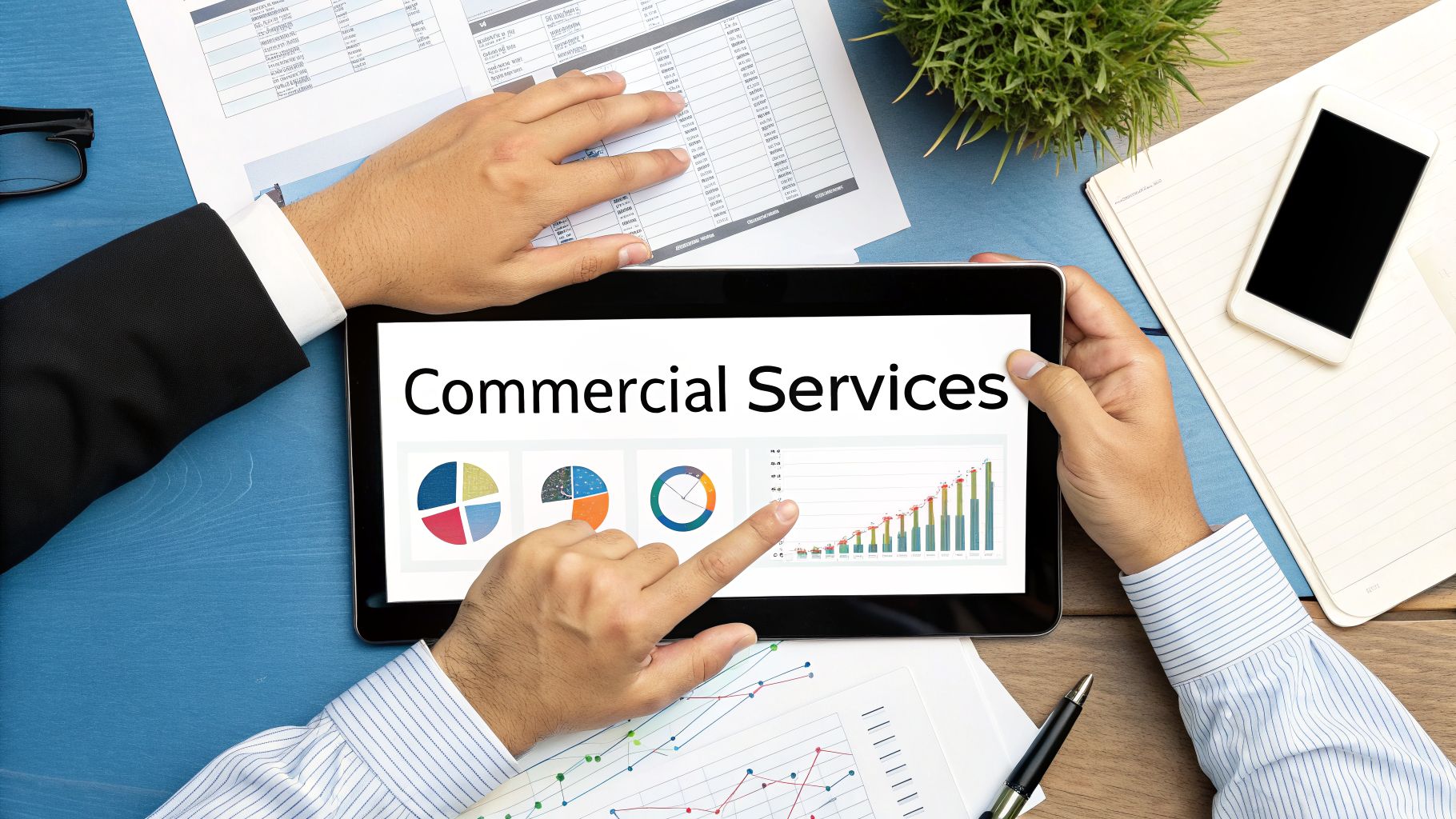
A modern business operates on much more than a simple checking account. To manage complex daily operations and drive sustainable growth, medium and large enterprises require a suite of powerful financial tools. These commercial services are the engine of your financial operations, working in concert to optimize efficiency and control.
When choosing a Sandy Springs bank, you are sourcing a partner capable of delivering this robust toolset. These services are core components that integrate directly into your financial ecosystem, supporting everything from routine transactions to long-term strategic initiatives.
Treasury and Cash Management
This is the command center for your company’s liquidity. Treasury and cash management services are designed to optimize cash flow, streamline payables, and accelerate receivables. For instance, Automated Clearing House (ACH) services enable efficient processing of direct deposit payroll and automated collection of recurring customer payments.
These tools also provide a critical line of defense against financial fraud. Advanced services include:
- Positive Pay: An automated fraud detection service that mitigates check fraud by matching checks presented for payment against a list of authorized issuances.
- Remote Deposit Capture (RDC): Enables you to scan and deposit checks directly from your office, accelerating funds availability and improving cash flow.
- Account Reconciliation Services: Automates the laborious process of matching your internal records with bank statements, freeing up valuable finance team resources.
Treasury management is about more than just moving money. It’s about gaining real-time visibility and control over your company's cash position, empowering you to make smarter, faster financial decisions.
Commercial Lending for Growth and Operations
Beyond managing daily liquidity, your business needs access to capital for operational flexibility and strategic investments. Commercial lending is not a one-size-fits-all product; the optimal loan structure depends entirely on your specific business objectives. You can also explore other business services that support corporate operations.
Key lending solutions include:
- Commercial Lines of Credit: This provides a flexible source of short-term capital to manage seasonal working capital gaps, fund inventory purchases, or cover unexpected operational expenses. It functions as a critical financial safety net.
- Term Loans: These provide a lump-sum disbursement for major capital expenditures, such as acquiring essential equipment, purchasing a commercial property, or financing an expansion. They are structured with a fixed repayment schedule.
Beyond conventional commercial loans, many banks facilitate specialized government-backed programs. It’s worth exploring a comprehensive SBA Loan Guide for Small Businesses to understand these powerful financing options. Together, these integrated services form the bedrock of a resilient financial foundation for your enterprise.
An Evaluation Checklist for Choosing Your Banking Partner
Selecting the right commercial banking partner is a critical decision that will impact your company's financial health and operational efficiency. When assessing a potential Sandy Springs bank, you must look beyond marketing materials and sales pitches to find a true partner for your medium or large business.
This is not simply about opening an account. It is about identifying a financial institution whose services, technology, and expertise align precisely with your daily workflows and long-term strategic goals. The right bank is a powerful asset; the wrong one becomes an operational bottleneck.
Assessing Core Financial Services
Begin by dissecting the bank's commercial account structures and fee schedules. Undisclosed or excessive fees can erode your bottom line, so demand absolute transparency. Analyze everything—from monthly maintenance charges and wire transfer fees to the pricing for advanced treasury management services.
Merchant services are equally vital. If your business accepts credit card payments, you need a banking partner that delivers competitive processing rates, reliable hardware, and PCI-compliant security. A bank that can bundle these services with your primary accounts often provides a more integrated and cost-effective solution.
A banking partnership is only as strong as its weakest link. A bank might offer attractive lending terms but have subpar cash management technology, creating daily friction that costs your team valuable time and money.
Evaluating Technology and Industry Expertise
In modern business, a bank’s online platform is its most important branch. The quality of that digital experience is a deciding factor for any large organization. The platform must be secure, intuitive, and robust enough to handle your company's transaction volume.
Your team requires a platform with essential features like:
- Multi-user access with customizable permissions to grant specific levels of control to different team members.
- Seamless integration with your accounting or ERP software to simplify and automate reconciliation.
- Efficient ACH and wire transfer initiation protected by robust security protocols.
- Remote deposit capture to accelerate check deposits and improve cash flow.
Beyond technology, specialized industry expertise is non-negotiable. A healthcare provider, for instance, must partner with a bank that understands HIPAA compliance and knows how to securely manage protected health information (PHI) in payment processing. This specialized knowledge ensures your financial operations remain compliant and efficient. A thorough evaluation is a core component of your overall business continuity planning checklist.
Systematically Comparing Your Options
To make a strategic, data-driven decision, you need a structured methodology for comparing potential banking partners.
The checklist below provides your leadership team with a clear framework to systematically evaluate each institution. By focusing on these concrete criteria, you can move past surface-level impressions and select a financial partner that delivers tangible, long-term value.
Commercial Bank Evaluation Checklist
| Evaluation Criterion | What to Look For | Red Flags to Watch For |
|---|---|---|
| Fee Structures | Transparent, competitive fee schedules; relationship-based pricing that rewards your total business. | Vague fee disclosures; high costs for essential services like wire transfers or ACH processing. |
| Online Platform | Intuitive interface; robust security features; integration with accounting software; reliable mobile app. | Outdated technology; frequent downtime; limited user permission settings; poor mobile functionality. |
| Industry Knowledge | Proven experience in your sector (e.g., healthcare, manufacturing, non-profit); dedicated specialists. | A generic, one-size-fits-all approach; lack of familiarity with your industry's compliance needs. |
| Merchant Services | Competitive processing rates; modern POS hardware options; PCI compliance support. | High equipment lease fees; confusing rate structures; poor customer support for payment issues. |
Using this disciplined approach ensures you find a banking relationship that not only meets your needs today but can also scale with you as your business grows.
The Strategic Value of Relationship Banking
In a business landscape driven by automation and digital interfaces, it is easy to undervalue one of the most powerful assets a company can possess: a dedicated banking relationship. While digital tools are essential for transactional efficiency, they cannot replicate the strategic value of a dedicated relationship manager—a professional who understands your business and advocates for your interests.
This personal connection provides a significant competitive advantage. When a complex commercial loan needs structuring or a high-value wire transfer requires immediate troubleshooting, an algorithm is insufficient. A skilled relationship manager provides direct intervention and resolution.
The Power of Local Expertise
Your relationship manager should function as an extension of your finance team, offering expert counsel and responsive service that a generic call center can never match. This principle is the cornerstone of community banking, where financial institutions are built to serve the specific needs of their local business environment.
This flowchart illustrates the key decision points when selecting a new bank, from fee structures to industry alignment.
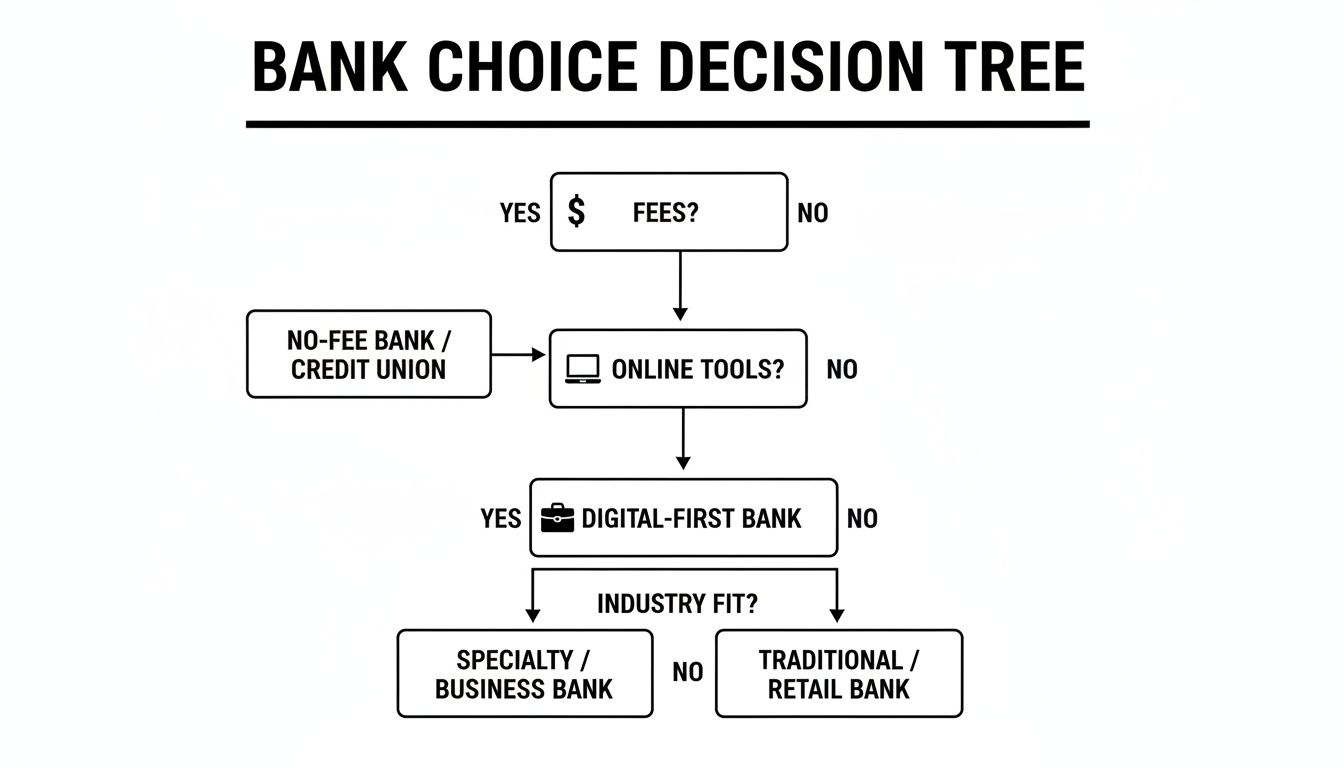
As the chart highlights, while technology and fees are foundational, the third pillar is critical: finding a bank that understands your specific industry. A strong banking partnership begins with an institution that has a proven track record with businesses in your sector. That specialized knowledge ensures they are prepared for your unique operational challenges.
Finding a True Financial Partner
This partnership-driven approach is embedded in the DNA of many community-focused banks. Consider Sandy Spring Bank, for instance. It was officially formed on July 10, 1868, when 26 Quaker farmers pooled their capital—each contributing just $3.50—to create a local savings institution. That origin story encapsulates a commitment to community, a principle that still defines premier relationship banking.
For any business in Sandy Springs, this translates to seeking a bank with a tangible local presence and a team of commercial bankers who are deeply integrated into this market. These are the institutions where you can forge a lasting, strategic partnership.
A dedicated relationship manager acts as your internal champion, helping you access the right services, secure favorable terms, and get decisive answers when you need them most. This human connection is the ultimate value-add.
Building this kind of relationship begins during the initial setup and procurement phases. For more on this, our guide on IT procurement best practices outlines effective strategies for making smart organizational decisions. By prioritizing a strong local relationship, you aren't just opening an account—you are gaining a strategic partner invested in your commercial success.
Secure Banking and IT Asset Management for IT Leaders
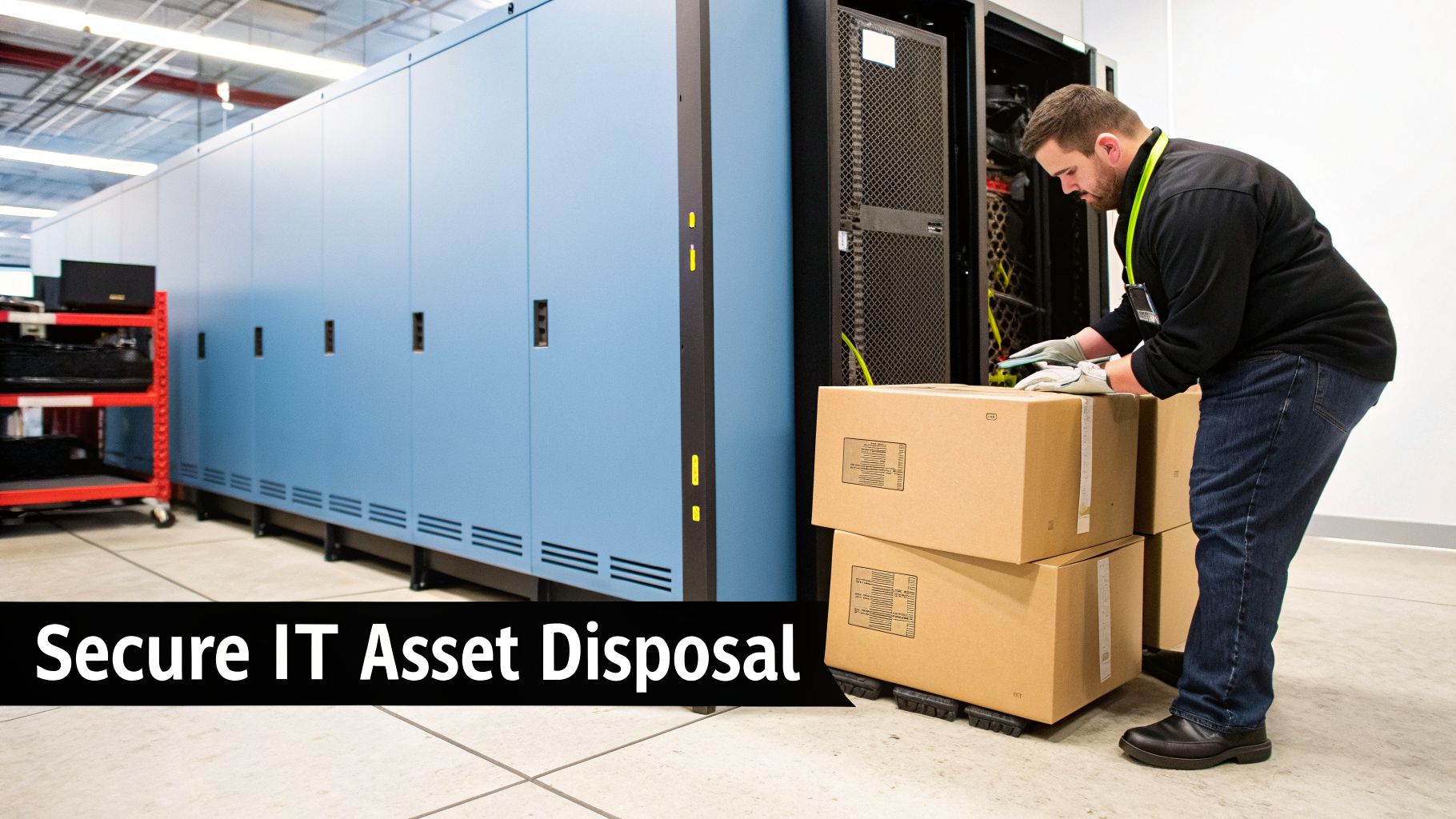
In financial management and IT security, there is no margin for error. For IT leaders, managing the technology that interfaces with your company's financial data is as critical as selecting the right Sandy Springs bank. Your responsibility extends far beyond network uptime.
During any office relocation, hardware refresh cycle, or facility closure, the secure disposition of legacy IT assets must be a top-tier priority. Every workstation, server, and mobile device that once accessed your banking portal or stored financial reports represents a significant data breach risk if not properly decommissioned.
Decommissioning Financial Workstations and Devices
A retired computer from the finance department is like an unlocked safe. Even if you believe it's empty, data remnants can persist on hard drives, creating a substantial liability. A robust decommissioning process is your most critical line of defense.
This process must go beyond simply deleting files. True data security involves several key steps:
- Secure Data Wiping: Utilize certified software to perform a multi-pass wipe on all hard drives and SSDs, overwriting data with random characters to make recovery virtually impossible.
- Physical Destruction: For drives that are end-of-life or cannot be reliably wiped, physical shredding is the only method to guarantee 100% data destruction.
- Inventory Tracking: Maintain a clear chain of custody for every asset. Document its serial number and track it from the moment it is taken offline to its final certified destruction.
To protect their operations and sensitive client data, IT leaders must make robust Cybersecurity Services a core part of their risk management strategy. This helps defend against both internal mistakes and external attacks.
The most secure banking platform in the world can't protect you if sensitive financial data walks out the door on an old hard drive. Your IT asset disposition (ITAD) policy is a critical pillar of your company's financial security.
Partnering for Secure and Compliant Disposal
Coordinating these efforts between your bank and a certified ITAD partner is essential. Before a major office transition, notify your bank to update security protocols, authorized user lists, and IP address whitelists to prevent service interruptions or false security alerts.
Simultaneously, engage a certified ITAD provider. They ensure that every piece of retired equipment is processed according to strict compliance standards, such as those mandated by HIPAA for healthcare organizations. A professional partner can manage the entire lifecycle—from on-site packing and secure transport to providing official Certificates of Data Destruction for your audit records.
For businesses in the area, a professional partner for secure IT asset disposal in Sandy Springs can provide the expertise needed to protect your organization. This is not a technical chore—it is a fundamental component of maintaining your company’s financial integrity.
Opening Your Commercial Bank Account: A Step-by-Step Guide
Once you have completed your due diligence and selected the optimal Sandy Springs bank for your company, the next step is to open the account. This can be a document-intensive process, but with proper preparation, it can be seamless.
The key to an efficient and successful account opening is preparation. Assembling all required documentation beforehand is the single most effective way to prevent delays and initiate your new banking relationship professionally.
Your Commercial Account Opening Checklist
While each bank's requirements may vary slightly, all will request a core set of documents to verify your business's legal status and identify authorized signers. The specific documentation depends on your business structure (e.g., LLC, S-Corp, C-Corp).
Here is a list of documents you will almost certainly need:
- Business Formation Documents: For a corporation, this is your Articles of Incorporation. For an LLC, it’s your Articles of Organization. These documents are filed with the state and prove your business's legal existence.
- Employer Identification Number (EIN): This is your business's federal tax ID number. You will need the official confirmation letter (Form SS-4) from the IRS that assigned this number.
- Business Licenses: Bring any city, county, or state licenses required for your business to operate legally.
- Corporate Resolution or Operating Agreement: This critical document specifies who has the authority to open a bank account on behalf of the company. Corporations use a Corporate Resolution, while for LLCs this authority is typically outlined in the Operating Agreement.
Preparing this paperwork in advance is the single most important step you can take. It transforms the account opening from a potentially frustrating process into an efficient, professional meeting, setting a positive tone for your new banking relationship from day one.
With these documents organized, you can approach your chosen Sandy Springs bank with confidence. This simple preparation ensures you can establish your financial foundation quickly and return your focus to running your business.
Frequently Asked Questions About Business Banking
Even with a comprehensive strategy, selecting the right financial partner can bring up last-minute questions. We've compiled some of the most common concerns business leaders have when evaluating a Sandy Springs bank to help you make a final, confident decision for your company.
National Power or Local Touch?
It’s a classic dilemma: do you partner with a national banking giant or a local community bank? The large national players often offer sophisticated digital platforms and the capacity to handle complex international transactions. Conversely, local banks provide personalized service and direct access to decision-makers, which can be invaluable.
The optimal choice depends on your business's primary need—a vast technology stack or a high-touch relationship with bankers who intimately understand the Sandy Springs market.
For many mid-sized companies, a regional bank hits the sweet spot. They're typically large enough to offer powerful online tools but still small enough to provide a dedicated relationship manager who knows your name.
The Importance of Online Banking
In today's business environment, a bank's online platform is not a mere convenience; it is a core operational hub. A robust platform can save hundreds of administrative hours and significantly tighten financial controls.
Ensure their system includes these non-negotiable features for commercial clients:
- Multi-user access with customizable permissions for your team
- Easy initiation for ACH transfers and wires
- Reliable remote deposit capture to get checks processed quickly
As you manage your company's financial hardware, remember that secure disposal is non-negotiable. Atlanta Computer Recycling offers certified IT asset disposition services to ensure your old financial data is completely destroyed. Protect your business by visiting us at https://atlantacomputerrecycling.com.