Your Guide to Commercial Recycling in Marietta GA


For any Marietta business, building a recycling in marietta program is more than just waste disposal—it's a smart operational move. It all starts with a clear-eyed look at what your company is throwing away and making sure your plan lines up with local commercial regulations. This isn't just about being green; it's about building an efficient, compliant system from the ground up.
Starting Your Marietta Business Recycling Program
Kicking off a commercial recycling program might feel like a huge undertaking, but it’s a necessary step for any forward-thinking business in Marietta. A successful program isn’t built on guesswork. It's built on data. Before you can manage your waste effectively, you need to know exactly what you’re dealing with. This simple first step helps you avoid common mistakes, like paying for dumpsters that are too big or services that don't fit what your company actually needs.
By taking a practical approach, you can create a program that's both environmentally sound and good for your budget right from the start. A quick analysis of your operations will give you the insights to make decisions that help your bottom line and boost your company's reputation.
Conduct a Practical Waste Audit
The first real step is a waste audit, and it's much simpler than it sounds. Just have your team use clear bags for trash and recyclables for a week. Or, take a quick look inside your bins and dumpsters before they get picked up. The goal is to see what your main waste streams are.
Are you seeing a mountain of cardboard from daily shipments? Stacks of office paper? Maybe you're noticing a lot of old electronics from recent upgrades? Documenting these patterns is everything.
A quick snapshot can tell you a lot. I’ve seen mid-sized offices discover that over 60% of what they were sending to the landfill was just clean, recyclable paper and cardboard. That's a huge opportunity to cut down on waste hauling fees.
Identify Your Key Waste Streams
Once you've done your audit, it's time to sort your findings. Most businesses in Marietta will see their waste fall into a few common categories:
- Paper and Cardboard: This is the obvious one—office documents, mail, shipping boxes, and all that packaging material.
- Plastics and Metals: Think about all the plastic bottles, aluminum cans from the breakroom, and other miscellaneous shipping materials.
- Electronic Waste (E-Waste): This is a big one. It covers all the old computers, monitors, printers, and servers that need to be handled by a professional. Knowing how this process works is critical for secure and compliant disposal.
This infographic breaks down the foundational steps for getting your program off the ground, from the initial audit to ensuring you're fully compliant.
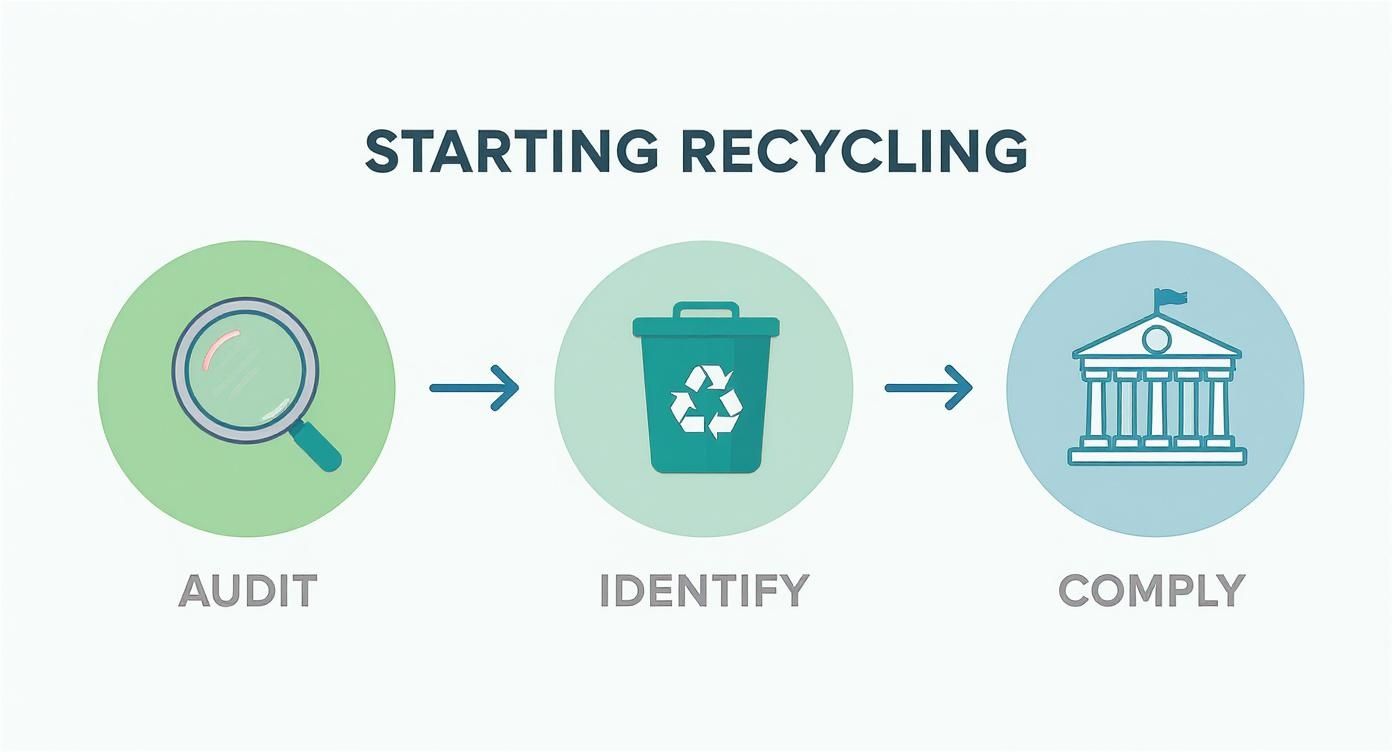
As you can see, a solid program is built on information. First, you gather it (Audit), then you organize it (Identify), and finally, you act on it within the local legal framework (Comply).
Understand Local Commercial Regulations
It's crucial to remember that the rules for commercial recycling in Marietta and Cobb County are very different from the residential curbside programs we're all used to. The City of Marietta has made structured waste management a core part of its community planning for years.
The city’s official framework outlines specific objectives for waste reduction and proper disposal that every business needs to follow. Getting familiar with these requirements ensures your program is compliant right out of the gate, helping you avoid fines and solidifying your reputation as a responsible local business.
How to Choose the Right Recycling Partner
Picking a commercial recycling vendor in Marietta is a bigger deal than just hiring someone to haul away your junk. The right partner becomes an extension of your own team, directly impacting your data security, brand reputation, and even your bottom line. It’s the difference between a simple pickup service and a genuine partnership.
You need to move beyond a basic hauler and find a company that actually gets what your business does. A medical clinic, for instance, has vastly different compliance needs than a manufacturing plant. A real partner helps you navigate those complexities, not just empty your bins.
Vet Potential Providers on Their Capabilities
Start by digging into what a vendor can actually do. Not all recyclers are created equal, especially when you're dealing with electronics. The company that’s great with your cardboard and paper might be completely out of its depth when it comes to secure e-waste disposal.
Don't be afraid to ask direct, pointed questions about their process. If you’re getting rid of old company computers, for example, you need answers to a few key things:
- What is your process for data destruction? If you get a vague answer, that’s a huge red flag. You want to hear specifics, like DoD 5220.22-M 3-pass wiping standards or details about their physical shredding process.
- Can you provide a Certificate of Destruction for each batch? This is non-negotiable. It’s your official proof that you did your due diligence and that the data is gone for good.
- What certifications do you hold? Look for industry benchmarks like R2 or e-Stewards. These credentials are a clear sign that a vendor is committed to responsible and secure electronics handling.
For any business, data security is everything. A single data breach from an improperly wiped hard drive can be catastrophic. A vendor's ability to provide serialized asset reports and certified data destruction isn't a luxury—it's an essential security measure.
Compare Service Models and Pricing Structures
Once you're confident a vendor has the technical chops, it's time to see how their service fits your day-to-day operations. The best fit for your recycling in Marietta depends entirely on your workflow and how much waste you generate.
Most providers offer a few common service models:
- Scheduled Pickups: This is perfect for businesses with a predictable rhythm, like an office that fills up a paper bin every Friday like clockwork.
- On-Demand Service: Ideal for project-based needs. Think of a major office cleanout or a large IT equipment refresh where you suddenly have a ton of gear to get rid of.
- Hybrid Models: Many of the best providers offer a flexible mix, giving you regular service with the option for special pickups when you need them.
When it comes to pricing, look past the initial quote. You need to ask about potential extra charges for things like oversized items, contaminated bins, or special handling fees. A transparent quote breaks down all possible costs so you can budget accurately and avoid nasty surprises down the road.
To get a clearer picture of what a quality partnership looks like, take a look at a directory of established electronic waste recycling companies. Seeing how the pros operate will give you valuable context and show you the industry standards you should expect. A good partner will work with you to create a scalable solution that makes financial sense.
Setting Up an On-Site E-Waste Recycling System
Once you've picked a recycling partner, the next step is getting your internal system running—and making sure your employees actually use it. A truly successful e-waste program isn't about enforcing strict rules. It's about making the responsible choice the easiest one. That means being smart about placement and getting your team genuinely on board.
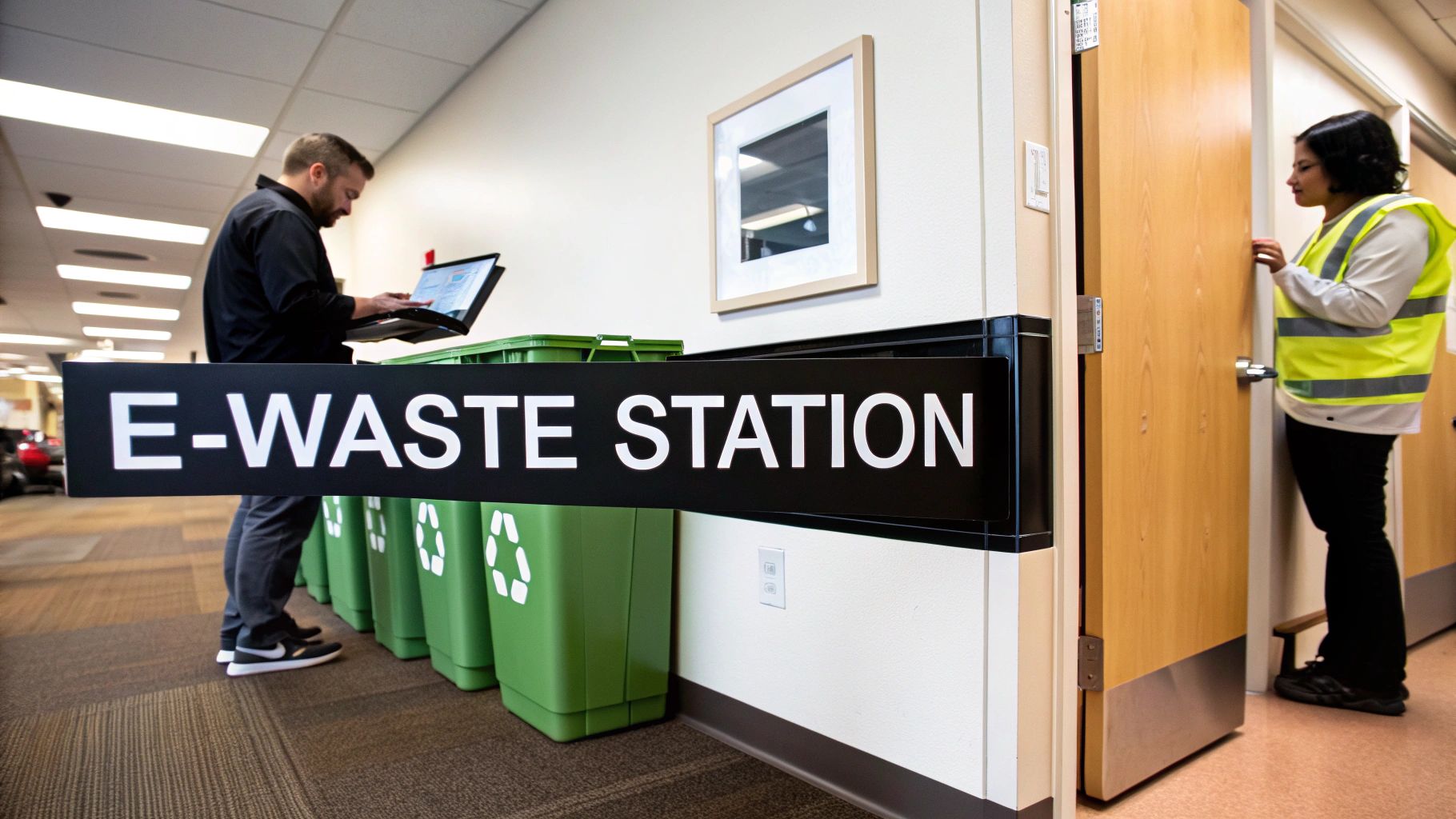
It all starts with accessibility. If tossing old electronics is a hassle, employees won't do it. Place clearly marked collection bins where they will be seen and used. Think beyond the IT closet—put them near copy machines, in break rooms, and in departmental storage areas where old keyboards, forgotten mice, and tangled cables seem to multiply.
Drive Participation with Clear Communication
Clarity is everything. Ambiguity is the fastest way to get a contaminated bin or, even worse, no participation at all. A simple "E-Waste" label just doesn't cut it. You need to create clear, visual guides that leave no room for guesswork.
For instance, your signage should have pictures showing:
- What's Accepted: Laptops, keyboards, cell phones, power cords.
- What's Not: Light bulbs, single-use batteries, or other hazardous materials that need a different disposal route.
This simple visual cue takes the pressure off your team. It’s a small tweak that drastically improves the quality of the materials you hand over to your partner for recycling in Marietta.
The goal is to build an intuitive system. A good program doesn't require a manual to use. An employee should be able to walk up to a bin, glance at the sign, and know immediately if their old monitor or tangled charger belongs there.
Getting this right has a direct impact on program efficiency. Contaminated loads drive up costs and can undermine the entire effort. By making the system simple and clear, you ensure a higher quality of recycled materials and a more cost-effective operation.
To help you get started, here's a quick guide to setting up your on-site collection points.
On-Site E-Waste Collection Best Practices
| Action Item | Why It Matters | Pro Tip |
|---|---|---|
| Use Visual Signage | Pictures are universal. They eliminate confusion about what is and isn't accepted, reducing contamination. | Laminate the signs and attach them directly to the bins with zip ties so they can't be misplaced. |
| Strategic Bin Placement | High-traffic areas (copy rooms, break rooms) make recycling a convenient, top-of-mind option. | Place a small bin right in the IT department's workspace. They generate the most e-waste and can lead by example. |
| Communicate the "Why" | Explaining the data security and environmental benefits gets employees invested in the program's success. | Share milestones in a company newsletter, like "We've recycled 500 lbs of e-waste this quarter!" |
| Provide a Point of Contact | Designate someone (often in IT or facilities) to answer questions and manage bin collection. | Add the contact person's name and extension directly on the signage so employees know who to ask. |
A well-planned internal system not only makes the recycling process smoother but also reinforces your company's commitment to doing things the right way.
Launching Your Program for Long-Term Success
Announcing the new system is your chance to frame it as a shared goal, not just another corporate policy. Don't just fire off a company-wide email. Bring it up in a team meeting and explain the real reasons behind it—how it protects sensitive company data, helps meet environmental goals, and reflects your corporate values.
Tie the impact directly to your brand. When responsible e-waste disposal becomes part of your company culture, the system basically runs itself. For businesses wanting to dig deeper, our guide to electronics recycling services offers more practical insights. This kind of internal buy-in is what turns a corporate mandate into a source of employee pride and real, lasting change.
Managing Data Security and Compliance
When your business gets rid of old electronics, you're doing more than just clearing out closet space. You're handling a critical security task. Think about it: that old server, retired laptop, or stack of company phones is packed with sensitive information. If you mishandle those devices, it’s not just a compliance headache—it's a direct invitation for a data breach. That kind of mistake can do serious damage to your company's reputation and bottom line.
For any Marietta business, getting the security side of e-waste right is non-negotiable. This is where a professional partnership really shows its value, turning a simple disposal task into an active risk management strategy.
Understanding Data Destruction Methods
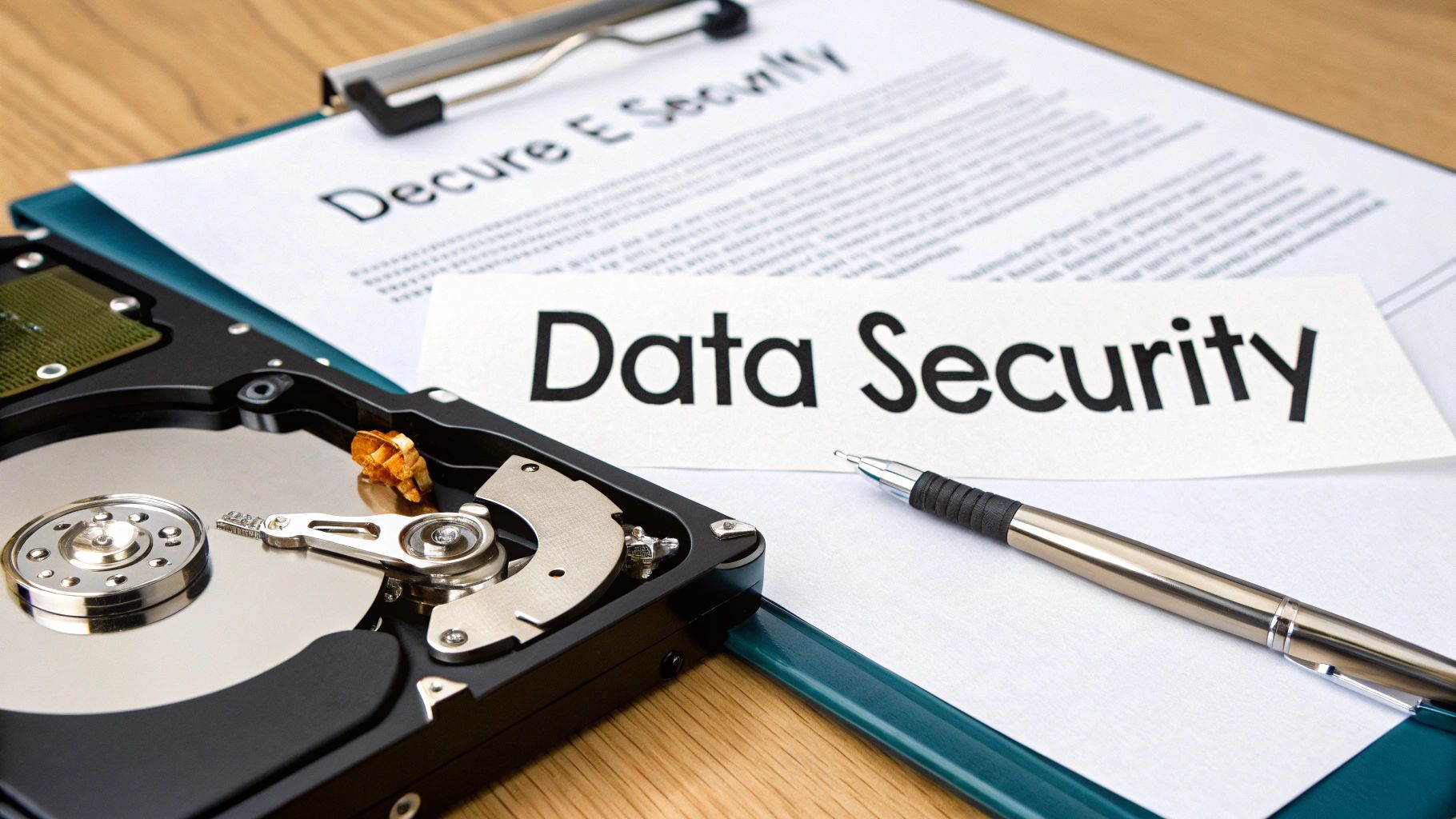
Simply deleting files from a hard drive does absolutely nothing to protect your data. To make sure that information is gone for good and completely irrecoverable, you need professional data destruction. Your recycling partner will typically use one of two rock-solid methods:
- Physical Shredding: This is exactly as aggressive as it sounds. Hard drives, SSDs, and other storage media are fed into industrial shredders that pulverize them into tiny, useless fragments. It’s the most secure method out there and provides absolute certainty that the data is destroyed forever.
- Degaussing: This process uses a ridiculously powerful magnetic field to wipe the data from magnetic media, like older hard drives. While it works well for that specific tech, it's completely ineffective on modern solid-state drives (SSDs). That’s why shredding has become the go-to, most reliable option for most businesses today.
When choosing a vendor for recycling in Marietta, finding one who offers certified and documented destruction is a must. A vague promise to "wipe the drives" just doesn't cut it. You need a guaranteed, verifiable process.
The Power of Certifications and Documentation
So, how can you be sure your recycling partner is actually doing what they say they are? The proof is in their certifications and the paperwork they provide. These are your guarantees that everything is being handled securely and by the book.
Trust is good, but verification is better. Industry certifications like R2 (Responsible Recycling) or e-Stewards aren't just fancy logos. They represent a deep commitment to rigorous, third-party audited standards covering everything from data security and environmental responsibility to worker safety.
When you’re vetting a potential partner, always ask for proof of these certifications. A certified recycler is held accountable to the highest industry standards, which gives you the peace of mind that your equipment—and the data on it—is in safe hands.
Your Indispensable Paper Trail
At the end of the day, documentation is your ultimate proof of due diligence. It’s the tangible evidence showing you took every necessary step to protect your company's data. After every single pickup, your recycling partner absolutely must provide you with detailed, specific documents.
These are the two non-negotiable documents you need to demand and keep on file:
- Certificate of Destruction: This is the official document confirming your data-bearing devices have been securely destroyed. It should clearly state the method used (like shredding) and the exact date of destruction. You can learn more about why a Certificate of Destruction is a cornerstone of any secure IT asset disposal program.
- Serialized Asset Report: For businesses that need to track individual assets for accounting or compliance, this report is vital. It creates a clear chain of custody by listing each device by its unique serial number, from the moment it leaves your facility to its final destruction.
These documents aren't just for your internal records. They are indispensable during security audits, compliance reviews, or in the worst-case scenario of a legal inquiry. They are your proof that your company acted responsibly.
Turning Recycling into a Business Advantage
A well-executed commercial recycling program is about so much more than just checking a compliance box. For smart businesses in Marietta, it's a powerful tool for building your brand, attracting top talent, and connecting with the community. What might seem like an operational cost can actually become a cornerstone of your company's identity.
This approach transforms a simple internal process into a genuine marketing asset. When you share your sustainability story, you're speaking directly to a growing audience of environmentally conscious customers. Highlighting these initiatives shows you’re a responsible partner in the community, which does wonders for your brand's reputation.
Communicating Your Sustainability Efforts
Your recycling efforts tell a story, and it's one worth sharing. It’s a tangible, real-world example of your company's values in action. Feature it in your Corporate Social Responsibility (CSR) reports, on your website’s "About Us" page, and across your social media channels.
Don't just make generic statements about being "green." Get specific. Create a short case study detailing a recent office-wide electronics upgrade where 100% of the old equipment was responsibly recycled. That kind of measurable achievement resonates far more than vague promises.
Your recycling program is a source of authentic, positive stories about your brand. Sharing these stories helps you connect with clients, investors, and potential employees who prioritize environmental responsibility. It’s a competitive differentiator that builds trust and loyalty.
This kind of positive community engagement has never been more important. It’s worth learning how local initiatives are tackling waste challenges in Cobb County to see how your company's story can fit into the bigger picture.
Boosting Morale and Attracting Talent
The ripple effects of a strong recycling program are felt inside your company, too. It’s a huge boost for employee morale. People feel a sense of pride working for a company that puts its values into practice. You can amplify that feeling by sharing program milestones, like the total weight of e-waste your team has diverted from landfills each quarter.
In today’s tight job market, a real commitment to sustainability can be the thing that makes top talent choose you over a competitor. Modern professionals want to work for employers whose values mirror their own. Highlighting your responsible recycling in Marietta program shows that your company is forward-thinking and invested in more than just the bottom line.
It's also a chance to give back directly. For instance, programs where businesses can donate a laptop add another powerful layer to your corporate giving story, supporting local community needs. This is how you turn an operational necessity into a clear competitive advantage.
Answering Your Top Questions About Commercial Recycling
When setting up a commercial recycling program, a few key questions always come up. Getting the right answers from the start is the difference between a smooth, cost-effective system and a compliance headache. Let's walk through the most common questions we hear from Marietta businesses so you can move forward with confidence.
What Are the Biggest Mistakes Marietta Businesses Make?
By far, the most common mistake is skipping a waste audit. If you don't know what your business is actually throwing away, you can't build an effective recycling program. This oversight almost always leads to paying for oversized dumpsters or the wrong kind of pickup service.
The other big one? Underestimating the importance of employee training. You can have the best bins in the world, but if your team doesn't know what goes where, you'll end up with high contamination rates—think half-eaten lunches in the paper bin. Contaminated loads drive up your costs and can even get your recyclables rejected by the processor.
We often see businesses focus heavily on bin placement but forget the people using them. A five-minute training session explaining what goes where can prevent 90% of contamination issues and make your entire program more cost-effective.
Are Businesses Legally Required to Recycle Electronics in Georgia?
This is a big one. While Georgia doesn't have a blanket landfill ban on electronics for businesses, federal laws like the Resource Conservation and Recovery Act (RCRA) absolutely apply. This act governs how you dispose of anything containing hazardous materials, and ignoring it can bring on some serious penalties.
But here's the even more critical part: data privacy. Modern regulations demand the secure and permanent destruction of any data stored on retired devices. Just tossing an old hard drive isn't just a bad idea—it's a direct violation of data security standards and a massive liability. Working with a certified e-recycler is the only surefire way to stay compliant with both environmental and data security laws. It’s about protecting your business from every angle.
How Much Should We Budget for a Commercial Recycling Service?
There's no one-size-fits-all answer here, as costs can vary quite a bit. That's why getting detailed, custom quotes is so important. Your final price tag will really depend on a few key factors:
- Your waste volume: How much material are you generating each week or month?
- The types of materials: E-waste that requires certified data destruction is priced differently than, say, a simple load of cardboard.
- Pickup frequency: Are you looking for a scheduled weekly plan or a more flexible, on-demand service?
Some vendors might charge a flat monthly fee, while others will bill per pickup or by the pound. The good news? A well-run recycling in Marietta program almost always lowers your total waste disposal costs. By diverting heavy materials like paper and electronics away from the landfill, you reduce your more expensive general trash fees. For many of our clients, the savings on general waste hauling end up offsetting a huge portion of their recycling service costs.
Ready to build a secure and compliant electronics recycling program for your Marietta business? The experts at Atlanta Computer Recycling are here to help you every step of the way, from initial pickup to certified data destruction. Contact us today for a custom quote.