Logistics Optimization for ITAD: A Complete Guide

If you're staring at a spreadsheet full of retired laptops, boxed network switches, and a row of servers that need to leave the building without disrupting users or exposing regulated data, you're not dealing with a normal pickup. You're managing a liability transfer. The truck is only one part of it.
That distinction matters because a lot of advice about logistics optimization was written for freight, parcel volume, or last-mile delivery. IT asset disposition works under different rules. A missed dock appointment is annoying. A broken chain of custody tied to data-bearing devices is a security problem, a compliance problem, and sometimes a legal problem.
Why ITAD Logistics is Not Standard Logistics

Most logistics content talks about miles, freight cost, route density, and delivery speed. That's useful if you're moving finished goods. It falls short when you're moving retired servers, storage arrays, backup appliances, and employee devices that may still contain sensitive data.
Industry commentary on optimization tends to focus on freight lanes and last-mile delivery, but it rarely addresses constrained, one-time, compliance-heavy moves where chain of custody and secure handling matter most. It also points out a critical reality for hospitals, data centers, and government facilities: the cheapest route can be the wrong route if it increases security exposure or downtime (RTS Labs).
That is the core ITAD rule. In this environment, a route isn't "optimal" because it's shorter. It's optimal when it reduces risk, preserves documentation, and lets operations continue without surprises.
For teams reviewing new key technologies for supply chains, the useful question isn't whether automation exists. It's whether the technology supports secure pickup windows, live status updates, serialized asset tracking, and documented handoffs. Generic automation can streamline movement. It doesn't automatically create defensible control.
Security changes the definition of efficiency
A standard freight planner might combine stops, use the lowest-cost carrier, and tolerate handoffs if that lowers transportation spend. In ITAD, each added touchpoint increases exposure. Every temporary staging area, subcontracted transfer, unlabeled pallet, or undocumented custody change creates a gap you may have to explain later.
Practical rule: If a logistics decision saves money but weakens visibility, custody control, or site security, it isn't optimization for ITAD.
That becomes even more important during office closures, hospital refreshes, and data center decommissions. Those projects create unusual flows. Equipment may come from multiple floors, secure rooms, satellite sites, and departments that use different tagging standards. The move is often one-time, fast-moving, and visible to internal audit.
A security-first plan usually borrows from broader supply chain risk management strategies rather than ordinary transportation playbooks. The planning lens shifts from "How do we move this cheapest?" to questions like these:
- Who touched the asset last
- What data risk category does it belong to
- Where can it be staged safely
- Which handoff requires a signature or scan
- What proof will audit, legal, or compliance ask for later
Downtime can cost more than transport
The hidden failure in many ITAD moves isn't freight cost. It's business disruption. If a pickup crew arrives during a tenant access restriction, blocks a loading dock at the wrong time, or removes equipment out of decommission sequence, the move creates operational noise immediately.
That is why logistics optimization in ITAD starts with risk-adjusted planning, not route math. A secure, boring, fully documented move is usually the right move.
Building Your Pre-Move Intelligence Report
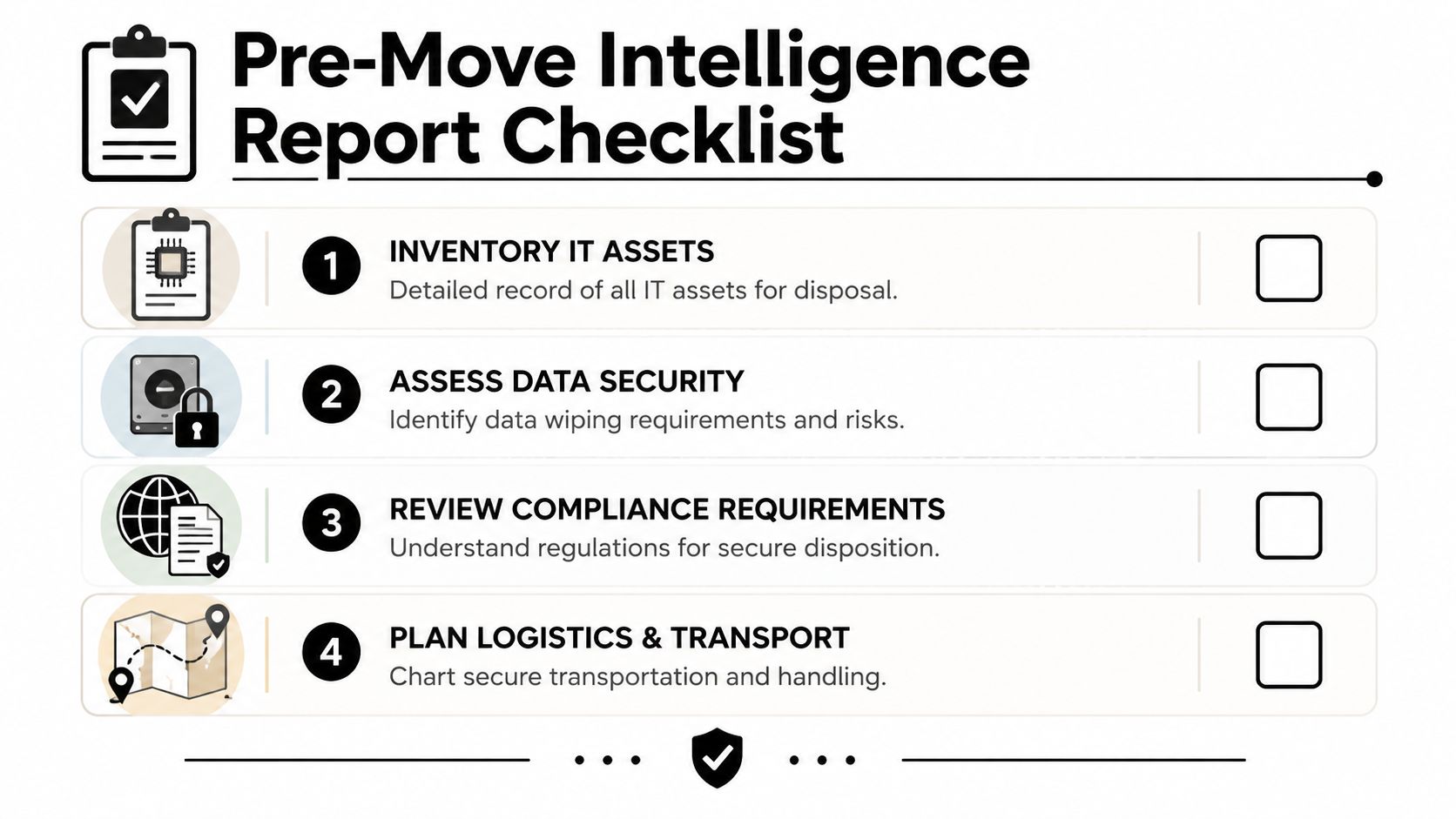
Bad ITAD projects usually don't fail in transit. They fail before pickup, when the asset list is incomplete, the site contact doesn't know building rules, or nobody clarified which devices need wiping, shredding, remarketing, or immediate destruction.
A strong logistics optimization workflow starts by defining measurable objectives, assessing data quality early, and piloting changes before full rollout. Guidance on execution also stresses that success depends on optimizing multiple levers, including route, load, and carrier, based on a clear initial assessment (Sheer Logistics). In ITAD terms, that means you need a pre-move intelligence report before anyone books a truck.
What belongs in the report
Think of this as an operations packet, not a generic checklist. It should give logistics, security, facilities, and compliance the same version of reality.
Include:
Master asset inventory
Build a line-level list of what is leaving. Use serial number, asset tag, device type, location, and ownership if available. If the source data is messy, fix it now. Don't assume the scan team can reconcile naming chaos on the dock.Data risk classification
Separate equipment into practical groups. Data-bearing devices from executives, finance, healthcare environments, or server rooms shouldn't be treated like keyboards, monitors, or empty chassis.Site constraints
Document dock access, freight elevator rules, badge procedures, parking restrictions, stair-only paths, pallet jack limitations, cage locations, and whether equipment needs de-racking or cable removal.Handling instructions
Note what must remain upright, what requires anti-static packing, what moves in locked bins, and what can be palletized.
Ask the site questions people skip
The most expensive surprises are usually simple. Is there after-hours access? Who can sign release paperwork? Can the crew enter the MDF or data hall without an escort? Will building management require a certificate of insurance before move day? Is there a service elevator reservation process?
If the pickup team learns building rules from the security desk on arrival, planning wasn't finished.
Teams that want tighter documentation often pair this work with better IT asset tracking software so the inventory, custody records, and final disposition reporting start from the same asset baseline.
Separate asset classes before move day
A mixed load creates confusion. A classified load creates control.
| Asset category | Primary concern | Planning response |
|---|---|---|
| Laptops and desktops | Residual data, user ownership gaps | Scan individually, assign wipe or shred path |
| Servers and storage | High data sensitivity, de-install complexity | Sequence removal, use dedicated handling plan |
| Network gear | Rack dependencies, configuration retention | Verify disconnect order and packaging |
| Peripherals and low-risk electronics | Volume and sort efficiency | Consolidate separately from data-bearing devices |
A short pilot helps when the project is large or the site is unusual. Test the scan workflow, packaging method, access route, and paperwork on a smaller batch first. In ITAD, pilots don't just validate speed. They expose custody gaps while the stakes are still manageable.
Designing Secure Routes and Disruption-Free Schedules
The best ITAD route plan often looks inefficient on paper. It may avoid multi-stop consolidation, skip the cheapest timing window, or use a longer direct path to reduce handoffs. That's not bad planning. That's planning around the actual cost drivers: exposure, access issues, and disruption to the client.
Choose the route that reduces custody risk
For standard freight, route optimization usually prioritizes distance, fuel, and stop density. For ITAD, route design starts with a different question: How do we get these assets from the pickup point to the processing facility with the fewest risk points?
That typically means preferring:
- Direct transport instead of adding unrelated stops
- Known drivers and vehicles instead of broad dispatch pools
- Tight departure windows so equipment doesn't sit staged on-site
- Pre-cleared arrival times at the receiving facility so unloading begins promptly
A downtown office pickup may only involve a few dozen devices, but the complexity can still be high. Building security may require an approved vendor list, loading access may be limited, and freight elevator time may be controlled in short windows. In that case, the route isn't the main challenge. The schedule is.
By contrast, a data center decommission usually needs phased removal. One truck may be enough physically, but not operationally. If hardware has to come out in a specific sequence, if some racks remain live while others are retired, or if devices need on-site segregation by disposition path, the smarter plan uses staged pickups and load consolidation after secure staging.
Schedule around business continuity
Most clients don't care whether your route model is elegant. They care whether users can work, whether the dock isn't jammed, and whether the server room isn't crowded with people at the wrong time.
A useful scheduling approach looks like this:
Office refreshes
Plan around employee traffic, receptionist staffing, and elevator availability. Early access or after-hours pickup often works better than mid-day activity.Healthcare sites
Build around patient flow, restricted treatment areas, and compliance-sensitive zones. The move plan should respect the facility's operating rhythm, not force the site to adapt to the truck.Campus and multi-building projects
Group pickups by access pattern and internal escort needs, not just geography.Data center work
Tie each move window to de-install sequencing, cage access, and receiving readiness.
A route that arrives on time but forces the client into chaos isn't an optimized route.
For organizations arranging a larger electronics recycling pickup, experienced coordination becomes evident. The pickup window, labor plan, packaging method, and receiving capacity all have to line up. Otherwise equipment waits. Delays often lead to mistakes.
Use scenarios, not assumptions
The strongest plans model failure points before move day. What happens if the dock is blocked? What if the designated signer is unavailable? What if one floor isn't ready? A secure schedule includes contingencies, alternate access instructions, and clear escalation contacts.
That discipline matters because ITAD moves are rarely repetitive. They are often one-off events with security implications. In one-time projects, assumptions don't get smoothed out by repetition. They become incidents.
Enforcing an Unbreakable Chain of Custody

A pickup isn't secure because the driver is trustworthy or the recycler has a good reputation. It's secure because the process creates proof. In ITAD, chain of custody has to survive scrutiny from compliance teams, legal reviewers, and internal audit. If you can't reconstruct who had the asset, when they had it, and what happened next, the process is weaker than it looks.
Build the custody trail at the asset level
The minimum standard is serialized accountability. Each asset should be tied to a unique identifier that can be scanned, matched, and reconciled later. For some environments, pallet-level logging isn't enough. Mixed loads and loose device counts create too much ambiguity.
A defensible custody workflow usually includes:
- Pickup scan records tied to asset tags or serial numbers
- Container or pallet association so groups of assets can be tracked during transit
- Documented handoffs at every change of responsibility
- Receiving confirmation at the processing facility
- Final disposition status that maps back to the original inventory
This is where digital visibility matters. Logistics has advanced from static, manual planning to digital, real-time routing and network optimization. One example cited in industry reporting is Johnson & Johnson, which reduced transportation costs by 15% while achieving a 99.8% on-time delivery rate for time-sensitive products through optimization and visibility controls (FarEye). ITAD can apply the same principle of visibility and control, even though the objective is different. Here, the value isn't just punctuality. It's traceability.
Physical controls still matter
Software logs don't replace physical security. They support it.
Use a layered approach:
| Control | Why it matters in ITAD |
|---|---|
| Tamper-evident seals | Shows whether containers were opened after pickup |
| GPS-tracked vehicles | Verifies route adherence and supports incident review |
| Locked bins or cages | Reduces casual access during staging and transport |
| Driver identification and release procedures | Prevents unauthorized collection |
| Signed transfer records | Creates accountability at each handoff |
Facilities teams that manage secure receiving areas often already understand this mindset from warehouse access control. Resources on how to secure your Perth warehouse access illustrate the same operational principle: access discipline and auditability have to be designed into the environment, not assumed.
The strongest chain of custody isn't the one with the most paperwork. It's the one where the paperwork matches the physical reality at every step.
Ask your ITAD partner hard questions
A serious provider should answer these directly:
- Do you scan at pickup or only at processing
- Are vehicles company-controlled or brokered
- How are exceptions documented
- What happens if a seal number doesn't match
- Who signs each custody transfer
- How do you support audit requests months later
Organizations that require tighter data-destruction controls often look for an AAA NAID certified process because custody, destruction handling, and audit expectations need to align. Certification isn't a substitute for operational discipline, but it does help frame the standard you should expect.
Measuring What Matters ITAD Logistics KPIs
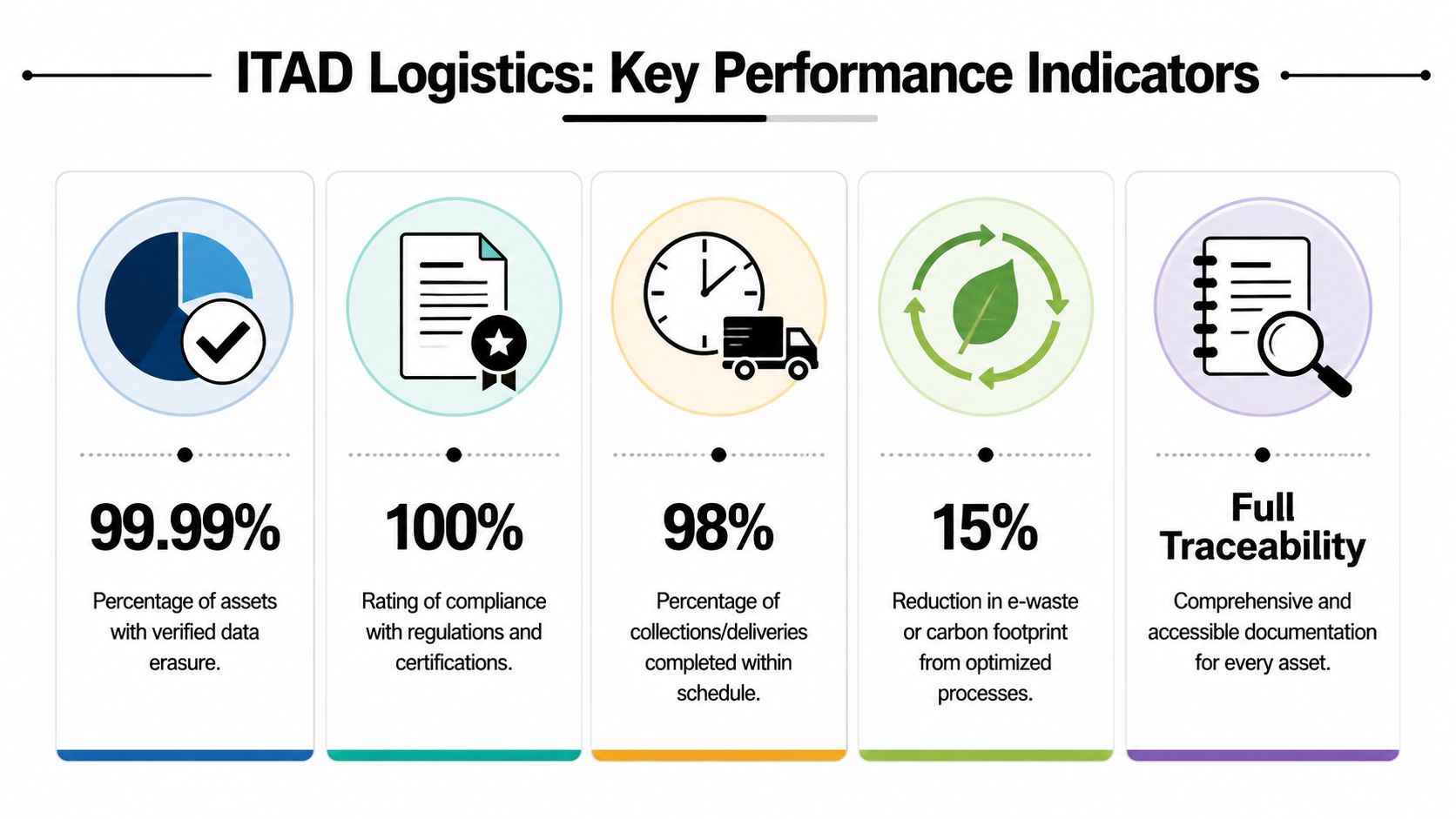
Most logistics dashboards overweight transportation metrics. They track miles, cost per stop, fuel, and carrier utilization. Those numbers can help, but they don't tell an IT manager whether the disposition project was controlled well.
For ITAD, the KPI set has to reflect the core business objective: remove retired assets without losing accountability, disrupting operations, or weakening compliance posture.
A sound optimization method translates strategy into a tiered KPI structure and avoids ad hoc KPI sprawl by using a uniform taxonomy for cost and performance data. Local metrics need a clear line of sight to total cost and business objectives (Efficio). In practice, that means your pickup team, project manager, compliance lead, and IT operations owner shouldn't all be measuring success differently.
The KPIs worth tracking
Start with a compact scorecard. If every team invents its own metrics, accountability gets fuzzy.
Chain of custody accuracy
Count whether every asset on the approved pickup list appears in scan records, transfer logs, and final reconciliation. In ITAD, missing records are not a minor variance.On-time pickup performance
Measure whether the crew arrived and completed collection within the agreed window. This isn't just a service metric. It reflects how well the move respected access constraints and business continuity.Documentation turnaround time
Track how quickly inventory reports, destruction documentation, and final reconciliation are delivered after processing. Slow paperwork delays internal closeout.Exception rate
Monitor mislabeled assets, unreadable tags, count discrepancies, or loads requiring manual research.Security incident rate
Any custody break, seal mismatch, unauthorized access issue, or undocumented deviation belongs here.
Don't let cost metrics dominate the dashboard
Cost still matters. It just shouldn't drive decisions in isolation.
A useful way to frame the dashboard is to separate security, service, and cost. Security metrics should carry the most weight. Service metrics come next. Cost metrics help identify process waste once the essential elements are safeguarded.
If a vendor reports a low transportation cost but can't produce clean reconciliation and custody records, the dashboard is telling you the wrong success story.
Here's a practical model:
| KPI group | Primary question |
|---|---|
| Security | Did every asset remain fully accountable from pickup to disposition? |
| Service | Did the move happen when promised, with minimal disruption? |
| Compliance documentation | Can the organization prove what happened to every device? |
| Cost | Was the process controlled efficiently without compromising the first three groups? |
Teams formalizing these controls often fold them into broader IT asset management best practices so disposition isn't treated as a disconnected end-of-life event. That's the right approach. If retirement data doesn't match the original asset records, your downstream metrics will always be noisier than they should be.
Keep the KPI list short enough to manage
A bloated scorecard creates busywork. A disciplined one drives decisions. If a metric doesn't affect staffing, route design, custody controls, or provider accountability, it probably doesn't belong in the main dashboard.
The point of logistics optimization in ITAD isn't to produce more charts. It's to make weak spots visible before they turn into audit findings or security incidents.
Finalizing the Project Close and Reconciliation
The project isn't finished when the truck leaves. It's finished when the paperwork, inventory, and disposition records agree.
That closeout step is where disciplined logistics proves its value. Broader supply-chain optimization guidance notes that effective optimization can reduce inventory costs by up to 30%, improve order-fulfillment cycles by 50%, and increase forecasting accuracy by up to 40% (Gurobi). The larger lesson applies directly to ITAD: optimization creates value through visibility and control across the full process, not through transportation alone.
Reconcile every line item
Start with the original approved inventory and reconcile it against:
- Pickup scan records
- Receiving confirmation
- Disposition outcome
- Final certificates and supporting reports
Every gap needs an explanation. Not later. At close.
A clean reconciliation package should show that each asset moved through a documented path from release to final outcome. If one server appears on the pickup log but not on the final processing record, that is not clerical noise. It is an unresolved liability until proven otherwise.
Archive the proof, not just the summary
Many organizations make the mistake of saving only the headline documents. Keep the underlying support too. That usually means chain-of-custody forms, scan exports, exception notes, destruction records, settlement documentation when applicable, and client-facing summary reports.
The audit trail has to outlast the memory of the people who ran the project.
A short post-project review is also worth doing while the details are fresh. Note what slowed the move, where site information was incomplete, which packaging assumptions were wrong, and whether the schedule matched the building's real operating conditions. The next project gets easier when those lessons are written down instead of carried informally by one project lead.
A well-run ITAD logistics plan closes the loop on asset liability. The assets leave. The records hold up. The organization can prove what happened.
Atlanta organizations that need secure, low-disruption IT asset pickups can work with Atlanta Computer Recycling for business-focused electronics recycling and ITAD support. If you're planning an office refresh, hospital equipment turnover, or data center decommission, their team can help coordinate pickup logistics, data destruction workflows, and final disposition documentation with the control commercial environments require.