IT equipment recycling Atlanta: A strategic guide for businesses

When your Atlanta business retires its IT assets, it's more than a logistical task—it's a critical moment for data security, environmental compliance, and operational efficiency. Handled correctly, IT equipment recycling in Atlanta transforms from a potential liability into a secure, responsible, and streamlined component of your technology lifecycle management.
Why Smart IT Recycling Is a Strategic Business Decision
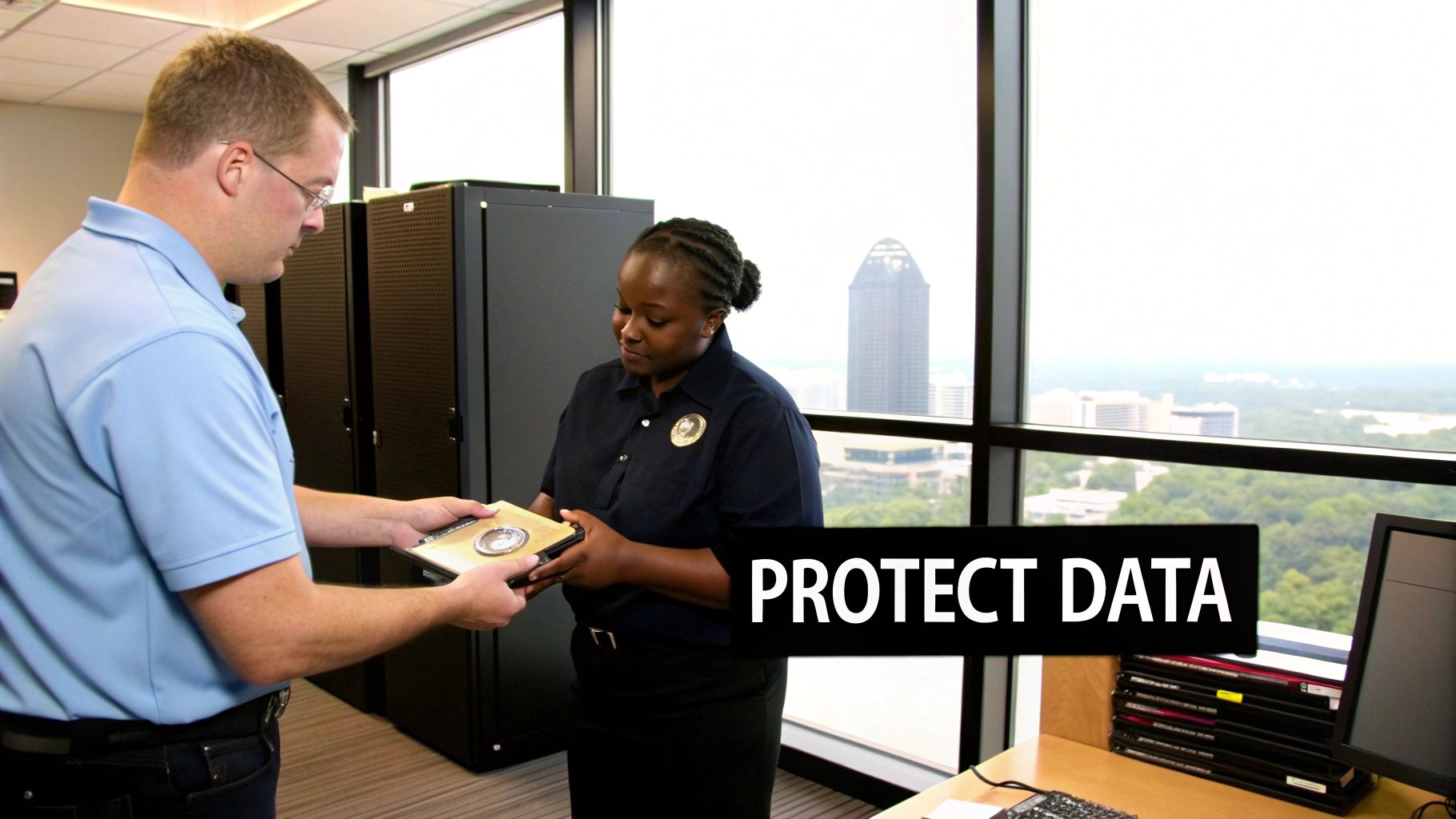
Once a corporate server, laptop, or storage array reaches its end-of-life, its journey is far from over. For Atlanta-based enterprises, this final phase is loaded with both significant risks and strategic opportunities. The most immediate threat? Data security. A single improperly discarded hard drive can contain a trove of sensitive corporate data, from customer PII and intellectual property to proprietary financial records.
Failing to manage end-of-life hardware is a direct threat to your organization's security posture. Without certified data destruction, that information becomes vulnerable. A data breach can lead to severe financial penalties, protracted legal battles, and irreparable damage to your brand's reputation.
Protecting More Than Just Corporate Data
Beyond digital risks, environmental stewardship is a growing corporate responsibility. Electronic waste, or e-waste, is one of the world's most rapidly expanding waste streams. Improper disposal of IT assets isn't just irresponsible—it can lead to non-compliance fines and run counter to corporate sustainability goals.
Professional IT equipment recycling ensures that hazardous materials like lead and mercury are managed safely, preventing them from contaminating local landfills and water supplies. For any business committed to its ESG (Environmental, Social, and Governance) targets, this is a non-negotiable operational standard. To better understand the scope of this issue, you can explore the environmental impact of electronic waste and see why professional management is critical.
Turning Liability Into an Asset
A well-executed IT asset disposition (ITAD) strategy does more than mitigate risk; it generates value. It provides a clear, auditable trail demonstrating your company's compliance with regulations like HIPAA, SOX, or PCI DSS. This "chain of custody" documentation is essential for businesses in regulated sectors such as healthcare, finance, and e-commerce.
By partnering with a certified specialist for IT equipment recycling Atlanta businesses gain assurance that their retired assets are managed securely and ethically. This guide serves as a strategic roadmap for navigating the ITAD process, protecting your data, and transforming a potential vulnerability into a secure, compliant, and intelligent business operation.
Decoding the Language of IT Asset Disposition
When your Atlanta business is ready to retire old hardware, "recycling" is just one component of a much larger discipline. A professional service operates under the umbrella of IT Asset Disposition (ITAD)—a comprehensive, end-to-end process designed to manage retired technology securely, responsibly, and efficiently.
An expert ITAD service functions as a specialized security operation for your company’s data, not merely a removal service. It doesn't simply transport old equipment; it ensures every byte of sensitive information is tracked, accounted for, and permanently destroyed before the hardware is responsibly recycled or remarketed. This distinction is what shields your business from costly data breaches and compliance failures.
This structured approach is more critical than ever. The global electronics recycling market was valued at USD 43.2 billion in 2025 and is projected to reach USD 147.9 billion by 2035. This growth signals an urgent need for businesses in major commercial hubs like Atlanta to secure reliable ITAD partners. PCs and laptops are driving this surge, accounting for a dominant 45.0% of the market and underscoring the absolute necessity of secure data management during disposal. You can dive deeper into the market data by exploring the growing electronics recycling market on factmr.com.
The Foundation of ITAD: Secure Data Destruction
At the core of any reputable ITAD program is certified data destruction. Simply deleting files or reformatting a hard drive leaves sensitive corporate data dangerously exposed and easily recoverable. Professional ITAD providers utilize two primary, industry-standard methods to ensure your data is permanently eradicated.
- Data Wiping (Sanitization): This software-based method overwrites every sector of a storage device with random data, rendering the original information unrecoverable. The industry benchmark is the DoD 5220.22-M 3-pass standard, which provides a verifiable, auditable process suitable for assets that may be refurbished and resold.
- Physical Shredding: For devices that are obsolete, non-functional, or contain highly sensitive information, physical destruction is the definitive solution. The hard drives are fed into industrial shredders that pulverize them into small, unrecognizable metal fragments, providing absolute proof that the data can never be compromised.
The appropriate method depends on your company's internal security policies and whether the assets hold any residual value. For Atlanta’s healthcare providers bound by HIPAA or financial firms requiring a transparent audit trail, these certified processes are a mandatory component of risk management.
A dangerous misconception is that a factory reset provides adequate data security for business assets. In reality, recoverable data fragments almost always remain, creating a significant security vulnerability for any organization that bypasses certified destruction methods.
Key Services That Protect Your Business
Beyond data destruction, a comprehensive ITAD program is a suite of integrated services designed to protect your organization from start to finish. These components create a seamless, secure, and documented process that covers every stage of the asset retirement lifecycle.
The table below outlines these core services and explains their strategic importance to your company's security and compliance framework.
Essential ITAD Services and Their Business Impact
| Service Component | What It Achieves | Why Your Atlanta Business Needs It |
|---|---|---|
| On-Site De-Installation | Professional technicians safely disconnect, de-rack, and prepare equipment for transport directly from your office or data center. | This minimizes disruption to business operations and mitigates the risk of damage or data exposure by ensuring proper handling from the outset. |
| Secure Logistics & Transport | Assets are securely packed and transported in company-owned, GPS-tracked vehicles operated by vetted employees. | This establishes a secure chain of custody the moment equipment leaves your facility, preventing loss, theft, or tampering during transit. |
| Asset Tagging & Tracking | Every device is inventoried and assigned a unique serial number for end-to-end tracking throughout the disposition process. | This creates a detailed, auditable record of every asset, which is crucial for compliance reporting, internal audits, and asset management. |
| Certified Recycling | Materials are processed in accordance with strict environmental standards, such as those mandated by R2 or e-Stewards certified facilities. | This guarantees responsible management of hazardous e-waste, shielding your company from environmental liability and supporting corporate sustainability initiatives. |
Each step is a critical link in a robust security chain. By understanding what IT asset disposition truly entails, you can perform effective due diligence and select a partner that fully protects your organization.
When you engage a provider for IT equipment recycling in Atlanta, you aren’t just hiring a vendor—you're commissioning a security operation for your retired corporate data.
Getting Data Security and Environmental Compliance Right
When your Atlanta business transfers custody of its retired IT assets, you're entrusting a partner with your company's most critical asset: its data. In this context, data security and environmental compliance are not guidelines—they are absolute legal and financial imperatives. A single misstep can result in significant regulatory fines, litigation, and lasting damage to your corporate reputation.
The first step is understanding the regulatory landscape. For any business handling sensitive information, compliance is governed by strict regulations with substantial penalties for violations.
- HIPAA (Health Insurance Portability and Accountability Act): For healthcare providers, insurers, or business associates in Atlanta, HIPAA compliance is paramount. A retired server or an old employee laptop still contains protected health information (PHI), and a breach can lead to fines reaching millions of dollars.
- PCI DSS (Payment Card Industry Data Security Standard): Any company that processes credit card payments must adhere to PCI DSS. End-of-life point-of-sale systems or back-office computers may hold sensitive cardholder data, making their secure disposal a critical compliance checkpoint.
These standards are non-negotiable. A compliant IT equipment recycling Atlanta service must include a documented and verifiable process for data destruction, keeping your business on the right side of the law.
Why Industry Certifications Matter
How can you be certain a vendor will reliably protect your data and manage e-waste responsibly? This is where industry certifications are indispensable. They provide third-party validation, transforming a company's claims into proven, audited operational standards you can trust.
Two certifications are recognized as the gold standard in the ITAD industry:
- R2 (Responsible Recycling): The R2 standard establishes rigorous requirements for environmental safety, worker health, and data security. An R2-certified facility has demonstrated adherence to a strict hierarchy of reuse, recovery, and disposal, ensuring your assets are managed responsibly throughout their end-of-life.
- e-Stewards: Often regarded as the most stringent certification, e-Stewards maintains a zero-tolerance policy against exporting hazardous e-waste to developing nations. It guarantees the highest level of environmental and social responsibility.
Partnering with a certified recycler provides peace of mind and, more importantly, a defensible, auditable process that demonstrates due diligence—your best protection against the fallout from a data breach or an environmental incident.
Building an Unbreakable Chain of Custody
The "chain of custody" is the cornerstone of a compliant ITAD program. It is a detailed, chronological paper trail documenting every movement of your equipment, from the moment it leaves your facility to its final destruction and recycling. This documentation is your proof of compliance.
A robust chain of custody is not just a best practice; it is a business necessity. It is the documented evidence that protects your organization by proving precisely how, when, and by whom your sensitive data was securely and permanently destroyed.
This process is vital, especially given the immense volume of global e-waste. This waste stream is projected to exceed 65 million metric tonnes in 2025, with businesses contributing nearly 40% of that total. Alarmingly, only about 20% of e-waste is properly recycled, leaving a massive opportunity for data breaches and environmental harm. Our guide on secure data destruction details the specific methodologies we use to ensure this process is airtight.
Beyond data security, environmental stewardship is a core component of our services. Businesses seeking to strengthen their green initiatives can also explore resources like Grants for Waste Prevention to support their sustainability goals. By choosing a certified partner for IT equipment recycling in Atlanta, you ensure every asset is accounted for, securing your data and upholding your commitment to corporate responsibility.
The IT Recycling Process From Office to Data Center
To fully grasp IT recycling in Atlanta, it's useful to understand what a project entails on the ground. The reality is that there is no one-size-fits-all solution. The process scales significantly depending on whether you're retiring a few dozen laptops or decommissioning an entire data center.
Let's examine two common business scenarios. Though they differ in scale, both follow a methodical framework designed to protect your data and provide a verifiable chain of custody from start to finish.
Scenario One: The Standard Office Refresh
Imagine your Atlanta headquarters is upgrading 50 employee laptops and retiring several outdated network switches. This is a standard project for an ITAD partner, and the process is engineered for efficiency and minimal disruption to your daily operations.
Here’s the typical project flow:
- Inventory and Proposal: You provide your partner with a general list of the assets slated for retirement. They respond with a detailed proposal based on the equipment type and the required level of data destruction services.
- Scheduling and Logistics: A pickup is scheduled to align with your business operations. The logistics team ensures the appropriate vehicle and professional crew are dispatched.
- On-Site Collection: Uniformed, professional technicians arrive at your office. They efficiently and respectfully collect the designated assets, packing them into secure, locked containers for transport.
- Secure Transit: The equipment is transported directly to a secure processing facility in a company-owned vehicle. This is critical for maintaining an unbroken chain of custody.
- Processing and Data Destruction: At the facility, every asset is logged by its serial number. Hard drives are then either sanitized using DoD-compliant software or physically shredded, according to your security requirements.
- Reporting and Certification: Upon completion, you receive the essential documentation: a Certificate of Data Destruction and a detailed report listing every processed asset. This is your official proof of compliance for internal and external audits.
This streamlined process ensures that even a smaller IT equipment recycling Atlanta project receives the same high-security treatment as a large-scale engagement. It's designed to be simple for your team but incredibly rigorous behind the scenes.
Scenario Two: The Complex Data Center Decommissioning
Now, let's escalate the complexity. A data center decommissioning is a distinct operational challenge, involving hundreds or thousands of assets—servers, storage arrays, networking gear—all intricately cabled within racks. This is not a simple pickup; it is a logistically intensive project demanding specialized expertise.
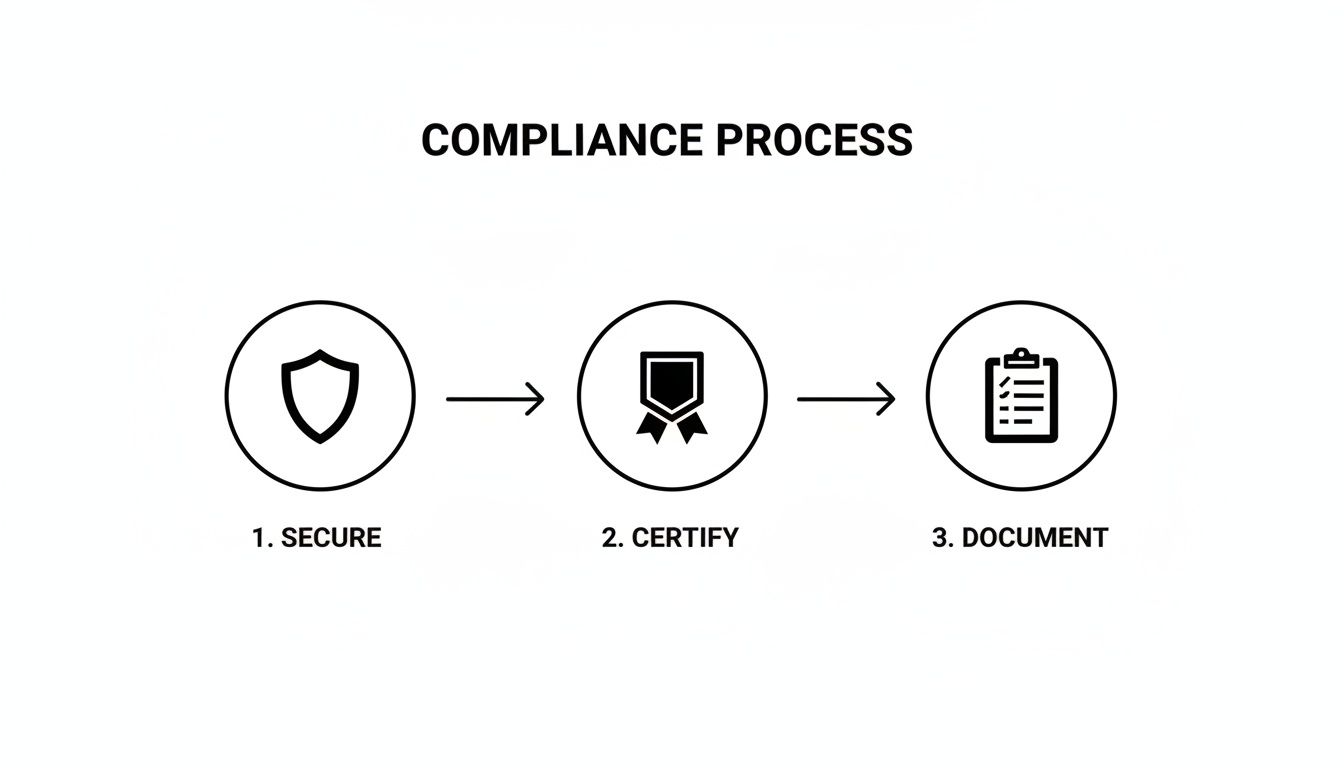
This diagram illustrates the core of any compliant project, regardless of scale. The principles of securing assets, certifying their destruction, and documenting the process remain constant, but the execution becomes far more hands-on.
Here’s what differentiates a data center project:
- On-Site Project Management: A dedicated project manager is assigned to be on-site, serving as your single point of contact to coordinate the entire decommissioning.
- De-racking and Disconnection: Trained technicians methodically disconnect all cabling and carefully de-install every server and switch, a delicate process to prevent damage to equipment or the facility.
- Asset Tagging and Palletizing: On-site, every piece of hardware is tagged with a unique barcode. All equipment is then professionally packed and shrink-wrapped onto pallets for secure transport.
For a project of this magnitude, many clients opt for on-site data destruction. This involves bringing a mobile hard drive shredder directly to your data center, allowing you to witness the physical destruction of your most sensitive media before it ever leaves your premises.
Comparing Two Common IT Recycling Projects
This table highlights the key differences between a typical office refresh and a full-scale data center decommissioning.
| Process Step | Standard Office Refresh (20-100 Assets) | Data Center Decommissioning (500+ Assets) |
|---|---|---|
| Planning | Simple inventory list and quote. | Detailed project plan, on-site assessment, and Statement of Work (SOW). |
| On-Site Work | Quick pickup by a 1-2 person crew. | Multi-day project with a full team for de-racking and cabling. |
| Data Destruction | Typically performed off-site at the vendor's secure facility. | Often performed on-site with mobile shredders for maximum security assurance. |
| Logistics | Assets loaded into secure bins or a box truck. | Assets palletized, shrink-wrapped, and transported via secure freight. |
| Documentation | Standard Certificate of Destruction and asset report. | Comprehensive reporting with individual asset tracking and on-site logs. |
As you can see, while the goals of security and compliance are the same, the execution is tailored to the project's complexity.
The volume of retired corporate equipment is immense. In 2022, the world generated 62 million tonnes of e-waste, a figure that has doubled since 2010. Furthermore, documented recycling rates are projected to fall to just 20% by 2030 as technology obsolescence outpaces processing capacity. By working with a certified local expert, you ensure your equipment doesn't contribute to the 5.1 million tonnes of e-waste shipped across borders annually, often without proper documentation.
Whether you're clearing out a small office or decommissioning a data center, the core principles of security and documentation are unwavering. The process simply scales to meet the project's demands, protecting your Atlanta business at every step. For a deeper dive into large-scale projects, review our guide on the data center decommissioning process.
How to Choose the Right Recycling Partner in Atlanta

Selecting a partner for your IT equipment recycling is one of the most critical security decisions your Atlanta business will make. The right vendor acts as a guardian for your data and a steward for your environmental commitments. The wrong one can expose your organization to devastating data breaches, legal penalties, and reputational damage.
Making an informed choice requires looking beyond a price quote. It involves a thorough due diligence process, scrutinizing a potential partner’s procedures, certifications, and security protocols. This checklist will help you ask the right questions to identify a trustworthy partner capable of protecting your company’s sensitive information.
Verify Industry Certifications
Certifications are your first line of defense. They provide independent, third-party verification that a company adheres to the highest industry standards for data security and environmental responsibility. Do not rely on verbal assurances—always request copies of their certification documents.
Focus on these two gold-standard certifications:
- R2 (Responsible Recycling): This certification confirms the vendor follows strict protocols for data sanitization, worker safety, and the responsible management of the entire recycling chain. An R2-certified partner demonstrates a commitment to accountability.
- e-Stewards: Widely considered the most rigorous standard, e-Stewards enforces a zero-tolerance policy against exporting hazardous e-waste to developing countries. It signifies the highest level of environmental and social responsibility.
A partner lacking these credentials does not have the audited systems in place to shield you from liability. Always confirm their certifications are current and valid.
An uncertified recycler operates as a black box. You have no verifiable assurance that your data is truly destroyed or that your equipment is managed responsibly, leaving your company exposed to significant risk.
Scrutinize Data Destruction Methods
Your primary objective is the absolute, irreversible destruction of all sensitive data. Any potential partner must clearly articulate their methodologies and provide documented proof of their efficacy.
Ask these specific questions:
- What data wiping standards do you adhere to? The answer should reference software that meets or exceeds NIST 800-88 or DoD 5220.22-M standards. These methods utilize multiple overwrites to make data forensically unrecoverable.
- What is your process for physical destruction? For non-functional hard drives or media containing highly sensitive data, physical shredding is essential. Inquire about the shred size—smaller is more secure.
- Do you provide a serialized Certificate of Data Destruction? This is non-negotiable. It is your official, auditable proof that your data was securely destroyed and should list the serial numbers of all processed devices.
Understanding the services offered by a professional electronic waste recycling company is key to ensuring they can meet your specific security requirements.
Inquire About Logistics and Chain of Custody
A secure process begins the moment your equipment leaves your facility. The chain of custody—the documented trail of your assets—must be unbroken. Any gap represents a potential security breach.
Your vetting process should include:
- Transportation Security: Does the vendor use their own background-checked employees and company-owned, GPS-tracked vehicles? Using third-party couriers introduces unnecessary risk.
- Asset Tracking: How do they inventory and track each item from your location to its final disposition? Look for a partner who uses serialized asset tags to generate detailed reports.
- Facility Security: Is their processing facility secure? Ask about access controls, 24/7 video surveillance, and alarm systems that protect your assets during processing.
- Insurance Coverage: Ensure they carry adequate liability insurance, including policies for data breaches and environmental pollution, to protect your business in a worst-case scenario.
By carefully evaluating these critical areas, you can move beyond sales pitches and select a partner for IT equipment recycling in Atlanta that delivers genuine security and complete peace of mind.
Your Go-To Partner for Responsible IT Asset Disposal
For any modern Atlanta business, selecting the right IT equipment recycling partner is a strategic decision that directly impacts data security, legal compliance, and corporate reputation. The process, whether a simple office refresh or a complex data center decommission, is about transforming a logistical challenge into a secure, efficient, and well-documented outcome. This begins with choosing a certified, local partner.
This is about more than just removing old hardware. It’s about implementing a defensible security process that protects your most sensitive information with an unbreakable, auditable chain of custody. It’s about ensuring hazardous e-waste is managed responsibly, keeping your company compliant and reinforcing your commitment to corporate sustainability.
At its core, professional IT asset disposition is effective risk management. It systematically closes security gaps, mitigates compliance risks, and protects the brand equity you have worked hard to build.
When you select the right team, you are not just disposing of old equipment; you are making a strategic investment in your company's security and future.
For Atlanta’s IT leaders, compliance officers, and data center managers, the path forward is clear. Do not leave your retired technology—and the sensitive data it contains—to chance. We invite you to schedule a consultation with our experts to discuss your specific requirements and develop a secure, compliant plan for your end-of-life IT assets.
Frequently Asked Questions About IT Recycling
When it comes to IT equipment recycling, Atlanta businesses have important questions. From data security protocols to cost structures, getting clear answers is the first step toward making a sound, compliant decision. Here are some of the most common questions from our corporate clients.
What Happens to Our Data-Bearing Devices?
This is the most critical question. The only acceptable answer is that 100% of your data is destroyed before any other processing occurs. A professional ITAD partner will either sanitize the drives using government-approved software (like the DoD 5220.22-M standard) that overwrites the data multiple times, or they will physically shred the drives into unrecoverable fragments.
For businesses in regulated industries like healthcare or finance, this is a mandatory step. You should always receive a formal Certificate of Data Destruction that lists the serial number of every drive processed. This document is your auditable proof of due diligence.
Do We Have to Pay for IT Recycling Services?
The cost for IT equipment recycling in Atlanta is determined by the project scope. The final pricing is a function of several variables: the type, age, and condition of your equipment, the total volume, and the logistical requirements of the project.
- Valuable Assets: If your equipment has residual market value (e.g., recent-generation servers or laptops), we can often provide a credit or purchase the assets. This can significantly offset or even eliminate service fees.
- Older or Mixed Assets: For obsolete or mixed-value equipment, a fee is typically required. This covers the costs of secure transportation, labor, certified data destruction, and responsible materials recycling.
- Complex Projects: Large-scale projects, such as a full data center decommissioning, will include costs associated with the specialized on-site labor required to de-rack and palletize equipment.
Always request an itemized proposal that provides full transparency.
A common mistake is selecting a vendor based solely on the lowest price. An unusually low quote can be a red flag for cut corners in data security or environmental compliance—risks that far outweigh any minor upfront savings.
What Types of Equipment Do You Accept?
A full-service ITAD partner should be able to manage the entire spectrum of your business technology assets, providing a single-vendor solution. While you should always confirm the specifics, we typically accept a comprehensive range of commercial equipment:
- Computers and Laptops: Desktops, workstations, and notebooks from all major manufacturers.
- Servers and Network Gear: Rack and blade servers, switches, routers, and firewalls.
- Data Center Equipment: Storage Area Networks (SANs), tape libraries, and enterprise-grade UPS systems.
- Office Electronics: Printers, copiers, scanners, and VoIP phone systems.
- Mobile Devices: Bulk quantities of corporate smartphones and tablets.
Professional ITAD services are structured for business needs, not residential electronics. We are equipped for the volume, logistics, and critical data security challenges that corporations face.
How Do We Prepare for a Pickup?
Your team's preparation should be minimal; we manage the heavy lifting. The primary task is to consolidate the equipment in an accessible location, such as a spare office or near a loading dock. You do not need to attempt to wipe drives yourself. It is more secure to allow certified professionals to handle data destruction so it is performed to standard and properly documented. For larger projects, our team performs all on-site work, from unplugging servers to palletizing assets for secure transport.
Ready to create a secure and compliant plan for your company's retired technology? As Atlanta's trusted experts in business-to-business ITAD, Atlanta Computer Recycling ensures your data is secure and your equipment is handled responsibly. Schedule a consultation to discuss your specific needs.