A Business Guide to Hard Drive Destruction Service

When a business needs to decommission old computers, servers, or storage devices, a professional hard drive destruction service is the only way to guarantee that sensitive corporate data is permanently and verifiably destroyed. It’s a non-negotiable security measure that protects your company from data breaches, reputational damage, and steep regulatory fines.
Why Your Old Hard Drives Are a Ticking Time Bomb
That closet full of retired IT assets isn't just taking up space—it's a massive business risk waiting to happen. It’s a common mistake to think that deleting files or reformatting a drive is enough to secure corporate data. This creates a false sense of security that can be incredibly dangerous for your organization.
Think of it this way: deleting files is like tearing the table of contents out of a book. The actual information—your customer lists, financial records, and proprietary strategies—is still written on the pages, ready for anyone with basic recovery tools to read. A professional hard drive destruction service isn't just an IT expense; it's a fundamental part of modern corporate security and risk management.
The Real Cost of Improper Disposal
The fallout from improperly discarded hardware can be catastrophic. A single hard drive recovered from a dumpster can unleash a data breach that triggers a cascade of devastating consequences for your business.
- Financial Penalties: Regulators don’t take "we thought we deleted it" as an excuse. A data breach from an old drive can result in crippling fines under laws like HIPAA, GDPR, or CCPA.
- Reputational Damage: The hit to your brand's reputation after a breach can be far more damaging than any fine. Rebuilding customer and shareholder trust is a long, expensive, and sometimes impossible journey.
- Legal Liability: On top of regulatory penalties, your company could be hit with class-action lawsuits from customers, partners, or employees whose private information was exposed.
Failing to properly destroy data isn't a simple oversight; it's a direct compliance failure. You can learn more about the best practices for handling this process by reviewing our guide on old hard drive disposal.
From Best Practice to Business Imperative
The demand for hard drive destruction has exploded as data breaches become more common and regulations get tougher. High-profile security incidents have pushed companies to get serious about managing their end-of-life IT assets. With strict rules like Europe's GDPR and U.S. laws like HIPAA and various state privacy acts, professional, documented destruction has become an absolute necessity for corporate governance.
A professional hard drive destruction service transforms data disposal from a liability into a documented, audit-proof security measure. It's the only way to guarantee that your company's digital history doesn't become someone else's asset.
While securing old hard drives is a critical step, it's just one piece of the puzzle. It's essential to build a comprehensive security plan that protects your data from every angle. You can learn more about modern data breach prevention strategies to ensure your business is fully protected.
Decoding the Methods: Shredding vs. Degaussing vs. Wiping
When it's time to retire old hard drives, deciding how to handle the data isn't just an IT task—it's a critical business decision. The method you choose has direct implications for your security, compliance, and bottom line. Getting it wrong can open the door to a devastating data breach.
To make sense of it all, let's think of a hard drive as a chalkboard filled with your most sensitive company secrets. Your one and only goal is to make sure nobody can ever read what was written on it.
Software Wiping: Erasing the Chalkboard
Software wiping, also known as data erasure, uses special programs to overwrite the information on a hard drive with random ones and zeros. This process is repeated multiple times in a series of "passes."
This is like meticulously erasing the chalkboard. From a distance, it looks perfectly clean, and the original message is gone. The problem? A determined forensics expert with the right tools might still be able to see the faint outlines of what was once written there. While wiping is a good option for drives you plan to reuse internally, it's not a foolproof solution for permanent disposal, especially when strict regulations are involved. You can get a much deeper look into how to delete hard drive data in our detailed guide.
Degaussing: Scrambling the Chalk Dust
Degaussing is a far more aggressive approach. It uses an incredibly powerful magnetic field to completely scramble the magnetic coating on the drive's platters where your data actually lives.
Back to our chalkboard analogy, degaussing is like taking a massive industrial magnet and completely scrambling the chalk dust on the board into a chaotic, meaningless pattern. The original message isn't just erased; its very structure is obliterated. This process renders the drive totally inoperable and the data is gone for good.
Physical Shredding: Grinding the Board to Dust
Physical shredding is the final word in data destruction. A specialized industrial shredder grabs the entire hard drive and grinds it into small, coin-sized pieces of metal.
This is the equivalent of taking the entire chalkboard—frame, slate, and all—and feeding it straight into a woodchipper. There is no board left to analyze and no chalk dust to reassemble. All that remains is a pile of unrecognizable debris. This method offers undeniable, visual proof of destruction, which is why it's the gold standard for any business needing to meet strict compliance rules like HIPAA or GLBA.
When absolute certainty is non-negotiable, physical destruction is the only method that leaves zero room for doubt. It provides a clear, audit-proof end to the data lifecycle, protecting your business from liability.
This flowchart shows the direct line between a forgotten hard drive and the enormous risks it represents for your business.
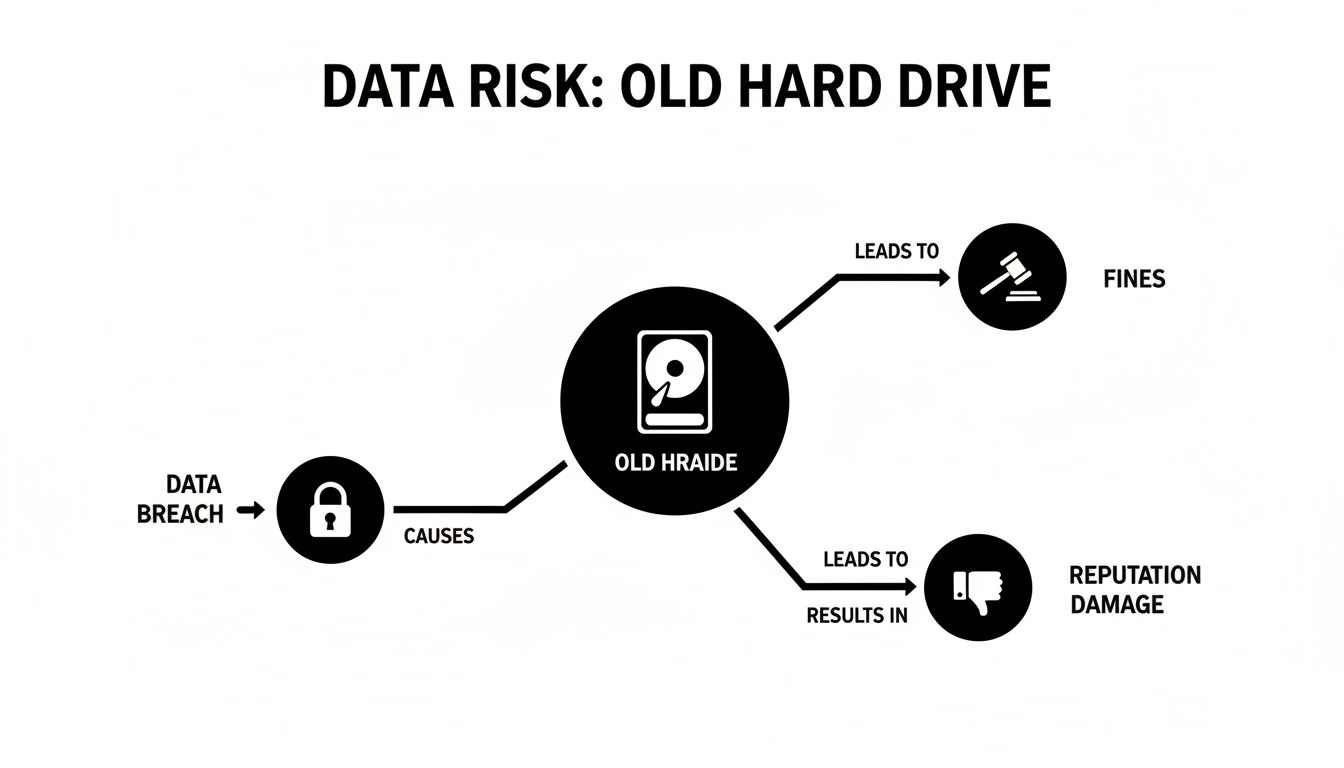
As you can see, a single improperly handled device can kick off a chain reaction, leading to a data breach, steep financial penalties, and lasting damage to your company's reputation.
Comparing Data Destruction Methods
Picking the right data destruction method comes down to your specific needs for security, compliance, and budget. Here’s a quick comparison to help you weigh the options.
| Method | How It Works | Security Level | Best For | Compliance Rating |
|---|---|---|---|---|
| Wiping | Overwrites data with random characters in multiple passes. | Medium | Preparing drives for internal reuse or resale with low-risk data. | Moderate |
| Degaussing | Uses powerful magnets to destroy the data's magnetic signature. | High | Rapidly destroying data on a large number of magnetic drives. | High |
| Shredding | Physically grinds the hard drive into small metal fragments. | Absolute | Meeting the strictest compliance standards (HIPAA, etc.) and ensuring data is 100% unrecoverable. | Highest |
For most businesses, especially those in regulated industries like healthcare or finance, physical shredding is the safest path forward. It completely eliminates any possibility of data recovery and gives you the concrete documentation needed to prove due diligence during an audit.
On-Site vs. Off-Site Destruction: What’s Right for You?
Figuring out the best way to destroy your data is only half the battle. The other crucial question is where it happens. This decision directly impacts your security, compliance, and peace of mind.
Every professional hard drive destruction service boils this down to two models: on-site destruction, where the shredder comes to you, and off-site destruction, where your devices are securely taken to a specialized facility. Each has its place, and the right choice depends on your organization's unique needs for security, oversight, budget, and convenience.
On-Site Destruction: The Gold Standard for Oversight
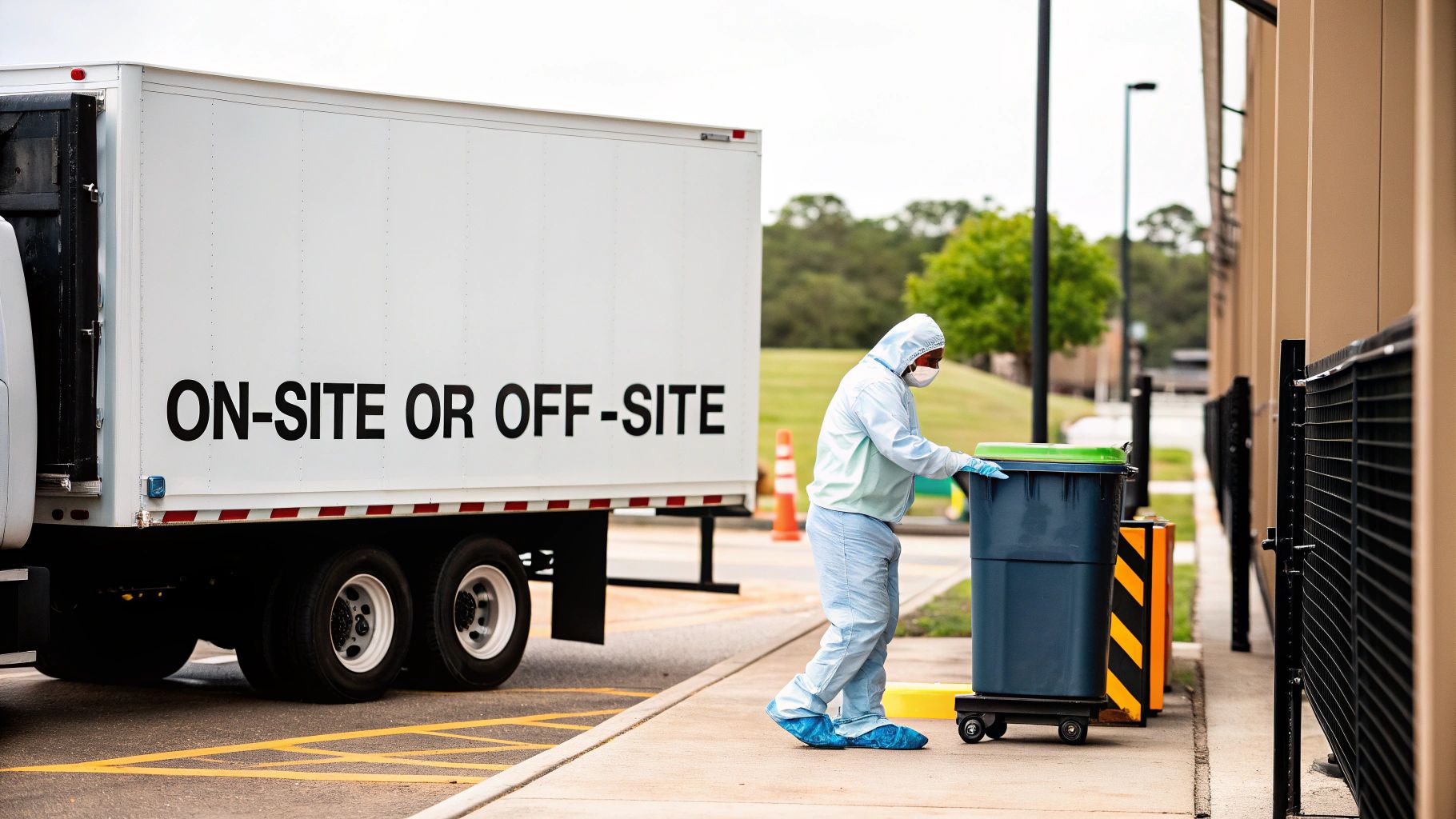
On-site destruction, often called mobile shredding, is exactly what it sounds like. A high-security truck equipped with an industrial-grade shredder pulls up to your business, and your hard drives never leave your sight until they’re turned into tiny metal fragments.
This process offers an unmatched level of transparency. Your team can literally watch the entire process unfold—from scanning serial numbers to feeding the drives into the shredder. There are no gaps in the chain of custody.
This hands-on verification is absolutely essential for industries with the tightest compliance rules.
- Healthcare (HIPAA): For hospitals and clinics, witnessing destruction firsthand is undeniable proof that Protected Health Information (PHI) was handled correctly.
- Finance and Legal: Firms managing sensitive client records or financial data often require on-site service to satisfy their own rigorous security policies and client agreements.
- Government Agencies: It’s common for public sector organizations and their contractors to mandate on-site destruction to ensure classified information is gone for good before it ever leaves the building.
If your business can’t afford even a moment of uncertainty, on-site service is the clear winner. You can learn more about finding a trusted local partner by exploring options for on-site shredding near you.
Off-Site Destruction: A Balance of Security and Efficiency
Off-site destruction, or plant-based shredding, provides a highly secure and often more budget-friendly alternative. In this scenario, a certified vendor collects your hard drives in locked, tamper-evident containers and transports them in a secure vehicle to a dedicated destruction facility.
Even though you don't watch it happen, the entire process is governed by a strict, documented chain of custody. Every single step, from collection and transit to the final shred, is tracked and verified. This ensures your assets are secure from the moment they leave your office until they’re destroyed.
Off-site destruction is a powerful option for businesses managing large volumes of IT assets, offering significant cost savings without compromising on certified security protocols.
This service is a perfect fit for:
- Large-Scale IT Upgrades: When you’re decommissioning hundreds or even thousands of devices, off-site destruction streamlines the logistics and often comes with volume-based pricing.
- Data Center Decommissioning: Clearing out a data center is a massive project. Off-site services can securely handle the huge number of drives involved.
- Budget-Conscious Organizations: For businesses without extreme regulatory pressures, off-site shredding delivers certified security at a more accessible price.
At the end of the day, both on-site and off-site services from a certified vendor will meet high security standards. The decision comes down to your organization's specific risk tolerance, compliance demands, and operational budget.
The Power of Proof: Certificates and Chain of Custody
When you hire a professional hard drive destruction service, you're paying for more than just the physical act of shredding. You're investing in a legally defensible process that proves your company did everything right. This proof is built on two foundational pillars: the Chain of Custody and the Certificate of Destruction.
Simply getting rid of old drives is a task; building an audit-proof record of secure data disposal is a smart business practice. This documentation transforms the process from a potential liability into a verified security measure, protecting you from the costly fallout of a compliance failure.
Demystifying the Chain of Custody
The Chain of Custody is a documented, unbroken trail that tracks your hard drives from the moment they leave your hands to their final destruction. Think of it like the evidence log in a legal case—every single touchpoint is recorded, ensuring nothing gets lost, misplaced, or mishandled along the way.
A proper Chain of Custody isn't just a vague promise. It involves several key steps:
- Secure Collection: Trained, background-checked technicians arrive at your facility to collect the assets.
- Serialized Asset Tracking: Each hard drive is scanned, and its unique serial number is recorded. This creates a detailed inventory list that becomes the foundation of the entire process.
- Locked Transport: Your devices are placed in secure, locked containers and transported in a GPS-tracked vehicle directly to the destruction site.
- Verified Destruction: The destruction is witnessed (if on-site) or confirmed (if off-site), and the serial numbers are reconciled against the initial inventory to confirm every single drive was destroyed.
This meticulous process provides a transparent and verifiable account of your assets' journey, effectively eliminating any security gaps. While it’s focused on hardware, understanding the importance of logistical tracking and custody in parcel delivery offers a great parallel for appreciating the secure chain of custody required for sensitive data.
Why a Certificate of Destruction Is Your Legal Shield
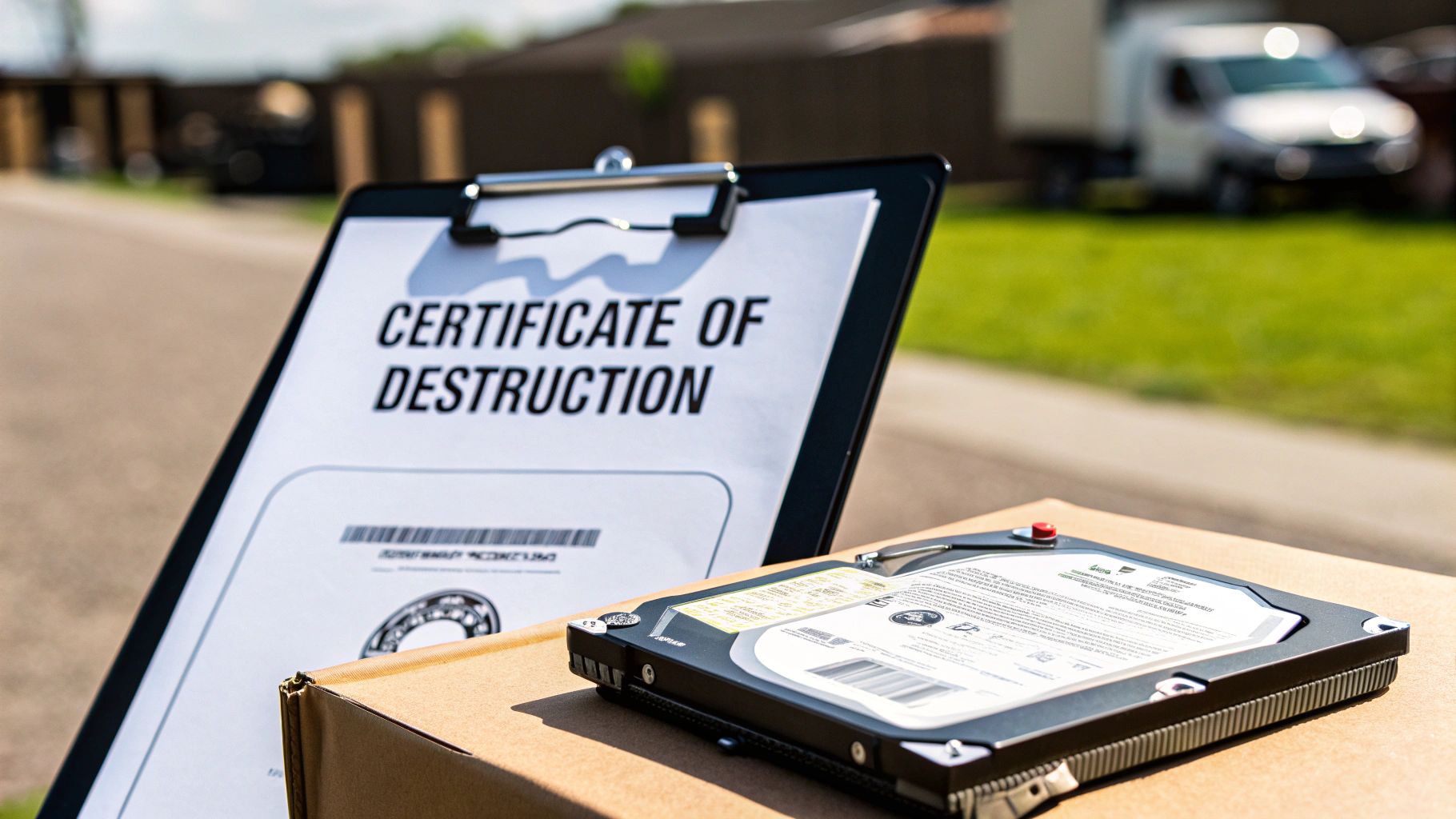
After the last drive is shredded, you receive the single most important document of the entire process: the Certificate of Destruction. This is far more than just a receipt. It’s a formal legal document that serves as your official proof of compliance, confirming that you took all the necessary steps to protect sensitive information.
A Certificate of Destruction is your indispensable legal shield in the event of an audit or data breach investigation. It demonstrates due diligence and effectively transfers the liability for proper disposal from your company to your certified vendor.
This document is absolutely essential for any business operating under regulations like HIPAA, where failing to prove proper data handling can result in fines running into the millions. Your Certificate of Destruction should always include key details like the date of service, the unique serial numbers of the destroyed drives, the method of destruction, and the signature of an authorized official from the destruction company. To see what this vital document entails, you can learn more about what a Certificate of Destruction includes and why it matters so much.
The Gold Standard: NAID AAA Certification
So, how can you be sure your vendor's Chain of Custody and destruction processes are genuinely secure? The answer is third-party validation, and the most respected credential in the industry is NAID AAA Certification.
This isn't a rubber stamp a company can just buy. The NAID AAA program involves unannounced, surprise audits of a vendor’s security protocols, employee screening, and operational procedures. Choosing a NAID AAA Certified provider is a direct guarantee that their entire process—from pickup to the final paperwork—meets the absolute highest security standards in the business.
Choosing the Right Hard Drive Destruction Partner
Picking a partner to handle your hard drive destruction is a serious decision that directly affects your company’s security and legal compliance. This is about more than just hauling away old tech; it’s about entrusting a vendor with the final, most critical step in your data’s lifecycle. One wrong move here can unravel all your other security measures, leaving you wide open to data breaches and steep regulatory fines.
Let’s be clear: secure data disposal has become a core business function. The global market for these services is booming, valued at USD 1.65 billion in 2024 and on track to hit USD 5.05 billion by 2035. North America leads the way, thanks to our high concentration of data centers and strict compliance laws that demand professional data destruction. You can read more about the growth of the secure destruction market on sphericalinsights.com.
This growth is a double-edged sword. You have more choices than ever, but that just means you have to be even more careful when vetting potential partners.
Your Vendor Vetting Checklist
To cut through the noise and find a partner you can actually trust, you need to ask the tough questions. Any reputable provider will have solid, confident answers for every single item on this list. Think of this as your non-negotiable checklist for vendor selection.
Are you NAID AAA Certified? This should be the very first thing you ask. NAID AAA Certification is the industry's gold standard for a reason—it’s verified through surprise, third-party audits. It’s an independent guarantee that the vendor follows the strictest protocols for security, hiring, and operations.
Can you provide a sample Certificate of Destruction? This document isn’t just a piece of paper; it’s your legal proof of compliant disposal. Look over a sample to make sure it includes critical details like unique serial numbers for each drive, service dates, and authorized signatures.
What are your Chain of Custody procedures? Have them walk you through their process, step by step. A truly secure chain of custody means background-checked employees, locked security containers, GPS-tracked vehicles, and a complete, unbroken audit trail from the moment they pick up your assets to the moment they are destroyed.
Can you handle media other than hard drives? Your corporate data lives on more than just traditional spinning hard drives. Make sure your partner can securely destroy SSDs, backup tapes, USB flash drives, and other media. This ensures you have one reliable partner for all IT asset disposition needs, simplifying your process.
Choosing a vendor is an exercise in risk management. A cheap service without proper certifications or a documented process isn't a bargain—it's a liability waiting to happen. Your goal is to find a partner who helps you build a defensible and audit-proof data disposal program.
Understanding the Factors That Influence Cost
While security and compliance have to be the top priorities, we all know that budget is a real-world concern. The cost of professional hard drive destruction usually comes down to a few key variables. Knowing what they are will help you budget accurately and understand the value you’re getting for your investment.
Service Type (On-site vs. Off-site): As we covered earlier, on-site mobile shredding gives you the ultimate peace of mind and is priced at a premium. Off-site, plant-based destruction is typically more cost-effective, especially for larger batches, while still maintaining strict security protocols.
Volume of Drives: This is simple economies of scale. Nearly every provider offers per-unit pricing that drops as your quantity goes up. A project with 1,000 drives will have a much lower cost-per-drive than a small job with only 50.
Logistics and Location: How far the truck has to travel to your facility can impact the price. Don’t forget about potential add-on services, like having technicians de-install drives from servers or computers on-site, which may also affect the final cost.
It’s crucial to get a detailed, all-inclusive quote that breaks down every single charge. A transparent partner will show you the costs for labor, transport, destruction, and certification, so you aren’t hit with any surprises later. A company that also manages recycling can offer incredible value by handling the entire IT asset lifecycle. For organizations here in Atlanta, you can learn more about how an electronic waste recycling company can meet both your data destruction and recycling needs in one seamless process.
Answering Your Hard Drive Destruction Questions
Once you understand the methods and processes, a few practical questions usually pop up. This is where the rubber meets the road—getting these final details right ensures your partnership with a hard drive destruction service is smooth, secure, and fully compliant from beginning to end. Here are the straight-up answers to the questions we hear most from business leaders and IT managers.
Do I Need to Wipe Hard Drives Before They Are Shredded?
This is a common point of confusion, but the answer is simple: no. While wiping drives is a good security habit in general, it’s completely unnecessary if you’re using a professional physical destruction service.
The entire point of shredding is that it makes data permanently unrecoverable, no matter what software-based wiping was done beforehand. For businesses under strict compliance rules like HIPAA, software wiping alone isn't enough anyway. Physical destruction is the only definitive, final step that provides an absolute guarantee—and the paperwork to prove it.
What Happens to the Shredded Hard Drive Materials?
A responsible hard drive destruction partner is also a key player in your company’s environmental goals. After your drives are turned into small, unrecognizable metal fragments, the job isn't done. These materials are securely transported to a certified recycling facility.
There, the different materials are carefully sorted and processed.
- Aluminum: Casings and platters are melted down to be used again in manufacturing.
- Steel: Components and frames are recycled into new steel products.
- Circuit Boards: Precious metals are extracted from the boards through a specialized smelting process.
This process ensures that while your sensitive data is gone for good, the raw materials re-enter the supply chain. It’s a responsible approach that helps your company meet environmental regulations and supports corporate sustainability, preventing hazardous e-waste from ever reaching a landfill.
How Much Does a Hard Drive Destruction Service Cost?
There’s no one-size-fits-all price tag for professional destruction. The cost is typically based on a few key factors, which can help you estimate your budget and get an accurate quote without any surprise fees.
The final cost almost always comes down to three main things:
- The number of drives: Most companies charge per drive and offer volume discounts. The more drives you have, the lower your price per unit will be.
- The type of service: On-site (mobile) shredding is a premium service. It involves specialized equipment and logistics, making it more expensive than having your drives destroyed at a secure off-site facility.
- Your location and logistics: The distance to your office and any extra labor—like pulling drives from servers—can also affect the total price.
Always insist on a detailed, written quote that breaks down every cost: transport, labor, the destruction itself, and the final Certificate of Destruction. Transparency is the mark of a partner you can trust.
Is a Certificate of Destruction a Legally Valid Document?
Absolutely. In fact, it's one of the most critical legal documents in your entire data security program. A Certificate of Destruction is your official, legally recognized proof of compliant data disposal.
It’s the concrete evidence showing your company took professional, documented, and defensible steps to destroy sensitive information according to industry best practices and government regulations. If you ever face a compliance audit or a data breach investigation, this certificate is your first line of defense. It proves your due diligence and formally transfers the liability for proper disposal from your company to the certified vendor. For any business handling confidential data, this document isn’t just a nice-to-have—it’s an essential part of your risk management strategy.
Ready to secure your retired IT assets with a certified, reliable, and environmentally responsible partner? Atlanta Computer Recycling offers NAID AAA Certified hard drive destruction services tailored for businesses across the Atlanta metro area. We provide a complete, audit-proof process, from secure pickup to your final Certificate of Destruction. Protect your business and ensure compliance today.
Schedule Your Secure Hard Drive Destruction Service with Atlanta Computer Recycling