Top Guide: Enterprise Electronics Recycling for Atlanta, GA Businesses

For IT managers and business leaders in Atlanta, managing end-of-life electronics is more than a disposal task—it's a critical business function. Choosing the right partner for enterprise electronics recycling in Atlanta GA is a strategic decision that directly protects your company's data, budget, and reputation.
A certified recycling partner is the key to transforming this operational liability into a secure, streamlined, and value-driven process.
Why Professional Electronics Recycling Is a Strategic Imperative for Atlanta Businesses
When your enterprise upgrades its technology, what is the plan for the retired hardware? Far too often, decommissioned servers, laptops, and networking gear are stockpiled in a storage closet or warehouse. This common practice is a significant and unnecessary risk.
Each of those retired devices can be viewed as an unsecured digital filing cabinet containing sensitive corporate, client, or financial data—a ticking time bomb for a potential data breach.
This is not an overstatement. Improperly disposed IT assets create massive corporate liabilities. For regulated industries like healthcare, finance, and legal services, a single data breach from a discarded hard drive can result in crippling regulatory fines, legal action, and irreparable damage to your brand equity.
From Liability to Strategic Advantage
A professional IT Asset Disposition (ITAD) strategy does more than just clear out old equipment; it neutralizes risk and can unlock residual value. A certified partner provides a structured, documented framework for managing these end-of-life assets, ensuring every step of the process is secure and compliant.
This proactive approach is critical for:
- Data Security: Guaranteeing that all sensitive information is permanently and verifiably destroyed, protecting your enterprise from costly breaches.
- Regulatory Compliance: Meeting strict data protection mandates under regulations such as HIPAA, SOX, GLBA, and FACTA.
- Corporate Responsibility: Demonstrating a tangible commitment to environmental stewardship and strengthening your ESG (Environmental, Social, and Governance) profile.
The demand for responsible ITAD is growing rapidly. The global electronics recycling market is projected to reach USD 147.9 billion by 2035, a substantial increase from USD 43.2 billion in 2025. As global e-waste generation surpasses 60 million metric tons annually with a formal collection rate under 20%, Atlanta enterprises have a clear opportunity to demonstrate leadership in responsible corporate citizenship.
A common mistake is viewing retired hardware as worthless junk. In reality, it represents a significant, unmanaged risk. A professional ITAD program transforms this risk into a documented, compliant, and secure business process.
Ultimately, engaging a professional partner for enterprise electronics recycling in Atlanta GA is not a cost—it's an essential investment in your company's operational security and long-term sustainability. To see what a comprehensive process looks like from start to finish, you can learn more about the complete electronics recycling process in Atlanta, GA. By addressing this challenge strategically, your organization can protect its data, fortify its reputation, and operate with greater efficiency and responsibility.
Understanding the Secure ITAD Process for Your Enterprise
So, you’ve decided to engage a professional for enterprise electronics recycling in Atlanta. What actually happens next? For many business leaders, the process can feel like a black box—you hand over your equipment and hope for the best.
A proper IT Asset Disposition (ITAD) process is the antithesis of that. Consider it a bonded, insured courier service for your company's digital history. It's not about simply hauling away old gear; it's a meticulously documented journey designed to shield your organization from risk, whether you're managing an office relocation, a data center decommissioning, or a routine technology refresh. Every single step is tracked to create an unbreakable and auditable chain of custody.
The journey transforms your old equipment from a potential liability into a securely managed and documented asset.
This flow illustrates how aging IT assets carry inherent risks, which a structured ITAD solution is built to neutralize, providing your enterprise with documented security and complete peace of mind.
The First Step: On-Site Assessment and Inventory
A professional partnership begins long before a single server is unplugged. The first step is a thorough on-site assessment where a specialist works directly with your team. We will map out every asset slated for disposition, from the servers in your data center to the laptops and desktops at every workstation.
This is not a simple headcount. We create a detailed, serialized inventory of every item, capturing the crucial data points that form the foundation of your audit trail:
- Asset Type: (e.g., Server, Laptop, Network Switch)
- Manufacturer and Model: (e.g., Dell PowerEdge R740)
- Serial Number: The unique identifier for tracking each device.
- Asset Tag: Your company’s internal ID tag for reconciliation.
This inventory list is the bedrock of the entire process. It establishes the initial chain of custody and guarantees that every asset you entrust to us is accounted for from pickup to final disposition.
Secure De-Installation, Packing, and Transport
Once the inventory is approved, our trained technicians execute the physical-logistics phase. We handle the secure de-installation of equipment directly from your server racks and workstations. This is a critical service, as it keeps your own IT staff focused on their core responsibilities instead of being diverted by a time-consuming and physically demanding task.
Assets are then professionally packed, stacked, and shrink-wrapped onto pallets for secure transit. This methodology prevents damage and ensures nothing is lost or separated en route to our facility.
The moment your equipment leaves your premises, it is officially in our secure chain of custody. Every pallet is tracked, and our sealed, GPS-monitored trucks function as a moving vault, protecting your assets until they arrive. This documented transit is a non-negotiable component of secure enterprise electronics recycling in Atlanta, GA.
Processing, Sorting, and Final Disposition
When your shipment arrives at our certified facility, the first action is to reconcile the contents against the original inventory list. This verification confirms every asset arrived safely. From there, your equipment is sorted based on its type, condition, and potential for remarketing.
This sorting stage determines the disposition path for each asset:
- Data Destruction: All data-bearing devices are immediately flagged and prioritized for secure data destruction. This is always the next step—no exceptions.
- Testing and Refurbishment: Newer or higher-value equipment is tested for functionality to determine if it can be repaired and remarketed, allowing your business to recover value.
- Component Harvesting: For older or non-functional devices, we salvage viable components like RAM, CPUs, and circuit boards for the repair market.
- Materials Recycling: Finally, what remains is de-manufactured, shredded, and separated into clean commodity streams like steel, aluminum, and plastics to be recycled responsibly.
This structured workflow ensures every piece of equipment is handled securely, responsibly, and with a focus on maximizing your financial return. To get a closer look at how this all comes together, you can learn more about our comprehensive IT asset disposition services in Atlanta.
Data Destruction: The Heart of Secure Electronics Recycling
For any Atlanta enterprise, the most critical part of the electronics recycling process happens long before a single component is reused. It is the complete, irreversible, and verified destruction of your sensitive data. When you hand over retired servers, laptops, or hard drives, you’re not just disposing of old hardware—you're entrusting a partner to safeguard your company’s most valuable intellectual property and confidential information.
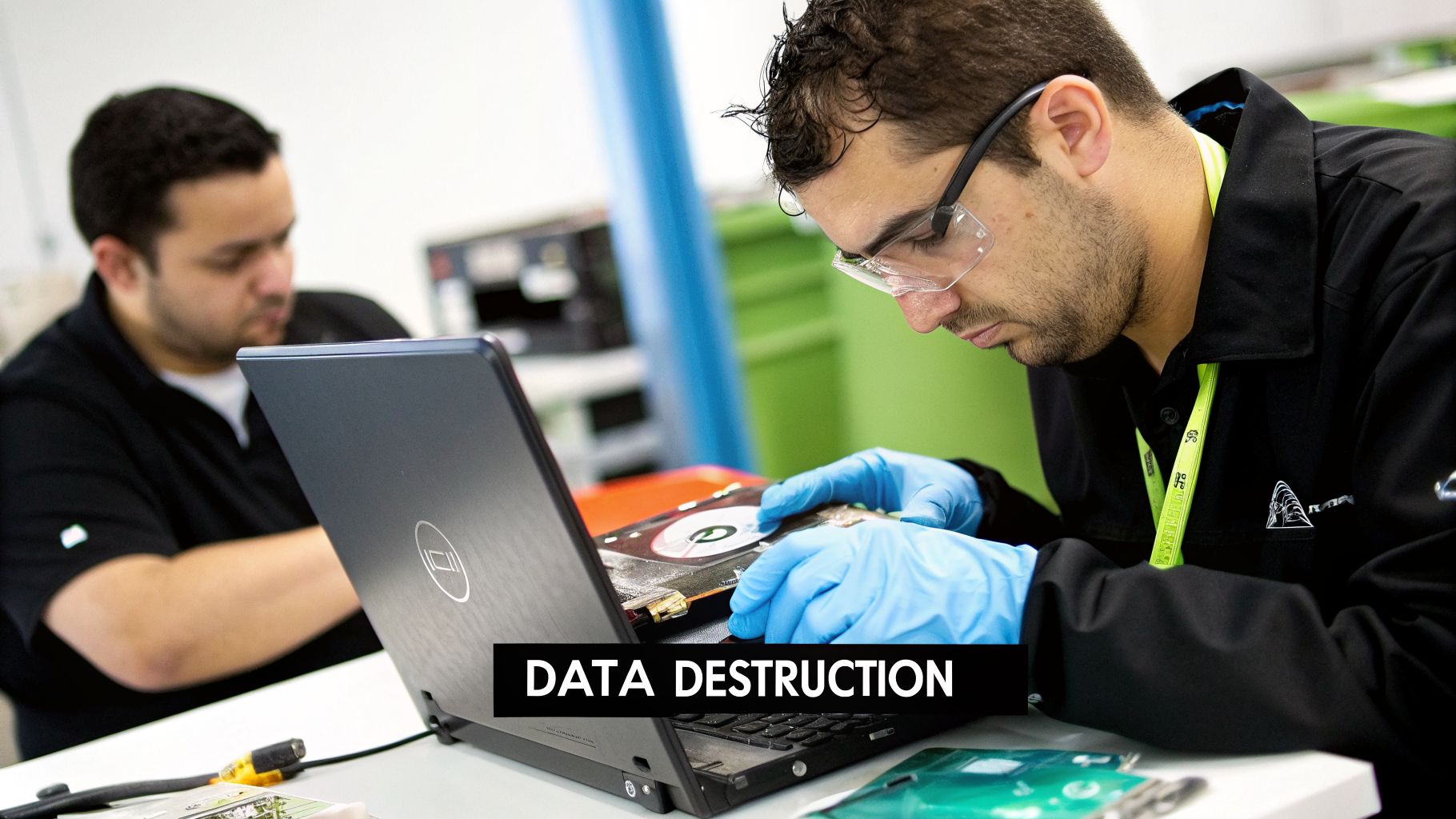
A single improperly handled device can have catastrophic consequences. A data breach from a discarded hard drive can trigger major legal penalties, significant financial losses, and do permanent damage to your brand. That’s why certified data destruction is the absolute core of any professional enterprise electronics recycling Atlanta GA program.
There are two primary, industry-approved methods to ensure your data is irrecoverable: software-based wiping and physical destruction. The right choice for your business depends on your internal security policies, compliance requirements, and whether the devices have potential resale value.
Software-Based Wiping For Secure Reuse
Software-based data wiping is a process of digitally overwriting every sector of a hard drive with random, meaningless data until the original information is impossible to recover. The drive itself remains physically intact, making this the ideal solution for newer, functional equipment that can be refurbished and remarketed.
One of the most recognized protocols is DoD 5220.22-M. This U.S. Department of Defense standard specifies a 3-pass overwrite method:
- Pass 1: Writes a specific character across the entire drive.
- Pass 2: Writes the complement of that character.
- Pass 3: Writes random characters and verifies the overwrite was successful.
This approach thoroughly sanitizes the media, making it a secure option for most corporate needs while allowing your business to recover value from its retired assets.
Physical Destruction: The Ultimate Guarantee
When a hard drive is at the end of its useful life, is non-functional, or contained highly sensitive data, wiping may not be sufficient. For these scenarios, physical destruction provides a 100% guarantee that the data is gone forever. It is the equivalent of feeding a paper document into an industrial cross-cut shredder—there is nothing left to reassemble.
This process involves feeding hard drives, solid-state drives (SSDs), backup tapes, and other storage media into a powerful shredder. The machine grinds the devices down into small, twisted fragments of metal, making data recovery physically impossible. For organizations in high-stakes industries, this is often a mandatory step.
The consequences of a data breach from improper IT asset disposal are severe, often involving significant legal and financial fallout. A study found the average cost of a data breach reached $4.45 million in 2023. This is why a certified destruction process is not just a best practice—it's essential risk management.
Matching The Method To Your Industry Needs
The appropriate data destruction method is directly tied to your industry’s specific compliance regulations. A one-size-fits-all solution is inadequate for Atlanta’s diverse business landscape.
- Healthcare (HIPAA): Hospitals, clinics, and their business associates must protect electronic patient health information (ePHI). Physical shredding is almost always the preferred method to ensure total compliance with HIPAA's strict privacy and security rules.
- Government Agencies: To secure classified or sensitive public data, physical destruction is typically mandated by policy to eliminate any possibility of a security incident.
- Corporate Enterprises: Businesses often use a hybrid approach to protect intellectual property, financial records, and customer data. They may opt for wiping for newer, reusable assets and shredding for obsolete or high-risk devices.
A professional recycling partner will help you navigate these choices, ensuring your enterprise electronics recycling program in Atlanta aligns perfectly with your security and compliance requirements. By prioritizing certified destruction, you build a fortress around your data. For a deeper look into the standards and documentation involved, check out our guide on secure data destruction services in Atlanta, GA.
How to Choose the Right ITAD Partner in Atlanta
Choosing the right IT Asset Disposition (ITAD) vendor is one of the most critical procurement decisions your organization will make. This is not about waste hauling; it's about entrusting a partner with your company’s sensitive data and its environmental reputation. A poor choice can lead to devastating data breaches, stiff compliance penalties, and a damaged brand.
For any business seeking enterprise electronics recycling in Atlanta GA, the vetting process must be rigorous. Approach it less like selecting a disposal service and more like hiring a specialized security firm for your retired digital assets. You need a partner with verifiable credentials, ironclad processes, and a proven local track record.
This guide provides a practical checklist to help you evaluate potential vendors, identify positive indicators, and spot the red flags that signal unacceptable risk.
Vendor Selection Checklist for Enterprise Electronics Recycling
Finding a trustworthy ITAD partner requires looking beyond a simple price quote. The right partner offers security, compliance, and transparency, while a risky one can create massive liabilities. This table breaks down what to look for versus what to avoid.
| Evaluation Criterion | What to Look For (Green Flags) | What to Avoid (Red Flags) |
|---|---|---|
| Industry Certifications | R2v3 and/or e-Stewards certified. These are non-negotiable and prove adherence to strict third-party audits. | No certifications, expired certifications, or vague claims like "we follow the standards." |
| Data Security | Offers both physical shredding and certified software wiping. Provides detailed Certificates of Data Destruction. | Unclear destruction methods. Hesitation to provide sample documentation or a facility tour. |
| Chain of Custody | A documented, serialized asset tracking process from your site to theirs. Secure, sealed, GPS-tracked trucks. | Casual "man with a van" pickups. No clear tracking process or secure transport protocols. |
| On-Site Capabilities | Professional, uniformed team for on-site de-installation, inventory, and packing services. | Subcontractors with no direct accountability. A messy or disorganized on-site process. |
| Reporting & Transparency | Provides comprehensive reporting for asset value recovery, recycling, and sustainability/ESG metrics. | Only offers a basic invoice. No detailed reports on where materials went or what value was recovered. |
| Insurance Coverage | Carries robust data breach and pollution liability insurance. Willingly provides a Certificate of Insurance (COI). | Minimal or no specialized liability insurance. Unwillingness to share their insurance details. |
A vendor who ticks all the green-flag boxes demonstrates a commitment to professional standards. A company showing multiple red flags represents a risk you simply can't afford to take with your company's data and reputation.
Certifications Are Your First Line of Defense
Before discussing pricing, your first question must be about certifications. These are not just logos on a website—they are hard-earned proof that a vendor has passed rigorous, independent audits covering data security, environmental standards, and worker safety.
Look for these two critical certifications:
- R2 (Responsible Recycling): This is the leading global standard ensuring recyclers follow best practices for environmental protection, data security, and employee health and safety. An R2-certified facility is audited to prove it handles the entire lifecycle of electronics responsibly.
- e-Stewards: Developed by the Basel Action Network, e-Stewards is another gold-standard certification. It has a strict no-landfill and no-export policy for hazardous e-waste, offering one of the highest levels of environmental assurance available.
If a potential vendor lacks either R2 or e-Stewards certification, it’s a major red flag. These certifications are the absolute baseline for any professional ITAD operation in Atlanta.
Data Security Protocols Must Be Verifiable
After certifications, your next focus is data security. A vendor’s promises are worthless without verifiable proof of their destruction process. You need to know exactly how they will sanitize your data-bearing devices and what documentation you will receive.
Demand total clarity on the following points:
- Destruction Methods: Do they offer both software wiping (to standards like DoD 5220.22-M) and physical shredding? A capable partner should provide both options to fit your security needs and potential for asset value recovery.
- Chain of Custody: Ask for a step-by-step walkthrough of their chain of custody. This must include serialized asset tracking from your facility to theirs, secure and sealed transport, and controlled access at their facility.
- Certificates of Destruction: Will you receive a serialized Certificate of Data Destruction? This document is your legal proof that the data was properly destroyed and is non-negotiable for compliance and audits.
Any vendor who is vague about their security protocols or hesitant to provide sample documentation is not a partner you can trust with your data.
Logistics and Reporting Transparency
A top-tier partner makes the entire process seamless and transparent. Their logistics and reporting should be designed to give you complete visibility and confidence from start to finish.
Evaluate these key operational capabilities:
- On-Site Services: Can their team come to your location to handle de-installation, inventorying, and packing? This service is a game-changer for large-scale projects, saving your internal IT team dozens of hours.
- Secure Transportation: Do they operate their own fleet of sealed, GPS-tracked trucks? This is a critical link in the chain of custody, ensuring your assets are protected from the moment they leave your control.
- Detailed Reporting: Beyond destruction certificates, what other reporting can they provide? Look for comprehensive reports detailing asset reuse, component harvesting, and final material recycling weights. This data is essential for your company’s sustainability and ESG goals.
By thoroughly vetting potential partners against these standards, you can confidently choose a company for your enterprise electronics recycling in Atlanta. To see what sets a professional service apart, it helps to understand the qualities of a top-tier electronic waste recycling company.
Navigating E-Waste Compliance and Corporate Responsibility
For any enterprise in Atlanta, managing retired electronics is a significant component of risk management. And while Georgia's state-level e-waste laws are minimal, your organization is still responsible for adhering to strict federal and industry-specific data protection regulations.
Compliance is the rulebook you must follow to avoid crippling fines and legal exposure. A proper IT Asset Disposition (ITAD) process is your game plan for adhering to those rules, especially when data is involved. The right partner for enterprise electronics recycling in Atlanta GA doesn't just haul away equipment; they act as your compliance guide through this complex regulatory landscape.
Federal and Industry-Specific Mandates
How you dispose of data isn’t just an internal policy—it's the law. Depending on your industry, you are bound by specific rules designed to protect sensitive information, and the penalties for non-compliance are severe.
Key regulations include:
- HIPAA (Healthcare): The Health Insurance Portability and Accountability Act demands absolute protection of patient health information (PHI). A single device disposed of improperly can trigger massive fines and legal action.
- GLBA (Finance): Under the Gramm-Leach-Bliley Act, financial institutions are required to safeguard consumer financial data. This includes secure, documented data destruction for every retired IT asset.
- FACTA (Consumer Data): The Fair and Accurate Credit Transactions Act mandates that any business holding consumer information from credit reports must destroy it completely before disposal.
Failure to comply is not an option. Working with a certified ITAD vendor provides you with a documented, defensible process that shields your organization from these costly compliance failures. You can dive deeper into making sure your practices are up to code in our guide on compliant IT disposal in Atlanta, GA.
Beyond Local Rules: Corporate Responsibility and Global Benchmarks
Meeting the regulatory minimum is one thing; true corporate leadership means looking ahead. While Georgia's laws set the floor, forward-thinking Atlanta companies are adopting global standards to build brand resilience and prove their commitment to ethical operations. Reviewing a vendor's Corporate Social Responsibility Policy is an excellent way to gauge if their values align with yours.
This is not just about appearances. It’s a proactive strategy that sends a powerful message to your customers, employees, and investors about your dedication to ethical and sustainable practices.
Taking a strong stance on e-waste isn't just about being green. It’s a smart business move that strengthens your brand, mitigates future regulatory risks, and aligns your company with global best practices.
The data speaks for itself. Europe is setting a high benchmark with a continent-wide 42.8% formal collection and recycling rate in 2024. That far outpaces the Americas at 30% and Asia at a concerning 11.8%. Atlanta-based businesses can aim for that higher standard by choosing a partner committed to maximum material recovery and a strict zero-landfill policy. A professional partner helps your company operate not just by today's rules, but for tomorrow's, ensuring you’re always a step ahead.
What Really Happens to Your Old IT Equipment
So, what happens after our truck pulls away with your retired IT equipment? Your old assets don’t just disappear. They begin a secure, multi-stage journey designed to protect your data and recover as much value as possible—a process often called the recycling hierarchy.
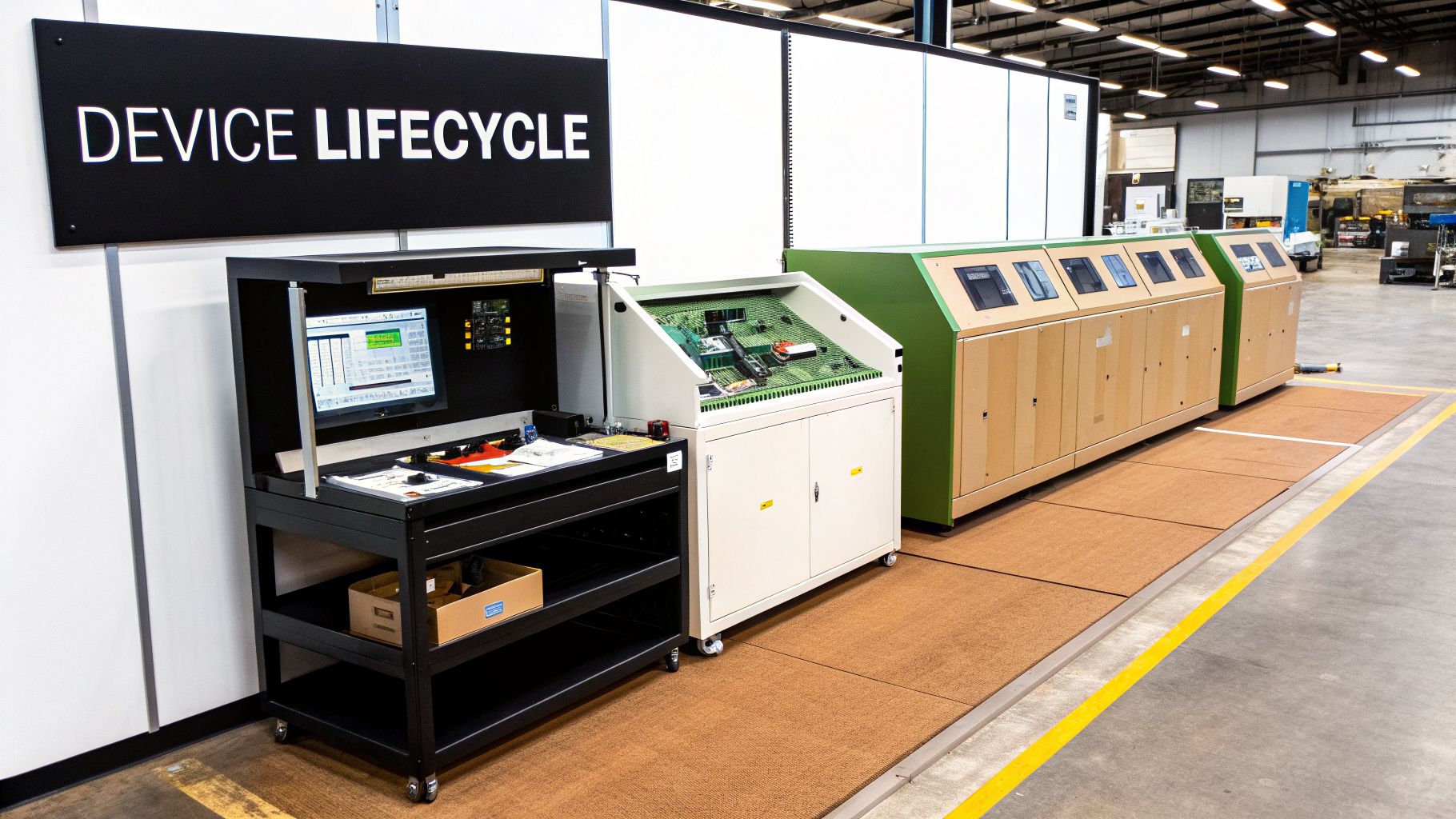
The best-case scenario, and our first priority, is always testing and refurbishment. Any device that still has functional life is put through rigorous testing, completely sanitized of all data, and prepared for a second life on the secondary market. Extending an asset’s useful life is by far the most sustainable form of recycling and offers the highest potential for value recovery.
Component Harvesting and Material Recovery
If a device is too old or damaged for refurbishment, we move to component harvesting. This can be thought of as an organ donor program for electronics. Our technicians carefully salvage valuable parts like RAM, CPUs, power supplies, and logic boards that still function properly.
These components can then be used to repair and upgrade other machines, reducing the need for new manufacturing. Understanding concepts like equipment depreciation life helps financial and IT teams determine when an asset has truly reached its end-of-life, making the entire process more efficient from both a cost and environmental standpoint.
The final destination for equipment that can't be reused or harvested is material recovery. This is where your old hardware is de-manufactured to its base elements, becoming a source of raw materials for new products and closing the loop in a circular economy.
The remaining chassis and non-working parts are mechanically shredded. From there, powerful magnets and advanced optical sorters separate the fragments into clean commodity streams:
- Precious Metals: We recover gold, silver, palladium, and copper from circuit boards.
- Base Metals: Commodities like aluminum, steel, and iron are isolated and sent to smelters.
- Plastics: Different plastic types are sorted and prepared for recycling into new goods.
Your Role in a Global Challenge
This structured process is a direct response to a massive environmental problem. Global e-waste is on track to exceed 82 million metric tons by 2030, but the formal recycling rate is expected to fall to just 20%. By choosing professional enterprise electronics recycling in Atlanta GA, your business becomes part of the solution. Every server rack or pallet of laptops you responsibly recycle keeps hazardous materials out of landfills and puts valuable resources back into the global supply chain.
Common Questions About Business E-Waste Recycling
Even with a solid plan, IT managers and procurement teams in Atlanta often have practical questions before starting an electronics recycling program. Getting clear, straightforward answers is the key to moving forward with confidence.
Here are the most common questions we hear from local businesses and the direct answers you need.
How Can I Be Sure Our Company's Data Is Secure?
This is always the top concern, and the answer must be absolute. Any professional recycling partner must provide a serialized Certificate of Data Destruction for every single data-bearing device they process. This is not just a receipt; it is your auditable, legal proof that your information was destroyed in a compliant manner.
That certificate should list the serial number of each device and specify the exact destruction method used—whether it was multi-pass software wiping or physical shredding. If a vendor cannot provide this level of documentation, they are not a viable partner.
What Types of Equipment Do You Accept?
A common misconception is that electronics recycling only covers desktops and laptops. A true IT Asset Disposition (ITAD) partner handles the entire spectrum of your technology assets, providing a single, secure process for everything.
We regularly manage a wide range of corporate equipment for businesses across the Atlanta area, including:
- Standard Office Technology: Desktops, laptops, monitors, printers, keyboards, servers, and copiers.
- Data Center Hardware: Server racks, network switches, routers, UPS battery backups, and storage arrays (SANs).
- Miscellaneous Electronics: Office phones, mobile devices, tablets, and all associated cables and accessories.
We also specialize in complete facility cleanouts, managing every electronic item during an office move or data center decommissioning project.
Do We Have to Deliver Our Old Equipment?
No, your team should not have to manage logistics. A professional ITAD partner removes that burden entirely. We provide secure pickup services across the Atlanta metro area, coordinating with your schedule to ensure minimal disruption to your business operations.
Our team handles the entire on-site process, from professional packing and palletizing to the heavy lifting and secure transport. We maintain a strict chain of custody from the moment we arrive at your facility until the assets are processed at ours, ensuring a seamless and secure experience for your business.
Is There a Cost for Business Recycling Services?
The cost structure depends entirely on the equipment being processed. For most standard IT assets like newer servers, laptops, and networking gear, we can often provide the service at no charge. The value we recover by remarketing the equipment or recycling the raw materials is sufficient to cover our processing costs.
Conversely, certain items with no resale value or those containing hazardous materials—such as old CRT monitors or highly specialized industrial equipment—may carry a service fee. This fee covers the cost of responsible, environmentally compliant disposal. We always provide a transparent, detailed quote upfront, so there will never be a surprise charge on your invoice.
Ready to implement a secure and compliant electronics recycling program for your Atlanta business? Atlanta Computer Recycling delivers certified data destruction, convenient on-site logistics, and a commitment to keeping e-waste out of Georgia's landfills. Let us handle your computer recycling and IT equipment disposal needs, from a single pallet to a full office cleanout.