Secure Computer Recycling Service for Your Business

A professional computer recycling service is your business's best defense for securely and responsibly decommissioning old IT equipment. This process, often called IT Asset Disposition (or ITAD), is much more than just disposal—it's about ensuring your company’s sensitive data is completely destroyed and that every piece of hardware is handled according to strict environmental and data privacy laws.
Think of it as a critical security and compliance function, one that protects your company’s bottom line and its reputation.
Why Smart Businesses Use a Computer Recycling Service
Let's be honest, those old corporate computers piling up in a storage closet aren't just taking up space; they're a ticking time bomb. For any IT manager or business executive, every single one of those outdated desktops, servers, and laptops is a potential liability. If they fall into the wrong hands, you're looking at the possibility of a devastating data breach, serious fines for non-compliance, and real damage to the reputation you've worked so hard to build.
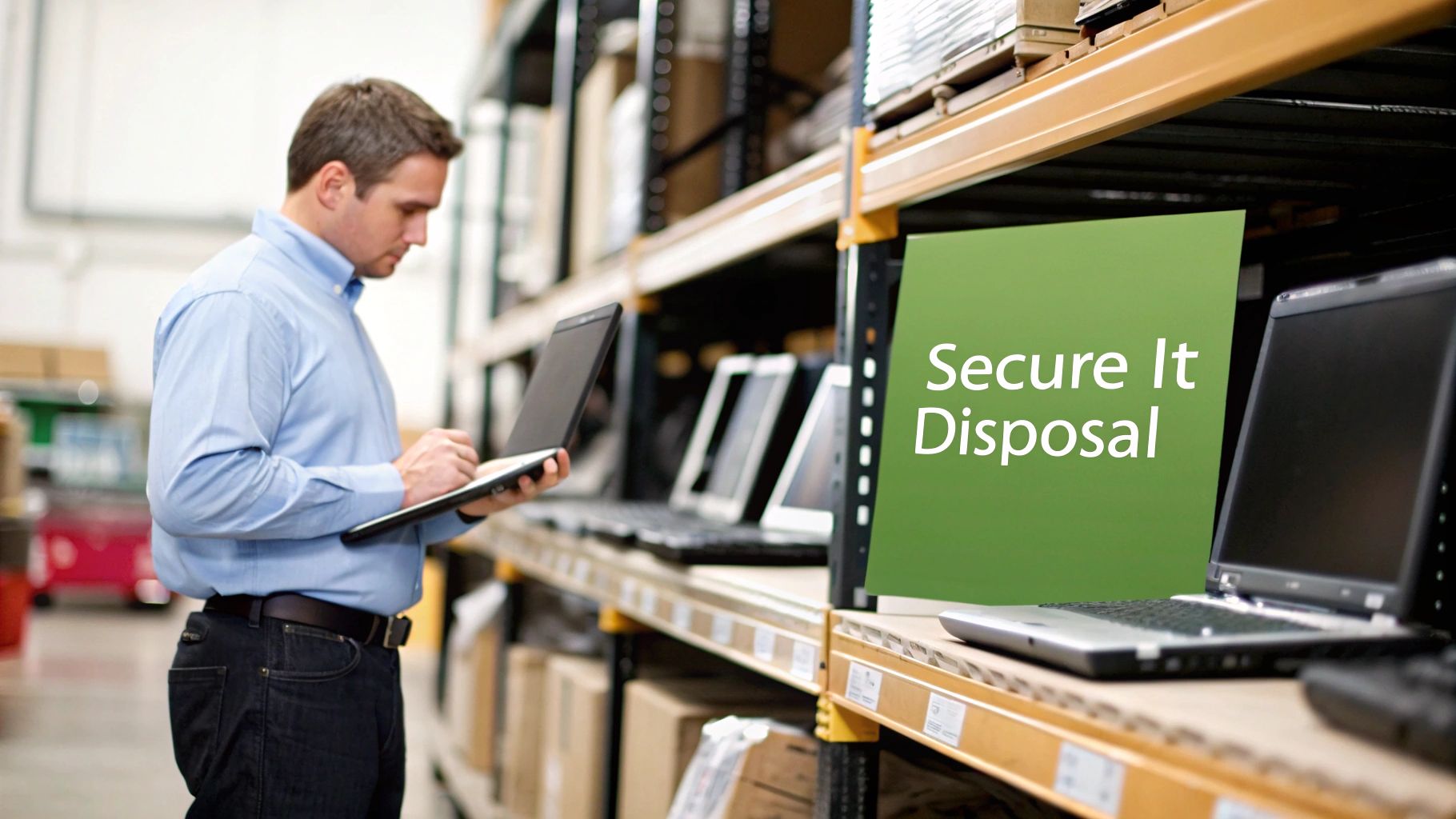
This is exactly where a professional computer recycling service steps in, turning that risk into a secure, compliant, and fully documented process. It’s time to stop seeing IT disposal as a logistical chore and start treating it as the essential business strategy it is.
The table below outlines the very real dangers of cutting corners on IT asset disposal.
Key Risks of Improper IT Asset Disposal
| Risk Category | Specific Threat to Your Business | Potential Consequence |
|---|---|---|
| Data Security | Un-wiped hard drives containing customer lists, financial records, or employee PII are stolen or recovered. | Crippling data breaches, loss of customer trust, and theft of intellectual property. |
| Legal & Compliance | Failure to adhere to data privacy laws like HIPAA or FACTA during disposal. | Steep regulatory fines, class-action lawsuits, and potential personal liability for executives. |
| Reputation | News of a data breach or improper e-waste dumping becomes public. | Irreversible brand damage, loss of clients, and negative media attention. |
| Environmental | Electronics containing lead, mercury, and cadmium are illegally dumped in landfills. | Fines for violating environmental regulations and harm to your corporate social responsibility image. |
These aren't just abstract threats; they are significant business vulnerabilities that a professional ITAD partner is specifically equipped to eliminate.
The Growing Challenge of Corporate E-Waste
The sheer volume of electronic waste is growing at an alarming rate, creating a massive challenge for businesses everywhere. The world is on track to generate over 60 million metric tons of e-waste every single year by 2025. A huge chunk of that—an estimated 4.7 million metric tons—will come from the small IT devices common in every office, like desktops and servers.
What's really shocking is that only about 17% of all e-waste ever makes it to a proper recycling facility. That means the vast majority of old corporate computers aren't being disposed of responsibly.
This isn't just an environmental problem; it's a huge business risk. Every one of those discarded devices is a potential treasure trove of confidential information, from internal employee records to sensitive customer data. Understanding the environmental impact of electronic waste really puts into perspective why proper disposal is a non-negotiable part of being a responsible company today.
From Hidden Risk to Strategic Advantage
Working with a professional recycling partner flips the script on IT disposal, moving it from a simple expense to a core part of your risk management strategy. It’s about more than just having someone haul away old gear, especially when you're making big changes like an office move or downsizing that require responsible office cleanout services.
The real benefits of bringing in an expert are clear:
- Ironclad Data Security: You get peace of mind knowing that every last byte of confidential data has been destroyed so completely that it can never be recovered.
- Guaranteed Compliance: You receive all the necessary documentation to prove your business is following data privacy laws like HIPAA and other industry regulations to the letter.
- Enhanced Reputation: You can confidently show your clients, partners, and stakeholders that you are committed to environmental stewardship and responsible business practices.
What a Secure IT Disposal Program Actually Involves
A professional computer recycling service isn't just a pickup truck and a handshake. A real IT Asset Disposition (ITAD) program is a tightly controlled security process, built to shield your business from the second your gear leaves your office until it's verifiably destroyed or responsibly recycled. It’s a disciplined system founded on trust, transparency, and bulletproof data security.
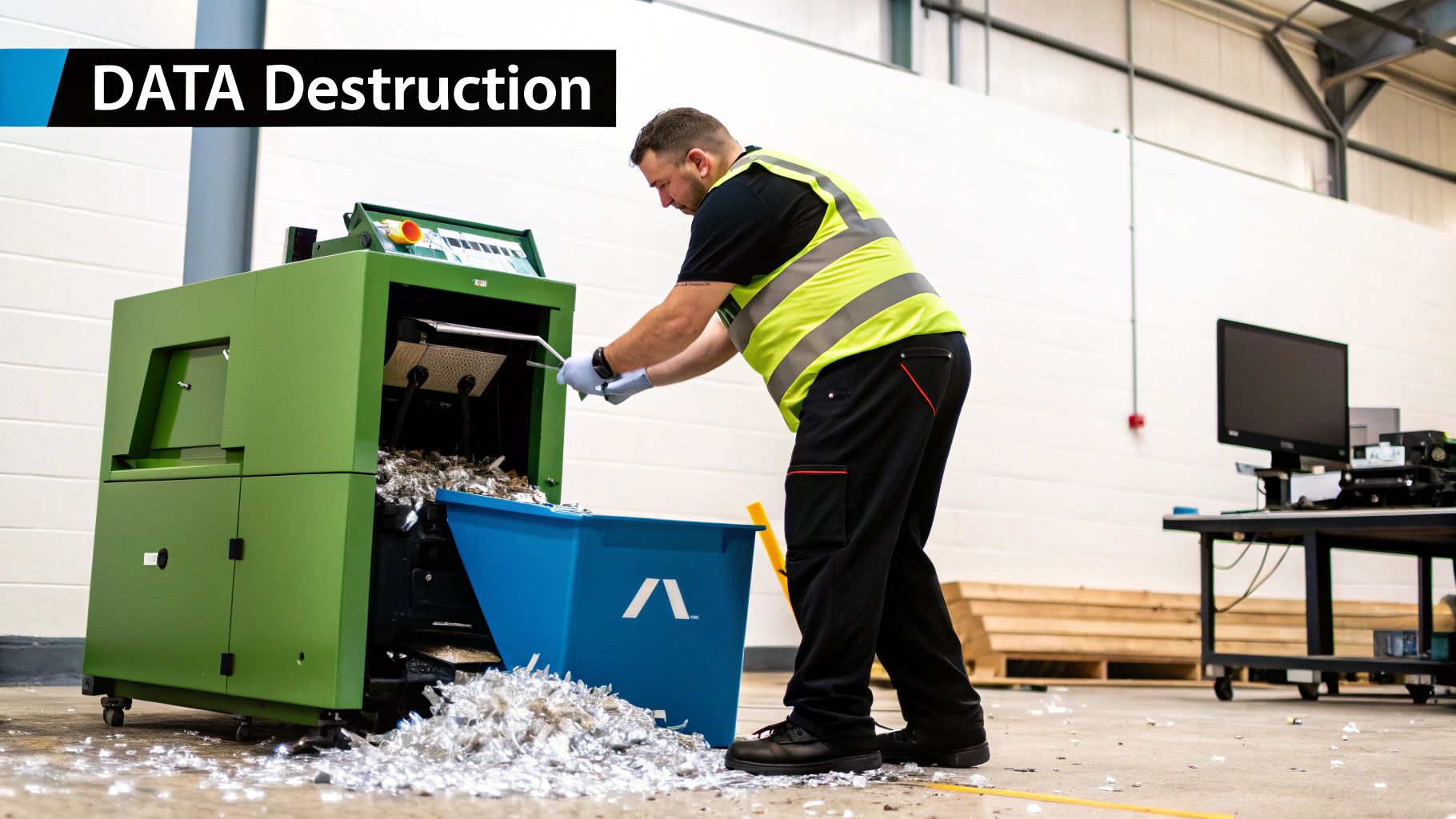
It all starts with secure logistics. Every single device, whether it's one server or a whole pallet of laptops, must be tracked with a documented chain of custody. This isn't just paperwork; it’s a critical step that creates a clear, unbroken audit trail from your facility to ours, shutting down any risk of assets getting "lost" along the way.
The Critical Difference in Data Destruction
Once your assets are at a certified facility, the most important part of the job begins: data destruction. It's imperative for businesses to get this part right—not all data removal methods are the same. Just deleting files or formatting a hard drive is like wiping a chalkboard. Sure, it looks clean, but the old information is often easy to recover with simple tools.
A true ITAD partner uses methods that make data gone for good. Period. The two main approaches are data sanitization and physical destruction, and they each have their place.
-
DoD-Standard Data Wiping: This is a software-based process that overwrites every single part of a hard drive with random data, usually in several passes. It follows strict standards like the Department of Defense (DoD 5220.22-M), essentially sterilizing the drive so the original data can never be recovered. This is the best route for newer, working hard drives that might be remarketed.
-
Physical Hard Drive Shredding: For old, broken, or extremely sensitive drives, there's only one surefire answer: physical destruction. It’s exactly what it sounds like. An industrial shredder grinds the drive into tiny, mangled bits of metal and plastic. Think of it as turning that chalkboard into dust—there’s zero chance of putting the information back together.
A crucial aspect of any secure IT disposal program involves understanding and adhering to a robust data privacy policy to ensure sensitive information is protected. For those looking to deepen their knowledge, reviewing an example of a well-structured policy can be very insightful, such as understanding your data privacy policy which outlines key considerations for data handling.
The ultimate proof is in the documentation you get back. For any business that has to prove compliance, that formal certificate is worth its weight in gold. You can learn more about how a certificate of destruction provides a legal, auditable record that the job was done right. It’s your definitive proof that your company’s data was handled responsibly.
Beyond Destruction: Asset Recovery and Recycling
A complete ITAD program doesn't just stop once the data is gone. After we’ve secured all data-bearing devices, our focus shifts to getting the most value out of your old equipment and making sure our environmental footprint is as small as possible. This is where a top-tier computer recycling service really proves its value.
The next steps involve a careful sorting and evaluation process:
-
Asset Triage and Testing: Our technicians put functional equipment—like newer laptops, servers, or networking gear—through its paces to see what kind of shape it's in and if it can be reused.
-
Remarketing and Value Recovery: Devices that still have market value are refurbished and sold through secure, established channels. This process can actually generate a financial return for your business, helping to offset the program's cost and turning old equipment into found money.
-
Certified Materials Recycling: Anything that can't be reused is de-manufactured. We break equipment down into its core materials—plastics, metals, glass, and circuit boards. These commodities are then sent to certified downstream partners who responsibly process them for use in new products, ensuring nothing ends up in a landfill.
This all-in-one approach guarantees your IT disposal strategy isn't just secure and compliant, but also financially smart and environmentally sound. It turns a potential risk into a well-managed part of your business that protects your data, recovers value, and supports your commitment to sustainability.
Navigating the Maze of E-Waste Compliance
For any modern business, compliance isn't just a suggestion—it's a requirement baked into your operations. When it's time to retire old IT assets, you aren't just clearing out a storage closet. You're navigating a complex set of rules designed to protect sensitive data and the environment, and a misstep can lead to staggering fines and a damaged reputation.
Think of a professional computer recycling service as your expert guide through this maze. Their job is to make sure every single piece of equipment is handled by the book, giving you the paperwork to prove it. This turns a major legal headache into a secure, straightforward process.
Decoding Data Privacy Regulations
Different industries have different rulebooks, and your disposal plan has to follow them to the letter. If you're in healthcare, the Health Insurance Portability and Accountability Act (HIPAA) sets the gold standard for protecting patient information. Tossing a computer that once held patient records without certified data destruction isn't just a mistake; it's a major violation that can bring massive penalties.
Likewise, financial firms have to follow the Gramm-Leach-Bliley Act (GLBA), which demands the protection of consumer financial data. Just hitting 'delete' on a file doesn't cut it. The law puts the responsibility squarely on your business to guarantee that data is permanently destroyed, not just discarded.
Your Proof of Protection: Certificates
So, how do you prove you've done everything right? It all comes down to the official documentation from your recycling partner. These documents are your legal shield, creating a clear, auditable trail that shows you acted responsibly.
-
Certificate of Data Destruction: This is arguably the most important piece of paper you’ll get. It’s your legal proof that the data on your hard drives was irretrievably destroyed, either through DoD-standard wiping or physical shredding. A proper certificate will list the serial numbers of the destroyed devices, creating an ironclad record for your files.
-
Certificate of Recycling: This document confirms that your other electronics—the ones without data—were processed in an environmentally sound way, following all local, state, and federal laws. It shows your company is committed to sustainability and ensures your old equipment doesn't end up in a landfill.
"For any organization handling sensitive information, a Certificate of Data Destruction is non-negotiable. It is the final, tangible proof that you have fulfilled your duty of care to protect your customers, patients, and business."
This paperwork is what closes the loop. It’s your official record, proving you did your due diligence and protecting your business long after the equipment is gone.
Understanding Key Industry Certifications
When you're choosing a computer recycling partner, their certifications are a shortcut to gauging quality and trust. Think of them as a seal of approval, guaranteeing the vendor operates at the highest level of security and environmental responsibility. Two of the most critical certifications to look for are R2 and e-Stewards.
-
R2 (Responsible Recycling): The R2 standard is all about making sure electronics are recycled with a heavy focus on protecting the environment, keeping workers safe, and ensuring data security. An R2-certified company has been independently audited to confirm they follow the industry’s best practices.
-
e-Stewards: Often seen as the most rigorous certification out there, e-Stewards is a global program that guarantees no hazardous e-waste gets exported to developing countries or dumped in landfills. It also demands the highest standards for data destruction and worker safety.
These aren't just logos to slap on a website; they are your assurance that a partner has committed to strict, verifiable standards. They signal that the vendor won’t cut corners, protecting both your data and your reputation.
The e-waste challenge is growing at an alarming rate. In 2022, the world generated a staggering 62 million tonnes of electronic waste, and old IT gear was a huge part of that. What's worse, only 22.3% of it was properly collected and recycled, which underscores just how vital certified partners are. You can dig into the full scope of this issue and read the detailed findings from the Global E-waste Monitor 2024.
Your Step-By-Step Corporate Recycling Roadmap
Kicking off a professional computer recycling service might seem like a huge undertaking, but the right partner makes the whole thing straightforward and completely transparent. It’s not a mystery box—it’s a structured process with clear stages designed to get your old assets from your building to their final, secure destination with zero guesswork.
This roadmap ensures your data is safe, your compliance is locked down, and your day-to-day business barely skips a beat, whether you’re retiring a handful of desktops or decommissioning an entire data center. The entire process is built on clear communication and documented security from start to finish.
Step 1: Initial Consultation And Scope Definition
It all starts with a simple conversation. During the first call, a recycling specialist sits down with your team to get a handle on the full scope of your project. We’re not just counting machines; we’re figuring out your specific data security needs, logistical challenges, and any compliance rules you need to follow.
We’ll figure out what kind of gear is involved—servers, laptops, networking switches, you name it—and decide on the best way to handle data destruction. That could mean on-site shredding for ultimate security or certified wiping at our facility. This first step makes sure the plan is perfectly aligned with your business goals from day one.
Step 2: Scheduling And On-Site Preparation
Once we have a solid plan, it's all about logistics. We'll schedule a pickup at a time that works for you, aiming for the least amount of disruption to your workflow. Before our crew arrives, your IT team can get a head start by gathering the assets in one spot and making sure everything is disconnected from the network.
A good checklist is your best friend here. For more complex jobs, like those involving servers, our detailed server decommissioning checklist gives your team a play-by-play guide so nothing gets overlooked. A little prep work makes for a fast, smooth pickup.
Getting your assets ready for pickup is a team effort. This checklist breaks down the typical responsibilities to make sure everyone is on the same page.
Business Preparation Checklist for E-Waste Pickup
| Phase | Action Item | Internal Responsibility (e.g., IT Dept, Facilities) |
|---|---|---|
| Inventory & Disconnection | Create a master list of all assets slated for disposal (include serial numbers if possible). | IT Department |
| Disconnect all devices from power sources and the corporate network. | IT Department | |
| Remove any proprietary peripherals or attachments not included in the disposal. | IT Department | |
| Consolidation | Designate a secure, accessible pickup location (e.g., loading dock, empty office). | Facilities / IT Department |
| Move and consolidate all disconnected assets to the designated pickup area. | Facilities / IT Department | |
| Final Checks | Confirm the asset list matches the physical equipment in the pickup area. | IT Department |
| Ensure the pickup location is clear of obstructions for the recycling team. | Facilities | |
| Inform building security (if applicable) of the scheduled pickup time and vendor. | Facilities / IT Department |
Following these simple steps ensures our team can work quickly and efficiently, getting the old equipment out of your way with minimal interruption.
Step 3: Secure Transport And Certified Processing
On pickup day, our professional logistics team shows up to securely pack and transport your assets. Every single device is handled carefully and documented to maintain a strict chain of custody from your door right to our certified processing facility. This paper trail is an absolute must-have for a secure ITAD program.
Once at our facility, the equipment is processed exactly as planned. Anything with a hard drive undergoes certified data destruction, and all other electronics are responsibly de-manufactured to recover raw materials. Absolutely nothing goes to a landfill.
This is where compliance becomes reality. The entire journey is governed by strict rules and verifiable steps.
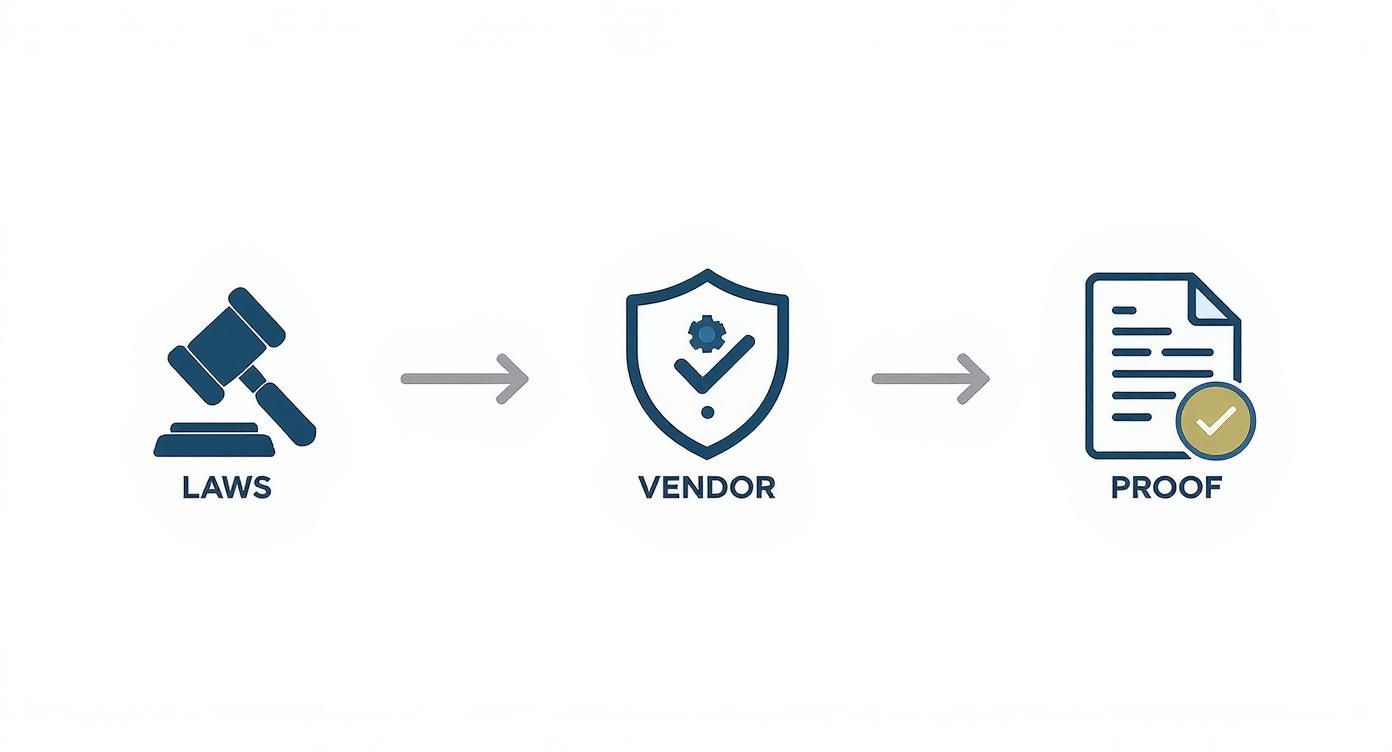
As you can see, following the regulations, working with a certified partner, and getting documented proof are the three pillars of a fully compliant disposal process.
Step 4: Final Documentation And Reporting
The last—and arguably most important—step is getting your complete compliance package. This is more than just an invoice; it's your official proof that you handled your e-waste the right way.
Your documentation package is the definitive proof that your company has met its legal and ethical obligations. It closes the loop on asset retirement, providing an auditable trail that protects your business from potential liability.
This package always includes a Certificate of Data Destruction, which lists the serial numbers of every sanitized or shredded hard drive, along with a Certificate of Recycling. This reporting provides the hard evidence your business needs to satisfy internal audits and regulatory demands, giving you total peace of mind.
How Businesses Win with Professional IT Recycling
Talk about compliance and data security can feel a bit abstract. The real value of a professional computer recycling service clicks into place when you see it solve real-world, high-stakes problems. This isn't a one-size-fits-all game; a true IT Asset Disposition (ITAD) partner adapts the strategy to the specific challenges a business is facing.
Let’s walk through two very different scenarios. Each one has its own set of hurdles, but both are solved with a secure, efficient, and tailored ITAD program. These examples show how a genuine partner does more than just haul away old gear—they eliminate risk.
Case Study 1: The Data Center Decommissioning
Picture this: a major financial services firm is moving its entire on-premise infrastructure to the cloud. This migration leaves behind a massive data center packed with thousands of servers, networking equipment, and storage arrays. Every single hard drive is a liability, loaded with years of sensitive customer financial records, proprietary trading algorithms, and internal company data.
The challenge here is enormous. The company’s number one priority is absolute, ironclad data security. A single data leak wouldn't just be a PR nightmare; it could trigger millions in regulatory fines and cripple them with lawsuits. They can't afford the slightest chance of a drive going missing or being improperly wiped.
For a project this critical, the solution needs to be executed with military-grade precision.
- On-Site Data Shredding: To completely remove any risk of data exposure during transit, the ITAD partner brings an industrial mobile shredder right to the data center. The company's own IT staff can physically watch as every single hard drive and SSD is pulled from the servers and pulverized into tiny, unrecoverable pieces.
- Serialized Audit Trail: Before a single drive is shredded, its serial number is scanned and logged. This builds a detailed chain-of-custody document, creating an unbreakable audit trail that proves each asset was destroyed and satisfies even the most demanding compliance officers.
- Complex Logistics Management: A dedicated project team manages the entire process—de-installation, palletizing, and the secure removal of thousands of bulky server racks. This ensures the data center is cleared out efficiently and right on schedule.
In this situation, the service is less about recycling and more about a full-scale security operation. The business wins by achieving total risk elimination, all backed by verifiable proof that protects them from catastrophic financial and reputational damage.
Case Study 2: The Multi-Location Healthcare Upgrade
Now, let's shift gears to a regional healthcare provider with two dozen clinics and offices spread across the area. They're in the middle of a system-wide tech refresh, replacing thousands of aging desktops, laptops, tablets, and printers—all devices that have been used by doctors, nurses, and staff.
Here, the equipment is incredibly varied, and nearly every device has come into contact with Protected Health Information (PHI). This makes strict HIPAA compliance the absolute top priority. On top of that, the provider has a strong corporate social responsibility policy and is committed to handling its old equipment in the most environmentally friendly way possible.
The scale of the e-waste problem—and the opportunity in recycling—is staggering. In 2022, the world generated 62 million tonnes of e-waste. The recoverable metals sitting in that mountain of discarded electronics are valued at an estimated $62.5 billion annually. You can learn more about these eye-opening e-waste statistics on wastedirect.co.uk.
The strategy here is a masterclass in balancing compliance, logistics, and sustainability.
The recycling partner sets up a phased pickup schedule to visit all 24 locations, ensuring minimal disruption to patient care. They provide secure, locked bins where staff can deposit old devices, and a professional team manages the logistics from each individual site.
Once at the certified facility, every hard drive undergoes a rigorous DoD-standard data wipe. The healthcare provider receives a comprehensive Certificate of Data Destruction for their records. Any functional equipment is then refurbished and resold, which generates a financial return that helps offset the cost of the entire project. All remaining materials are responsibly recycled through a network of certified downstream partners.
For the healthcare provider, this is a multi-faceted win. They nail their HIPAA compliance obligations, meet their environmental goals, and even recover value from their retired assets—all handled through a single, coordinated, and stress-free program.
Choosing the Right Computer Recycling Partner
Picking a computer recycling service is a lot more than a simple logistics call—it’s a major business decision that directly impacts your data security, legal compliance, and even your company's reputation. This isn't just about finding someone to haul away old gear. It's about bringing on a partner who will protect your business through every single step of the IT disposal process.
The stakes are far too high to leave it to chance. A real IT Asset Disposition (ITAD) partner builds trust on a foundation of verifiable standards. They act as a shield, protecting you from the serious risks that come with retiring corporate electronics and turning a potential liability into a secure, streamlined part of your operations.
Non-Negotiable Partner Qualifications
When you're vetting potential vendors, some qualifications aren't just "nice to have"—they're absolutely essential. Think of this as the basic checklist that separates the true professionals from the simple pickup services. If a company can't meet these standards, your business is left wide open to risk.
Your partner must have:
- Top-Tier Certifications: Look for R2 (Responsible Recycling) or e-Stewards certification. These aren't just logos on a website; they are hard-earned credentials proving a facility has passed tough, independent audits for data security, environmental safety, and worker protection.
- Ironclad Data Security Protocols: Any partner worth their salt must offer certified data destruction, whether through DoD-standard wiping or physical shredding. They also need to provide a Certificate of Data Destruction for every single job, creating a clear, auditable paper trail for your compliance records.
- Transparent Reporting and Chain of Custody: From the second your assets leave your building, you need a documented chain of custody. A professional partner will give you detailed reports confirming every device was handled exactly as promised.
Your Trusted Atlanta ITAD Partner
For businesses across the Atlanta metro area, Atlanta Computer Recycling not only meets these critical standards but exceeds them. Our entire operation was built from the ground up to handle the specific security and compliance needs of commercial clients. We deliver the peace of mind that modern businesses demand.
We combine R2-certified practices with a proven history of helping organizations protect their data and meet their sustainability goals. As you look at the different e-waste disposal companies, you'll quickly see that our deep commitment to security and transparency is what sets us apart. We don’t just recycle your computers; we protect your business.
Ready to secure your retired IT assets? Schedule a no-obligation consultation with our team today to discuss your specific disposal needs and build a plan that keeps your data safe.
Your Top Questions About Computer Recycling Answered
Even with a solid plan, it’s natural to have questions when you’re about to hand over your company’s retired hardware. We get it. Below are some of the most common things business owners and IT managers ask us, with straightforward answers to give you confidence in the process.
What Happens To The Data On Our Company Hard Drives?
This is the big one, and your data security is our absolute top priority. We use data destruction methods that meet or exceed the rigorous standards set by the Department of Defense (DoD 5220.22-M) and NIST 800-88.
That means we either use specialized software to completely wipe the drives, making the data impossible to recover, or we physically shred them into tiny, unrecognizable pieces of metal. For every single project, you receive a Certificate of Data Destruction. This document lists the serial numbers of every drive we destroyed, giving you a clear, auditable paper trail for your compliance records.
Can You Handle A Large-Scale Office Cleanout With Thousands Of Devices?
Absolutely. We specialize in commercial projects of all sizes, from a handful of desktops at a small office to complex, large-scale data center decommissioning jobs. Our experienced team manages all the logistics—secure on-site inventory, professional packing, and dedicated transport.
We bring the right people and the right equipment to get the job done efficiently and with minimal disruption to your daily operations. We’ll work directly with you to build a project plan that fits your schedule and security needs perfectly.
Is There Any Value In Our Old Computer Equipment?
Yes, there often is, and unlocking that value is a key part of what we do. A true IT Asset Disposition (ITAD) service isn't just about disposal; it's about smart recovery. We carefully evaluate all your retired equipment to see what might have resale value.
Newer or in-demand gear like servers, laptops, and networking components can often be refurbished and resold through our secure, established channels. When that’s the case, we have a transparent value-sharing model that can help offset—or even exceed—the costs of recycling and data destruction. It can turn your old assets into an unexpected revenue source. Our final report gives you a clear breakdown of which items were recycled and which were remarketed, so you know exactly where everything went.
Once the components are sorted and processed, their journey continues. To see exactly how retired devices are broken down into raw materials, you can learn more about what happens to recycled electronics in our detailed guide.
Ready to create a secure, compliant, and responsible disposal plan for your company’s retired IT assets? Contact Atlanta Computer Recycling today to schedule your no-obligation consultation and discover how our professional services can protect your business. Visit us at https://atlantacomputerrecycling.com.