A Business Guide to the City of Palmetto GA

Don't mistake the City of Palmetto for just another quiet suburb. For smart businesses, it’s a strategic commercial hub with serious logistical power, making it a prime location for companies aiming to grow within the greater Atlanta metroplex.
Why Palmetto is a Strategic Business Position

If you think of the Atlanta economy as a massive wheel, the City of Palmetto, GA, isn't just a point on the map—it’s a critical spoke. It connects the central hub to the region's most vital transportation arteries, opening up unique opportunities for commercial growth.
This location gives businesses a real competitive edge. Situated just south of Hartsfield-Jackson Atlanta International Airport, one of the planet's busiest cargo hubs, Palmetto offers a direct line to global supply chains. Its proximity to major interstates like I-85 also puts it right at the crossroads of regional commerce.
A Growing Hub for Commerce
This logistical advantage is no secret. Palmetto's population growth is a clear indicator of its expanding economic footprint. The city's resident count has climbed steadily over the past two decades, matching the explosive development of the broader Atlanta region. From 2000 to its 2020 peak, the population grew significantly and has maintained stable growth in recent years.
But this isn't just about new residents. This expansion signals growth in other key areas:
- Infrastructure: New roads, utilities, and commercial real estate projects are popping up to support the influx of businesses and people.
- Support Services: As more companies set up shop, the demand for essential B2B services—from logistics and supply chain management to IT support—grows right along with them.
- Economic Activity: A growing population creates local demand and provides a ready workforce for expanding industries.
For any business, this growth translates directly into opportunity. A larger community needs more schools, healthcare facilities, and local government services, all of which run on robust IT infrastructure that will eventually need responsible disposal.
Seizing the Opportunity Responsibly
As businesses move into Palmetto or expand their existing footprint, managing operational responsibilities is everything. This covers the entire lifecycle, from the initial setup to ongoing compliance with local and federal rules. For companies serious about building a strong presence, understanding why SEO is crucial for small businesses is a great first step toward a competitive advantage.
A key piece of this responsibility is the proper management of electronic assets. The same growth that fuels success also produces a constant stream of outdated IT equipment. This guide will walk you through how your business can tackle these challenges, especially when it comes to e-waste and recycling. To get a head start, you can dive into our guide on professional e-waste services in the Metro Atlanta area.
Palmetto's Economic and Demographic Profile
To really get a feel for the business landscape in the City of Palmetto, GA, you have to look past the map and dig into the numbers. The economic and demographic data here tells a compelling story about market stability, the local consumer base, and the kinds of institutions that anchor the community. For any commercial service provider, these details point toward a resilient, mature, and growing market.
What the data shows is a community with deep roots and growing financial strength. This creates a solid foundation for B2B partnerships, especially for services tied to established local pillars like schools, government, and healthcare.
A Mature and Stable Community
A quick look at the demographics shows that Palmetto is an established, stable community, not a transient one. The median resident age is a key indicator of this maturity, suggesting a town with well-developed public institutions.
Think about what that means for commercial services:
- Established Public Sector: A mature population supports long-standing schools, libraries like the Palmetto branch of the Fulton County Library System, and local healthcare facilities.
- Constant Need for Upgrades: These very institutions are the ones that frequently undergo technology refreshes, creating a consistent need for IT asset disposition (ITAD) and compliant e-waste recycling.
- Focus on Long-Term Planning: Stability allows your business to build lasting relationships rather than chasing short-term, fleeting opportunities.
This demographic profile is a strong signal of recurring service needs. For instance, a local medical clinic upgrading its patient management systems will need HIPAA-compliant data destruction for old servers and computers—a critical service in a community with deep healthcare roots. We see similar opportunities in nearby cities like Hapeville, which has its own unique character. If you're exploring the broader region, check out our business guide to the City of Hapeville, GA.
Economic Growth and Diversity
Palmetto's economy is defined by two key factors: steady income growth and a diverse population. In 2023, the median household income hit $54,745, reflecting a 4.39% annual increase from the year before. This rising prosperity fuels both consumer spending and business investment, creating a healthier economic environment for everyone.
This isn't just a number; it’s a clear sign of economic vitality. Rising incomes point to a thriving workforce and successful local businesses, which in turn require more sophisticated support services to manage their growth and stay compliant.
As you evaluate the market, it helps to have a snapshot of the key indicators. The data below paints a picture of a stable, growing, and diverse community.
City of Palmetto GA At a Glance (2026 Data)
| Metric | Figure |
|---|---|
| Median Household Income (2023) | $54,745 |
| Annual Income Growth Rate | 4.39% |
| Median Age | 42.8 years |
| African American Population (2020) | 58.15% |
These figures underscore Palmetto’s strength as a B2B market. The combination of rising incomes and a mature population means you're dealing with established organizations that value compliance, security, and long-term partnerships.
Furthermore, Palmetto’s demographic makeup reflects the rich diversity of the greater Atlanta region. The 2020 census reported a predominantly African American population of 58.15%, and the median age of residents is 42.8 years. You can find more details in this general overview of Palmetto, Georgia. For businesses, this mix of factors points to a reliable and expanding market with a strong institutional base—an ideal target for building lasting partnerships.
Navigating Palmetto's City Government and Business Services

Starting or running a business in the City of Palmetto, GA, means working hand-in-hand with its municipal government. It's best to see the city not as a hurdle, but as a partner—providing a clear framework to guide your company from day one to long-term success. Knowing your way around this system saves time, prevents expensive mistakes, and helps you build a solid foundation.
Palmetto's business-friendly mindset is built on a long history of resilience. The city was officially incorporated way back in 1854, and its government has always adapted to support a community focused on moving forward. A perfect example came in 2023 with the election of the city’s first female and first African American mayor, a moment that highlights Palmetto's progressive spirit.
Key Departments for Your Business
For any business, two departments are absolutely critical: Community Development and Public Works. These offices are your go-to contacts for almost every physical part of your operations.
Community Development Department: This is your first stop for anything involving building, zoning, and licensing. They manage business permits, enforce local codes, and give the green light on site plans. Before you even think about signing a lease or breaking ground, talking to this department is non-negotiable.
Public Works Department: This group oversees the city’s core infrastructure, from roads and water to sanitation services. For businesses, their most direct role often comes down to waste management rules and getting your utilities connected.
Knowing who to call is half the battle. This proactive engagement makes sure your business starts off right and stays compliant for years to come.
Think of these departments as your business's co-pilots. Just like a pilot needs air traffic control for a clear flight path, your business depends on these city officials to navigate the journey from planning and permits to smooth daily operations.
A Practical Approach to City Services
Working with the City of Palmetto, GA, is a straightforward process once you know the key players. Whether you're a new business applying for a license or an established company planning to expand, these contacts are your starting point for getting things done.
Of course, your responsibilities extend beyond the initial setup, especially when it comes to operational rules for things like electronics disposal. To help Palmetto businesses meet these requirements, we offer a full suite of certified IT asset disposition and recycling services. Building strong relationships with both city hall and expert partners creates a powerful support system for your business.
Meeting E-Waste and Commercial Recycling Regulations
For businesses in Palmetto, GA, managing old equipment goes way beyond the weekly trash pickup. When it’s time to retire electronics like computers, servers, or monitors, just tossing them in a dumpster isn't just bad practice—it’s a huge liability. This kind of waste, known as e-waste, comes with serious legal, financial, and data security risks.
Your regular commercial trash service simply isn't set up to handle the complexities of IT equipment. These devices often contain hazardous materials like lead and mercury, which are regulated to keep them out of the environment. More importantly, they hold sensitive data, even if you think you’ve wiped them clean.
What Counts as E-Waste
The first step toward compliance is knowing what actually qualifies as e-waste. It's more than just old desktop computers. The term covers a whole range of electronic devices your business relies on daily.
Common examples include:
- Computers and Laptops: The most obvious sources of sensitive corporate and customer data.
- Servers and Network Gear: The backbone of your IT infrastructure, holding vast amounts of proprietary information.
- Monitors and Displays: Older CRT monitors contain lead, while even newer models have components that need special handling.
- Printers, Scanners, and Peripherals: These devices often have internal memory that stores copies of documents you thought were long gone.
Getting this wrong can have disastrous consequences. Think about a local medical practice in Palmetto tossing old office PCs into a standard recycling bin. If that equipment still holds patient records, the practice could face crippling fines for violating the Health Insurance Portability and Accountability Act (HIPAA).
The High Stakes of Non-Compliance
The risks of mishandling e-waste aren't just hypothetical. They carry very real penalties that can damage a business's reputation and its bottom line. This isn't a minor paperwork error; it's a critical operational failure with risk at every turn.
The biggest mistake a business can make is assuming that a deleted file is gone forever. Data can often be recovered from discarded hard drives, creating a direct pipeline for data breaches, corporate espionage, and identity theft.
For example, schools in Palmetto are subject to the Family Educational Rights and Privacy Act (FERPA), which protects student records. Financial firms have to follow rules like the Fair and Accurate Credit Transactions Act (FACTA). A violation through careless e-waste disposal can easily lead to:
- Hefty Fines: Regulatory bodies don't hesitate to impose severe financial penalties for data breaches.
- Reputation Damage: News of a data breach can shatter customer trust that took years to build.
- Legal Action: Your business could face lawsuits from customers or clients whose data was exposed.
Because the stakes are so high, working with a specialist isn't a luxury—it's a necessity. A certified e-recycler understands this complex web of regulations and has the right tools to make sure your data is permanently destroyed and your old gear is recycled responsibly. For a deeper look at the standards involved, you can learn more about our process for compliant IT disposal in the Atlanta area.
Your Guide to Compliant E-Waste Disposal
For any IT manager or administrator in the City of Palmetto, GA, figuring out what to do with old company electronics is more than just a chore—it’s a critical part of your job. Having a clear, repeatable process is the only way to protect company data, stay compliant with regulations, and sidestep some very costly mistakes. This is your playbook for getting IT asset disposition (ITAD) right.
Think about a local medical clinic in Palmetto upgrading its patient check-in kiosks. Suddenly, they have dozens of old desktops, tablets, and printers sitting in a storage room. You can't just toss them in a dumpster. This is exactly why a structured disposal plan is non-negotiable.
Step 1: Conduct a Thorough IT Asset Inventory
First things first: you can't manage what you don't measure. The initial move is always to create a detailed inventory of every single piece of equipment you plan to retire.
Don't just count the devices. You need to document specifics like serial numbers, internal asset tags, make and model, and its last known user or department. A simple spreadsheet usually works just fine. This list becomes your official record for internal audits and the manifest for your recycling partner.
Step 2: Identify All Data-Bearing Devices
With that list in hand, go through it and flag every device that could possibly hold sensitive information. The obvious culprits are computers and servers, but you have to think beyond that.
Many businesses forget about the less obvious items. Office printers, network switches, and even scanners often have internal hard drives or memory that store data.
- Computers and Laptops: These contain hard drives (HDDs) or solid-state drives (SSDs) packed with company files and information.
- Servers: The heart of your operations, holding your most critical business and customer data.
- Multifunction Printers: Can retain digital copies of every document scanned or printed on an internal drive.
- Company Mobile Phones and Tablets: Are filled with emails, contact lists, and saved login credentials.
This step is all about assessing your risk. Until its data is verifiably destroyed, every one of these devices is a potential liability.
The risk isn't just theoretical. A single misstep in how you dispose of e-waste can have severe consequences, as this graphic shows.
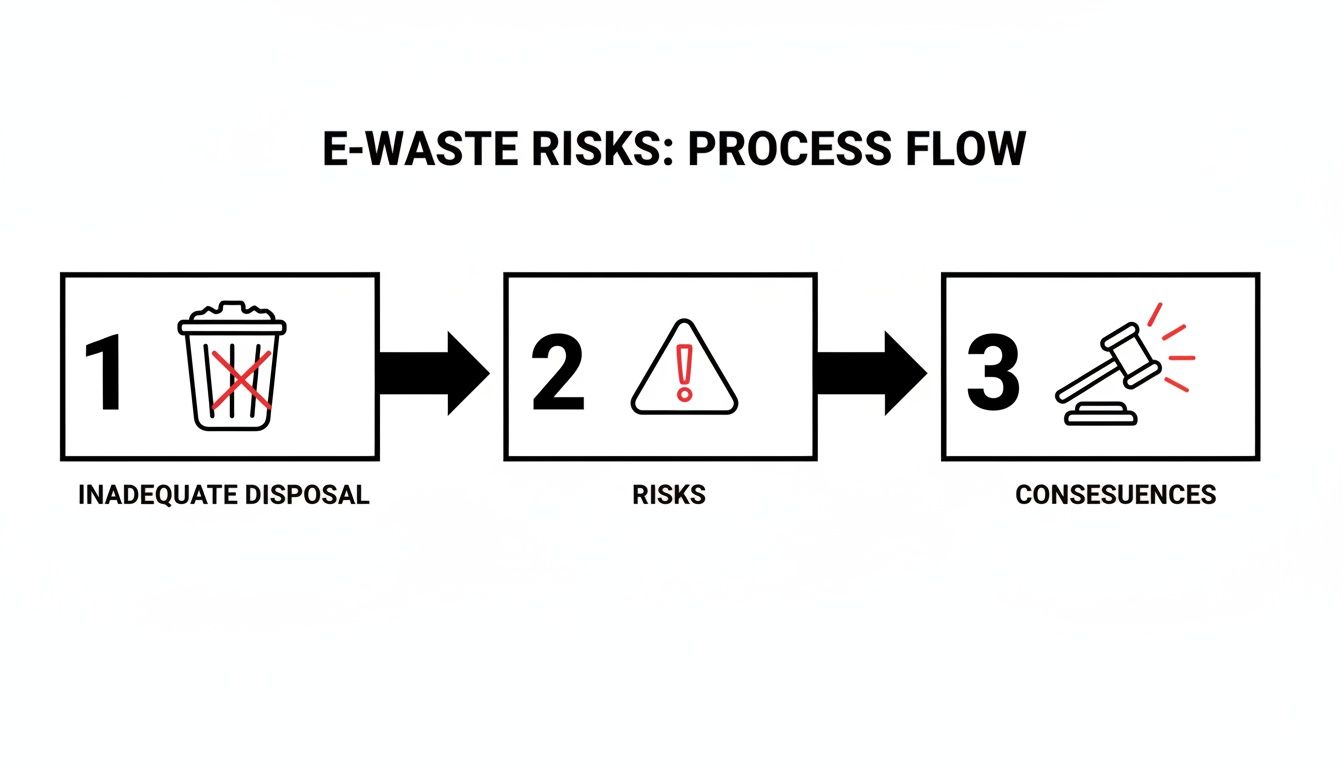
As you can see, inadequate disposal isn't just a compliance issue; it's a direct path to data breaches, financial loss, and serious legal trouble.
Step 3: Understand Data Destruction Methods
Now that you know which assets carry data, you need to decide how to destroy it for good. Your two main options are data wiping and physical shredding.
Deciding between them depends on your security needs, compliance requirements, and whether the hardware has any resale value.
Choosing Your Data Destruction Method
| Method | Best For | Compliance Level | Outcome |
|---|---|---|---|
| Standard Data Wiping | Reusable assets like newer laptops, desktops, and servers. | Meets most compliance standards (HIPAA, FACTA). A DoD 5220.22-M wipe is a common software method. | Data is overwritten and rendered unrecoverable by software tools; the physical drive remains intact and can be reused. |
| Physical Shredding | End-of-life, damaged, or non-functional hard drives. Also for devices containing highly sensitive intellectual property. | The highest level of security, providing irrefutable proof of destruction. | The drive is physically ground into tiny, unusable metal fragments, making data recovery impossible. |
For businesses in Palmetto navigating complex data security policies, it's also worth knowing about related fields like professional data recovery services to fully understand the lifecycle of digital information. The key is to ensure data you want gone, stays gone.
Step 4: Vet a Certified E-Recycling Partner
This might be the most important decision you make. Don't just go with the cheapest option. You need to look for a vendor with credentials like the R2v3 (Responsible Recycling) certification.
This certification is your guarantee that the partner follows the highest industry standards for both data security and environmental responsibility. A certified recycler will provide a complete chain of custody for your assets and issue an official Certificate of Destruction when the job is done.
Step 5: Arrange for Secure Logistics and Pickup
The final step is getting the equipment out of your building safely. Your chosen partner should offer secure, on-site pickup to make sure your assets are handled correctly from the moment they leave your control.
A professional service will show up with the right team and equipment to pack and transport everything without getting in the way of your day-to-day operations. For businesses in the area, you can learn more and schedule an e-waste pickup in the Atlanta area to get the process started.
How Atlanta Computer Recycling Serves Palmetto Businesses
Knowing the rules of e-waste disposal is one thing, but finding a partner you can trust to handle it correctly is another. For businesses in the City of Palmetto, GA, the constant pressures of data security and environmental compliance are very real. Atlanta Computer Recycling (ACR) offers a direct, expert solution designed for Palmetto’s commercial sector.
We close the gap between retiring old IT assets and achieving total peace of mind. Our entire process is built on a foundation of security, certified compliance, and convenience, protecting your business from the moment you decide to dispose of your equipment.
A Seamless and Secure Process
Picture this: an IT manager at a growing Palmetto firm has just finished a major server upgrade. They're now left with a room full of old hardware—servers, desktops, and hard drives—all loaded with sensitive client information. They know a single misstep could lead to a costly data breach and steep non-compliance fines.
Instead of taking on that risk, they make one phone call to Atlanta Computer Recycling.
- Initial Consultation: We start by discussing the project's scope, including the specific types and quantity of equipment you need removed.
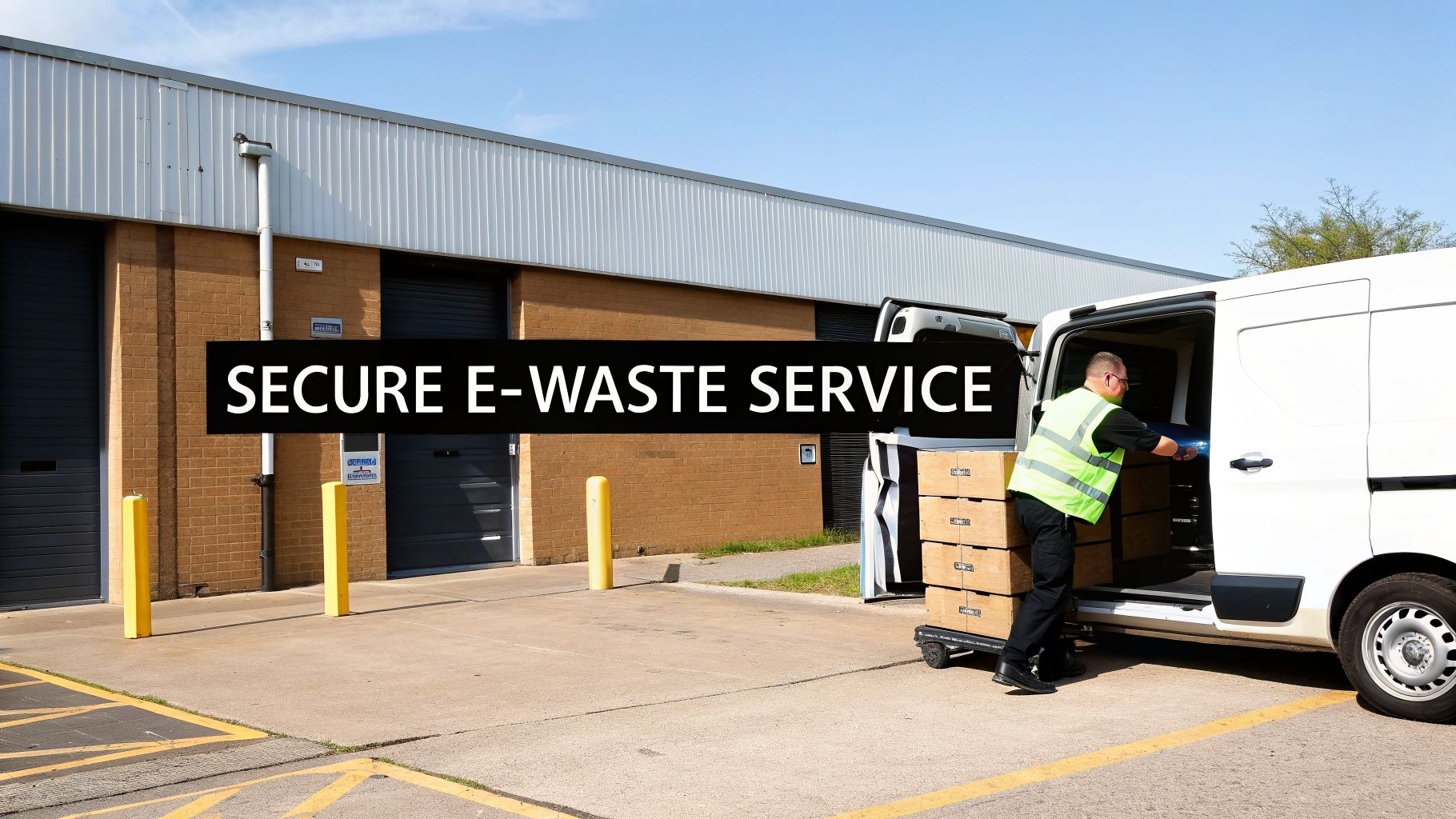
- Secure On-Site Pickup: Our professional team arrives at your Palmetto office to securely pack and transport all assets, ensuring minimal disruption and a complete chain of custody.
- Certified Data Destruction: Back at our secure facility, every single data-bearing device undergoes our strict, certified data destruction process.
We’ve designed this operation to be completely seamless for your business, turning a major compliance headache into a simple, scheduled task.
Core Services for Palmetto's Key Industries
Palmetto businesses, particularly those in sensitive fields like healthcare, education, and finance, operate under strict data protection mandates. Our services are built not just to meet these rules, but to exceed them, giving you a powerful shield against liability.
We believe ironclad data security shouldn't come at a premium. That's why we include complimentary DoD 5220.22-M 3-pass data wiping with our services. This military-grade standard overwrites your data, making it completely unrecoverable by software means.
Our commitment to compliance is proven by our R2v3 certification—the gold standard in the electronics recycling industry. This credential is your guarantee that we manage your assets with the highest level of environmental responsibility and data security. For devices that can't be wiped or are at the end of their life, we provide physical shredding, which turns hard drives into small, indecipherable fragments.
The ACR Process From Start to Finish
Our partnership with a Palmetto business is a clear, fully documented journey. After the secure pickup and data destruction are complete, we issue a Certificate of Destruction. This official document is your proof of compliance, listing every serialized asset that we processed.
This certificate is your final assurance that your company has met its legal and ethical duties. It confirms that all sensitive data was permanently destroyed and that the hardware was recycled according to strict environmental standards. From an IT manager’s first call to that final certificate, Atlanta Computer Recycling delivers a complete, accountable solution for every business in the City of Palmetto, GA.
Frequently Asked Questions About Business in Palmetto
Thinking about setting up shop in Palmetto? You probably have a few questions. We've put together some straightforward answers to the most common ones we hear from businesses looking at the City of Palmetto, GA.
What Are the First Steps to Starting a Business in Palmetto, GA?
First things first, get in touch with the City of Palmetto's Community Development Department. Before you sign a lease or buy property, you need to make sure your business type is a good fit for the local zoning rules. Once you've got the green light on location, you can move on to applying for a business license and any other permits the city requires.
Are There Specific Business Incentives Available in Palmetto?
Absolutely. As part of both Fulton County and the wider Atlanta metro area, Palmetto businesses can often tap into various local and state-level incentives. These programs are typically aimed at attracting new companies or helping existing ones expand, especially in high-growth industries. The best move is to speak directly with the city’s economic development team for the latest info.
A key takeaway for any business is that while formal incentives exist, Palmetto's greatest advantage is its strategic location. Its proximity to major logistics routes is a built-in benefit that can be more valuable than any single tax credit.
Is Professional E-Waste Recycling Required for All Businesses in Palmetto?
While there isn't a single city ordinance forcing every business to use a pro recycler, the answer is effectively yes. Every company has a legal and ethical responsibility to protect the sensitive data on its old devices—that includes customer lists, employee records, and patient files. Using a certified e-recycler is the only surefire way to comply with data privacy laws like HIPAA or FACTA and steer clear of hefty fines for improper disposal.
How Close Is Palmetto to Major Transportation and Logistics Routes?
This is where Palmetto truly shines. For any business involved in distribution, manufacturing, or e-commerce, the logistical access is second to none. The city sits just south of Hartsfield-Jackson Atlanta International Airport, one of the world's busiest cargo hubs. It also offers direct on-ramps to major arteries like I-85, making it a true cornerstone for commerce in the region.
For businesses in the City of Palmetto, GA, making sure your retired IT assets are disposed of securely and by the book isn't optional. Atlanta Computer Recycling provides certified, on-site services to handle all your e-waste needs, from data destruction to final recycling. Contact us today to schedule a pickup at https://atlantacomputerrecycling.com.