A Business Guide to Circuit Board Recycling

Recycling circuit boards is more than an environmental initiative; it's a critical business function. This sophisticated process involves extracting valuable precious metals while ensuring the secure and compliant disposal of hazardous materials. For any business, a structured circuit board recycling program is a core strategy for managing risk, controlling costs, and protecting your corporate reputation.
A well-planned program ensures your proprietary data remains secure and your company stays compliant with complex regulations, all while turning obsolete e-waste into a recoverable asset.
Why Smart E-Waste Recycling Is a Business Necessity
For most companies, the accumulation of old servers, computers, and networking gear in a storage closet is an operational headache and a hidden liability. A structured circuit board recycling program transforms this burden into an opportunity. It's not just an operational expense; it's a strategic move for risk management, cost control, and enhancing your corporate image.
Ignoring your electronic waste poses a direct threat to your bottom line. Improper disposal can lead to steep fines for environmental non-compliance. Even worse, a single discarded hard drive containing sensitive corporate or client data can trigger a financial and reputational nightmare.
Beyond Compliance: The Business Case for Recycling
The benefits of a formal recycling program extend far beyond penalty avoidance. Proactive companies are leveraging responsible e-waste management as a tangible competitive advantage. It has become a fundamental component of corporate social responsibility that customers, partners, and stakeholders actively look for.
Here’s how a robust plan directly impacts your business:
- Real Cost Savings: Landfill and disposal fees for e-waste are continually rising. A professional recycling partner can often provide cost-neutral or even revenue-generating services by recovering valuable materials, turning a disposal expense into a potential income stream.
- Stronger Brand Trust: Customers and B2B partners increasingly prefer to work with businesses that demonstrate strong environmental credentials. A commitment to responsible e-waste management builds trust and positions your brand as a modern, forward-thinking organization.
- Ironclad Data Security: Certified recyclers provide documented, verifiable data destruction. This eliminates the risk of sensitive information leaking from retired assets, protecting your company from litigation and reputational damage.
- Resource Recovery and Revenue: Your circuit boards are laden with gold, silver, copper, and palladium. Partnering with a specialist in precious metal recovery can generate rebates that offset program costs and contribute directly to your revenue.
When your business treats e-waste as a resource instead of trash, it unlocks hidden value. A single ton of computer circuit boards can contain thousands of dollars in recoverable gold, flipping a disposal cost into a profitable venture.
Mitigating Risks and Unlocking Opportunities
The risks associated with improper electronics disposal are too significant for any business to ignore. This isn't just about getting rid of old equipment; it's an investment in smart, upstream risk management. Some businesses may even qualify for grants available for waste prevention to help launch these critical initiatives.
Ultimately, a structured circuit board recycling program is an investment in your company’s resilience. It shields you from regulatory penalties, ensures data security, and demonstrates a tangible commitment to sustainable corporate practices.
To understand the broader context, learn more about the environmental impact of electronic waste and why responsible disposal is so critical for modern businesses. It’s a strategic move that transforms a basic operational task into a clear corporate advantage.
Preparing Your Electronics for Secure and Compliant Disposal
Before a single piece of retired technology leaves your facility, a comprehensive plan is essential. Executing this initial phase correctly is the most critical step in any corporate circuit board recycling project—it’s where you prevent data breaches, ensure regulatory compliance, and directly impact your financial return.
The process begins with a thorough inventory and audit of your retired IT assets. This is more than a simple headcount of old desktops; it's a strategic assessment to identify high-value, high-risk items. Assets like enterprise servers and networking gear often contain circuit boards rich with precious metals like gold and palladium, making them prime candidates for generating a financial rebate.
A detailed audit allows you to create a prioritized disposal list, clearly distinguishing between low-value peripherals and high-risk assets like SAN arrays or blade servers. This audit forms the foundation of your entire disposal strategy.
Segregation and Data Security Protocols
Once the inventory is complete, the next step is segregation. Physically separating high-value circuit boards from bulky plastics, metal chassis, and other low-value materials is key to maximizing your financial return. When a recycler receives clean, pre-sorted materials, their processing costs decrease—and those savings are often passed back to your business. While handling this equipment, it's wise to use professional ESD workspace and storage solutions to protect sensitive components until pickup.
However, the most critical, non-negotiable step is ensuring data security. A retired hard drive is a potential data breach. Your company must implement a bulletproof data sanitization policy before any device is handed over to a third party.
Your business has two primary, highly secure options:
- Data Sanitization: This software-based method completely overwrites a hard drive with random data, rendering the original information forensically unrecoverable. For many businesses, this is a perfectly secure and cost-effective solution. Our complete guide explains how to properly erase a hard drive before recycling.
- Physical Destruction: For drives that contained highly sensitive information, or for any that are non-functional, physical destruction is the only guaranteed method. This process shreds the drive into small, irreparable pieces, ensuring the data can never be accessed.
Ultimately, a smart e-waste strategy is about reducing corporate risk, achieving cost savings, and enhancing your brand's reputation as a responsible enterprise.
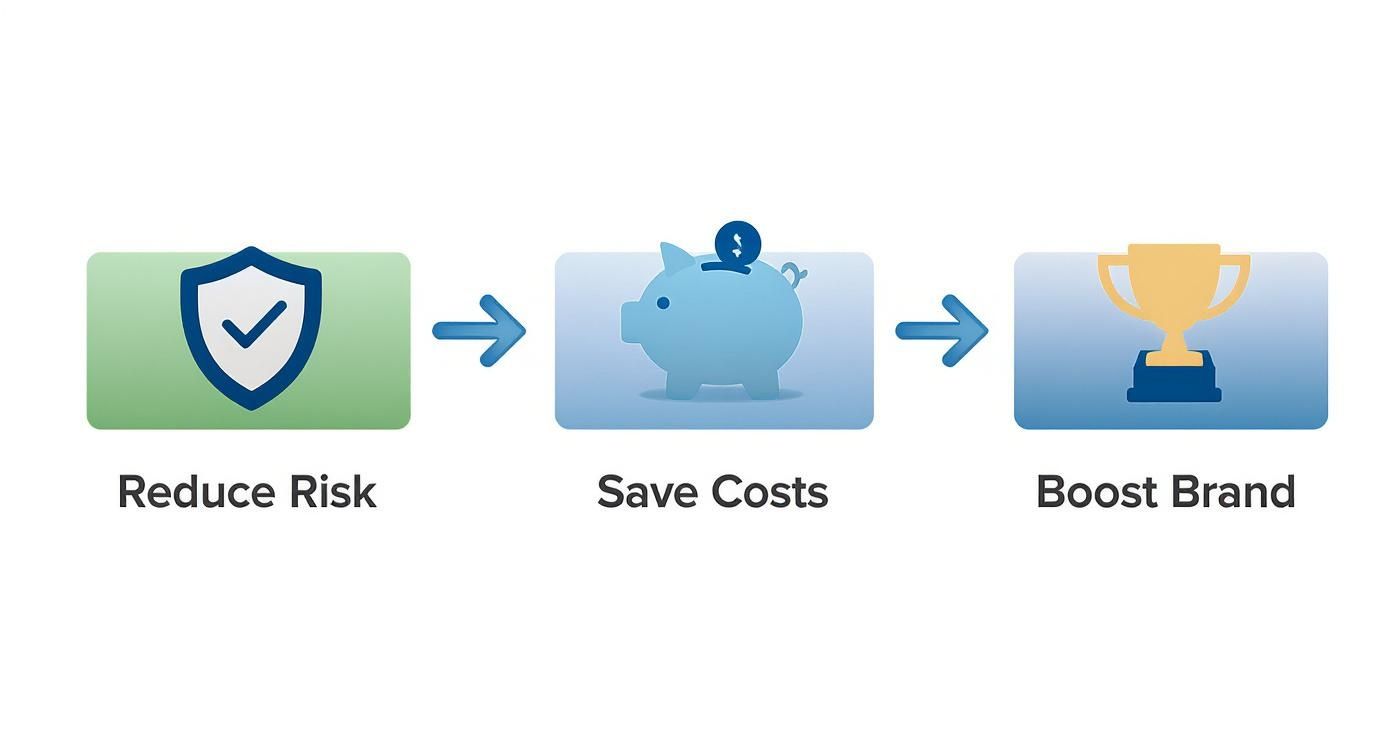
As you can see, a secure disposal plan isn’t just an operational task—it’s a strategic business decision.
Establishing a Defensible Chain of Custody
A documented chain of custody is your legal proof of due diligence. This paper trail tracks your assets from the moment they leave your control to their final destruction and recycling. It’s the defensible record that protects your business in the event of an audit or legal challenge.
Be meticulous with your chain of custody documentation. It must include serial numbers for major assets, pickup dates, transport details, and confirmation of data destruction. This isn’t just paperwork; it’s your corporate liability shield.
This documentation is especially vital when complying with regulations like HIPAA for healthcare data. Without it, your organization remains liable for data breaches, even long after the equipment has been disposed of. Partnering with a certified recycler is the best way to ensure this process is handled correctly and that you receive a formal Certificate of Destruction—the final piece of evidence confirming your compliance.
The global e-waste challenge is enormous. In 2022, the world generated an estimated 62 million metric tons of electronic waste, filled with valuable metals and plastics. Only about a third of that was documented as being properly collected and recycled, underscoring the urgent need for structured corporate recycling programs.
Navigating E-Waste Compliance and Certifications
The regulatory landscape for electronic waste is a minefield for businesses. A failure to comply is not a minor oversight; it can lead to substantial fines, legal action, and significant damage to your company's reputation. For any business managing circuit board recycling, maintaining compliance is a critical risk management function.
The specific regulations that apply to your business depend on your industry and location. A healthcare provider, for instance, must adhere to the strict data protection rules of the Health Insurance Portability and Accountability Act (HIPAA). This mandates that any device that has ever stored patient information must be disposed of in a manner that makes data recovery impossible.
Furthermore, all businesses must be aware of the Resource Conservation and Recovery Act (RCRA), the federal law governing hazardous waste. Because circuit boards contain materials like lead and mercury, they are often classified as hazardous and require specialized disposal methods.
Understanding Key E-Waste Certifications
This is where professional certifications become an invaluable tool for your business. Instead of attempting to master every e-waste regulation, you can leverage the expertise of a certified recycling partner. These certifications are proof that a vendor adheres to the highest industry standards for environmental safety, data security, and ethical operations.
Think of them as a third-party seal of approval, confirming that a recycler’s entire process has been independently audited and verified. For your business, this certification is your shield against downstream liability.
Here are the two premier certifications to look for in a recycling partner:
- R2v3 (Responsible Recycling): This is the leading global standard for the electronics recycling industry. An R2v3 certified facility is audited on everything from data security protocols and employee safety to its complete environmental impact. It guarantees a clear, provable chain of custody, which is crucial for preventing the illegal export of e-waste.
- e-Stewards: Developed by the Basel Action Network, the e-Stewards certification is renowned for its stringent standards. It includes an absolute prohibition on exporting hazardous e-waste to developing nations and enforces rigorous requirements for data protection and worker safety.
Selecting a partner with these credentials is not about environmental posturing; it's a strategic business decision that directly protects your company's security and legal standing.
A certified recycler provides more than a pickup service—they provide a liability shield. Their documented, audited processes are your best defense against claims of improper disposal or data mismanagement.
To help you quickly compare these essential credentials, here’s a breakdown of what they mean for your business.
Key E-Waste Recycling Certifications at a Glance
| Certification | Key Focus Area | What It Guarantees for Your Business |
|---|---|---|
| R2v3 | Comprehensive EHS, Data Security, & Chain of Custody | A transparent, auditable trail for all assets, ensuring legal compliance and secure data handling from start to finish. |
| e-Stewards | Strict Environmental & Social Responsibility | The highest level of protection against illegal e-waste exporting and a guarantee of rigorous data security protocols. |
Both certifications demonstrate a recycler's commitment to best practices, but understanding their nuances can help you align a partner with your company’s specific risk profile and corporate responsibility goals.
How Certifications Guarantee Security and Compliance
When you engage a certified recycler, you are not just hoping they handle your retired assets correctly—you have documented proof. Their certification represents a commitment to specific, high-stakes practices that protect your organization.
For instance, both R2v3 and e-Stewards mandate meticulous standards for data destruction. This ensures that whether a hard drive is sanitized or physically shredded, the process meets or exceeds legal requirements set forth in regulations like HIPAA or the Sarbanes-Oxley Act (SOX). Without this documented proof, your business remains liable for a data breach even after the equipment is gone.
This proof is formalized in a Certificate of Destruction. This legal document serves as your official record, confirming that your company’s data-bearing assets were destroyed in a fully compliant manner. It is a vital component of your risk management framework. To see why this document is so critical, you can learn more about what a Certificate of Destruction entails.
By prioritizing certified partners, you effectively outsource the complexities of compliance. This allows you to proceed with confidence, knowing your circuit boards and electronics are being processed in a way that protects your data, adheres to environmental laws, and upholds your company’s commitment to corporate responsibility, freeing you to focus on your core business.
How to Choose the Right Recycling Partner

Selecting the right partner for your circuit board recycling program is one of the most critical decisions in your e-waste management strategy. This extends far beyond finding a vendor to haul away old technology. You are entrusting them with your company’s sensitive data, your legal compliance obligations, and your brand’s reputation.
An unsuitable partner can lead to data breaches or costly regulatory fines. The right partner, however, becomes an integral part of your risk management strategy. The key is to find a vendor whose capabilities and services align perfectly with your security, logistical, and financial requirements.
Evaluating Core Capabilities and Logistics
First, look beyond the sales pitch and scrutinize a vendor’s operational capabilities. How do they manage the physical collection and transport of your retired assets? A professional partner will have a comprehensive logistics plan that prioritizes security at every stage.
Ask direct, specific questions:
- Secure Transportation: Do they use locked, GPS-tracked vehicles? For any company serious about asset security, this is a non-negotiable requirement from the moment equipment leaves your loading dock.
- Chain of Custody: Can they provide meticulous, serialized tracking from pickup to final destruction? A robust chain of custody is your legal proof of responsible disposal.
- On-Site Services: What services can they perform at your facility before transport? This may include asset tagging, palletizing, or even on-site hard drive degaussing and shredding.
A vendor’s logistical process is a direct reflection of their commitment to security. A disorganized pickup process is a major red flag indicating that their internal standards may also be lacking.
On-Site vs Off-Site Processing: What’s Best for You?
A key decision is whether to have your data-bearing devices destroyed at your location or at the recycler's secure facility. Each option has distinct advantages, and the best choice depends on your company's risk tolerance and compliance mandates.
On-Site Destruction is precisely as it sounds—a mobile shredding truck comes to your facility. Your team can witness the physical destruction of hard drives before they leave your premises. This offers the ultimate level of assurance and is often preferred by organizations in healthcare, finance, and government that handle highly sensitive data.
Off-Site Destruction involves the secure transportation of your assets to the recycling facility for processing in a highly controlled environment. Certified vendors follow strict, audited procedures for this process. This option is often more cost-effective and practical for large volumes of equipment and is perfectly secure when performed by an R2v3 or e-Stewards certified partner.
The choice between on-site and off-site services is a trade-off between absolute security assurance and cost-effectiveness. For maximum peace of mind, on-site shredding is unparalleled. For efficiency at scale, a certified off-site process is a secure and reliable industry standard.
Understanding Pricing Models and Material Rebates
Finally, demand a clear understanding of a potential partner’s pricing model. The costs associated with circuit board recycling can vary significantly, so it is vital to get a full breakdown of all potential fees and, just as importantly, any potential revenue from material rebates.
Most recyclers use one of several common models:
- Flat Fees: A straightforward charge per item, per pallet, or per pickup.
- Weight-Based Pricing: Billing is based on the total weight of the electronics collected.
- Profit Sharing/Rebates: The recycler processes the materials, extracts valuable commodities like gold and copper, and provides your business with a share of the revenue.
The profit-sharing model is where an expert partner can deliver significant value. They should provide a transparent, easy-to-understand report detailing how they calculate the value of recovered materials and what your share will be. This can transform a disposal cost into a revenue stream, directly improving your project's ROI.
The value at stake is significant. The global market for printed circuit board e-scrap was valued at nearly $700 million and is growing rapidly. Top-tier recyclers process millions of tons annually. You can discover more insights about the PCB e-scrap market to appreciate the scale of this opportunity.
Choosing the right partner requires due diligence, but the payoff is immense. By carefully vetting their logistics, security standards, and financial transparency, you can build a partnership that protects your business and delivers tangible value. Our guide to the top electronic waste disposal companies is an excellent starting point for your research.
What Really Happens to Your Circuit Boards
Once your retired electronics are securely transported from your facility, a highly controlled and sophisticated process begins. Understanding this journey demystifies circuit board recycling and highlights the value a professional partner provides. This is not mere disposal; it's a precise science of material recovery.
The process starts with meticulous sorting and manual disassembly. Technicians separate circuit boards from other components like plastic casings, power supplies, and metal frames. This initial segregation is vital for maximizing the purity and efficiency of all subsequent recovery stages.
Next, the sorted circuit boards are fed into industrial shredders. These powerful machines liberate the various materials from each other, breaking everything down into small, uniform fragments that are ready for complex separation.
The Science of Material Separation
With the boards reduced to a shredded mix of metals, plastics, and fiberglass, advanced separation technologies take over. A combination of techniques is used to isolate different material streams, ensuring that both valuable and hazardous elements are managed correctly.
This multi-stage process typically involves:
- Magnetic Separation: Powerful magnets extract ferrous metals, such as steel and iron, from the shredded material.
- Air Classification: Controlled jets of air separate lighter materials, like fiberglass and resin, from the heavier metallic fragments.
- Eddy Current Separation: A rotating magnetic field repels non-ferrous metals like aluminum and copper, diverting them into a separate collection stream.
These physical separation steps are highly efficient, but the metallurgical refinement stages are where the true value is unlocked and precious metals are finally extracted from the concentrated metallic mix.
What happens behind the scenes is a combination of brute force and fine science. The shredding and physical separation get the materials sorted, but it’s the metallurgical processes that unlock the true financial and environmental value locked inside every circuit board.
Advanced Metallurgical Recovery
The concentrated mix of precious and base metals proceeds to highly specialized recovery processes. The two primary industrial-scale methods are pyrometallurgy and hydrometallurgy, each designed to isolate specific elements with incredible precision.
Pyrometallurgy is an advanced form of smelting. The metallic concentrate is heated to extremely high temperatures in a furnace. Different metals, having different melting points, can be separated as they liquefy. This process is highly effective for recovering base metals like copper, which also acts as a collector for precious metals like gold and silver.
Hydrometallurgy uses chemical solutions to selectively dissolve and extract metals. The shredded material is placed in a controlled chemical bath—often an acid solution—that leaches out specific metals. For example, a specialized solvent can dissolve gold while leaving other materials intact. The dissolved gold is then precipitated out of the solution and collected as a high-purity solid.
Both methods are complex and require stringent environmental controls to manage emissions and chemical waste safely. This is a key reason why partnering with an R2v3 or e-Stewards certified facility is non-negotiable; they are audited on their ability to perform these processes responsibly. You can explore a broader overview of what happens to recycled electronics to see how this fits into the larger e-waste lifecycle.
This intricate process transforms your old IT assets from a liability into a valuable resource, ensuring hazardous materials like lead and mercury are contained while recovering precious metals to re-enter the global supply chain.
Answering Your Top Circuit Board Recycling Questions
When establishing a corporate electronics recycling program, several key questions invariably arise. Securing clear answers is the first step toward building a process that is secure, compliant, and financially advantageous. Here are answers to the most common questions from businesses embarking on their circuit board recycling journey.
Can My Business Get Paid for Old Circuit Boards?
Yes, absolutely. Generating revenue from retired circuit boards is a standard industry practice. The financial return, or rebate, depends on the quantity and quality of precious metals—such as gold, silver, palladium, and copper—that can be recovered from the boards.
A reputable recycler will assess your specific materials and provide a transparent valuation. High-grade boards from servers and enterprise telecom equipment will always yield a higher return than low-grade boards from peripherals like printers or keyboards. The final payout is directly linked to current commodity market prices.
How Can I Be Certain Our Company Data Is Destroyed?
This is a critical concern for any business. The solution lies in certified processes and comprehensive documentation. A qualified recycling partner will guarantee data destruction and provide a Certificate of Destruction as legal proof.
Your company has two primary, highly secure options:
- Software Sanitization: Utilizes specialized software to overwrite a hard drive multiple times, making the original data unrecoverable. This is an excellent option for newer devices that may be refurbished.
- Physical Shredding: For older, damaged, or highly sensitive drives, physical destruction is the most secure method. For maximum assurance, a mobile shredding truck can perform this service at your facility, allowing you to witness the process.
Engaging a vendor with R2v3 or e-Stewards certification adds another layer of confidence, as their data destruction methods are rigorously audited by independent third parties.
What Types of Circuit Boards Are Most Valuable?
Not all circuit boards are created equal. From a recycler's perspective, their value is a direct function of their precious metal content. The most valuable boards are typically found in high-performance enterprise equipment that required superior conductivity and reliability.
Recyclers generally categorize them as follows:
| Board Category | Common Sources | Key Characteristics |
|---|---|---|
| High-Grade | Servers, network switches, telecom gear | Dense with gold-plated connectors, pins, and IC chips. |
| Medium-Grade | Motherboards from desktops and laptops | A moderate amount of precious metals, less dense than server boards. |
| Low-Grade | Monitors, printers, power supplies | Minimal precious metal content; often processed for base metals like copper. |
Understanding this hierarchy helps your business set realistic expectations for potential rebates from your circuit board recycling program.
Do We Need to Remove the Boards from the Equipment Ourselves?
In most cases, no. A full-service IT Asset Disposition (ITAD) partner manages the entire workflow. This includes on-site de-installation, asset tagging, and secure packing and transport. Their trained technicians can dismantle equipment efficiently and safely, saving your internal teams significant time and effort.
Attempting to disassemble complex electronics without proper tools and expertise is inefficient and can be hazardous. Allowing your recycling partner to handle disassembly ensures every component is managed correctly and prepared for the downstream recycling process.
"A common mistake businesses make is underestimating the labor involved in preparing e-waste. A good partner doesn't just pick up your old gear; they provide an end-to-end service that includes the heavy lifting, freeing up your team to focus on their core responsibilities."
Ultimately, a successful circuit board recycling program is a strategic partnership. Asking these questions upfront will help you select a vendor that aligns with your company's security, compliance, and financial objectives.
Ready to implement a secure, compliant, and cost-effective electronics recycling program for your business? Atlanta Computer Recycling offers tailored solutions for companies across the Atlanta metro area, ensuring your data is destroyed and your assets are handled responsibly.