How Weather in Johns Creek, GA, Impacts Your Commercial Operations


For any business managing physical assets, logistics, or sensitive equipment, the weather in Johns Creek, GA is more than just a topic for small talk—it’s a critical operational variable. The region's humid subtropical climate, with its hot, muggy summers and mild, damp winters, creates year-round challenges that can directly impact your company's bottom line.
Why Johns Creek Weather Is a Business Concern

If you’re an IT manager, facility operator, or business owner, you know that monitoring local weather isn't about planning the company picnic. It’s about protecting the expensive, mission-critical infrastructure your enterprise depends on.
Consider our intense summer humidity a silent threat to your capital investments. It quietly creeps into server rooms, data closets, and storage facilities, where airborne moisture can condense on cool electronic components. That condensation leads to corrosion, short circuits, and sudden, unexpected hardware failures that disrupt business continuity.
This isn't just a hypothetical problem. When servers, networking gear, or specialized operational technology fail due to environmental stress, it triggers costly downtime and grinds productivity to a halt. The financial impact isn't just about replacement costs—it’s lost revenue, potential data breaches, and emergency repair expenditures.
Proactive Planning Is Essential
The most effective strategy is to treat our local climate as a predictable business risk. Instead of reacting when a server overheats or a storm disrupts logistics, you can build a plan to mitigate these factors. This goes beyond checking the weekly forecast; it means integrating climate resilience into your long-term operational and capital expenditure strategies.
Your company’s servers and networking equipment are the central nervous system of your business. You protect them from digital threats; you must also shield them from physical ones like heat, humidity, and sudden temperature shifts.
Effective risk management for your commercial assets comes down to a few key areas:
- Climate Control Infrastructure: Your HVAC system is your first line of defense. Ensuring it can handle peak summer heat and humidity isn't just a matter of employee comfort—it's non-negotiable for protecting high-value IT assets. For businesses, professional Commercial Air Conditioning Servicing is a critical investment.
- Asset Lifecycle Management: The constant thermal stress from our seasons shortens the operational lifespan of electronics. A strategic IT asset disposition (ITAD) plan is essential for cycling out equipment that has been degraded by years of environmental exposure before it fails.
- Logistical Scheduling: Planning a data center migration, office relocation, or bulk e-waste pickup? Timing is critical. Scheduling around severe weather warnings can prevent massive disruptions and protect your assets during transit.
The Four Seasons of Risk for Your IT Infrastructure
Here in Johns Creek, the four distinct seasons do more than just change the scenery—they bring a predictable cycle of risk to your business technology. Understanding this cycle allows you to shift from reactive problem-solving to proactive prevention, turning local weather data into a powerful tool for asset protection.
Thinking about the weather in Johns Creek, GA on a seasonal basis is the first step toward building a resilient operation. Our humid subtropical climate means the threats to your equipment are constantly evolving. The shift from a cool spring to a hot, humid summer isn't just a matter of adjusting the thermostat; it's about preparing your entire infrastructure for a significant change in environmental stress.
Summer Heat and Fall Transition
Summer is, without a doubt, the most dangerous season for electronics in our area. The combination of intense heat and suffocating humidity places a massive strain on your facility’s cooling systems. If your HVAC unit fails or simply can't keep up, server room temperatures can spike, leading to immediate hardware shutdowns and risking permanent data loss.
The primary adversary here is humidity. When warm, moisture-laden air contacts cool server components, condensation forms. This is effectively a slow, silent leak occurring inside your most critical equipment, causing corrosion that leads to unexpected failures long after the heatwave subsides.
As summer transitions to fall, the large daily temperature swings create a different issue. This rapid cooling and heating causes microscopic expansion and contraction in circuit boards and solder joints—a process known as thermal stress. Over time, this constant flexing degrades components and significantly shortens the lifespan of your hardware.
Winter Dampness and Spring Showers
Winter in Johns Creek introduces another type of moisture risk. While not as dramatic as summer’s humidity, the persistent damp chill and occasional freezes can compromise electronics, especially equipment in storage or less climate-controlled areas. Icy conditions also create logistical nightmares. An ice storm can shut down roads, making it impossible to execute a planned office move or e-waste pickup, as seen in past storms that closed key routes like Medlock Bridge Road.
Finally, spring brings heavy rain and the threat of severe thunderstorms. This is a major concern for any business with a ground-floor data center or storage area vulnerable to water intrusion.
To stay prepared, it's helpful to see the year laid out in a clear, actionable way.
Seasonal Business Impact of Johns Creek Weather
This table breaks down the primary weather challenge each season presents and offers a corresponding action your business can take to mitigate risk.
| Season | Primary Weather Challenge | Recommended Business Action |
|---|---|---|
| Summer | Extreme Heat & High Humidity | Schedule preventative HVAC maintenance; monitor server room humidity levels to prevent condensation. |
| Fall | Wide Temperature Swings | Audit equipment lifecycle status; plan for upgrades before thermal stress causes failure. |
| Winter | Ice, Freezing Temps & Dampness | Plan logistics around potential road closures; protect stored electronics from moisture. |
| Spring | Heavy Rain & Thunderstorms | Inspect facility for water intrusion risks; ensure data backups are secure and off-site. |
By aligning your operational planning with these seasonal patterns, you can build a more resilient infrastructure that's ready for whatever the Georgia weather throws at it.
This seasonal rhythm is a core part of our local climate. Johns Creek gets an average monthly precipitation of around 66.9 mm (2.63 inches), but this figure hides the real story—July's rainfall is often more than double that of January. For businesses across the metro area, understanding these regional patterns is vital, which is why we also provide insights on weather in East Point, Georgia.
Humidity and Precipitation: The Unseen Risk to Your Electronics
In Johns Creek, two of the biggest threats to your company’s electronics aren’t hackers or power surges—they're our famously high humidity and sudden downpours. That heavy, humid air we experience all summer is like a silent, slow-motion water leak, seeping into your office and server rooms. Over time, it corrodes the sensitive circuit boards, connectors, and power supplies inside your most valuable IT equipment.
The problem is compounded by condensation. When warm, moisture-packed outside air meets the cool, climate-controlled air of a server room, water forms directly on your hardware. It’s the same principle that causes a glass of iced tea to “sweat” on a porch, but instead of a harmless puddle, you’re looking at a catalyst for equipment failure.
This climate data gives you a snapshot of what your business is up against here in Johns Creek.
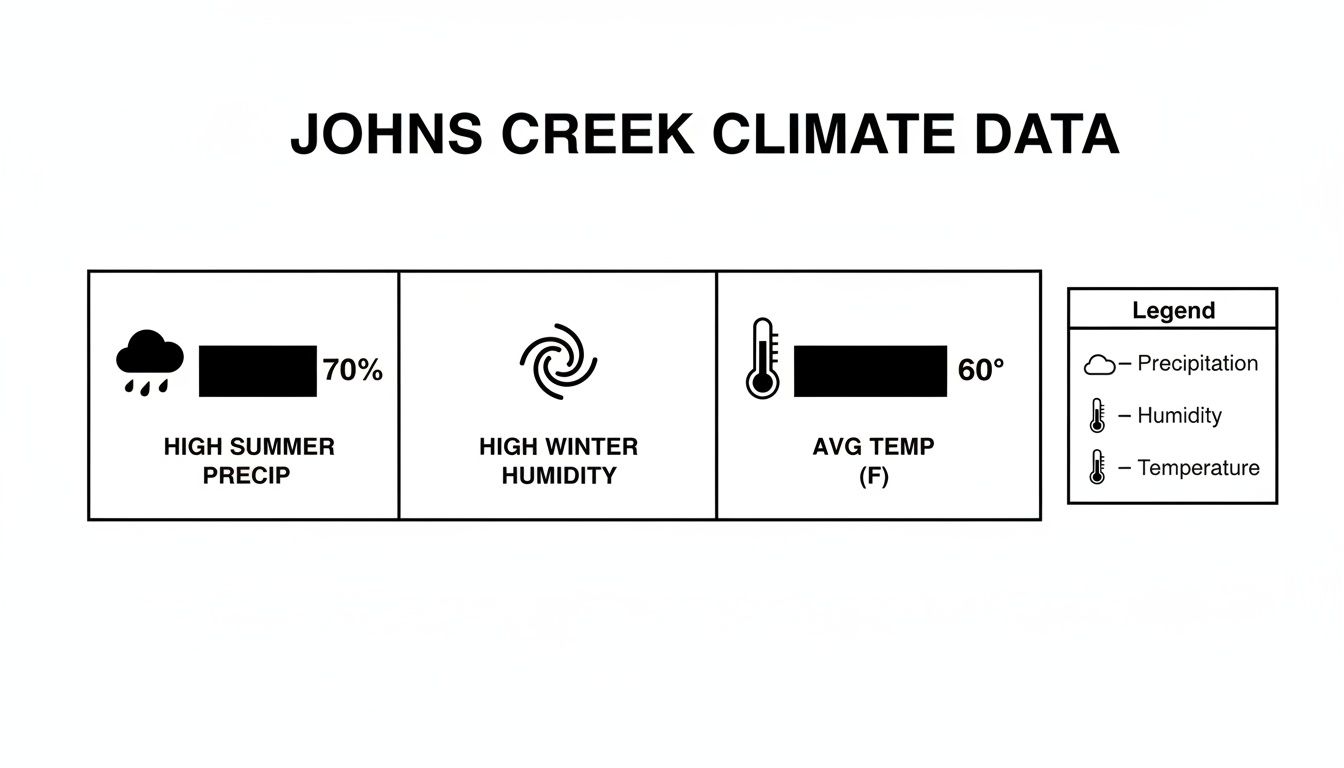
As you can see, persistent humidity and significant rainfall aren't just an inconvenience; they’re a direct business risk.
From Corrosion to a Data Breach
Initially, moisture damage might manifest as intermittent glitches or phantom errors that are nearly impossible to troubleshoot. But that slow corrosion eventually leads to total hardware failure, expensive downtime, and a growing inventory of useless, data-laden equipment.
Once humidity or water damages an electronic device, it ceases to be an asset and becomes a liability. The components may be compromised, but the sensitive corporate and customer data on the hard drives remains—and is now at risk.
You cannot simply discard this equipment. The weather in Johns Creek, GA, creates a perfect storm for data security challenges. Our rainfall varies dramatically, from an average of 51.26 mm (2.02 inches) in March to a soaking 88.94 mm (3.5 inches) in August. You can explore Johns Creek’s historical weather patterns to see just how unpredictable it can be. A sudden downpour could easily flood a ground-floor office or server room, leaving you with a stack of compromised hard drives.
This is exactly why any IT assets damaged by moisture require certified data destruction. Physically shredding the hardware is the only way to be 100% certain that a weather-damaged device doesn't turn into a future data breach. Businesses across the metro area face similar climate challenges; our guide to the weather for Fairburn, GA explores how these issues impact IT operations there, too.
How Temperature Swings Quietly Degrade Your Hardware
Extreme heat is an obvious threat, but the silent killer for your IT hardware is something far more subtle: thermal stress. This is the physical damage caused by the constant cycle of expansion and contraction your electronic components undergo during temperature swings. It’s a quiet but relentless process that weakens equipment from the inside out.
Consider moving a server from a hot loading dock into a frigid, climate-controlled server room. That rapid temperature change forces the metal, plastic, and silicon parts to expand and contract at different rates. The result? Microscopic stress fractures begin to form in solder joints, connectors, and circuit boards.
A single, dramatic temperature shift is unlikely to cause catastrophic failure on its own. Instead, the damage accumulates day after day, season after season. It’s analogous to bending a paperclip back and forth—eventually, it breaks. Over months and years, those tiny fractures grow until they lead to premature equipment failure.
The September Case Study
The transition from summer to fall is a perfect time to observe this risk in action. Here in Johns Creek, GA, September brings a noticeable shift as average daily highs can drop from 86°F down to 77°F. This 9°F swing, along with more overcast days, alters your facility’s cooling demands and energy costs. However, lingering warmth and humidity still create a major risk for condensation, a critical concern for businesses in regulated industries like healthcare that require HIPAA-compliant disposal for failed electronics. You can see more details on September's climate shifts in Johns Creek and how the environment changes.
This constant flexing caused by the weather in Johns Creek, GA, accelerates the physical end-of-life for your hardware. After years of thermal stress, that equipment is no longer reliable or functional. This makes it crucial to not only manage your current IT environment but also to have a solid strategy for asset retirement. A well-defined strategy is a core component of any effective business continuity planning checklist for IT operations.
Smart E-Waste Disposal Planning for Johns Creek Businesses

When you’re coordinating a large-scale IT asset disposition (ITAD) project—such as a data center decommission or a full office tech refresh—the local weather in Johns Creek, GA, is a serious logistical variable that can make or break the entire operation.
Attempting to move sensitive electronics during a humid July downpour or a surprise January ice storm is an unnecessary risk. One slip, one leaky pallet, or one weather-related delay can damage valuable assets and throw your entire project off schedule, impacting budgets and timelines.
That’s why we always advise scheduling major pickups during the calmer, drier months. The stable weather we typically see in April, May, and October provides the optimal window to get your equipment moved safely and efficiently, without fighting the elements.
Building a Weather-Proof ITAD Process
A professional ITAD partner doesn't just show up with a truck; they arrive with a comprehensive plan. We build weather contingencies directly into our process, ensuring we have the right equipment and protocols to handle whatever the Georgia skies throw at us.
Think of it as adding a layer of insurance to your asset recovery process. By aligning your ITAD schedule with favorable weather patterns, you not only streamline logistics but also add a crucial layer of efficiency and security to your entire project.
Here’s what that looks like in action:
- Secure On-Site Packing: We securely pack and palletize all assets right at your location, using materials like shrink wrap to shield everything from an unexpected shower during loading.
- Efficient Loading Protocols: Our team works quickly to minimize the time your equipment spends exposed to the elements between the safety of your building and our secure transport vehicle.
- Alternate Route Planning: If a storm or ice shuts down a major artery like Medlock Bridge Road—a common occurrence in past winter events—we have backup routes ready to avoid logistical bottlenecks.
Whether equipment is being retired from a planned upgrade or has been damaged by a sudden power surge, it must be handled correctly. Understanding the proper methods for the safe disposal of old computers is a key part of protecting your data and maintaining compliance. A smart ITAD strategy protects your assets from the moment we arrive until they are securely processed at our facility.
For a closer look at how we manage logistics for local businesses, find more information about our IT asset disposition services in Johns Creek, GA.
Frequently Asked Questions About Weather and IT Management
As a business leader or IT manager in Johns Creek, you’re likely aware of how local weather can impact operations. Here are a few common questions we hear about protecting technology assets from the elements.
What Is The Biggest Weather-Related Risk To My Servers?
While a sudden storm gets all the attention, the biggest risk from the weather in Johns Creek, GA is actually the persistent high humidity. It’s a quiet problem that causes slow-building corrosion and condensation inside your servers, eventually leading to sudden failures and expensive downtime.
Beyond controlling your server room's climate, you need a process for failed equipment. Even if moisture takes a device offline, the data is often recoverable—and that makes it a security liability.
A non-functional, water-damaged hard drive is not a secure hard drive. Data can often be recovered from compromised devices, making certified data destruction essential for any weather-damaged IT assets.
When Is The Best Time to Schedule E-Waste Disposal?
For a large-scale e-waste pickup, your best bet is to schedule it during the drier, milder months. We recommend targeting April, May, and October.
Booking your pickup during these more stable weather windows helps you avoid the logistical headaches of moving sensitive equipment in heavy rain or extreme heat, ensuring a smoother, more secure process from start to finish.
Is Data On A Water-Damaged Hard Drive A Security Risk?
Yes, absolutely. A hard drive that will not power on due to water damage can still be a major security risk. The data stored on its platters is often recoverable with specialized tools, leaving your company's sensitive information exposed.
This is precisely why certified data destruction is so critical for risk management. Physically shredding the drives is the only way to guarantee the data is 100% unrecoverable. It’s a necessary step to protect your business from a data breach and stay compliant with regulations like HIPAA.
When weather impacts your IT lifecycle, trust the experts to handle the final step securely. Atlanta Computer Recycling provides certified data destruction and responsible e-waste disposal for businesses across Johns Creek. Protect your data and your bottom line by visiting https://atlantacomputerrecycling.com to schedule a pickup.