Hard Drive Destruction Near Me: A Guide for Secure IT Asset Disposition

When your business searches for "hard drive destruction near me," you're not just clearing out an old server room. You're executing a critical final step in your data security protocol. Improper disposal of IT assets isn't an inconvenience; it's a direct threat to your company's financial health, client trust, and legal standing. Professional hard drive destruction is a non-negotiable component of modern risk management.
The Real Risks Hiding in Your Old Hardware
It's a common oversight for businesses to underestimate the liability stored in their retired IT assets. Obsolete computers, servers, and even office copiers are repositories of sensitive corporate and client data. This can include financial records, employee PII (Personally Identifiable Information), and proprietary intellectual property. A simple factory reset or deleting files offers a false sense of security, as that data is easily recoverable with widely available software.
This isn't a theoretical risk. The consequences are tangible and severe. Morgan Stanley faced a $35 million SEC fine for failing to properly decommission old hard drives, a lapse that exposed the personal information of approximately 15 million customers. This breach wasn't the result of a sophisticated cyberattack but a fundamental failure in physical asset disposition.
Why DIY Destruction Fails the Business Standard
While taking a hammer to an old hard drive might seem effective, for a business, DIY methods are dangerously inadequate. Drilling holes or smashing the casing often leaves significant fragments of the data platters intact. A determined actor with the right tools can still reconstruct this information. These methods provide no auditable proof of destruction, leaving your business exposed during compliance checks or legal challenges.
For any organization, data destruction must be absolute and auditable. The objective isn't merely to render a drive unusable; it's to make the data forensically unrecoverable. This is the only standard that satisfies regulatory compliance (like HIPAA, GDPR, or FACTA) and safeguards your corporate reputation.
This critical business need is fueling rapid growth in the secure disposal market. The global hard disk destruction service market is projected to be worth $2.5 billion by 2025, a clear indicator that businesses are prioritizing secure IT asset disposition (ITAD). You can learn more about the trends shaping the secure disposal market.
Ultimately, professional services are the only way to guarantee security and compliance. When your company retires hardware, you are managing a significant liability. To mitigate this risk, you must understand how to dispose of old computers safely and what certified processes entail. A professional partner provides a documented, secure chain of custody that protects your business long after the equipment has left your premises.
Finding and Vetting Local Destruction Services
A search for "hard drive destruction near me" will yield numerous options. The critical task for your business is to differentiate certified data destruction specialists from general e-waste haulers. The distinction can mean the difference between bulletproof compliance and a future data breach.
Your vetting process should begin with one non-negotiable requirement: NAID AAA Certification.
The National Association for Information Destruction (NAID) AAA Certification is the industry's gold standard. It is not a self-awarded emblem but a rigorous, ongoing verification by a third party. Certified companies are subject to unannounced audits, comprehensive employee background checks, and strict operational security protocols. Engaging a non-certified vendor is an unnecessary business risk.
Key Questions for Potential Vendors
Once you've confirmed certification, probe deeper into their operational procedures. A professional and transparent company will be prepared to answer these questions thoroughly.
- What does your chain of custody look like? Request a detailed walkthrough of the process, from the moment their technician arrives at your facility to the issuance of the final Certificate of Destruction. Every touchpoint must be documented and secure.
- Can we witness the destruction? For on-site services, witnessing is standard. If you are considering off-site destruction, ask about their policy for client observation at their facility. Their response is a strong indicator of their commitment to transparency.
- How are your employees vetted? The personnel handling your company's sensitive data must be trustworthy. This means they must undergo recurring, comprehensive background checks and drug screenings as mandated by their certification.
This decision tree illustrates the primary choice between on-site and off-site services.
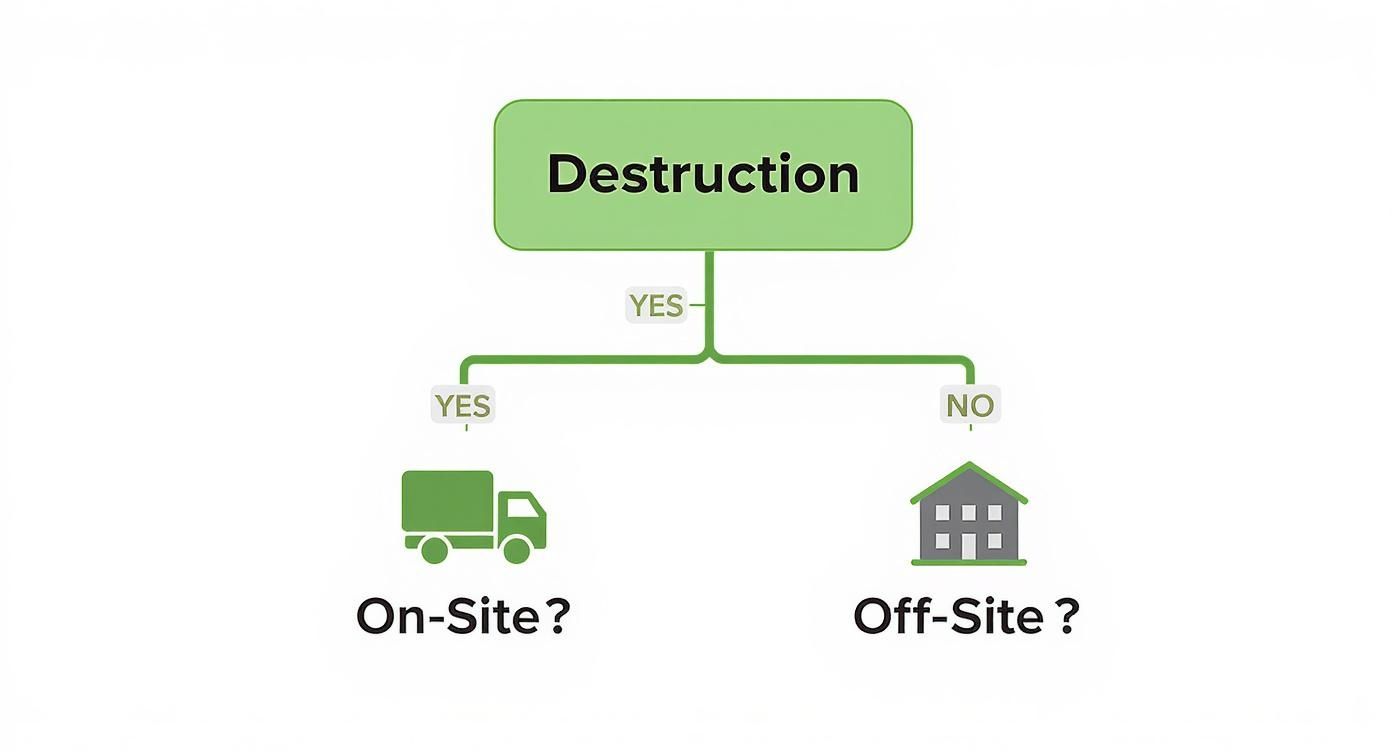
You are essentially balancing the absolute security and peace of mind of on-site witnessing against the potential cost efficiencies of off-site processing. Both are secure options from a certified vendor, but the choice depends on your company's internal security policies.
The end goal is always the same: a serialized Certificate of Destruction. This is not merely a receipt; it is a legal document that serves as your proof of compliance and is your primary defense in an audit. It must list the unique serial numbers of every destroyed drive, linking your asset inventory directly to its secure and final disposition.
If a potential vendor hesitates or provides vague answers to these questions, consider it a significant red flag and continue your search.
Choosing the right partner is a critical component of your IT asset disposition (ITAD) strategy, as important as your initial search for disposal of computers near me. True professionals deliver a service that is documented, auditable, and legally defensible, fully insulating your business from downstream liability.
Decoding Hard Drive Destruction Methods
When your business evaluates "hard drive destruction near me" services, it's crucial to understand that the methods are not interchangeable. The technology behind secure data disposal must align with the media being destroyed to be effective. Choosing an inappropriate method can leave sensitive corporate data exposed.
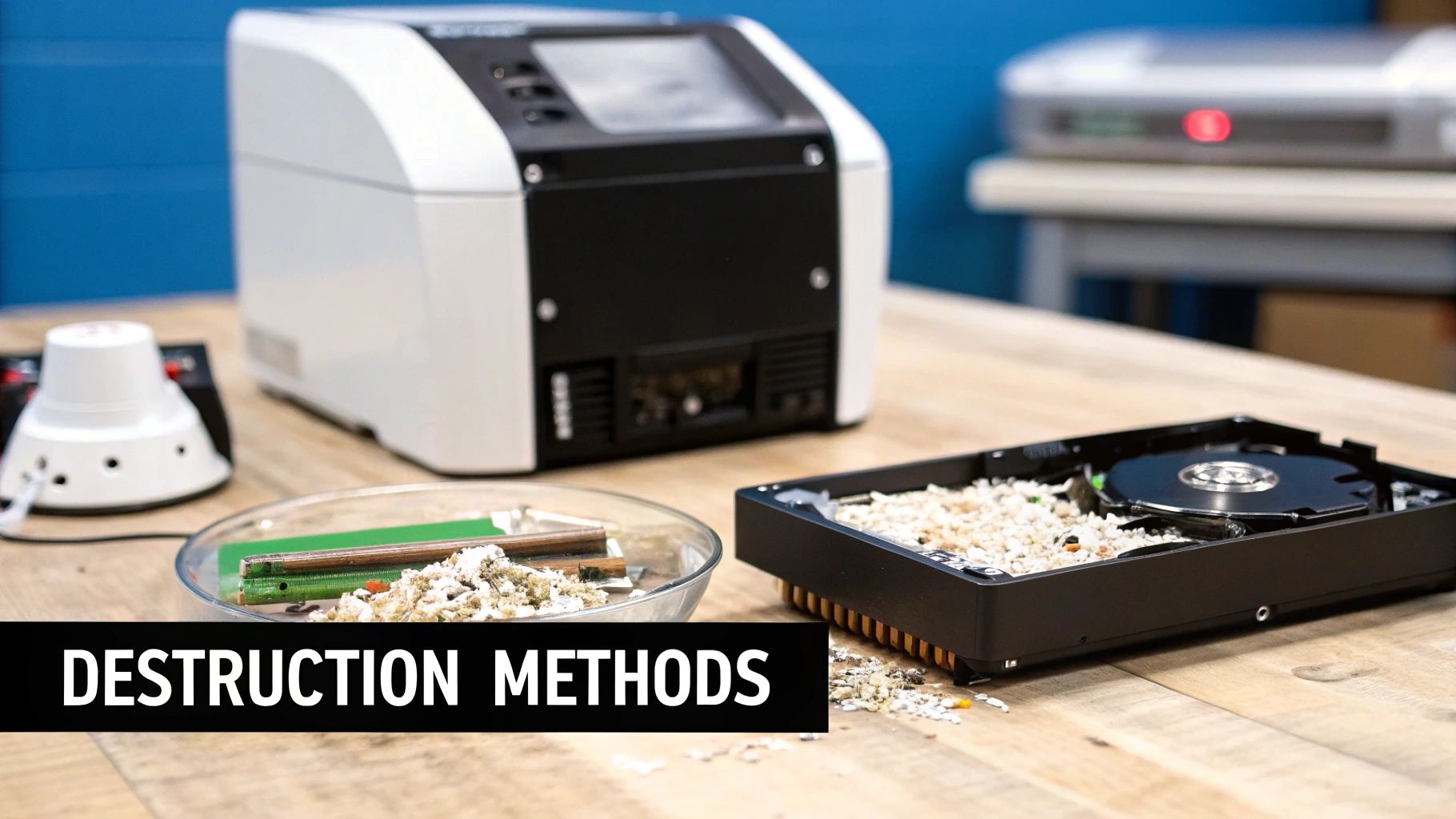
This is particularly relevant when dealing with a mix of legacy and modern storage media. A technique that is effective for older hard disk drives (HDDs) may be completely ineffective against modern solid-state drives (SSDs).
A prime example is degaussing. This process uses powerful magnetic fields to erase data on magnetic platters found in HDDs. However, it has zero effect on SSDs, which store data on non-magnetic flash memory chips.
The demand for effective destruction technology is driving significant industry investment. The market for hard disk destruction equipment was valued at $1,760 million in 2024 and is projected to reach $2,559 million by 2032. You can discover more about the growth of destruction technology that underpins professional services.
The Gold Standard: Physical Destruction
For the vast majority of businesses, especially those managing a diverse inventory of IT assets, physical destruction is the only method that guarantees complete data security. These are the primary methods offered by certified vendors:
- Shredding: This is the industry benchmark. Industrial shredders tear drives into small, irregular metal fragments, making data recovery physically impossible. The final particle size can be specified to meet stringent compliance standards, such as those for HIPAA or the Department of Defense (DoD).
- Crushing: A hydraulic press drives a steel punch through the hard drive, bending and shattering the internal platters. While effective, it may not destroy every data fragment with the same totality as shredding.
- Disintegration: This method pulverizes media into a fine, dust-like material. It provides the highest level of security available and is typically reserved for top-secret government data due to its higher cost.
While software-based wiping has a role in data lifecycle management (e.g., for device reuse), it is not a substitute for physical destruction when hardware is being retired. Verifying a successful wipe across a large inventory of diverse devices is complex and prone to error. Our guide explains how to properly wipe a computer hard drive for internal redeployment.
Ultimately, understanding these distinctions empowers your business to ask vendors the right questions. You must confirm their proposed method is appropriate for your specific hardware mix, whether it consists of servers full of HDDs or a fleet of modern laptops with SSDs.
How to Navigate Pricing and Service Agreements
As you evaluate proposals from "hard drive destruction near me" providers, you'll find that pricing models vary. Resisting the temptation to select the lowest bidder is crucial; treating data security as a commodity is a significant strategic error. The true value is not in the price per drive but in the comprehensive security and liability protection detailed in the service agreement.
Most professional vendors utilize one of two primary pricing models. For smaller quantities, a per-drive fee is common. For large-scale projects, such as a data center decommissioning or a company-wide laptop refresh, a bulk rate per pound is often more cost-effective.
Reading Between the Lines of a Quote
An unusually low quote can be a red flag for hidden fees that will inflate the final invoice. To ensure budget predictability, your procurement team should clarify the following:
- Fuel Surcharges: Are they included for on-site services, particularly if your location is outside the vendor's standard service radius?
- Environmental Fees: Reputable providers charge for the responsible recycling of the shredded materials.
- Labor Costs: Does the quote include the labor for removing drives from chassis, or is that a separate line item?
- Documentation Fees: Is the official Certificate of Destruction included in the base price?
A transparent partner will provide an all-inclusive quote that itemizes every charge, ensuring no financial surprises.
The most critical document you will engage with is the Service Level Agreement (SLA). This is more than a contract; it is your legal shield. A robust SLA defines the chain of custody, specifies the destruction method, guarantees compliance, and outlines the provider's liability.
Beyond Price: A Practical Scenario
Imagine your company is retiring 150 laptops. Vendor A offers a very low per-drive price with a generic, one-page agreement. Vendor B's quote is 15% higher, but they provide a detailed SLA and a sample Certificate of Destruction that confirms serialization for every device.
The prudent choice is Vendor B. While the initial outlay is higher, the investment provides auditable proof of compliance that protects your business from potentially catastrophic liability. A comprehensive agreement is the cornerstone of professional hard drive destruction services, and its value far exceeds any minor cost savings from a less-documented service.
Preparing for Your Data Destruction Service
With a certified vendor selected, a small amount of internal preparation will ensure the service day is efficient and secure. A smooth, professional engagement begins with proper asset management on your end.
First, create a detailed media inventory. This requires more than a simple headcount; you must catalog the serial number of every drive slated for destruction. This step is non-negotiable, as these serial numbers form the auditable link between your assets and the final Certificate of Destruction.
With the inventory complete, prepare the devices physically. In most corporate environments, this involves the IT department removing hard drives from desktops, servers, and laptops. Once removed, consolidate the drives in a secure, locked room or container to await pickup.
What to Expect on Service Day
When the vendor's technicians arrive, your first action should be to verify their credentials. They should be uniformed, possess photo identification, and be able to confirm they are bonded employees of the company you contracted. Do not hesitate to perform this verification.
For on-site service, they will transport your staged drives to their mobile shredding vehicle. A representative from your company must be present to witness the entire destruction process. For off-site service, the technicians will place your media into locked, tamper-evident containers for secure transport, maintaining a strict chain of custody from your facility to theirs.
The final step is the most critical for your compliance records. Upon completion of the service, you will receive a Certificate of Destruction. Do not simply file it. Review it meticulously to ensure that every serial number from your inventory is accurately listed.
This documentation serves as your definitive proof of due diligence in the event of an audit. The business demand for certified and environmentally responsible disposal is driving enormous growth in this sector. Projections indicate the hard drive destruction service market will expand from a $1.65 billion valuation in 2024 to $5.05 billion by 2035. You can review the full research on the future of the data destruction industry to understand market dynamics.
Common Questions About Hard Drive Destruction
When businesses investigate professional data disposal, several key questions consistently arise. Addressing these concerns is essential for making an informed and secure decision.
A common misconception is that drilling holes in a drive is a sufficient security measure. While this does cause physical damage, it often leaves large portions of the data platters—where information is stored—intact. For a motivated party, data recovery is still possible. Professional shredding is the only method that guarantees the data is forensically unrecoverable.
Verifying Security and Compliance
A primary concern for any business is documentation. The Certificate of Destruction is your official, auditable record that your company has met its legal and ethical obligations to protect sensitive data. This document is not just a formality; it is a critical compliance tool for any organization subject to regulations like HIPAA, SOX, or GDPR.
To understand the specifics of this documentation, you can explore the details of a certificate of destruction for hard drives.
Businesses also frequently ask if services are limited to traditional hard disk drives (HDDs). The answer is no. A certified provider is equipped to destroy a wide range of data-bearing media, including solid-state drives (SSDs), backup tapes, and mobile devices, applying the appropriate destruction method for each technology.
Ultimately, selecting a trustworthy "hard drive destruction near me" service depends on verifying their credentials, such as NAID AAA Certification, and ensuring they provide a serialized, auditable chain of custody from pickup to final documentation.
For a certified, secure, and compliant solution to your IT asset disposition needs, trust Atlanta Computer Recycling. Schedule your business's e-waste pickup today.