City of Suwanee GA ITAD & E-Waste Guide for Businesses


A lot of Suwanee organizations don’t realize they have an IT disposal problem until it turns into a move, a remodel, a server refresh, or a storage room full of retired equipment nobody wants to touch. The hard part usually isn’t identifying what’s obsolete. It’s figuring out how to remove it without exposing data, interrupting operations, or creating a compliance mess.
That’s why the city of Suwanee GA is worth looking at through an IT asset disposition lens. Fast-growing suburbs add offices, clinics, schools, and technical infrastructure quickly. They also retire laptops, network switches, phones, drives, monitors, and rack equipment just as quickly. If you manage facilities, infrastructure, or security in Suwanee, e-waste isn’t a side issue. It’s part of operations.
Suwanee's Growth An Opportunity and an IT Challenge
Suwanee no longer operates like a small outlying town. It operates like a mature suburban business environment with constant equipment turnover, more tenant movement, and more pressure on IT teams to retire assets cleanly.

The growth is clear in the city itself. Suwanee, Georgia, located in Gwinnett County, has grown from 8,725 residents in 2000 to a projected 24,082 in 2026, with a 14.56% increase since 2020 alone according to Suwanee population data. That kind of expansion means more occupied office suites, more healthcare administration, more educational technology, and more hardware reaching end of life.
What growth changes on the ground
A facilities manager usually sees the visible side first. New furniture arrives. Departments shift floors. A branch consolidates. Construction teams need rooms cleared. Then the hidden problem shows up:
- Old devices still hold data and can’t just be handed to a general junk hauler.
- Mixed loads slow projects down because monitors, drives, printers, and networking gear need different handling.
- Storage becomes risk when retired assets sit untracked in closets, MDF rooms, or loading areas.
One practical mistake comes up again and again. Teams treat retired equipment as a disposal issue instead of a controlled offboarding process. That’s when chain of custody breaks down.
Practical rule: If a device ever touched credentials, patient records, payroll data, student information, or internal files, treat it like a security project first and a recycling project second.
Cost control starts before pickup day
Smart IT managers in growth markets don’t wait for a crisis cleanup. They build disposition into refresh planning, lease exits, office changes, and decommission schedules. That approach fits broader proven IT cost reduction strategies because it reduces storage sprawl, prevents duplicate handling, and keeps retired assets from turning into unmanaged liability.
For organizations operating across Gwinnett, it also helps to work from a local service footprint rather than trying to improvise one-off removals. This is especially true if your equipment is spread between offices, clinics, schools, and support spaces in the same county. A local reference point for commercial pickups and service coverage in the area is this Gwinnett-focused page: https://atlantacomputerrecycling.com/georgia-gwinnett-county/
Understanding Suwanee’s Thriving Business Environment
Suwanee’s business profile matters because ITAD demand doesn’t come from population alone. It comes from the type of organizations a city attracts and the type of workforce those organizations serve.
Suwanee has a median property value of $480,600, 27% of residents were born outside the U.S., it carries an “A” grade for ethnic diversity, and it ranked #27 on Fortune’s Top 50 Best Places to Live for Families, based on the demographic overview published in this Suwanee market profile. For an IT manager, those facts point to a stable, educated, professionally active suburb with strong institutional demand.
Why that matters for retired electronics
In a market like this, you don’t just see one category of e-waste. You see several, often at the same time.
| Environment | Typical retired assets | Main concern |
|---|---|---|
| Professional offices | laptops, desktops, docks, phones, printers | user data, timing around staff transitions |
| Schools and training environments | lab PCs, displays, carts, networking gear | volume, scheduling around academic calendars |
| Healthcare settings | workstations, drives, scanners, tablets | regulated data and documented destruction |
| Technical operations | servers, storage, switches, SSDs | sanitization depth and de-install logistics |
Affluence creates complexity, not just opportunity
Higher-value commercial and mixed-use areas tend to produce a wider range of assets and more frequent change. Businesses upgrade conference room systems. Clinics add devices for intake and records access. Schools rotate student and staff hardware. Distributed offices accumulate old network gear nobody wants to claim.
What doesn’t work is applying the same process to every asset class.
A quick cleanout approach may be fine for empty metal shelving. It’s not fine for a stack of thin clients with stored credentials or a batch of copiers with internal drives. Good ITAD planning starts by separating equipment into categories that match business risk.
A practical way to read the city of Suwanee GA
For commercial decision-makers, Suwanee is attractive precisely because it blends family-oriented stability with serious professional activity. That creates three conditions:
- Consistent device churn from growing teams and office turnover.
- Higher expectations for compliance in healthcare, education, finance, and public-facing services.
- Less tolerance for disruption because most organizations can’t afford a messy pickup or an improvised after-hours clearout.
The best IT disposal programs in active suburban markets are boring by design. Assets are inventoried, removed on schedule, sanitized correctly, documented, and gone.
That’s the standard businesses in Suwanee should expect.
Navigating E-Waste and Data Security Compliance in Suwanee
Compliance problems usually start with ordinary behavior. Somebody sets aside a few laptops after onboarding replacements. A copier gets pushed into storage after a lease change. A nonworking server stays in a rack because no one wants to deal with the drive inside it. Months later, nobody can say what data remained on the device or who handled it.
That’s the risk.
What regulated organizations need to control
If your Suwanee operation handles patient information, financial records, employee files, or other sensitive business data, disposal has to be documented and repeatable. The relevant rules vary by industry, but the practical questions are the same:
- What assets are leaving service
- Whether the data was sanitized or physically destroyed
- Who maintained custody
- What proof the organization retained
A lot of teams understand the legal acronym but miss the operational detail. HIPAA, FACTA, and similar obligations don’t only apply when systems are live. They matter at retirement too.
The documents that actually matter
Two records tend to separate a controlled project from a risky one.
- Chain of custody documents who handled assets from collection through final processing.
- Certificate of destruction confirms that data-bearing media was destroyed or sanitized according to the agreed method.
Without those records, an organization may know that equipment is gone but still lack proof that data risk was properly closed.
For teams that want a broader operations view, this guide on navigating compliance challenges in data handling is useful because it connects policy expectations to day-to-day business handling decisions.
Environmental handling is part of compliance too
E-waste isn’t just a data issue. It’s also a materials issue. Monitors, batteries, peripherals, and mixed electronics can’t be treated like ordinary office trash. Businesses need an outlet that aligns with proper universal waste handling, especially when projects involve multiple device types in one pickup. This resource on https://atlantacomputerrecycling.com/universal-waste/ is a practical reference for that side of the process.
A retired device can create two failures at once. A data failure if storage wasn’t handled correctly, and an environmental failure if the equipment went out through the wrong waste stream.
What works and what doesn’t
What works is simple, even if the project isn’t.
- Identify data-bearing assets first.
- Separate reuse candidates from destruction candidates.
- Schedule removal with custody controls.
- Keep final documentation with your internal records.
What doesn’t work is guessing, mixing everything together, or allowing unofficial disposal by office staff, movers, or maintenance vendors who aren’t handling data destruction as part of a defined process.
Key E-Waste Generators in Suwanee and Their Needs
Suwanee’s e-waste profile isn’t driven by one industry. It comes from several groups with very different risk profiles. That’s why one-size-fits-all disposal usually breaks down.
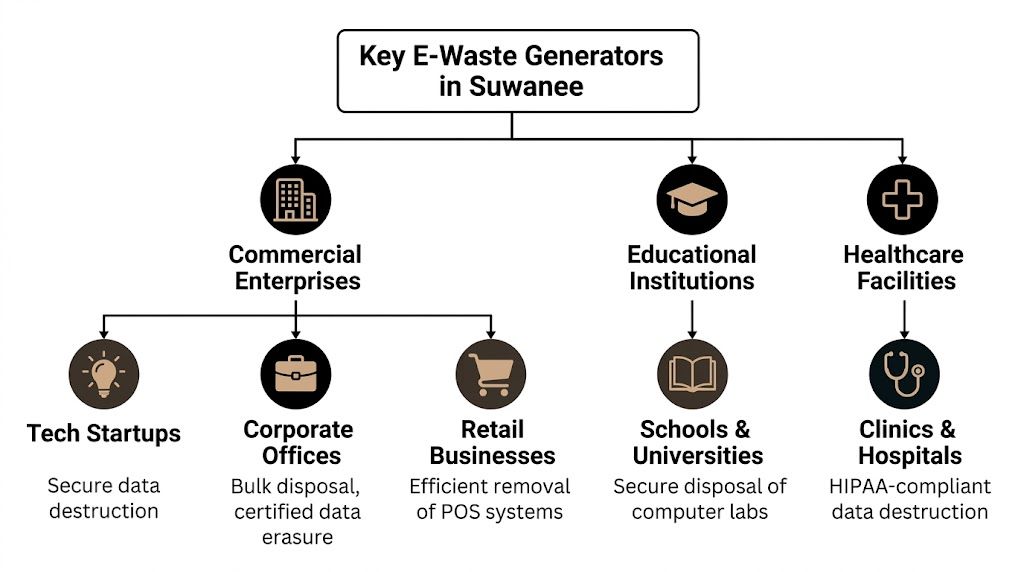
A key local signal is Suwanee’s data center presence. The QTS Suwanee 1 Campus has over 100 MW of planned critical power, and PrimeCare Technologies operates an SSAE 16-certified data center in Suwanee. Decommissioning in these environments calls for NIST 800-88r1 sanitization and physical shredding of SSDs because of the risk of data remanence as noted in this Suwanee data center reference.
Data centers and colocation environments
These projects are the least forgiving.
A data center decommission isn’t just “pickup.” It involves rack-by-rack coordination, staged removal, media segregation, serial capture where required, and transport controls that won’t interfere with uptime or neighboring infrastructure. SSDs, NVMe devices, failed drives, and storage nodes need special attention because logical deletion isn’t enough.
What works:
- pre-scheduled removal windows
- clear separation of sanitized media from destroy-only media
- on-site packaging by technicians who understand rack gear
What fails:
- mixed pallets
- vague inventories
- ad hoc removal by general freight teams
Healthcare clinics and medical support offices
Healthcare environments often have smaller footprints than data centers, but the compliance stakes are just as real. Front-desk systems, nurse station workstations, diagnostic peripherals, tablets, and printer/copier drives can all hold sensitive information.
The main trade-off in clinics is speed versus documentation. Staff want old equipment gone fast, especially during EHR changes or office renovations. But if that speed comes at the cost of poor tracking, the organization keeps the risk.
In healthcare, the device that looks least important is often the one people forget to sanitize. Check-in terminals, local print devices, and backup desktops cause more confusion than the main server.
Schools and training environments
Schools generate volume differently. They retire in waves.
A district, private school, or training center may remove carts of aging laptops, classroom displays, lab machines, access points, and admin office devices all at once. The challenge isn’t just data. It’s floor logistics, loading access, and timing around students and staff.
A useful planning step is to isolate display equipment from data-bearing equipment early. Many schools also struggle with older monitors, especially when they’ve accumulated across storage rooms after phased upgrades. For teams dealing with that specific category, this guide on https://atlantacomputerrecycling.com/what-to-do-with-old-computer-monitors/ is a practical starting point.
Corporate offices and mixed commercial sites
Suwanee’s office users often face the most common ITAD project type. A standard business refresh with more hidden variables than expected.
You may have:
- executive laptops with local files
- shared desktops from hybrid work transitions
- VoIP handsets
- networking gear in wall cabinets
- old conference room systems
- breakroom displays
- surplus accessories nobody inventoried
The common mistake is underestimating labor. An office with “just a few pallets” can still require careful sorting and secure handling if devices came from multiple departments.
Government and public sector spaces
Government environments care about traceability above all else. The questions are procedural.
Who signed off. Who touched the devices. What happened to failed media. Whether the final documentation matches the internal asset list. Public sector teams rarely need fancy language from a vendor. They need a process that stands up to scrutiny.
Logistical Planning for E-Waste Pickups in Suwanee
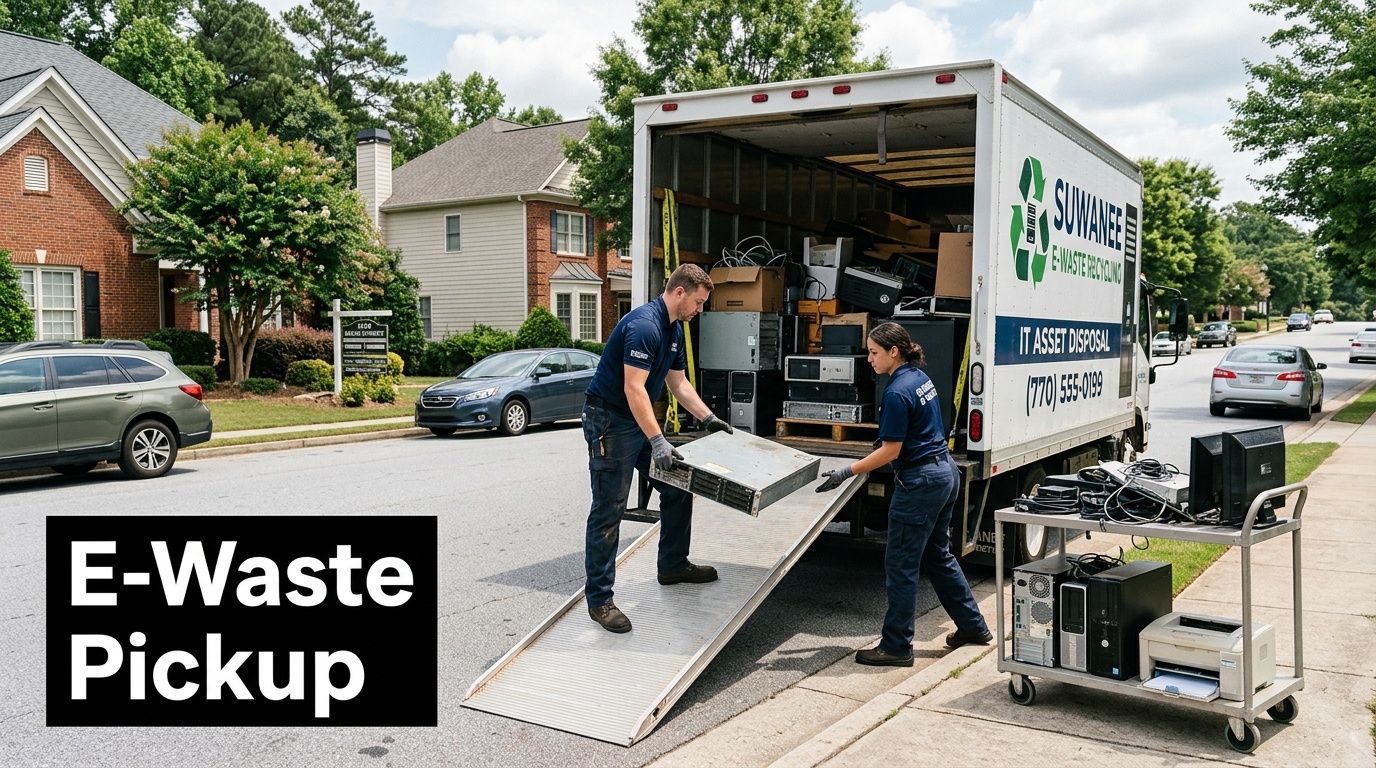
A well-run ITAD project is won before the truck arrives. Logistics determine whether a pickup feels controlled or chaotic.
In Suwanee, that matters because commercial activity, construction, tenant improvements, and active suburban traffic patterns can all affect how equipment leaves a site. The Buford Highway reconstruction project is described as transforming the highway into a “main street of downtown,” and that kind of infrastructure work creates relocation pressure, office transitions, and a real need for coordinated on-site de-installation and secure disposal according to the City of Suwanee planning reference.
Why pickups fail
Most failed pickups don’t fail because the recycler can’t lift equipment. They fail because the site wasn’t prepared for the essential work.
Common causes include:
- No loading plan: Teams discover too late that elevators, dock access, or building rules limit removal windows.
- Assets are scattered: Equipment sits in offices, closets, IDF rooms, and storage cages instead of one staging area.
- Decision-makers aren’t aligned: IT wants sanitization, facilities wants space cleared, and nobody approved the sequence.
What a workable plan looks like
A practical pickup plan usually includes a short pre-project checklist.
| Question | Why it matters |
|---|---|
| Is the equipment centralized or dispersed? | Determines labor time and packing needs |
| Are there drives, SSDs, or copiers with storage? | Changes the security workflow |
| Does the building require scheduled dock or elevator access? | Prevents day-of delays |
| Is this tied to a move, remodel, or closure? | Affects timing and de-install scope |
If you’re coordinating a commercial removal in the metro area, a dedicated pickup process matters more than people think. A reference for that service model is https://atlantacomputerrecycling.com/it-equipment-pickup-atlanta-ga/
Local projects need on-site flexibility
Suwanee businesses dealing with renovation or road-adjacent disruption can’t rely on a vague “we’ll swing by sometime” approach. They need crews that can pack, label, remove, and adapt when building access changes or tenant schedules shift.
That’s especially true for:
- offices exiting suites on tight lease dates
- clinics replacing rooms in phases
- organizations clearing surplus ahead of construction work
- technical sites that need de-installation rather than curbside pickup
Good logistics are invisible to end users. Staff keep working, the old equipment disappears in a controlled way, and the documentation shows up after the job.
That’s the benchmark worth holding.
ACR’s Secure and Compliant Services for Suwanee Businesses
Suwanee organizations need ITAD service that matches the way commercial operations work. That means secure handling for data-bearing devices, practical pickup support for busy facilities, and documentation that closes the loop.
A strong local example is the need emerging across Gwinnett County healthcare support organizations. The expansion of safety-net providers such as the Hope Clinic and Good Samaritan Health Center points to a real need for affordable, HIPAA-compliant ITAD, and ACR’s free DoD-standard wiping and certified recycling directly address that gap as reflected in this Gwinnett human services reference.
What that service mix should include
For most commercial clients in the city of Suwanee GA, the core needs are straightforward:
- Secure data destruction: Data-bearing devices need either documented wiping or physical destruction, depending on condition and policy.
- On-site de-installation: Rack gear, office equipment, and distributed hardware often need hands-on removal, not just pickup.
- Responsible recycling: Equipment that can’t be reused still needs proper downstream handling.
- Project support for bulk loads: Offices, schools, clinics, and public agencies often retire equipment in batches, not one item at a time.
A practical reference point for the data side of that work is https://atlantacomputerrecycling.com/secure-data-destruction-atlanta-ga/
What businesses should expect from an ITAD partner
The right provider should make your internal process easier, not more confusing.
Expect:
- clear instructions on what to stage and what to leave in place
- a defined custody path for drives and other storage media
- flexibility for office, healthcare, school, and data center settings
- final reporting that supports your internal audit trail
What you shouldn’t accept is vague language about “disposing” of devices without a precise answer on sanitization, transport, and documentation.
For Suwanee businesses, especially those handling regulated information, the right service isn’t the cheapest truck. It’s the process that removes assets cleanly and leaves no uncertainty behind.
Partnering for Sustainable Growth in Suwanee
Suwanee’s appeal is easy to see. It’s growing, professionally active, and full of organizations that depend on technology to serve employees, customers, patients, and students. That same strength creates a steady stream of retired equipment that has to be handled with more care than ordinary waste.
It's simple: In a city like Suwanee, responsible IT asset disposition is part of operating well. It protects data, supports compliance, keeps projects moving, and helps businesses avoid the slow buildup of unmanaged hardware in back rooms and closets.
It also supports sustainability in a practical way. Reuse where appropriate. Recycle responsibly when reuse isn’t possible. Destroy data-bearing media correctly. Document the result.
That’s what mature organizations do.
If you manage technology, facilities, security, or compliance in the city of Suwanee GA, don’t wait until an office move or audit forces the issue. Build a disposal process that fits your refresh cycles, your regulatory obligations, and your real building logistics. The businesses that do this well don’t just reduce risk. They operate faster and cleaner as the city grows around them.
Atlanta businesses that need secure pickup, compliant data destruction, and responsible electronics recycling can work with Atlanta Computer Recycling for practical ITAD support across offices, healthcare facilities, schools, government sites, and data center environments.