Atlanta hartsfield jackson atlanta international airport: At


If you're responsible for moving people, equipment, or sensitive data through Atlanta, ATL isn't just an airport on the edge of your org chart. It's often the place where plans either stay on schedule or start slipping.
That shows up in practical ways. A server refresh has to leave a nearby facility without disrupting operations. A regional team is flying in for a same-day meeting. A medical group needs retired laptops removed under a defensible chain of custody, not left sitting in a back office while travel and building access get messy. At atlanta hartsfield jackson atlanta international airport, the business challenge is rarely just transportation. It's coordination, compliance, timing, and risk.
Understanding Hartsfield Jackson as a Business Epicenter
A lot of companies still talk about ATL as if it's mainly a passenger gateway. That view is too narrow for anyone running operations in metro Atlanta.
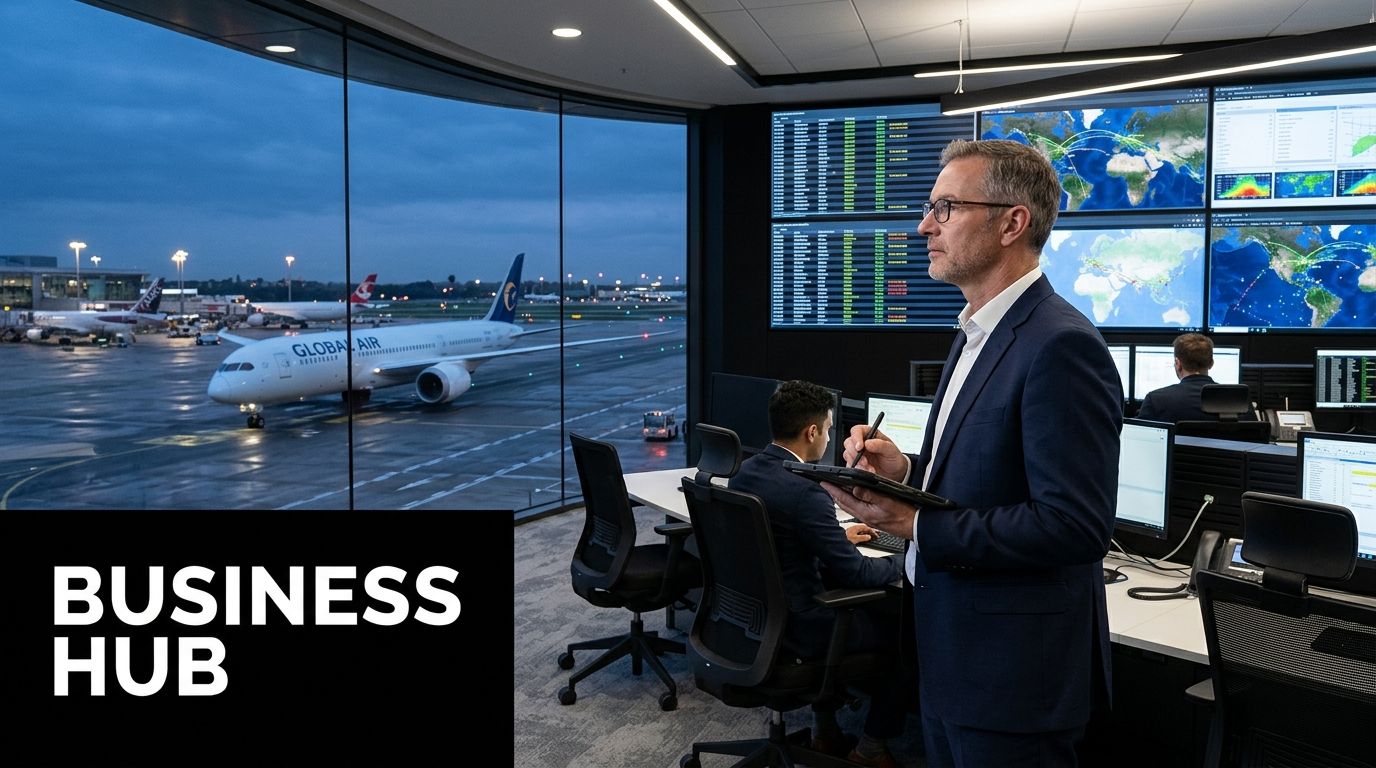
Hartsfield-Jackson Atlanta International Airport has been the world's busiest airport since 1998. In 2024, it served 108.1 million passengers and processed 645,834 metric tons of cargo. Atlanta also sits within a two-hour flight of 80% of the U.S. population (Invest Clayton airport profile). For a business audience, those aren't vanity metrics. They explain why ATL shapes staffing decisions, delivery windows, client travel, vendor response times, and supply chain design across the region.
Why businesses feel ATL's gravity
An airport this large creates its own commercial orbit. Companies near the field don't just benefit from connectivity. They adapt to it.
A healthcare network may route executives and specialists through ATL weekly. A distributor may depend on airport-adjacent freight timing. A concessionaire or service contractor may need tight scheduling because a missed access window creates operational drag for days, not hours.
The useful mindset is this: treat ATL as a business ecosystem, not a transit point.
Practical rule: If your company touches executive travel, cargo, field service, retail operations, or retired IT equipment near the airport, ATL should already be part of your operating model.
What works and what doesn't
What works is centralized planning. One owner tracks travel, site access, vehicle movements, and compliance-sensitive assets. Teams that do this well don't separate "airport issues" from "facility issues." They treat both as the same workflow.
What doesn't work is fragmented decision-making.
- Travel booked in one silo: Operations learns about arrival times too late to coordinate pickups.
- Equipment decommissioned without logistics planning: Hardware sits idle while approvals, transport, and disposal are sorted out.
- Freight and staff movements treated separately: One missed handoff creates cascading delays.
Businesses that understand ATL as an economic engine make better decisions faster. They know that the airport's scale creates opportunity, but only for teams that can operate with discipline.
Navigating the Airport Footprint Terminals and Concourses
The first operational mistake many business travelers make is assuming ATL is intuitive. It isn't difficult, but it is large enough that poor mental mapping creates avoidable delays.
Build the right mental map
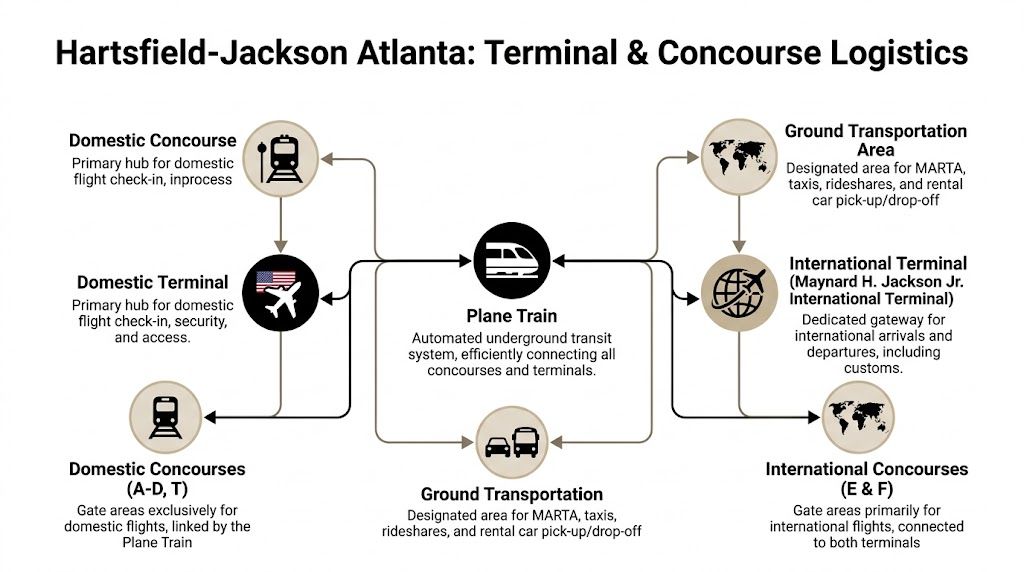
Think of ATL as a set of connected zones rather than a single building.
Passenger-side zones
The core business-use layout is straightforward:
- Domestic Terminal handles domestic-origin activity and is the anchor point for many ground transportation decisions.
- International Terminal, the Maynard H. Jackson Jr. International Terminal, serves international arrivals and departures and changes how you plan pickups, customs timing, and visitor routing.
- Concourses T, A, B, C, and D are the domestic gate environment.
- Concourses E and F are the international side of the concourse system, though operational use can be more fluid depending on airline scheduling.
- The Plane Train is the central connector once you're inside the secure side.
For business travel, the key lesson is simple. Don't evaluate a connection or meeting transfer by terminal name alone. Evaluate it by where the person is entering, where they need to go, and whether they are already past security.
Fastest movement for business travelers
For tight turns, the Plane Train usually wins because it reduces walking distance across a broad footprint. It's the right choice when an employee lands on one concourse and needs to continue deeper into the terminal system.
Walking can still make sense in some cases. If a traveler needs a short movement and wants to avoid waiting for train arrival and platform circulation, walking may be more predictable. That said, operations teams should never assume "short on the map" means short in practice. Crowd density changes everything.
The efficient move at ATL is the one with the fewest decision points. Extra turns, elevators, and handoffs are where business itineraries break down.
Ground access versus cargo context
Passenger terminals are only part of the airport footprint. Businesses coordinating freight, service calls, or IT asset pickups need to understand that the cargo environment is functionally separate from the passenger journey.
That matters when a company is trying to do two things on the same day, such as:
- Fly in a technical team.
- Receive or release equipment through airport-adjacent logistics channels.
Those are related tasks, but they usually shouldn't be managed as one movement plan.
If your staff supports airport-area operations, it's worth keeping a location-specific reference on hand for Hartsfield-Jackson Atlanta International Airport logistics and service coverage. The point isn't marketing. It's reducing confusion when teams need to align terminal access, local roads, and nearby service zones.
A better way to brief employees and vendors
Use a short routing brief before any high-stakes movement.
| Routing item | What to confirm |
|---|---|
| Arrival side | Domestic or international |
| Post-security need | Whether the traveler must change concourses |
| Pickup point | Exact ground transportation area |
| Equipment involved | Personal luggage, samples, or sensitive devices |
| Secondary destination | Hotel, office, cargo facility, or meeting site |
This five-point check prevents the usual ATL mistakes. Wrong terminal. Wrong curb. Wrong assumptions about timing.
Ground Transportation and Logistics for Business Operations
Choosing a ride from ATL isn't a travel preference issue. It's an operations decision.
The right option depends on who's moving, what they're carrying, how fixed the schedule is, and whether the trip has any compliance or client-service sensitivity. A junior analyst heading downtown for a workshop doesn't need the same transportation plan as a hospital IT manager carrying serialized devices or a senior executive meeting investors.
The decision criteria that matter
For business use, ground transport should be judged on four things:
- Predictability: Can you rely on timing when traffic or curb congestion gets ugly?
- Control: Do you know who the driver is, where the pickup occurs, and how changes get handled?
- Asset suitability: Is this option acceptable if staff are moving sensitive hardware, boxed devices, or project materials?
- Administrative ease: Can the trip be booked, tracked, and reconciled cleanly for the business?
A lot of teams overvalue convenience and undervalue handoff quality. That's backwards near ATL.
ATL Ground Transportation Options for Business Use Cases
| Method | Typical Cost to Downtown | Estimated Time | Best For |
|---|---|---|---|
| MARTA | Lower-cost public transit option | Traffic-resistant, schedule-dependent | Solo travelers going light to downtown meetings |
| Rideshare | Variable | Variable with pickup congestion | Individual travelers with moderate schedule flexibility |
| Hotel or shared shuttle | Usually pre-arranged or bundled | Depends on route and stops | Airport hotel transfers and low-priority team travel |
| Pre-booked car service | Premium | More controlled than ad hoc options | VIP transport, clients, tightly timed itineraries |
| Rental car | Variable total cost | Slower at first due to pickup process | Multi-stop days and regional travel after arrival |
When MARTA is the smart play
MARTA makes sense when an employee is traveling alone, carrying only standard luggage, and heading to a predictable destination near rail access. It strips out some roadway uncertainty and is often the cleanest option for downtown movement.
It is not the right default when staff are moving sensitive electronics, presentation kits, or anything that shouldn't be exposed to crowded, multi-step handling.
When rideshare works, and when it doesn't
Rideshare is useful for flexible individual trips. It can be fine for consultants, sales staff, or internal travelers who know the pickup routine and don't need a highly managed arrival.
It starts to break down when the trip matters more than the app experience.
- Client pickup: Too many failure points.
- Large team arrival: Coordination gets messy fast.
- Sensitive gear: Chain of custody becomes informal.
- Airport-area disruptions: Surge conditions and confusion hit execution.
Where premium service earns its keep
For controlled arrivals, a pre-booked provider is often worth it. Businesses that host investors, board members, healthcare partners, or enterprise customers usually need less improvisation, not more. In those cases, a vetted reliable airport shuttle service can be a useful reference point when you're deciding whether a managed transfer is better than leaving the trip to curbside availability.
That isn't about luxury. It's about reducing variables.
The more important the passenger or the tighter the meeting window, the less sense it makes to improvise ground transportation at ATL.
Rental cars and airport-adjacent operations
Rental cars are often the best option when the traveler has multiple stops across the metro area. They also make sense when an employee needs freedom to pivot between airport-area offices, industrial parks, hospitals, or campus sites.
The trade-off is setup friction. The employee has to clear the airport flow, complete the rental handoff, and then contend with Atlanta traffic personally. That's fine for field engineers and regional managers. It's not ideal for tired executives or anyone arriving under a hard deadline.
If your organization runs projects around the airport's west and south commercial corridors, keep a reference for nearby operational zones such as Camp Creek Marketplace in East Point. These nearby clusters often become informal staging areas for vendors, meetings, and equipment handoffs.
Best practice for operations teams
Write transport rules by scenario, not by employee rank.
For example:
- Downtown meeting, single traveler, no sensitive gear: MARTA or rideshare.
- Executive arrival or client hosting: Pre-booked service.
- Technical team with tools or boxed devices: Dedicated vehicle or rental car.
- Airport-adjacent project day with multiple stops: Rental car or fleet vehicle.
That kind of policy removes guesswork and cuts waste without making teams slower.
The Engine Room ATL Cargo and Freight Facilities
Passenger traffic gets attention. Commercial operators know that the primary advantage often sits on the cargo side.
At ATL, freight planning is less about headline scale and more about whether your team understands how airport infrastructure, documentation discipline, and ground handling all fit together. If you ship parts, medical equipment, high-value electronics, or time-sensitive replacement hardware, that understanding matters.

Why ATL's airside capacity matters to freight users
ATL's operational capacity was boosted by 40% with the completion of its fifth runway, increasing average hourly flights from 184 to 237. That infrastructure is supported by a centralized fiber-optic backbone and is described as essential for real-time logistics while handling over 700,000 tons of cargo annually (Airport Technology project profile). For…airport-technology.com/projects/hartsfield_jackson/)).
For businesses, the takeaway isn't just that ATL is big. It's that the airport has been built to support throughput. More movement capacity and stronger communications infrastructure improve the environment in which freight coordination happens.
That doesn't mean every shipment moves smoothly. It means the airport has the bones to support serious commercial volume if your process is tight.
The real work happens before the truck arrives
Freight problems at airports usually start before cargo reaches the gate.
Three failures show up repeatedly:
- Incomplete documentation
- Poor packaging or labeling
- No alignment between shipper, driver, and receiving party
None of those are glamorous. All of them determine whether a shipment clears handoffs cleanly.
Documentation discipline
If your team ships through ATL regularly, build a checklist that confirms names, references, destination details, and release instructions before pickup. Don't let the driver discover missing information at the cargo facility.
Packaging and load quality
Even airport-bound freight still lives in the practical world of road transport. Pallets shift. Cases tip. Mixed loads become damaged loads if they aren't secured correctly. For teams reviewing truck-side standards before airport delivery, the FMCSA cargo securement rules are a practical baseline.
Driver and consignee coordination
The most expensive "small mistake" is assuming the receiving side knows what the shipping side meant. They usually don't. Confirm release windows, contact names, and escalation paths in writing.
Freight moves faster when everyone uses the same reference numbers and the same pickup language. Verbal shorthand causes more trouble than people admit.
North and South cargo thinking
Businesses don't need to memorize every airport cargo detail to operate well at ATL. They do need to recognize that cargo functions are distinct from passenger-facing airport activity and should be planned as a separate workflow with separate timing assumptions.
That means:
- Don't book driver arrival based on passenger-side intuition.
- Don't assume airport-adjacent means easy access.
- Don't send first-time vendors without a precise handoff brief.
If your work includes electronics, retired infrastructure, or bulk technology movement in airport-related lanes, a local reference point on Atlanta airport cargo logistics topics can help teams think in the right operational frame.
What works for commercial shippers
The strongest ATL freight workflows share a few traits:
| Practice | Why it works |
|---|---|
| Single shipment owner | One person resolves handoff issues fast |
| Written release instructions | Reduces confusion at pickup and receipt |
| Conservative timing | Builds in room for road, dock, or handling delay |
| Equipment-specific packaging | Protects fragile or serialized assets |
| Carrier and local transport alignment | Prevents idle time and missed windows |
What doesn't work is treating air freight like parcel shipping. Once the load is operationally significant, informal habits stop scaling.
On-Site and Nearby Business Support Services
Most business guides to ATL stop at lounges, hotels, and ground transportation. Those matter, but they don't cover the full support system companies need around the airport.
Airport-area business operations often involve temporary workspaces, client hosting, employee recovery time between flights, device staging, and the retirement of aging equipment from offices, concessions, clinics, and support facilities. The gap isn't amenities. It's operational continuity.
Useful support services near ATL
For normal business travel, the basics still matter.
Meeting-ready spaces
Airport hotels and nearby commercial properties can absorb schedule volatility better than downtown offices when flights shift late in the day. If a visitor's itinerary has a narrow margin, keeping the meeting close to the airport often saves the plan.
Lounges and quiet work areas
Lounges, business centers, and short-stay workspaces are useful for travelers who need to take calls, finalize documents, or recover between legs. The value isn't comfort alone. It's preserving work output during transit friction.
Staging points for vendors
Nearby commercial districts become practical handoff zones for service teams, technicians, and project managers. That matters when several vendors are supporting the same airport-adjacent account but can't all operate from the client site at once.
For example, airport corridor businesses often rely on surrounding hospitality and food-service nodes for meetings and staging. A local point of reference such as Volare Bistro in Hapeville may seem minor, but these nearby landmarks help teams coordinate more cleanly than vague "meet near the airport" instructions.
The overlooked service gap
Here's where airport-area business support gets thin. ATL's sustainability guidance does not provide specific protocols for secure disposal of business e-waste and IT assets, creating a compliance risk for airport-based businesses that need HIPAA-compliant destruction or certified recycling of retired technology (ATL sustainability page).
That gap matters more than many operators realize.
A tenant may refresh point-of-sale systems. An office may retire desktops after a platform migration. A clinic or healthcare contractor near the airport may need laptops, drives, or network hardware removed with documented handling. If the airport's public-facing sustainability framework doesn't address secure business IT disposition in detail, the burden shifts to the organization.
Why this becomes an operations issue fast
Retired equipment is easy to neglect because it feels inactive. In practice, old devices create three kinds of exposure:
- Data exposure: Drives and storage media may still contain regulated or confidential information.
- Space and security exposure: Stacked hardware in offices or closets becomes unmanaged inventory.
- Process exposure: The longer equipment sits, the more likely chain-of-custody details get lost.
Sustainability without data handling discipline is incomplete. A recycled device that wasn't properly governed first is still a business failure.
What works for airport-area tenants and vendors
A workable process is usually simple:
- Identify what is being retired.
- Separate reusable equipment from media requiring destruction.
- Assign one person to control pickup timing and records.
- Keep removal off the critical path of normal operations.
What doesn't work is ad hoc disposal. Staff taking devices home, storing boxes indefinitely, or mixing business electronics with general recycling all create unnecessary risk.
For businesses in and around ATL, support services should be evaluated the same way you'd evaluate a freight vendor or travel plan. Ask whether the service preserves uptime, protects information, and reduces confusion. If it doesn't, it isn't really support.
Navigating Security from TSA Checkpoints to IT Compliance
Security at ATL isn't just about getting people through a checkpoint faster. For business operators, that's only the visible layer.
The more important security question is whether your organization can keep moving when travel conditions deteriorate, while still protecting equipment, records, and regulated data. That requires a broader definition of security than most travel policies use.
Passenger-side security is only one part of the picture
Frequent travelers already know the basics. Use trusted traveler programs where appropriate. Keep itineraries realistic. Avoid avoidable baggage complications on high-pressure days. Those are useful habits, but they don't solve operational resilience by themselves.
The deeper issue is that airport disruption can spill into business logistics quickly.
In 2026, severe TSA staffing shortages led to over 700 delays and 237 cancellations at ATL on a single day, exposing logistical vulnerabilities for companies that depend on reliable airport-linked movement (coverage of ATL staffing disruptions). If your decommissioning project, office closure, or hardware transfer relies on people or assets moving through already strained airport processes, your plan is fragile.
Why IT compliance belongs in the same conversation
ATL's own operational modernization has emphasized data unification and governance. Businesses should take the same lesson internally when they retire technology.
A device isn't safe because it's unplugged. It's safe only when data governance, physical control, and final disposition are all documented. That's why organizations with healthcare, education, government, or enterprise risk exposure need disposal workflows that include secure wiping, destruction where required, and chain-of-custody records.
If your team is working through regulated disposal questions, a focused resource on HIPAA compliance and IT requirements is useful context for understanding why transport and destruction planning can't be separated.
What resilient security planning looks like
The companies that handle ATL-area disruption best do three things differently.
They avoid checkpoint dependency for asset removal
If a business can execute on-site pickup and de-installation directly from a facility, it should. Sensitive equipment shouldn't be routed through unnecessary airport friction points just because the airport is nearby.
They separate traveler logistics from asset logistics
An employee flight itinerary and an equipment removal plan are not the same workflow. Mixing them often causes custody gaps and scheduling confusion.
They document before movement begins
Serials, asset lists, media categories, release approvals, and responsible contacts should be confirmed before anyone touches the equipment.
Secure disposal starts before pickup. If the records are vague on day one, they won't become clearer after the hardware leaves the building.
What doesn't hold up under pressure
These habits fail when ATL operations tighten:
- Waiting until travel disruptions begin to look for disposal or transport help.
- Letting internal staff improvise movement of old devices without a documented process.
- Assuming sustainability equals compliance when data-bearing equipment is involved.
Physical security and information security meet at the same point during decommissioning. The organization either controls the handoff, or it doesn't.
Conclusion Your Strategic Partner for ATL Operations
The most useful way to think about ATL is not as a passenger amenity hub, and not even just as a freight gateway. It's a dense operating environment where travel, cargo, facilities, vendors, and compliance all intersect.
That intersection creates an advantage for businesses that plan well. It also creates avoidable risk for teams that treat airport-area operations as routine. The difference usually comes down to process discipline. Know the footprint. Match ground transportation to the actual use case. Treat cargo as a specialized workflow. Use nearby business support intelligently. Build security plans that include data and asset control, not just checkpoint timing.
ATL's own modernization offers a good model. Its Phase 1 AI roadmap unified 11 disparate data sources into a single source of truth to improve operations (GovTech coverage of ATL's data initiative). Businesses should do the same when retiring technology. Before an asset leaves a site, the organization should know what it is, who approved its release, what data risks it carries, and how destruction or downstream disposition will be verified.
That's the operational standard that holds up under pressure.
If your business operates in or around atlanta hartsfield jackson atlanta international airport, don't leave critical handoffs to generic vendors or improvised internal processes. The airport rewards organizations that work with specialists who understand logistics, timing, and compliance as one system.
Businesses across metro Atlanta that need secure, compliant removal of retired computers, servers, storage, and network gear can work with Atlanta Computer Recycling for B2B electronics recycling and IT asset disposition. If you're planning an office closure, data center decommission, healthcare hardware refresh, or airport-area equipment pickup, they're equipped to handle on-site de-installation, logistics, and data protection with a process built for commercial environments.