City of South Fulton GA Business: Governance, Zoning & IT

As one of metro Atlanta’s newest and most vibrant commercial centers, the City of South Fulton, GA, is a city on the rise. Officially incorporated in 2017, it represents a landscape of fresh opportunity and explosive growth, making it a strategic destination for businesses in healthcare, tech, and government.
Why Businesses Are Choosing South Fulton GA

Welcome to South Fulton. Think of it less as just another suburb and more as a ground-floor opportunity that combines startup energy with the resources of a major metro area. For business leaders, facility managers, and IT professionals, this is where significant advantages can be found.
Since its founding, the city has seen a boom in both population and commercial development. This rapid expansion creates a truly unique environment. Unlike older, established cities with decades of layered bureaucracy, South Fulton offers a more modern, streamlined approach for businesses looking to integrate and grow.
A Landscape of Opportunity
This fast-paced growth is especially visible in sectors that depend heavily on technology. As new medical facilities, data centers, and corporate offices come online, the demand for support services skyrockets. This includes the critical need for managing the entire lifecycle of IT assets—from initial deployment to secure, compliant disposal.
For any business operating in a new and growing city, understanding local regulations is not just about compliance—it is a core component of your operational strategy. This is especially true for technology management and data security.
If you're an IT manager at a new hospital or a director overseeing a data center relocation, navigating this landscape is absolutely crucial. Properly handling retired equipment isn't just an environmental responsibility; it’s a legal and financial imperative. A misstep can lead to serious consequences.
Strategic Advantages for Commercial Operations
Because the city is still young, its infrastructure and regulations are continuously being refined. This can be a major benefit for proactive businesses. Getting involved with local governance early on can help you shape policies and build strong, foundational relationships.
For businesses putting down roots in South Fulton, attracting customers is the top priority, and resources like this Ultimate Guide to Local Business Advertising can provide a powerful playbook.
Key opportunities for businesses here include:
- Access to a Growing Workforce: The expanding residential base provides a rich and diverse talent pool.
- Modern Infrastructure: New developments mean access to state-of-the-art facilities, utilities, and fiber networks.
- A Pro-Business Environment: The city’s leadership is actively working to attract and retain commercial investment.
This guide is built to be your roadmap. As we dig into the specifics of operating here, you might also find our guide to the neighboring City of Palmetto, GA useful for regional context.
Navigating South Fulton's Government and Business Resources
For any business setting up shop in South Fulton, understanding the local government isn't just about red tape—it's a real competitive edge. The City of South Fulton, GA, is run by a Mayor-Council government. The Mayor serves as the chief executive, while a seven-member City Council acts as the legislative branch, setting the policies that shape the commercial landscape.
Knowing exactly who to call in the city government is critical, especially for businesses in regulated fields like healthcare, education, or technology. It saves you time, helps you avoid expensive mistakes, and builds a solid foundation for growth.
Key Departments for Business Operations
While the city has many departments, a few are absolutely essential for businesses. Focusing on these will streamline everything from your initial launch to day-to-day compliance. The Department of Community Development and Regulatory Affairs, for example, is your command center for most operational matters.
This single department is your go-to for:
- Business Licensing: Securing and renewing the necessary licenses to operate legally.
- Permitting: Getting the right permits for new construction, renovations, or major changes to your facility.
- Code Enforcement: Staying on top of local ordinances to prevent fines or interruptions.
Think of these departments not as gatekeepers, but as partners in your venture. Building a positive relationship with key personnel can provide clarity and support as you establish and grow your business in South Fulton.
Accessing Economic Data and Support Systems
Smart business decisions are built on good data. Fortunately, the City of South Fulton's growth story provides a strong case for setting up here. As Georgia's 8th-largest city, its economic power is undeniable, with a 2026 projected population of 116,982.
The city's median household income, estimated between $81,798-$84,745, is well above many of its peers, signaling strong local purchasing power. This rapid expansion is fueling demand across all commercial sectors, including the need for compliant electronics recycling. You can explore South Fulton's demographic and economic data on censusreporter.org.
Beyond the numbers, you’ll find practical support from local organizations. The South Fulton Chamber of Commerce is an excellent resource for networking, advocacy, and learning about incentive programs. For businesses expanding throughout the airport area, our guide to the neighboring City of Hapeville, GA offers valuable regional context.
Building Your Network and Finding Customers
Engaging with the city is a great start, but long-term success means connecting with your customers. In addition to civic resources, businesses need effective local online business marketing strategies to build a strong presence in the community.
To help you get started, here are some essential local contacts:
| Resource | Primary Function | Why It Matters for Your Business |
|---|---|---|
| City of South Fulton Website | Official information hub | Provides direct access to ordinances, department contacts, and official announcements. |
| South Fulton Chamber of Commerce | Business advocacy and networking | Connects you with other business leaders and potential partners. |
| Community Development Dept. | Licensing and permitting | Your go-to for all regulatory and compliance needs. |
| Gladys S. Dennard Library | Public information and resources | Offers community resources and a place to understand local culture. |
By actively using these resources, you shift from being just another business to becoming an integrated part of the South Fulton commercial community. That proactive approach is the key to lasting success.
Understanding Commercial Zoning and Permitting
For any business setting up shop in the City of South Fulton, GA, zoning and permitting can feel like a high-stakes game. These rules aren't just red tape—they're the blueprint for how and where your business can operate. Whether you're building a new data center or decommissioning an old office, getting this right is non-negotiable.
Think of the city’s zoning ordinance as the rulebook that gives every neighborhood its character. It ensures a high-traffic logistics hub doesn't open next to a quiet subdivision, protecting property values and maintaining a balanced community.
For any commercial project, locking in a location with the right zoning is the most important first step. A mismatch here can stop a project in its tracks, leading to expensive delays or forcing you back to the drawing board.
The Basics of Commercial and Industrial Zones
South Fulton divides its land into different categories, but for most businesses, the focus will be on commercial and industrial zones. Each district is tailored for specific operations, from small storefronts to massive manufacturing plants.
Here are the key commercial and industrial zones you need to know:
- C-1 (Community Commercial District): Perfect for retail and service shops that cater to nearby residential areas.
- C-2 (General Commercial District): A more flexible zone allowing for larger retail centers, car dealerships, and offices.
- O-I (Office-Institutional District): Designed for professional offices, medical clinics, and schools that need a quieter setting than a busy commercial strip.
- M-1 (Light Industrial District): Home to light manufacturing, warehousing, and distribution centers with minimal external noise or traffic.
- M-2 (Heavy Industrial District): Reserved for intensive operations like large-scale manufacturing and processing facilities.
For example, a hospital planning a new outpatient clinic would target an O-I district. In contrast, a logistics firm with a fleet of trucks would need to be in an M-1 or M-2 zone to operate legally.
The Permitting Lifecycle: A Project Manager's Playbook
Once you've secured a property in the correct zone, it's time to get your permits. This is the city's official review process to confirm your project meets every safety, building, and environmental code on the books.
Think of the permitting process as a detailed checklist. The most common reason for project delays is a missed step or incomplete paperwork, which can throw timelines and budgets off course.
The journey from application to final approval is a clear, multi-stage process. It all starts when you submit your project's detailed plans—like architectural drawings or electrical schematics—to the Department of Community Development.
Here’s what the typical permitting lifecycle looks like:
- Pre-Application Meeting: Before you file anything, schedule a consultation with city staff. It’s the best way to spot potential roadblocks early.
- Application Submittal: Turn in your complete application packet with all required plans, surveys, and forms.
- Plan Review: Multiple city departments (building, fire, public works) will comb through your plans to ensure they meet every code.
- Permit Issuance: Once every department gives its approval, the city issues your permits. You're now cleared to start work.
- Inspections: At key stages of construction, city inspectors will visit your site to make sure the work matches the approved plans.
- Certificate of Occupancy (CO): After your project passes the final inspection, you’ll receive a Certificate of Occupancy. This is the official document that allows you to open for business.
To stay on track, stick to the official resources on the City of South Fulton, GA website. There, you’ll find up-to-date zoning maps, permit applications, and fee schedules. Doing your homework and getting your submissions right the first time is the fastest way to get your doors open while ensuring you're fully compliant.
Managing E-Waste and IT Disposal for South Fulton Businesses
For any business in the City of South Fulton, GA, rapid growth is a double-edged sword. While it fuels opportunity, it also creates a major operational challenge: what to do with retired technology. Every new office, hospital wing, or data center leaves behind a trail of outdated servers, laptops, monitors, and specialized equipment. This is the world of electronic waste, or e-waste.
While the city offers programs for residents, businesses operate under a completely different set of rules. The sheer volume and the sensitive data contained in commercial electronics put them in their own category. A household might get rid of one old PC; a company could decommission hundreds at once.
Why Businesses Need Specialized ITAD Solutions
This is where IT Asset Disposition (ITAD) becomes essential. Think of it as industrial-strength digital waste management, but with much higher stakes. ITAD is a formal, structured process for securely and responsibly getting rid of obsolete IT gear. It's not about just tossing things out—it's the final, critical step in your technology lifecycle.
The risks of getting this wrong are huge. Simply tossing old servers into a dumpster could lead to a devastating data breach, costing your organization millions in fines, lawsuits, and a tarnished reputation. Failing to comply with data privacy laws like HIPAA for healthcare or FACTA for financial institutions carries severe penalties.
For commercial operations in South Fulton, ITAD is not an optional expense—it's a core component of risk management. The goal is to ensure that when a device leaves your facility, your data does not go with it.
The city's explosive growth directly feeds the e-waste stream. South Fulton officially became a city on May 1, 2017, and its population quickly swelled to 107,436 by the 2020 U.S. Census, with 2026 projections nearing 116,982. This surge across its 92-square-mile territory has packed the area with new businesses, schools, and medical facilities, all generating significant e-waste. This environment underscores the skyrocketing need for secure, commercial-scale ITAD programs. You can see more details on South Fulton's rapid growth on Wikipedia.
Residential Programs Versus Commercial Requirements
Understanding the difference between residential and commercial e-waste management is crucial for any IT manager or facilities director in South Fulton. The city’s residential programs are designed for low-volume, non-sensitive electronics from households. They simply aren't equipped to handle the logistical or security demands of a business.
The simple process flow below for project approvals shows that while the city provides clear administrative paths, the responsibility for operational details like IT disposal falls squarely on the business itself.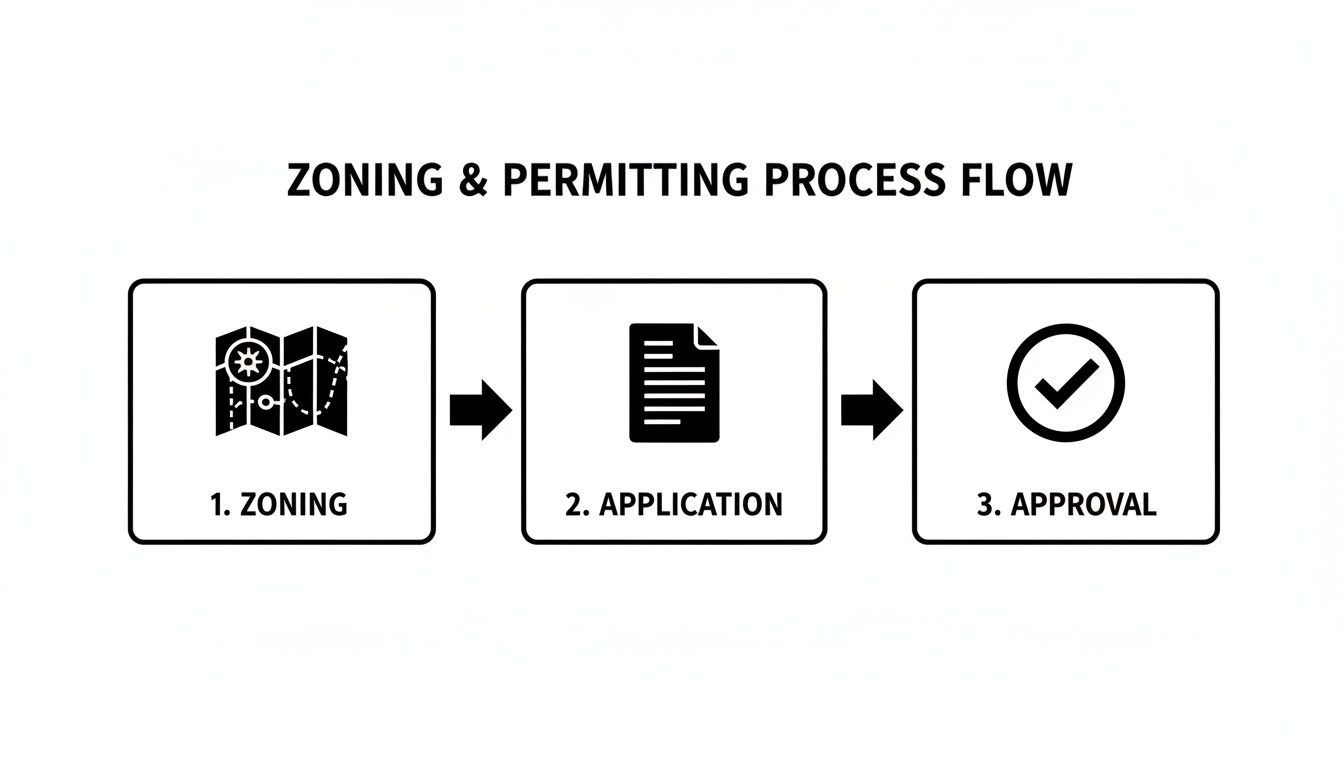
To make it perfectly clear, the services available to a resident are worlds apart from what a business needs. This table breaks down the key differences.
Commercial Versus Residential E-Waste Disposal in South Fulton
| Aspect | Residential Disposal | Commercial Disposal (For Businesses) |
|---|---|---|
| Primary Goal | Convenient recycling for personal electronics. | Secure data destruction, compliance, and asset recovery. |
| Volume | Low (1-5 items per household). | High (hundreds or thousands of items at once). |
| Data Security | User responsibility to wipe data; not a formal requirement. | Certified data destruction is mandatory to protect sensitive business, customer, or patient data. |
| Documentation | None. Drop-off is typically the final step. | Requires Certificates of Destruction and a full Chain of Custody for audit and legal proof. |
| Logistics | Residents drop off items at designated sites. | Requires professional, scheduled pickups, secure transport, and on-site services. |
| Compliance | General environmental regulations. | Must adhere to strict industry regulations (HIPAA, FACTA, etc.) and environmental laws. |
Ultimately, a business cannot rely on municipal programs. The stakes are too high. Professional ITAD partners bridge this gap, providing the security, documentation, and logistics that commercial operations require.
Here’s a breakdown of why commercial ITAD is fundamentally different:
- Data Security: Business devices are packed with confidential information—customer records, financial data, and intellectual property. ITAD providers must offer certified, guaranteed data destruction.
- Chain of Custody: Businesses need a documented paper trail from the moment an asset leaves their building to its final destruction or recycling. This is your proof of compliance.
- Volume and Logistics: A professional ITAD partner can manage the pickup and transport of hundreds or even thousands of devices, a job far beyond the scope of city services.
- Compliance and Reporting: Commercial disposal demands formal documentation, like a Certificate of Data Destruction, to prove you’ve met your legal obligations during an audit.
For organizations navigating these logistics, you can see how professional coordination works by reviewing our overview of professional e-waste pickup services in the Atlanta area.
Critical Scenarios for South Fulton Businesses
Let's look at a few real-world examples to see why a professional ITAD strategy is non-negotiable for businesses in the City of South Fulton, GA.
Scenario 1: A Healthcare Clinic Upgrade
A new medical clinic in South Fulton replaces 200 desktop computers and several servers. These devices contain protected health information (PHI) governed by HIPAA. Improper disposal could trigger a data breach and millions in fines. A compliant ITAD partner provides on-site packing, a secure chain of custody, and certified data destruction, arming the clinic with a Certificate of Destruction as legal proof.
Scenario 2: A School District's Tech Refresh
A local school district decommissions 1,000 student laptops. While some might be refurbished, most are at the end of their life. These devices contain student data and software licenses. A proper ITAD program ensures all data is wiped to federal standards and the devices are recycled responsibly, keeping hazardous materials out of landfills.
Scenario 3: A Data Center Decommissioning
A company shuts down its local data center, leaving racks of servers, networking gear, and storage arrays. The data on these assets is the company's lifeblood. The ITAD process here is a massive, coordinated effort involving on-site data wiping, physical hard drive destruction, and the removal and recycling of tons of equipment.
In each case, the business isn't just getting rid of old hardware. It's actively protecting itself from legal, financial, and environmental risks—a fundamental part of operating responsibly in a thriving community like South Fulton.
Data Security & Certified Destruction: A Commercial Imperative
For any business in the City of South Fulton, GA, thinking the 'delete' key is a data destruction policy isn't just a mistake—it's a massive liability. When it’s time to retire old IT assets, the single most important step is ensuring rock-solid data security and meeting every regulatory requirement. This is where professional data sanitization becomes absolutely essential.
Simply erasing files just doesn't cut it. That data is often easily recoverable, leaving your organization wide open to a breach. True security means using proven, certified methods to make data impossible to retrieve. This isn't just a best practice; it's a core part of modern risk management.
The Gold Standard of Data Sanitization
To ensure data is gone for good, IT asset disposal (ITAD) professionals rely on specific, verifiable standards. One of the most trusted is DoD 5220.22-M, a method originally developed by the U.S. Department of Defense. This process overwrites the data on a hard drive multiple times, effectively scrubbing it clean.
Think of it like painting over a dark wall. One coat of paint might let the old color bleed through, but after three distinct coats, the original is gone without a trace. The DoD standard works the same way, leaving no remnant of the original data behind.
Why does this matter so much? Imagine a hospital in South Fulton upgrading its patient check-in kiosks. Those old hard drives contain a huge amount of Protected Health Information (PHI).
A single device thrown away improperly could trigger a catastrophic data breach. The result? Staggering HIPAA fines, a ruined reputation, and a complete loss of patient trust. For organizations handling sensitive information, certified data destruction isn't an option—it's a mandate.
Real-World Scenarios in South Fulton
Different industries face different compliance hurdles. For businesses across the City of South Fulton, GA, knowing these specific rules is the key to a smart ITAD strategy.
Here’s how data destruction needs play out in a few key sectors:
Healthcare: A South Fulton clinic must be HIPAA compliant. That means every byte of patient data on retired servers, laptops, and medical devices has to be destroyed according to strict protocols. A certified partner provides both the destruction service and the documentation to prove it.
Finance: A local financial advisory firm is governed by laws like the Gramm-Leach-Bliley Act (GLBA) and FACTA. When they replace old computers, every hard drive with client financial records must be physically destroyed or wiped to NIST standards to prevent identity theft.
Education: A school district retiring thousands of student Chromebooks is obligated to protect student privacy under FERPA. Professional data wiping guarantees that all student files, login details, and personal information are permanently gone before the devices are recycled or sold.
In every one of these cases, the organization isn't just disposing of old hardware. It's actively protecting itself, its clients, and its stakeholders from severe legal and financial fallout.
Software Wiping Versus Physical Destruction
When it comes to destroying data, you have two main choices: software-based wiping and physical destruction. The right option depends on the device, its condition, and your company's security policies.
Software-Based Data Wiping
This technique uses specialized software to overwrite every sector of a working hard drive, following standards like DoD 5220.22-M or NIST 800-88.
- Best for: Functional hard drives (both HDDs and SSDs) that you might want to reuse or resell.
- Advantage: It preserves the hardware's value, making it a good choice for both your budget and the environment.
- Process: A drive is hooked up to a wiping station, where software performs a multi-pass overwrite and then generates a report to verify the job was done.
Physical Destruction
When a drive is broken, holds top-secret data, or is an older format like a magnetic tape, physical destruction is the only surefire method. This means shredding, crushing, or degaussing the device until it’s nothing but fragments and the data is gone forever.
- Best for: Damaged drives, obsolete media, or as the ultimate security measure.
- Advantage: It offers absolute, visual proof that your data has been permanently destroyed.
- Process: Hard drives are fed into an industrial shredder that grinds them into small, unrecognizable pieces of metal.
A complete ITAD strategy often uses both—wiping functional drives to recover value and shredding everything else.
The Certificate of Data Destruction: Your Proof of Compliance
So, how do you prove you did everything right? The answer is the Certificate of Data Destruction. This legal document is your official record of compliance and the most critical piece of paper you'll get from your ITAD partner. It’s your defense in an audit or legal dispute.
A proper certificate must include:
- A unique serial number for tracking
- The date and method of destruction (e.g., DoD 5220.22-M wipe, physical shred)
- A detailed list of the destroyed assets, including their individual serial numbers
- A statement transferring custody and liability to the disposal vendor
This document officially closes the loop on your asset's lifecycle, giving you a clear, defensible record that you met your obligations. You can see what this involves by looking into the details of a Certificate of Destruction and its role in compliance. By demanding this level of documentation, you can vet partners effectively and operate with confidence as your business grows in South Fulton.
Your Partner For Compliant ITAD In South Fulton
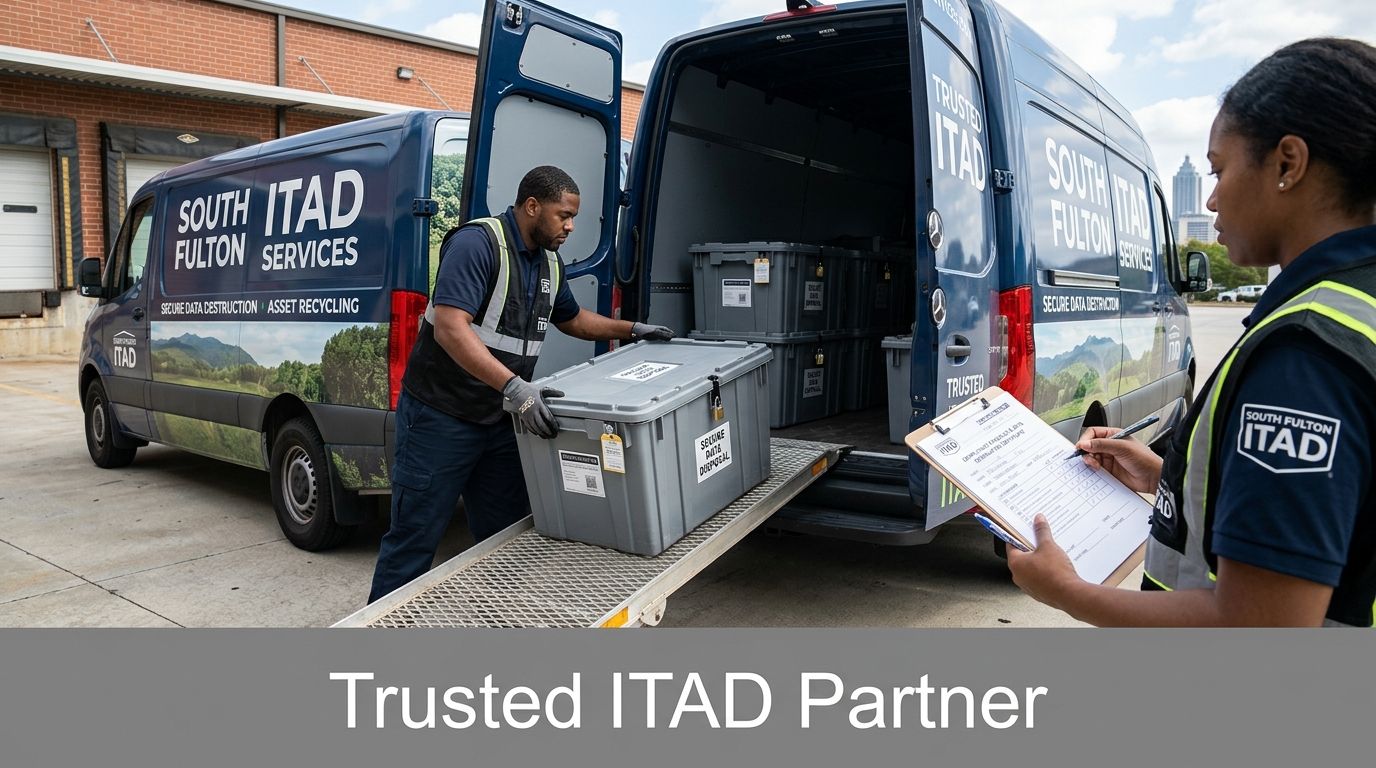
For any business in the rapidly growing City of South Fulton, GA, figuring out what to do with old IT assets can feel like a major headache. Now that you know the risks and local rules, let’s talk about a real-world solution. Atlanta Computer Recycling is here to turn that complicated process into a simple, secure, and straightforward one.
We're more than just another vendor you call. Think of us as an extension of your IT and compliance departments. We provide a complete, full-service approach that handles every challenge we've discussed, giving your IT managers and facility directors total peace of mind.
End-To-End Service for South Fulton Businesses
Our process was built from the ground up to handle everything, so your data stays protected and your company hits its sustainability goals. We manage the entire lifecycle of your retired electronics, providing a secure and documented chain of custody from your door to ours.
This all-in-one management covers:
- On-Site Logistics and Secure Transport: Our team comes directly to your facility, professionally handles de-installation and packing, and transports everything securely back to our certified facility.
- Certified Data Destruction: We offer both DoD 5220.22-M compliant data wiping and physical shredding. You'll receive a Certificate of Destruction for your audit trail and compliance records.
- Responsible Recycling: Any materials that can't be reused are processed through our certified channels. This keeps hazardous e-waste out of landfills and helps you meet your environmental targets.
We aren't just a service; we are your compliance partner. Our job is to help you protect sensitive data, meet sustainability metrics, and confidently manage the complexities of ITAD in a fast-growing city like South Fulton.
Built for Your Industry Needs
Whether you're a hospital navigating HIPAA compliance, a school district protecting student data, or a data center planning a full decommissioning, our services are designed for your specific industry. A one-size-fits-all approach simply doesn’t cut it when security and compliance are on the line.
Our teams, for instance, are pros at coordinating logistics in sensitive environments with almost no disruption to your daily operations. You can learn more about how we handle the small but critical details by checking out our process for IT equipment pickup throughout the Atlanta area.
When you work with a partner who gets your operational reality, you can get back to focusing on your core business, knowing your IT assets are being handled correctly.
Ready to build a secure and compliant ITAD program for your South Fulton business? Let's start the conversation today.
Your South Fulton Business Questions, Answered
If you're running a business in the City of South Fulton, GA, you know there are unique rules and opportunities. We often hear from IT managers and local leaders with questions about operations and proper IT asset management. Here are some straight answers to the most common queries.
Does The City Of South Fulton Have Its Own Commercial E-Waste Program?
No, not for businesses. The city’s e-waste and recycling programs are built for residents and can't handle the volume or security needs of a commercial operation.
For any significant amount of IT equipment, or anything containing sensitive data, the city expects you to use a certified IT disposal vendor. Municipal services just aren't set up for the secure chain of custody, certified data destruction, and large-scale logistics that keep your business compliant with state and federal laws.
What Documentation Proves Compliant Data Destruction In South Fulton?
The single most important document you need is a Certificate of Data Destruction. This is the official legal record, provided by your ITAD partner, that proves your data was properly and permanently destroyed according to standards like NIST 800-88 or DoD 5220.22-M.
This document is your official proof of compliance. It should detail the device serial numbers and the specific destruction method used, which is critical for demonstrating adherence to regulations like HIPAA or FACTA.
How Can A Hospital Decommission Assets Without Disrupting Operations?
Decommissioning assets in a live healthcare environment demands a specialized approach. You'll need an ITAD provider that offers on-site services and understands the challenges of sensitive locations.
A great partner will work with you to create a plan for after-hours or weekend pickups, preventing any interference with patient care. Their team should manage the careful de-installation and packing on-site, establishing a secure chain of custody the moment a device is touched. This is how you maintain HIPAA compliance and minimize disruption from start to finish.
Are There Specific Business Incentives For Moving To South Fulton?
Absolutely. The City of South Fulton and its economic development partners offer a range of incentives to attract and retain businesses, especially in growing fields like technology and healthcare. These can include tax credits, workforce development programs, and other benefits.
Your best first step is to get in touch with the South Fulton Chamber of Commerce. They have the most up-to-date information on programs that fit your specific industry and business goals.
For businesses in the City of South Fulton, GA looking for a reliable partner to handle all aspects of IT asset disposition, Atlanta Computer Recycling provides secure, compliant, and cost-effective solutions. Learn more about our certified services and schedule your pickup today.