Where to Recycle Electronics in Atlanta: 12 Top Resources for Businesses in 2025

Retiring company laptops, servers, or specialized medical equipment presents a significant challenge for any Atlanta-based organization. It's not just about decluttering; it's about data security, environmental compliance, and protecting your company's reputation. The critical question isn't simply if you should recycle, but where to recycle electronics in a way that meets stringent business standards. Improper disposal can lead to catastrophic data breaches, steep regulatory fines for non-compliance with standards like HIPAA, and significant environmental harm, ultimately damaging your brand.
This guide is specifically designed for IT managers, healthcare administrators, and operations leaders in the Atlanta metro area who are responsible for managing end-of-life IT assets. We cut through the noise to provide a direct, actionable resource list. You will find a detailed breakdown of the best options available, from municipal drop-offs suitable for smaller needs to certified IT Asset Disposition (ITAD) providers equipped for enterprise-level projects.
We will navigate the complex landscape of e-waste, comparing services, data destruction protocols, accepted materials, and ideal use cases for each listed resource. Each entry includes direct links and essential details to help you find the right partner for your commercial recycling needs. This guide ensures you can make a secure, compliant, and responsible decision that aligns with your organization's operational requirements and security policies, whether you're a hospital, a university, or a data center operator.
1. Atlanta Computer Recycling
Atlanta Computer Recycling (ACR) establishes itself as a premier B2B partner for IT asset disposition (ITAD) and certified electronics recycling in the Atlanta metro area. Tailored specifically for commercial, institutional, and governmental clients, ACR provides a comprehensive, security-first solution that goes far beyond simple drop-off services. Their process is engineered to mitigate risk for organizations, ensuring that sensitive data is destroyed and environmental compliance is meticulously maintained.
 wipe. Non-functional or obsolete media is physically shredded, guaranteeing data is irretrievable.
- Logistics & Support: ACR operates its own fleet for on-site packing and pickup, handling everything from a single server rack to an entire office floor's worth of equipment.
- Sustainability Focus: With a "reuse-first" philosophy, ACR prioritizes refurbishing and remarketing viable assets, resorting to certified R2 or e-Stewards recycling partners only when equipment has reached its true end-of-life.
Practical Considerations
ACR’s services are exclusively business-to-business; they do not offer residential pickups but refer individuals to partner drop-off locations. Pricing is customized based on project scope, logistics, and the types of assets involved. Businesses must contact them directly for a quote, as no public pricing is listed on their site. This model ensures that clients receive a tailored solution that accurately reflects their needs, from HIPAA-compliant disposal for healthcare providers to large-scale asset management for enterprise IT teams.
Website: https://atlantacomputerrecycling.com
2. US EPA — Electronics Donation and Recycling
The U.S. Environmental Protection Agency’s website serves as an authoritative, unbiased starting point for any organization formulating an electronics disposition strategy. Rather than being a direct service provider, it acts as a crucial educational and navigational hub. It provides the foundational knowledge businesses need to understand compliance, data security, and environmental stewardship before they decide where to recycle electronics.
For IT managers and compliance officers, its most valuable function is explaining the key industry certifications that ensure responsible recycling. This is where you can learn the difference between standards like R2 (Responsible Recycling) and e-Stewards, which is essential for vendor selection, especially for organizations handling sensitive data like healthcare providers (HIPAA) or financial institutions.
Key Features and Use Cases
This platform is not a transactional site; it is a gateway to vetted resources. It aggregates links to national manufacturer take-back programs and directories of certified recyclers, saving your team significant preliminary research time.
- For Vendor Vetting: Use the EPA’s explanations of R2 and e-Stewards certifications to create a checklist for qualifying potential ITAD partners. This ensures any recycler you consider meets federal guidelines for data destruction and environmental safety.
- For Policy Development: The site's guidance on data wiping and battery handling provides a strong, citable basis for creating or updating your internal IT asset disposition policies.
- Access: This informational resource is completely free to access and requires no signup.
The primary limitation is that you must click through to third-party sites to find and engage a recycler. However, by starting here, your organization ensures its e-waste program is built on a foundation of federal best practices.
Website: https://www.epa.gov/recycle/electronics-donation-and-recycling
3. Earth911 — Recycling Locator
For organizations seeking quick, hyper-local drop-off options, especially for smaller batches of electronics or one-off items, Earth911’s Recycling Locator is an invaluable consumer-grade tool. While not designed for enterprise-level ITAD, it excels at providing a broad, map-based directory of recycling locations by searching for a specific device type and ZIP code. This makes it a practical resource for employees looking for where to recycle electronics from home or for small businesses needing to find a nearby drop-off point.
Its primary strength is its simplicity and scope. The platform aggregates data from thousands of municipal, retail, and private recycling programs across the country into a single, user-friendly search interface. An IT manager could use it to quickly find take-back programs at stores like Best Buy or Staples for a handful of peripherals, or to direct employees to local options for their personal e-waste, supporting corporate sustainability goals. However, data quality can be inconsistent, and it doesn't vet for enterprise-level certifications like R2 or e-Stewards.
Key Features and Use Cases
Earth911 serves as a rapid-lookup directory, not a comprehensive business solution. Its value lies in identifying geographically convenient options for non-sensitive, low-volume e-waste that doesn't require certified data destruction.
- For Employee Recycling Programs: Provide the Earth911 link on your company intranet as a resource for employees to responsibly dispose of their personal electronics, including old cell phones. If you want to know more about this specific topic, you can learn more about cell phone recycling options on atlantacomputerrecycling.com.
- For Small Office Cleanouts: A small business can use the search to find local drop-off sites for a few monitors, printers, or keyboards without needing to engage a full-service ITAD vendor.
- Access: The search tool is free to use and requires no registration.
The main limitation is its consumer focus. It lacks the necessary detail for vetting commercial recyclers for data security and compliance, making it unsuitable for disposing of assets containing sensitive corporate or customer information.
Website: https://search.earth911.com
4. e‑Stewards — Find a Recycler
For organizations where data security, environmental ethics, and global responsibility are paramount, the e‑Stewards directory is the definitive resource. This platform is more than a simple locator; it’s a direct line to recyclers who have met the most stringent industry standards for electronics disposition. The e‑Stewards Standard explicitly forbids the export of hazardous e‑waste to developing nations and mandates rigorous data destruction protocols, making it the gold standard for healthcare, financial, and government sectors.
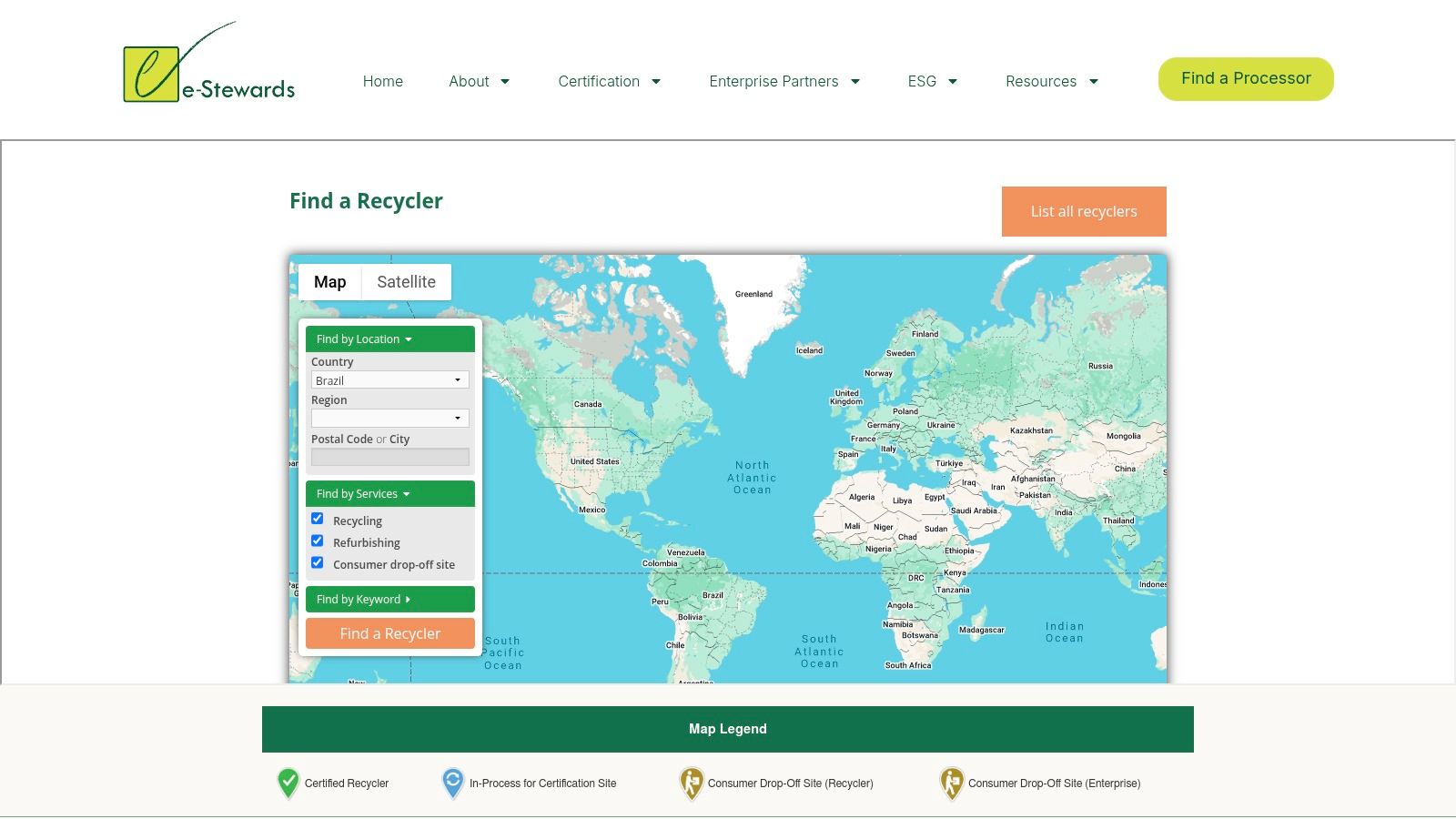
This focus on a secure and ethical chain of custody is what sets e‑Stewards apart. While other platforms may list more vendors, the e‑Stewards site provides unparalleled assurance that your assets will be handled responsibly from pickup to final processing. For any IT manager concerned with compliance and brand reputation, using an e‑Stewards certified recycler is a critical risk mitigation strategy.
Key Features and Use Cases
The platform's primary function is its interactive map and directory, which allows businesses to find and verify certified partners. The site clearly shows a facility's certification status, removing any guesswork from the vetting process.
- For High-Security Industries: A healthcare provider or financial institution can use the directory to exclusively identify Atlanta-area vendors that meet HIPAA and other data privacy requirements, ensuring a documented, auditable chain of custody.
- For Corporate Social Responsibility (CSR) Programs: Enterprises building sustainability policies can use the directory to guarantee their e-waste partners align with strict environmental and social governance (ESG) goals, specifically preventing illegal international dumping.
- Access: The directory is free to search. However, the listed recyclers are independent businesses and will have their own service fees for pickup, data destruction, and processing.
The main limitation is the smaller number of certified locations compared to broader, less stringent directories. This is a direct result of the standard's rigor. Businesses might find fewer local options, but each one offers the highest level of certified security and environmental protection.
Website: https://e-stewards.org/find-a-recycler/
5. SERI (Sustainable Electronics Recycling International) — R2 Certified Facility Directory
While the EPA provides the educational framework, the SERI R2 Certified Facility Directory is the practical, actionable tool for organizations needing to find credentialed vendors. This platform is the official, daily-updated database of all facilities certified to the R2 (Responsible Recycling) Standard. For any business prioritizing data security and environmental compliance, this directory is a non-negotiable step in the vendor selection process.

This resource moves beyond simple listings by allowing users to filter for specific services crucial to commercial clients. An IT manager for a healthcare system, for example, can use the directory to generate a shortlist of Atlanta-area R2-certified recyclers that also explicitly offer data sanitization services, dramatically streamlining the search for a HIPAA-compliant partner. It provides transparency and empowers businesses to verify credentials directly.
Key Features and Use Cases
The SERI directory is a search and verification tool, not a service provider. Its primary value is in its advanced filtering capabilities, which allow organizations to match their specific disposition needs with a certified recycler’s documented scope of services.
- For Vendor Shortlisting: Use the geographic search and service filters to identify local R2-certified facilities. You can specifically filter for recyclers that offer data sanitization, repair and refurbishment, or even those that accept consumer drop-offs.
- For Due Diligence: Before signing a contract, verify a potential ITAD partner’s certification status and scope directly from the source. The directory provides the most current information, protecting your organization from partners with lapsed or fraudulent credentials.
- Access: The directory is a free public resource and requires no registration to use.
The main limitation is that the platform is geared toward commercial and institutional users; finding a convenient consumer drop-off point may require more sifting. Additionally, all service arrangements and fee discussions must happen directly with the facilities you find, as SERI only provides the directory.
Website: https://sustainableelectronics.org
6. Best Buy — Electronics & Appliances Recycling
Best Buy’s national recycling program offers a convenient, widely accessible option for businesses needing to dispose of smaller quantities of common electronics or manage appliance upgrades. While primarily consumer-focused, its ubiquity makes it a practical solution for ad-hoc recycling needs that don't require the scale of a full ITAD service. The website provides clear, state-specific information on what is accepted, any associated fees, and daily limits, making it a reliable resource for quick reference.
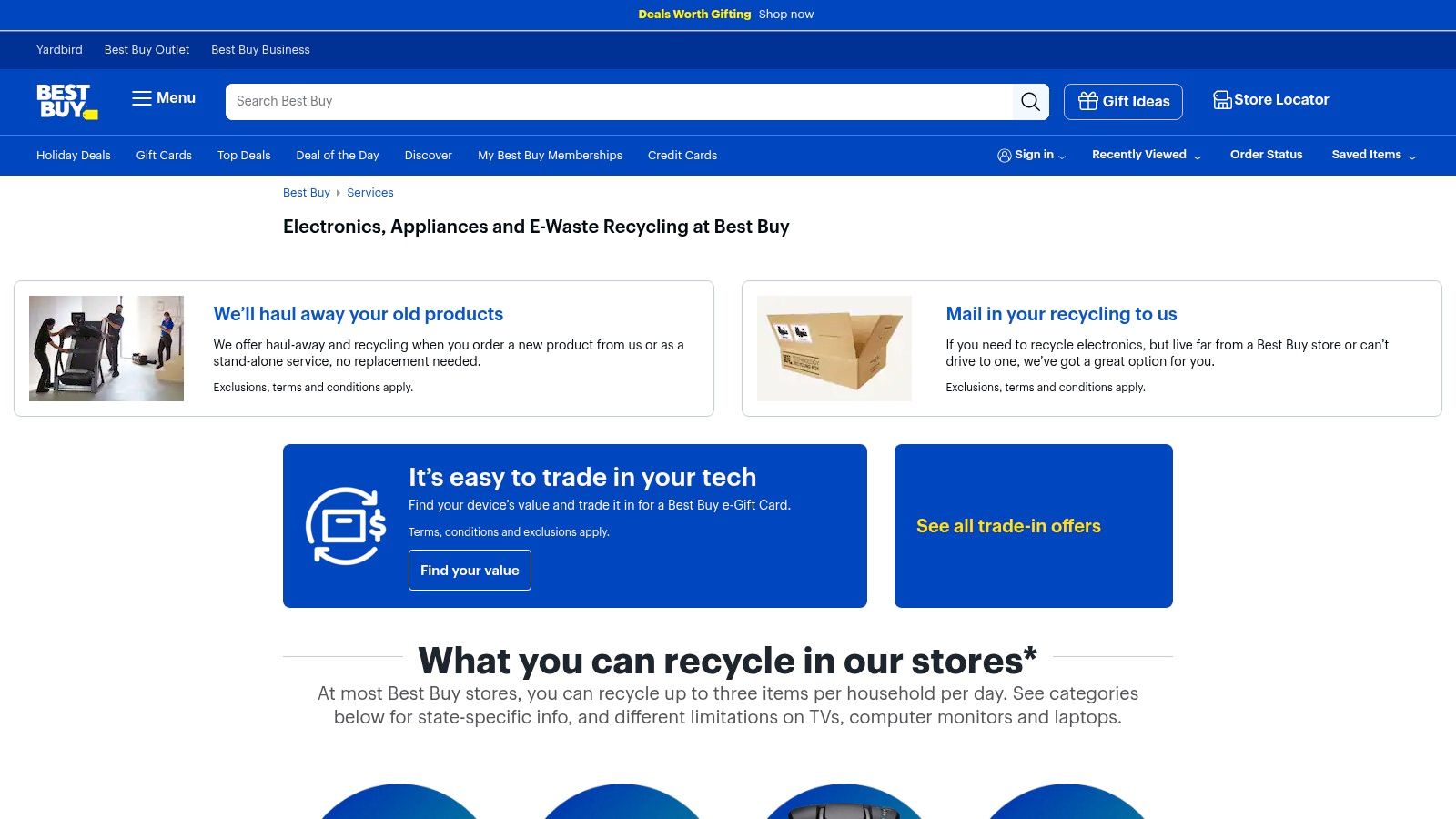
For a business audience, Best Buy's program is less about bulk IT asset disposition and more about logistical convenience. If a company is purchasing new office appliances or a large television for a conference room, the haul-away service can be bundled with the delivery and installation. This simplifies the process by consolidating removal and setup into a single transaction, though it does not typically include certified data destruction services for IT equipment.
Key Features and Use Cases
The platform's main value is its straightforward, retail-based approach to recycling. It clearly outlines costs and limitations upfront, which is useful for planning small-scale disposals.
- For Office Appliance Upgrades: When purchasing new kitchen or office appliances, use the haul-away service to remove old units. This is often discounted or included with the delivery of the new product.
- For Ad-Hoc Small Electronics: The in-store drop-off is ideal for a handful of items like keyboards, mice, or cables that accumulate over time. Check the website for the specific list of accepted electronics and be mindful of the three-item-per-household-per-day limit, which may require multiple trips for larger quantities.
- Access: Most in-store drop-offs for small items are free, but fees often apply for monitors and TVs. Haul-away services are a paid feature.
The primary limitation for commercial clients is the lack of certified data destruction, chain-of-custody documentation, and capacity for bulk disposals. It serves as a complementary solution, not a replacement for a dedicated ITAD partner.
Website: https://www.bestbuy.com/site/services/recycling/pcmcat149900050025.c?id=pcmcat149900050025
7. Staples — Free Tech Recycling
For businesses with a small, steady stream of office electronics to dispose of, Staples offers one of the most convenient drop-off recycling programs available. This nationwide retailer leverages its physical store footprint to provide a simple, no-cost option for recycling items like keyboards, mice, small printers, and mobile devices. It serves as an excellent supplementary solution for a company’s primary ITAD strategy, handling the day-to-day e-waste that doesn't warrant a bulk pickup.

The program's key advantage for a business audience is its accessibility for peripherals and consumables. While not designed for enterprise-level asset disposition requiring certified data destruction, it’s an ideal outlet for recycling depleted ink and toner cartridges, often with store rewards, and other non-sensitive office tech. For larger-scale needs, Staples also partners with certified providers to offer mail-back and box programs, bridging the gap between simple drop-offs and full-service ITAD.
Key Features and Use Cases
This service is primarily transactional, focused on the physical drop-off of accepted items. It is not a platform for managing compliance documentation or certified data destruction, which must be handled through a dedicated ITAD vendor.
- For Routine Office Cleanouts: Use the in-store program for disposing of old peripherals like keyboards, routers, and webcams accumulated from employee desk refreshes. This avoids stockpiling minor e-waste.
- For Managing Consumables: The ink and toner recycling program is a practical way to manage these common waste items responsibly, with the added benefit of potential store credit rewards.
- Access: The in-store drop-off is free, though daily limits per customer may apply. Check with your local Atlanta-area store for specifics, as acceptance of items like batteries can vary.
The main limitation is the lack of certified data destruction for items dropped off in-store, making it unsuitable for any device that has stored sensitive corporate or personal data. Additionally, it does not accept larger items like TVs or large office copiers.
Website: https://www.staples.com/sbd/cre/noheader/about_us/corporate-responsibility/environment/
8. Dell Reconnect (with Goodwill)
The Dell Reconnect program is a strategic partnership with Goodwill that transforms a familiar community donation center into a powerful, free option for computer recycling. This initiative is ideal for small businesses needing to dispose of outdated equipment without incurring costs. By leveraging Goodwill’s extensive network of drop-off locations, it provides a convenient and socially responsible answer to the question of where to recycle electronics, as proceeds from any resold equipment support Goodwill's local job training programs.
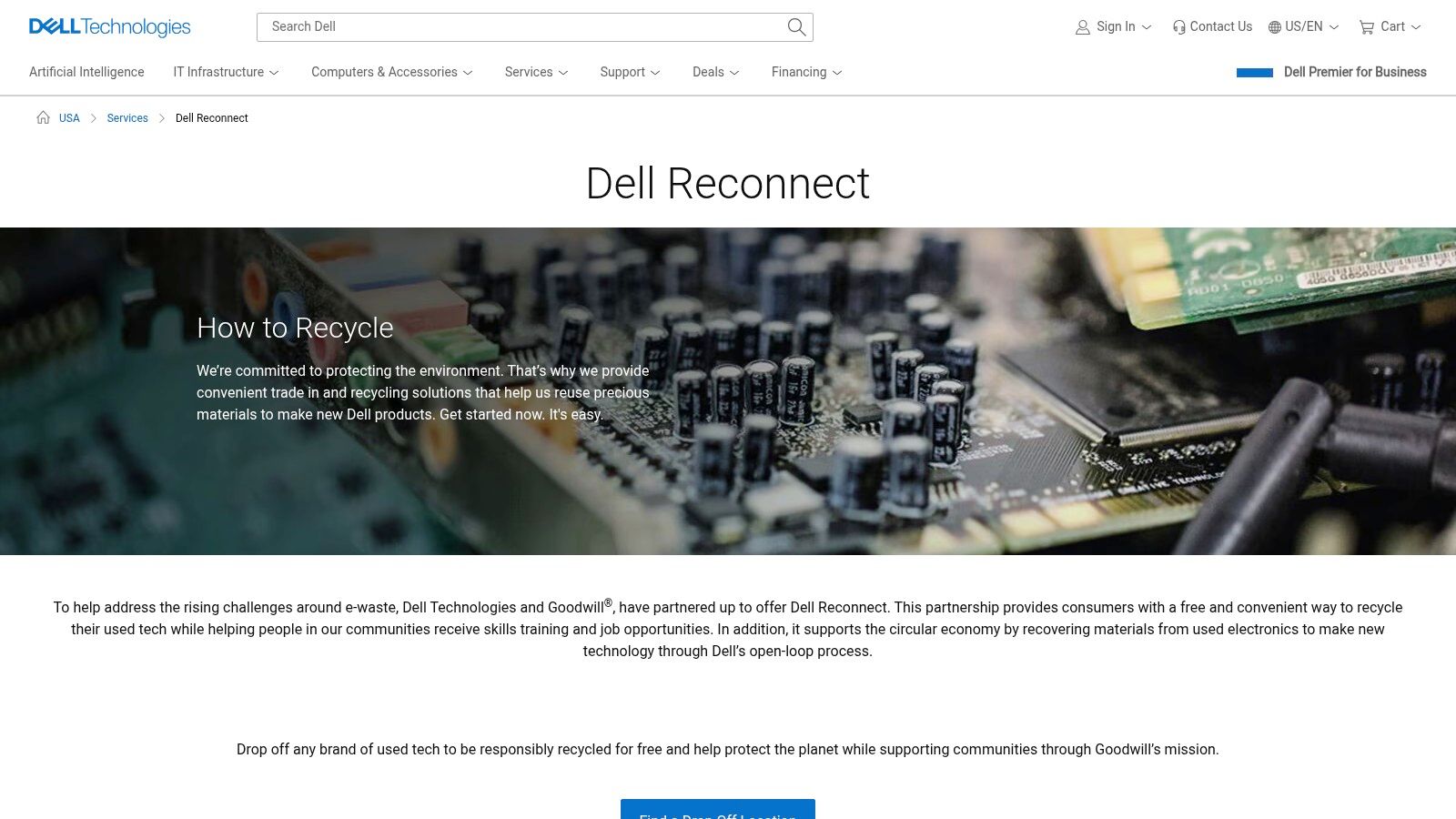
While primarily consumer-focused, this program can be a practical solution for a business's community engagement or employee electronics recycling drives. It stands out by accepting any brand of computer equipment, not just Dell products, making it a versatile drop-off solution. The key is its simplicity; it removes the logistical hurdles and fees often associated with e-waste disposal for smaller device quantities, integrating the process into a standard donation run.
Key Features and Use Cases
The program functions as a direct drop-off service, turning thousands of Goodwill locations into accessible e-waste collection points. Remember that Dell ensures any equipment that cannot be refurbished is recycled responsibly by certified partners.
- For Employee E-Waste Drives: A business can promote local Goodwill locations as a free, endorsed option for employees to recycle their personal home office equipment, supporting a corporate sustainability initiative.
- For Small Office Cleanouts: A small business or nonprofit with a handful of desktops, monitors, and printers can use this program for free and receive a donation receipt for potential tax deductions.
- Access: This is a free drop-off service at participating Goodwill locations; no signup is needed.
The main limitation for the target business audience is the lack of bulk pickup, certified data destruction certificates, and asset tracking required for corporate compliance. It is not designed for large-scale ITAD but excels as a no-cost, community-focused alternative for non-sensitive, small-volume disposals.
Website: https://www.dell.com/reconnect
9. Apple — Trade In and Recycling
Apple’s Trade In program offers a streamlined, brand-direct solution for organizations looking to responsibly retire their fleet of Apple devices. While known for its consumer trade-in credits, the program's most significant value for businesses is its free, responsible recycling service for any Apple product, regardless of age or condition. This provides a secure and verifiable endpoint for iPhones, iPads, and MacBooks that are out of warranty or have no resale value.
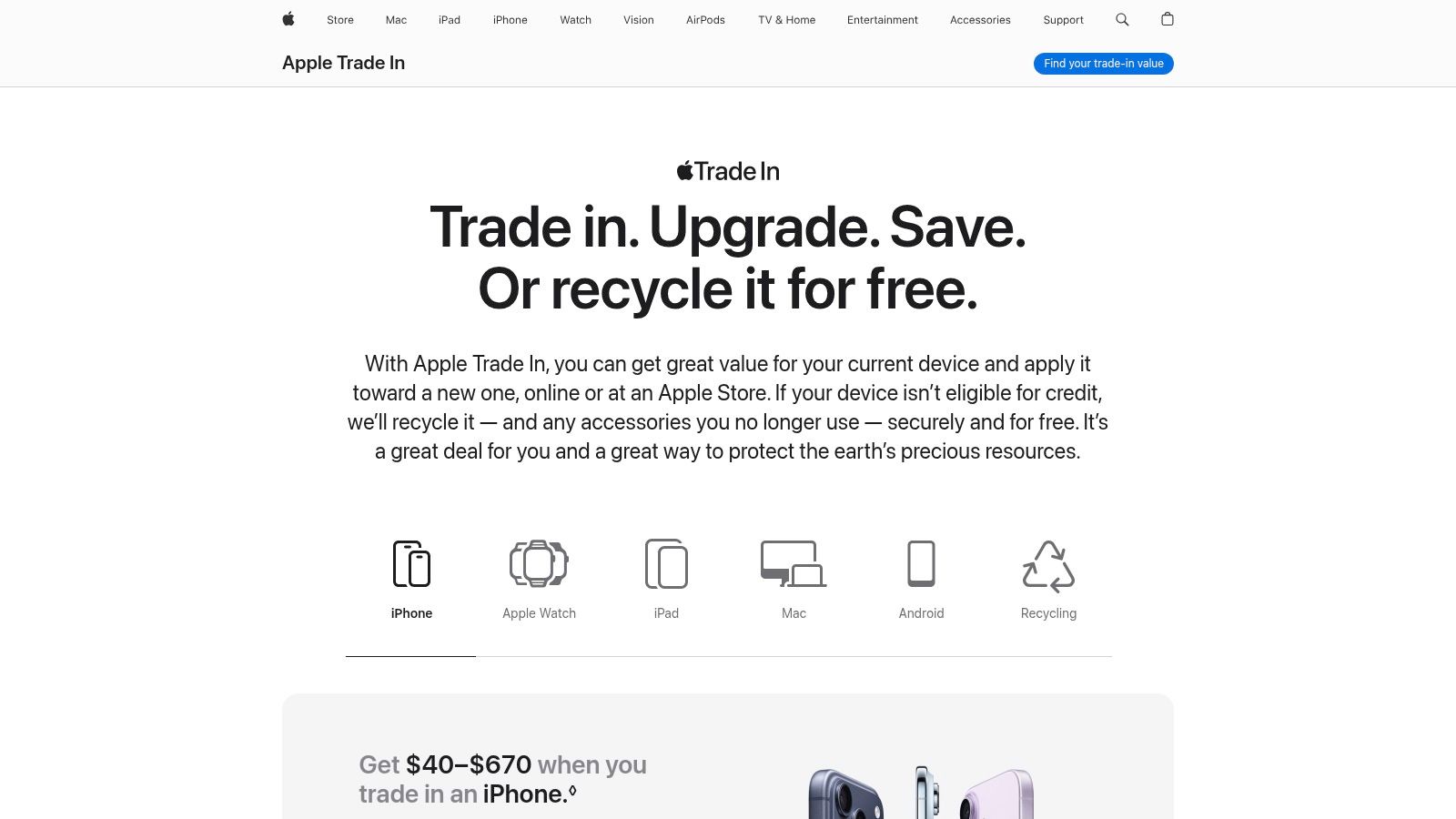
For IT managers overseeing corporate device lifecycle management, Apple’s platform simplifies one part of the disposition puzzle. The company provides clear, step-by-step instructions for data erasure and device preparation, aligning with internal data security protocols before the hardware leaves the premises. The process, handled by certified partners, ensures that materials are recovered and recycled in an environmentally sound manner, supporting corporate sustainability goals.
Key Features and Use Cases
This platform is ideal for the final stage of an Apple-specific device refresh. It offers both mail-in and in-store options, providing flexibility for organizations with distributed teams or a central IT hub.
- For Corporate Device Fleets: Utilize the free recycling service for end-of-life iPhones and MacBooks that don't qualify for trade-in credits. Apple provides prepaid shipping kits, simplifying the logistics of returning devices from multiple locations.
- For Data Security Prep: Follow Apple’s detailed on-site data wiping instructions before shipping. For businesses needing to dispose of old iPhones securely, this first step is crucial before handing devices over.
- Access: The trade-in value estimator and recycling service are free to use. Devices can be dropped off at any Apple Store or mailed in using a provided kit.
The primary limitation for commercial use is its exclusive focus on Apple products and its inability to provide bulk processing logistics or certificates of data destruction for compliance audits. It is best used for smaller batches of devices rather than full-scale data center or office cleanouts.
Website: https://www.apple.com/us/shop/goto/trade_in/
10. Amazon — Trade‑In and Device Recycling (Second Chance)
Amazon's trade-in program provides a streamlined, mail-in option for organizations looking to offload smaller, high-value consumer electronics like smartphones, tablets, and smart speakers. While not a bulk ITAD solution, it serves a niche purpose for recovering value from surplus mobile devices or office gadgets. The platform evaluates items online, provides a trade-in quote, and issues a prepaid shipping label, making it a convenient, fire-and-forget process for specific assets.

For a business, this can be an effective way to handle a small batch of company-owned cell phones after an upgrade cycle. The process is straightforward, and the compensation in the form of an Amazon gift card can be repurposed for purchasing new office supplies or equipment. If a device has no trade-in value, Amazon still facilitates recycling through its approved partners, ensuring the item is handled responsibly rather than discarded.
Key Features and Use Cases
This platform is transactional, focused on trading specific devices for credit. It is not designed for enterprise-level asset disposition but excels at handling low-volume, common consumer electronics that a business might accumulate.
- For Low-Volume Asset Recovery: Use the program to trade in a handful of corporate iPhones, Echo devices, or tablets. The process is simple enough for an office manager to handle without needing specialized ITAD knowledge.
- For Zero-Value Device Recycling: If an item is too old or damaged for a trade-in credit, you can still use Amazon's mail-back recycling service, which provides a free and verifiable disposal channel for smaller electronics.
- Access: The service is free to use; users need an Amazon account to process the trade-in and receive gift card credit.
The primary limitation for a business audience is the lack of scale and the narrow range of accepted products. It does not accept typical office equipment like printers, monitors, or desktops and offers no data destruction certification, placing the onus of data wiping entirely on the organization.
Website: https://www.amazon.com/tradein
11. Call2Recycle — Battery and Cellphone Drop‑off Locator
While most ITAD providers handle embedded batteries, Call2Recycle is an essential resource for managing loose batteries and retired company cell phones separately. This nonprofit program focuses specifically on the collection and recycling of batteries and mobile devices, providing a vast network of drop-off points that are often more convenient for smaller, ad-hoc disposals than scheduling a bulk pickup. Its value lies in its simplicity and accessibility for items that might otherwise be improperly discarded.
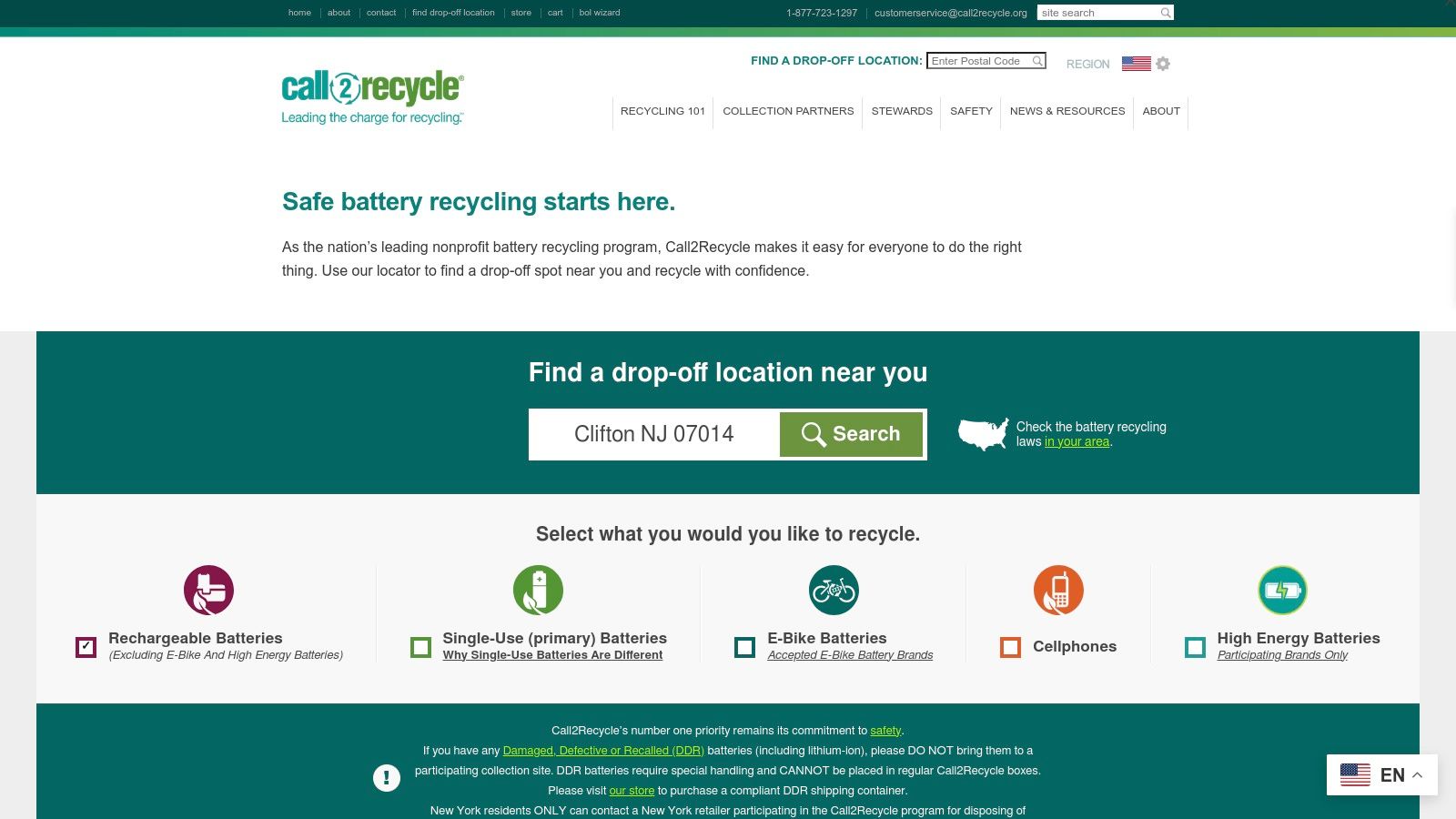
For a business, this platform is the definitive answer to the question "what do we do with the bucket of old laptop batteries?" The locator tool is incredibly straightforward, identifying nearby retail partners like The Home Depot or Lowe's that accept these items. This makes it an excellent supplement to a larger ITAD strategy, safely diverting potentially hazardous materials from the primary e-waste stream and general waste.
Key Features and Use Cases
Call2Recycle’s website is primarily a locator tool but also a valuable source for battery safety and handling information, which is crucial for corporate EHS (Environment, Health, and Safety) compliance.
- For Office Operations: Use the locator to establish a centralized battery collection point in your office. When the box is full, an employee can easily find a nearby retail partner for a free drop-off, simplifying a common waste management challenge.
- For Mobile Device Fleets: For organizations that don't require certified data destruction on low-value cell phones, this provides a convenient disposal path. You can learn more about other options for phone disposal that include data security.
- Access: The consumer drop-off locator and its associated retail network are free to use.
The primary limitation is its narrow focus; it does not accept general electronics like laptops, monitors, or servers. However, for its specific niche of batteries and cell phones, it is an unparalleled and highly accessible resource for any Atlanta-based organization.
Website: https://www.call2recycle.org/locator/
12. ecoATM — Phone/Tablet Kiosk Recycling and Trade‑in
For organizations with a small number of mobile devices to dispose of quickly, ecoATM provides a uniquely convenient, consumer-facing solution. These self-service kiosks, found in retail locations like Walmart and Kroger throughout Atlanta, offer instant evaluation and cash payment for smartphones and tablets. While not designed for bulk commercial recycling, they serve as a practical option for employee-owned devices under a BYOD policy or for disposing of a handful of company-owned phones that fall outside a larger ITAD project.
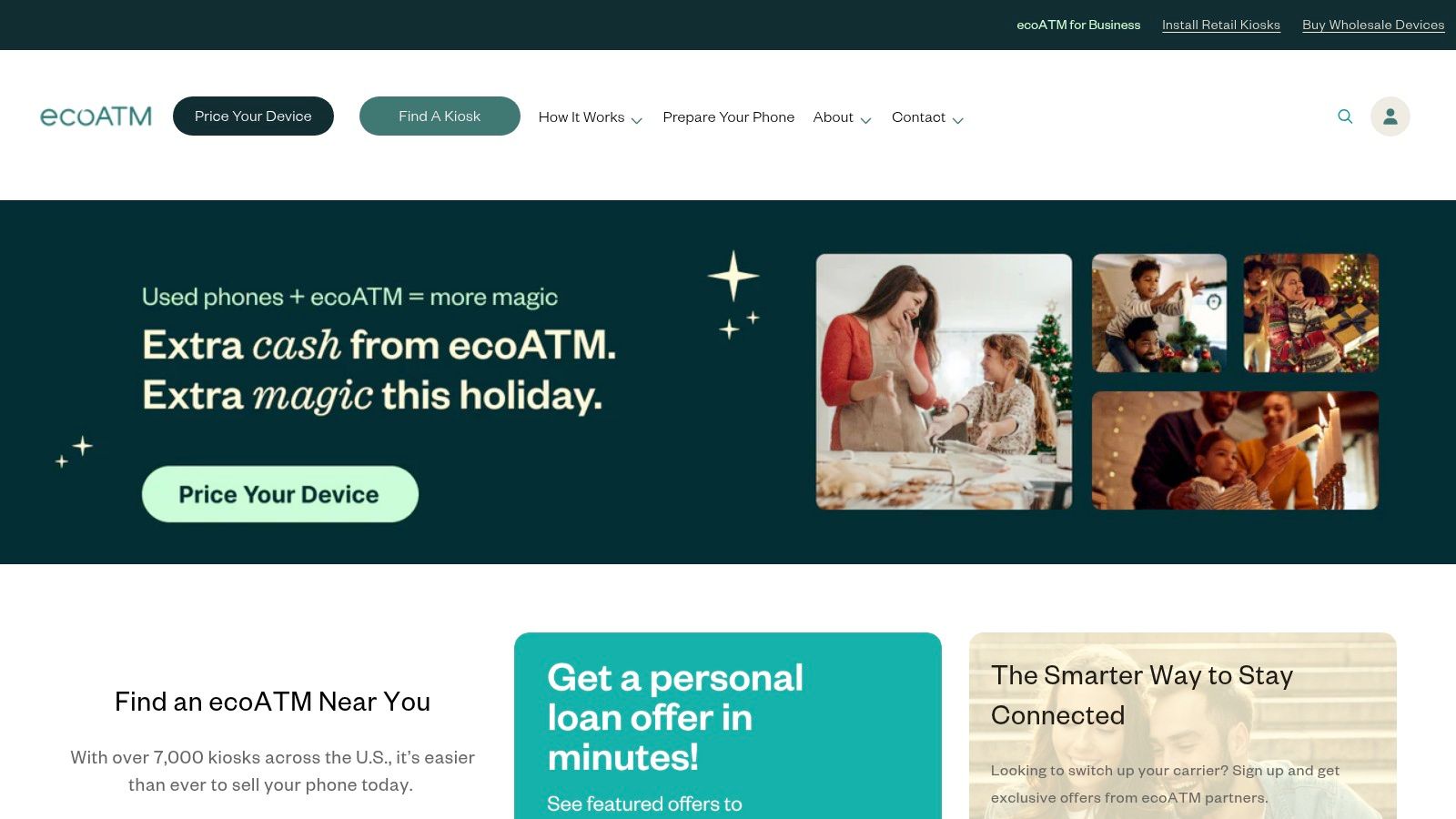
The primary advantage is speed and accessibility; there is no need for shipping or scheduling. The kiosk analyzes the device and provides an immediate offer. If accepted, it dispenses cash on the spot. Devices that have no resale value are collected and routed to a certified facility for responsible recycling, ensuring they do not end up in a landfill. This makes it a better alternative than simply discarding old, low-value company phones.
Key Features and Use Cases
ecoATM is a transactional platform best suited for immediate, small-scale disposals rather than a comprehensive ITAD strategy. It bridges the gap between individual recycling and large-scale commercial services.
- For Off-boarding Employees: Provides a simple, immediate option for an exiting employee to responsibly dispose of a personal or company-owned phone, separate from a scheduled IT asset pickup.
- For Disposing of Test Devices: IT departments can use ecoATM to quickly offload a few older model test phones or tablets that are no longer needed for development or support.
- Access: Kiosks are publicly accessible during retail store hours. A valid state ID is required to complete a transaction for security and fraud prevention.
The main limitation is its scope; it only accepts phones, tablets, and MP3 players, and it is not a solution for corporate data destruction compliance. Organizations must perform a thorough data wipe according to internal policies before using a kiosk, as ecoATM’s process is not a substitute for certified data sanitization required for regulations like HIPAA.
Website: https://www.ecoatm.com/
12 Electronics Recycling Options Compared
| Provider | Core Services | Data Security & Compliance ★ | Sustainability & Value 💰 | Target Audience 👥 | Unique Selling Points ✨ |
|---|---|---|---|---|---|
| Atlanta Computer Recycling 🏆 | ITAD, on-site de‑install, pickups, data center decommissions | DoD 5220.22‑M 3‑pass wiping; shredding; chain‑of‑custody ★★★★★ | Reuse-first, certified recycling; cost-effective (quote) 💰 | IT managers, hospitals, schools, gov, data centers 👥 | Local fleet, rapid turnarounds, compliance docs ✨ |
| US EPA — Electronics Donation & Recycling | Guidance hub, links to certified programs | Explains R2/e‑Stewards & wiping best practices ★★★★ | Authoritative info; no transactions (free) 💰 | Orgs seeking compliance standards & certified vendors 👥 | Federal guidance & certification primer ✨ |
| Earth911 — Recycling Locator | ZIP/device search for drop‑offs & events | Varies by listing; depends on recycler ★★★ | Broad nationwide locator; consumer‑focused 💰 | Small businesses or for employee recycling programs 👥 | Includes events, hours, contact details ✨ |
| e‑Stewards — Find a Recycler | Directory & map of e‑Stewards certified sites | Strict enviro + worker + data controls; no export ★★★★★ | High‑trust stewardship; facility fees possible 💰 | Corps needing highest security & ethical standards 👥 | Certified map, clear facility status ✨ |
| SERI (R2) — Facility Directory | Search R2‑certified recyclers by service | R2 certification, filters for sanitization ★★★★★ | Transparent cert data; business/ITAD focus 💰 | Commercial buyers, IT teams seeking certified vendors 👥 | Daily‑updated cert scopes & filters ✨ |
| Best Buy — Recycling | In‑store drop‑off, haul‑away options | Store‑dependent wiping/processing ★★★ | Widely available; some fees for TVs/monitors 💰 | Businesses with small-batch or appliance needs 👥 | Ubiquitous retail drop‑off + haul‑away services ✨ |
| Staples — Free Tech Recycling | Free in‑store drop‑off; business mail‑back | Store limits; varies by location ★★★ | Free for many office items; limits apply 💰 | Small businesses needing peripheral & consumable disposal 👥 | Mail‑back programs & ink/toner rewards ✨ |
| Dell Reconnect (Goodwill) | Goodwill drop‑off for computers & accessories | Goodwill processing; varies by location ★★★★ | Free option; supports reuse/resale 💰 | Small businesses & nonprofits; employee drives 👥 | Nonprofit reuse network; donation receipts possible ✨ |
| Apple — Trade In & Recycling | Trade‑in credit; free recycling (mail/in‑store) | Brand‑handled processing; prepaid kits ★★★★ | Trade credit for eligible devices; free recycling 💰 | Businesses with Apple-specific device fleets 👥 | Prepaid mail kits, in‑store drop‑off, clear guidance ✨ |
| Amazon — Trade‑In & Second Chance | Online eval, prepaid shipping, gift‑card credit | Routes to approved recyclers; varies ★★★ | Convenient mail‑in; limited categories for credit 💰 | Businesses offloading small-volume consumer electronics 👥 | Prepaid labels, online valuation & gift card credit ✨ |
| Call2Recycle — Battery & Phone Locator | Locator for batteries & cellphones at retailers | Battery safety guidance; handling protocols ★★★★ | Typically free household battery/phone drop‑offs 💰 | Businesses managing loose batteries & basic phones 👥 | Retail network partners & safety instructions ✨ |
| ecoATM — Kiosk Recycling & Trade‑in | Kiosk evaluation, instant cash payout for phones/tablets | On‑site evaluation; devices refurbished or recycled ★★★ | Instant payment for eligible devices; convenient 💰 | Businesses with a few mobile devices for quick disposal 👥 | Thousands of kiosks, app pre‑check, instant payout ✨ |
Partnering for a Compliant and Sustainable IT Asset Disposition Strategy
Navigating the landscape of where to recycle electronics in the Atlanta metro area presents a complex but critical challenge for businesses, healthcare institutions, and educational organizations. The decision goes far beyond simple disposal; it's a strategic choice that impacts data security, regulatory compliance, environmental stewardship, and your organization's reputation. As we've explored, the options range from convenient consumer-facing retail programs to robust, certified commercial recycling partners, each serving a distinct purpose.
For an IT manager at a growing enterprise or a compliance officer at a hospital, the path forward requires a clear understanding of the risks and rewards associated with each choice. While programs like Best Buy or Staples offer accessible drop-off points for a handful of devices, they are not designed to handle the scale, security requirements, or logistical complexities of corporate IT asset disposition (ITAD). These retail solutions lack the certified data destruction processes and chain-of-custody documentation essential for meeting HIPAA, SOX, or GLBA standards.
Choosing the Right Partner for Your Organization's Needs
The central takeaway for any organization is the critical distinction between consumer recycling and a professional ITAD strategy. Your decision-making process should be guided by a clear assessment of your specific operational needs.
- For Small Businesses with Occasional Needs: Utilizing a combination of municipal drop-off events and trusted retail partners can be a viable, low-cost solution for a small number of non-sensitive devices. However, you must ensure you have a separate, verifiable process for wiping all data beforehand.
- For Medium to Large Enterprises and Data Centers: Your primary focus must be on security, compliance, and logistical efficiency. Partnering with a certified e-Stewards or R2 recycler, such as Atlanta Computer Recycling, is non-negotiable. These partners provide on-site services, serialized asset tracking, and certificates of data destruction, which are indispensable for audit trails and risk mitigation.
- For Healthcare, Finance, and Legal Sectors: Data security is paramount. The only acceptable solution is a specialized ITAD provider that offers documented, compliant data destruction methods. The potential cost of a data breach far outweighs the investment in a secure, certified recycling partner.
- For Educational Institutions and Government Agencies: Managing bulk disposals of varied equipment (laptops, servers, smartboards) requires a partner capable of handling diverse asset types at scale. A certified recycler can also offer remarketing and refurbishment services, potentially providing a return on investment for still-valuable equipment.
Integrating ITAD into Your Overall Asset Management
A successful electronics recycling program doesn't exist in a vacuum. It is the final, crucial step in a comprehensive asset lifecycle plan. To build a truly compliant and sustainable IT Asset Disposition strategy, a foundational understanding of the entire technology lifecycle is essential. Learn more about understanding IT Asset Management (ITAM) to effectively track and manage your business's tech assets from acquisition to secure disposal. Integrating ITAD into your ITAM framework ensures that no device falls through the cracks, protecting your organization from security vulnerabilities and environmental non-compliance.
Ultimately, knowing where to recycle electronics is about choosing a partner that aligns with your organization's commitment to security and sustainability. By prioritizing certified, professional ITAD services, Atlanta-area businesses can transform a complex obligation into a strategic advantage, confidently protecting their data, upholding their environmental responsibilities, and contributing to a greener, more secure community.
Ready to implement a secure and compliant electronics recycling program for your Atlanta-based organization? Contact the experts at Atlanta Computer Recycling to develop a tailored IT Asset Disposition plan that meets your specific security, logistical, and environmental needs. Visit Atlanta Computer Recycling to schedule a consultation and ensure your retired assets are handled responsibly.