A Business Leader’s Guide to Old Cell Phone Donations


For most businesses, that growing pile of old company phones in a supply closet is more than just clutter—it's a ticking clock of security risks and environmental liability. But what if you could transform that liability into a strategic asset?
Forward-thinking companies are reframing device retirement not as a disposal chore, but as a strategic component of their operations. By implementing a formal process for old cell phone donations, they're converting a potential security and compliance headache into a powerful tool for brand building, risk mitigation, and corporate responsibility.
The Strategic Value of Donating Old Company Phones

This isn't just about corporate altruism, though that's a positive outcome. It's about transforming a necessary IT task into a public relations win and a security safeguard. When your business professionally manages the donation of its retired devices, you're sending a clear message to your customers, investors, and the community about your commitment to operational excellence.
Enhance Your Corporate Social Responsibility Profile
A structured phone donation program is a tangible, reportable action that demonstrates your company's values. It’s real-world proof you can include in your Corporate Social Responsibility (CSR) and Environmental, Social, and Governance (ESG) reports and leverage in your marketing efforts.
This kind of initiative shows stakeholders that you're invested in more than just the bottom line. It builds brand trust and loyalty—two incredibly valuable assets in today's competitive market.
It’s also a significant win for employee engagement. Top talent wants to work for companies that operate responsibly. Involving your team in the process can create a powerful sense of shared purpose and pride in their employer.
Meet Sustainability and Security Goals
Properly managing retired electronics is no longer optional—it's a critical component of any credible corporate sustainability plan. Donating phones extends their useful life, keeping them out of landfills where they leach toxic materials into the environment. It’s a direct contribution to the circular economy and a straightforward way to reduce your company's environmental footprint.
By turning potential e-waste into a valuable resource, your business does more than just avoid environmental harm; it proves its commitment to responsible operations. This move strengthens your brand and aligns perfectly with the growing demand from consumers and investors for sustainable business practices.
The scale of this challenge is massive. As technology churns forward, the number of retired devices grows exponentially. With worldwide smartphone shipments projected to reach 1.24 billion units in 2025, the pool of corporate phones requiring end-of-life management is staggering. Many leading companies are already partnering with certified ITAD vendors to refurbish and redistribute millions of devices to communities in need.
Of course, beyond the environmental benefits, a managed donation program is a non-negotiable security measure. Storing or improperly disposing of old phones is a data breach waiting to happen. A professional process guarantees that every byte of sensitive company data is verifiably destroyed before the device ever leaves your control.
This is a cornerstone of any sound IT asset disposition strategy, protecting your business from the significant legal and financial fallout of a data leak.
Securing Your Data Before Donating Devices
Before any company phone changes hands, data security isn't just a step—it's the critical mandate. A simple factory reset is a dangerous gamble for corporate devices loaded with sensitive emails, client details, and network credentials. This is about more than just deleting files; it's about active risk management to protect your company from a potential data breach and the ensuing regulatory chaos.
A common but dangerous assumption in many businesses is that a standard "wipe" or factory reset eradicates all data. The reality is, these functions often just remove the pointers to the data, leaving the actual information behind and easily recoverable with off-the-shelf software. That oversight can turn your well-intentioned donation program into a catastrophic liability.
Beyond the Factory Reset
True data sanitization demands a forensically sound approach. For any business, this means using certified data destruction software that overwrites a device's storage multiple times with random data. This process is designed to make the original information unrecoverable—the gold standard required to meet compliance with regulations like GDPR, CCPA, and HIPAA.
It all comes down to adopting governance-first approaches to data protection. This mindset shifts your IT focus from just hitting "delete" to implementing a robust, verifiable security protocol from the very beginning of the asset lifecycle.
This infographic drives home the difference between a simple reset and using certified software.
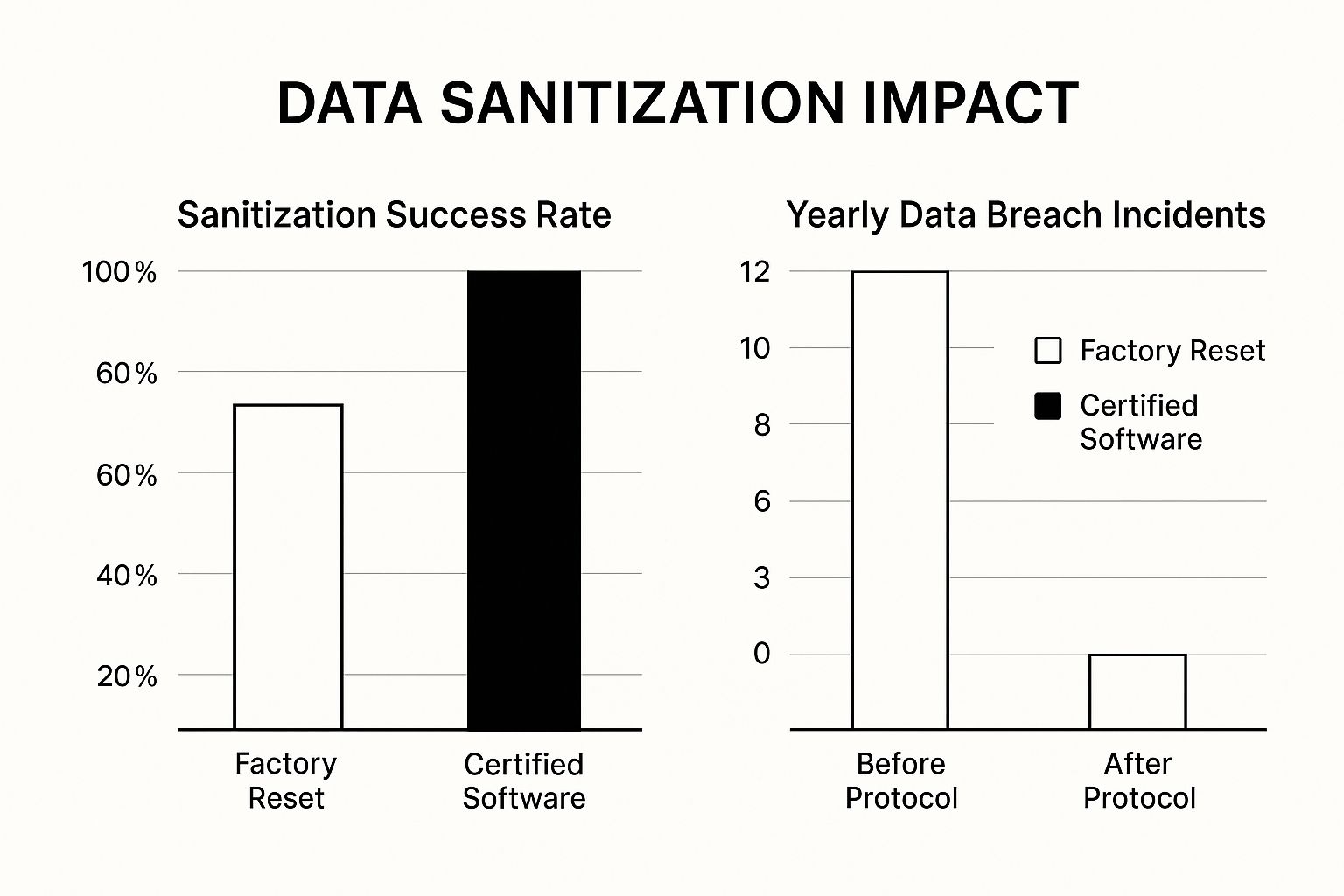
The numbers don't lie. A factory reset can fail to secure data up to 40% of the time, whereas certified software delivers complete sanitization and drastically reduces breach risk.
Establishing a Clear Sanitization Protocol
A reliable data destruction process is one you can document and audit. Your internal protocol must be a clear playbook that any IT team member can follow, ensuring no device ever slips through the cracks. This isn't just a best practice; it's your proof of due diligence in the event of a security audit.
Your protocol should mandate these key actions:
- Log Everything: Maintain a detailed log of every single device, identified by its serial number or IMEI. You must track its journey from the moment it’s taken out of service to its final data destruction.
- Use Certified Software: Mandate the use of specific, certified data erasure software that meets or exceeds current industry standards like NIST 800-88.
- Get Verification: Always require your ITAD partner to provide a formal Certificate of Data Destruction for every device they process. This document is your non-negotiable proof that the job was done right.
When it comes to corporate assets, data sanitization isn't a suggestion—it's a hard requirement. A single improperly wiped device can expose your entire organization to reputational damage, steep regulatory fines, and legal action. The cost of a breach is always far greater than the investment in a secure process.
Building this protocol creates consistency and, more importantly, accountability. For a deeper look into the technical side, you can find detailed guidance on how to wipe a hard drive for business use, which covers principles that are just as relevant for phones and other corporate devices.
How To Choose The Right Donation Partner
Selecting a partner for your company's old cell phone donations is a critical business decision, not an administrative task. The right partner becomes an extension of your IT and compliance departments, protecting your data and your reputation. The wrong one can open your business to major security risks, compliance failures, and environmental liabilities.
For businesses, the choice usually boils down to the well-intentioned local charity versus the airtight, certified process of a professional e-waste recycler or IT Asset Disposition (ITAD) vendor. While giving to a local non-profit is a noble gesture, they typically lack the infrastructure for certified data destruction or responsible downstream recycling—two non-negotiable requirements when dealing with corporate assets.
Key Vetting Criteria For Corporate Partners
When you evaluate potential partners, your focus must be locked on three areas: security, compliance, and logistics. A partner has to be able to handle the volume and specific needs of a business, which are fundamentally different from an individual dropping off a personal phone.
Here’s your vetting checklist—no exceptions:
- Industry Certifications: The partner absolutely must hold either R2 (Responsible Recycling) or e-Stewards certification. These are the gold standards in electronics recycling, guaranteeing they adhere to the strictest protocols for both environmental safety and data security.
- Certified Data Destruction: Don't just take their word for it. Demand proof of their data sanitization process. They must provide a Certificate of Data Destruction for every single device, which creates the auditable paper trail you need for your compliance records.
- Secure Logistics: A qualified partner offers a secure, documented chain of custody from the moment devices leave your facility. This includes secure transport, controlled-access facilities, and a transparent process.
A partner’s certifications are your company’s insurance policy. They guarantee that your retired assets won't end up improperly discarded overseas or become the source of a devastating data breach. Without this verification, you are taking on unacceptable risk.
Comparing Your Donation Options
The differences between potential partners become clear when you put their capabilities side-by-side. While local charities do incredible community work, their model isn't built to handle the stringent requirements of corporate IT asset disposition. For a deeper dive, our guide on where to dispose of old phones securely offers additional context.
To simplify the decision, let's break down the key features you should be weighing.
Comparing Corporate Donation Program Features
This table highlights the fundamental differences between common donation routes, helping you assess the risks and benefits for your business.
| Feature | Local Charity Drop-off | Mail-in Program | Certified E-Waste Partner |
|---|---|---|---|
| Data Destruction | Basic wipe, if any; rarely certified | Often certified, but chain of custody is a concern | Certified, with Certificates of Destruction provided |
| Certifications | Typically uncertified | Varies; may be R2 certified | R2v3 and/or e-Stewards certified |
| Logistics | You must handle drop-off | You must pack and ship; risk of loss/damage | Secure, on-site pickup and transport provided |
| Reporting | Basic donation receipt | Limited tracking and reporting | Detailed inventory and impact reports |
| Ideal For | Personal devices; very small businesses with non-sensitive data | Individuals or small batches of low-risk devices | Businesses of all sizes, especially those with compliance needs (HIPAA, etc.) |
Ultimately, any business managing more than a few devices requires a certified e-waste partner. It's the only option that aligns with modern security, privacy, and environmental regulations. They provide the documentation you need, assume the liability for data destruction, and ensure your old cell phone donations are handled responsibly from start to finish. This turns a potential risk into a documented, secure, and sustainable part of your company's operations.
Building Your Internal Donation Program
A successful cell phone donation program isn't a one-off event—it’s a sustainable part of your IT asset management lifecycle. For it to be effective, the internal logistics must be seamless. The process needs to be simple, secure, and easy for all employees to follow. The objective is to create an efficient workflow, not a logistical bottleneck.
The first step is effective internal communication. Employees need to understand why this program exists and their role in its success. Clearly explain the security mandates, the positive environmental impact, and how their old company phones will directly support the community.
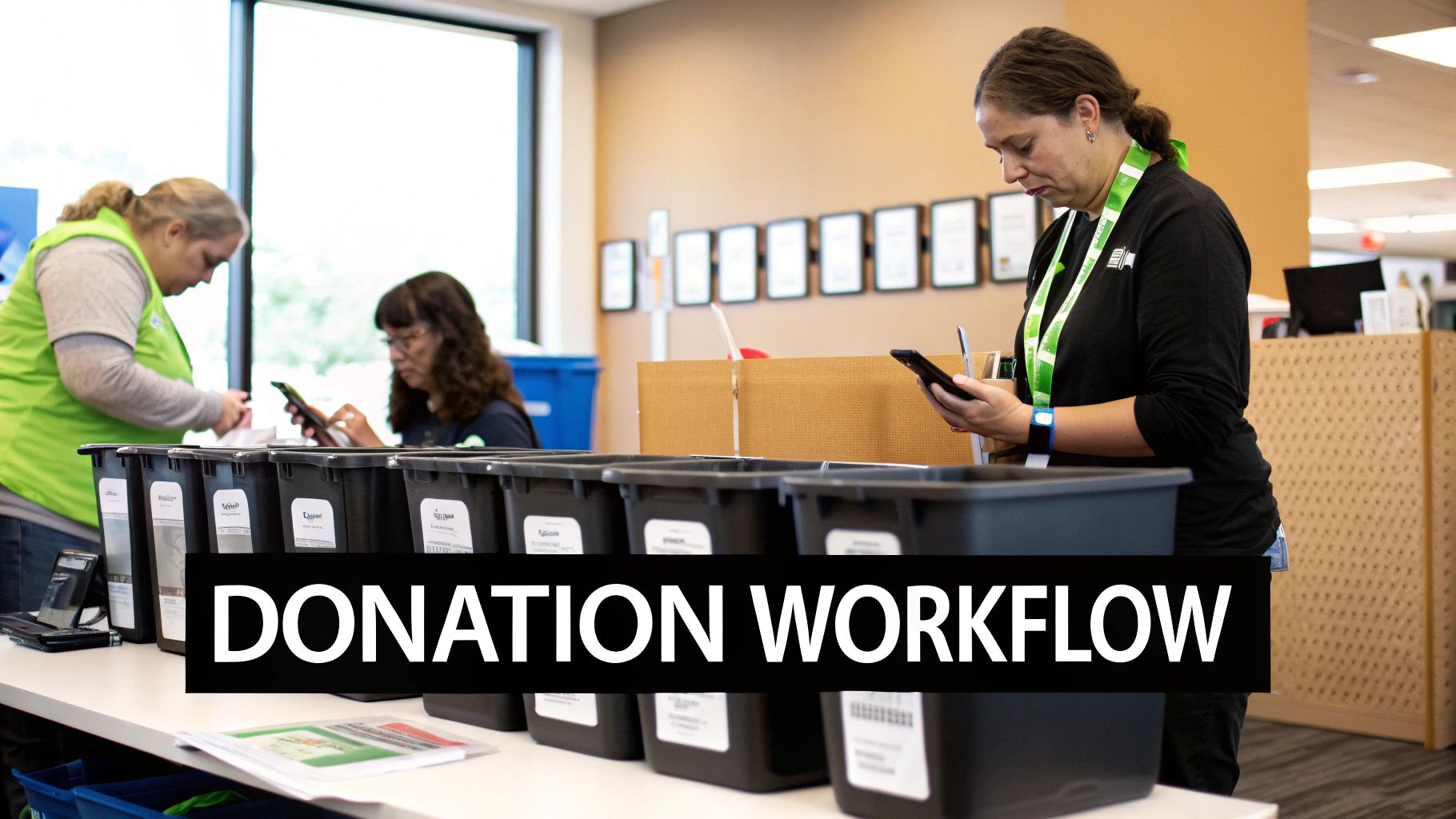
This internal marketing builds momentum and ensures compliance with necessary steps, like logging out of all accounts before turning in a company-issued device.
Creating A Structured Collection Process
To manage the collection of retired devices, you need a clear, organized system. Piling old phones on a desk in the IT department is a recipe for lost assets and serious security risks. Instead, establish a structured process that is clear to everyone.
A key component is appointing an internal champion. This person, typically from your IT or facilities team, becomes the single point of contact for the program. They will manage the collection points, coordinate with your donation partner, and ensure all protocols are being followed. This centralizes responsibility and eliminates confusion.
Next, set up secure collection points. These should not be open cardboard boxes in a busy hallway. Use locked bins or a designated, access-controlled room where employees can securely deposit their retired devices.
Finally, create a simple pre-donation checklist for staff. It should be concise and cover the essentials:
- Log out of all personal and corporate accounts (iCloud, Google, etc.).
- Perform a factory reset as a preliminary step (note: this does not replace professional sanitization).
- Remove SIM cards and any external memory cards.
Your internal program's strength lies in its simplicity and security. A straightforward, well-communicated process reduces friction, encourages participation, and ensures that every device is handled correctly from the moment it’s retired.
This structured approach is more important than ever. Electronic waste is the fastest-growing waste stream globally, with an estimated 57.4 million metric tons generated in 2021 alone. By creating an effective internal program, your company directly helps reduce this waste, conserve valuable resources, and minimize the carbon footprint associated with manufacturing new devices.
When you integrate this process into your existing asset management system, it becomes a truly sustainable initiative. It should be as routine as your protocols for what to do with outdated computers. A formal phone donation plan becomes a standard operational procedure, not just an occasional cleanup project. That is the key to long-term success and continuous impact.
Measuring the Impact of Your Phone Donations
A strategic cell phone donation program does more than just clear out old inventory—it generates powerful, measurable results. When you partner with a certified recycler, you're not just disposing of old assets. You’re collecting data that tells a powerful story about your company’s commitment to security, sustainability, and community support.
This is no longer just an IT function. It’s a source of valuable data for your marketing, compliance, and leadership teams. The key is to demand detailed reporting from your recycling partner. Vague promises are insufficient. You need tangible proof of your program's impact to report to stakeholders, from your executive team to your customers.

Key Reports to Demand From Your Partner
To truly measure your program's ROI, you must insist on three core documents after your devices are processed. These reports provide the exact metrics needed for compliance audits, ESG reporting, and marketing communications.
Here’s what your non-negotiable reporting package should include:
- Certificates of Data Destruction: This is your ironclad proof of security and compliance. Each certificate should be tied to a specific device by serial number, confirming all its data was professionally and permanently destroyed according to industry standards.
- Environmental Impact Statements: This report quantifies your sustainability efforts. It should detail the total weight of e-waste diverted from landfills, list the specific materials recovered, and outline the positive environmental outcomes (e.g., CO2 emissions avoided).
- Social Impact Summaries: If your phones were refurbished and donated, this summary specifies where they went and who they helped. It might include the number of devices provided to a specific non-profit or the communities that benefited.
These reports are far more than just paperwork. They are the building blocks for a strong corporate narrative, providing hard data to substantiate your company's claims of being a responsible corporate citizen.
Turning Data into a Compelling Narrative
Once you have these reports, translate the data into compelling stories that resonate with your stakeholders. Currently, an estimated 150 million old cell phones are sitting in storage across the United States—a massive untapped resource. Charities like Cell Phones for Soldiers collect over 700,000 phones every year, demonstrating the potential of organized donation efforts. You can learn more by exploring the latest smartphone donation statistics.
Use your data to craft specific messages for different audiences. For your annual ESG report, highlight hard numbers like "diverted 2,000 pounds of e-waste from landfills." For a marketing campaign, tell a story about how your donated devices are "providing essential communication tools to underserved communities." This approach is an effective way to showcase your proactive stance on the environmental impact of electronic waste.
Don't forget to share these wins internally. It’s an excellent way to boost employee morale and reinforce your company’s culture of security and sustainability.
Got Questions About Corporate Phone Donations? We’ve Got Answers.
When establishing a corporate device donation program, questions about logistics, security, and compliance are inevitable. Getting clear answers is the first step toward gaining internal buy-in and ensuring the process is executed flawlessly. Let's address a few of the most common queries we hear from business leaders.
Is a Factory Reset Good Enough to Protect Our Data?
In a word: no. This is the most common—and most dangerous—misconception in corporate device disposal. A factory reset may make a phone appear clean, but it often leaves behind data fragments that are recoverable with basic forensic tools. It’s the digital equivalent of trying to shred a sensitive document by hand; the pieces are still there for a determined actor to reassemble.
For any device that has accessed corporate data, certified data erasure software is the only acceptable solution. It overwrites the device's storage multiple times, rendering the original data completely unrecoverable. Your donation partner must provide a Certificate of Data Destruction for every single device. That certificate is not just a piece of paper—it's your auditable proof of compliance and your defense against future liability.
What’s the Difference Between R2 and e-Stewards Certifications?
Both are the gold standard for electronics recyclers, but they have slightly different areas of emphasis. Understanding the distinction helps you select a partner that aligns with your company’s specific environmental and social governance (ESG) goals.
- R2 (Responsible Recycling) is a comprehensive certification that covers data security, environmental standards, and worker health and safety throughout the recycling chain.
- e-Stewards is particularly known for its strict, zero-tolerance policy on exporting hazardous e-waste to developing nations, where it could be processed unsafely.
While a partner with either certification is a responsible choice, companies with a strong focus on global environmental justice and preventing illegal e-waste exportation often prioritize the e-Stewards standard.
Can Our Business Get a Tax Deduction for Donating Phones?
Yes, this is a distinct possibility, but meticulous documentation is required. The IRS allows businesses to claim a deduction based on the fair market value of the phones at the time of donation. However, a simple drop-off receipt from a charity will not suffice for a corporate audit.
To properly claim this deduction, your recycling partner must provide detailed inventory reports and accurate valuations for the donated assets. This documentation substantiates your claim and ensures compliance. As always, consult your tax advisor to ensure you are following the specific IRS regulations for non-cash charitable contributions to maximize your entitled deduction.
Ready to turn your company's retired phones into a secure, sustainable, and impactful asset? Atlanta Computer Recycling offers certified data destruction and responsible electronics recycling services for businesses across the Atlanta metro area. We manage every detail of the process, providing the documentation and peace of mind you need. Learn more about our IT asset disposition services.