A Business Leader’s Guide to IT Equipment Recycling

That old server collecting dust in the storage closet? It’s not just an operational inconvenience—it's a ticking time bomb loaded with business risk. Proper IT equipment recycling isn't just about environmental responsibility anymore. It’s a core business strategy that protects your company from catastrophic data breaches, steep regulatory penalties, and a damaged brand reputation.
Why IT Equipment Recycling Is a Business Imperative
For too many businesses, retired electronics are out of sight, out of mind. Obsolete laptops, servers, and networking gear get shoved into closets or off-site storage, slowly turning into a forgotten liability.
But ignoring end-of-life hardware exposes your organization to serious, unnecessary dangers. Every one of those obsolete devices could still hold sensitive corporate data—confidential client information, employee records, or your company's intellectual property.
Without a professional disposal plan, those assets are a wide-open vulnerability. A single misplaced hard drive could spiral into a catastrophic data breach, leading to crippling fines, legal battles, and a permanent stain on your brand's reputation. With the average cost of a data breach climbing every year, proactive data security at the end of an asset's lifecycle has never been more critical.
From Operational Headache to Strategic Advantage
When you view IT equipment recycling as a strategic initiative, it stops being a logistical chore and becomes a powerful tool for risk management. A certified recycling program is, at its heart, a security strategy. It ensures that every last bit of data on your retired devices is professionally and permanently destroyed, providing a documented chain of custody and a Certificate of Destruction for your compliance records.
This process is about more than just dodging a bullet; it’s about building a stronger, more resilient business. A formal recycling program demonstrates a tangible commitment to corporate social responsibility and environmental stewardship. It protects your organization from non-compliance with environmental regulations and reinforces your dedication to protecting stakeholder data. You can get a closer look at the bigger picture in our article on the environmental impact of electronic waste.
A professional IT recycling program is your last line of defense in the data lifecycle. It ensures that retired assets don't become future liabilities, protecting your data, your brand, and your bottom line.
Ultimately, a structured approach to managing your end-of-life electronics delivers several crucial business benefits:
- Mitigates Data Breach Risks: Securely destroys sensitive information on hard drives and other storage media, eliminating the threat of unauthorized access.
- Ensures Legal Compliance: Helps your business adhere to data privacy laws like HIPAA and environmental regulations governing e-waste.
- Protects Brand Reputation: Demonstrates to customers, partners, and stakeholders that your organization takes data security and environmental responsibility seriously.
- Improves Operational Efficiency: Frees up valuable office or storage space by systematically clearing out obsolete and unused equipment.
The Journey of Your Retired IT Assets
What actually happens to your company's old servers, laptops, and networking gear after they leave your facility? The answer to that question determines whether those assets become a data breach waiting to happen or a responsibly managed resource.
The journey of professional IT equipment recycling is a precise, multi-stage process. It's designed from the ground up to protect your sensitive corporate data and recover valuable materials from your retired technology.
Think of it as a reverse manufacturing line. Instead of building something new, each device is carefully deconstructed, its components sorted, and its data storage permanently destroyed. This is a deliberate system—far more than just "tossing it"—that turns potential liabilities into secure, recycled commodities.
Step 1: Secure Collection and Logistics
The process starts with transporting your equipment from your facility to ours, securely. A professional IT recycling partner doesn't just show up with an open truck. We arrive with secure, GPS-tracked vehicles and a clear plan to inventory and transport every single asset.
This first step establishes a documented chain of custody. This is your auditable proof that every device is accounted for from the moment it leaves your control. That meticulous tracking is absolutely essential for compliance and provides assurance that nothing gets "lost" in transit.
Step 2: Sorting and Manual Dismantling
Once the equipment arrives at our certified processing facility, trained technicians begin the hands-on work of manually sorting and dismantling each device. This isn't a chaotic teardown; it's a careful separation of components.
- Categorization: Devices are sorted by type. Laptops, desktops, servers, and monitors each follow a specific processing path.
- Component Separation: Key components like motherboards, RAM, CPUs, power supplies, and hard drives are carefully removed.
- Hazardous Material Removal: Any components containing potentially harmful substances, like batteries or legacy CRT monitor parts, are isolated for specialized handling to prevent environmental contamination.
This manual stage is crucial. It maximizes the value that can be recovered from each asset and ensures hazardous materials are managed according to strict environmental regulations.
The goal of professional IT equipment recycling is twofold: achieve 100% data destruction and recover the maximum amount of reusable materials, effectively closing the loop on the electronics lifecycle.
The following infographic drives home how this strategic process transforms a major business risk into a tangible advantage.
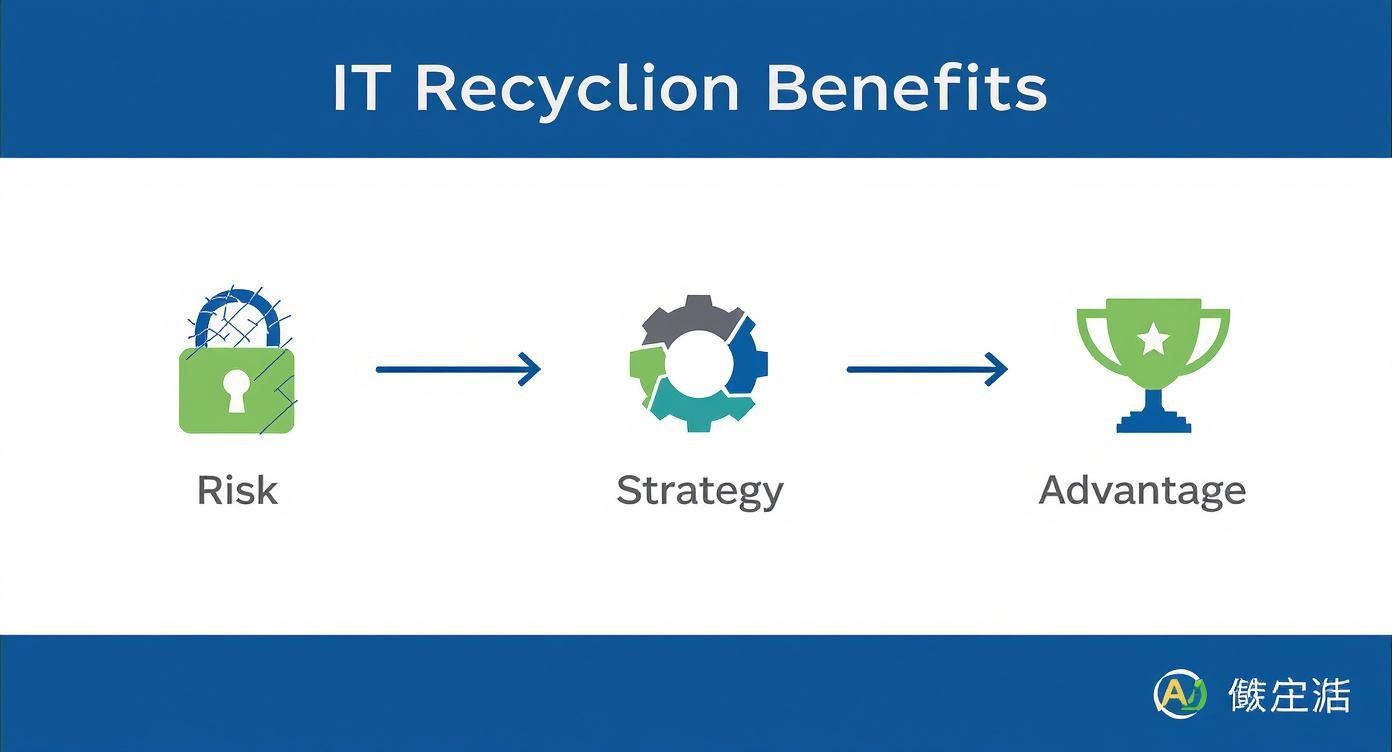
As you can see, implementing a formal strategy converts the initial risk of a data breach into a clear competitive edge built on security and corporate responsibility.
Step 3: The Critical Data Destruction Phase
For any business, this is the most important step in the entire process. Before anything else happens, all data-bearing devices—like hard drives (HDDs) and solid-state drives (SSDs)—are segregated for secure data destruction. This step is non-negotiable.
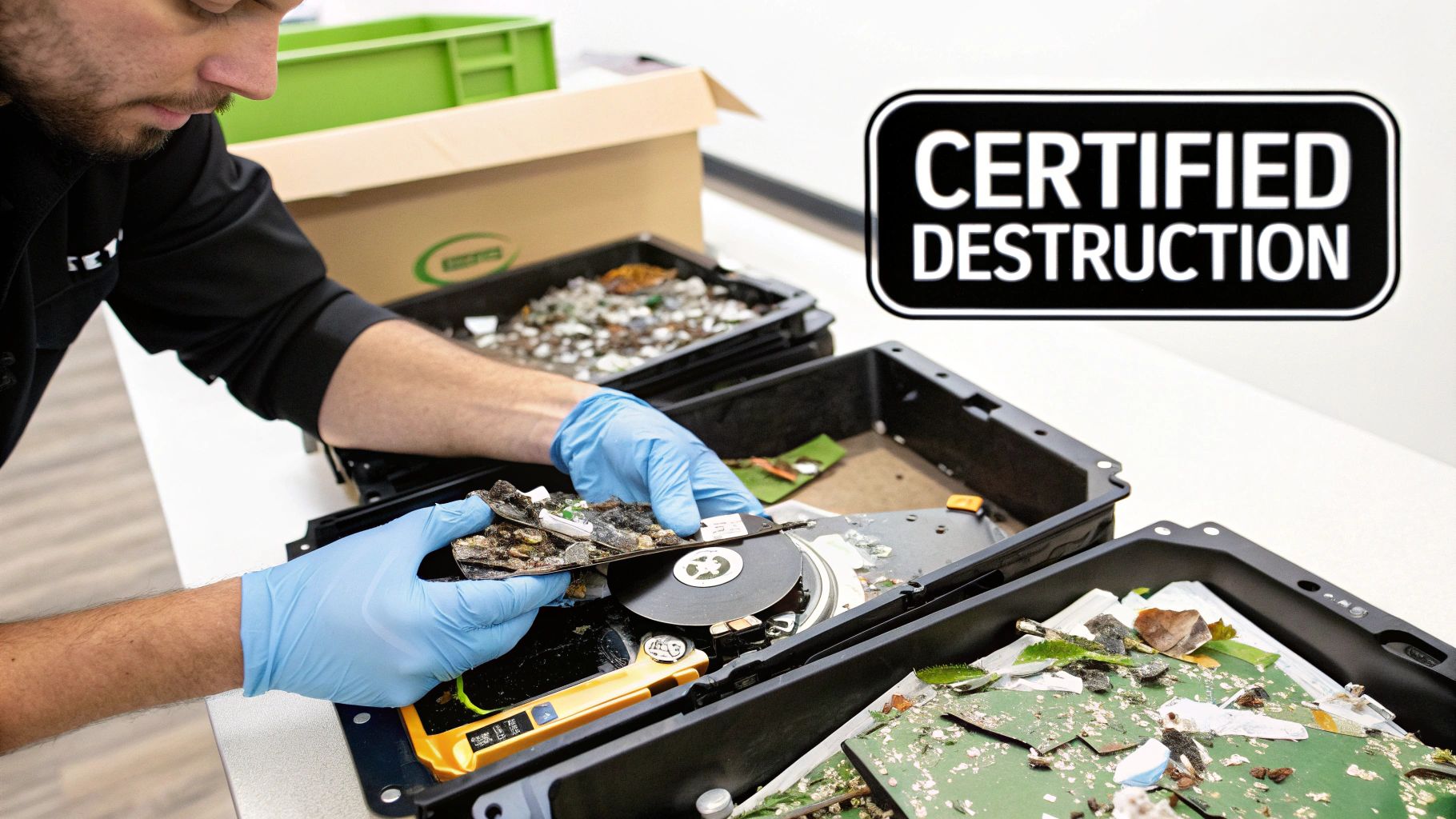
We use industrial shredders powerful enough to grind metal drives into coin-sized fragments. This physical destruction renders the storage platters completely unreadable, making data recovery impossible. Upon completion, your business receives a Certificate of Destruction, a legal document that serves as your official record of compliance and due diligence.
Step 4: Material Separation and Recovery
With all corporate data securely destroyed, the remaining components are ready for the final stage: material recovery. Large-scale machinery takes over, separating the shredded mix into clean streams of raw materials.
- Mechanical Shredding: The deconstructed electronics are fed into powerful shredders that break them down into small, uniform pieces.
- Magnetic Separation: Powerful magnets pull out all ferrous metals like steel and iron from the mix.
- Advanced Sorting: Other technologies like eddy currents and water separation are used to sort non-ferrous metals like aluminum and copper from plastics and glass.
The resulting raw materials—purified metals, plastics, and glass—are then sent to manufacturers to be used in new products. This entire journey, from pickup to final recovery, is a key part of what’s known as IT Asset Disposition—a complete strategy for managing retired technology. To dive deeper, check out our guide explaining what IT Asset Disposition is. This is how you ensure your company's old equipment is handled securely and sustainably, from start to finish.
The Hidden Data Security Risks Lurking in Old Tech
It’s a common corporate mistake: dragging files to the trash or performing a "factory reset" and assuming sensitive data is gone for good. That’s like tearing the table of contents out of a book—all the information is still there, just harder to find. In reality, data can often be recovered from hard drives, SSDs, and mobile devices long after they have been decommissioned.
This lingering data is one of the biggest vulnerabilities for any organization. Old equipment can be a treasure trove of confidential information, from employee PII and client financials to proprietary business strategies. Without a secure disposal plan, you’re leaving the door wide open for a data breach, even years after the asset has left your building.
The consequences can be devastating. Countless stories have emerged of confidential corporate data being pulled from improperly discarded equipment sold on the second-hand market. These incidents lead to massive regulatory fines, expensive lawsuits, and irreversible damage to a company’s reputation—all from a device that was supposedly "wiped."
Wiping vs. Physical Destruction
Getting data security right starts with understanding the two core methods: wiping and physical destruction. They both have their place in a secure it equipment recycling program, but they are not interchangeable.
-
Data Wiping: This is a software-based approach where specialized programs overwrite every sector of a drive with random data, sometimes multiple times. This process effectively buries the original information, making it nearly impossible to recover with standard tools. For a closer look, you can learn more about how to completely wipe out a hard drive in our guide.
-
Physical Destruction: This is the most foolproof method for guaranteeing data elimination. It involves using industrial shredders to physically obliterate the hard drive or storage device into tiny, unsalvageable fragments. There’s no software to outsmart and no data to recover—just a pile of shredded metal and plastic.
Here’s a simple way to think about it: Wiping a drive is like painting over a canvas so thoroughly that the original image is gone forever. Physically destroying it is like feeding that same canvas through a woodchipper. Both are effective, but physical destruction offers a finality that software can't match, especially for older, damaged, or non-functioning drives.
When you need absolute certainty, physical destruction is the gold standard in data security. It completely eliminates any possibility of data recovery and gives your business documented, verifiable proof that its sensitive information is gone for good.
The Power of a Certificate of Destruction
How can your organization prove its data was truly destroyed? That’s where the Certificate of Destruction comes in. This isn’t just a receipt; it’s a formal, legal document that serves as your official record of secure data sanitization.
A proper Certificate of Destruction creates a clear audit trail and should always include:
- A unique serial number for tracking
- A detailed inventory of the devices that were destroyed, including serial numbers
- The specific method of destruction used (e.g., shredding)
- The date and location where the destruction took place
- A statement of confidentiality confirming the secure handling of your assets
This single document is your ultimate proof of due diligence. In the event of an audit or legal inquiry, it proves your company took the necessary steps to comply with data privacy laws like HIPAA or GDPR. It is a non-negotiable component of any legitimate recycling partnership, turning a promise of security into documented proof and protecting your business from future liability.
Navigating E-Waste and Data Privacy Laws
For any business, the legal landscape around e-waste and data protection can feel like a minefield. Non-compliance isn't a minor slip-up—it can lead to staggering fines, legal battles, and a reputation that’s hard to rebuild. The first step toward a secure and responsible it equipment recycling strategy is understanding the regulatory framework.
This complex web of rules isn’t just for massive corporations. Laws governing hazardous waste and data privacy apply to businesses of all sizes, making compliance a universal responsibility. The key is to stop seeing these regulations as hurdles and start seeing them as a framework for protecting your company from very real risks.
Legal scrutiny is only getting more intense. The global IT equipment recycling market is on track to hit $1,257.6 million by 2025, a boom driven by a rising tide of e-waste expected to reach 82 million tonnes by 2030 and stricter regulations.
Key E-Waste and Data Security Regulations for Businesses
A handful of major regulations form the foundation of e-waste and data security compliance for U.S. businesses. While this isn't a complete legal brief, these are the heavy hitters that directly shape how your company must handle its retired IT assets. They cover everything from hazardous materials inside a monitor to proving you've securely destroyed every last byte of data.
| Regulation | Governs | Key Requirement for Businesses |
|---|---|---|
| RCRA (Resource Conservation and Recovery Act) | Disposal of solid and hazardous waste in the U.S. | Prohibits landfilling of e-waste containing hazardous materials like lead and mercury, which are common in older electronics like CRT monitors. |
| HIPAA (Health Insurance Portability and Accountability Act) | Protection of sensitive patient health information (PHI). | Mandates the secure, permanent, and documented destruction of PHI on any retired medical or office equipment. |
| GDPR (General Data Protection Regulation) | Personal data of European Union (EU) citizens. | Requires the complete erasure of personal data when no longer needed, even if your business is in the U.S. but serves EU customers. |
Adhering to these rules isn't just about avoiding penalties. It's about creating a bulletproof process that protects your business from the financial and reputational fallout of a data breach or an environmental citation.
The Role of Certifications Like R2 and e-Stewards
How do you verify a recycling partner is actually compliant with these laws? This is where industry certifications become your seal of approval. Think of them as a third-party guarantee that a vendor meets the absolute highest standards for environmental safety, worker protection, and data security.
Two certifications stand out as the gold standard in the IT asset disposal industry:
- R2 (Responsible Recycling): This certification sets a high bar for environmental protection, data security, and downstream tracking of all recycled materials. Choosing an R2-certified recycler means you're partnering with a vendor committed to a transparent and accountable process.
- e-Stewards: Developed by the environmental watchdog group Basel Action Network, the e-Stewards certification is known for its strict, no-exceptions ban on exporting hazardous e-waste to developing nations. It ensures your old equipment is handled responsibly, both domestically and globally.
Choosing a partner holding these certifications does most of the heavy lifting for your due diligence. It confirms they’ve been audited and are committed to best practices, allowing you to meet your legal obligations with confidence. Of course, a certified partner is only one piece of the puzzle. Every organization needs a solid data retention and disposal policy to guide how retired assets are handled internally. To learn more, check out our article on the importance of a Certificate of Destruction.
How to Choose the Right IT Recycling Partner

Selecting a vendor to handle your retired electronics is a high-stakes decision. This isn’t just about logistics; you're entrusting a third party with your company’s sensitive data, your legal compliance, and your brand reputation.
The right partner is your final line of defense against data breaches and environmental fines. The wrong one can expose your business to enormous risk.
To choose wisely, you need to go beyond a simple price quote and conduct thorough due diligence. A professional it equipment recycling firm will not only expect this level of scrutiny but will welcome it with clear, verifiable answers.
Before you sign any contracts, make sure you have an effective third-party risk management process in place. It's the only way to ensure your assets—and your data—are handled securely from start to finish.
Vet Their Certifications and Compliance
The fastest way to shorten your list of potential vendors is to check for industry-standard certifications. These aren't just logos for a website; they are hard-earned proof that a recycler has passed rigorous, independent audits of their data security, environmental safety, and operational standards.
Start by looking for these two gold-standard certifications:
- R2 (Responsible Recycling): This certification confirms the recycler meets the highest standards for protecting the environment, ensuring worker safety, and securing data.
- e-Stewards: Known for its incredibly strict policies, an e-Stewards certification is your guarantee that no hazardous e-waste gets illegally exported to developing countries.
A vendor with these credentials has already proven their commitment to best practices. If a potential partner lacks them, you need to ask why and what equivalent standards they follow.
Scrutinize Their Data Destruction Methods
This is a non-negotiable area. You need absolute, verifiable proof that your data will be completely and permanently destroyed. A vague promise to "wipe the drives" simply isn't sufficient.
A vendor's refusal or inability to provide a detailed, documented data destruction process is the biggest red flag you can encounter. Walk away immediately.
Get specific with your questions:
- Can you perform on-site and off-site shredding services?
- What is your process for determining which drives can be sanitized for resale versus which must be physically destroyed?
- Will we receive a serialized inventory of every hard drive that is destroyed?
- Do you issue a formal Certificate of Destruction upon completion?
That Certificate of Destruction is your legal proof of due diligence. Ensure it’s detailed, including unique serial numbers, the date of destruction, and the exact method used.
Demand a Transparent Chain of Custody
From the moment your equipment leaves your building, you need a clear, unbroken trail of accountability. A documented chain of custody is non-negotiable for proving compliance and ensuring no device—and no hard drive—gets lost along the way.
Your partner should be able to walk you through their entire process:
- Secure Logistics: Are their vehicles locked and GPS-tracked during transport?
- Asset Tagging: Is every piece of equipment inventoried and tagged on-site before it’s moved?
- Secure Facility: Is their processing facility protected by access controls, security cameras, and monitored alarms?
- Reporting: Can they provide detailed reports or even real-time tracking to show you where your assets are at every stage?
Ultimately, choosing the right partner is about minimizing risk. By focusing on certifications, data destruction, and chain of custody, you can find a vendor who doesn't just recycle your equipment but actively protects your business.
Your IT Equipment Recycling Questions Answered
Even with a solid plan, it's natural for business leaders to have questions when moving forward with professional IT equipment recycling. Let's tackle some of the most common concerns we hear from Atlanta businesses, so you can take the next step with total confidence.
What Happens to the Data on Our Old Devices?
This is, without a doubt, the number one question on every executive's mind—and for good reason. A certified recycling partner ensures your sensitive corporate information is permanently destroyed using proven data destruction methods. This usually means physically shredding hard drives, SSDs, and other storage media into tiny, unrecoverable pieces.
Upon completion, you should always receive a Certificate of Destruction. This is your legal proof that the data-bearing devices were securely and permanently eliminated, which is crucial for any compliance audit.
Is There a Cost for Professional Recycling Services?
The cost of it equipment recycling depends on the assets being processed. For older equipment with little to no resale value, there may be a service fee based on the volume and type of gear.
However, if your retired hardware includes newer assets like servers or laptops, an IT Asset Disposition (ITAD) partner can often refurbish and resell them. The revenue from those sales can often offset—or even completely cover—the recycling costs. In some cases, it can generate a positive return for your business, turning a disposal project into a value recovery initiative.
Partnering with a recycler who also handles ITAD means you get the best of both worlds: secure, compliant disposal for obsolete items and potential financial return on still-valuable assets.
What Kind of Paperwork Should We Expect?
Proper documentation is your shield against future liability. A reputable vendor will provide a complete and transparent paper trail that shows a clear chain of custody from your facility to its final disposition. When dealing with older hardware, it's important to understand what to do with outdated computers to ensure compliance.
Your documentation package should always include:
- An initial inventory of every asset collected from your facility.
- Secure transport logs and transfer of custody forms.
- The all-important Certificate of Destruction for any device that held data.
This paperwork is essential for proving your company's due diligence and compliance with data privacy and environmental regulations.
Ready to implement a secure and compliant recycling program for your business? The experts at Atlanta Computer Recycling are here to help. We provide end-to-end IT equipment recycling and asset disposition services designed for businesses across the Atlanta metro area. Contact us today to schedule your free pickup and ensure your retired assets are handled the right way. https://atlantacomputerrecycling.com