End of life IT asset management Atlanta GA: Secure & compliant asset disposition

For any IT manager or business executive in Atlanta, managing retired technology is more than just a clean-up job—it's a critical component of your operational strategy. A robust plan for end of life IT asset management in Atlanta, GA, is what stands between your organization and a potential data breach, compliance violation, or negative impact on your ESG goals.
Why Smart IT Asset Disposition Matters in Atlanta

Technology lifecycles are shrinking. What was state-of-the-art yesterday is a storage room filled with retired servers, laptops, and networking gear today. For businesses in Atlanta’s thriving tech, healthcare, and finance sectors, this constant churn of equipment must be managed securely and responsibly. The risks of inaction are too high to ignore.
The scale of this challenge is significant. The global IT asset disposition (ITAD) market is projected to hit USD 29.23 billion by 2025 and is expected to grow to an incredible USD 99.82 billion by 2035. This growth is driven by accelerated IT hardware refresh cycles, creating a wave of e-waste that demands a professional, strategic approach from every business in the metro area.
The Twin Dangers of Getting It Wrong
Improperly managed retired assets expose your organization to two major business risks. The first is data security. A single hard drive that wasn't properly sanitized can expose sensitive customer data, proprietary intellectual property, or protected health information. The consequences can be devastating, from significant financial penalties to irreparable reputational damage.
The second is regulatory compliance. Regulations like HIPAA and Sarbanes-Oxley (SOX) have stringent requirements for secure data destruction and responsible disposal. Non-compliance is not a minor oversight—it can lead to serious legal and financial repercussions.
Your end-of-life IT asset management plan is your first line of defense. It transforms a logistical challenge into a controlled, auditable process that protects your company’s data, reputation, and bottom line.
To help you build this defense, we've outlined the key priorities for Atlanta businesses planning an ITAD project.
IT Asset Disposition Priorities for Atlanta Businesses
| Priority Area | Key Action for Atlanta IT Managers | Associated Risk if Ignored |
|---|---|---|
| Data Security | Implement certified data destruction (shredding or wiping) for all storage media. | Data breaches, financial penalties, and irreversible reputation damage. |
| Regulatory Compliance | Maintain a clear chain-of-custody and get Certificates of Destruction for all disposed assets. | Fines from HIPAA, SOX, or other regulatory bodies; legal action. |
| Logistical Efficiency | Partner with a local vendor who can handle on-site pickup, packing, and transport from your facility. | Internal team burnout, operational disruptions, and hidden costs. |
| Value Recovery | Have assets professionally audited to identify equipment with resale value. | Lost revenue opportunity; higher net cost for the disposal project. |
| Sustainability | Ensure your vendor is certified for responsible e-waste recycling to avoid landfill disposal. | Environmental damage and negative impact on corporate ESG goals. |
While these priorities might seem daunting, the right professional partner makes them entirely manageable. Strategic planning is the key to success.
Beyond Risk: Finding Value and Upholding Sustainability
A well-executed ITAD strategy is not just about mitigating risk. It's also a clear opportunity to recover value and demonstrate your company’s commitment to corporate social responsibility. Many assets, especially enterprise-grade equipment less than five years old, retain significant market value.
A professional ITAD partner can help your business:
- Recover Value: Functional equipment can be tested, securely sanitized, refurbished, and resold. The resulting revenue can offset or even exceed the project's costs.
- Ensure Sustainability: For equipment with no resale value, a certified recycler will ensure all components are processed responsibly, keeping hazardous e-waste out of landfills and supporting your ESG initiatives.
- Simplify Logistics: Managing the secure pickup and processing of hundreds of devices is a massive operational lift. A dedicated partner handles the entire process, freeing your team to focus on core business objectives.
When you formalize your disposition plan, you convert a necessary operational cost into a strategic advantage. You can check out our guide on IT asset management best practices to dive deeper into building a program that works for your business.
Ultimately, a well-run strategy for end of life IT asset management in Atlanta, GA, is a non-negotiable for any modern business operating in this city.
Creating Your IT Asset Disposition Plan
Every successful IT asset refresh in Atlanta begins with a meticulously crafted plan. The foundation of that plan is a detailed inventory. Simply acknowledging a "pile of old computers" in a storage room is insufficient for a professional operation. A clear, itemized list is what enables smart, secure, and financially sound decisions for every single retired device.
This is more than a simple headcount; it’s about capturing the right data points for each piece of hardware. The objective is to build a complete manifest of what you have, where it is, and, most importantly, the data risk it represents.
Building a Practical Asset Inventory
You do not need a complex, expensive system for this initial stage. While your corporate IT asset management (ITAM) software is an excellent starting point, a well-organized spreadsheet can be equally effective for this specific task. The key is tracking the right information consistently.
For every asset slated for retirement, your inventory must capture:
- Asset Type: Is it a laptop, desktop, server, network switch, or monitor?
- Make & Model: This is critical for assessing potential resale value.
- Serial Number & Asset Tag: These are non-negotiable for establishing an auditable chain of custody.
- Physical Condition: Make an objective assessment. Is the device functional, physically damaged, or missing components?
- Data Sensitivity: Flag any machine that stored or processed sensitive data, such as PII, financial records, or Protected Health Information (ePHI).
This level of detail allows you to segment your assets into practical groups. You can immediately identify which batch of newer laptops may have resale value versus a pallet of obsolete servers destined for secure shredding.
A detailed inventory isn't just a list; it's a strategic tool. It empowers you to accurately forecast costs, identify value recovery opportunities, and ensure every single asset is handled according to its specific security and compliance requirements.
A Real-World Atlanta Scenario
Let's apply this to a practical business case. Imagine a large Atlanta-based healthcare system refreshing 500 laptops used by its clinical staff. The IT Director understood that a one-size-fits-all approach was not an option, especially with HIPAA compliance at stake.
Using a detailed inventory spreadsheet, the team categorized each laptop based on two key factors: age/condition and data exposure.
- Newer, Functional Laptops (Approx. 200 units): These devices contained ePHI, so their hard drives were designated for certified, HIPAA-compliant data wiping. Once sanitized, these functional laptops were remarketed, generating revenue that significantly offset the project's total cost.
- Older or Damaged Laptops (Approx. 300 units): For this group, which included devices with failed hard drives where wiping was not feasible or cost-effective, the assets were immediately tagged for physical shredding to guarantee complete data destruction and maintain compliance.
This strategic asset categorization enabled the hospital to maximize its ROI while ensuring the highest level of security for devices posing a data risk. It transformed a logistical burden into a well-managed and partially self-funded project.
You can learn more about the entire process by exploring professional IT asset disposal services. This strategic approach is a perfect example of effective end of life IT asset management in Atlanta, GA.
Selecting the Right Data Destruction Method for Compliance
With your inventory finalized, the next critical step is determining how to permanently and verifiably destroy the data on your retired assets. For any business in Atlanta, particularly in regulated industries like healthcare, finance, or legal services, this is not just about "deleting files"—it’s about ensuring ironclad compliance, security, and protecting your corporate reputation.
Choosing the right data destruction method is a cornerstone of any secure end of life IT asset management Atlanta GA strategy. The choice typically falls between two certified methods: software-based data wiping or physical destruction. Your decision will be driven by the asset's condition, its potential for reuse, and the sensitivity of the data it contains.
This decision tree illustrates a simple, practical framework for asset disposition based on its value and data sensitivity.

The flowchart highlights the core logic of smart ITAD: functional, valuable equipment should be securely wiped for remarketing, while devices with sensitive data or no resale value require physical destruction and recycling.
Data Wiping: Preserving Value for Reuse
For functional hard drives in equipment you intend to remarket, data wiping is the preferred method. This process utilizes specialized software to completely overwrite the drive with random patterns of ones and zeros, rendering the original data unrecoverable. The most widely recognized industry benchmark is the DoD 5220.22-M standard, which employs a secure 3-pass overwrite process.
This method is the ideal solution for:
- Functional Laptops and Desktops: Wiping preserves the hardware's integrity, allowing it to be refurbished and sold to recover value for your organization.
- Servers with Resale Value: Newer servers can be sanitized and resold on the secondary market, recouping a significant portion of your initial capital expenditure.
- Meeting Foundational Compliance: A certified wipe, supported by detailed documentation, satisfies the data sanitization requirements for most major regulations.
Think of data wiping as securely preparing a device for its next lifecycle. It eliminates all traces of your organization's data while preserving the hardware, turning a potential liability into a recoverable asset.
Physical Destruction: When There’s No Room for Risk
In some cases, wiping is not feasible or does not meet an organization's internal security policy. In these instances, physical destruction—shredding or degaussing—is the only method to guarantee data is irretrievably destroyed. Shredding reduces a hard drive to a pile of tiny, mangled metal fragments, making data recovery physically impossible.
Physical destruction is non-negotiable in several key scenarios:
- Failed or Damaged Hard Drives: If a drive cannot power on, wiping software cannot be run. Shredding is the only secure alternative.
- Maximum Security Protocols: For devices that stored proprietary R&D, trade secrets, or highly sensitive client data, many companies mandate a zero-risk policy of shredding all storage media.
- End-of-Life Solid-State Drives (SSDs): Due to the data storage architecture of SSDs, shredding is often considered a more foolproof destruction method than wiping.
For an Atlanta-based law firm retiring drives containing confidential case files, shredding is an absolute necessity to uphold client privilege and ethical obligations. Another powerful tool is degaussing, and you can learn more about what a degausser is and how it functions in our detailed guide.
A simple 'delete' or factory reset is dangerously insufficient for business use. Neither process actually removes the data; they merely remove the pointers to it. Your sensitive corporate information can often be recovered with basic software tools, leaving your business exposed.
A Special Focus on HIPAA Compliance in Atlanta
Atlanta is a major hub for the healthcare industry, home to numerous hospitals, clinics, and biotech firms. For these organizations, HIPAA compliance dictates every decision surrounding end-of-life IT assets. The law requires that Protected Health Information (ePHI) be rendered "unusable, unreadable, or indecipherable to unauthorized individuals."
This means your documentation is as critical as the destruction process itself. To withstand a HIPAA audit, you must provide a bulletproof chain of custody and a Certificate of Data Destruction that lists the unique serial number of every single hard drive that was wiped or shredded.
The demand for this level of security is clear. Data destruction services led the ITAD market in 2025 with a USD 5 billion valuation, demonstrating that businesses are prioritizing ironclad data security. This is why IT leaders at Atlanta hospitals and universities recognize there are no shortcuts—computers and laptops often contain sensitive data that requires certified destruction. While focusing on secure data destruction, it's also valuable to understand the broader landscape of regulatory adherence, including considerations for global logistics compliance, to ensure all operational aspects meet legal standards.
Coordinating Logistics for On-Site Pickups in Atlanta
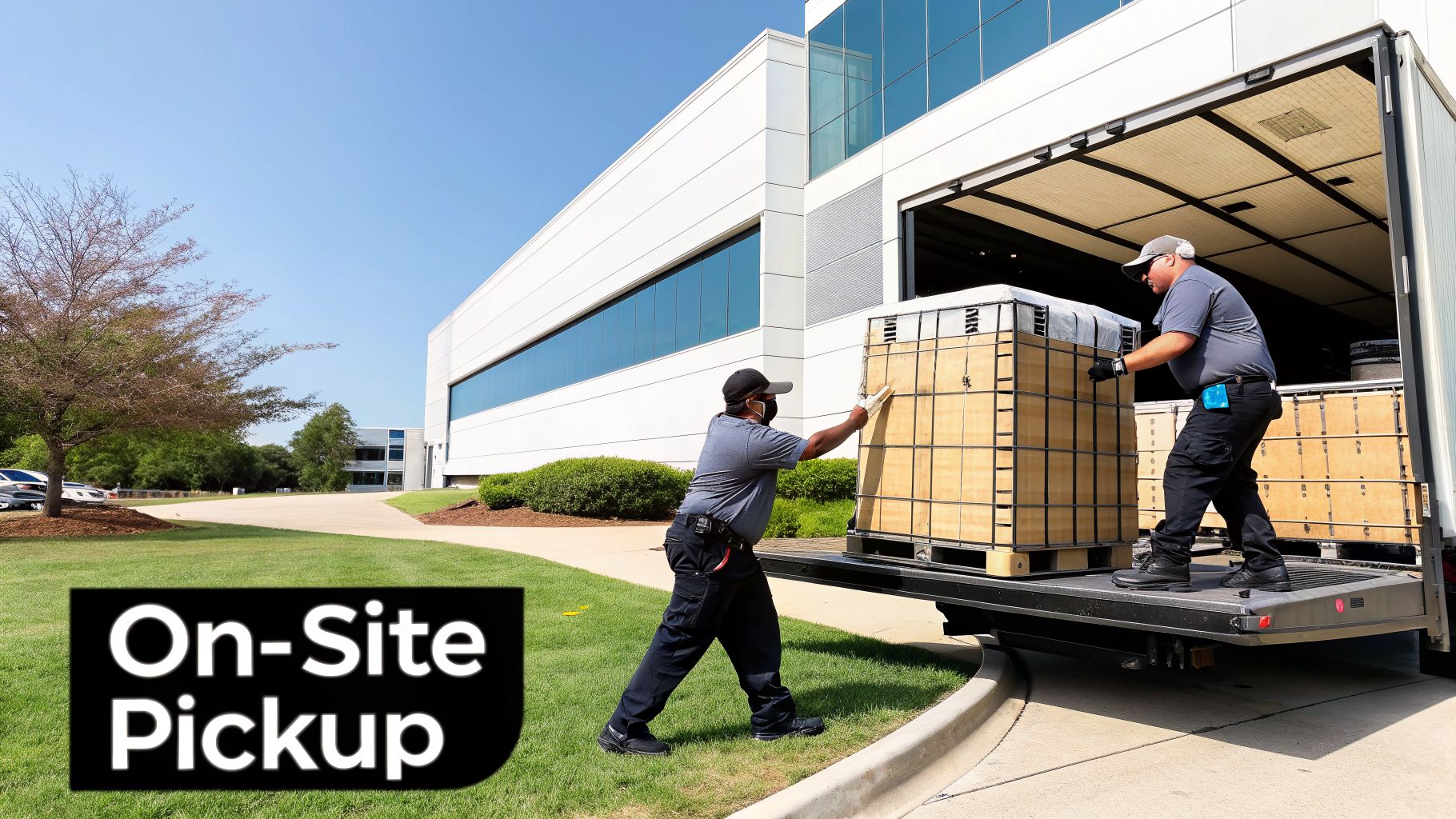
Once your inventory is finalized and data destruction methods are assigned, it’s time to manage the physical removal of equipment from your facility. This is where a robust logistics plan is indispensable. A poorly executed pickup can disrupt business operations, introduce security vulnerabilities, and create an unnecessary burden for your internal team.
A smooth on-site pickup is a critical service component of any successful end of life IT asset management in Atlanta, GA. From a high-security downtown skyscraper to a sprawling suburban corporate campus, the removal process demands precise coordination between your team and your ITAD partner.
Preparing for a Smooth Pickup
Proper preparation is the key to a fast and efficient removal. While a professional ITAD provider will supply the crew and equipment—pallets, shrink wrap, and secure transport containers—a small amount of groundwork from your team can make a significant difference.
Before the logistics team arrives, we recommend this simple pre-pickup checklist:
- Consolidate Equipment: Gather all tagged assets into a single, secure, and accessible staging area. This prevents the pickup crew from having to conduct searches across multiple offices, storage closets, or floors.
- Clear an Egress Path: Ensure there is a clear route from your staging area to the loading dock or exit. Move any obstacles and provide a heads-up to your building security or facilities management about the scheduled activity.
- Confirm Your Inventory: Conduct one final reconciliation against your asset list. Verify that every item designated for pickup is accounted for and ready for loading.
Completing these steps dramatically reduces the time the crew spends on-site and minimizes disruption to your staff and business operations.
Tailoring Logistics to Unique Atlanta Scenarios
Every commercial pickup has unique variables, and Atlanta’s business landscape presents a diverse set of logistical challenges. A qualified ITAD partner knows how to adapt their plan to your specific environment, ensuring a seamless pickup regardless of your location.
Midtown High-Rise Office Tower: Extracting equipment from a busy office tower requires precision. This often involves scheduling the pickup after business hours, coordinating freight elevator access with building management, and operating discreetly to avoid disturbing other tenants. A professional crew can de-install workstations, securely pack all assets, and be gone before your employees arrive for the next business day.
Alpharetta Data Center Decommissioning: A large-scale project, such as decommissioning hundreds of servers from a colocation facility, requires a specialized team. The process involves systematically de-racking hardware, securely packing sensitive drives on-site, and loading multiple pallets onto GPS-tracked trucks, all while working efficiently to help you meet strict facility exit deadlines.
School District Warehouse Pickup: When a school district needs to clear out thousands of old Chromebooks and desktops during a summer break, the logistics must be executed quickly and with extreme organization. An ITAD partner can supply large rolling bins to rapidly gather assets from a central warehouse, providing serialized tracking for each device to ensure complete accountability.
A well-coordinated pickup is where a true ITAD partner proves their value. They provide the labor, equipment, and secure transport, allowing your business to maintain operations with minimal interruption.
A professional team handles the heavy lifting—literally—so your IT staff can remain focused on their core responsibilities. They ensure that from the moment your assets leave your building, they are secure and fully accounted for within a documented chain of custody.
To see how the process works, you can learn more about scheduling a commercial computer pickup in the Atlanta area. Our goal is always to make this final step of your ITAD plan completely painless and secure.
Verifying Chain of Custody and Final Reporting
Once your retired IT assets are off-site, the project is not complete. The final phase—and arguably the most critical for risk mitigation—is documentation. Without a complete, auditable paper trail, your organization has no legal defense in the event of a compliance audit or a data breach investigation traced back to your disposed equipment.
This is where chain of custody is your most important asset. It is a documented, unbroken timeline that tracks every single asset from the moment it leaves your facility to its final disposition. This isn't just a receipt; it's your ironclad proof that every device was handled securely and in full compliance with regulations like HIPAA or Sarbanes-Oxley.
The Anatomy of an Auditable Report
Any credible ITAD partner will provide a comprehensive documentation package as a standard deliverable. If your vendor only provides a generic invoice or a vague "receipt of recycling," consider it a major red flag. You require detailed, serialized reporting that will withstand scrutiny from your legal team, compliance officers, and external auditors.
Here are the non-negotiable documents you must secure at the conclusion of any ITAD project:
- Serialized Inventory List: This report must reconcile with the inventory you created at the start of the project. It needs to list every asset by make, model, and—most importantly—its serial number.
- Certificate of Data Destruction: This is the cornerstone of your compliance defense. It officially certifies that the data on your storage media was destroyed according to a specific, recognized standard, whether through DoD 5220.22-M wiping or physical shredding.
- Environmental Compliance Report: This document confirms that your e-waste was recycled in an environmentally responsible and ethical manner, keeping hazardous materials out of landfills and helping you meet corporate sustainability goals.
This documentation package is your corporate insurance policy. To see exactly what this looks like, you can review a sample certificate of destruction form and know what to expect from your vendor.
Your final documentation isn't just a formality; it's the legal conclusion of your ITAD project. It transfers liability from your organization to your certified vendor and provides the auditable proof needed to close the book on those retired assets.
Real-World Scenario: Proving Compliance in Atlanta
Consider a common business scenario. An Atlanta-based financial services firm completes a major server refresh. Six months later, they are subject to a routine regulatory inquiry. Auditors request specific proof of data destruction for a handful of servers that had processed sensitive client financial data.
Because the IT manager had insisted on a robust documentation package from their ITAD partner, the response was immediate and decisive. He was able to produce two key documents instantly:
- A serialized inventory report showing the exact serial numbers of the servers in question.
- A Certificate of Data Destruction that cross-referenced those same serial numbers, confirming they were physically shredded on a specific date.
The inquiry was closed without further action. Without that serialized, auditable proof, the firm would have faced a lengthy, expensive, and potentially damaging investigation. This is precisely why detailed reporting for end of life IT asset management in Atlanta, GA isn’t just a best practice—it’s an essential business control.
Essential vs. Optional ITAD Documentation
Not all documents serve the same purpose. As an IT or operations leader, you need to distinguish between what is non-negotiable for compliance and what is valuable for internal financial reporting. This table clarifies the distinction.
| Document Type | Why It's Essential | What to Look For |
|---|---|---|
| Certificate of Destruction | This is your primary legal proof that sensitive data was irretrievably destroyed, satisfying HIPAA, SOX, and other regulations. | Asset serial numbers, destruction method (wipe/shred), date, and vendor signature. |
| Serialized Asset Report | It creates a direct link between the assets that left your facility and the assets that were processed, closing the custody loop. | A complete list of makes, models, and serial numbers that matches your inventory. |
| Environmental Certificate | This proves you met sustainability goals and environmental regulations by keeping hazardous e-waste out of landfills. | A statement confirming R2 or e-Stewards certified recycling and a zero-landfill policy. |
| Value Recovery Statement | While not a compliance document, it details any revenue from remarketed assets, proving ROI to stakeholders. | A breakdown of assets sold and the final monetary return credited to your account. |
Ultimately, your final paperwork should tell a complete and closed-loop story. It must trace every asset from your facility to its final disposition—be it resale, recycling, or shredding. This verified record is what allows you, your CISO, and your executive team to have confidence that the project was executed correctly.
Common Questions About ITAD Services in Atlanta
If you’re an IT manager or business owner in Atlanta, you likely have questions about retiring old technology. The process can appear complex, but partnering with a local expert makes it more straightforward—and more affordable—than you might expect.
Let’s address some of the most common questions we receive from businesses across the metro area.
What Does Professional IT Asset Disposition Cost for an Atlanta Business?
This is the first question on every executive's mind, and the answer is often surprising. While project costs depend on the volume and type of equipment, your location, and specific service requirements like on-site hard drive shredding, the most significant factor is value recovery.
Many professional ITAD providers in Atlanta can offset or even eliminate project costs by remarketing your functional equipment. Newer assets like laptops, servers, and networking gear are securely refurbished and sold, with the revenue credited directly back to your project.
In many cases, for qualifying bulk pickups of reusable equipment, core services like transportation and DoD-standard data wiping can be provided at no charge. This makes professional ITAD an incredibly cost-effective solution, especially when weighed against the catastrophic financial risk of a data breach.
How Do We Dispose of Old Computers and Remain HIPAA Compliant?
For Atlanta’s large healthcare sector, from small clinics to major hospital systems, this is a non-negotiable requirement. Achieving HIPAA compliance isn’t just about wiping a drive; it's about implementing a documented, auditable, and defensible process.
To ensure compliance, your ITAD partner must provide:
- Secure Chain of Custody: A documented trail that tracks every single asset from the moment it leaves your facility.
- Serialized Tracking: Each hard drive and data-bearing device is logged by its unique serial number.
- Certified Data Destruction: You need proof that all Protected Health Information (ePHI) was destroyed using an approved method, like DoD 5220.22-M wiping or physical shredding.
- A Certificate of Data Destruction: This is your legal proof of compliance—an auditable document listing every serialized asset and confirming its sanitization.
Without this level of documented control, your organization remains exposed to significant compliance risk.
Can You Handle a Large-Scale Data Center Decommissioning?
Absolutely. A full-service ITAD partner is specifically equipped for complex, large-scale projects like a data center decommissioning. This is not a simple pickup; it's a fully managed project designed to clear your facility securely and on schedule.
A typical data center decommissioning service includes:
- On-site project management to coordinate all logistics.
- Systematic de-installation and de-racking of servers, switches, and storage arrays.
- Professional packing and palletizing of all hardware.
- Secure, GPS-tracked transport to a certified processing facility.
- Comprehensive, serialized asset reporting from start to finish.
This is a core service within the end of life IT asset management Atlanta GA offering. It's designed to help you meet tight facility exit deadlines, minimize the burden on your internal resources, and transform a logistical challenge into a smooth, managed process.
The core difference between recycling and remarketing lies in their end goals. Recycling prioritizes environmental sustainability by breaking assets down into raw materials, while remarketing focuses on financial return by giving functional equipment a second life. A smart ITAD strategy uses both.
What Is the Difference Between Recycling and Remarketing?
Understanding this distinction is key to maximizing the value of your retired IT assets.
Recycling is the process for non-functional or truly obsolete electronics. It's an environmental service that de-manufactures equipment into commodities like metal, plastic, and glass, ensuring hazardous e-waste is kept out of landfills.
Remarketing, on the other hand, is about financial return. Also known as IT asset value recovery, this is the process of testing, sanitizing, refurbishing, and reselling equipment that still has a useful operational life. It is the mechanism for generating ROI from your retired technology.
An effective strategy for end of life IT asset management in Atlanta, GA, expertly balances both. You remarket what you can to recover value and responsibly recycle the remainder to meet your corporate sustainability goals.
Ready to simplify your IT asset disposition? The team at Atlanta Computer Recycling is here to help. We provide secure, compliant, and cost-effective ITAD solutions for businesses across the Atlanta metro area. Contact us today for a free consultation.