A Guide to Electronic Recycling in Atlanta for Your Business


For any business in Atlanta, managing retired IT assets isn't just about clearing out a storage closet—it's a critical component of data security, regulatory compliance, and corporate responsibility. A strategic approach to electronic recycling in Atlanta protects sensitive corporate and client information, ensures compliance with regulations like HIPAA or PCI, and demonstrates a commitment to environmental stewardship. This guide outlines how your business can implement a secure and efficient IT asset disposition strategy.
Navigating IT Asset Disposition in Atlanta
Properly managing end-of-life electronics is a significant operational challenge. When servers, laptops, and networking gear reach retirement, they cannot be simply discarded or left to accumulate. This is where a formal process known as IT Asset Disposition (ITAD) is essential. ITAD is a comprehensive lifecycle management plan, not merely recycling.
The core objective is to move beyond simple equipment disposal and actively manage business risk. A single retired hard drive containing customer or proprietary data can lead to a catastrophic breach if it falls into the wrong hands. A robust ITAD process establishes a secure, unbroken chain of custody to mitigate this risk entirely.
Why a Formal ITAD Strategy Matters for Your Company
Implementing a well-defined ITAD plan addresses several critical business concerns. The global e-waste problem continues to grow; in 2022 alone, 62 million tonnes of e-waste were generated worldwide—an 82% increase from 2010, with only 22.3% properly recycled. This issue directly impacts Atlanta, where local businesses are a primary source of this waste stream.
A formal strategy provides your organization with key competitive advantages:
- Ensuring Data Security: It guarantees that all data is permanently destroyed before any asset is recycled or remarketed, protecting your business from breaches.
- Maintaining Compliance: You receive essential documentation, such as Certificates of Destruction, to satisfy auditors and regulatory bodies.
- Supporting Sustainability Goals: It visibly demonstrates your commitment to corporate social responsibility by preventing hazardous e-waste from entering landfills.
- Maximizing Value Recovery: We identify equipment with residual value that can be refurbished and resold, recovering capital for your bottom line.
A proactive ITAD strategy is a core component of corporate risk management. It transforms a potential liability—old, data-bearing electronics—into a securely managed process that protects your reputation and bottom line.
Understanding the fundamentals is the first step. To delve deeper, you can learn more about what IT Asset Disposition involves and how it can directly benefit your organization.
Preparing Your IT Assets for Secure Recycling
A seamless and secure electronics recycling project begins long before our truck arrives at your facility. The internal preparation your team conducts is crucial for a transparent and efficient process. Properly preparing your assets prevents logistical delays and, more importantly, closes potential data security vulnerabilities before they become a threat.
The first critical action is to build a detailed inventory of every asset slated for retirement. You cannot protect what you do not track. This inventory serves as the master record for accountability throughout the entire disposition process.
Building a Bulletproof Asset Inventory
A vague list like "50 laptops and 10 servers" is insufficient for professional ITAD. For truly secure electronic recycling in Atlanta, detailed documentation is required. The objective is to create an auditable record that can be reconciled at every stage of the process, from your server room to our certified facility.
For each device, your inventory should capture:
- Asset Tag Number: Your company's unique internal identifier.
- Serial Number: The manufacturer's unique identifier.
- Device Type: Be specific (e.g., "Dell Latitude 7420 Laptop," "HP ProLiant DL380 Server").
- Physical Location: The last known location (e.g., "Office 314," "Data Center Rack 7").
This detailed log is your first line of defense. When our team arrives, we can cross-reference our count against your master list, providing immediate confirmation that every asset is accounted for before it leaves your premises.
A meticulously documented inventory is the cornerstone of a defensible ITAD process. It provides an indisputable record that demonstrates due diligence and establishes a clear, verifiable chain of custody from the outset.
Essential Internal Security Protocols
With a complete inventory, the next step is to secure the assets internally. This involves methodically severing all connections between these devices and your live network environment. Overlooking this stage can leave significant security vulnerabilities, even on powered-down devices.
First, physically disconnect every device from your network. Unplug all ethernet cables and disable any Wi-Fi connections. This is a fundamental step to prevent any possibility of unauthorized remote access.
Next, revoke all associated credentials. Collaborate with your IT security team to eliminate user access, service accounts, and administrative privileges tied to the retired hardware. A decommissioned server can still pose a threat if its accounts are not properly terminated.
Finally, while we perform certified data destruction, a preliminary data wipe on your end adds a valuable layer of security. Implementing these internal protocols ensures a clean, secure handoff and establishes the foundation for a compliant, risk-free recycling project.
Choosing the Right E-Recycling Partner in Atlanta
Not all Atlanta businesses share the same IT disposal requirements. A tech startup retiring a single server rack faces different security and logistical challenges than a healthcare system upgrading thousands of clinical workstations. The key is to find the right balance of security, convenience, and efficiency for your specific operational needs.
The optimal choice depends on your company's scale, data sensitivity, and internal resources. By understanding the available service models, you can select an electronic recycling atlanta partner that aligns perfectly with your business workflow and security mandates.
Scheduled Pickup Services for Bulk Asset Removal
For many businesses, a scheduled pickup service is the most efficient solution. This is ideal for organizations that have already inventoried, disconnected, and consolidated their retired IT assets in a secure, designated area. It is a highly effective option for routine office cleanouts, technology refreshes, or end-of-lease returns.
Consider a financial services firm in Buckhead retiring 50 employee laptops and monitors. Their IT team can stage the equipment in a secure storage room. A scheduled pickup provides a simple, cost-effective method to have the assets securely removed with minimal disruption to daily operations.
This model is designed for convenience and is most effective when:
- Your business has a manageable volume of equipment.
- Your internal team can handle the preparatory work.
- The assets do not require complex de-installation from live environments.
On-Site Services for Maximum Security and Convenience
When data security is the paramount concern, on-site services bring the destruction process directly to your facility. This is indispensable for organizations in healthcare, finance, or government operating under strict regulations like HIPAA or GLBA. On-site hard drive shredding, for example, allows your team to witness the physical destruction of data-bearing devices before they leave your premises.
Another critical on-site service is professional de-installation. Imagine an enterprise data center decommissioning a row of servers. A certified partner can come on-site to professionally de-rack the units, securely manage all hard drives, and package everything for transport. This offloads the burden from your internal IT staff and ensures the work is performed safely and efficiently.
Bringing the recycling process to you delivers an unmatched level of transparency and control. For equipment that’s deeply integrated into your infrastructure or holds highly sensitive information, on-site services are the gold standard for eliminating risk.
Full-Scale Data Center Decommissioning
The most comprehensive offering is full-scale data center decommissioning. This is a project-based solution for companies undergoing significant infrastructure transformations, such as migrating to the cloud, consolidating facilities, or closing a location. It is a white-glove service that manages every logistical detail from start to finish.
This goes far beyond a simple pickup. A decommissioning project involves a coordinated effort to de-rack servers, disconnect networking equipment, remove cabling, and palletize hundreds or thousands of assets for secure transport. The objective is a rapid, orderly shutdown that minimizes downtime and provides a complete, documented chain of custody for every single component.
Selecting a partner for such a project is a major vendor management decision. It is crucial to apply sound Vendor Management Best Practices to ensure you are collaborating with a reliable, certified, and insured team.
This commitment to responsible recycling is vital for Atlanta's business community. By partnering with a certified specialist, your company not only protects itself but also contributes positively to local environmental goals. To learn more about how a dedicated partner can assist your business, explore the services offered by a specialized electronic waste recycling company based here in Atlanta.
Atlanta E-Recycling Service Models Compared
Choosing the right service can seem complex, but breaking it down by your business needs simplifies the decision. This table compares the primary options to help you identify the best fit for your situation.
| Service Model | Best For | Key Advantage | Consideration |
|---|---|---|---|
| Scheduled Pickup | Routine office cleanouts, smaller batches of equipment, tech refreshes. | Cost-effective and convenient for pre-staged assets. | Requires your team to handle all prep work (disconnecting, gathering). |
| On-Site Services | High-security needs, HIPAA/PCI compliance, integrated equipment. | Maximum security and transparency; witness data destruction on-site. | Higher cost due to specialized on-location labor and equipment. |
| Data Center Decommissioning | Full facility shutdowns, cloud migrations, large-scale infrastructure projects. | Complete project management from start to finish; white-glove service. | A significant undertaking requiring detailed planning and coordination. |
Ultimately, whether you require a simple pickup or a fully managed decommissioning, the goal remains the same: secure, compliant, and responsible disposition of your retired IT assets.
Ensuring Compliant Data Destruction and Chain of Custody
Once your retired IT assets are inventoried and staged, the most critical phase begins: ensuring all data is verifiably and permanently destroyed. For any business handling sensitive corporate, customer, or patient information, this is a legal and ethical mandate. Simply deleting files is insufficient; data is often easily recoverable from discarded drives, exposing your organization to significant liability.
True data security in electronic recycling atlanta is built on two pillars: selecting the appropriate destruction method and maintaining a meticulously documented chain of custody. This combination guarantees that from the moment a device leaves your control to its final processing, all data is accounted for and completely eradicated, protecting your organization from the consequences of a data breach.
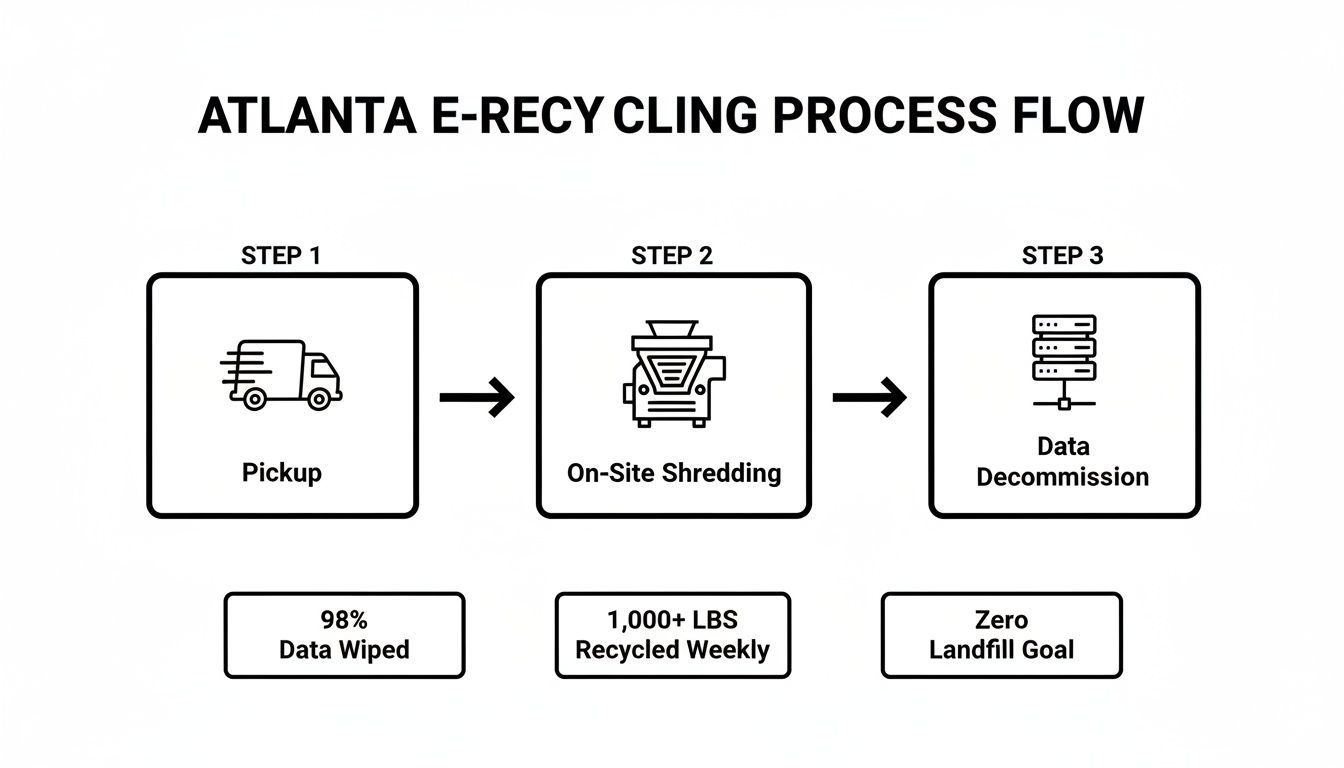
This flowchart illustrates our secure e-recycling workflow. It demonstrates how every service—from scheduled pickups to full data center decommissioning—adheres to a secure, documented process. We maintain a consistent standard of care, regardless of the project's scale.
Data Wiping vs. Physical Destruction: What's the Difference?
Not all data destruction methods are suitable for every situation. Choosing the right one depends on the media type and your company's internal security policies. Understanding the two primary approaches is key to making an informed decision.
First is data wiping, or sanitization. This software-based method overwrites the entire hard drive with random data, typically in multiple passes. The industry benchmark is the DoD 5220.22-M 3-pass protocol, which effectively renders data irrecoverable. Wiping is an excellent choice for newer, functional hard drives that may be refurbished and resold, allowing you to recover value from retired assets.
The second, more definitive option is physical destruction. This is the only acceptable method for non-functional hard drives, solid-state drives (SSDs), or when your corporate policy demands absolute certainty of destruction.
Physical destruction methods include:
- Shredding: We utilize industrial shredders that grind drives into small metal fragments, completely destroying the storage platters.
- Degaussing: This process employs a powerful magnetic field to permanently erase the magnetic data from traditional hard drives and tapes.
For most businesses, a hybrid strategy is the most practical approach. We can securely wipe functional drives for potential resale and shred older or damaged media to ensure complete data elimination.
The Non-Negotiable Certificate of Data Destruction
Regardless of the method used, the process is incomplete without proper documentation. A Certificate of Data Destruction is the formal, legally defensible document we issue to confirm that all your data-bearing devices were sanitized or destroyed in accordance with federal standards like NIST 800-88.
This certificate is your official record of due diligence. In the event of an audit or legal inquiry, this document serves as undeniable proof that you took the necessary steps to protect sensitive information. It effectively transfers the liability for data destruction to us, your certified recycling partner.
This document is essential for any organization subject to data privacy regulations such as HIPAA, SOX, or GLBA. It provides the detailed evidence required to satisfy compliance officers and auditors. You can learn more about the Certificate of Destruction and why it is a cornerstone of any secure ITAD program.
Maintaining an Unbroken Chain of Custody
The chain of custody is the chronological paper trail that documents every touchpoint for an asset, from your facility to its final disposition. This meticulous tracking ensures that no device is lost, stolen, or mishandled. A certified e-recycling partner establishes this chain the moment we scan your assets at pickup.
Each device's serial number is logged, and its journey is tracked through secure transport, arrival at our facility, and final data destruction. This creates a closed-loop system of accountability that is critical for regulated industries. A financial institution, for instance, can use this documentation to prove to regulators that every server drive was handled according to established protocols.
It is crucial to understand that general municipal recycling streams are not designed for secure business e-waste. By choosing a specialized partner, you ensure your assets are managed within a secure, documented workflow from start to finish. Prioritizing both verified data destruction and a rigorous chain of custody helps you build a defensible and compliant recycling program that protects your business interests. This aligns with the broader principles of data security and privacy in device handling across the entire IT lifecycle.
Understanding Pricing, Logistics, and Reporting
Transitioning from a collection of retired IT equipment to a fully documented, compliant disposal is a multi-step process. To budget effectively and set clear expectations, it is essential to understand the practical details of how pricing, scheduling, and final reporting are structured for an electronic recycling atlanta project.
The final cost is a balance between the services provided and the potential value recovered from your retired assets. Understanding this dynamic is key to a successful partnership.
Decoding the Pricing Models
The cost for an electronics recycling project is typically not a flat fee. It is determined by the volume and type of equipment, the level of data destruction required, and any potential resale value. The final price is a combination of service fees minus any value recovery credits.
Our service fees cover the direct costs of executing the project properly:
- Logistics and Transportation: The cost to deploy our secure trucks and professional crew to your Atlanta-area facility and back.
- On-Site Labor: If you require our team for on-site services like de-installing servers or shredding hard drives, this covers their specialized labor.
- Data Destruction Services: While DoD-standard wiping is often complimentary, physical shredding may have an associated fee, particularly for large quantities.
- Specialized Recycling Fees: Certain items, such as CRT monitors or UPS batteries, contain hazardous materials and incur special processing fees to ensure safe handling.
However, service fees are only one part of the financial picture. The other side is asset remarketing, which can significantly reduce your net costs.
How Asset Remarketing Can Offset Your Costs
Many retired IT assets, especially enterprise-grade servers, networking equipment, and newer laptops, retain significant market value. A key part of our service is identifying this equipment, securely sanitizing it, and preparing it for the secondary market.
The revenue generated from reselling these assets is shared back with you as a credit, which is applied directly against your service fees. For large-scale projects like a data center decommissioning, this recovered value can often dramatically reduce or even completely eliminate your final cost.
For example, a company retiring 100 late-model laptops could generate enough resale value to cover the entire cost of data wiping and logistics. What begins as a disposal expense can become a zero-cost project, or in some cases, result in a payment back to your company. Our goal is to maximize this return for you while ensuring every device is processed with uncompromising security.
The Logistics of Scheduling and Pickup
Coordinating the physical removal of your assets should be a seamless experience for your team. Once your inventory is prepared, scheduling is straightforward. We will work with you to find a time that minimizes disruption to your business operations.
Whether it's a simple pickup from a loading dock or a multi-day project to clear an entire data center, our logistics team manages all the heavy lifting. We arrive equipped with pallets, security cages, and packing materials to load your equipment safely and securely for transport to our facility. We prioritize clear communication, so you will know exactly when to expect us and what our team needs to complete the job efficiently.
The Value of Post-Recycling Documentation
The project is not complete when our truck leaves. The final, and arguably most critical, step is the delivery of your final reporting. This documentation provides the verifiable proof necessary for internal audits, compliance reviews, and corporate social responsibility (CSR) initiatives.
You will receive a complete documentation package, including:
- A Certificate of Data Destruction: The official document legally confirming that every data-bearing device was securely sanitized or physically destroyed.
- A Serialized Asset Report: A detailed list that reconciles the serial numbers of collected assets against your original inventory, providing a closed-loop chain of custody.
- An Environmental Impact Statement: This report quantifies the positive environmental impact of your project, detailing the total weight of materials diverted from landfills and the natural resources conserved.
This final suite of documents provides a complete, defensible record of the entire project, demonstrating your company's commitment to both data security and environmental stewardship.
Common Questions About Atlanta Business E-Recycling
Even with a comprehensive plan, questions often arise when undertaking IT asset disposition. For businesses focused on electronic recycling in Atlanta, clear and direct answers are essential for moving forward with confidence. We regularly interact with IT managers, compliance officers, and business owners, and several key questions consistently emerge.
Our objective is to provide the clarity your business needs to manage its digital footprint responsibly from end-to-end.
What Specific Types of Electronics Do You Accept?
Businesses need a single, reliable partner for all their retired equipment, and our services are designed to be that solution. We handle a comprehensive range of business-grade IT assets and are equipped to manage the full spectrum of technology found in a corporate environment.
We specialize in recycling and remarketing assets such as:
- Computers and Laptops of all brands and models.
- Servers, including rack-mount and blade servers.
- Networking Gear such as switches, routers, firewalls, and modems.
- Data Center Equipment, including server racks, SANs, and UPS systems.
- Monitors (LCD, LED), keyboards, mice, and other peripherals.
- Printers and Scanners, from desktop units to large multifunction devices.
- Smartphones and Tablets used in a corporate environment.
Our focus on these items allows us to provide highly secure and efficient processing, particularly for electronics that contain your company's most sensitive data.
It is important to note that our services are designed specifically for commercial clients. For individuals seeking to dispose of personal devices, residential drop-off points are the appropriate channel. Information on where to recycle electronics for residents can be found through local municipal programs.
Why Are Certifications like R2 and e-Stewards Important?
Certifications such as R2 (Responsible Recycling) and e-Stewards are indicators of a reputable and compliant vendor. These are not merely marketing badges; they represent a commitment to the highest industry standards for environmental protection, data security, and worker safety. They serve as your assurance against irresponsible e-waste handling.
An uncertified recycler may engage in practices like exporting hazardous materials overseas or using local landfills, creating significant environmental damage and exposing your company to legal and reputational risk. Choosing a certified partner guarantees a transparent and accountable process.
Here’s what these certifications mean for your business:
- R2 (Responsible Recycling): Now updated to R2v3, this standard provides a strict framework for managing used electronics throughout the entire recycling chain. It mandates stringent data security protocols, environmental controls, and a fully documented chain of custody.
- e-Stewards: Often considered the most rigorous standard, it includes a complete ban on exporting hazardous e-waste to developing nations and the use of prison labor, holding recyclers to the highest level of environmental and social responsibility.
Partnering with a certified vendor for your Atlanta e-recycling is a critical component of your corporate due diligence.
Is My Business Too Small for Your Services?
Not at all. We serve Atlanta-area organizations of all sizes, from small businesses retiring a few computers to large corporations decommissioning entire data centers. While we do not handle single-item residential drop-offs, we offer solutions tailored for small and medium-sized businesses (SMBs).
A common misconception among SMBs is that their volume is too low to warrant a professional ITAD service. This is a dangerous assumption. Data security is equally critical for a five-person company as it is for a Fortune 500 enterprise. A single data breach can be devastating to a business of any size.
We provide flexible pickup options and can often consolidate smaller projects in the same geographic area to make logistics cost-effective for all clients. The best first step is to contact us to discuss your inventory. We can quickly determine the most efficient and affordable solution for your specific needs, ensuring you receive the same high level of security and service as our largest corporate clients.
Ready to implement a secure, compliant, and responsible e-recycling program for your Atlanta business? Atlanta Computer Recycling provides end-to-end ITAD solutions tailored to your organization's needs. From on-site data destruction to full data center decommissioning, our team ensures your assets are handled with the highest level of security and environmental care.
Contact us today to schedule your free consultation and see how we can help.