A Guide to Data Center Equipment Recycling Atlanta GA

When it's time to retire a data center, the process is far more involved than simply unplugging old equipment. For any company in Georgia, having a solid plan for data center equipment recycling in Atlanta, GA is a strategic business necessity. This isn't just about clearing space; it's about protecting sensitive corporate data, ensuring regulatory compliance, and maximizing ROI on retired assets. A professional IT Asset Disposition (ITAD) partner can turn a complex logistical challenge into a secure, streamlined, and profitable process.
Your Playbook for Atlanta Data Center Decommissioning
Once a data center reaches its end-of-life, IT executives and facility managers face a critical decision. This isn't just about disposing of old servers—it's about protecting your company's most sensitive information, adhering to strict environmental laws, and safeguarding your brand's reputation. This guide is your playbook for executing the entire decommissioning project professionally.
The stakes are especially high for businesses in Atlanta’s thriving tech, finance, and healthcare sectors. A single server with patient records disposed of improperly could trigger millions in HIPAA violation fines. Similarly, tossing old networking gear into a dumpster can lead to severe environmental penalties and a public relations nightmare. That’s why the legacy "just get rid of it" mentality poses a significant business risk.
Shifting from Disposal to Strategic ITAD
This is where a modern, business-first approach comes in: IT Asset Disposition (ITAD). It’s a structured process that treats retired equipment as assets with residual value and inherent risks that must be managed, not as scrap. A proper ITAD program provides a clear framework for:
- Secure Data Destruction: Ensuring every bit of data on hard drives and SSDs is completely and permanently destroyed, meeting compliance standards like HIPAA or SOX.
- Maximizing Asset Value: Identifying servers, switches, and storage gear that can be refurbished and sold, which often generates revenue that can offset or even exceed project costs.
- Environmental Compliance: Adhering to standards like R2v3 and e-Stewards, which guarantee that hazardous e-waste from your project won't end up in a landfill, protecting your company's ESG commitments.
The difference between a risky DIY approach and a secure, professional process is stark.
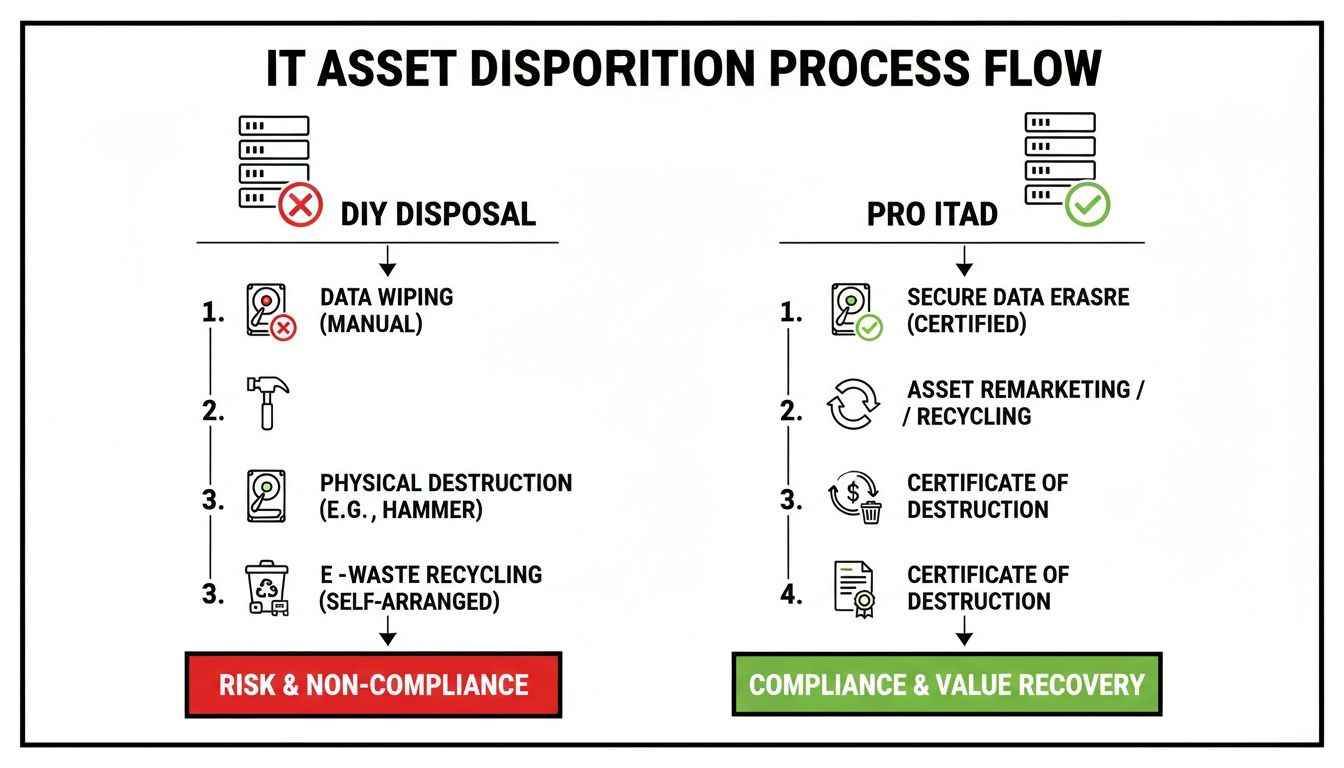
Cutting corners on disposal exposes a business to serious financial, legal, and reputational harm. The following table breaks down exactly what's at stake.
Professional ITAD vs Improper Disposal A Risk Comparison
| Factor | Risk of Improper Disposal | Benefit of Professional ITAD |
|---|---|---|
| Data Security | High risk of data breaches, theft of sensitive information, and brand damage. | Certified data destruction with serialized reporting, guaranteeing data is unrecoverable. |
| Legal Compliance | Potential for massive fines from HIPAA, SOX, PCI-DSS, or GDPR violations. | Full compliance with all data privacy laws, backed by Certificates of Destruction. |
| Environmental | Fines for illegal dumping; negative ESG impact from e-waste in landfills. | R2v3/e-Stewards certified recycling ensures responsible, sustainable processing. |
| Financial Return | Zero value recovery. Equipment is treated as a cost liability. | Asset remarketing identifies valuable gear, generating revenue to offset project costs. |
| Logistics | Internal resources wasted on a non-core, complex, and high-risk project. | A single point of contact manages all logistics, from on-site de-installation to transport. |
As you can see, professional ITAD isn't a cost center—it's a risk management strategy that protects your entire business.
The Real-World Business Case for Certified Recycling
Let’s look at a common scenario we see with Atlanta-based financial services firms. One of our clients recently upgraded their main data center, leaving them with three dozen blade servers and two large storage area networks (SANs) to decommission.
By working with us, they didn't just clear out the old hardware.
A detailed audit showed the SANs were recent models with strong demand on the secondary market. The revenue we generated from reselling those units completely covered the cost of securely shredding all the server hard drives and recycling the remaining obsolete equipment.
That's the power of a professional decommissioning strategy. It transforms a logistical nightmare into a secure, compliant, and financially smart business move. To see how these steps fit together in a full project, you can learn more about our comprehensive data center decommissioning process. It’s this kind of detailed planning and execution that protects your business and its bottom line.
Uncovering Hidden Value: Your Asset Inventory is the Key
Before you can recover a single dollar from retired equipment, you need to know exactly what you have. This isn't just about creating a list of "old servers." A detailed asset inventory is the absolute foundation of a successful data center decommissioning, and it's where the process of maximizing value truly begins.
Think of it as the project's command center. A proper inventory is what allows a partner like us to provide an accurate, transparent quote. It helps us identify equipment with high resale value and plan the logistics for a secure, efficient pickup. For many Atlanta businesses, getting this right can mean the difference between paying for a service and having the project pay for itself.
What to Track for Maximum Return
To build an inventory that generates ROI, you must capture the details a reseller or recycler requires. Go beyond just counting boxes and create a spec sheet for every piece of hardware being retired.
Your inventory, whether a spreadsheet or a database, should have columns for:
- Asset Type: Is it a server, switch, SAN, PDU, or something else?
- Make and Model: Be specific. "Dell PowerEdge R740" or "Cisco Catalyst 9300."
- Serial Number: This is non-negotiable for a secure chain-of-custody and audit trail.
- Physical Condition: Make a quick note of any visible damage, missing parts, or heavy wear.
- Key Specifications: This is where the value lies. For servers, you need the CPU type, RAM amount, and hard drive configuration (e.g., "2x Intel Xeon Gold 6248R, 256GB RAM, 8x 1.2TB SAS HDDs").
- Location: Note the specific rack and U-position. This streamlines the on-site de-installation process.
This level of detail is a must-have for any organization planning data center equipment recycling in Atlanta GA. It directly impacts the financial return you can get from your old assets.
How a Detailed Inventory Turns into Real ROI
Let's look at a real-world example. We worked with an Atlanta-based financial services firm that was upgrading its infrastructure and decommissioning two full rows of racks. Their initial list was vague—just "48 servers and 2 SANs." A list like that typically leads to a quote focused on recycling costs, with minimal value recovery.
We guided them through creating a proper inventory. That deep dive revealed that while most servers were indeed old, the two Storage Area Networks (SANs) were fairly recent NetApp models packed with high-capacity drives.
Because the firm took the time to capture the exact model numbers and drive configurations, we immediately recognized their value on the secondary market. The revenue we generated from reselling just those two SANs covered the entire project cost. That included certified data destruction for all 48 servers and the responsible recycling of everything else.
That’s a perfect illustration of how spending an hour on details can translate into thousands of dollars. Without that inventory work, those valuable SANs would have been treated like scrap, and they would have left a lot of money on the table.
To make this process even smoother, many businesses rely on specialized tools. You can learn more about how IT asset tracking software works to automate a lot of this discovery and documentation.
Why Your Inventory Drives the Entire Project
A solid asset inventory does more than just uncover financial value. It’s the blueprint for the entire decommissioning project.
Your ITAD partner will use this information to:
- Build an Accurate Quote: With detailed specs, we can give you a transparent proposal breaking down the revenue from remarketing against the costs for recycling and data destruction.
- Plan for Data Security: Knowing the exact number and type of hard drives (HDDs and SSDs) allows us to plan for secure on-site or off-site data destruction, ensuring all your compliance needs are met.
- Speed Up On-Site Logistics: An inventory with rack locations helps our de-installation crew work quickly and efficiently, minimizing any disruption to your live environment.
Ultimately, a well-prepared inventory is your single best tool for ensuring your data center recycling project is smooth, secure, and financially smart.
Ensuring Compliant Data Destruction
Once you’ve got a handle on your inventory, the real make-or-break phase begins: destroying the data. For any Atlanta business, especially those in healthcare, finance, or government, this isn't just about cleaning house. It’s a mission-critical security task.
A single hard drive that slips through the cracks can lead to a devastating data breach, costing you fines, customer trust, and your reputation. Just hitting "delete" or reformatting drives is nowhere near enough. You need a bulletproof, auditable process that proves every byte of sensitive data is gone for good.
Software Wiping vs. Physical Shredding
When it comes to data sanitization, there are two primary methods: software wiping or physical destruction. The right choice hinges on your security requirements, the age of your hardware, and whether you want to recover value from the equipment.
Software-Based Wiping: This method uses specialized programs to overwrite every sector of a drive with random data, making the original information unrecoverable. The gold standard is the NIST 800-88 guideline, which offers different levels of sanitization. A 3-pass DoD 5220.22-M wipe is a common and highly effective technique that meets the "Purge" level of this standard. Wiping is the preferred method when you plan to resell or reuse hard drives, as it preserves the hardware's value.
Physical Destruction: For older drives, failed media, or devices that held extremely sensitive information, nothing beats physical destruction. We feed hard drives, SSDs, and other media into an industrial-grade shredder that grinds them into tiny, useless fragments. It’s the ultimate guarantee of data elimination. Given the sophistication of modern professional data recovery services, shredding offers complete peace of mind.
For many Atlanta healthcare providers needing to satisfy HIPAA's final disposition rules, physical shredding isn't just an option—it's a requirement. The same goes for financial firms where absolute data security is non-negotiable.
Choosing the right method is key to balancing security, compliance, and cost. Below is a quick comparison to help guide your decision.
Data Destruction Methods Compared
| Method | Security Level | Best For | Asset Value Impact | Compliance Suitability |
|---|---|---|---|---|
| Software Wipe | High | Reusable, high-value HDDs & SSDs | Preserves asset value for resale | Excellent for NIST 800-88, SOX, PCI DSS |
| Physical Shred | Absolute | Obsolete, failed, or highly sensitive media | Destroys asset value completely | The gold standard for HIPAA, DoD, and high-security mandates |
Ultimately, a hybrid approach often makes the most sense.
A Real-World Example
Let's say you're an IT manager at an Atlanta-based law firm decommissioning a server room. You have a mix of assets:
- Older Servers: The rack has five servers with outdated SAS drives. They have no resale value, and the client data they hold is protected by attorney-client privilege. Physical shredding is the only safe bet here. It removes all risk.
- Newer Servers: You also have two high-performance servers with valuable SSDs. Using a NIST 800-88 Purge-level wipe lets you sanitize the drives completely while keeping them in sellable condition. The money you make back from these SSDs could easily cover the cost of the entire project.
This is where working with an experienced partner really pays off. We help you make these calls on an asset-by-asset basis, maximizing your return without ever compromising on security. For a closer look at the technical details, our guide on choosing secure data destruction services in Atlanta is a great resource.
Your Proof: The Certificate of Destruction
No matter which method you use, the job isn’t done until you have the paperwork. A Certificate of Destruction (CoD) is your official, legally recognized audit trail. It's the document that proves you did everything right.
A legitimate CoD isn't just a generic receipt. It must include:
- Unique Serial Numbers for every single drive that was sanitized or destroyed.
- The Method Used, clearly stating whether it was a NIST 800-88 Purge wipe or physical shredding.
- Complete Chain of Custody, detailing who handled the assets, where the destruction took place, and when.
- A Transfer of Liability Statement, where your vendor formally accepts responsibility for the final destruction.
A piece of paper that says "50 hard drives destroyed" is worthless in an audit. Without serialized proof, you can't prove that a specific drive from a specific server was handled correctly, leaving your business exposed.
Managing On-Site Logistics and Secure Transport
Once your inventory is sorted and the data destruction plan is set, the physical work begins. This is where we get the equipment out of your facility and securely to ours. It’s also the stage where security gaps and logistical headaches can pop up, which is why professional oversight is so important for any company handling data center equipment recycling in Atlanta GA.
A solid logistics plan is about minimizing business disruption while maintaining an unbroken chain-of-custody on every single asset. It takes more than just muscle; it demands careful coordination. Any professional ITAD partner should work directly with your facilities and security teams, scheduling the work for off-peak hours. This is especially true for businesses in the busy high-rises of Midtown and Downtown Atlanta.
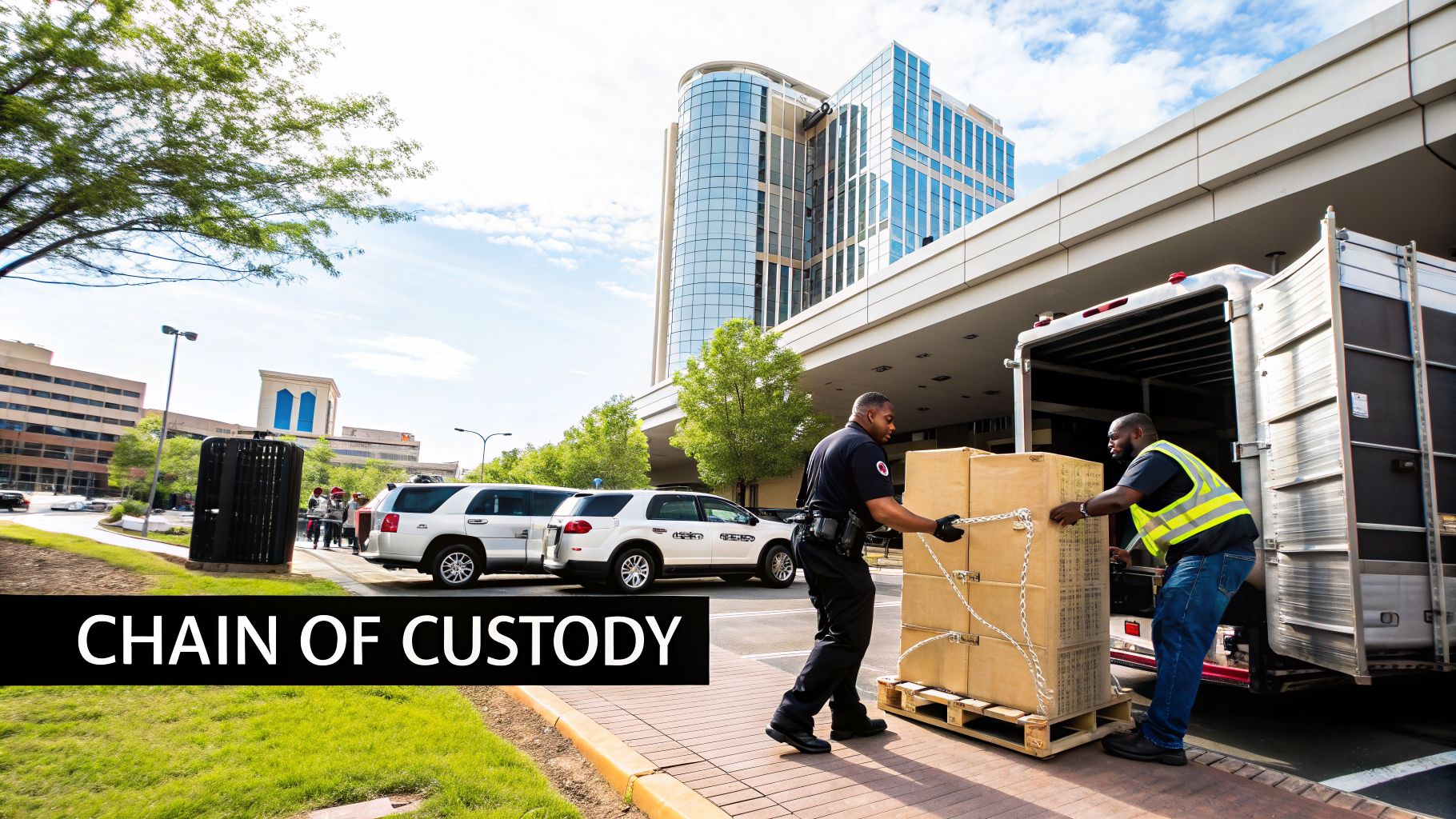
On-Site De-Installation and Packing
When an experienced decommissioning crew shows up, they come prepared. This isn't like calling a standard moving company. Our technicians know IT hardware inside and out, and more importantly, they understand the security protocols that come with it.
Here’s what professional on-site execution looks like:
- Systematic De-racking: Our team carefully disconnects and pulls every server, switch, and storage array from the racks, checking each one against the inventory list. Nothing gets missed.
- Secure Palletizing: We professionally pack and stack all equipment onto pallets. For sensitive assets like loose hard drives, we can place them into locked containers right there on-site before they're even moved.
- Asset Tag Verification: As equipment comes off the racks, we scan serial numbers and cross-reference them with your inventory list. This step creates the very first link in the chain-of-custody, giving you proof that every asset is accounted for from the start.
This methodical work prevents damage—critical for value recovery—and makes the entire process fully auditable. Our team lives and breathes these logistics; you can learn more about our process for a commercial computer pickup and removal.
The Journey: Secure Transport and Chain of Custody
With your equipment packed and ready, it's time for transport. This is the most vulnerable point in the entire process. That's why secure, dedicated transport is absolutely non-negotiable.
A professional ITAD provider will only use vetted, uniformed personnel and a fleet of sealed, GPS-tracked vehicles. This gives you a documented and verifiable record of your assets' location from the moment they leave your loading dock until they arrive safely at the processing facility.
This level of security is essential for compliance and peace of mind. It prevents equipment from "falling off a truck" or getting diverted somewhere it shouldn't be. For any business in a regulated field like healthcare or finance, this documented transit isn't just a best practice—it's a requirement.
This focus on security is part of a fast-growing industry. The global IT equipment recycling service market, valued at USD 25 billion in 2025, is projected to grow at a 12% CAGR through 2033. This boom is fueled by constant data center upgrades and tightening data privacy laws. In a tech hub like Atlanta, picking a certified recycler committed to landfill diversion is the only way to meet both your compliance needs and environmental goals. You can read the full research about these market trends to see where the industry is headed.
A Real-World Scenario: Live Data Center Migration
Let's put this into practice. Imagine a large financial services firm in a Buckhead high-rise needs to migrate to a new colocation facility. The catch? They must decommission their old server room without any interruption to daily operations.
An experienced partner coordinates with building management to secure the freight elevators after 6 PM. A crew arrives, de-racks only the designated servers, and packs them onto pallets in a sectioned-off staging area. Each pallet is then shrink-wrapped, sealed with a tamper-proof tag, and loaded onto a locked truck. The facility manager signs the chain-of-custody form, noting the truck's unique seal number. The truck then travels directly to the secure recycling facility, its journey monitored by GPS, ensuring a seamless and fully documented handoff that doesn't disrupt the building's other tenants.
Once the last server rack is rolled out of your data center, it might feel like the project is over. But it’s not—the most critical phase is just beginning: the final audit and reporting. For any business in Atlanta, this documentation is everything. It's your concrete proof of compliance, your defense in an audit, and a genuine asset for your company's ESG goals.
Without a complete, verified paper trail, the entire decommissioning project is at risk. A missing Certificate of Destruction or an incomplete chain-of-custody log means you can't prove you handled sensitive data securely or disposed of e-waste by the book. That's a liability you can't afford.
The Essential Documents You Must Demand
A seasoned partner handling data center equipment recycling in Atlanta GA will provide a comprehensive reporting package as a standard part of their service. These aren't add-ons; they are non-negotiable deliverables.
Your final packet should always contain:
- Serialized Certificate of Destruction: This is your most important security document. It needs to list the individual serial numbers for every single hard drive, SSD, or tape that was wiped or physically shredded, specifying the destruction method for each one.
- Complete Chain-of-Custody Log: This report tracks your assets from the second they leave your site. It includes signatures, dates, vehicle details, and confirmation of arrival at the secure processing facility.
- Certificate of Recycling: This confirms that all non-reusable materials were processed in line with environmental laws and kept out of landfills. It’s your proof of responsible e-waste management.
- Final Settlement Report: If any of your gear had resale value, this report gives you a transparent, line-by-line breakdown of what was sold and the revenue it brought in, reconciling the project's costs and credits.
This paperwork is what truly closes the loop on your project, giving you documented peace of mind.
Why R2v3 and e-Stewards Certifications Matter
When you're reviewing these final reports, look for two key certifications: R2v3 (Responsible Recycling) and e-Stewards. These aren't just logos for a website. They represent a serious, ongoing commitment to the highest industry standards, verified by intensive third-party audits.
Partnering with a certified recycler is the only way to guarantee your Atlanta business is protected from environmental penalties and the reputational fallout from improper e-waste disposal. These certifications ensure your vendor is audited on everything from data security to environmental protection and worker safety.
Certified recyclers follow a strict "reuse-first" hierarchy. They prioritize refurbishment before breaking down equipment for materials recovery. This approach is a direct countermeasure to the staggering global e-waste problem. In 2022, the world generated 62 million metric tonnes of e-waste, yet only 22.3% was properly collected and recycled. Worse, millions of tonnes are shipped to developing nations, often illegally. You can see the scale of the data center recycling crisis and understand why choosing a certified partner is so vital.
Turning Compliance into a Corporate Asset
Once that documentation is in your hands, you have more than just audit-proof records—you have a success story. That stack of paper transforms a compliance headache into a powerful statement about your company's values.
Think about how this plays out for an Atlanta-based company:
- Your C-Suite sees a clear ROI in the settlement report, showing how a cost center generated real value. The Certificates of Destruction and Recycling provide tangible proof that the company is shielded from data breach lawsuits and environmental fines.
- Your Marketing Team can use the sustainability metrics—like the total weight of e-waste diverted from landfills—as powerful content for the company’s annual ESG report, website, or social media.
- Your Compliance Officer gets a complete, auditable trail that satisfies strict frameworks like HIPAA, SOX, or PCI DSS. If you want to see the level of detail involved, you can review our Certificate of Destruction form to understand what a compliant document looks like.
Ultimately, this final reporting step is what locks everything down. It’s the proof that the job was done securely, profitably, and responsibly from start to finish.
Common Questions on Data Center Recycling in Atlanta
Even with a solid plan, the last-mile details of retiring IT assets can feel overwhelming. We get it. Data center managers and IT executives across the Atlanta area often come to us with specific, practical questions about how data center equipment recycling in Atlanta GA really works on the ground.
Getting these concerns addressed upfront is the best way to demystify the process and see the clear business benefits of working with a certified partner. Here are the answers to the questions we hear most often.
What Will This Data Center Recycling Project Cost?
This is usually the first question on every executive's mind, and the answer isn't always what you'd expect. The truth is, many data center decommissioning projects can be cost-neutral or even turn into a significant revenue generator for your company.
It all comes down to the balance between your equipment's resale value and the service fees for logistics and secure destruction. The value we can recover from reselling newer servers, networking hardware, or storage arrays often more than covers the cost of responsibly recycling obsolete items and destroying data. A reputable partner will only give you a transparent quote after a thorough inventory assessment, showing you exactly how to maximize your financial return.
The profitability of any project hangs on the quality of your asset inventory. A detailed list with makes, models, and specs is what allows a recycler to spot the high-value components for remarketing, turning what looks like an expense into a revenue stream.
How Can We Be Sure Our Data Is Secure During Transport?
This is a non-negotiable, and for good reason. The journey from your facility to a processing plant is a critical security checkpoint. We protect your data’s integrity with a strict, documented chain-of-custody process that is designed from the ground up to be fully auditable.
This protocol starts right at your site with asset tagging and serialized inventory logs as we de-install the equipment. From there, your hardware is moved in locked, GPS-tracked vehicles operated by vetted, uniformed personnel. It goes directly to a secure, access-controlled facility. This end-to-end security is built to satisfy tough compliance standards like HIPAA and protect your business from a breach at every single step.
Our goal is simple: leave zero gaps where an asset could be lost or mishandled.
Can You Handle a Mix of Servers, SANs, and Networking Gear?
Absolutely. A true full-service ITAD provider is built to manage the entire spectrum of data center hardware. It’s almost unheard of for a project to involve just one type of equipment, and a good partner comes prepared for that complex reality.
We’re equipped to handle everything, including:
- Server racks and blade servers
- Storage area networks (SANs) and tape libraries
- Routers, switches, and firewalls
- UPS systems and power distribution units (PDUs)
The whole point is to offer a single, integrated solution for your entire project. This simplifies logistics and vendor management for your IT team, so you don't have to waste time hiring one company for servers and another for the networking gear.
What Kind of Documentation Will We Get?
The job isn't finished until you have the final reports in hand. Once everything is processed, you should expect a comprehensive reporting package that becomes your official audit trail. This documentation is your ultimate proof of compliance.
This package must include three key documents:
- A serialized Certificate of Data Destruction covering every single storage device.
- A Certificate of Recycling to confirm environmental compliance and complete landfill diversion.
- A detailed settlement report that transparently outlines the value recovered from any resold assets.
This paperwork is critical for satisfying internal security audits, proving regulatory compliance, and backing up your company's ESG (Environmental, Social, and Governance) initiatives.
The broader industry push toward a circular economy is changing how major players view old hardware. For example, Microsoft is on track to achieve a remarkable 90.9% reuse and recycling rate for its cloud hardware by 2026, thanks to its Circular Centers program. This initiative, which reused over 3.2 million components in just one year, proves the power of structured circularity. With 5,427 data centers operating in the US alone as of late 2025, this trend highlights why partnering with certified recyclers is more important than ever for IT managers in Atlanta.
Ready to turn your retired IT hardware into a secure and profitable asset? The team at Atlanta Computer Recycling provides certified data destruction, responsible recycling, and value recovery services for businesses across the Atlanta metro area. We handle the entire process, from on-site logistics to final reporting, ensuring your project is compliant and hassle-free. Contact us today for a consultation.