The Ultimate Guide to the Data Center Decommissioning Process

Mistaking a data center decommissioning for a simple IT clean-up is one of the costliest errors a business can make. A professional data center decommissioning process is a strategic corporate initiative, not just a technical task. It is a formal, documented methodology for retiring IT infrastructure securely, compliantly, and in a way that protects your bottom line and brand reputation.
Proceeding without a structured plan exposes your organization to significant data security vulnerabilities and results in missed opportunities to recover value from retired IT hardware.
Why Decommissioning Is a C-Suite Conversation Now
Legacy hardware disposition has evolved from a back-office IT function to a critical business operation demanding executive oversight. The drivers are clear: accelerated cloud migration, facility consolidation to reduce operational expenditures, and ongoing hardware refresh cycles. Each initiative transforms what seems like a simple teardown into a high-stakes project with major financial and brand implications.
Executed correctly, decommissioning transitions from a cost center to a value-creation engine. This process is about far more than reclaiming floor space; it's a strategic opportunity to generate revenue from retired assets, eliminate security vulnerabilities from legacy data, and demonstrate corporate environmental responsibility.
The Business Case for a Formal Decommissioning Process
For executives in finance, IT, and operations, a structured process provides a direct link between meticulous planning and measurable business outcomes. The strategic advantages are too significant to overlook:
- Mitigating Catastrophic Risk: A formal plan ensures every data-bearing device is identified and sanitized to rigorous standards like NIST 800-88. This is how you shield the business from devastating data breaches and the severe regulatory penalties that follow, particularly under compliance frameworks like HIPAA.
- Maximizing Asset Value Recovery: Instead of defaulting to recycling, a strategic process identifies servers, networking equipment, and components with residual market value. This transforms retired equipment into a new revenue stream that can offset project costs.
- Ensuring Auditable Compliance: With a fully documented chain of custody and serialized certificates of destruction, your organization has irrefutable proof for any audit. You can demonstrate, without question, that you have met all legal and corporate governance requirements for data and asset disposition.
- Achieving Corporate Sustainability Goals: Responsible e-waste management is a key pillar of corporate social responsibility. Understanding the environmental impact of electronic waste highlights the importance of partnering with a certified specialist to ensure retired assets are processed ethically and never end up in a landfill.
A haphazard approach is a recipe for disaster. We've seen companies face seven-figure fines simply because a single un-wiped hard drive was misplaced during a move. A formal process isn't optional; it's essential insurance against catastrophic failure.
The market has recognized this reality. The global data center decommissioning service market was valued at approximately $5 billion in 2025 and is projected to exceed $15 billion by 2033. This growth is driven by enterprise consolidation and the relentless migration to cloud infrastructure. North America leads this market, largely due to stringent data security regulations and the high density of data centers. Read the full research about market growth.
Building Your Decommissioning Blueprint
Every successful data center decommissioning begins with a meticulous project plan, not a powered-down server. Too many projects fail due to a premature focus on physical execution. Your project blueprint serves as the single source of truth, transforming a potentially chaotic process into a predictable, manageable business operation. Bypassing this stage is the fastest route to budget overruns, missed deadlines, and unacceptable security risks.
A robust plan starts with a clear definition of scope and business objectives. Is the project a complete shutdown for a full cloud migration? A consolidation of multiple sites? Or a partial hardware refresh within a live environment? The "why" dictates the "how" and informs every subsequent decision.
The reality is, most decommissioning projects are driven by a larger strategic goal.
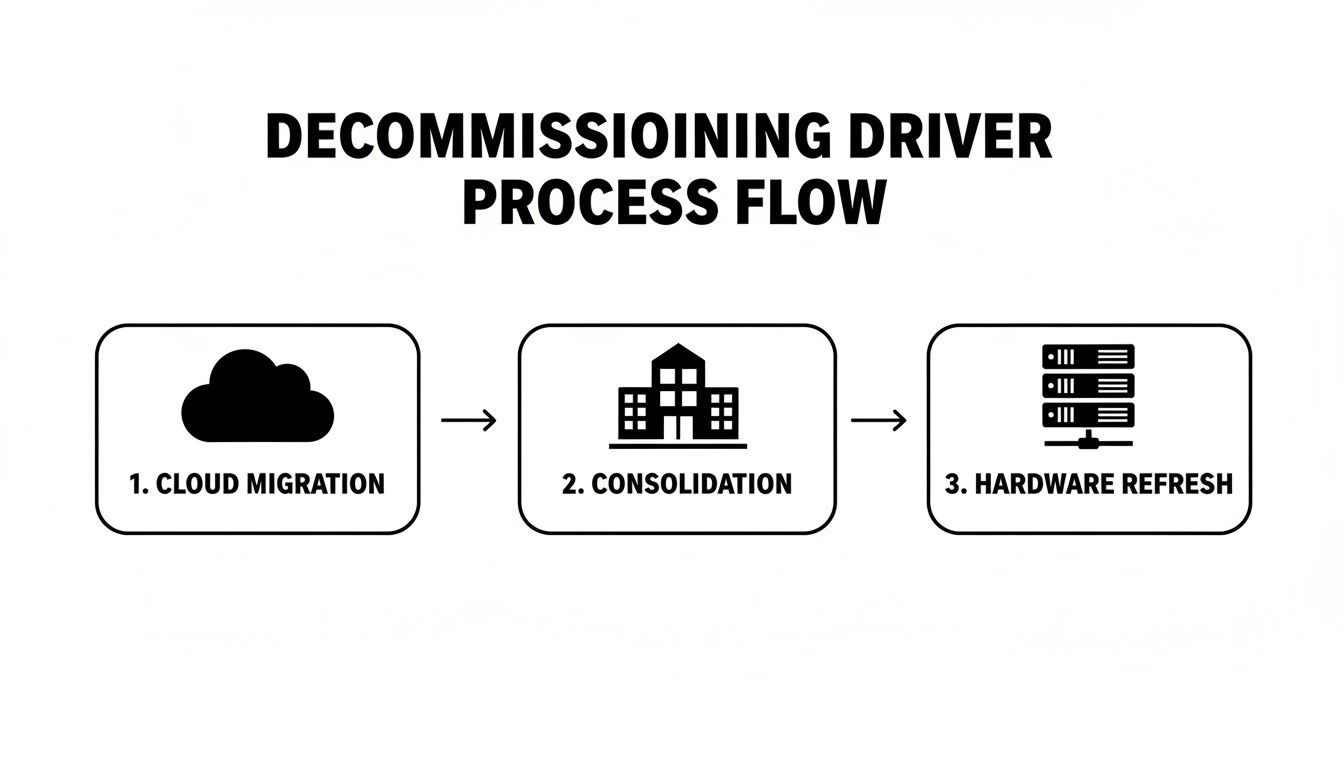
Whether it’s a cloud migration, a facility consolidation, or a simple tech refresh, each of these initiatives requires a well-documented process to pull off successfully.
Assembling Your Decommissioning Team
A project of this magnitude is not a solo endeavor. It requires a cross-functional team with clearly defined roles and responsibilities established from the outset. This is not merely an IT project; it is a complex operational, financial, and logistical initiative that intersects with multiple business units.
Your core team should include representation from:
- IT Operations: The technical leads responsible for mapping system dependencies, defining the shutdown sequence, and overseeing hands-on execution.
- Facilities Management: The team that manages physical site logistics, including building access, power and cooling shutdowns, and coordination with your logistics partner.
- Finance and Procurement: This group is responsible for tracking asset value, managing the project budget, and overseeing contracts with external service providers.
- Security and Compliance: The stakeholders in charge of ensuring all data destruction methods adhere to regulatory requirements (e.g., HIPAA) and internal corporate policies.
Applying the same project management rigor as other major business initiatives, such as office relocation project management, is critical. This framework establishes clear communication channels, accountability, and proactive risk mitigation from day one.
Creating the Definitive Asset Inventory
The asset inventory is the absolute foundation of the entire decommissioning plan. An inaccurate or incomplete inventory will inevitably lead to financial loss or data exposure. This process is far more involved than a simple device count.
The objective is to create a detailed manifest of every piece of hardware within the data center, including:
- Servers and storage arrays
- Switches, routers, and firewalls
- Power Distribution Units (PDUs) and UPS systems
- Racks, cabinets, and cabling infrastructure
For each item, you must document critical details: make, model, serial number, corporate asset tag, and precise physical location (row, rack, and U-position). Critically, you must identify every data-bearing device—a category that extends beyond servers to include SAN switches or controllers with flash memory. This list directly informs the scope of your data destruction work and establishes the first crucial link in the chain of custody.
A detailed asset inventory is your best defense against scope creep and unexpected costs. When you know exactly what you have and where it is, you can accurately budget for logistics, data sanitization, and value recovery.
To help you get started, we've put together a checklist of the essential planning and inventory tasks. This table breaks down what needs to be done and which roles are typically responsible, ensuring no critical steps are missed as you kick off your project.
Data Center Decommissioning Project Plan Checklist
| Task Category | Key Action Items | Responsibility (Example Role) |
|---|---|---|
| Project Scoping | Define business drivers (e.g., cloud migration, consolidation). | Project Manager, IT Director |
| Establish clear project goals, budget, and timeline. | Finance, Project Manager | |
| Identify all key stakeholders and assemble the project team. | Project Manager | |
| Asset Inventory | Conduct a physical audit of all hardware assets. | IT Operations, Field Technician |
| Document make, model, serial number, and location for each asset. | IT Operations | |
| Identify and tag all data-bearing devices for special handling. | Security Team, IT Operations | |
| Dependency Mapping | Map all application and service dependencies to physical hardware. | Application Owners, IT Ops |
| Create a logical power-down and migration sequence. | Systems Administrator, Network Engineer | |
| Validate the shutdown plan with all relevant business units. | Project Manager, Business Liaisons |
Having a comprehensive checklist like this ensures that your team is aligned from the very beginning and provides a clear roadmap for the initial, most critical phase of the decommissioning.
Mapping Dependencies and Building the Timeline
With a definitive inventory, you can begin to map the intricate web of system dependencies. Which applications reside on which servers? What is the correct power-down sequence to prevent data corruption or disruption to other live operations? This "decommissioning choreography" is essential, especially when retiring a portion of a live facility.
Once this dependency map is complete, you can build a realistic project timeline with key milestones. A typical project framework includes:
- Phase 1 – Planning (Weeks 1-4): Finalize scope, assemble the team, complete the full asset inventory, and select vendors.
- Phase 2 – Pre-Decommissioning (Weeks 5-8): Execute final data migrations, validate new application functionality, and schedule on-site logistics.
- Phase 3 – Execution (Weeks 9-10): Physical de-installation, data destruction, and packing and removal of all assets from the site.
- Phase 4 – Post-Decommissioning (Weeks 11-12): Off-site asset processing, final reporting, and reconciliation of value recovery payments.
This structured approach ensures stakeholder alignment and moves the project logically toward a secure and efficient conclusion. The data gathered here also provides a perfect foundation for the next stage: defining your strategy for IT asset disposition. If that term is new, our guide on what is IT asset disposition explains its role in the larger process.
Securing Your Data and Ensuring Compliance
With the decommissioning blueprint established, the project transitions to its most critical phase: data protection. In any data center project, your stored information represents your greatest liability. A single error at this stage can escalate into a catastrophic data breach, leading to crippling regulatory fines and irreparable brand damage.
Ensuring every byte of sensitive data is properly handled and verifiably destroyed is non-negotiable. Bypassing this step is akin to planning a flawless bank vault relocation but forgetting to lock the door. The project's success hinges on an unimpeachable data security and compliance strategy.
Choosing the Right Data Destruction Method
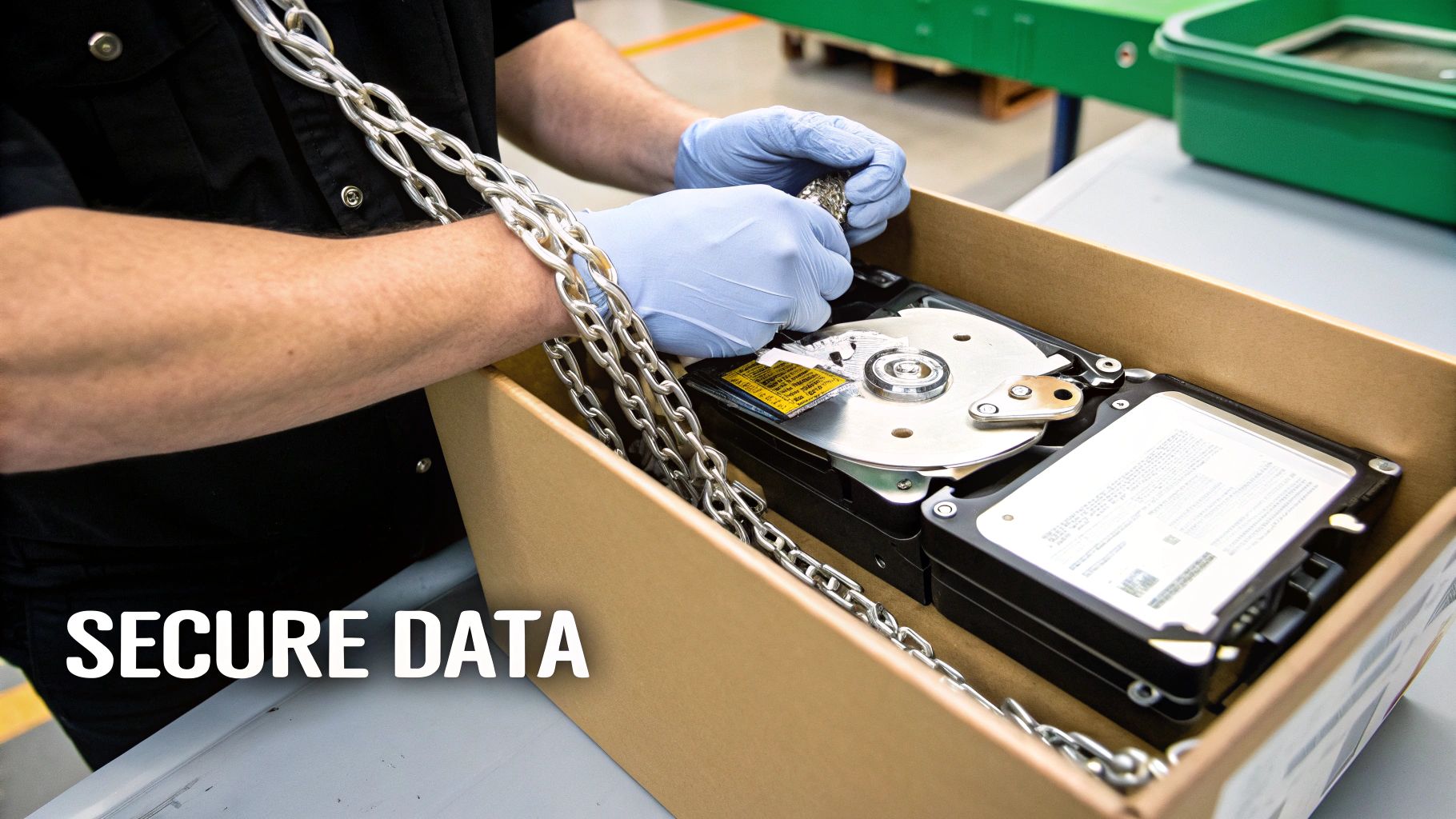
Not all data destruction methods are created equal, and selecting an inappropriate one can leave your organization dangerously exposed. The two primary, industry-accepted methods are certified data wiping and physical shredding. The correct choice depends on the media type, its condition, and the intended disposition path of the asset.
- Certified Data Wiping (Erasure): This software-based method overwrites every sector of a hard drive or SSD according to strict standards like NIST 800-88. It is the ideal choice for newer, functional equipment intended for resale or internal redeployment, as it preserves hardware value while ensuring complete data sanitization.
- Physical Shredding: For end-of-life drives, failed media, or hardware containing highly sensitive data, physical destruction is the definitive solution. The device is processed through an industrial shredder, which reduces it to small, mangled fragments, making data recovery physically impossible.
Consider a healthcare provider decommissioning a server that processed patient health information. To meet HIPAA mandates, their strategy would likely involve certified wiping for newer drives to be remarketed, coupled with on-site, witnessed shredding for older or failed drives to ensure absolute compliance.
Your compliance strategy is only as strong as its documentation. Without a complete chain-of-custody log and individual Certificates of Destruction for every single data-bearing device, you have no verifiable proof that you met your legal obligations.
The Critical Role of Chain of Custody Documentation
From the moment a server is disconnected to its final disposition, you must maintain an unbroken, auditable trail documenting its journey. This is the chain of custody. This documentation is your ultimate defense in an audit, proving precisely who handled each asset, when, and what actions were performed.
A robust chain of custody includes:
- Serialized Asset Tracking: Every data-bearing device is scanned and tracked by its unique serial number, linking it back to the master project inventory.
- Secure Logistics: Documented procedures for on-site packing and transport in secure, locked vehicles are essential.
- Verified Destruction: A Certificate of Destruction is issued for each serial number, confirming the date, method, and witness of the sanitization or shredding.
This meticulous record-keeping ensures no device is ever unaccounted for and provides the auditable proof required by regulators and internal governance teams. A mastery of secure data destruction is central to a successful project.
Navigating Environmental Compliance and E-Waste Regulations
Beyond data security, decommissioning carries significant environmental responsibilities. Electronic waste (e-waste) contains hazardous materials like lead and mercury that can cause immense environmental damage if landfilled. Consequently, its disposal is governed by a complex framework of federal and local regulations.
Non-compliance can result in substantial fines and directly conflicts with corporate sustainability initiatives. This is why partnering with a certified e-waste recycling specialist is critical. Look for vendors holding certifications like R2v3 (Responsible Recycling), which guarantees adherence to the highest standards for environmental safety, worker protection, and downstream accountability.
A certified partner ensures your retired assets are managed responsibly, transforming a potential liability into a tangible demonstration of your company's commitment to sustainability.
Managing On-Site Logistics and Removal
With the plan defined and data security protocols in place, the project transitions from strategic planning to on-site execution. This phase involves heavy equipment, complex cabling, and a paramount focus on safety. A single misstep can result in asset damage, project delays, or, most importantly, personal injury.
Managing the on-site removal is a logistical challenge that extends far beyond unplugging servers. It requires precise coordination between your IT personnel, facilities management, and your decommissioning partner to ensure the physical tear-down is executed smoothly, safely, and efficiently.
De-Racking and Equipment Handling Best Practices
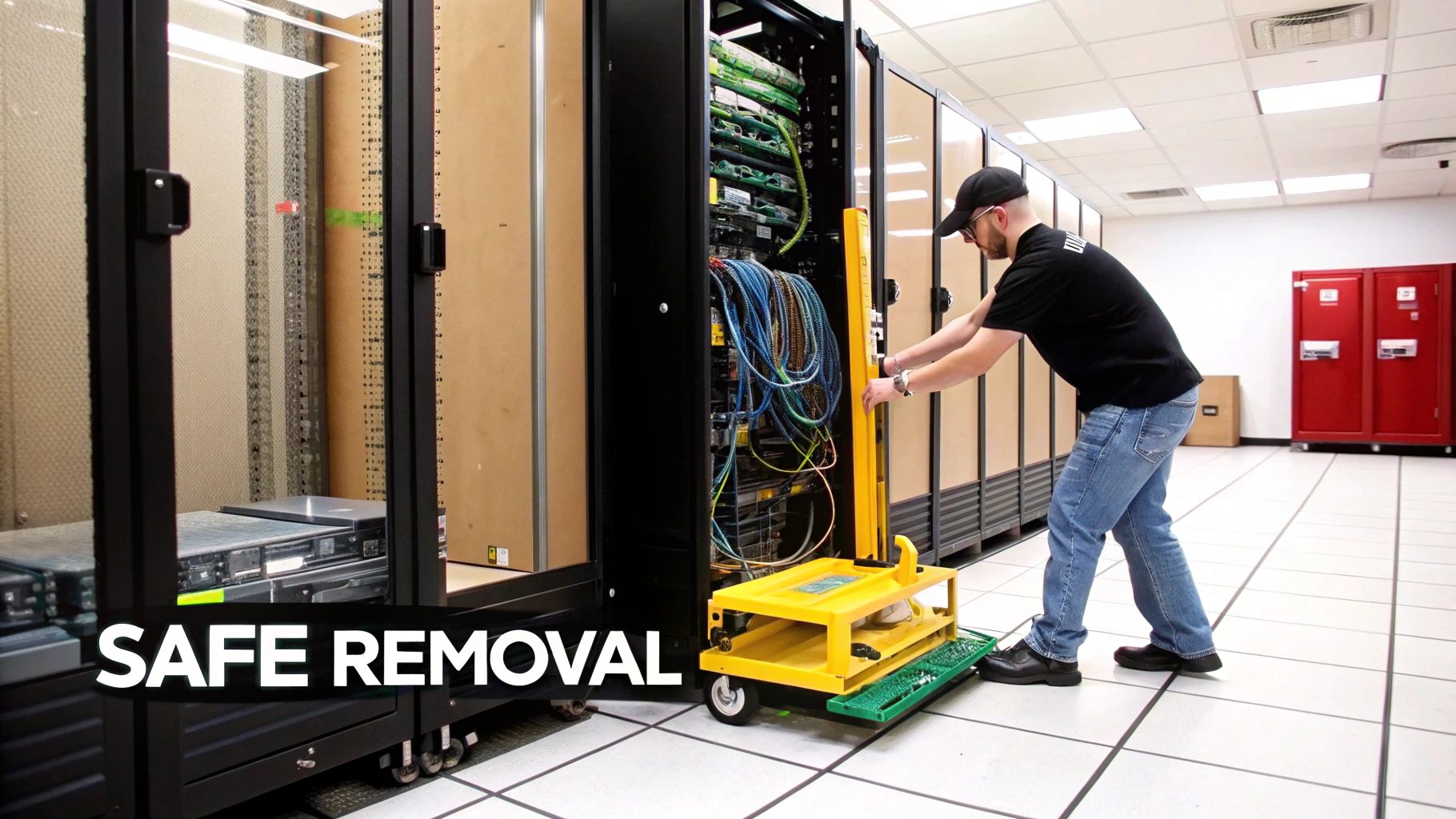
Removing hundreds or thousands of servers, switches, and storage arrays is physically demanding work. Enterprise equipment is heavy, cumbersome, and surprisingly fragile. Dropping an asset is not just a financial loss; it is a significant safety hazard. This is why professional teams utilize specialized equipment.
The use of proper tools is mandatory for a safe and efficient operation:
- Server Lifts: These are essential for safely removing heavy servers from racks without risking injury to personnel.
- Heavy-Duty Carts and Pallet Jacks: The correct tools are needed to transport equipment from the data hall to the staging area.
- Proper Packing Materials: To prevent damage during transit, all assets must be wrapped in anti-static materials and secured on pallets.
As each piece of equipment is disconnected, its cables are labeled and its serial number is verified against the master inventory. This step is critical for maintaining the chain of custody and ensuring every component is accounted for before it leaves the facility.
Coordinating with Building Management
Your decommissioning project has a direct impact on the facility, making early and continuous communication with building management essential. They are your partners in navigating the building's specific operational rules and procedures.
Key areas for coordination include:
- Loading Dock Access: Schedule dedicated time for loading docks and freight elevators to prevent conflicts with other tenants and ensure a clear exit path.
- Power Down Procedures: Work directly with facilities to de-energize circuits safely, avoiding accidental outages to other parts of the building.
- Floor Protection: Ensure temporary floor coverings are used in high-traffic areas to prevent damage from heavy carts and equipment.
A well-coordinated logistics plan is the difference between a seamless, professional exit and a chaotic scene that disrupts building operations and creates unnecessary friction with your landlord. A good partner handles this coordination for you.
Staging, Packing, and Secure Transport
After de-racking, equipment is moved to a secure, designated staging area. Here, assets are sorted, audited a final time against the inventory, and prepared for transport. Hard drives designated for off-site shredding are segregated into locked containers, while assets intended for resale are carefully palletized.
The final on-site step, transport, is another critical security checkpoint. Your partner should use their own security-vetted personnel and unmarked, dedicated vehicles. For businesses, finding a partner with a structured pickup process is key. Many providers offer commercial services like a free electronic recycling pick up, which streamlines this final stage.
By managing these on-site logistics with professional precision, you can be confident that the physical de-installation of your data center will be completed safely, efficiently, and without costly surprises.
Maximizing Value from Your Retired IT Assets
A data center decommissioning should be a value-generating event, not just an expense line item. Executed strategically, it presents a significant opportunity to recover capital and advance corporate sustainability goals. The objective is to convert retired hardware into a financial and environmental victory.
Every asset, from a high-performance server to a simple power distribution unit, has a defined end-of-life path. That path can either incur costs or generate revenue.
The key is to move beyond a simple disposal mindset and adopt a strategy that sorts equipment into one of three channels: remarketing, redeployment, or recycling. An experienced IT asset disposal (ITAD) partner is invaluable here, transforming a logistical challenge into a source of ROI.
Turning Old Hardware into New Revenue
Do not assume your retired equipment is destined for recycling. A significant amount of hardware retains value on the secondary market. Servers that are three to five years old, networking gear, and individual components like CPUs and RAM are often in high demand.
The key to maximizing returns is knowing which assets are valuable and having access to the right buyers. A professional ITAD partner's global sales network is a game-changer. They have established relationships with buyers seeking specific models, ensuring you receive the highest possible return.
Equipment with strong resale potential often includes:
- Enterprise Servers and Storage Arrays: Even older models are valuable for parts or for organizations with less demanding compute needs.
- Networking Gear: High-quality switches, routers, and firewalls from leading brands retain their value well.
- Individual Components: High-core-count CPUs, large-capacity RAM modules, and enterprise-grade SSDs can often be sold individually for a premium.
To realize the most from your used equipment, it is vital to understand proven strategies for liquidating assets for maximum return. The revenue generated from these sales can often offset—or even exceed—the total cost of the decommissioning project.
The Smart Case for Internal Redeployment
Before selling, always evaluate internal needs. Redeploying functional equipment within your own organization is the most cost-effective form of reuse. It eliminates the need to purchase new hardware for non-critical functions and extends the value of your existing capital investments.
Common redeployment scenarios include:
- Building Test and Dev Labs: Older servers are ideal for creating sandboxed environments for developers.
- Setting Up Staging Environments: Use retired equipment to mirror production environments for pre-deployment testing.
- Filling Less Critical Roles: A server no longer suitable for a primary database might be perfect for internal file sharing or secondary DNS services.
This strategy not only reduces capital expenditure but also aligns with corporate sustainability goals by maximizing the useful life of your IT investments.
A strategic approach to asset disposition is no longer a 'nice-to-have.' It's a core component of a financially sound and environmentally responsible data center decommissioning. It proves you can be both profitable and sustainable.
Responsible Recycling: Your Last Line of Defense
For any assets that are too old, non-functional, or have no market value, responsible recycling is the only acceptable disposition path. This is a certified process that protects your organization from significant environmental liability.
Improperly disposed electronics can leak hazardous materials, leading to substantial fines and brand damage. Industry certifications are your best insurance against this risk.
Certifications like R2v3 (Responsible Recycling) are non-negotiable. They provide third-party verification that your partner adheres to the strictest standards for environmental safety, data security, and worker health. A certified partner provides a clear, auditable paper trail, proving your e-waste was handled legally and ethically and protecting you from all downstream liability.
Answering Your Decommissioning Questions
Even with a robust plan, a full-scale data center decommissioning can seem like a daunting undertaking. Business leaders often have practical, high-level questions before committing to a project. Here are the answers to the most common inquiries we receive.
How Long Does a Typical Decommissioning Take?
There is no standard timeline; the duration is dictated by project scale and complexity. A small server closet with a dozen assets might be completed in a few days. Conversely, a large enterprise facility with thousands of devices could require several months from initial planning to final reporting.
Key factors influencing the schedule include:
- Asset Volume: The quantity of servers, switches, and storage arrays directly impacts the time needed for physical de-installation and processing.
- Data Security Requirements: On-site data shredding, for instance, is more time-intensive than secure off-site processing by a vendor.
- Logistical Constraints: Operating within a live production environment or dealing with strict building access rules can add significant time to the project.
A detailed planning phase is the only way to establish a realistic timeline that all stakeholders can commit to.
What Is the Biggest Mistake Companies Make?
Without question, the single most damaging mistake is underestimating the need for a meticulous asset inventory at the project's outset. A rushed or incomplete inventory creates a cascading effect of problems that compromises every subsequent phase.
When you don't know exactly what you have, you can't protect its data, you can't get a fair value for it, and you can't prove you disposed of it properly. A shoddy inventory is the root cause of almost every decommissioning failure, leading directly to security breaches, lost revenue, and painful project delays.
A poor inventory inevitably results in unaccounted-for data-bearing devices—a severe security risk—and assets that lose all financial value. It is a recipe for project failure.
Can We Handle Decommissioning with Our In-House Team?
While it may seem cost-effective to use an internal IT team, this approach is often inefficient and exposes the company to significant risk. Decommissioning demands a unique combination of skills, specialized equipment, and industry relationships that most internal teams do not possess.
An in-house approach often falls short due to a lack of:
- Specialized Tools: Professional server lifts, purpose-built carts, and proper packing materials are necessary to prevent injury and asset damage.
- Certified Processes: True compliance demands certified data destruction methods and an auditable chain-of-custody that can withstand regulatory scrutiny.
- Remarketing Network: A professional partner leverages a global network to sell retired assets for maximum value—a capability an internal team cannot replicate.
Engaging a specialist not only ensures security and compliance but also allows your valuable IT staff to remain focused on core business functions rather than complex logistics.
What Should I Look For When Choosing a Decommissioning Partner?
Selecting the right partner is the most critical decision you will make. This vendor is the expert you are trusting to mitigate major liabilities and maximize financial returns on your retired assets.
When vetting potential partners, demand verification. Key industry certifications serve as a third-party endorsement of their processes and ethics.
- R2v3 or e-Stewards: These are the gold standards for environmental compliance, guaranteeing your e-waste is managed responsibly.
- NAID AAA: This certification is non-negotiable for data security, verifying the vendor adheres to the strictest protocols for secure data destruction.
Beyond certifications, request a certificate of insurance to ensure you are covered. Ask for sample reports and chain-of-custody documentation. Finally, always check references and case studies to confirm they have a proven track record of successful project execution.
Navigating a data center decommissioning requires a partner with proven expertise and a total commitment to your security. At Atlanta Computer Recycling, we provide end-to-end ITAD services for Atlanta-area businesses, ensuring your project is handled securely, sustainably, and efficiently. Contact us today to plan your decommissioning project.