A Business Guide to Bulk Electronics Recycling in Atlanta GA

For businesses in Georgia, managing outdated technology is a critical operational task, and professional bulk electronics recycling in Atlanta GA offers a secure and compliant solution. This service is designed for companies managing large volumes of IT assets, ensuring that everything from old computers to servers is disposed of responsibly, protecting both your company's data and the environment.
Why Smart E-Waste Management Is A Business Imperative
In today's competitive business climate, mishandling e-waste is a significant corporate liability. This isn't just about environmental stewardship; it's about protecting your Atlanta-based organization from data breaches, steep regulatory fines, and brand reputational damage.
A storage closet full of retired servers isn't just clutter—it's a ticking time bomb of sensitive company data and potential environmental hazards regulated under federal law.
The global e-waste problem has reached a critical point. Projections show the world will generate a staggering 82 million metric tons of electronic waste by 2030—growing five times faster than documented recycling efforts. For Atlanta businesses, this translates to a hidden risk under laws like the Resource Conservation and Recovery Act (RCRA), which classifies many electronics components as hazardous waste due to toxic materials like lead and mercury.
The Real Risks For Atlanta Businesses
Negligence in proper IT asset disposal can have serious consequences. A single un-wiped hard drive leaving your facility could expose customer lists, financial records, or proprietary intellectual property. The financial penalties for non-compliance are substantial, but the damage to your brand's reputation can be even more costly.
Consider the real-world impact on your organization:
- Data Breach Liability: A single discarded laptop can contain enough data to trigger a major security incident, leading to legal action and a complete loss of customer trust.
- Regulatory Fines: Federal laws like RCRA and industry-specific rules like HIPAA impose strict guidelines for handling devices with hazardous materials or sensitive information.
- Environmental Damage: Electronics that end up in landfills leach toxic chemicals into our soil and groundwater. Your company could be held responsible for the cleanup, and you can learn more about the environmental impact of electronic waste in our detailed article.
A proactive IT asset disposition (ITAD) plan is no longer a 'nice-to-have' for IT managers and executives in Atlanta—it's an essential component of modern corporate risk management. It transforms a potential liability into a structured, secure, and compliant process.
Developing Your Company's IT Asset Disposition Plan
Facing a room full of obsolete electronics can be overwhelming. However, with a clear plan, you can transform that clutter into a smart, strategic asset management process. This is the essential starting point for any major equipment refresh, office consolidation, or data center decommissioning.
The first step in any successful bulk electronics recycling Atlanta GA project is to build a detailed inventory. Consider it less a simple list and more a strategic map of your end-of-life assets.
This initial audit defines the scope of the project. For most businesses, a simple spreadsheet is sufficient. You will need to log a few key details for every asset slated for disposition.
Here's what we recommend tracking:
- Asset Type: Is it a laptop, server, monitor, or smartphone?
- Manufacturer & Model: Be specific, e.g., Dell Latitude 7420 or Cisco Catalyst 9300.
- Serial Number or Asset Tag: This is crucial for unique identification and chain-of-custody tracking.
- Age and Condition: Is it working, damaged, or completely obsolete?
- Data-Bearing Status: Does it contain a hard drive or solid-state drive that requires secure data destruction?
This inventory forms the foundation of your IT Asset Disposition (ITAD) strategy. For a deeper dive into formalizing this process, our guide on IT asset disposition in Atlanta provides a complete framework built for local businesses.
Creating Your Strategic Asset Map
Once your inventory is complete, you can begin segregating devices into different end-of-life pathways. This strategic mapping is what ensures you maximize value, secure sensitive data, and maintain regulatory compliance. Every asset should be assigned to a category: remarketing, refurbishment, or recycling.
To streamline the management of this hardware, consider exploring various IT Asset Management Software options. These tools can simplify the disposition process, often integrating directly with vendors to smooth out the entire workflow from inventory to final reporting.
This simple risk management flow is one every business should follow.
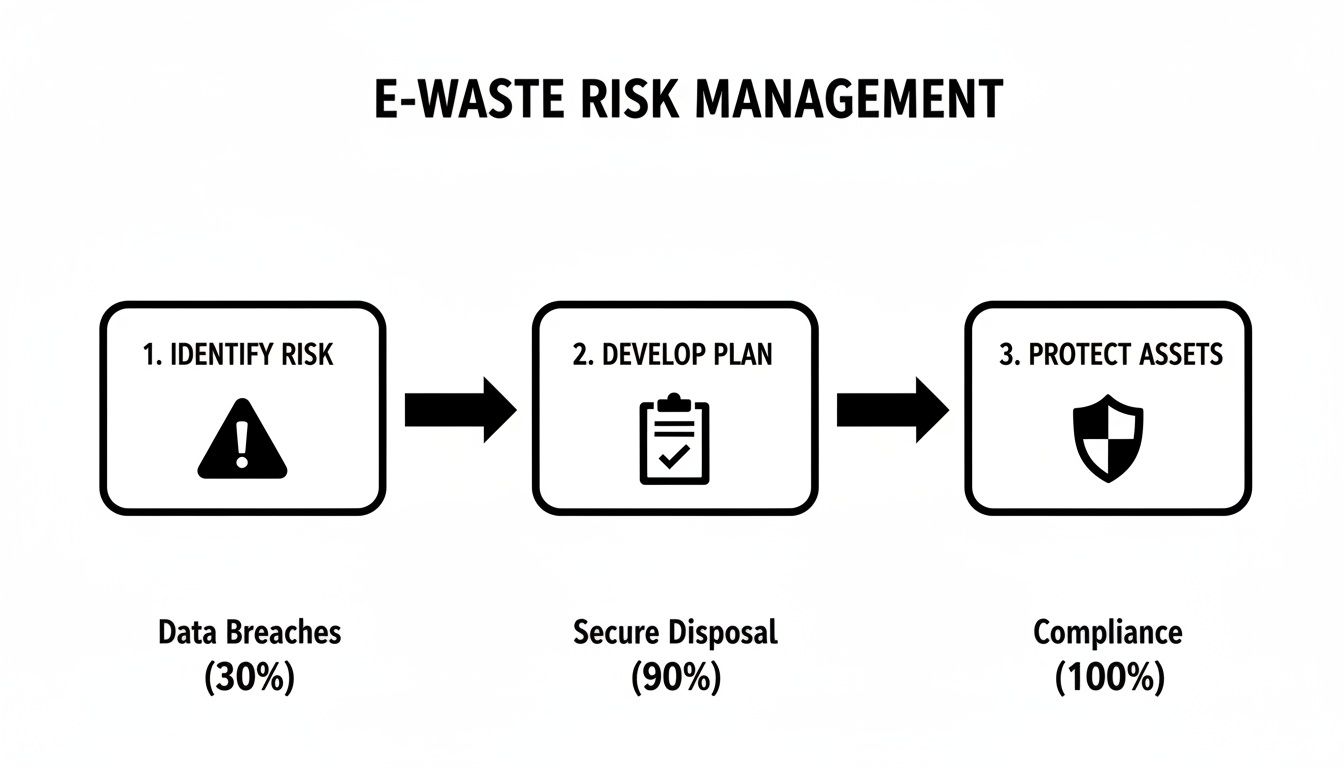
As you can see, a structured plan is the bridge between identifying the risks of e-waste and actually protecting your organization from data breaches and compliance headaches.
Real-World Planning Scenarios
Let's examine how this plan is executed in two real-world business scenarios.
Imagine an Atlanta-based law firm upgrading 200 laptops. During their inventory, they tag every device as containing sensitive client data. Because the laptops are relatively new, they are prime candidates for certified data wiping rather than physical shredding. This strategic decision preserves their residual value for potential resale.
A critical part of your plan is assigning a data destruction method to each asset. This decision directly impacts both your security posture and your potential financial return.
Now, consider a hospital system decommissioning patient-facing terminals and back-office workstations. The patient terminals, while older, fall under strict HIPAA regulations. Their ITAD plan designates these devices for physical hard drive shredding to completely eliminate any risk of a data breach.
The newer administrative workstations, however, are flagged for a secure DoD-compliant wipe, allowing the hospital to recover a portion of their initial investment through a buyback program.
This level of detail streamlines the entire bulk electronics recycling Atlanta GA process. It enables an accurate quote, prepares your team for the logistics, and ensures every device is handled according to security and value-recovery requirements.
Navigating Data Security and Compliance In Atlanta
For any business in the Atlanta area, the data on retired electronics represents the single greatest risk in the disposal process. When you arrange for bulk electronics recycling in Atlanta GA, you're not just clearing out old hardware—you're managing a critical security endpoint. This is the phase where you must guarantee that your company's sensitive information is irretrievably destroyed.

Protecting that information requires understanding your data destruction options and obtaining the correct legal documentation afterward. Let's focus on what matters for your business.
DoD Wiping Versus Physical Shredding
You have two primary paths for destroying data: software-based wiping and physical destruction. Both are effective, but they serve different purposes and have major implications for compliance, cost, and potential asset value.
Software Wiping (DoD 5220.22-M Standard): This method uses specialized software to overwrite a drive's data with random characters, typically in multiple passes. The original information becomes unrecoverable, but the physical hard drive remains intact and functional. This is the ideal choice for newer, valuable equipment you may wish to resell or redeploy.
Physical Shredding: As the name implies, we feed the hard drive into an industrial-grade shredder that grinds it into small, unrecognizable metal fragments. This offers the ultimate level of security because the drive is physically destroyed and data recovery is impossible.
For a deeper dive into the technical specifics, check out our guide to secure data destruction in Atlanta to help you make the right call.
To help you decide, here's a quick comparison of the two most common methods we use for our Atlanta clients.
Data Destruction Methods DoD Wiping vs Physical Shredding
| Feature | DoD 5220.22-M Wiping | Physical Shredding |
|---|---|---|
| End Result | Drive is wiped clean, data is unrecoverable. | Drive is physically destroyed into small pieces. |
| Asset Reuse | Yes, the hardware remains functional for resale. | No, the hardware is completely destroyed. |
| Best For | Newer PCs, laptops, and servers with resale value. | End-of-life drives, damaged media, and highly sensitive data. |
| Security Level | High security, meets government standards. | Absolute security, data is physically irrecoverable. |
| Compliance | Meets requirements for HIPAA, FACTA, and SOX. | The gold standard for HIPAA, GLBA, and government data. |
| Documentation | Certificate of Data Erasure with serial numbers. | Certificate of Data Destruction with serial numbers. |
Ultimately, the optimal method depends on your specific risk tolerance, compliance mandates, and whether you aim to recover value from your retired IT assets.
A Real-World HIPAA Scenario
Imagine a local Atlanta healthcare provider decommissioning 50 patient-facing tablets and 100 administrative computers. Under HIPAA, protecting patient health information (PHI) is non-negotiable. Even a minor data breach could lead to crippling fines and irreversible damage to their reputation.
In this case, the provider makes a smart, strategic decision.
For the 50 tablets that directly handled PHI, they mandate physical hard drive shredding. The risk is simply too high to consider any other option. For the 100 administrative computers, which are only a few years old, they opt for a certified DoD 5220.22-M wipe. This allows the hospital to securely remarket those assets and recoup some of their initial investment, all while maintaining full compliance.
Choosing between wiping and shredding isn't just a technical decision—it's a risk management strategy. For highly sensitive data regulated by laws like HIPAA, FACTA, or GLBA, physical shredding is often the only acceptable answer.
Demanding The Right Compliance Documentation
Your corporate responsibility doesn't end when the equipment leaves your facility. To fully shield your business from liability, you must obtain documentation proving that data was destroyed and assets were handled correctly.
We ensure every client receives these critical documents:
- Chain-of-Custody Records: This document tracks your assets from the moment they leave your facility to their final processing. It creates an unbroken, auditable trail that stands up to legal scrutiny.
- Certificate of Data Destruction: This is your official, legally defensible proof that the data on your drives was destroyed according to industry standards. It includes the serial numbers of every drive processed.
These documents are your legal shield. They demonstrate due diligence and are essential for any compliance audit. They are a key part of the robust cybersecurity compliance solutions that modern businesses need to stay protected.
While Atlanta's municipal recycling program collected nearly 20,000 tons of recyclables in 2023, its scope is limited for commercial needs. Specialized bulk electronics recycling in Atlanta, GA, is essential because general curbside programs cannot handle the volume or provide the necessary security documentation for businesses.
Mastering The Logistics Of Your Recycling Project
With your inventory prepared and a data destruction plan in place, it’s time to manage the physical removal of the equipment. A successful pickup for any bulk electronics recycling Atlanta GA project is defined by professional coordination that minimizes disruption to your daily operations.

Whether you’re decommissioning an entire data center or clearing out desktops from an office building, the process should be seamless and secure from the moment our team arrives.
Scheduling Your On-Site Service
The first step is coordinating the pickup. When scheduling your service, we will discuss key logistical details. We will need to know the volume and type of equipment, your building’s access points (like loading docks or freight elevators), and if you require any special on-site services, such as de-installing servers from racks.
A professional team arrives prepared. We bring all necessary equipment, from secure, locked bins for sensitive items like hard drives to pallet jacks and dollies for heavy server hardware. Crucially, we dispatch sufficient staff to complete the job efficiently and without interfering with your employees. This level of preparation ensures a smooth operation.
The goal of a professional pickup is to be a ghost operation. The team should be able to enter your facility, securely remove all designated assets, and leave with minimal impact on your business's workflow.
For example, we recently partnered with a law firm in downtown Atlanta to remove 150 workstations. To avoid interrupting billable hours, we coordinated with their building management for weekend access. Our team arrived with rolling carts, cleared every floor, and by Monday morning, all assets were gone with no disruption to their business.
From Your Door To The Processing Facility
As soon as assets are loaded onto our truck, our chain-of-custody protocol begins. Your equipment is transported directly to our secure, access-controlled processing facility. Assets are never left unattended, and the vehicle remains locked and tracked throughout transit.
Upon arrival at the facility, the equipment is reconciled against the initial inventory list or the bill of lading signed at pickup. This step is critical—it ensures every single asset is accounted for before any processing begins. From there, each device is sorted for its designated path: data destruction, refurbishment, or responsible materials recycling.
This secure journey is a key part of our service. You can learn more about how we handle the entire process by reading about our professional IT equipment pickup in Atlanta.
Final Reporting And Peace Of Mind
After all processing is complete, you will receive the final documentation that closes the loop on your project. This package includes your Certificates of Data Destruction and a detailed report summarizing all recycled assets. This final paperwork provides a clear, auditable trail, delivering total peace of mind and the certified proof required for any compliance audits.
Atlanta's growing importance in sustainable tech management is even drawing events like the upcoming E-Waste World Expo North America 2026. This conference brings industry leaders to our city to advance the circular economy, reinforcing our role as a key hub for innovation in e-waste. This local focus ensures that services for bulk electronics recycling in Atlanta GA stay aligned with global best practices. You can read more about Atlanta's role in e-waste management at ScrapMonster.com.
Finding The Financial Upside In Old Electronics
A smart IT asset disposition (ITAD) plan is not just an expense—it can be a revenue source. For any business arranging bulk electronics recycling in Atlanta GA, shifting focus from simple disposal to value recovery can change the project's entire financial outlook. It’s about recognizing the financial upside hidden in your storage rooms and server racks.
This comes down to identifying which assets are candidates for remarketing. Recent-model laptops, enterprise-grade networking gear, and powerful servers often retain significant value. By partnering with a recycler who offers buy-back or revenue-sharing programs, you can offset recycling costs or even generate a positive return on your retired technology.
Identifying Equipment With Resale Value
Not all electronics are created equal in terms of reuse potential. A quick assessment can help you determine what is worth setting aside for remarketing versus what is destined for responsible recycling.
Use this practical checklist to evaluate your equipment:
- Age: Is the equipment less than five years old? Devices within this window, especially from brands like Apple, Dell, and Lenovo, have a much stronger position on the secondary market.
- Condition: Does it power on and function correctly? Minor cosmetic wear is acceptable, but broken screens or major physical damage typically disqualify an item from resale.
- Function: Is it a complete, working unit? A whole laptop has more value than its individual parts. Enterprise equipment like servers and switches from Cisco or HP are also highly sought-after.
- Completeness: Do you have the necessary accessories, like power adapters? While not always a deal-breaker, including original accessories can boost resale value.
A simple rule of thumb: if it’s a piece of equipment your own employees would still find useful, there's a strong chance another business will, too. That’s the foundation of the IT reuse market.
Demystifying The Quoting Process
Understanding how costs are calculated helps you budget accurately and avoid surprises. When you request a quote for bulk recycling, the final price is a balance between service costs and the value recovered from your assets.
Logistics, such as requiring on-site de-installation or transport from your Atlanta office, will factor into the cost. The data destruction method you choose also matters—certified software wiping allows for resale, while physical shredding destroys the asset but offers maximum security, often at a slightly higher processing fee.
Many common items, like standard desktops and servers, can often be recycled with minimal or no cost, especially in large volumes. Conversely, items with low commodity value or hazardous materials—such as old CRT monitors or specific batteries—may carry a recycling fee. By identifying valuable assets for a buy-back program, you can balance these costs, turning a potential expense into a budget-neutral or even profitable project.
Your Questions On Atlanta Business Recycling Answered
Even after this overview, you likely have some practical questions. Every business's situation is unique, and it's important to have clear answers.
Let's address some of the most common questions we hear from IT managers, COOs, and business owners here in Atlanta.
Do I Get Paid For My Old Electronics?
The short answer is: quite possibly, yes. While not all equipment has resale value, a buy-back program is a viable option for assets that are still functional, in good condition, and relatively new.
This is most common with enterprise-grade hardware. Think servers, networking equipment, and recent-model business laptops from brands like Dell, HP, and Apple. The value recovered from these items often helps offset—or even completely cover—the cost of recycling older, non-valuable assets in your project.
What Items Are Typically Excluded From A Pickup?
We can handle nearly any IT asset, but some items fall outside the scope of a typical bulk electronics recycling in Atlanta GA pickup.
These generally include:
- Large appliances such as refrigerators, air conditioners, and microwaves.
- Non-electronic items like old office furniture or general scrap metal.
- Items containing hazardous liquids that are not integral to the electronic device itself.
When in doubt, it is always best to ask. Providing a detailed inventory list upfront allows us to confirm exactly what we can accept and help you find a solution for any excluded items.
How Much Does Commercial E-Waste Recycling Cost?
The final cost depends on the specific mix of equipment. We can often provide free recycling for large quantities of standard equipment like PCs and servers or for projects with a high concentration of valuable, reusable assets.
Fees are typically associated with items that have low commodity value or contain hazardous materials, such as old CRT monitors. Services like on-site hard drive shredding or server de-installation also have associated costs.
Your final quote is a balance sheet. The value from your reusable assets is credited against the costs for logistics, data destruction, and processing any fee-based items.
Is My Business Liable After The Equipment Leaves?
Your liability is directly tied to the documentation you receive from your recycling partner. This is a critical point for risk management.
As long as you work with a certified recycler who provides a complete chain-of-custody record and a Certificate of Data Destruction, your legal responsibility is effectively transferred. That paperwork is your official proof of due diligence, protecting your business from any future claims related to improper disposal or a data breach.
For more information on drop-off locations for items not typically included in a bulk pickup, you can explore our guide on where to recycle electronics in Atlanta.
Ready to clear out your old IT assets securely and responsibly? Contact Atlanta Computer Recycling today for a transparent quote and a plan that protects your data and your bottom line. Visit us at https://atlantacomputerrecycling.com.