How to Recycle Circuit Boards: A Guide for Businesses

Recycling circuit boards is far more than an environmental good deed—it’s a critical business function that directly impacts your company's security, bottom line, and reputation. When electronic waste is mismanaged, it exposes your organization to significant data breach risks and hefty regulatory fines.
A smart IT Asset Disposition (ITAD) strategy, on the other hand, turns that liability into an asset. It protects your brand and often uncovers hidden value in hardware you thought was worthless.
Why Circuit Board Recycling Is a Business Imperative
Too many organizations see old electronics as just clutter taking up space in a storage closet. That perspective completely overlooks a massive financial and legal minefield. Every single server, laptop, and network switch contains printed circuit boards (PCBs) that can hold sensitive company and customer data. If you don't dispose of them properly, the consequences can be catastrophic.
Think about it: just one decommissioned server ending up in the wrong hands could trigger a six-figure lawsuit. It could also lead to major regulatory penalties for non-compliance and do irreparable damage to your brand's reputation. This isn't some far-fetched scenario; it's a real-world risk that every IT manager and business leader needs to get ahead of.
The Hidden Risks of Neglecting E-Waste
Failing to properly recycle your circuit boards opens your business up to a whole cascade of preventable problems. These risks go way beyond a simple fine—they can impact your entire operation.
Here are the key areas where you’re exposed:
- Data Security Breaches: Simply formatting a drive isn't enough. Residual data can often be recovered from hard drives and memory chips still on the boards. Without certified data destruction, you’re basically leaving the door wide open for a breach.
- Legal and Regulatory Penalties: Federal laws like the Resource Conservation and Recovery Act (RCRA), along with various state regulations, have strict rules for e-waste. Non-compliance can lead to severe fines and legal action.
- Reputational Damage: News of a data breach or environmental carelessness spreads fast. The long-term cost of losing customer trust almost always outweighs the initial financial penalties.
A strategic plan to recycle circuit boards is not an operational expense; it is an essential investment in modern risk management and corporate responsibility. Protecting your data and your brand starts with how you handle hardware at its end of life.
Uncovering Value and Ensuring Compliance
Beyond just dodging risks, a professional ITAD program can unlock real, tangible value. Circuit boards are packed with precious metals like gold, silver, copper, and palladium. A certified recycling partner can recover these materials efficiently, often providing a financial return that helps offset the service costs. You can learn more about the broader consequences and see why the environmental impact of electronic waste is a growing concern for all businesses.
This isn't a niche market, either—it's exploding. The global Printed Circuit Board (PCB) e-scrap recycling market was valued at around USD 699.43 million in 2024 and is on track to nearly double, hitting an estimated USD 1,371.12 million by 2032. This growth is being driven by the sheer volume of e-waste coming from the IT and telecom sectors. This trend just goes to show how critical it is for businesses to adopt a formal, compliant approach to managing their electronic assets.
Developing a Secure E-Waste Disposition Plan
A solid plan is your playbook for turning a chaotic pile of old hardware into a secure, compliant, and valuable asset recovery stream. Without a documented process, you're not just managing clutter; you're managing unmitigated risk.
The goal here is to build a repeatable system that locks down your data and ensures every single circuit board is accounted for from the moment it’s taken offline until it's recycled. This process starts long before a recycling truck ever shows up. It begins with a meticulous inventory, moves into the critical phase of absolute data destruction, and only then can you focus on the physical logistics of getting your assets ready for their final journey.
Starting with a Comprehensive Asset Inventory
You can't protect what you don't know you have. The very first step is to create a detailed inventory of every IT asset slated for retirement. This isn’t just about counting laptops; it’s about documenting the specific details that will inform the entire process down the line.
Let's say your company is refreshing 200 employee laptops. Your inventory sheet needs to capture a lot more than just the count. It should include:
- Asset Tag or Serial Number: This unique identifier is non-negotiable for tracking each device.
- Device Type and Model: Differentiating a high-performance engineering workstation from a standard administrative laptop absolutely matters for remarketing value.
- Location: Knowing if a device is in the main office or a remote branch helps with logistical planning.
- Data-Bearing Status: Does it contain a hard drive (HDD), solid-state drive (SSD), or other storage media? This simple flag determines the required data destruction protocol.
This detailed log becomes the foundation of your chain of custody, a document that proves you handled every asset responsibly. A secure e-waste disposition plan should be woven into your broader IT asset management best practices to ensure consistency across the entire asset lifecycle.
The Non-Negotiable Step: Data Sanitization
Once inventoried, the single most important task is making sure every bit of sensitive data is permanently destroyed. Simply deleting files or reformatting a drive is a rookie mistake that leaves your company completely exposed. Professional data sanitization is a mandatory security measure.
There are two primary methods for certified data destruction:
- Software Wiping: This involves using specialized software to overwrite the entire drive with random data, making the original information impossible to recover. The industry standards to look for are NIST 800-88 and DoD 5220.22-M.
- Physical Destruction: For drives that are dead, obsolete, or contain extremely sensitive information, physical shredding is the only foolproof method. The drive is fed into an industrial shredder that grinds it into small, useless fragments.
For any business, receiving a Certificate of Destruction for every single serialized drive is non-negotiable. This document is your legal proof that the data was properly eliminated, protecting you from future liability.
A critical mistake is assuming a device is "too old" to contain valuable data. Even a decade-old server can hold legacy client lists, financial records, or intellectual property that could be devastating in the wrong hands. Treat every data-bearing device with the same high level of security.
Preparing Circuit Boards and Components for Recycling
After data destruction, the focus shifts to preparing the physical hardware. Proper de-installation and packaging don't just ensure safety—they can also maximize the financial return from your old equipment. When you recycle circuit boards, their condition matters.
During a company-wide laptop refresh, for example, your IT team or recycling partner should carefully remove components. Intact RAM modules, CPUs, and certain high-grade circuit boards often have a much higher resale or commodity value than shredded e-waste.
Globally, around 1.2 million metric tons of PCB waste are generated annually, but only about 34% of this is handled in environmentally sound facilities. Printed circuit boards contain valuable metals like gold and silver, with some estimates showing an average yield of 165 grams of gold per metric ton of boards. Proper handling helps ensure these precious materials are recovered.
Establishing a Clear Chain of Custody
The final piece of your disposition plan is the chain of custody. This is the documented paper trail that follows your assets from your facility all the way to the recycling plant. It should include your initial inventory list, signed transport logs, and the final certificates of destruction and recycling.
This documentation is your ultimate defense in an audit or legal challenge. It proves you acted responsibly and partnered with a certified vendor to recycle circuit boards securely and in compliance with all regulations. A comprehensive plan, as we've outlined here, is a core component of any effective ITAD strategy, which you can read more about in our guide on what is IT Asset Disposition. It transforms a potential liability into a structured, secure, and transparent business process.
Circuit Board Recycling Checklist for Businesses
To help you stay on track, we've put together a simple checklist that covers the entire process from start to finish. Following these steps helps ensure you don't miss anything critical along the way.
| Phase | Action Item | Key Consideration |
|---|---|---|
| 1. Planning & Inventory | Create a detailed list of all assets for disposal. | Include serial numbers, asset tags, device type, location, and data-bearing status. |
| 2. Data Security | Perform certified data destruction on all media. | Choose between software wiping (NIST 800-88) or physical shredding for sensitive drives. |
| 3. Documentation | Obtain a Certificate of Destruction for every drive. | This is your legal proof of compliance and protection against data breach liability. |
| 4. Preparation | De-install and package hardware safely. | Separate high-value components (RAM, CPUs) to maximize potential returns. |
| 5. Logistics | Arrange for secure transport with a certified recycler. | Confirm the vendor provides a documented chain of custody from pickup to final processing. |
| 6. Verification | Receive final Certificate of Recycling/Destruction. | This document confirms that all assets were processed in an environmentally compliant manner. |
This checklist provides a framework for a secure and responsible disposition process. By methodically addressing each phase, you can protect your organization's data, comply with regulations, and ensure your e-waste is handled ethically.
Navigating E-Waste Compliance and Regulations
Getting a handle on the complex world of e-waste law isn't just a good idea—it's an absolute must for any business managing electronic assets. Get it wrong, and you're looking at staggering fines, painful legal battles, and a black eye on your brand's reputation. When you decide to recycle circuit boards, you're entering a regulated space, and you need to know the rules of the road.
The laws can feel like a tangled mess, but they all circle back to one core concept: "generator liability."
This principle is the bedrock of regulations like the Resource Conservation and Recovery Act (RCRA). In plain English, it means your business is legally responsible for its electronic waste from the day it's created until the moment it's properly and permanently disposed of. You can't just pass it off and hope for the best.
This simple process visualizes the critical stages of a secure e-waste plan, from getting a count of your assets to seeing them safely on their way.
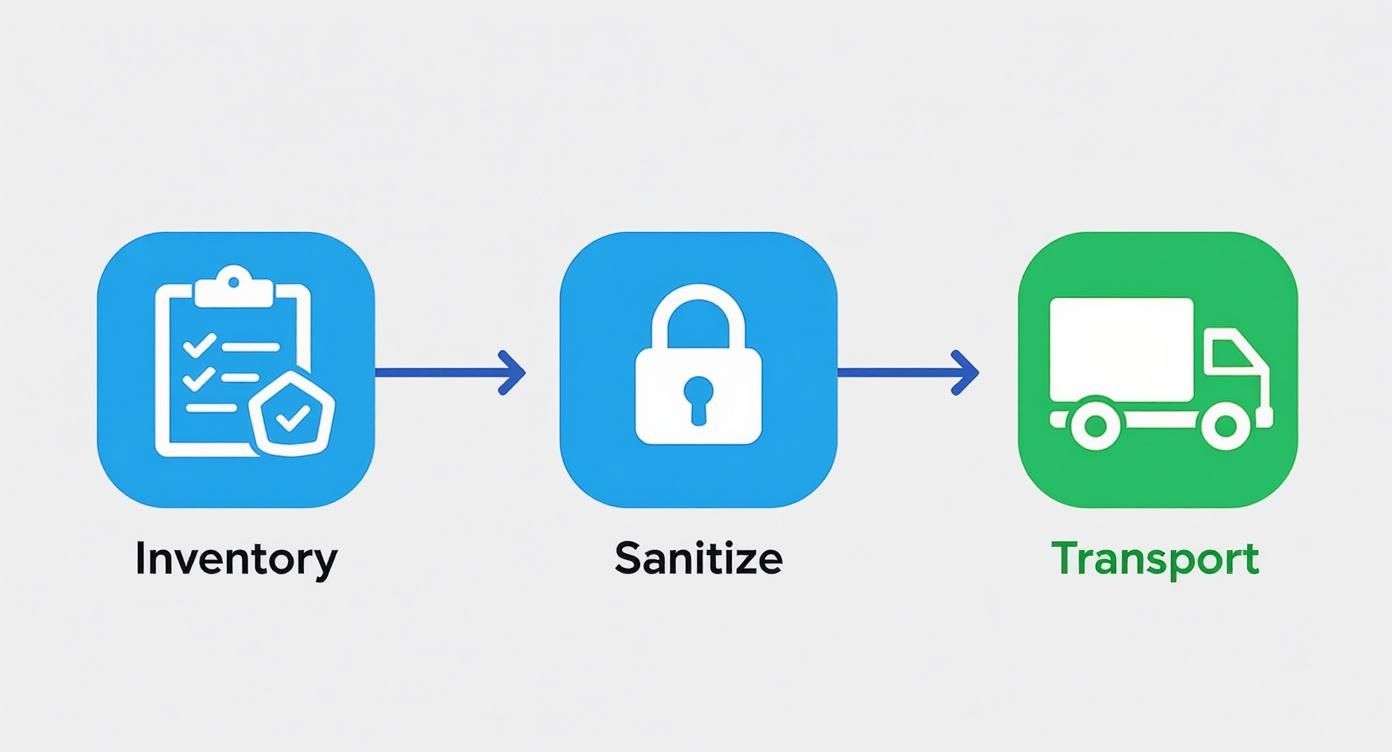
Each of these steps—inventory, data sanitization, and transport—is a vital link in the chain of custody required to keep you compliant.
The High Cost of Cutting Corners
Let’s walk through a common scenario. A well-meaning employee, tasked with clearing out a storage closet, decides to toss a box of old office PCs and their internal circuit boards right into the company dumpster. It feels like a quick fix, but it's an act that can unleash a torrent of problems.
If that dumpster gets inspected, your business could be facing:
- Hefty Fines: The EPA and state agencies don't mess around. Fines can climb into the tens of thousands of dollars per violation.
- Legal Nightmares: If someone pulls a hard drive from that trash and recovers sensitive data, you’re now exposed to lawsuits from clients or customers.
- Reputation Damage: The PR fallout from being labeled a polluter or, worse, a company that's careless with data can cost you more than any government fine.
What “Generator Liability” Really Means for You
Generator liability means that if your e-waste ends up illegally dumped in a landfill—even by a company you hired to handle it—your business is still legally on the hook. This is precisely why picking the cheapest disposal quote is one of the riskiest moves you can make.
Imagine you hire a recycler whose prices seem too good to be true. To keep costs down, they might ship your old circuit boards to a developing nation where they’re dismantled in unsafe conditions. When regulators trace that e-waste back to its source, they're coming for your business. Your company shares the liability for any environmental damage or labor violations.
This is why vetting your recycling partner isn't just a suggestion; it's a core business necessity.
Meticulous Documentation Is Your Shield
So, how do you protect your organization? You build a rock-solid paper trail that proves you did everything right, every step of the way. When navigating the maze of e-waste regulations, finding strong compliance solutions is a key part of building a process that can stand up to scrutiny.
Your documentation file should never be without these key items:
- Serialized Inventory Lists: A detailed spreadsheet of every single asset being recycled, complete with serial numbers or internal asset tags.
- Chain-of-Custody Forms: Signed transfer documents that track the assets from the moment they leave your control to the moment they arrive at the recycler.
- Certificates of Destruction and Recycling: These are your golden tickets. The Certificate of Recycling confirms materials were handled according to environmental laws. But the real legal armor is the proof of data sanitization—you can learn more about why a Certificate of Destruction is your ultimate defense against a data breach claim.
When you treat compliance as a key part of your risk management strategy instead of just another box to check, you protect your business from financial hits and reputational harm. It turns the chore to recycle circuit boards from a simple disposal task into a strategic move that protects your bottom line.
How to Select a Certified E-Waste Recycling Partner
Choosing the right partner to recycle your circuit boards is probably the single most important decision in your entire IT asset disposition (ITAD) plan. This isn't just about hauling away old gear; it directly impacts your data security, legal standing, and even your company's reputation. You have to look past the price quote and find a vendor who acts as a true extension of your risk management team.
A suspiciously low price should be a major red flag. It often means a vendor is cutting corners—maybe they're skipping crucial data destruction steps, using unsafe labor, or illegally shipping e-waste overseas. Remember, your liability as the generator doesn't just vanish when the truck leaves your dock. A bad choice can come back to bite you with fines and legal headaches years down the road.
Demand E-Waste Industry Certifications
The fastest way to weed out unqualified vendors is to make industry certification a non-negotiable. These aren't just fancy logos for a website; they prove a recycler's commitment to secure, ethical, and environmentally sound processes that are verified by independent auditors.
The two gold standards in the United States are R2 and e-Stewards.
Insisting on one of these is your first and best line of defense. It confirms the recycler follows a strict set of rules for everything from data security and worker safety to environmental protection. Without that third-party validation, you're just taking their word for it.
Choosing a certified recycler isn’t about finding a vendor; it’s about securing a partner who is contractually and ethically bound to protect your interests. This decision minimizes your risk and ensures your retired assets don't become future liabilities.
Key Questions to Ask Every Potential Vendor
Once you've confirmed a recycler holds a valid certification, it's time to dig a little deeper. Any professional, transparent partner will welcome your questions and give you clear, detailed answers.
Use this checklist to guide the conversation:
- Data Destruction: "Can you walk me through your specific procedures for data sanitization and physical destruction? How do you document this for each asset?" You're listening for adherence to standards like NIST 800-88 and a clear process for providing serialized Certificates of Destruction.
- Downstream Auditing: "Can you provide documentation tracing our materials all the way to their final destination?" A certified recycler is required to audit their downstream partners and should be able to prove your e-waste isn't ending up in a landfill in a developing country.
- Insurance Coverage: "What are your liability and data breach insurance limits?" Make sure they have enough coverage to protect you in a worst-case scenario. Don't be shy about asking for a certificate of insurance.
- Logistics and Security: "Describe your chain-of-custody process, from pickup at our facility to final processing." This should include secure, GPS-tracked trucks, locked containers, and background-checked employees.
These questions help you separate a real ITAD professional from a basic scrap hauler. As you evaluate your options, it's useful to see what a top-tier provider looks like. Exploring the services offered by reputable electronic waste recycling companies can set a benchmark for the level of security and compliance you should expect.
Comparing R2 and e-Stewards Certifications
Both R2 and e-Stewards are excellent standards, but they have slightly different philosophies. Understanding the nuances helps you match a partner’s certification to your company's priorities, whether you need maximum flexibility or the absolute tightest environmental controls.
Here’s a quick comparison to help you understand what each certification guarantees.
Comparing R2 and e-Stewards Certifications
| Feature | R2 (Responsible Recycling) | e-Stewards |
|---|---|---|
| Core Focus | Balances environmental, health, and safety with a focus on encouraging reuse and repair. | Emphasizes the strictest environmental and social responsibility, with a primary goal of stopping illegal e-waste exports. |
| Export Rules | Allows the export of tested, working equipment to vetted partners in certain countries. | Prohibits the export of hazardous electronic waste to developing nations, period. |
| Data Security | Mandates data destruction in alignment with NIST 800-88 guidelines. | Also requires adherence to stringent data security protocols, with a strong emphasis on privacy protection. |
| Flexibility | Generally considered more flexible, allowing recyclers to tailor processes to different material streams. | Known for its more rigid and prescriptive requirements, which some organizations prefer for maximum assurance. |
At the end of the day, choosing a partner with either certification is a huge leap forward from working with an uncertified vendor. The best fit depends on your organization's risk tolerance and corporate social responsibility goals. By asking the right questions and demanding certification, you can make an informed choice that protects your company for years to come.
What Happens Inside a Modern Circuit Board Recycling Facility
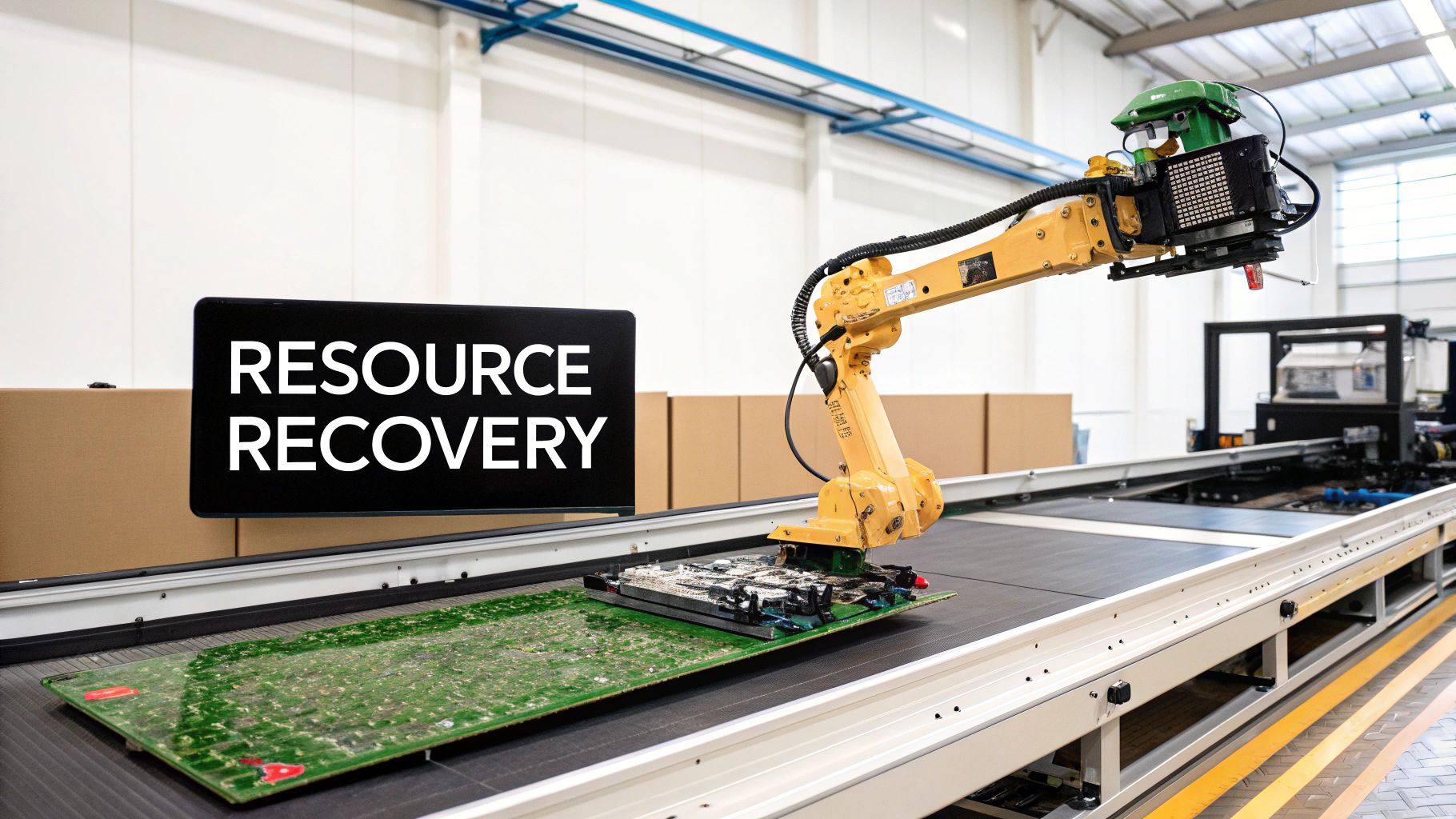
So, you’ve handed off your old IT assets. What happens next? Their journey is far from over. A certified e-waste recycling partner doesn't just haul them to a scrap yard; they're taken to a highly controlled facility where technology and precision chemistry come together. Think of it as a high-tech refinery for electronics, designed to safely dismantle devices, neutralize hazardous materials, and pull out every last bit of value.
Understanding this process gives you real confidence that your decision to recycle circuit boards is making a genuine impact. When you see how a top-tier facility operates, you realize the value a true partner brings to the table, helping you hit your corporate sustainability goals.
The First Steps: Automated Disassembly and Shredding
When your equipment arrives, it’s immediately weighed, inventoried, and checked against your chain-of-custody paperwork. The first hands-on (or, more accurately, robot-hands-on) step is disassembly. Modern facilities use automated systems with robotic arms to quickly break down devices and separate the main components.
From there, the circuit boards are sent into massive industrial shredders. These machines tear the boards into small, uniform pieces. This is a critical mechanical step—it liberates the different materials from each other, making the next stage of separation far more effective.
Advanced Separation and Recovery
Once shredded, the real science kicks in. The fragmented mix of fiberglass, resins, and metals goes through a series of advanced separation techniques. The entire goal is to isolate and purify the valuable commodities locked inside those boards.
This usually involves one of two key methods:
- Pyrometallurgy: This is a high-temperature smelting process. Intense heat is used to separate precious metals like gold, silver, palladium, and copper from everything else. The molten metal is then poured into ingots, ready to be used again.
- Hydrometallurgy: Instead of heat, this technique uses chemical solutions (a process called leaching) to dissolve specific metals out of the shredded mix. It's incredibly precise for recovering certain elements with high purity and is often seen as a greener approach than smelting.
Choosing a certified recycler is non-negotiable here. It guarantees these complex—and potentially hazardous—processes are handled in a controlled environment that follows all EPA regulations. It’s about protecting workers and the environment.
The demand for the high-tech equipment that runs these facilities is booming. The circuit board recycling machine market was valued between USD 1,549 million and USD 2,231 million in 2025, and it’s only growing. This investment is heavily driven by automation, with over 60% of machines in developed markets using AI to get the best possible material recovery rates. You can dig into the specifics in recent market research on recycling technology.
This whole intricate process ensures the maximum amount of valuable material is reclaimed and put back into the supply chain, which means less need for destructive mining. For a bigger picture, check out our overview of what happens to recycled electronics after collection. By working with a facility that uses these advanced methods, you're directly supporting a true circular economy.
Your Top Questions About Circuit Board Recycling, Answered
Even with a solid plan, you're bound to have questions when it’s time to recycle old circuit boards. For most IT managers and business owners, getting straight answers on a few key topics is the final step before they feel comfortable moving forward.
Let's clear up the most common concerns.
What Happens to the Data on Our Old Circuit Boards and Hard Drives?
This is always the first—and most important—question. A certified, professional recycler provides a rigorous, documented process for total, irreversible data destruction.
First, every single data-bearing device undergoes sanitization software that meets government standards, like NIST 800-88. Once that digital wipe is verified, the physical media itself—the hard drive platter, the SSD chip, the board—gets fed into an industrial shredder. This machine pulverizes the hardware into tiny, useless fragments, making data recovery completely impossible.
The job isn't done until you have a formal Certificate of Destruction in your hands. Think of this as your legal receipt. It's the official record proving that every single serialized asset was securely destroyed, and it’s your best defense if a data breach is ever questioned.
Can We Get Money Back From Recycling Old Circuit Boards?
Yes, it's possible. Printed circuit boards are packed with valuable materials, including small but recoverable amounts of precious metals like gold, silver, copper, and palladium. For businesses with a large volume of electronics, the value of those recovered commodities can add up.
A reputable ITAD partner will be transparent about how they assess the value of your retired gear. They’ll evaluate the quality and quantity of your circuit boards and other components. Based on current commodity rates, they can often offer a financial return that helps offset—or even exceed—the cost of pickup, data destruction, and processing.
How Should Our Business Prepare Electronics for Pickup?
Your recycling partner will provide specific instructions, but some basic prep work helps the whole process run smoothly and securely.
Here’s what your team typically needs to do:
- Create an Inventory: Compile a detailed list of all the equipment you're retiring. Include asset tags or serial numbers where possible.
- Segregate Data Devices: Separate any assets with a hard drive, SSD, or other storage. This ensures those items get priority handling for data security.
- Palletize Equipment: Neatly stack your equipment on pallets and shrink-wrap it securely. This protects the gear during transit and simplifies logistics.
For large projects like a data center decommission or a company-wide tech refresh, your recycling partner can often provide on-site services. This includes de-installation, inventory creation, and secure packing, taking the entire burden off your internal team.
What Kind of Paperwork Should Our Business Expect?
Solid documentation is the bedrock of a compliant e-waste program. This paperwork is your legal proof that you met your "generator liability" and disposed of everything responsibly.
At a minimum, you should demand and receive these three documents:
- A Detailed Chain-of-Custody Record: This tracks your assets from the moment they leave your building, showing an unbroken line of responsibility.
- A Certificate of Destruction: You'll get one of these for every single device that held data, confirming all sensitive information was permanently wiped out.
- A Certificate of Recycling: This final document certifies that all the materials were processed in an environmentally sound way, following every federal, state, and local rule.
These documents officially close the loop on the disposal process and are absolutely critical for any compliance audit you might face down the road.
Ready to put a secure, compliant, and cost-effective e-waste strategy in place for your company? The team at Atlanta Computer Recycling is here to help. We provide complete ITAD services designed for businesses across the Atlanta metro area, making sure your data is destroyed and your hardware is recycled the right way.
Schedule your free business pickup today at atlantacomputerrecycling.com